
Engineering recruiting firms worth investigating include Actalent, Kelly Engineering, NES Fircroft and Airswift, but the useful shortlist depends on the engineering work, location and employment arrangement you need. Start with the deliverable the engineer must produce, then check which local recruiting team actually handles that work. A recognisable brand is a starting point for verification, rather than proof of a suitable vacancy or candidate pool.
Which engineering recruiting firms belong on your shortlist?
The four firms below publish identifiable engineering recruitment or staffing services. They are examples to investigate, not a ranking, an exhaustive directory or a promise of availability. Their service pages establish the kinds of work they advertise; they do not establish comparative placement quality, current vacancies, agreed fees or the capability of every branch.
Swipe horizontally to compare on a small screen.
| Provider | Advertised engineering coverage | Useful first question |
|---|---|---|
| Actalent | Manufacturing, mechanical and electrical; systems and software; power; civil and construction-related practices. | Which local specialist desk handles this deliverable, and are we discussing staffing or engineering delivery? |
| Kelly Engineering | Product lifecycle work across manufacturing, automation, automotive, aerospace, energy, medical devices and electronics. | Does the requirement call for contract staffing, direct hire or a defined project-delivery service? |
| NES Fircroft | Technical recruitment across energy, chemicals, infrastructure, manufacturing, mining and other project industries. | Which office covers the work location, project phase and required employing arrangement? |
| Airswift | Engineering recruitment with contract, direct-hire and workforce support services. | Which technical practice will own the search, and what assignment support is included? |
Use the directory in two passes. First remove firms whose advertised practice does not cover the work. Then compare the remaining local desks against one specific requirement. For revenue-based market comparisons and employer procurement questions, use the largest U.S. engineering staffing firms guide; the job here is to reach an appropriate recruiting desk with a requirement it can recognise.
Actalent: a broad engineering staffing starting point
Actalent publishes engineering staffing coverage across manufacturing, mechanical and electrical work; systems and software; transmission, distribution and power; and architecture, environmental, civil and construction. That breadth makes it a reasonable starting point when a role crosses related disciplines, such as electrical design within a manufacturing operation. The useful next question is which specialist team owns the requirement in the target market.
For an employer, ask the desk to explain the boundary between supplying an individual engineer and delivering a managed engineering service. Those arrangements put different responsibilities on your internal team. If your engineering manager will assign and approve the work, you are discussing a different need from buying an agreed package of engineering deliverables with supplier management.
For a job seeker, start with a relevant vacancy or a clearly defined practice rather than a generic registration alone. Ask who would employ you, where you would work and what engineering output the assignment involves. A familiar client industry does not establish whether the actual position is design, testing, documentation or production support. The official Actalent engineering staffing page is the appropriate entry point for checking its advertised disciplines.
Kelly Engineering: product lifecycle and manufacturing-related work
Kelly Engineering describes coverage in automotive and aerospace, chemical and energy, advanced manufacturing and automation, medical devices, and semiconductor and electronics work. It also distinguishes contract staffing, direct hire and project delivery. This is useful when the problem begins with a product or production milestone, because the same industry can need several different engineering functions before that milestone is complete.
Consider a manufacturer moving a product toward production. A design engineer may own drawings, a manufacturing engineer may establish the process and a quality engineer may develop verification evidence. Asking for an engineer with experience in that industry leaves too much unresolved. Specify the function and work product before discussing whether an individual placement or a delivery service fits.
Job seekers should also separate technical scope from the employment label. A contract role can contain substantial technical responsibility, while a permanent role can be narrow. Compare the actual tasks, decision authority and support available. Use the official Kelly Engineering service descriptions to identify the relevant practice and delivery model; benefits, rates and assignment terms still require an opportunity-specific discussion.
NES Fircroft: technical recruitment across project industries
NES Fircroft advertises contract staffing, permanent hire and related workforce services across industries including energy, chemicals, construction and infrastructure, manufacturing, mining and life sciences. Its regional network is particularly relevant when a requirement involves a project location as well as a technical discipline. A process engineer needed for a plant project must match the project phase and working conditions, not merely the industry label.
For employers, distinguish the recruiting question from the mobilisation question. Finding someone with commissioning experience does not, by itself, establish that the person can start at a particular site on the required date. Travel, access requirements and the employing arrangement can become critical dependencies. Ask the relevant office which services are included and which remain your responsibility.
For engineers, establish the assignment location, rotation or travel pattern, expected duration and the organisation responsible for employment support. Do not assume that services described on a regional page apply to every vacancy. The official NES Fircroft service and regional directory helps locate the appropriate starting desk; it is not confirmation that a particular role offers sponsorship, relocation or accommodation.
Airswift: engineering recruitment with workforce support
Airswift describes contract and direct-hire engineering recruitment alongside workforce services. Its engineering material addresses technical work in project-led industries and distinguishes hiring permanent staff from bringing in contractors. This makes it another candidate to investigate when the requirement combines technical capability with a defined project or work location.
The important comparison with another provider is the actual service boundary. Two firms can both advertise engineering recruitment while offering different packages for the same requirement. One proposal may cover candidate introduction; another may include employment administration or assignment support. Ask for those components separately before treating a higher price as poor value or a lower price as a saving.
A candidate should ask the recruiter to connect the opportunity to a specific engineering responsibility, reporting line and employment arrangement. General assurances about global reach do not answer those questions. The official Airswift engineering recruitment page provides a service starting point. Local vacancies, eligibility and the final employment terms must be verified separately.
First check: is it actually a recruiter?
Before adding another name, open its own service page and identify what it supplies: candidate introductions, advertising space, assessment software, freelance matching or engineering delivery. Then check whether that service can solve the present need. This category check prevents a long directory from becoming a mixture of unrelated businesses.

HireVue describes a hiring platform with interviewing and assessment functions. Treating that as an engineering staffing agency would confuse the system used during hiring with the organisation sourcing or employing the engineer. Toptal describes a freelance talent network, including software developers; that can be relevant to a defined software engagement, but it is not interchangeable with a broad mechanical, civil or process-engineering recruitment desk.
A simple test is to ask, “What happens after I submit my requirement?” A recruitment service should explain its candidate-introduction process. A job board may sell a listing, while software may help you evaluate applicants you already have. Some businesses offer more than one service, so classify the specific offer rather than relying on the company name. If the answer remains unclear, leave the name outside the active shortlist until the service is explained.
For broader background on recruitment models, use the engineering staffing agency guide. The decision here is narrower: which identifiable provider and local desk deserves the next conversation for a particular engineering output.
How do you reduce the list to firms that fit the work?
Translate the job title into a deliverable
Begin with the work that must be completed. State the discipline, the deliverable and the project stage in one short brief: “Mechanical engineer to release production drawings for a manufactured assembly.” Add location and employment preference after that technical core. This gives a recruiter a concrete routing question instead of a title that could describe very different jobs.

For an employer, separate essential evidence from trainable preferences. If the engineer must release drawings using your established design process, drawing-release experience may be essential, while experience with one particular product family may be learnable. For a candidate, use the same distinction to describe what you have personally owned rather than every system used somewhere in your former organisation.
The common mistake is an overloaded specification: a long list of software, standards and industry terms with no explanation of the first assignment. Correct it by asking what the person should be able to complete at the first meaningful handover. That answer reveals which experience is central and which terms merely describe the surrounding environment.
Consider two illustrative candidates who both use the title mechanical engineer. The first develops assemblies and releases controlled drawings; the second investigates equipment failures and coordinates maintenance changes at an operating plant. A provider may advertise mechanical recruitment for both, but the relevant desk and vacancy families can differ. The first candidate should ask about design and development work, while the second should ask about reliability or plant-support work that matches the actual experience.
Now change only the project stage. A candidate who supported prototype builds may have relevant design experience without having owned a production release. That distinction should remain visible in the first conversation. Saying “supported prototype assembly and drawing updates” gives a recruiter a truthful routing basis; changing it to “owned production release” would turn a useful adjacent match into a misleading claim.
If you cannot disclose the product, describe a non-confidential output and its constraints. “Mechanical assembly drawings under controlled revision” conveys more than “confidential engineering position.” You do not need to disclose proprietary drawings, client identities or restricted project information to establish the relevant recruiting practice. The observable result is a brief the desk can route to a specialist without guessing.
Apply hard gates before comparing advantages
Evaluate each provider against three gates: relevant technical practice, service availability in the work location and the required engagement model. A gate can be confirmed, unresolved or unsuitable. Keep unresolved answers visible; do not convert silence into either a pass or a failure. Only compare softer advantages after the necessary conditions are established.

For example, a provider with an appropriate mechanical practice may still be unsuitable for an assignment if it cannot support the required local employment arrangement. Another firm might operate in the country but handle a different discipline through that office. These are different gaps and require different follow-up questions. Treating both as a low overall score conceals the reason the match is weak.
Swipe horizontally to compare on a small screen.
| Gate | Evidence to ask for | Decision if unresolved |
|---|---|---|
| Technical practice | A relevant discipline or service page plus confirmation from the responsible desk. A broad industry claim alone does not identify the work it handles. | Describe the deliverable and ask for the correct specialist. Do not assume a matching job title establishes expertise. |
| Work location | Confirmation that the team can support this assignment in the actual country or market, including the proposed employment route. | Identify the office responsible. A global footprint does not establish local availability or eligibility. |
| Engagement model | A clear distinction between individual staffing, permanent introduction and a supplier-managed delivery service. | Ask who employs, directs and accepts the work. Defer price comparison until the service boundary is understood. |
This is an exclusion process, not a performance league table. A provider that fails one requirement may suit another reader perfectly. Avoid invented fit percentages, weighted reputation scores or claims that a bigger vacancy count means a better match. The question is whether the necessary conditions for this specific conversation exist.
An unresolved answer needs a specific recovery question. Suppose the provider confirms its mechanical practice and local coverage but replies only that it offers flexible solutions. The missing fact is the engagement model. Ask whether it can introduce a permanent employee, employ an assigned contractor or deliver the engineering package itself. If that answer never becomes clear, keep the provider outside the active comparison rather than assigning it an invented middle score.
When several firms clear the gates, prefer a small set whose strengths are meaningfully different. An illustrative shortlist might include one broad engineering staffing practice and one project-industry specialist, provided both cover the actual location and model. Adding three near-identical desks is less informative than testing two genuinely different routes. There is no universal ideal number of agencies to use.
Verify the local desk, not just the global website
Open the provider’s official location or contact directory independently. Find the office serving the work location, use the published contact route and ask which team handles the discipline. Then compare that answer with a relevant vacancy or service description. The objective is to establish a traceable connection between the brand, the local desk and the requirement.

A multinational website may show global capabilities while the nearby office concentrates on a narrower market. Conversely, a specialist team may cover the location remotely without a storefront in the same city. Physical proximity alone is therefore a weak filter. Ask who will own the assignment and how that person will coordinate the technical and employment questions.
For candidates contacted unexpectedly, verify the recruiter through an independently found company contact before sharing sensitive documents. A professional-looking profile or message does not establish identity. Ask the office to confirm the contact and vacancy through its published route; do not rely solely on a phone number or link supplied in the incoming message. Pause if that independent confirmation cannot be obtained.
If you have only a broad location and no disclosed employer, ask for the work location, discipline and vacancy reference first. A confidential search may legitimately limit what can be shared early, but it should still have a coherent process and an explanation of when further details become available. Confidentiality is not a reason to accept an unexplained role or an unverified sender.
Regional coverage is a separate decision from a general company shortlist. The Massachusetts engineering recruitment article concerns that specific market; use it only when that is the actual work location. For another region, confirm the provider’s local service rather than transferring assumptions from a different office.
What evidence makes one engineering recruiter more useful than another?
Ask the recruiter to explain the technical handover
Use one concrete engineering example to test whether the desk understands the requirement. Ask what evidence would demonstrate that a candidate can produce the deliverable, who will evaluate it and how any uncertainty reaches the hiring manager. This is more revealing than asking whether the agency has “technical expertise,” which almost every provider will claim.

An illustrative mechanical-design discussion might focus on a released drawing: what the engineer owned, how a manufacturing constraint affected the design and how a change was approved. The point is to distinguish personal responsibility from exposure to a project. A recruiter does not need to perform the employer’s complete engineering assessment to explain how that evidence will be collected and passed on accurately.
For employers, ask for an anonymised example of the submission format rather than another client’s confidential candidate file. A useful summary separates demonstrated experience, candidate statements and items still needing technical assessment. If a requirement is unclear, the desk should identify the uncertainty instead of representing every keyword as verified competence.
A useful technical handover also preserves uncertainty. In an illustrative discussion, the candidate says they updated assembly drawings, the recruiter confirms that the vacancy needs drawing-release experience, but independent release authority remains untested. The recruiter can pass on exactly that distinction: relevant drawing work demonstrated in discussion; release authority to be assessed by the hiring manager. A complete-sounding summary that removes the final qualification is less accurate, even if it looks more persuasive.
For candidates, describe one relevant decision you made and its engineering consequence. “Used CAD” says little about responsibility. “Updated the assembly model and released the revised drawings after resolving an interference issue” gives the recruiter a more specific account to discuss. Keep the example truthful, preserve confidentiality and distinguish your contribution from the team’s work.
A common failure is demanding confidential work samples as the price of an initial conversation. Offer a verbal walkthrough or a purpose-built, non-proprietary example instead. Employers can also use an agreed, proportionate assessment of their own. The practical checkpoint is a shared understanding of what evidence is available, what it shows and what remains untested.
Professional registration, client approval and authority to sign off engineering work are separate questions from general experience. If the role requires one of them, name the requirement and verify it through the appropriate process for that role and jurisdiction. A staffing brand, degree title or previous project list does not substitute for the specific authorisation required.
Compare the same service boundary and work period
When comparing offers or supplier proposals, first align the employment model and the work period. Then identify which components are included, excluded or still unknown. A headline salary, hourly pay rate and supplier bill rate represent different things; putting them in the same column without explaining the difference creates a false comparison.

For an engineer comparing employment options, separate the offer into confirmed components before judging the headline rate. Keep uncertain items outside the guaranteed comparison, and ask what applies to the particular offer rather than importing benefits from a general corporate page.
- Paid work: guaranteed pay, expected paid hours and assignment duration.
- Additional value and costs: paid leave, benefits, reimbursed expenses and work-location costs.
- Conditional outcomes: possible extensions, discretionary bonuses and hoped-for conversion, each kept separate from guaranteed compensation.
Consider an illustrative contract at $50 per paid hour for 40 paid hours over 26 weeks. Gross pay for those assumptions is $52,000: $50 × 40 × 26. If two of those weeks are unpaid, the comparable gross amount becomes $48,000. Neither number establishes take-home pay or an equivalent permanent salary; taxes, benefits, expenses and the remainder of the year are outside the example.
For employers, distinguish worker pay from the amount invoiced by the supplier. A bill rate may include employment costs, administration and supplier margin, depending on the arrangement. Comparing it directly with a permanent employee’s salary ignores both the different time basis and the components included. Ask for a clear commercial proposal rather than assuming a universal markup.
Swipe horizontally to compare on a small screen.
| Item | Candidate comparison | Employer comparison |
|---|---|---|
| Time basis | Use confirmed paid hours or periods; keep any unpaid time explicit. Do not multiply a short contract into an assumed full working year. | Compare the same period, expected hours and agreed assignment scope. |
| Included components | Separate guaranteed pay from leave, benefits, reimbursed expenses and uncertain bonuses. | Separate bill rate, applicable additional charges and the services included. |
| Responsibility | Identify the employer, work supervisor and route for assignment questions. | Identify who directs the engineer and who accepts the engineering deliverables. |
| End or change | Check duration, notice and what happens if the assignment ends or conversion does not occur. | Check scope changes, agreed termination provisions and any conversion conditions in the proposal. |
The useful result is an aligned comparison, not a single “best value” number. If a lower rate excludes essential support, add that responsibility to the decision. If the higher-priced proposal includes services you do not need, ask for a narrower scope. For an individual, an attractive hourly rate may still be a poor fit when paid hours or location costs remain unresolved.
If a provider will not quote until the role is scoped, compare the scope first. This is often more productive than demanding a price for an undefined requirement. Confirm which information is needed to produce a meaningful proposal and which terms can change later. An unquoted price remains unknown; it is not evidence of either affordability or excessive cost.
For discipline-specific exploration, the mechanical engineering recruiting guide provides a related route. Keep the present comparison anchored to your deliverable, because the same job title can refer to product design, manufacturing support or another engineering responsibility.
How should you approach shortlisted firms without losing control of the search?
Agree the submission boundary before representation
Before a recruiter submits a candidate to an employer, clarify the specific opportunity, what information will be shared and whether the candidate has already been considered through another route. Employers should likewise establish how agencies identify submissions and handle possible duplicates under the agreed process. A controlled handover is more useful than unrestricted circulation.
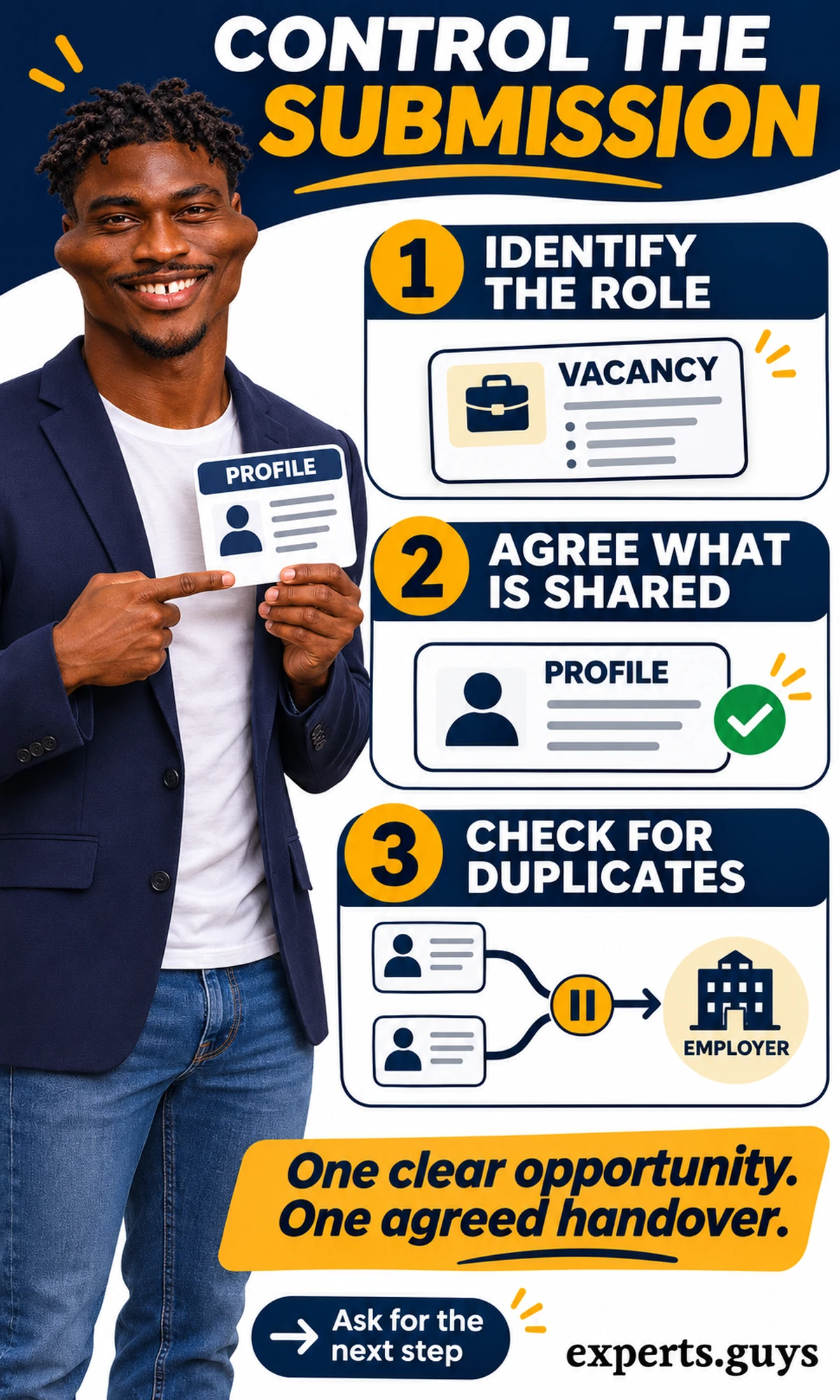
For a candidate, a useful question is, “Which role is this submission for, what will you send and when will I hear what happens next?” Where the employer’s identity is initially confidential, ask when it will be disclosed and how duplicate submissions are checked before proceeding. Read any authorisation carefully; an agreement covering a specific vacancy is different from broad permission to circulate a profile.
For an employer, request enough information to identify the vacancy and the introduction without collecting unnecessary personal data. If two agencies present the same person, pause that submission while the parties clarify the sequence and applicable terms. Do not treat receipt of two profiles as proof of misconduct or decide responsibility from the latest email alone. The contract and actual introduction history matter.
A common mistake is asking several recruiters to send the same profile everywhere because it feels like broader exposure. The correction is to define the opportunity and permission before each introduction. If the candidate cannot identify whether an application already exists, establish the employer’s process before authorising another submission. A short clarification can prevent confusion about who is representing whom.
Use a specific opening, then judge the response
An employer’s opening can be brief: “We need a mechanical engineer to release production drawings for an assembly, working at our site under a contract arrangement. Which team covers that work, and what information do you need to confirm fit?” Replace those details with the actual requirement. The aim is to discover whether the desk can own a relevant next step.
A candidate can use the same structure: “My experience is mechanical assembly design and drawing release. I am considering roles in this location under this employment model. Does your team handle that work, and is there a relevant current vacancy?” This asks for routing and relevance without implying that the agency owes a vacancy or can guarantee an interview.
Judge the reply by what it resolves. A useful response identifies the responsible desk, clarifies a missing constraint or explains that the agency does not cover the requirement. A generic registration link may still be a legitimate entry point, but it does not establish an active match. Follow the stated process and keep direct employer applications available when agency coverage is limited.
If the shortlist produces no relevant response, change the search boundary before adding more names. A nearby title may fit the same deliverable, or an internal constraint may be unnecessarily narrow. Preserve genuine requirements such as work location, authorisation and essential technical responsibility; revise preferences that do not change the work. This is a scope correction, not a reason to misstate experience or accept unsuitable terms.
The shortlist has done its job when you can identify who handles the work, which service is being offered and what remains to be verified. An application count or a stack of brochures does not establish that outcome. Move forward with the desk that can explain the next concrete step and its limitations.
Frequently asked questions
Should a graduate use these firms or apply directly to employers?
Both routes can be useful. Check whether the local recruiting desk actually handles graduate or junior roles; a large engineering practice may mainly cover experienced positions. Keep graduate programmes and direct employer vacancies in the search, because agency coverage is not the whole market.
Does contract-to-hire guarantee a permanent job?
No. Treat conversion as a possibility unless a specific commitment is established in the actual terms. Ask what conditions affect conversion and what happens if the assignment ends without it; do not value an uncertain outcome as guaranteed employment.
Can a recruiter promise sponsorship or overseas eligibility?
A general international service page cannot establish eligibility for a particular person or vacancy. Confirm whether the specific employer and assignment support the necessary arrangement and what conditions apply. Recruitment reach, permission to work and professional authorisation are separate matters.
What if a recruiter asks for a payment?
Ask what the payment is for, which entity is requesting it and what written terms apply. Verify the request independently through the company's official contact route before paying or sharing financial details. Do not assume a fee is legitimate because the sender uses a recognised agency's name.
Why does an engineering recruiter show no relevant vacancies?
The desk may not currently have a matching opening, the work may sit under a different job title, or the public vacancy list may not describe every search. None of those possibilities establishes an available role. Ask whether the team handles the deliverable and what its actual next step is; keep direct applications available rather than waiting on an assumed vacancy.
Your next step: validate one relevant desk
Choose a provider whose advertised practice matches the engineering output, then verify the desk serving the work location. Use the deliverable-based opening to establish the service model and the next piece of evidence needed. Expand the shortlist only when that conversation reveals a specific gap that another provider can reasonably address.