
LG Staffing careers and employment searches can lead to different businesses with similar names, so identify the company before judging a job’s pay or benefits. LG Staffing Solutions on Demand, LGS Staffing and LG Electronics should not be treated as one employer. Start with the full name and application route, then trace the terms of the particular role to the organization offering them.
The useful question is not whether a recognizable name offers good careers in general. It is whether this vacancy, with this employer and these conditions, gives you the work you are trying to secure. A staffing company’s introduction can establish the services it advertises; it cannot establish your personal wage, insurance eligibility or permanent employment status.
Our recommendation: resolve employer identity before comparing compensation. A higher quoted wage is not a better offer if the hours are uncertain, and an attractive benefits page is irrelevant if it belongs to a different company or employee group.
Which LG company does the job actually belong to?
Use the full business name and website together. LG Staffing Solutions on Demand is a staffing business with its own recruiting route; LG Electronics has a separate careers route, and the former LGS Staffing web address currently redirects to Job&Talent. These are different starting points, not interchangeable labels for the same employment package.
The distinction matters because a search engine can place an employer profile, agency page and manufacturing vacancy close together. An abbreviated name in a result title does not explain the relationship between them. Nor does a worksite’s brand tell you which organization will employ you on an agency assignment.
LG Staffing Solutions on Demand’s official website describes staffing services across office and industrial work, including temporary, direct-hire and temp-to-hire arrangements. That establishes the scope it advertises. It does not establish that every category has an opening, that every applicant qualifies or that a particular assignment offers a specified schedule.
| Search name | Route and boundary |
|---|---|
| LG Staffing Solutions on Demand | Its own staffing website and job-seeker instructions. Does not establish: That an LG Electronics benefits page applies to an assignment. |
| LGS Staffing | Follow the current redirect, then identify a live role. Does not establish: That an old listing or its terms are still available. |
| LG Electronics | The company’s official careers route and relevant location. Does not establish: That a similarly named staffing business offers the same employment. |
| A client name on an agency vacancy | The named employer and specific assignment terms. Does not establish: That working at the client makes you its direct employee. |
For LG Electronics opportunities, start from the company’s official careers route. Follow the relevant location and position rather than borrowing employment details from an unrelated staffing profile. The same care applies in the other direction: a corporate benefits description should not be presented as an agency worker’s entitlement.
The LGS Staffing address redirected to Job&Talent when checked for this rewrite. A redirect is useful routing evidence, but it does not by itself identify the employer behind every old listing or prove that an old vacancy remains available. Navigate onward to a current role and its stated employer.
Compare the name attached to the vacancy with the employer name in the offer and onboarding documents. If the names differ, ask what each organization does. A recruiter may source candidates, a client may supervise the work, and another named entity may appear in the employment terms; the relationship needs an explanation rather than an assumption.

Separate an outdated listing from a different company
A listing can be genuine yet outdated. A company can also be genuine while the listing refers to a different business with a similar name. These require different corrections: an expired role calls for a current vacancy, while a company mismatch calls for a different application route. Repeatedly applying through the wrong route does not solve either problem.
For example, imagine an applicant reading a staffing review and then finding a benefits page for an electronics manufacturer. The benefits page may accurately describe a program for that manufacturer’s eligible employees. The unsupported step is attaching those benefits to the staffing opportunity without evidence of the employment relationship. The error is attribution, not necessarily dishonesty by either company.
If you cannot identify the company from the advert, ask for its full legal employer name, the role location and the current vacancy reference or description. Reach the organization independently through its official site before submitting sensitive information. You do not need to decide whether an unfamiliar name is suspicious merely from the name itself; you need enough consistent information to identify the opportunity.
The broader guide to staffing arrangements explains how agency placements differ from direct employment. Use that background when the arrangement itself is unclear; use the checks here to stop terms from one LG-related search result migrating into another company’s offer.
How do you apply with evidence that fits the role?
Apply through the identified company’s current instructions and show evidence for the duties in the vacancy. For LG Staffing Solutions on Demand, the job-seeker page invites applicants to submit a resume and publishes a careers email address. Check that page yourself for the current route rather than treating a forwarded message as the application instructions.
An initial submission may put you into consideration without connecting you to a specific vacancy. Ask whether you are registering for future opportunities, applying for an identified role or being put forward to a client. Each stage calls for a different expectation; sending a resume is not confirmation of an interview, assignment or start date.
Match a requirement to proof, not to an impressive label
Read the essential duties before editing your resume. Select a relevant requirement, identify something you actually did, and describe the connection without enlarging your authority or experience. If the requirement is unclear, ask whether it is an entry condition, a preference or something taught after hiring. That answer can change whether the application is worth pursuing.
Consider an illustrative applicant moving from home-renovation work toward a stockroom role. Counting materials, checking deliveries and flagging discrepancies may provide relevant evidence of careful inventory handling. Calling those tasks “warehouse management” would overstate the experience if the applicant never managed a warehouse. The useful transfer is the action and its accuracy, not the grander title.
A concise example might be: “I compared delivered quantities with the order and raised missing items before the next task began.” If that is true, it explains a behavior relevant to checking goods. It does not establish knowledge of a particular warehouse system, permission to operate equipment or a qualification the applicant does not hold.

There is no need to invent percentages to make an example credible. A verifiable task, the check you used and the problem it addressed are useful even without a measured performance improvement. Include a quantity or result only when you can support it and disclose it appropriately; do not bring a previous employer’s confidential records into an application.
If your experience is adjacent rather than exact, say so. “I have checked incoming materials, but I have not used your inventory software” gives the recruiter a clear training question. A vague claim of being a fast learner leaves both sides guessing about the actual gap.
- Essential qualification missing: ask whether it must be held before applying; do not describe yourself as qualified.
- Experience relevant but from another setting: explain the action and its original context.
- Requirement described only as preferred: show what you can substantiate and ask how the remaining gap affects consideration.
- Role details incomplete: clarify the work before spending time on a heavily tailored application.
For a first job, suitable evidence may come from an accurately described course, volunteer task or other relevant responsibility. Keep its setting clear. A training exercise is not paid employment, and a personal project is not a professional credential. The goal is to make the evidence legible, not to disguise where it came from.
The CV format guide covers organizing experience and qualifications. Here the priority is narrower: give the recruiter enough truthful evidence to decide whether your background matches this role and whether a missing requirement can be addressed.
Clarify who answers each employment question
Before a screening conversation ends, separate the people who handle recruitment, day-to-day duties and employment administration. Ask who will explain the assignment, who confirms payroll arrangements and who communicates changes. A single recruiter may coordinate these answers, but coordination is not the same as being the employer or the worksite supervisor.
Use a direct question: “For this assignment, which organization employs me, who directs my work, and who handles pay and benefits questions?” Then check that the explanation agrees with the documents you receive. If a question is passed to someone else, ask for the relevant verified contact rather than accepting an answer about another employee group.

This is particularly useful when a vacancy carries a client’s recognizable brand. Working at that client’s premises does not by itself establish access to the client’s employee benefits. Likewise, a recruiter explaining a future direct-hire possibility has not established that the client is already your employer. Keep the present arrangement separate from a possible later one.
Be specific about practical constraints early. State the hours you can reliably attend, whether the location is reachable and any essential requirement you cannot meet. You do not have to disclose unrelated personal circumstances to explain that a particular shift is unavailable. Accurate availability prevents an apparently suitable role from becoming an unsuitable commitment.
If there is no current role that fits, ask which requirement is blocking the match. The answer may be location, schedule, experience or simply lack of a vacancy. Those explanations lead to different next steps; sending the same resume repeatedly without understanding the barrier adds activity without improving the match.
What pay and benefits can you reasonably count on?
Count on terms confirmed for the identified role and your employee group, subject to their stated conditions. Treat broad statements about competitive pay, flexibility or insurance as prompts for specific questions. They are not enough to calculate income or establish when coverage would begin.
The LG Staffing Solutions on Demand job-seeker page mentions insurance categories, but it does not establish every applicant’s eligibility, contribution or coverage dates. Those details need confirmation for the actual opportunity. This distinction lets you use the company’s information without converting a general description into a personal promise.
Separate hourly rate, paid hours and attendance time
A quoted hourly rate answers only one part of the income question. To compare ordinary weekly gross pay, multiply the confirmed rate by the expected paid hours, keeping uncertain hours separate. Then consider how much time the schedule occupies, including travel and any unpaid time identified in the terms. Do not assume every hour between arrival and departure is paid.
Here is a hypothetical comparison, not an LG vacancy or wage estimate. Assume an assignment pays $21 an hour for 35 ordinary paid hours each week. Ordinary gross pay would be $735 before taxes and other deductions. If attendance occupies 40 hours and travel occupies five more, the assignment takes 45 hours of the applicant’s week.
Dividing $735 by those 45 hours gives about $16.33 per hour of committed time. That is a personal comparison measure, not the contractual wage, a take-home estimate or a legal minimum-wage calculation. It helps explain why the quoted $21 rate alone does not describe the time cost of accepting the job.

Keep the assumptions visible. In that example, the difference between attendance and paid time is an assumed five unpaid hours across the week; it is not a claim about the company’s break policy. Actual working-time and pay rules depend on the jurisdiction and arrangement. Ask how the advertised schedule translates into paid hours rather than guessing which parts are unpaid.
Now change only the paid hours to 30. Gross pay becomes $630 at the same rate. The reduction comes from hours, not a wage cut. If the assignment merely offers “up to 35 hours,” do not plan essential spending on 35 as though it were guaranteed. Ask what hours are scheduled, what may vary and how changes are communicated.
Do not make overtime, bonuses or a shift premium necessary for a comparison unless the terms support including them. Ask when each component applies and calculate ordinary pay separately. This keeps a role with dependable ordinary hours distinguishable from one whose attractive total depends on conditions you may not meet.
| Component | Confirmation and decision |
|---|---|
| Rate | The actual starting rate and when any premium applies. Decision: Which rate belongs in ordinary gross-pay arithmetic. |
| Paid hours | Scheduled hours, any commitment and what can vary. Decision: Whether the expected weekly total is dependable. |
| Attendance and travel | Required presence, identified unpaid time and travel. Decision: How much of your week the assignment occupies. |
| First payment | Pay frequency, processing cutoff and expected first payment. Decision: Whether you can manage the initial cash gap. |
| Benefits | Applicable plan, eligibility, employee cost and effective date. Decision: Whether the benefit is accessible during the assignment. |
Cash timing is a separate issue from total compensation. Ask the pay frequency and the first expected payment date for your start date, including any processing cutoff. A job can have acceptable weekly earnings yet create an initial cash gap. That is a planning constraint to resolve before accepting, not evidence that its wage is necessarily poor.
Read salary estimates and employee reviews in context
A review becomes useful only after you know which business and employment group it concerns. An office employee describing an agency’s own workplace may have a different arrangement from someone assigned to a client. A manufacturing employee’s experience may concern a separate electronics company altogether. A shared abbreviation does not make their compensation comparable.
Before using an estimate, identify its role, location, pay unit and basis. An annual figure based on a full-time assumption cannot be compared directly with an hourly assignment whose paid hours vary. A range also does not establish where a new applicant would fall within it. Use estimates to frame questions about a verified vacancy, not to replace the vacancy’s terms.
Individual reviews may suggest a question worth asking, such as how schedule changes are communicated or which contact resolves payroll issues. They do not establish how every branch or client operates. An unexplained star rating is especially weak evidence for choosing between assignments with different duties, supervisors and hours.
Where review details cannot be matched to the correct company, leave them out of the comparison. It is more useful to have a small set of confirmed terms than a large set of attractive figures whose employer or method is uncertain. There is no defensible single “LG Staffing salary” that this article can assign to every search result.
Trace each benefit to eligibility and a start date
A benefit has practical value only if you can access it on useful terms. For medical coverage, ask which plan applies, who is eligible, what you contribute, how enrollment works and when coverage starts. For paid leave or holidays, ask which policy covers your employee group and what conditions apply. Do not infer these answers from a client’s careers page.
Use this order in the conversation: name the benefit, identify the employer or plan offering it, establish the eligibility condition, then confirm the effective date and cost. If one part is missing, leave the benefit unresolved in your decision. You can value a confirmed benefit; you cannot responsibly price a promise whose eligibility is still unknown.
Imagine a hypothetical eight-week assignment whose coverage would begin after six weeks, if the applicant met the plan’s other conditions. Only the final two weeks fall after that assumed start date. That timing does not establish what happens when the assignment ends, so the next question is whether coverage continues, stops or has another stated arrangement.
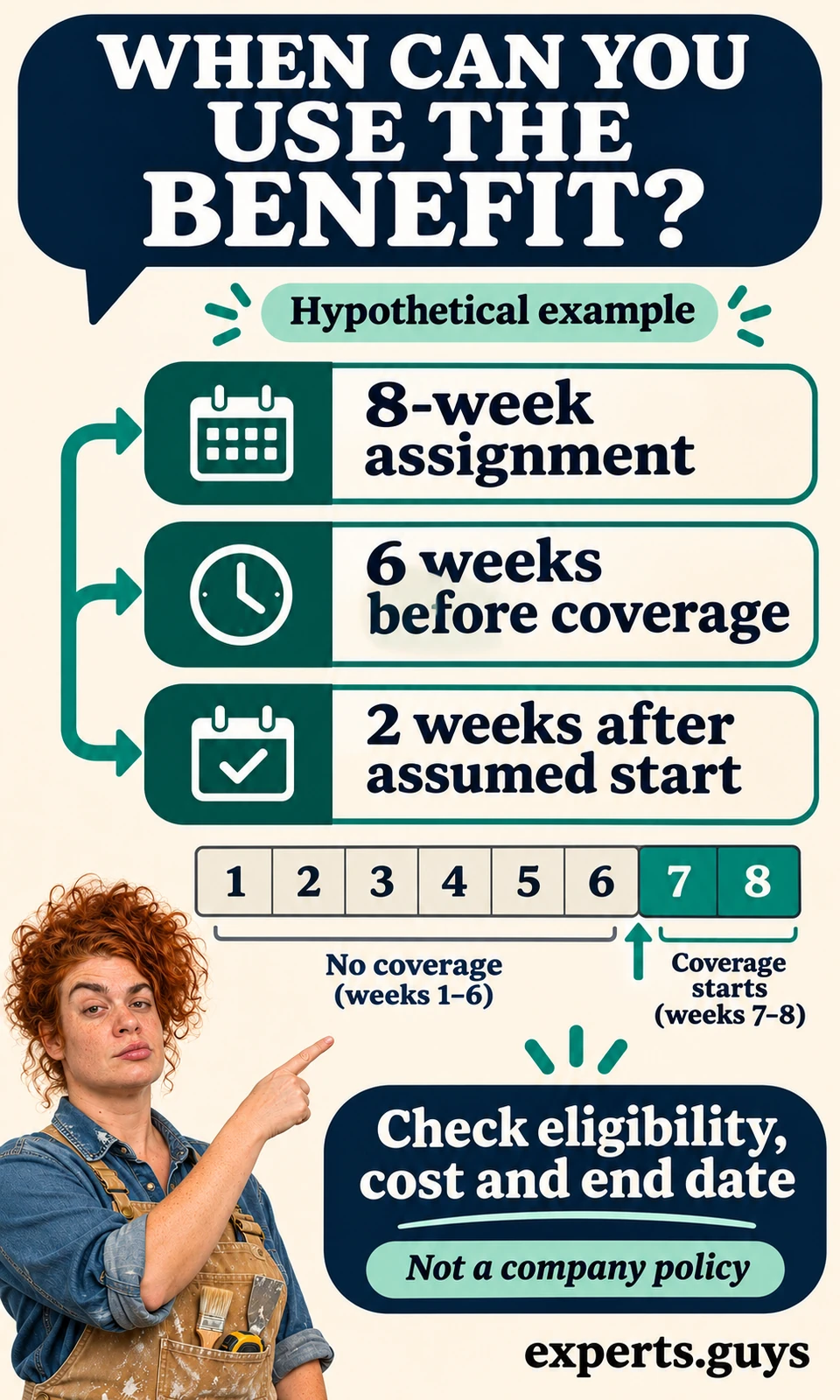
The example does not describe an LG policy or a legally required waiting period. Its purpose is to expose a mismatch that a benefits checklist can miss: a benefit may exist but become available late in a short assignment. Ask about coverage between assignments as well as coverage during work. A gap between placements can matter more than the number of benefits listed.
Separate employee-paid options from employer contributions. Being allowed to enroll in a plan and having the employer pay its full cost are different arrangements. Likewise, a choice of available assignments is different from being able to set any hours you want. Translate attractive labels into the condition that affects your decision.
Compare offers in the order your circumstances require. If you need a predictable income floor, confirmed ordinary hours may outweigh a higher rate with uncertain scheduling. If continuity of insurance is essential, eligibility and coverage dates may outweigh a small wage difference. This is a trade-off framework, not a ranking of the companies.
For the broader career decision after those terms are clear, the discussion of job security and career advancement examines income predictability and growth. Keep that longer-term judgment separate from establishing what this particular offer actually provides.
What needs to be clear before you accept?
Accept the present arrangement on its confirmed terms, with any outstanding conditions understood. Registration, screening, selection and clearance to start are different states. A conversation about future permanent work should not substitute for the employer, pay, hours and conditions that apply now.
LG Staffing Solutions on Demand’s services page includes contract-to-hire and direct placement among its arrangements. These describe different recruiting possibilities. They do not establish that a particular temporary placement will convert, that conversion happens on a fixed timetable or that the later package matches the current one.
Treat conversion as a change to be confirmed
For a temp-to-hire opportunity, ask what is being offered today and what would have to happen for a later change. Who decides? Is there a planned review point? Does the client need an available permanent position? Which employment terms would be replaced if a separate direct offer arrived? Ask for the process without treating a review date as a promised hiring date.
A useful hypothetical comparison starts with an agency assignment and ends with a possible client offer. At the first stage, the assignment’s employer, wage, schedule and applicable policies govern your decision. At the second stage, compare the new employer, terms, benefits eligibility and effective dates before agreeing. Do not assume service time or benefits carry across unless confirmed.

The common mistake is comparing today’s temporary wage with a hoped-for permanent benefits package as if both were already available. Correct it by evaluating the assignment on its present merits. The prospect of conversion can be an additional consideration, but it should not be the only reason an otherwise unsuitable assignment appears acceptable.
Direct placement needs its own clarity. Establish which organization would employ you and which terms it is offering, rather than assuming the recruiting agency provides the employment package. If you are discussing an internal recruiter or office position at the agency, say so explicitly; that is different from being placed with a client.
If permanent employment is essential from the outset, an assignment with an uncertain conversion route may not fit even when the work is attractive. If you value short-term experience or a defined period of work, the same arrangement may be useful. Fit depends on the present offer and your objective, not on a universally “best” staffing model.
Resolve the condition that could stop the start
Before making arrangements that depend on starting, ask whether the offer is final or conditional and which steps remain. Screening, required documents, client approval or orientation may be relevant to a particular role, but do not assume every opportunity uses the same process. Ask who confirms completion and how the start is communicated.
A conditional start date is not the same as a cleared start. If transport, childcare or notice to a current employer depends on that date, identify the remaining uncertainty before committing. The practical aim is not to demand a guarantee that no job can provide; it is to understand which decision is still pending and whether you can accommodate it.

Read changes together with the original terms. If the worksite, shift or duties change, ask whether the pay, travel, required preparation or employment arrangement changes too. An answer to the old vacancy does not automatically answer the revised one. Ask for the current terms to be confirmed rather than trying to reconcile contradictory versions yourself.
Keep a compact boundary around personal information. A verified onboarding process may require employment documents at the appropriate stage, but an initial inquiry does not require passwords, bank login details or payment to secure a place. Use the organization’s confirmed channel for sensitive documents rather than replying automatically to whoever contacted you first.
The U.S. Federal Trade Commission’s job-scam guidance warns against paying for the promise of employment and against depositing a supposed employer’s check and sending money onward. Treat those requests as reasons to stop the transaction. A recognizable company name does not make an unverified sender’s payment instructions legitimate.
If you cannot obtain a clear answer, distinguish a delay from a refusal. A recruiter may need another person’s confirmation; ask which fact is pending and when an answer is expected. Continue considering suitable alternatives while it remains unresolved. Do not turn missing information into either an assumed benefit or an accusation unsupported by evidence.
Questions that remain after comparing the role
Why does the published careers email use a different domain?
The LG Staffing Solutions on Demand job-seeker page publishes an address using LGStaffing.com while the website uses lgstaffingsolutions.com. A domain difference alone does not prove a message is genuine or fraudulent. Independently open the official page and compare its current instructions; verify an unexpected sender through a separately reached company contact before sending sensitive documents.
Can I apply through more than one staffing company?
You can consider different opportunities, but tell a recruiter if another agency has already submitted you for the same client role. Ask how that client handles duplicate submissions before authorizing another. Applications to different vacancies are a separate matter; keep the company and role clear so you do not mistake one conversation for progress on another.
What if my availability changes after I send a resume?
Tell the recruiting contact before an interview or assignment is arranged around the old availability. Explain the specific change, such as a start date or shift you can no longer cover, and ask whether the role still fits. A clear correction is more useful than leaving the recruiter to assume that the original details remain accurate.
Does no reply mean the agency rejected me?
Silence does not explain whether a role closed, the client paused recruitment or your background did not match. A brief follow-up can ask whether the vacancy remains active and whether anything is required from you. If no response arrives, continue a suitable wider search rather than treating the unanswered submission as a reserved opportunity.
Your next step
Open the correct company’s current recruiting route and identify one role you can actually evaluate. Ask first about the unresolved fact most likely to change your decision: employer identity, paid hours, benefit eligibility or clearance to start. Once that answer is clear, compare the opportunity on its own terms rather than on the reputation or package of a similarly named business.