
Kelly Services connects organisations with workers and also helps manage recruitment, workforce programmes and defined business operations. The useful distinction is what you need Kelly to provide: a person, a hiring process, a supplier programme or an agreed result. Identify that responsibility first, then confirm the specialty, country coverage and contract terms that apply to your situation.
The name “Kelly International Services” appears in older descriptions, but it should not be treated as a separate current service you can order. Kelly Services, Inc. is the company identified in its official disclosures. Its reporting structure, service brands and local delivery arrangements are different layers of the business, and confusing them can send a job seeker or hiring manager to the wrong conversation.
For a job seeker, the central question is who will employ you under the particular offer. For a hiring manager, it is who will direct the work and remain accountable for delivery. A company profile is useful only when it helps resolve those questions; a long list of past offices or placements cannot answer them for an individual engagement.
Start with your actual purpose
- Finding work: use the candidate route and a specific opportunity.
- Filling a role: discuss the specialty and employment model.
- Running recruitment or suppliers: discuss programme scope and governance.
- Handing over a process: define the output and acceptance conditions.
What does Kelly provide, and where is it available?
Kelly provides staffing, permanent placement and broader talent services across several specialties. Its November 2026 reporting identifies three operating segments: Enterprise Talent Management; Science, Engineering & Technology; and Education. That current structure replaces the five-segment description still found in some older company summaries.
Understand the three business segments
Enterprise Talent Management brings together office, contact-centre and industrial staffing with broader workforce solutions. Science, Engineering & Technology covers specialist technical work. Education serves education organisations, including school staffing and related services. These labels explain the organisation of the business; they do not tell you whether a particular position is temporary, direct hire, remote or available locally.
The distinction matters because the same service model can appear in more than one specialty. A laboratory employer and an office employer might both need a temporary worker, even though different recruiting teams understand their work. Conversely, an employer within one specialty might need a permanent recruit for one function and a managed service for another.
Use the segment as a signpost, then describe the work in ordinary language. “We need a quality-control scientist for this location” is a more useful starting point than asking for an unexplained corporate division. The receiving team can clarify its coverage and the relevant service without making you decode every brand or reporting label first.
| Business segment | Broad work covered | What still needs confirmation |
|---|---|---|
| Enterprise Talent Management | Office, contact-centre and industrial work; broader talent programmes | Local specialty, service scope and delivery entity |
| Science, Engineering & Technology | Science and clinical, engineering, technology and telecommunications specialties | Discipline, work location and engagement model |
| Education | Education and related talent services | Role, local requirements and employing organisation |
Kelly’s latest quarterly disclosure provides the current segment names. Its annual business description explains their specialties and service types. Neither document is a promise that a recruiter has an open vacancy for your skills or that a proposed engagement will be accepted.
Separate global capability from local staffing
An international workforce programme and a local staffing office are not interchangeable. A provider can coordinate suppliers across countries without directly employing every worker in those countries. A global client relationship also does not establish that the provider recruits every profession in each market where that client operates.
Kelly completed the sale of its European staffing business in 2024 while retaining global capabilities in services including MSP and RPO. That change is a concrete reason to avoid relying on an old office list as evidence of current local staffing coverage. The official sale announcement distinguishes the operations sold from the capabilities retained.
For a cross-border enquiry, separate three facts: the country where the work will take place, the specialty involved and the service required. A programme serving a multinational employer may have a different delivery route from a local job application. Remote work does not erase this distinction; the employment location and eligibility conditions still need a definite answer.

That is why “Does Kelly operate internationally?” is too broad to settle most decisions. The answer you need is whether the relevant team can deliver the specified service for the specified work location. An affirmative answer about global programme management does not settle local employment, and a local job listing does not establish programme-management capability across several countries.
Check coverage without building an agency directory
Use this short sequence when you know the type of work but are unsure which Kelly route serves it. It is an editorial enquiry method, rather than an official eligibility assessment. Its purpose is to obtain a useful routing answer before preparing a detailed application or procurement discussion.
Coverage sequence
- Identify the work country, including the employment location if different from a project destination.
- Name the actual specialty or function, such as contact-centre operations, engineering or education.
- State whether you want a job, a recruit or a managed programme.
- Ask the official company route which team and legal entity can handle that combination.
For example, a business with offices in several countries might need engineering recruitment in one country and supplier oversight across the whole group. Those are two scopes, even if the eventual provider coordinates them. Ask for the delivery arrangement for each instead of assuming one local recruiter owns both.
If the full scope is not yet known, start with the work country and function, and ask to be routed. The completion point is a named responsible team with confirmed scope, or a clear answer that the requested combination is unsupported. A vague statement about global reach leaves the key question unresolved.

For a deeper discussion of technical recruitment requirements, the separate engineering staffing guide covers the discipline-specific context. This page concerns how those requirements fit within Kelly’s service structure; it does not attempt another ranking of engineering agencies or a second technical recruiting checklist.
What changes between a staffing assignment and direct hire?
A staffing assignment and a direct-hire placement involve different employment arrangements. In the staffing model described in Kelly’s investor materials, Kelly supplies and pays workers while the customer directs their work. In permanent placement, Kelly recruits for a role with the client; the selected person joins that client’s employment. Confirm the exact legal employer in the offer because brands and workplace names alone are insufficient.
Follow the employment relationship, not the workplace logo
Three parties can appear in a staffing engagement: the worker, the staffing employer and the client workplace. A worker may spend each day at the client’s site, use its systems and receive daily task instructions there. Those visible features do not, by themselves, mean the client is the employer named in the employment documents.
Direct hire changes that relationship. The recruitment provider assists with finding and selecting the person, while the employment offer comes from the hiring organisation under the applicable arrangement. The recruiter may remain involved during the transition, but the continuing employment relationship is not determined by how many interview emails came from the agency.
Kelly’s published service-model explanation distinguishes staffing, permanent placement, talent solutions and outcome-based services. The practical lesson is to trace the relationship behind the introduction. A service name tells you the broad model; the offer or agreement supplies the actual parties and obligations.

Suppose an illustrative candidate is offered an assignment inside a manufacturer. The manufacturer’s supervisor allocates daily tasks, but the staffing employer handles the agreed employment administration. If the same manufacturer later makes a direct employment offer, the candidate should compare that new offer on its own terms rather than assuming the earlier arrangement simply changes its label.
This is a commercial explanation, not a universal legal allocation of duties. Workplace responsibilities and employment protections depend on the jurisdiction and facts, and several parties can have obligations. Do not use a simplified diagram to decide who bears a legal duty after an incident. Use it to identify the documents and responsible people that need to be clear before work begins.
Full-time hours do not establish permanent employment
“Full time” usually describes the working-hours arrangement. “Temporary” describes a time-limited engagement, while “direct hire” describes the hiring relationship. These dimensions can coexist: a job can have full-time hours for a defined assignment period. A person can also be recruited directly into an arrangement whose duration needs separate confirmation.
The distinction is visible in myKelly’s job search, which separates employment-type filters such as temporary and direct hire. Treat the listing as a route to the current opportunity and read the full terms. A filter label cannot resolve pay eligibility, guaranteed hours, benefits or the conditions attached to a particular start.
An illustrative offer might specify 40 hours per week for 12 weeks. The arithmetic describes 480 scheduled hours if every week and hour occurs as assumed; it does not establish guaranteed pay, a right to extension or permanent employment. Those questions require the actual terms rather than a calculation based on the headline schedule.

For the candidate, this changes how to evaluate stability. A longer assignment can offer useful continuity without guaranteeing what happens afterward. For the manager, it changes capacity planning: the assignment end, extension process and any later hiring arrangement should be understood before the team builds dependencies around a person remaining indefinitely.
A supplier charge and a worker's pay answer different questions
An employer's staffing invoice and a worker's pay statement describe different transactions. The employer purchases the agreed staffing service; the worker receives pay under the employment arrangement. A difference between those amounts should not automatically be described as recruiter profit, because the service charge can also relate to employment costs and the work involved in providing the service.
This distinction prevents two misleading comparisons. A candidate cannot use a client bill rate as if it were an offered wage. An employer cannot assume a quoted worker rate is the entire cost of an agency engagement. The meaningful comparison depends on what the amount represents and what the agreement includes, rather than whether two numbers both have an hourly label.
Benefits need the same care. A general description of benefits associated with a company does not establish eligibility under a particular assignment, country or employment entity. Similarly, a potential client benefit is not automatically available to someone working at that client's site through a staffing arrangement. The terms applicable to the worker must supply that answer.
Where pay, an expected schedule or an extension affects whether you can accept a role, unresolved wording is a material gap rather than a minor administrative detail. Clarifying it is part of evaluating the offer. It does not require predicting future earnings, estimating an agency's margin or assuming that a favourable conversation replaces the employment terms.
Keep pay, supervision and issue resolution distinct
The person who assigns today’s task may not be the person who can correct an employment record. Likewise, a recruiter may coordinate a hiring process without owning a client’s internal approval. Clarify these roles once at the handover so an ordinary problem does not bounce between parties that each assume someone else owns it.
| Question | Why it matters | What should be clear |
|---|---|---|
| Who employs and pays the worker? | The worksite name alone cannot settle the relationship. | The legal employer and applicable employment terms |
| Who directs daily work? | Operational instructions and employment administration can sit with different parties. | The authorised supervisor and escalation route |
| Who confirms hours or delivery? | Unclear approval can leave a routine issue unresolved. | The approver and agreed handover process |
| Who confirms the start or a change? | A recruiter conversation may precede outstanding conditions. | The responsible contact and remaining requirements |
For an illustrative time-approval problem, the worker may need the client’s authorised approver to confirm the hours and the staffing contact to explain the payroll correction route. That example illustrates a division of work, not a guaranteed Kelly procedure or a particular payroll deadline. The useful question is who has authority at each stage of the actual arrangement.
For a safety concern, use the immediate workplace reporting and emergency arrangements appropriate to the situation, as well as the staffing employer’s stated route where applicable. Do not wait for a general recruiting inbox to resolve an urgent hazard. Before starting, understand whom to contact and what instruction applies at the location where the work is performed.
If you only need a broad explanation of temporary, contract and permanent hiring, the staffing-agency guide owns that wider comparison. The Kelly-specific decision here is narrower: establish which relationship the proposed service actually creates, then evaluate its terms rather than relying on a familiar company name.
When do RPO, MSP or outcome-based services fit?
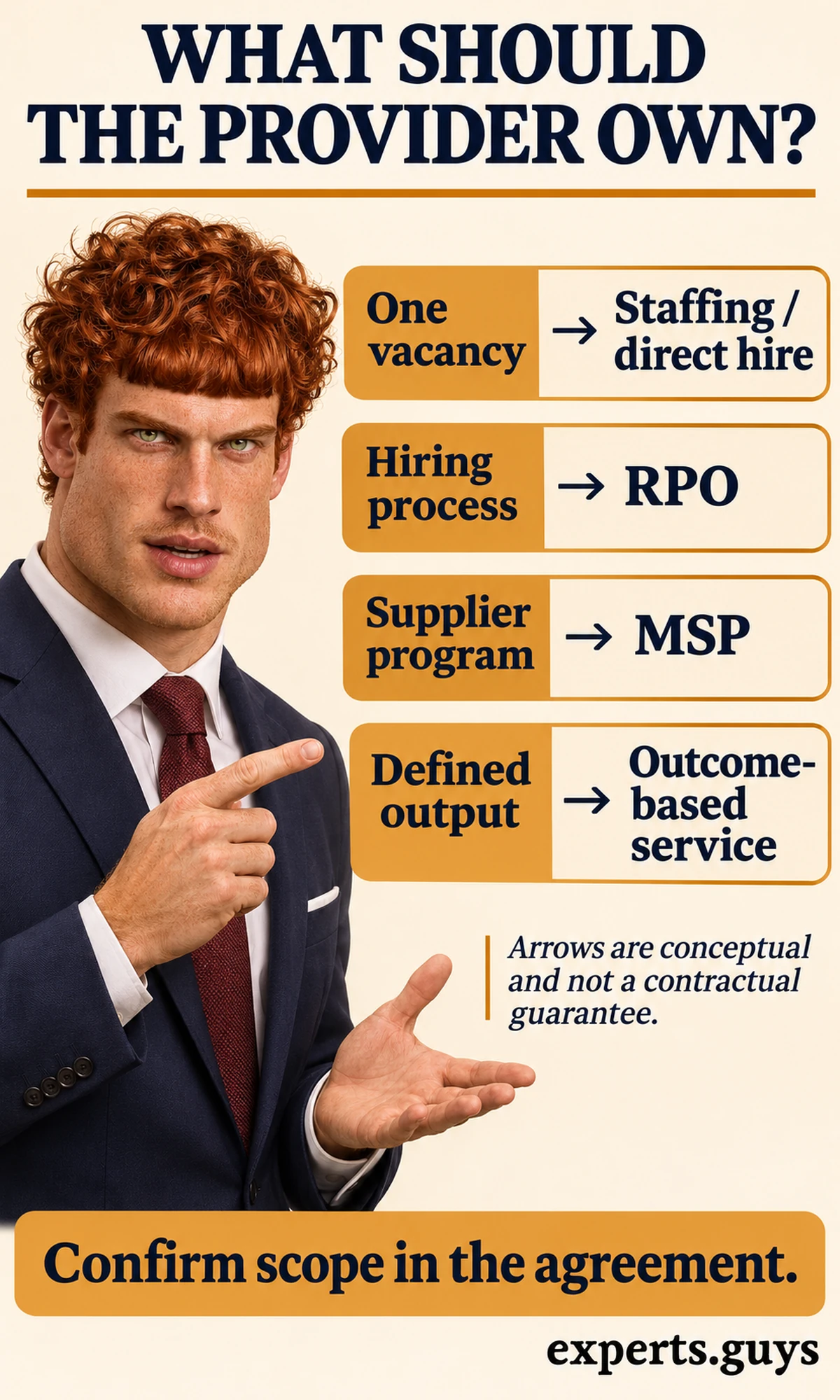
RPO, MSP and outcome-based services address different operational problems. RPO concerns recruitment-process delivery; MSP concerns management of an external-workforce supplier programme; outcome-based services concern an agreed process or project result. They can coexist, but none should be selected merely because a business needs “more help with people.”
Match the service to the responsibility you want to transfer
A single vacancy is a sourcing and selection problem. Recurring hiring across teams may become a recruitment-process problem. A business already using several staffing suppliers may face a governance problem. A function that needs someone to run the work and meet defined service requirements presents a delivery problem. Each situation needs a different conversation about authority, information and success.
The recommendation is to begin with the smallest scope that resolves the actual constraint. A company filling one vacancy may not benefit from a programme-level arrangement. Equally, adding another recruiter may not fix inconsistent supplier reporting or an operation that lacks a clear owner. The relevant trade-off is between extra coordination and the responsibility the service can genuinely take on.
Kelly’s guidance on selecting a staffing partner distinguishes individual roles, workforce programmes and project or business-function delivery. It is the provider’s own description of its offering, rather than independent evidence that every engagement produces a particular saving or hiring result. Use the categories to ask better questions, then assess the proposal.
RPO: clarify which part of recruitment is being delivered
Recruitment process outsourcing can cover all or part of an employer’s recruitment activity. Its useful scope may include sourcing, screening, coordinating interviews or supporting an ongoing hiring operation. The important distinction from an isolated placement is the responsibility for a defined part of the recruitment process across the agreed scope.
Before comparing an RPO proposal, make the handoffs explicit. Who approves the requirement? Who communicates with candidates? Who decides whether a candidate can proceed? Who makes the offer? An outsourced process can still stall if internal approvals remain slow or the provider cannot access necessary information. A provider cannot reliably own a stage it lacks authority or inputs to perform.
Judge the process through the problem you are trying to solve. If interview scheduling causes delays, distinguish scheduling time from waiting for a hiring manager’s decision. If the concern is inconsistent candidate communication, define which messages the provider owns and when escalation occurs. A single average hiring-time figure can conceal several different constraints.
These are editorial evaluation criteria, not a promised Kelly service specification. A smaller organisation may only need support for one recruitment stage; a larger one may require a wider operating arrangement. Ask for the scope that removes the observed bottleneck, and establish which decisions remain with the employer instead of assuming the word outsourcing transfers everything.
MSP: clarify the programme boundary
A managed service provider coordinates an agreed external-workforce programme, which can involve staffing suppliers, processes and reporting. That is different from being the individual recruiter for every vacancy. A programme can include workers employed by multiple suppliers, so the MSP’s presence does not tell a worker which supplier is their legal employer.
For a manager, the first boundary question is which sites, worker groups and suppliers are included. The second is which decisions the programme manager can make. Consolidated reporting is useful only if the underlying definitions match: an open request, a submitted candidate and an approved start are different states, and local teams need to use them consistently.
The trade-off is that standardisation can improve visibility while requiring changes to local habits. A department may prefer to contact a familiar supplier directly, but the programme may require a central request route. Ask how urgent needs, specialist exceptions and existing supplier relationships are handled. A rule that exists only in a presentation will not resolve the operational exception.
Outcome-based services: define what counts as delivery
An outcome-based engagement focuses on the agreed process or project and the provider’s delivery responsibilities. It should not be reduced to a synonym for supplying a team. Depending on the agreement, the provider may manage the people and methods used to complete the work rather than merely placing them under the client’s daily direction.
The service label also does not prove that every fee is fixed, every risk is transferred or every outcome is guaranteed. Kelly’s service-model materials describe arrangements that can be billed on time or per-unit bases. Responsibility, pricing and acceptance are separate questions, and the agreement needs to make their relationship understandable.
Define the output, quality conditions, dependencies and exception route before comparing offers. If a client system is unavailable, who decides the revised priority? If the incoming workload changes substantially, how is scope adjusted? Without those conditions, a price comparison may reward the proposal that leaves the most work or uncertainty outside its stated commitment.
Dependencies are part of the service boundary
A provider can be accountable for delivery while still depending on client access, approvals or source information. That is not necessarily a weakness; many services require cooperation. The weakness is leaving the dependency invisible, so each party evaluates the same delay against a different understanding of what was ready and who was responsible.
For example, an administrative service may be unable to complete an item because the client has not supplied a required decision. Counting that item alongside fully actionable work can produce a misleading performance picture. The contract's treatment of exceptions matters more than a headline promise about speed because it determines how the difficult cases will actually be handled.
The same reasoning applies to changes in workload. More incoming items, a new category of work and stricter quality requirements are different changes, even if all appear as a larger backlog. A service level agreed for one mix of work may not describe another. The proposal should make the basis of delivery intelligible without implying that every change requires identical effort.
This is why a credible scope can be more valuable than an ambitious promise. A proposal that identifies exclusions and client responsibilities lets both sides judge what is being bought. An undefined commitment to handle everything may look convenient but leaves the commercial decision unfinished. Clear boundaries support accountability; they do not establish that any provider will achieve an unverified result.
Worked example: a temporary backlog has two possible scopes
Consider an illustrative company with an administrative backlog expected to last 12 weeks. In the first version, the manager requests three people, trains them and assigns their daily work. That is a capacity brief: the business is buying access to people while retaining responsibility for the queue and how it is processed.
In the second version, the company asks a provider to run a defined queue, apply agreed quality checks and deliver a specified service level. That is an output brief. It requires a clearer description of what enters the queue, what counts as completed work, which exceptions return to the client and what access the provider needs.

Neither version is automatically better. The capacity version can fit a business that already has effective supervision and simply lacks enough people. The output version may fit a business that wants to transfer defined operational responsibility and can supply stable requirements. If the process is still changing every day, the uncertainty must be addressed rather than hidden behind an outcome-based label.
A simpler way to begin is to describe one bottleneck and one boundary: “We can supervise the work, but need temporary capacity,” or “We need someone to run this defined activity.” The completion point is a proposal whose responsibilities match that need. A polished description that leaves daily direction and acceptance unresolved has not yet completed the buying decision.
How should you approach Kelly with the right enquiry?
Use the candidate route for finding work and the employer route for buying a service. Within either route, state the work location, specialty and relationship you need clarified. The purpose of the first contact is to identify the responsible team and next decision, rather than obtain a universal claim about Kelly’s pay, speed or international reach.
Candidates: resolve the relationship before judging the promise
For a candidate, begin with the employer and opportunity, then ask about the terms that change your decision. This can be a short conversation: “Is this a staffing assignment or direct employment with the client? What are the hours and expected term? Which conditions remain before a start can be confirmed?” These questions establish what is actually being discussed.
A common mistake is to accept “full-time opportunity” as an answer to all three. Ask separately about the legal employer, work schedule and duration. If a condition is missing, the simpler next step is to request that one missing detail rather than complete a large comparison exercise. You can evaluate suitability once the relationship and basic terms are clear.

For example, a candidate seeking continuing direct employment might discover that an attractive role is a time-limited staffing assignment. That does not make the role illegitimate or necessarily unsuitable. It changes the decision: the candidate must decide whether the term fits their needs, without assuming a later conversion that has not been offered.
The separate Kelly jobs guide covers remote-role conditions, vacancy matching and the application stages in more detail. Use it for that specialist task. Here, the useful outcome is identifying whether the opportunity’s employment model matches what you are seeking before treating a promising conversation as a settled arrangement.
Employers: describe the unresolved responsibility
An employer enquiry should make the operational gap clear. State whether the business needs people under its own direction, support for recurring hiring, supplier-programme management or delivery of a defined activity. Add the work location, specialty and timing constraints that affect feasibility. Those facts let the receiving team route the request without assuming every vacancy requires the same product.
Use a concise verbal brief if that is easier: “Our team can train and supervise three temporary office workers for a 12-week backlog,” or “We need a provider to manage a defined queue with agreed quality checks.” The example numbers are illustrative requirements, not a staffing recommendation. The wording changes who is expected to organise and deliver the work.
Then ask what the proposed service includes and excludes. Who will manage workers? Which client inputs are required? What constitutes acceptance? What happens when demand changes? A useful first response identifies the appropriate scope and the information needed for a proposal. It need not promise a price or start date before the work has been understood.
Keep one independent verification safeguard
Kelly is an established company, but its name does not authenticate every message claiming to represent it. Before sharing sensitive information with an unexpected contact, open the official route independently and confirm the person and opportunity. Do not rely on the sender’s own verification link or telephone number as the only check.

Kelly’s recruitment-fraud guidance states that candidates are not charged job-placement fees and explains how to verify suspicious contact. Secure onboarding after a verified hire is a different stage from an unsolicited request for banking or identity information. Stop an unverified transaction rather than paying to release a supposed job or forwarding money on someone’s instructions.
This safeguard is necessary shared context, rather than a reason to turn every service enquiry into a fraud investigation. For ordinary contact, use the company’s current official routes and the details relevant to your task. For a suspicious message, complete independent verification first. In both cases, the next step should resolve a specific uncertainty instead of repeating a general request for “more information.”
Frequently asked questions
Does a Kelly business-segment name tell me my employer?
No. A reporting segment describes part of the corporate business. Your offer and employment documents identify the relevant employer. A client workplace, recruiting brand and reporting segment can all appear in the same engagement without being interchangeable.
Can one organisation use more than one Kelly service?
Yes, where the agreed coverage supports it. An organisation might recruit a permanent employee while separately arranging temporary capacity or programme management. Keep the scope and responsibilities of each engagement clear; combining services does not make their employment or delivery terms identical.
Is payroll outsourcing the same as recruiting workers?
No. Payroll process outsourcing concerns an agreed payroll-related function, while recruitment concerns finding and selecting people. A broader arrangement can involve both, but the presence of one service does not establish the scope of the other.
Does an outcome-based service always have a fixed price?
No. An output-focused arrangement can use different pricing structures. Check what the fee covers, how changes are treated and what delivery responsibilities are actually agreed. The label alone establishes neither a fixed total nor an unconditional performance guarantee.
Should company revenue or placement totals decide my choice?
Those figures can explain corporate scale, but they do not demonstrate local capacity, suitability for your specialty or the terms of an individual engagement. Give more weight to confirmed delivery coverage, a credible scope and clear responsibilities for the work you need.
Before you proceed
Action checklist
- Choose the candidate or employer route that matches your purpose.
- Confirm the specialty, work country and responsible team.
- Separate business-segment labels from the actual service and legal employer.
- Resolve who directs the work, who owns delivery and which terms remain outstanding.
- Proceed on confirmed scope and terms; pause an unexpected request until independently verified.