
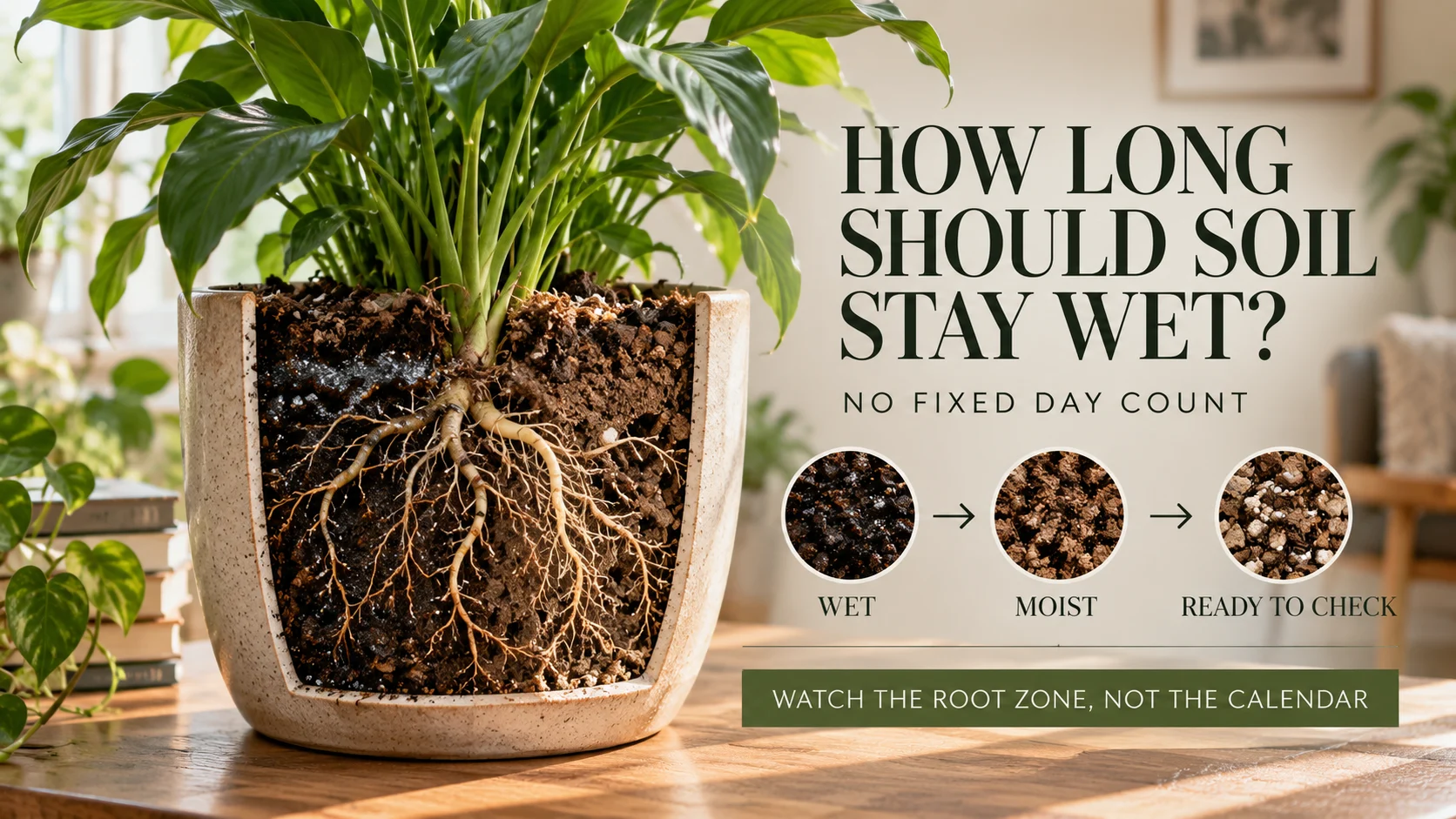

Potting soil should become less saturated after watering and progressively move from wet to moist to partly dry, but there is no universal number of days when every houseplant’s soil should be dry. A pot can still contain healthy moisture several days after watering; what matters is whether excess water drained away, the root zone is gaining air as the mix dries, and the plant reaches its appropriate rewatering point rather than remaining continuously saturated.
That distinction matters because “still moist” and “still waterlogged” are very different conditions. A healthy potting mix can retain useful moisture while also containing air around the roots, whereas a poorly aerated mix may remain saturated enough to restrict root oxygen. The first question, therefore, is not simply How many days has it been? It is What moisture state is the root zone in now?
There Is No Universal 3-Day, 7-Day or 10-Day Rule
Fixed drying-time rules are tempting because they make watering seem measurable. They can also be misleading. A small plant in terracotta beside a bright window may lose water much faster than the same species growing in a large glazed pot in lower light, even when both plants received water on the same morning.
The horticultural guidance supports this condition-based approach. Virginia Tech’s guidance on properly watering container houseplants explains that potting-medium composition affects how much water and oxygen remain available to roots, while container size, shape and material influence drying. Illinois Extension’s houseplant watering guidance likewise identifies plant type, temperature, humidity, light, pot size, plant size, potting mix and drainage as factors affecting watering frequency.
Use elapsed time as a diagnostic clue, therefore, rather than as an automatic watering instruction. If a pot that normally progresses toward its rewatering point in several days suddenly remains heavy and wet much longer under similar conditions, the change is more informative than whether it has crossed an arbitrary number such as seven days.
Quick Check: What Does the Soil Feel Like Now?
| Moisture state | What it suggests | What to do |
|---|---|---|
| Wet immediately after watering | Normal if excess water can leave the container. | Allow the pot to drain fully. |
| Moist but no longer saturated | Usually part of a normal dry-down cycle. | Wait and monitor the root zone. |
| Surface dry, deeper mix moist | Common because the surface can lose water before the root zone. | Check below the surface before watering. |
| Persistently soggy, heavy or stagnant | Dry-down may be abnormally slow. | Check drainage, pot size, mix structure and growing conditions. |
The third condition is particularly easy to misread. If your surface looks ready for water while deeper soil is still moist, see our guide to why soil looks dry on top but wet underneath before adding more water.
What Happens Inside the Pot After You Water?
Water does not simply enter the top of a pot and then disappear at a predictable daily rate. It moves through pores in the growing medium, some drains under gravity, some remains held within smaller pores and on particle surfaces, roots take up part of it, and additional water is lost through evaporation and plant transpiration. The proportions continually change as the pot dries.
This is why drainage speed and drying speed are not the same measurement. Water pouring from the drainage hole tells you that some water has travelled through the container, but it does not tell you how much remains in the root zone. Virginia Tech specifically notes that drainage should not be judged merely by how much water comes out after watering; retained water matters as well.
A useful mental model is therefore:
Saturated after watering → excess water drains → air begins returning to larger pores → root zone remains usefully moist → moisture continues declining → plant reaches its species-appropriate rewatering point.
The healthy target is a functioning wet-dry cycle, rather than forcing the entire pot to become bone-dry as rapidly as possible.
Eight Things That Change How Long Potting Soil Stays Wet
The drying time you observe is the combined result of the plant, container, growing medium and room. Changing even one of those variables can noticeably alter the next watering interval.
- Light: A plant receiving useful light generally uses water differently from the same plant under substantially lower light. A sudden move into dimmer conditions can therefore lengthen the dry-down period.
- Temperature: Warmer conditions generally increase water loss, while cooler conditions can slow evaporation and plant activity.
- Humidity: Higher surrounding humidity reduces the moisture gradient driving evaporation, so pots can dry more slowly.
- Air movement: Moving air can increase evaporation from exposed surfaces compared with stagnant conditions.
- Pot material: Unglazed terracotta allows moisture to escape through its porous walls. Plastic and glazed containers largely do not.
- Pot size relative to the roots: A small root system surrounded by a large volume of wet mix may not remove water rapidly enough from the unused substrate.
- Potting-mix structure: Fine or compacted media tend to retain more water and provide less air than appropriately structured coarse media.
- Plant water use: Species, leaf area, root mass, growth rate and current growing conditions all influence how rapidly stored water is used.
This is why copying another person’s watering interval can fail even when you own the same plant. Their pothos may genuinely need water sooner because their pot, substrate, root mass, light and indoor environment form a different water-storage system.
Pot Material Can Change the Drying Curve More Than You Expect
Virginia Tech’s container guidance explains that unglazed terracotta loses moisture through its walls, which makes its root zone dry faster than a comparable nonporous container. Glazed clay and plastic largely restrict water loss to the substrate surface, drainage openings and water used by the plant.
That does not make terracotta universally “better.” Faster drying can help a plant whose current combination of substrate and environment retains excessive moisture, but it can create unnecessary water stress for a moisture-demanding plant. Container material is one part of the system rather than a substitute for appropriate potting mix and drainage.
Pot geometry matters too. Virginia Tech notes that taller containers generally drain differently from shallower containers because container height changes the water distribution within the medium. Two pots holding similar volumes of mix can therefore produce different root-zone conditions.
A Pot Can Drain Quickly and Still Stay Wet Too Long
Seeing water leave the drainage hole within seconds is reassuring, but it does not prove that the root zone has adequate air after drainage stops. Water can find preferential paths through the substrate while substantial moisture remains elsewhere, and a fine or degraded mix can still retain a large amount of water after free drainage has finished.
The opposite problem also occurs. Extremely dry peat- or bark-based potting media can become difficult to rewet, allowing irrigation water to travel around dry sections and escape rapidly. A pot that seems to “drain brilliantly” may therefore contain a surprisingly dry root ball rather than an ideally aerated one.
This is one reason the pot’s weight after thorough watering is useful. Learning how heavy the container feels when evenly hydrated gives you a physical reference that can later be compared with the lighter state reached during dry-down.
When Is Soil Staying Wet Too Long?
Treat prolonged wetness as a problem when the whole pattern suggests that the root zone is failing to recover air, rather than simply because a certain number of calendar days has elapsed. A pot deserves closer investigation when several clues begin occurring together.
Look for:
- the pot remaining unusually heavy compared with its established normal cycle;
- deeper mix staying saturated rather than progressing toward merely moist;
- standing water remaining inside a cachepot or saucer;
- a musty, sour or stagnant smell;
- yellowing or wilting while the root zone is still wet;
- stalled growth without another obvious explanation;
- persistently wet conditions after light or temperature has decreased;
- water collecting in the bottom of a container without an effective drainage route.
Roots require oxygen as well as water. UConn Extension’s houseplant watering guidance explains that excess water remaining around container roots can displace necessary oxygen, contributing to root deterioration and reduced water uptake. This is why a badly overwatered plant can eventually wilt even though its substrate is wet.
Why Large Pots Often Stay Wet Longer
Pot size should be considered relative to root-ball size, rather than to the visible canopy alone. When a relatively small root system is surrounded by a large volume of wet growing medium, there are fewer roots occupying and extracting water from that additional substrate.
Illinois Extension’s container guidance specifically warns against placing a small plant directly into an excessively large pot because the soil can remain wet too long, increasing the risk of poor growth or root rot. Its general repotting guidance is to move up incrementally rather than making a dramatic jump in container size.
This also explains why drying behavior sometimes changes immediately after repotting. You may not have changed your watering technique at all; you changed the ratio between root mass and water-holding substrate.
The Hidden Saturated Zone Near the Bottom of a Pot
The lower portion of a container can remain wetter than the surface because gravity, pore structure and container geometry produce a moisture gradient through the growing medium. The result is especially important when the pot contains fine-textured or compacted material.
Iowa State University Extension’s explanation of potting-media porosity describes the lower area of a container as a saturation zone where the medium has fewer air-filled pores after watering. The height and severity of that wetter zone depend partly on pore characteristics and container geometry.
This gives us a more useful interpretation of “my soil has been wet for days.” The top centimeter is not the measurement that matters most. What matters is whether the root-occupied portion of the container is progressing from high water content toward an appropriate balance of moisture and air.
Don’t Add Gravel to the Bottom to Make Soil Dry Faster
A gravel layer sounds logical: large gaps between stones appear as though they should provide an easy escape route for water. Container physics does not work that way at the boundary between fine potting medium and a much coarser layer.
Washington State University’s houseplant guidance explains that water can accumulate in the finer material above a coarse drainage layer before moving across that boundary. Raising this wetter region higher into the container can put more of the root zone into persistently saturated conditions.
If a pot stays wet too long, improve the actual system instead: verify the drainage opening, assess the growing medium, reconsider pot size and examine the environmental conditions controlling water use.
How to Tell Whether Your Pot Is Drying Normally
Do not rely on one test. Use several observations that measure different parts of the system.
1. Check below the surface
Insert a finger or clean wooden chopstick into the growing medium where doing so will not damage major roots. The surface can be dry while deeper substrate remains moist, so the test needs to reach the depth relevant to your plant and container.
2. Lift the pot
Compare its weight with how it felt immediately after a thorough watering. As water leaves the container, the pot becomes lighter. After several watering cycles, that weight difference becomes one of the simplest ways to recognize your plant’s normal dry-down pattern.
3. Watch the direction of change
A pot that moves steadily from wet to moist is behaving differently from one that remains cold, heavy and saturated with almost no apparent change. Trajectory is more useful than a single observation.
4. Check where drained water goes
A drainage hole only helps if the escaping water can actually leave the root system. Empty standing water from saucers and decorative cachepots rather than allowing the inner pot to remain immersed.
5. Compare with the plant’s previous cycles
Your own plant provides a useful baseline. A meaningful increase in drying time after a seasonal light change, repotting, relocation or decline in root health deserves investigation even if an online day-count chart says the interval is “normal.”
What to Do If Soil Is Still Very Wet
Do not automatically water again because the calendar says it is watering day. First determine why the root zone is retaining water.
| What you find | Likely issue | Next action |
|---|---|---|
| Water standing in cachepot | Inner pot remains exposed to drained water | Empty it and let the inner container drain. |
| Small root ball in a large pot | Too much wet substrate relative to active roots | Reassess pot size rather than simply extending a watering schedule. |
| Dense, compressed mix | Poor air-filled porosity and high water retention | Consider an appropriate fresh mix when repotting is justified. |
| Drying slowed after relocation | Light, temperature or airflow changed | Recalibrate watering to the new environment. |
| Wet soil plus foul smell or soft dark roots | Possible root deterioration | Inspect the root system and correct the underlying moisture problem. |
Do not compensate for persistently wet soil by placing a shade-tolerant plant into harsh direct sun simply to “bake” the pot dry. Correct the structural or environmental cause while keeping the plant within appropriate growing conditions.
Should You Repot Immediately If the Soil Won’t Dry?
Not necessarily. Repotting itself disturbs roots, so slow drying alone is not always enough reason to pull a healthy plant apart.
Start with reversible problems: remove standing drainage water, stop premature rewatering, verify that drainage openings are functional, and reassess whether light and temperature recently changed. If the plant remains stable and the substrate is gradually losing moisture, observation may be preferable to emergency intervention.
Repotting becomes more reasonable when you identify a structural problem that cannot be corrected in place – for example, severely compacted or degraded medium, a badly oversized container, ineffective drainage, or root deterioration that requires inspection and removal of damaged tissue.
What If the Soil Dries Extremely Fast?
Very fast drying is the opposite diagnostic problem and does not automatically mean your setup is excellent. A small pot, high light, warm air, porous terracotta, a very coarse mix, a large root system or a root-bound plant can consume or lose available water rapidly.
There is also a deceptive failure mode: very dry peat-based material can become difficult to wet evenly. Water may run down gaps at the pot edge and emerge from the drainage hole while parts of the root ball remain dry. Virginia Tech recommends checking pot weight and moisture distribution when unusually rapid drainage suggests that the medium did not actually hydrate properly.
The goal is therefore neither “dry as quickly as possible” nor “hold as much water as possible.” The useful target is a repeatable moisture cycle appropriate to the plant in which roots receive water and subsequently regain adequate aeration.
Stop Watering by Calendar – Track the Pot Instead
A weekly reminder can be useful as a prompt to check a plant. It should not automatically become an instruction to pour water.
Record the date of a thorough watering, then check the pot’s weight and root-zone moisture over the following days. After several cycles, you will begin seeing how quickly that particular plant dries under its actual conditions.
When the environment changes, expect the pattern to change as well. A plant moved farther from a window, placed in a larger pot or entering a period of slower growth may take longer to reach the same rewatering condition than it did previously.
That personal baseline is considerably more useful than asking whether every houseplant should be dry by Day 5 or Day 7.
FAQ
Is soil still being wet after a week always bad?
No. A week by itself does not diagnose overwatering because plant type, container size, substrate, root mass, light, temperature and humidity all affect drying. Investigate when the root zone remains unusually saturated or the drying time has become substantially longer than that plant’s established pattern, especially when plant symptoms appear at the same time.
Should soil be completely dry before I water again?
Not for every plant. Some drought-adapted plants tolerate or require much greater drying between waterings, while plants adapted to more consistently moist substrates should generally be watered before the entire root zone becomes extremely dry. Base the endpoint on the plant’s needs rather than applying “completely dry” to every species.
Why is my soil still wet when the drainage hole works?
A drainage hole removes free drainage water but does not determine how much moisture the potting medium retains afterward. Fine particles, a large container, low water use by the plant, nonporous pot walls and environmental conditions can all keep the root zone moist even when water initially exits the hole normally.
Can I water again if the top inch is dry?
Sometimes, but surface dryness alone is weak evidence. The deeper root zone may still contain substantial moisture, particularly in larger pots or water-retentive mixes. Check deeper moisture and pot weight before deciding.
Does terracotta make soil dry faster?
Usually, yes. Unglazed terracotta is porous, so moisture can escape through the container wall as well as through the substrate surface and plant. That can be useful for plants and conditions prone to excessive moisture retention, but faster drying is not automatically desirable for every plant.
Can a plant wilt while the soil is still wet?
Yes. Persistently saturated root conditions can reduce root function as oxygen availability declines, which can interfere with water uptake. Because underwatering can also cause wilting, check the root-zone moisture before responding to wilt by adding more water.
Should I use a moisture meter?
A moisture meter can provide another clue, but it should not replace observation of the substrate, pot weight, drainage and plant condition. Illinois Extension notes that moisture-meter probes can be useful but may not always be reliable.
The Bottom Line
There is no universal number of days that potting soil should remain wet after watering. Healthy soil should move through a drying cycle: excess water leaves, the root zone becomes less saturated, air returns to pore spaces, useful moisture remains available, and eventually the plant reaches its appropriate rewatering point.
Instead of asking whether Day 5, Day 7 or Day 10 is automatically too long, learn your plant’s normal drying trajectory. Check below the surface, learn the pot’s wet and drier weights, watch for changes in drainage and growing conditions, and investigate when the root zone remains persistently saturated or suddenly dries much more slowly than usual.
That turns watering from a calendar habit into something far more reliable: a response to what is actually happening around the roots.