
Healthcare jobs include direct patient care, technical services and the administrative work that keeps care moving. Start with the duties you are qualified to perform, then check the location, employment terms and conditions that must be completed before you can begin.
A promising job title can hide a mismatch. A medical receptionist, a medical assistant and a registered nurse may work in the same clinic, but their responsibilities and entry requirements are different. The useful question is which vacancy gives you a realistic route from your current experience to work you can safely and reliably do.
For most applicants, the best starting point is the closest credible match to their present qualifications, with a clear route to any missing requirement. A higher advertised rate or a more impressive title cannot compensate for a mandatory qualification you do not hold, an unsuitable roster or an unclear employment arrangement.
Which healthcare jobs match the work you want to do?
Choose the work family before choosing a job title. Healthcare employers need people who deliver care, operate technical services, manage information and support everyday operations; these routes involve different kinds of contact, responsibility and preparation. Searching only for “hospital jobs” can put all of them in one results list and make unlike opportunities appear interchangeable.
- Direct care: helping or treating patients within the responsibilities of a particular occupation, with the relevant training and professional authority where required.
- Technical services: work involving investigations, equipment, specimens or treatment support, with requirements determined by the exact role.
- Information and operations: scheduling, records, billing, facilities and other services that enable care, including roles without hands-on clinical work.
These are practical search categories, not a legal classification. A single position can cross their boundaries, and local job titles may use different words for similar work. Read the duties and person specification together. The occupation descriptions in the US Occupational Outlook Handbook provide a useful starting vocabulary, but their education and labour-market information describes the United States rather than every country.

Start with the task you could explain and demonstrate
Imagine two hypothetical vacancies: a clinic appointments coordinator and a healthcare assistant on a ward. Both involve communication with patients. The first may centre on telephone calls, appointment systems and accurate information; the second may include personal care and other delegated duties. Being comfortable speaking to people does not establish that you are prepared for both roles.
Open the full vacancy and identify its recurring tasks. Look for the verbs: schedule, transfer, clean, assess, code, dispense, monitor or operate. Those words reveal the work more reliably than a broad label such as “patient services”. Where a verb is ambiguous, ask what the employee actually does and who supervises it. Do not infer permission to perform a clinical task from a general job title.
Then compare those tasks with your existing preparation. Someone with reception experience may have strong evidence for managing queues, explaining arrangements and protecting private information, while still needing training in a clinic’s systems. A qualified clinician moving into a new specialty may face a different gap: professional registration may be current, but the vacancy can require experience with a patient group or equipment they have not used.
Swipe horizontally to compare on a narrow screen.
| Work family | Examples to investigate | Requirement to clarify |
|---|---|---|
| Hands-on clinical care | Nursing, medical practice and therapy roles | Professional registration, scope, specialty preparation and employer requirements. |
| Care support | Healthcare assistant or similar support positions | Permitted duties, training, delegation and supervision in the actual setting. |
| Technical services | Laboratory and diagnostic imaging roles | The specific occupation’s education, credentials and equipment responsibilities. |
| Records and administration | Records, scheduling, reception and billing | Required terminology, information skills, credentials and local systems. |
| Operational support | Facilities, cleaning, stock and other service roles | Role-specific training, access, work conditions and safe procedures. |
This distinction prevents two opposite mistakes: dismissing all healthcare work because you are not a clinician, and assuming that a non-doctor title means a job has no formal requirements. The appropriate next move depends on the actual vacancy. If the tasks fit but the terminology is unfamiliar, investigate further; if the role requires a regulated scope you do not hold, a different application route is needed.
What if you have no healthcare experience?
Separate “no healthcare experience” from “no relevant experience”. Customer service, accurate data handling, stock control, cleaning and team coordination can be relevant to particular support roles. Their value depends on whether the employer accepts that background and provides the necessary role-specific training. An entry-level label alone does not establish this; some entry-level vacancies still require a named qualification or practical placement.
Look for a clearly described training route rather than a promise that anyone can start immediately. Useful details include what is taught, whether training is part of employment, which tasks remain supervised and what must be completed before independent work. If the advert merely says “full training”, ask whether that covers the duties in the description or only the employer’s software and procedures.
For a non-patient-care example, US medical records specialists typically work with patient information rather than provide hands-on care. BLS describes several educational routes and notes that certification may be required or preferred. That makes the occupation worth investigating for someone interested in information work, but it does not mean every records vacancy accepts an applicant without training.
Avoid buying a course just because its advertising uses a familiar healthcare title. Find an actual target role first and check whether its employer recognises that qualification. A course can teach useful knowledge without satisfying a registration rule, an employer’s screening requirement or the practical experience needed for a specific position. The course and the job need to connect through a requirement you can verify.
A useful shortlist at this stage contains a small number of job families with a reason for each. You should be able to say, “This role uses skills I already have, and its missing requirement is clearly defined,” rather than “This hospital has many vacancies.” If you need a recruiter with the right sector focus, the guide to employment agencies by industry explains how specialisms differ.
Which requirements are essential before you apply or start?
Read requirements as separate gates: permission to practise, qualifications or experience used in selection, and employer-specific checks before starting. Passing one does not automatically satisfy the others. A recruiter’s interest, an interview invitation and a conditional offer are different stages, each with its own unresolved questions.
Distinguish a licence, certification and local training
A professional licence or registration concerns permission to practise within the relevant jurisdiction and scope. Certification is a named credential, often issued by a professional or certification organisation. Employer training concerns local systems, procedures or duties. The categories can interact, so the deciding source is the regulator and the exact vacancy rather than the everyday use of the word “certified”.
In the United States, CareerOneStop’s licensing guidance distinguishes state occupational licences from certifications and explains that requirements vary by state. Its directory can help identify the responsible agency, but the service also warns that its information is not complete for every state. Check the issuing regulator when a requirement determines whether you may practise.

The same need for jurisdiction-specific checking applies internationally. For example, the Singapore Nursing Board’s application guidance describes registration or enrolment assessment and separate routes for local and foreign-trained applicants. An overseas qualification is therefore not, by itself, proof that every local requirement has been met. This example illustrates the distinction; it is not a complete guide to nursing registration or immigration permission.
Employer wording also needs care. “Certification preferred” usually signals a different selection condition from “current registration required”, but neither phrase should be interpreted in isolation from the full specification. If the vacancy seems internally inconsistent, ask which requirement is mandatory and when it must be satisfied. Keep your application status accurate while waiting for the answer.
Use the official vacancy to filter your application
Use the following sequence on screen, with the vacancy open. First, locate the position through the employer’s official careers page or a recruiter whose identity you have independently confirmed. Match the vacancy reference, location and role rather than relying only on a copied job-board headline. A closed official listing needs clarification; it is not proof that the person contacting you is authorised to reopen it.
Second, read the duties, site and work pattern together. A role advertised under a city name may be based at a particular clinic, several community sites or a client facility. Check whether travel between sites is part of the job and whether the stated roster describes normal work or only the employer’s operating hours. This is a feasibility check, not a commitment to accept the role.
Third, separate required conditions from preferences. Compare the required credential, experience and availability with what you can truthfully provide. If one condition is unclear, ask a narrow question: “Does this role require the credential at application, or can it be completed through the stated training route?” The useful outcome is a clear reason to apply, clarify or choose another vacancy, rather than an invented percentage match.
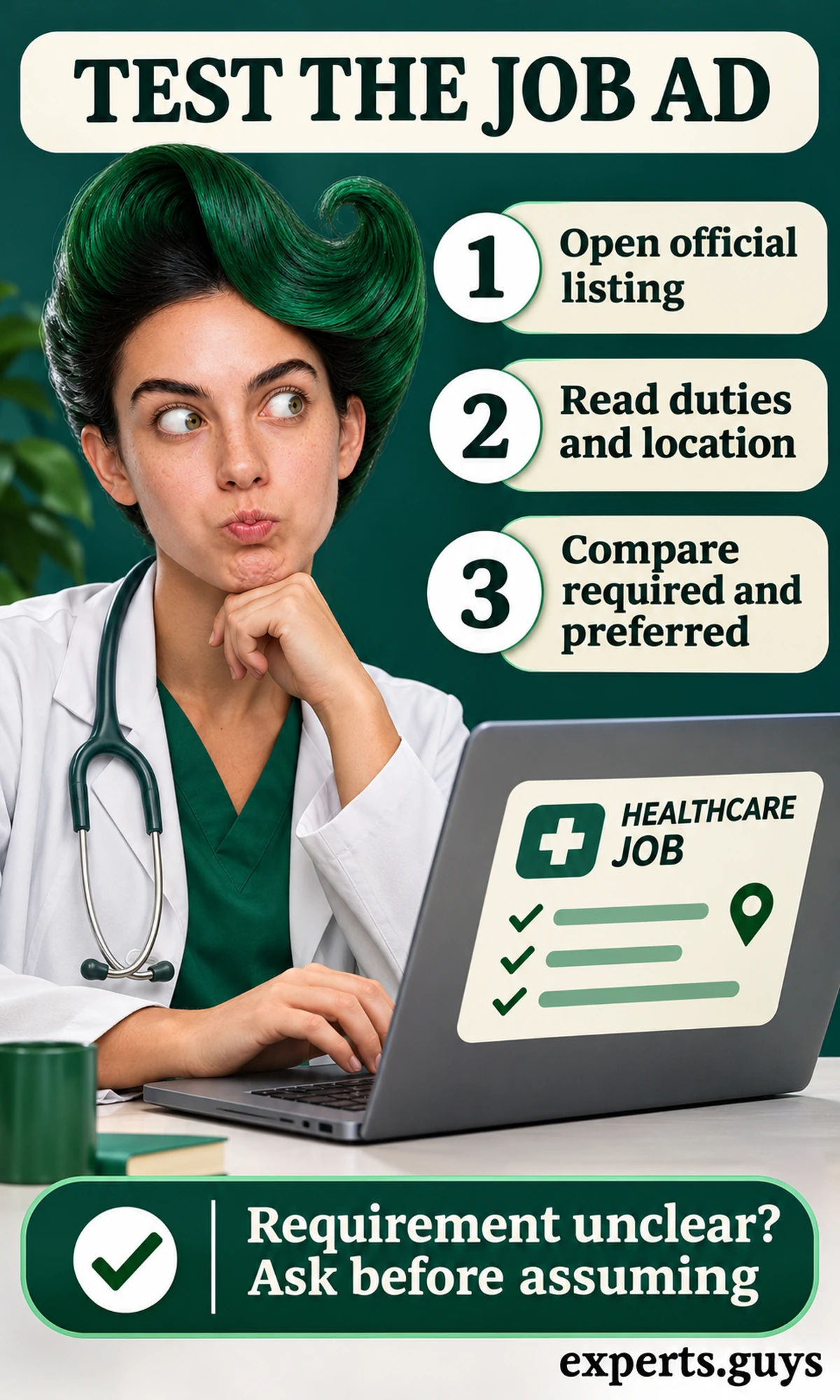
A hypothetical applicant may meet every administrative requirement except experience with a named booking system. If the advert lists that system as preferred and offers induction, applying with evidence of learning similar software can be reasonable. The answer changes if the missing item is mandatory professional registration for the duties. Treating both gaps as ordinary training needs would erase a consequential distinction.
If a long specification feels difficult to interpret, begin with just the essential-criteria section and the duties it supports. Expand to the preferred items after those gates are clear. Do not repeatedly submit applications that depend on the same unresolved requirement; clarify that point once through the verified contact, then use the answer to select suitable openings. Nobody can guarantee an interview simply because the listed essentials appear to match.
Understand what an offer still leaves unfinished
A conditional offer may depend on items such as identity and right-to-work checks, references, qualification verification, occupational health requirements or background screening, as applicable to the role and local rules. Not every position uses the same checks. Ask the employer which conditions apply, who arranges them and what confirms completion; a generic internet checklist cannot establish your clearance.
For a concrete UK example, the NHS employment-check standard explains that verifying professional registration alone does not establish suitability for a post; other relevant checks remain necessary. That distinction is useful when interpreting a conditional offer, but the NHS process should not be copied as a universal checklist for employers in other countries.
Professional permission and immigration or work permission are separate questions where both apply. Likewise, completing a general training course does not establish that the employer has assessed competence in its own setting. You do not need to solve every process before making an initial enquiry, but you do need to avoid promising a start date that depends on approvals you have not received.
Keep sensitive documents within the verified process requested by the employer or authorised recruitment partner. An initial conversation rarely justifies sending an unrestricted bundle of identity, financial and health information to an unverified personal account. If the requested channel or document list seems inconsistent, confirm it using contact details obtained independently from the organisation’s own website.
How can you show fit without overstating your experience?
Make the application connect a real duty to truthful evidence, then clarify the work setting at interview. A polished CV cannot repair a qualification mismatch, but a suitable applicant can be overlooked when relevant experience is hidden behind vague descriptions. The aim is a readable account of what you have actually done and what preparation remains necessary.
Build one duty-to-evidence connection at a time
With the vacancy and your existing CV open, choose a responsibility central to the role. Find a genuine example from work, study, a placement or volunteering that demonstrates the relevant skill. Explain the task and your contribution in ordinary language. Where the experience is transferable rather than clinical, say so through accurate job titles and descriptions rather than allowing the reader to infer a qualification you do not hold.
Consider a hypothetical applicant for clinic reception who previously handled customer-service calls. “Managed appointment queries” would be misleading if the earlier work did not involve appointments. A truthful connection would describe handling high volumes of enquiries, explaining next steps and escalating issues, then identify those as relevant communication skills. Any actual volumes or outcomes must come from the applicant’s own experience, not a suggested template.
Keep the boundary visible. Dealing calmly with a distressed customer can demonstrate communication; it does not establish competence in clinical assessment. Using a database can demonstrate accurate information handling; it does not establish expertise in medical coding. The application becomes stronger when the employer can see exactly what transfers and what needs training, without having to correct inflated claims later.
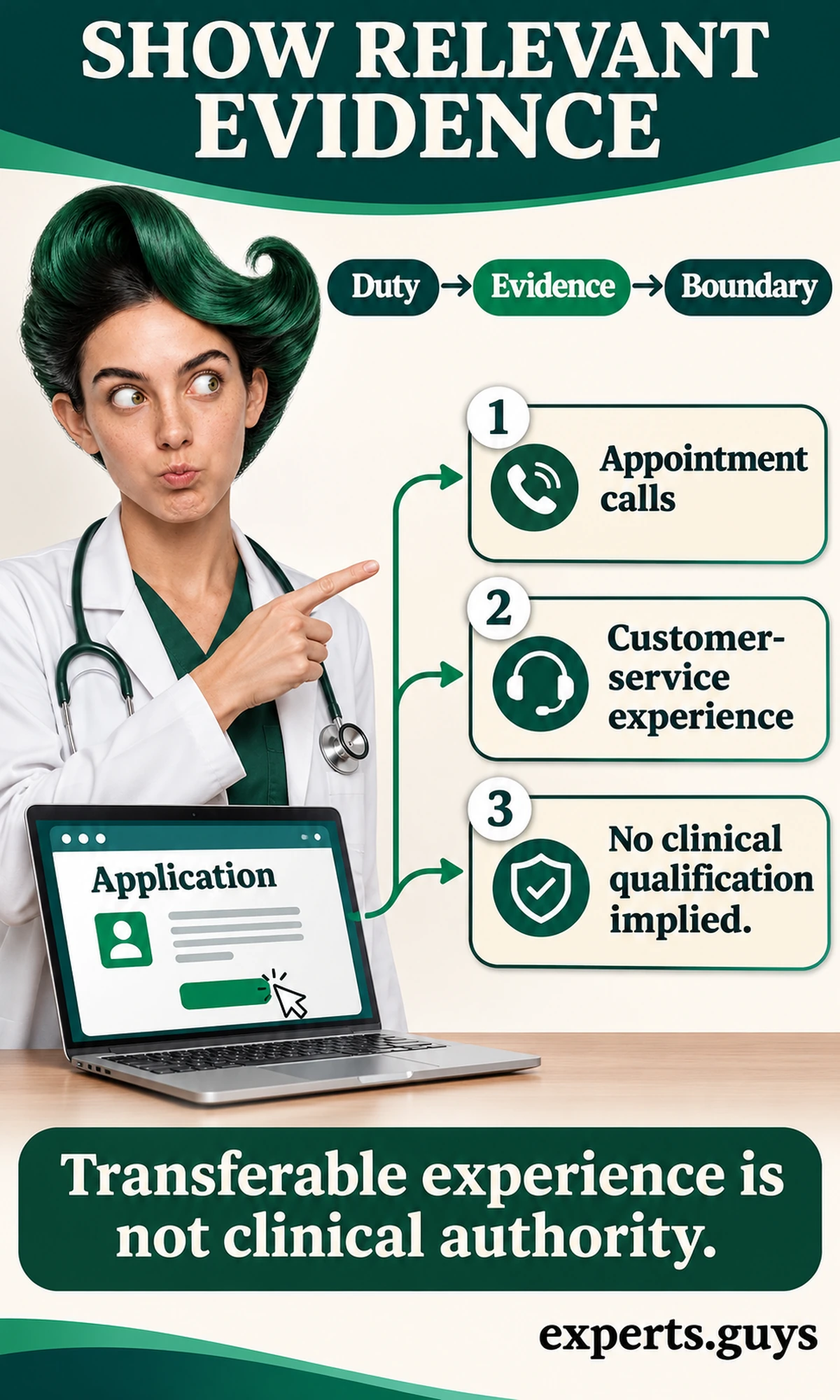
- Duty: name the responsibility that matters in this vacancy.
- Evidence: describe a real example and your own contribution, using only details you can substantiate.
- Boundary: identify the context accurately, including trainee, supervised or non-clinical status where relevant.
If you have limited work experience, a supervised placement or relevant course activity may provide evidence, provided you identify it accurately. If you have no example for a central requirement, do not manufacture one; consider whether the vacancy offers training or whether a different entry route is more appropriate. The finished application should make your position easier to understand, not merely contain more keywords.
Include the status of a required credential precisely. “Application submitted”, “exam booked” and “registration active” describe different facts. Use the status the regulator or issuing body actually recognises, and avoid presenting an anticipated award as already held. Where expiry, renewal or restrictions affect the role, follow the employer’s instructions for supplying accurate verification through the appropriate channel.
General formatting advice belongs in the CV preparation guide. Here, the additional healthcare-specific task is evidence with boundaries: make duties, setting, supervision and credential status explicit. Do not attach patient records, identifiable case material or confidential workplace documents to prove experience; use appropriate descriptions and the formal verification process instead.
Ask for a normal-shift example at interview
A job description lists responsibilities, but it may say little about how they combine during a busy shift. Ask the interviewer to walk through a normal day or night: where the work begins, which duties take most time, who assigns priorities and how unfinished work is handed over. This makes the role concrete without asking the interviewer to promise that every shift will be identical.
Clarify four areas: roster, workload, supervision and handover. For roster, ask about actual start and finish times, rotation and weekend expectations. For workload, ask which routine duties and service demands shape the shift. For supervision, ask who is available when a new employee reaches a limit. For handover, ask how responsibilities pass to the next person or team.
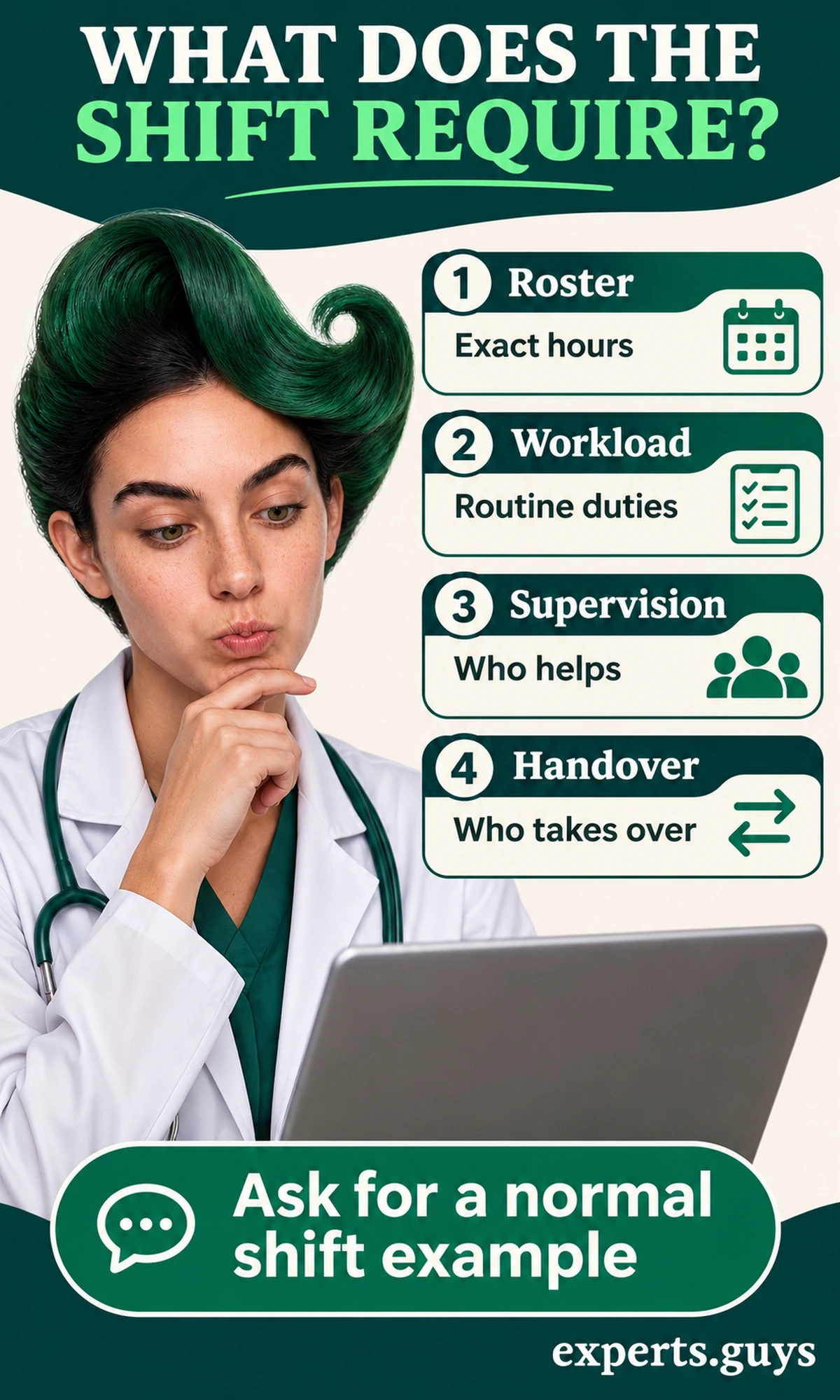
The answers can reveal a mismatch that salary comparison misses. An applicant seeking predictable daytime work may discover rotating early starts. A newly qualified professional may find that an apparently suitable position expects independent specialist work without the induction they need. These are reasons to explore fit and support more closely, not evidence that the employer is necessarily unsafe or unsuitable for everyone.
Follow vague answers with a specific example. If the interviewer says “the team is supportive”, ask how a new starter receives help during the shift and who covers supervision when the usual contact is away. If the answer is “hours vary”, ask what variation the role ordinarily involves and how rosters are communicated. A concrete explanation is more useful than a general assurance of flexibility.
People returning after a career break can use the same conversation to establish the induction and support relevant to their current experience. Do not describe a gap as proof of inability, or assume previous competence transfers unchanged to a different system. Ask what preparation the employer expects before independent duties and whether there is a suitable supported route. Acceptance depends on the employer and applicable professional requirements.
If you need help with broad interview questions, the general interview preparation guide covers that wider task. Use this conversation to learn about the actual operating conditions. The practical result should be a clearer view of whether you can do the work with the proposed roster and support, rather than simply a better performance in the interview.
How should you compare an offer and confirm a realistic start?
Compare dependable terms before attractive extras, and treat a proposed start date as provisional until the relevant conditions are resolved. Two offers can use the same hourly unit while providing different hours, benefits, locations and obligations. A useful comparison makes those differences visible instead of awarding the higher rate an automatic win.
Compare the hours you can count on
Begin with the base rate and the hours that are actually stated or guaranteed in the terms. Separate those from possible overtime, shift premiums, bonuses and allowances. Ask how the arrangement works when shifts are unavailable or cancelled, and which organisation employs and pays you. The answer is contract- and jurisdiction-specific; neither a recruiter’s enthusiastic estimate nor the maximum displayed in a job advert establishes dependable income.
In a hypothetical example using the same currency, offer A pays $25 for 40 paid hours, producing $1,000 gross for that week. Offer B pays $30, but only 24 paid hours are offered, producing $720 gross. The example excludes tax, deductions, benefits, overtime and allowances. It demonstrates why a higher hourly rate can produce less weekly income; it is not a healthcare wage benchmark or a prediction of future shifts.

If B later provides 40 hours at the same rate, its gross amount would be $1,200 before those exclusions. That does not make either offer universally better. The decision depends on the reliability of the hours, your need for income stability and the other terms. If the hours are unknown, keep that uncertainty visible instead of filling the comparison with an assumed full-time week.
| Offer detail | Clarification that changes the decision |
|---|---|
| Paid hours | What hours are stated or guaranteed, and what depends on available shifts? |
| Base pay and extras | Which amounts are ordinary pay, conditional premiums, bonuses or expense reimbursements? |
| Employment arrangement | Who employs and pays you, and which written terms govern the work? |
| Location and roster | Which site or sites, shift times, rotation and travel duties apply? |
| Training and support | What induction and supervision are available before independent duties? |
| Conditions and start | What remains outstanding, who confirms completion, and when are reporting details final? |
| Benefits and obligations | What eligibility, leave, notice, repayment or assignment-end terms apply? |
Do not combine a reimbursement for an expense with base pay as though they were interchangeable. An allowance may depend on conditions, and relocation or training support may have repayment terms. Ask what is paid, when, under which conditions and whether any obligation remains if the employment or assignment ends. Obtain the applicable terms rather than applying a general internet rule to your situation.
The workplace also affects the offer’s practical value. A clinic role, a hospital ward and a community position can involve different travel, reporting locations and schedules. A higher rate can be unattractive if you cannot reliably reach the site for the stated shift. Equally, a shorter schedule may suit someone deliberately seeking part-time work. Compare against your actual constraints instead of assuming everyone should maximise hours.
Where an agency is involved, clarify the employment and assignment arrangement before accepting. The broader explanation of how staffing agencies work covers the general models. This article’s concern is the offer in front of you: the employer, duties, workplace, rate, hours and unresolved conditions. A recruiter can help coordinate these details, but their involvement does not replace the necessary professional or employer checks.
Resolve the start conditions in the right order
Keep three stages distinct: the offer, completion of required checks and written start details. Agreeing to the terms begins the arrangement; it does not establish that every prerequisite is complete. Confirm with the responsible employer or agency contact which conditions remain and who will tell you when the start is authorised. Do not rely on the absence of a new email as proof of clearance.
Once the relevant conditions are confirmed, obtain the reporting site, date, time and contact in writing through the verified channel. Clarify any required induction and who provides access or instructions at arrival. If the site or duties change, ask whether the previous clearance and preparation still apply. The purpose is a coherent handoff, not assembling an extra personal tracking system.

If there is uncertainty, ask a direct question: “Is this the confirmed start, or is it still subject to an outstanding check?” That is easier to resolve than a broad request for an update. If an urgent vacancy requires a prerequisite you cannot yet meet, discuss an appropriate later date or another suitable role. Urgency does not establish permission to begin regulated duties or bypass required employer procedures.
Be cautious when urgency is paired with demands for money or unusual document sharing. The US Federal Trade Commission’s job-scam guidance warns about paying for the promise of a job and fake-cheque arrangements. Independently verify the organisation and contact before following payment or onboarding instructions; a genuine vacancy can still be impersonated by someone who has no authority to recruit for it.
A legitimate regulator or training provider may charge a published fee, which is a different situation from paying an unverified recruiter to guarantee employment. Check the named service, recipient and official payment route rather than treating every charge as automatically genuine or automatically fraudulent. An offer to send you a cheque and have you forward money for equipment is a strong reason to stop and verify independently.
Healthcare jobs: questions applicants still ask
Can I work in healthcare without becoming a nurse or doctor?
Yes. Healthcare organisations also employ people in records, scheduling, facilities, finance, technology and other support functions. Entry requirements vary by role, so investigate the actual duties and specification rather than assuming that all non-clinical work requires no training.
Does a remote healthcare job mean I can work from any country?
No. A remote vacancy can still restrict where the employee may work, and clinical duties may involve professional requirements linked to the relevant jurisdiction. Confirm the permitted work location and role requirements before treating a remote label as permission to work internationally.
Can I apply while a qualification or registration is pending?
Sometimes an employer accepts applications before completion, particularly where the vacancy describes a graduate or supported route. State the current status accurately and ask when the condition must be met. Permission to apply does not establish permission to start the duties.
Does hospital experience automatically qualify me for community work?
No. Experience in one setting may be relevant, but community work can involve different responsibilities, travel, equipment and access to immediate support. Compare the actual specification and supervision arrangements rather than treating all healthcare settings as equivalent.
Should I leave my current job as soon as I receive an offer?
A proposed move needs a confirmed understanding of the new terms, any outstanding conditions and the start arrangement, alongside your current notice obligations. A conditional offer alone may leave important uncertainty. Clarify those points before making a decision that depends on the new work starting as expected.
Choose the next step your application actually needs
A useful healthcare job search moves from a suitable task to a credible application and then to a workable start. If the duties fit but an essential requirement is unclear, resolve that requirement first; if the application is suitable but the offer is vague, clarify the hours and operating conditions. Move forward when the next decision rests on terms you understand, rather than on the confidence of an advert or a recruiter’s promise.