


Spending hours in virtual reality can bring real connection and enjoyment, but discomfort, lost sleep, and activities displaced outside the headset are signs to change the routine. Research describes short-term effects much better than the consequences of living a large part of every day in VR for months. The useful question is what happens during and after a session, and what the time replaces.
A video challenge such as Ryan Trahan’s “I Spent 100 Days in the Metaverse” makes an arresting premise. It is an entertainment account, however, not a controlled study of 100 continuous days under a headset. People searching for what “living in the metaverse” does to someone usually need a more precise answer: which experiences are temporary, which changes depend on daily habits, and which long-term claims have not been established.
What does “living in VR” actually mean?

There is no clinical definition of living in the metaverse. One person meets friends in a headset several evenings a week; another uses social VR for many hours, works at virtual screens, or falls asleep while connected. Desktop participation in a virtual world does not involve the same headset exposure as immersive VR, even if the social setting is identical.
Three measures help separate those patterns: time wearing a headset, time inside an online world, and activities displaced from ordinary life. A six-hour headset session with frequent breaks differs from six hours of uninterrupted visual immersion. Neither number alone tells you whether someone is eating properly, keeping up with work, moving regularly, or sleeping enough.
There is no trustworthy population estimate showing that 40–100 hours a week is common among social VR users. Highly visible anecdotes demonstrate that intensive participation exists; they do not establish its prevalence. For your own routine, track actual start and stop times for a week instead of relying on an impression of “just a little while.”
Physical effects: what may happen during and after a session
Cybersickness is the clearest recurring concern. Nausea, headache, dizziness, sweating, and disorientation can occur when what the eyes see does not agree with the body’s motion and balance signals. A systematic review of head-mounted displays documents substantial variation across people, content, devices, and measurement methods; it does not produce a single safe daily duration for everybody.
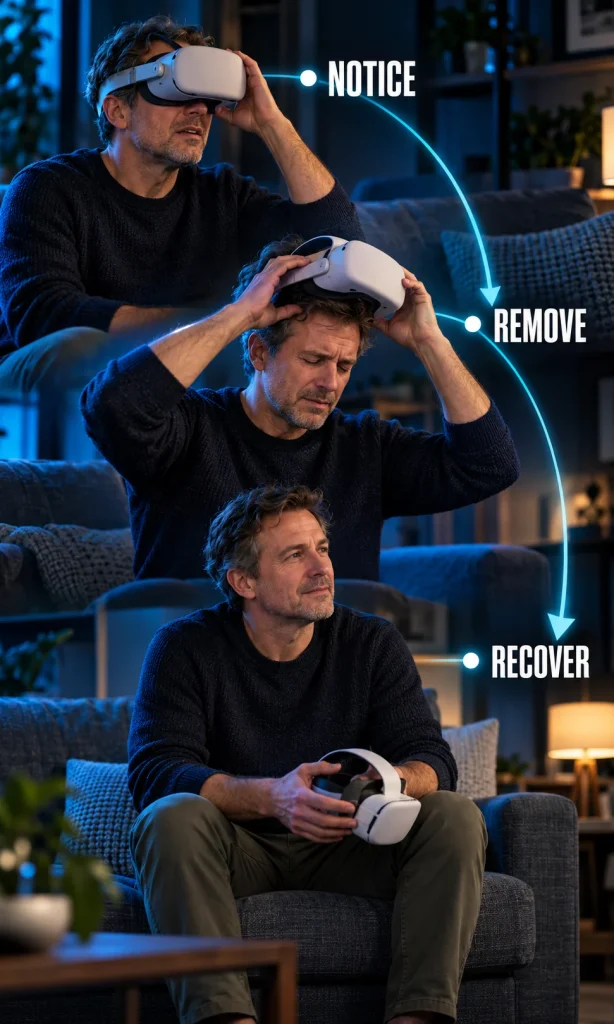
Some people feel fine in a stationary social world but become uncomfortable with artificial locomotion, fast turns, a poor frame rate, or a badly fitted headset. Symptoms can continue briefly after the headset comes off. Stop at the first signs, rest in the real environment, and avoid driving or another balance-sensitive task until you feel fully normal. Persistent, severe, or recurrent symptoms merit medical advice.
Eye discomfort can include dryness, blur, and fatigue. Prolonged focus on displays and reduced blinking can contribute, while fit, lens position, and existing vision issues may change the experience. Current evidence does not justify claiming that ordinary headset use permanently damages adult eyes, and it also cannot establish that every unusually long routine is harmless. If vision remains blurred after a break or symptoms recur, stop using the headset and seek an eye-care assessment.
A heavy headset, tight strap, poor posture, and prolonged stillness can leave the face, neck, shoulders, or back uncomfortable. Movement games may be physically active; sitting through social sessions may instead replace ordinary movement. Design the room for a clear boundary, check the floor before putting on the headset, and choose a comfortable position that you can change regularly.
These effects are not interchangeable. Someone who gets dizzy in a fast-moving game may have no problem attending a seated conversation, while someone who tolerates the visuals may still get neck pain from a poorly balanced device. Note the specific world, movement setting, headset fit, and duration when discomfort appears; changing one factor at a time helps identify a trigger. Do not keep testing a setup that repeatedly makes you ill just to “build tolerance.”
What about VR sleep?
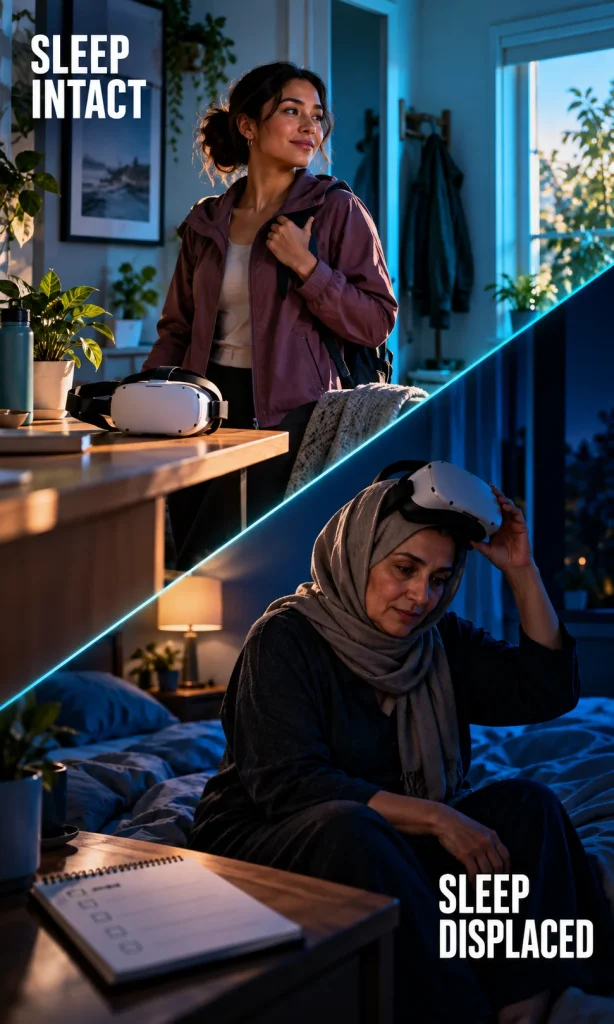
Sleeping with a headset on is described by some social VR users, but this habit has not been studied enough to give it a safety endorsement. Fit and pressure can become uncomfortable, a powered device and cables need normal safety care, and a late-night session can delay bedtime. Record your actual sleep duration and how rested you feel; a virtual bedtime that cuts into sleep is a more concrete warning than the novelty of the practice.
Try ending headset time before your usual bedtime, put the device down outside the bed, and return to an ordinary sleep environment. If sleep worsens, change that pattern first. People with an existing sleep condition or repeated daytime sleepiness should discuss persistent problems with a clinician instead of assuming VR is the only cause.
Psychological effects: what evidence supports and what remains uncertain
Feeling briefly strange or less grounded after immersive media is possible, but claims that long-term VR use routinely makes people unable to distinguish reality from fiction go beyond the evidence. A survey of 754 VR users found no linear association between use over the previous six months and depersonalization or derealization symptoms after accounting for other factors. Longer individual sessions and being a newer user were associated with more symptoms in secondary analyses; an observational survey cannot prove cause and effect.
That distinction matters for someone who feels unreal, detached, or unsettled after removing a headset. Treat the experience as a reason to stop and assess how you feel, rather than as proof of permanent brain damage. If such feelings are intense, return repeatedly, or continue outside VR, seek professional evaluation, especially if anxiety, substance use, or other symptoms are also present.
There is also a meaningful positive side to social immersion. A small study of adults using a social VR platform during the pandemic found lower reported loneliness and social anxiety while participants were in that setting, particularly around regular friendship groups. Its sample and setting do not establish that VR cures loneliness or that every virtual relationship improves offline wellbeing.
Motivation and attention are harder to interpret. If someone stays online because they enjoy a scheduled gathering and still meets their obligations, that is different from repeatedly intending to leave but staying up all night. Measure the observable effect on next-day functioning instead of assigning a mental-health label to a session length.
Can friendships in virtual worlds count as real relationships?
Yes. Support, shared routines, creative collaboration, and trust can be genuine even when people meet as avatars. The issue is whether a person has the freedom to choose the relationship and whether the time devoted to it leaves room for health, privacy, responsibilities, and contact outside that particular platform.
Identity experiments can make social VR inviting: a user can choose an avatar, join a group, or practice conversations at a manageable pace. Online spaces can also expose users to harassment, unwanted contact, privacy concerns, and pressure to remain available. Use platform controls, protect personal information, and notice whether a community respects your boundaries when you log off.
The same social hours may be helpful for a person who has limited local access to friends and difficult for someone who has begun abandoning other valued relationships. Ask what the community adds, how you feel after meeting there, and whether you can still say no to an invitation. A narrow friend group online can be deeply meaningful; the practical safeguard is retaining choices and sources of support when schedules or platforms change.
A useful comparison is what happens during a disruption. If a friend cannot get online for a week, does the relationship remain supportive through another channel? If the platform changes its rules, can you maintain important connections? Moving some friendships beyond a single application, when both people want that, reduces dependence on the platform without diminishing the value of meeting there.
How long is too long in VR?
There is no validated universal daily hour limit. Duration matters, but symptoms, recovery, sleep, physical activity, and loss of control matter more. Manufacturer and pediatric guidance generally favors starting with shorter sessions, taking breaks, and stopping when symptoms begin. The American Academy of Pediatrics notes that evidence about children’s long-term exposure is limited and advises families to make sure VR does not crowd out homework, physical activity, sleep, and in-person connection.
Use an adjustable session plan rather than treating a timer as a medical clearance. Begin with a duration you already tolerate, pause before discomfort builds, take the headset off, drink water if needed, move, and check how you feel in the room. New content or a new device may require shorter sessions; taking a break does not make a long session automatically safe.
Recovery is part of the observation. Write down whether you felt normal immediately, after a short rest, or only later; also note whether sleep or next-day concentration changed. If the same experience repeatedly causes symptoms, a shorter session or another comfort setting may help, but recurring or severe symptoms call for a different activity and appropriate medical advice. No study can infer your personal safe limit from a stranger’s hours online.
| What you notice | What it may mean | Practical response |
|---|---|---|
| Mild discomfort during one particular world | Motion or visual settings may be a trigger | Stop, recover, then try comfort settings or different content another day. |
| Headache, nausea, or imbalance after taking off the headset | Recovery is incomplete | Do not resume or drive until fully well; seek care if symptoms are severe or persistent. |
| Repeatedly missing sleep, meals, work, or school | The routine is displacing essentials | Set an end time, restore essentials, and seek support if you cannot keep the boundary. |
| Regular enjoyment with healthy sleep and obligations intact | Time alone does not show a problem | Continue to take breaks and reassess if your circumstances change. |
Try the private check-in below to sort symptoms, displaced activities, and a sensible next step. It does not diagnose a condition or certify that any number of hours is safe.
A practical VR routine check-in
VR Immersion Check
See what your sessions change in your body and daily life, then choose one useful next step.
No diagnosisNo hour scorePrintable summaryChoose the closest answers for a typical recent week. Answers stay in this browser and are not submitted to the site.
This is educational guidance, not a medical diagnosis or a declaration that a particular session length is safe. Stop if you feel unwell; seek medical advice for severe or persistent symptoms.
When does heavy use become a concern?
Look for a pattern over several weeks: repeatedly failing to stop when you intend to, regularly sacrificing sleep or essential responsibilities, continuing despite distressing symptoms, and feeling unable to meet social or emotional needs anywhere else. A day-long event is not automatically a disorder. Neither is having close online friends.
The World Health Organization defines gaming disorder in terms of impaired control, gaming taking priority over other activities, and continued gaming despite negative consequences, with significant impairment. That diagnosis concerns gaming behavior, not a blanket diagnosis for using VR or attending social events in it. If these patterns cause significant distress or disruption, discuss them with a qualified professional rather than trying to self-diagnose from a checklist.
For children and teenagers, adults should examine the content, social setting, privacy controls, age guidance, and effects on offline routines. A younger user may not recognize early nausea or eyestrain, and the evidence on long-term exposure is limited. A calm agreement about time, breaks, and whom to tell about upsetting encounters is more useful than an arbitrary rule applied without context.
What survived the “metaverse” shift?
As of 2026, the broad promise of one persistent, all-purpose virtual world has not become ordinary daily life. Meta has explicitly separated its Quest VR platform from its Worlds platform and moved Worlds toward a largely mobile focus. Meta also reported continued Quest use and VR developer activity. Calling all of VR “dead” confuses a company’s changing social-world strategy with the wider medium.
Social platforms such as VRChat still support headset participation alongside desktop or mobile access. Those modes differ physically: a desktop visitor can share the same conversation without headset-related cybersickness or facial pressure. The live platform landscape can change, so the durable question for users is which activity is valuable and how it fits into life, not whether an old metaverse slogan has won.
The shift also changes what designers need to build for: a social world may be entered through a phone, computer, or headset. For the separate product-design question, see The Metaverse Is Inevitable and It’s Already Changing Product Design as We Know It. Its historical framing should be reviewed against current platform changes before using it as evidence of the present market.
A practical routine for frequent VR users
- Decide on the purpose before joining. Name the event, friend, creative project, or game you want to spend time on.
- Choose an end point. Use an alarm outside the headset and tell friends when you plan to leave.
- Check the room and your body. Clear obstacles, adjust fit, and stop for nausea, dizziness, eye discomfort, or pain.
- Take real breaks. Remove the headset, look around the room, move, and allow symptoms to settle completely.
- Protect sleep and ordinary contact. Keep meals, work, school, movement, and valued relationships on the calendar.
- Review the following day. If the session made the next day harder, shorten the next one or change the time of day.
These are practical safeguards, not experimentally validated prescriptions for everyone. The decision point is whether your routine remains chosen, comfortable, and compatible with the rest of your life. If not, reduce the exposure, address the displaced need, and get professional help when symptoms or loss of control persist.
Frequently asked questions
Is living in the metaverse possible in 2026?
You can spend substantial time socializing, playing, or creating in virtual worlds, but people still need an ordinary physical environment, food, sleep, and offline responsibilities. “Living in VR” is an informal description, not a single technology or clinical state.
How many hours a day in VR are safe?
No universal safe daily limit has been established. Start with short, comfortable sessions, take breaks, and stop when symptoms begin. Consider how the time affects recovery, sleep, movement, and obligations rather than treating a particular number as a guarantee.
Do VR aftereffects go away?
Cybersickness commonly fades after use stops, but recovery varies. Do not resume VR or perform balance-sensitive tasks while dizzy or disoriented. Seek medical advice if symptoms are severe, persistent, or keep returning.
Can someone become addicted to VRChat?
Heavy participation alone does not establish an addiction. Repeated loss of control, neglected responsibilities, and continued use despite significant harm warrant attention. Gaming disorder has specific criteria, and a clinician should assess concerning behavior in its full context.
Did a 100-day metaverse challenge prove VR is safe or dangerous?
No. Ryan Trahan’s video is an entertainment challenge, not a controlled medical study or a record of uninterrupted headset wear. Its value here is the question it raises about prolonged immersion, which requires evidence and individual context to answer.
Sources and evidence notes
- Systematic review of cybersickness and discomfort from head-mounted displays (2025).
- Survey of VR use and depersonalization/derealization symptoms (2023); observational, not proof of causation.
- Study of social VR, loneliness, and social anxiety (2023); small, pandemic-era sample.
- American Academy of Pediatrics: virtual reality use and children.
- World Health Organization: gaming disorder FAQ.
- Meta: VR and Worlds strategy; Meta: GDC 2026 VR update; VRChat platform access.