
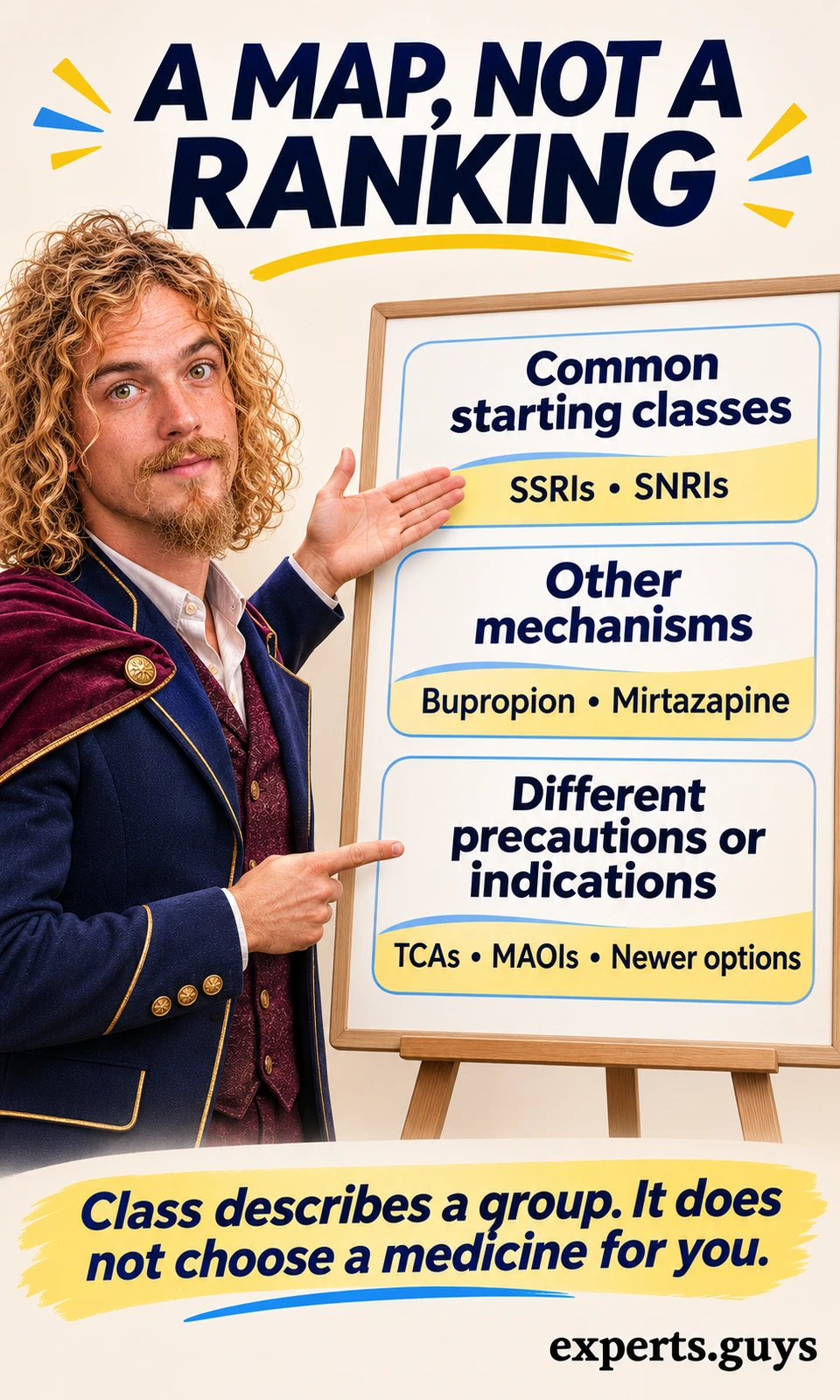
Antidepressant types include SSRIs, SNRIs, several medicines with other mechanisms, older TCAs and MAOIs, and treatments with more specific indications. These names explain how medicines are grouped; they do not tell you which drug will suit you or whether one is “stronger” than another.
The useful first distinction is between a class and a named medicine. Sertraline is a medicine within the SSRI class, while venlafaxine is an SNRI. A broad class description can orient you, but the individual medicine, the condition being treated and your health history determine which details matter. Examples here concern adults; licensing and availability differ between countries.
This guide focuses on understanding those labels and reading comparisons accurately. If you already understand the groups and need help with an individualized discussion, the guide to choosing an antidepressant for depression and anxiety covers that separate decision. A list of classes cannot replace an assessment or justify starting, stopping, combining or switching prescription medicines.
What do the main antidepressant class names tell you?
Some names describe a major pharmacological action, such as inhibiting serotonin reuptake. Others reflect chemical structure, as with tricyclic antidepressants, or act as a broad filing category, such as “other” or “atypical” antidepressants. Expecting every label to describe medicines in exactly the same way creates unnecessary confusion. It is more useful to ask what kind of information the label actually contains.
A helpful reading order is common classes first, individual differences second, and indication-specific treatments third. That is an editorial way to make the vocabulary manageable, rather than a treatment sequence everyone must follow. The NHS overview of antidepressants explains why SSRIs are commonly offered initially: tolerability and safety considerations matter alongside effectiveness. “Usually offered first” does not mean weak, and “offered later” does not automatically mean stronger.
Imagine seeing three headings on a medicine information page: “SSRI,” “other antidepressant” and “treatment-resistant depression.” The first names a class, the second groups medicines that need further explanation, and the third describes a clinical treatment context. They are different kinds of headings. Sorting them before comparing them prevents a category label from turning into a prediction about your recovery. No position on this map predicts how your particular treatment will go.
SSRIs and SNRIs: what changes when another target is added?
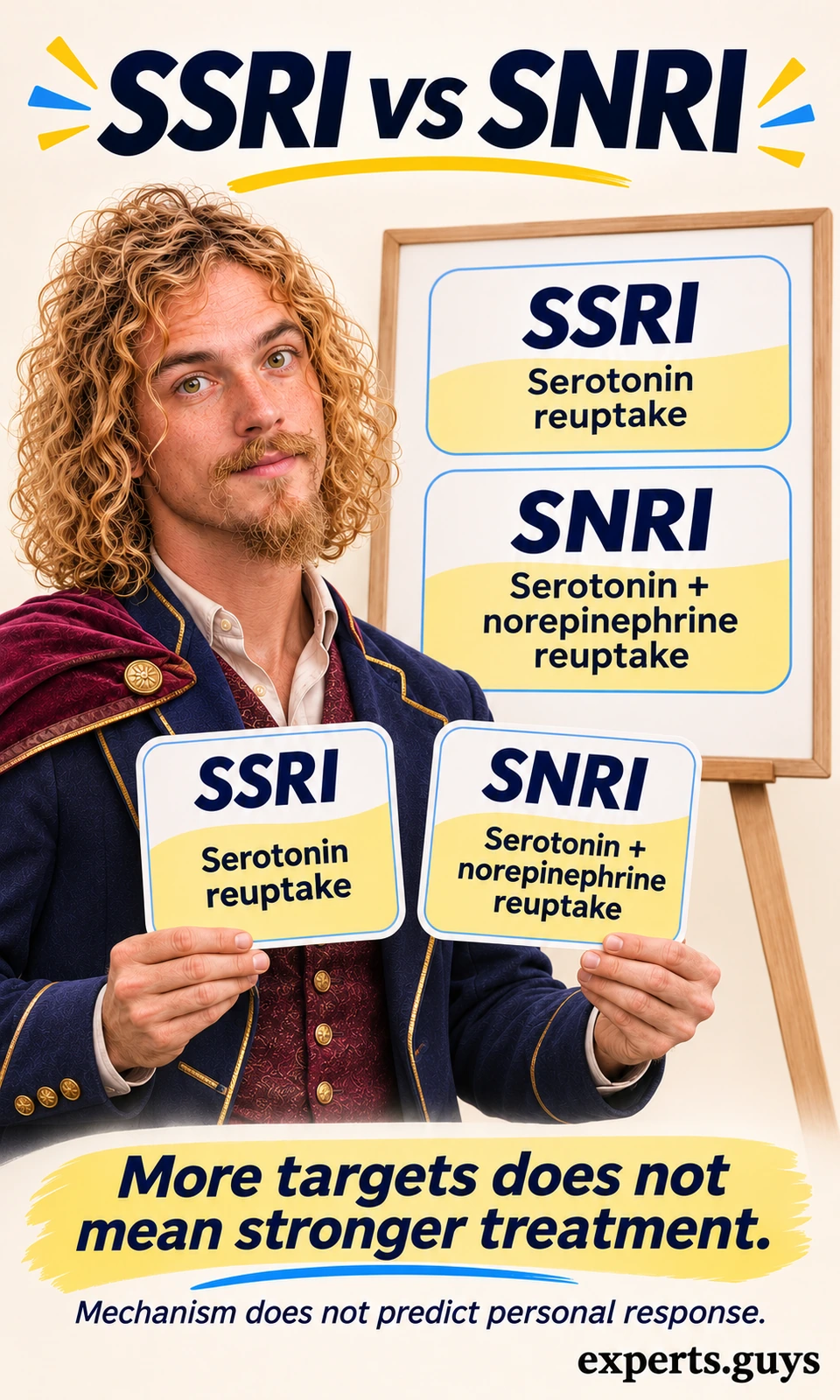
SSRI stands for selective serotonin reuptake inhibitor. Medicines in this group include sertraline, fluoxetine and escitalopram. Reuptake is part of how signaling chemicals are cleared after release; inhibiting that process changes serotonin signaling. This is a description of a drug action, not a blood test showing that a person has too little serotonin, and not a complete explanation of depression.
SNRI stands for serotonin–norepinephrine reuptake inhibitor; norepinephrine is also called noradrenaline. Venlafaxine and duloxetine are familiar examples. These medicines affect reuptake involving both systems, but “two systems” is not a numerical measure of benefit. Adding a target can change the profile of effects and precautions without establishing that an SNRI is the correct next step for a particular person.
A common misunderstanding is that an SSRI addresses mild depression while an SNRI addresses severe depression. Class names do not encode that distinction. The severity and history of depression, previous treatment, other medicines and tolerability all contribute to treatment planning. The class abbreviation alone cannot establish how much a person is struggling or how much improvement they should expect.
Side effects overlap as well as differ. Nausea, sleep changes, sweating and sexual difficulties can occur with serotonin-reuptake medicines; the pattern and persistence vary. The NHS inform SSRI guide distinguishes common effects from less common complications. A possible effect is something to understand and discuss, rather than a forecast that every person will experience it.
An SNRI may also bring a specific monitoring consideration. For example, duloxetine prescribing information calls for blood-pressure assessment before treatment and periodic monitoring. That is a concrete medicine-level requirement. It should not be rewritten as “all SNRIs are dangerous,” just as an absence of symptoms does not establish that a required check is unnecessary.
| Label | What it identifies | What it cannot establish |
|---|---|---|
| SSRI | A class centered on serotonin reuptake inhibition. | A measured serotonin deficiency or a guaranteed side-effect pattern. |
| SNRI | A class involving serotonin and norepinephrine reuptake inhibition. | A universally stronger medicine or an automatic next step. |
| A named medicine | The actual substance, such as sertraline or duloxetine. | Its suitability without the indication, history and other medicines. |
Some antidepressants also have indications outside depression. Duloxetine, for example, has particular pain-related indications in its U.S. label. This does not mean that an SNRI is a general-purpose painkiller or that every member of the class has every other member’s approvals. Read the condition attached to the named drug rather than transferring an indication across the entire group.
Similarly, a medicine being used for an anxiety disorder does not mean it has stopped being an antidepressant. A pharmacological class and an approved use describe different things. Two people can receive medicines from the same class for different conditions, with different treatment goals. Seeing the same medicine name in both contexts is not by itself evidence of a prescribing error.
Mechanism descriptions are useful at the right scale. “Inhibits reuptake” can distinguish groups, but it cannot tell someone which symptom will change first or how an individual brain will respond. In particular, the number of named neurotransmitters is not a score. A more detailed biological explanation should improve understanding, not create a false sense that the choice can be calculated from a diagram.
When comparing an SSRI with an SNRI, separate the group-level difference from the medicine-level question. First establish what the abbreviations describe; then identify the actual drugs being compared; finally check the outcome or precaution that matters in that comparison. The result is a more precise question, rather than a self-selected prescription. Keep each statement at the level supported by its evidence.
- Mechanism: Which reuptake system or systems does the class name describe?
- Named medicine: Does the statement concern one drug or the entire group?
- Outcome: Is it discussing symptom benefit, a side effect, another indication or a monitoring requirement?
For example, “duloxetine requires blood-pressure monitoring” and “SNRIs act on serotonin and norepinephrine reuptake” can both be accurate, yet they answer different questions. Neither statement proves that duloxetine is better for a person who feels exhausted, or that an SSRI would be ineffective. This distinction matters whenever a short social-media comparison presents a mechanism as if it were a personal treatment result. Ask for the medicine-level evidence for the decision being discussed.
What sits outside the standard SSRI and SNRI groups?
Bupropion and mirtazapine are different examples, not one alternative class
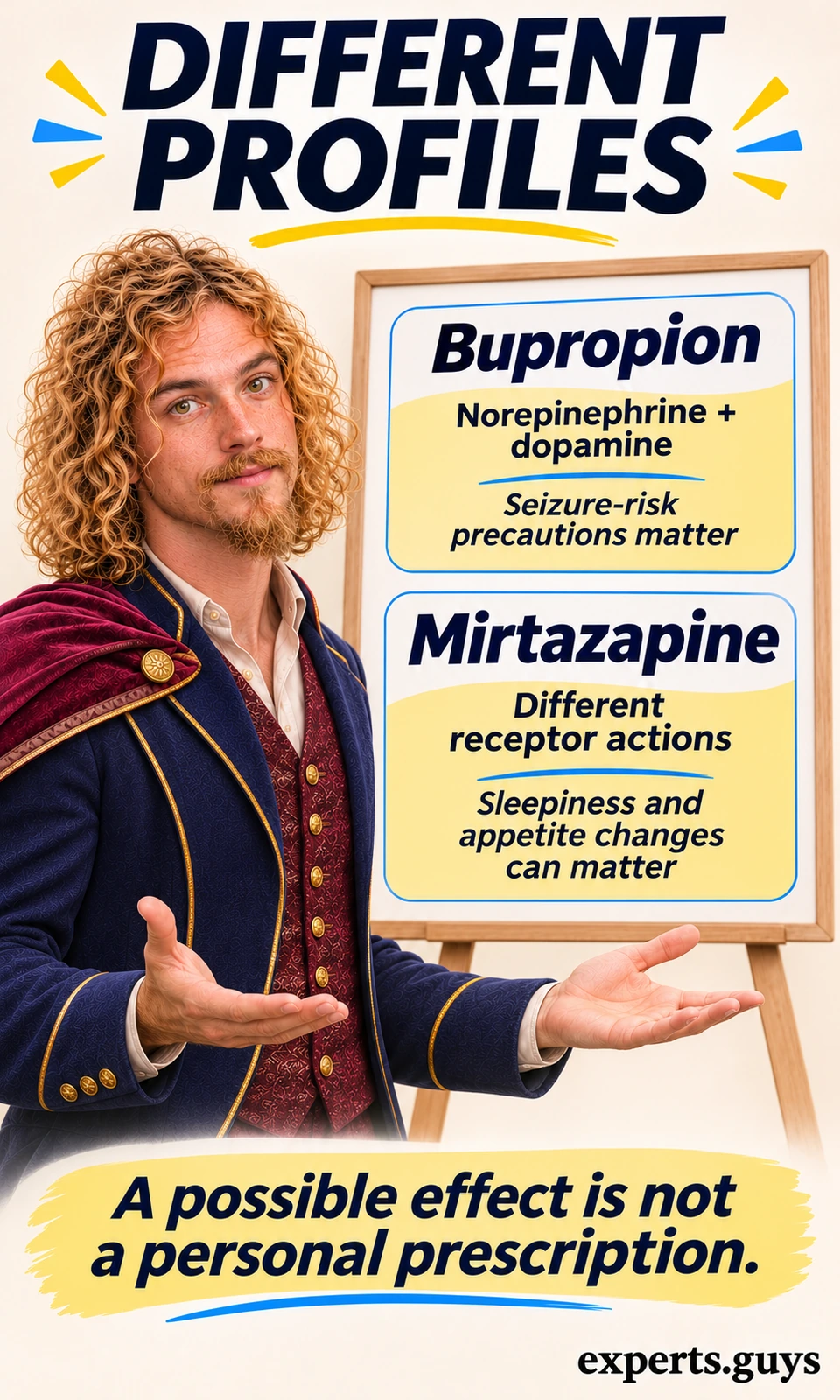
Bupropion is commonly described as a norepinephrine–dopamine reuptake inhibitor, or NDRI. Its prescribing information describes effects involving norepinephrine and dopamine and states that its antidepressant mechanism is not fully understood. Calling it an NDRI helps distinguish it from an SSRI; it does not mean that a person can identify a dopamine deficit from low motivation and choose it on that basis.
Bupropion also illustrates why an appealing mechanism summary is insufficient. The U.S. label contraindicates it in people with a seizure disorder or a current or previous diagnosis of bulimia or anorexia nervosa, among other circumstances. These are not minor footnotes that a “more energy” headline can cancel. Nor does a different transmitter profile mean no interactions, no unwanted effects or no need for monitoring.
Mirtazapine works differently, involving adrenergic and serotonin receptors rather than being a standard serotonin-reuptake inhibitor. Its practical profile can include sleepiness and increased appetite or weight. The NHS mirtazapine information describes these effects in patient-facing terms. Someone may regard a particular effect as helpful, troublesome or both, depending on their circumstances; that judgment cannot be made from the drug’s category alone.
Consider an illustrative comparison between two information cards. One mentions possible insomnia with bupropion; the other mentions sleepiness with mirtazapine. The cards identify issues that may matter, but do not create a reliable rule that one medicine treats low energy and the other treats poor sleep. Depression, sleep disruption, other conditions and other medicines can interact. A possible effect is not the same as an approved symptom-matching algorithm.
The useful comparison therefore has two layers: how the medicines differ, and which consequences require individual assessment. Keep those layers separate. If an explanation moves straight from a neurotransmitter name to “this is the one for you,” it has skipped the second layer. This is also why a single side effect should not be presented as a useful benefit or an unacceptable burden.
Why do “atypical,” “multimodal” and serotonin labels overlap?
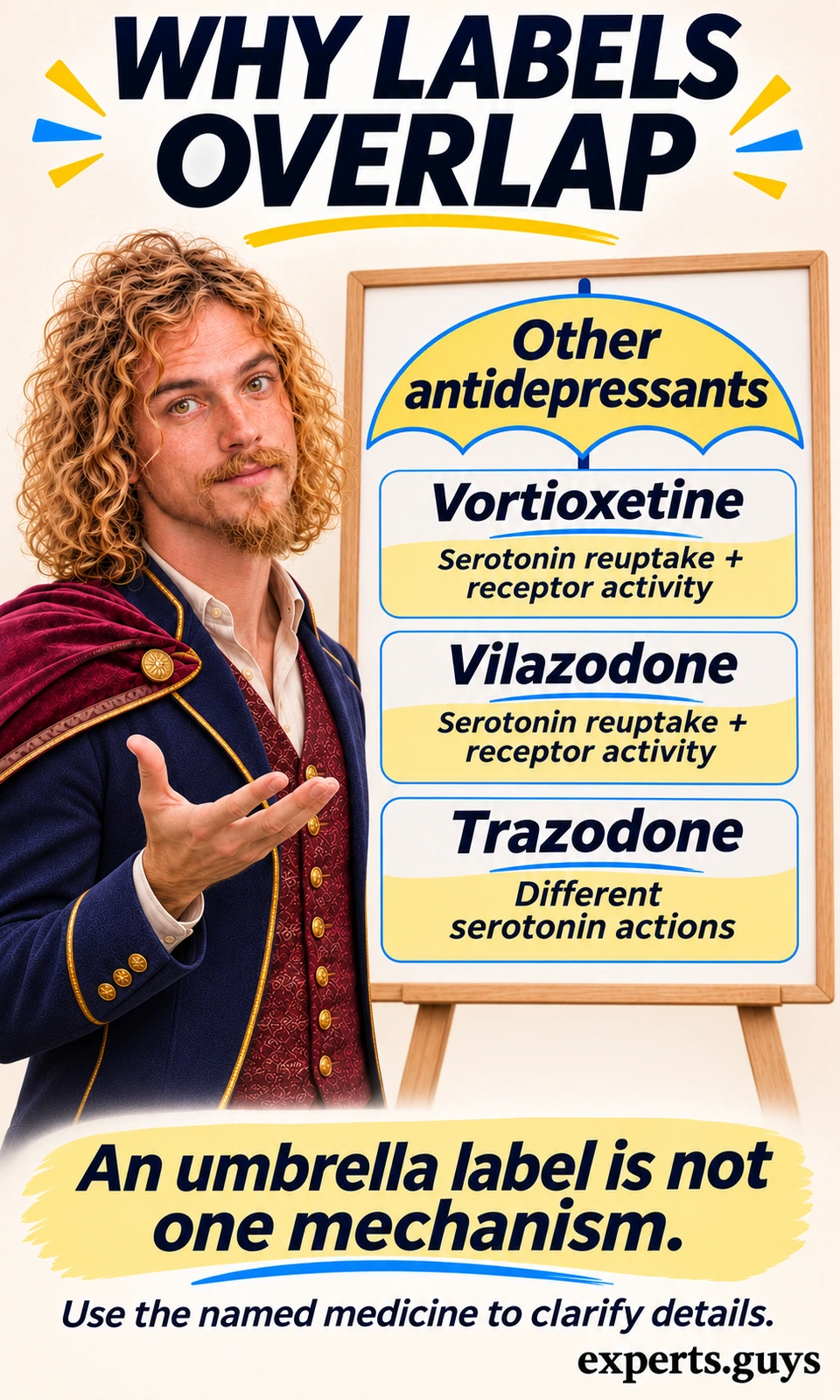
“Atypical antidepressant” is often an umbrella term for medicines that do not fit neatly into the familiar major groups. It is not one uniform mechanism and does not mean a medicine is experimental, unusual in a worrying way or free of the usual precautions. A list placing bupropion and mirtazapine under the same umbrella is organizing a page; it is not claiming that the medicines work identically.
Vortioxetine and vilazodone make the classification issue especially visible. Both involve serotonin reuptake inhibition and additional serotonin-receptor activity. The labels for vortioxetine and vilazodone describe those actions while qualifying what is known about their contribution to antidepressant effects. “Multimodal” therefore describes pharmacology; it is not proof of superiority or a guarantee of cognitive benefit.
Trazodone is another medicine that may appear under a broad “other” heading or a more specific serotonin-action description. Its U.S. prescribing information identifies adult major depressive disorder as its indication. Being known for a sedating effect does not make every use for sleep equivalent to a licensed depression treatment plan. Indication, dose and purpose still need to be distinguished, without inferring one from the other.
If two reputable resources put the same medicine under different headings, first read the definitions of those headings. One may be grouping by a broad clinical family and the other by a more specific action. Use the named medicine and its current product information to resolve practical questions. Once the level of classification is clear, the apparent contradiction becomes easier to resolve.
How do older classes and newer treatments fit?
TCAs and MAOIs have different precaution patterns
Tricyclic antidepressants, or TCAs, include amitriptyline and nortriptyline. The name refers to their chemical structure, rather than the severity of depression they treat. These medicines remain relevant, but effects such as dry mouth, constipation, blurred vision and difficulty passing urine can be important. Heart-rhythm considerations and toxicity in overdose also affect prescribing decisions. The NHS inform class guide explains these characteristic concerns.
A TCA appearing on a prescription does not establish that all newer medicines have failed. Some members have other uses, and the reason for a particular prescription must be understood in its own context. Conversely, “it has been used for decades” does not remove the need to check other medicines and relevant health conditions. Age of the class is historical information, rather than a shortcut to either safety or danger.
Monoamine oxidase inhibitors, or MAOIs, affect an enzyme involved in breaking down monoamine signaling chemicals. Phenelzine is one example. This is different from the TCA category. Certain MAOIs have substantial interactions with medicines and tyramine-rich foods, which can cause a dangerous rise in blood pressure. The phenelzine label explains why medication and dietary precautions are central to its use.
Do not turn that warning into a universal ban on every fermented food for everyone taking an antidepressant. The restrictions depend on the medicine and, for some products, its formulation and dose. An internet food list detached from the actual product can be incomplete or unnecessarily broad. The relevant output is a product-specific precaution plan, rather than trying to memorize a class-wide blacklist from a short article.
The same precision applies to switching. Some combinations must be avoided and some transitions require a waiting period, but the interval depends on which medicines are involved. A single “wait this many days” rule is unsafe across the category. Do not overlap supplies, reuse an old prescription or improvise a gap from a class chart; the prescriber and pharmacist need the exact medicines to arrange the transition safely.

| Class | Distinctive consideration | Mistake to avoid |
|---|---|---|
| TCA | Anticholinergic effects, heart-rhythm considerations and overdose toxicity. | Treating the chemical-structure label as a measure of severity. |
| MAOI | Drug interactions and product-specific dietary precautions. | Applying a generic food list or switching interval to every product. |
| Either class | The individual medicine and treatment context remain essential. | Assuming a long history of use removes precautions. |
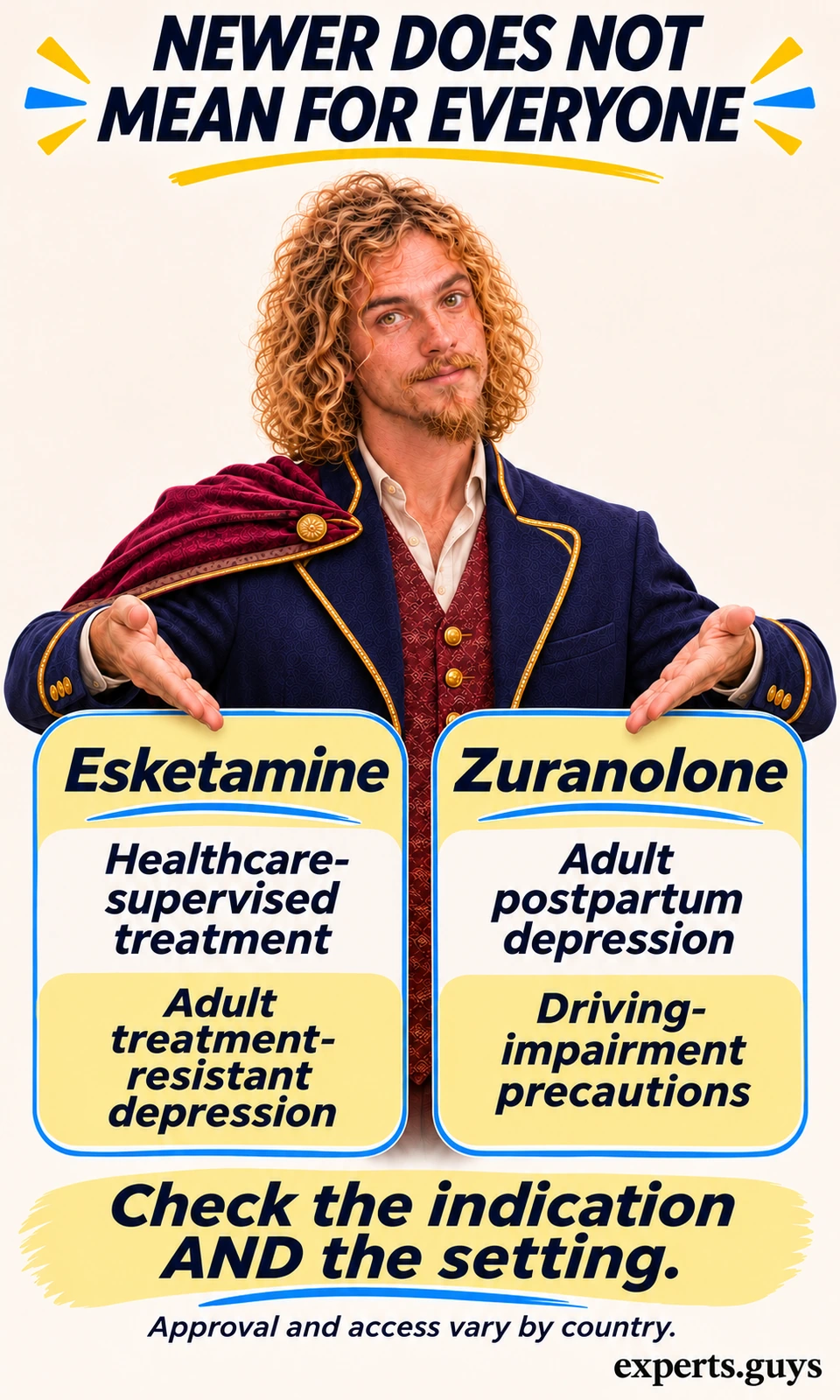
Esketamine and zuranolone have specific treatment boundaries
Newer depression treatments should not be placed at the top of a universal class ladder. Their indications, evidence and treatment settings differ. A headline about speed or novelty leaves out essential questions: which condition was studied, which population was treated and how treatment was delivered. Those boundaries matter before any comparison with a routinely prescribed oral antidepressant.
Esketamine nasal spray is an NMDA-receptor antagonist used under healthcare supervision. The current Spravato prescribing information allows its use for adult treatment-resistant depression either alone or with an oral antidepressant. A separate indication, depressive symptoms in adults with major depressive disorder and acute suicidal ideation or behavior, specifies use with an oral antidepressant. The indication changes the answer to the “always combined?” question.
Its supervised setting is equally important. The U.S. program requires monitoring after administration because of risks including sedation, dissociation and respiratory depression, alongside abuse and misuse concerns. The label does not establish that it prevents suicide. It is therefore misleading to describe it as an ordinary take-home nasal substitute or a guaranteed emergency cure. A different delivery route does not make the surrounding clinical safeguards optional.
Zuranolone is a neuroactive steroid GABA-A receptor positive modulator. The April 2026 FDA label for Zurzuvae identifies postpartum depression in adults as its indication; that is not an approval for every form of depression. The label has a boxed driving-impairment warning, including avoiding driving or hazardous activities for at least 12 hours after administration. Feeling alert is not a reliable substitute for that restriction.
For a reader comparing headlines, the lesson is to keep the boundary attached to the treatment name. “New medicine for depression” is too broad if the evidence and approval concern a specific population or setting. The availability of a treatment in one country also does not establish local access, funding or suitability. Before interpreting its novelty as a personal option, identify the right question to ask about it.
How can you use the class information accurately?
Separate the class, the medicine and the formulation
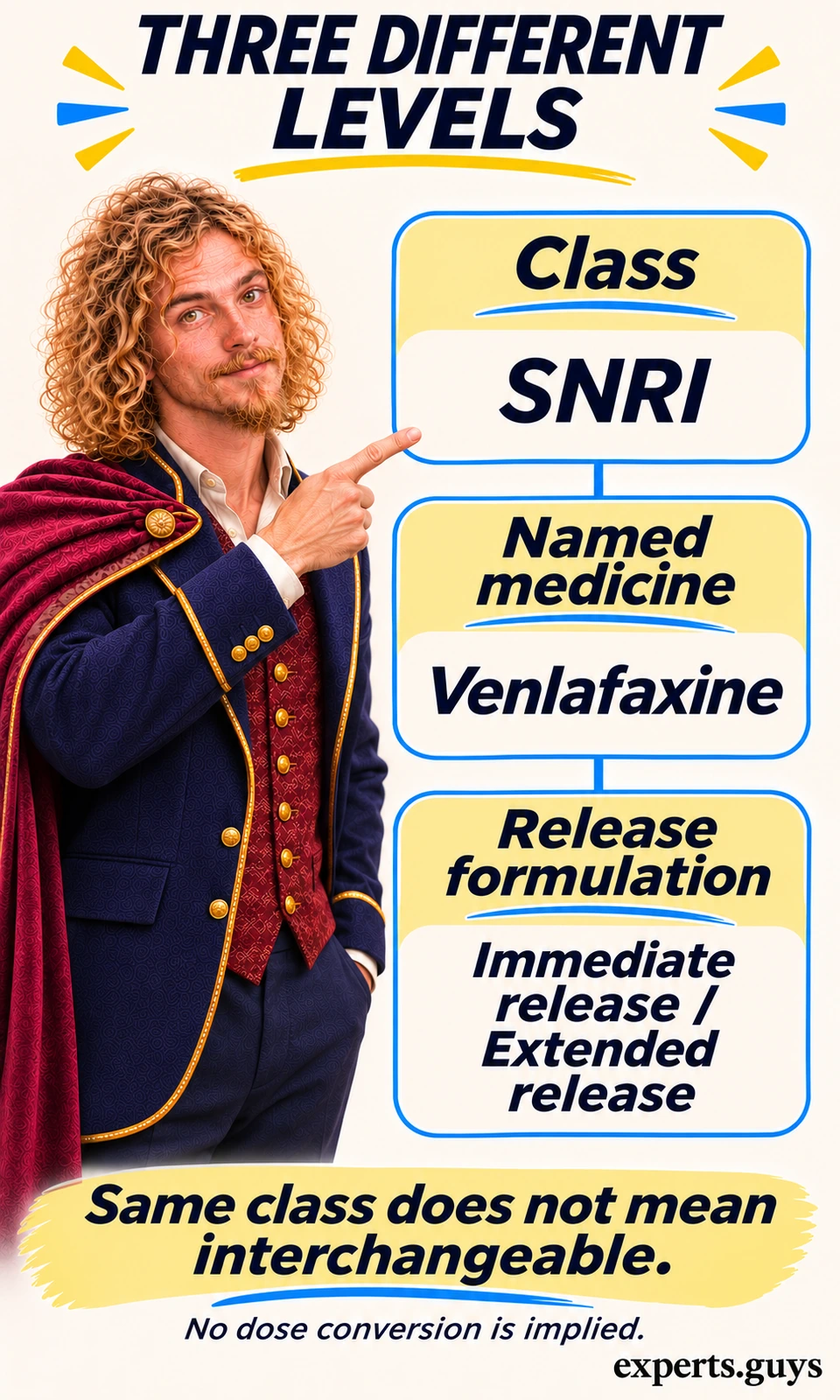
A class name answers “what group?” A generic medicine name answers “which substance?” A formulation describes how the product is prepared or releases its medicine. These levels are related, but they are not interchangeable. Recognizing which level a sentence refers to prevents an explanation about a whole class from being mistaken for an instruction about one product.
For a concrete example, venlafaxine is the named medicine and SNRI is its class. Immediate-release and extended-release describe different release formulations. Those words do not establish a substitution rule, and the milligram number on one antidepressant cannot be compared with the milligram number on a different antidepressant as if they shared a common strength scale. No dose conversion can be inferred from the abbreviations.
A brand name adds another label, rather than creating another pharmacological class. Brand availability differs between countries, so a generic name is usually clearer in a broad educational comparison. Even then, the exact product still matters for instructions. If a description appears inconsistent, clarify which substance and formulation it concerns instead of assuming that sharing a class makes the substitution valid.
Read a “better antidepressant” claim in three checks
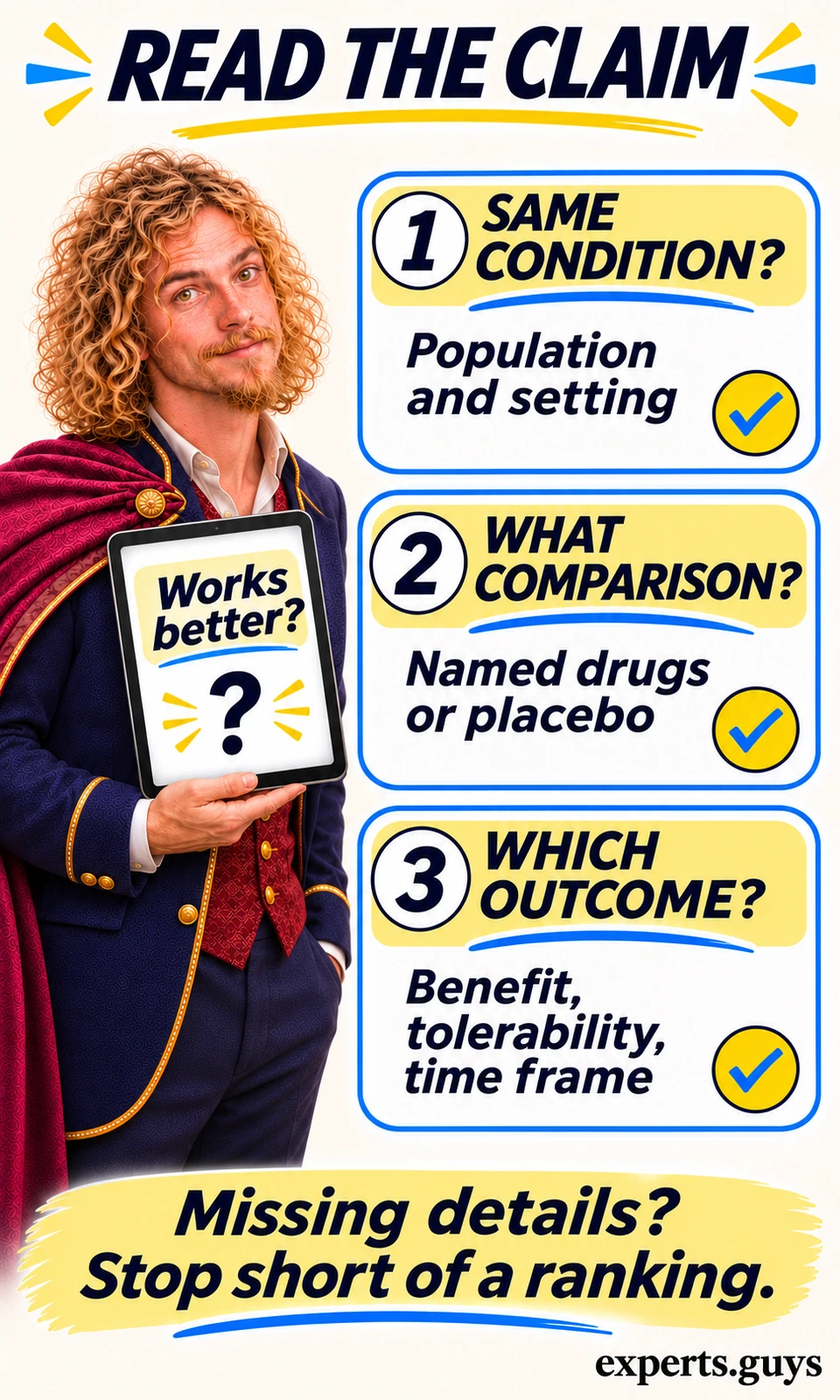
Use this process on information, rather than on your own prescription. Start with the condition and population: is the claim about adult major depression, an anxiety disorder, postpartum depression or another setting? A result cannot automatically be transferred across those boundaries. If the population is missing, the comparison is incomplete before you even reach the medicine names.
Next identify the actual comparison. Was one named medicine compared with placebo, another named medicine, or an entire pooled group? A placebo-controlled result does not by itself establish that the medicine outperforms a different active treatment. Likewise, a comparison of two drugs should not be casually rewritten as a verdict on every member of their classes.
Finally identify the outcome and time frame. Improvement in a depression score, remission, discontinuation because of side effects and a change in sleep are different outcomes. “Better tolerated” does not mean “no side effects,” and a group average does not promise an individual result. If these details are absent, use the claim as a lead to investigate rather than as a reason to change treatment.
The time frame needs to travel with the outcome. A study of symptoms during an acute treatment period addresses a different question from a study of relapse prevention after improvement. If an article leaves out when the result was measured, it becomes difficult to judge what the result means. This does not invalidate research; it identifies a missing piece of the summary. Look for the study’s stated aim before using it to support a wider claim about recovery.
Side-effect comparisons need the same care. A list of possible unwanted effects is not a frequency comparison, and a study participant leaving treatment is not the same thing as that participant experiencing any side effect. A claim about fewer treatment discontinuations should retain that outcome rather than becoming “no sexual effects” or “no weight effects.” The distinction is especially useful when an advertisement gives a reassuring overall phrase but does not explain the specific concern you wanted answered.
- Check the setting: same condition, relevant population and treatment context.
- Check the comparison: named drugs, placebo or pooled class data.
- Check the result: which outcome, over what period, with which limitations.
Here is an illustrative example, not a report of a trial: a headline says “Medicine X works better,” while its summary only describes improvement versus placebo in adult postpartum depression. It does not identify a comparison with Medicine Y in general major depression. The correction is to narrow the conclusion to the population and comparator actually described. If the details cannot be checked, stop short of the ranking. You have improved the interpretation by stating only what the claim itself supports.
If the comparison is hard to read, reduce it to a spoken sentence: “In this group, this medicine was compared with this alternative, for this outcome, over this period.” You can use the same sentence in a phone’s text-to-speech or accessibility reader; there is no need to build a symptom diary or complete a scoring worksheet. An empty part of the sentence identifies the information to look for. The aim is a clearer interpretation of the claim, not a new clinical assessment.
Treat “best” and “strongest” as incomplete questions until their criteria are visible. A person concerned about an adverse effect may be asking something different from a researcher measuring symptom change, or a service comparing treatment attendance. Those are legitimate differences in the question, not evidence that one source must be dishonest. The useful correction is to name the outcome and population explicitly, then keep the conclusion within those limits. This makes a comparison more useful without pretending it selects a medicine for you.
What class information must never replace
A class chart cannot establish whether depression is unipolar or part of bipolar disorder. A past period of unusually increased energy, reduced need for sleep or risky behavior can change the assessment even when the current problem is low mood. The guide to bipolar types and episodes explains that separate history. Mention a possible past episode rather than using a medicine-class quiz to diagnose it.
Nor does a class chart provide an instant response test. The NIMH medication overview describes antidepressant effects developing over weeks, with some changes occurring before mood improves. Early side effects do not by themselves prove a medicine will fail, but worsening symptoms should not simply be endured while waiting for a calendar deadline. The existing antidepressant treatment-management guide covers the wider follow-up process.
Starting, changing and stopping treatment are safety-sensitive periods. NICE depression guidance recommends planned review and individualized withdrawal management; abrupt stopping or missed doses can cause withdrawal symptoms. Those symptoms can overlap with other problems, so a class label cannot reliably tell you whether a change is withdrawal, recurrence or another cause. This article deliberately supplies no taper schedule or self-switching instructions.
New or worsening suicidal thoughts, severe agitation or a striking increase in activity with much less sleep warrant prompt help. The MHRA antidepressant safety update emphasizes that concerning changes can occur at any age, with the highest trial signal for suicidal thoughts and behavior in people under 25. If someone may act on suicidal thoughts or cannot stay safe, seek emergency help immediately.
Seizure, trouble breathing, severe allergic swelling, or fever with confusion and marked muscle stiffness also need urgent medical assessment. Interactions can involve nonprescription products as well as prescription medicines; “natural” does not make St John’s wort safe to combine with serotonergic treatment. These are reasons to act on the actual symptoms and products involved, rather than trying to identify a drug class first or waiting to finish this guide.
Questions that class lists often leave unresolved
Why is my medicine missing from a short antidepressant list?
A short list is usually illustrative, not a complete local formulary. Some medicines are unavailable in certain countries, and newer or less frequently used products may be grouped under “other.” Search by the generic name in the current product information for your country. Absence from a general article does not establish that a prescription is incorrect or that the medicine belongs to no class.
Does the same class mean the same side effects for everyone?
No. A class can suggest effects worth discussing, but it does not predict a person’s complete experience. Individual medicines within a group also differ. A friend’s experience may identify a concern you want explained; it cannot determine how likely the same outcome is for you or justify copying their treatment.
Does “first-line” mean an antidepressant is less effective?
First-line describes a usual starting place in a guideline or clinical context. It reflects the overall balance of evidence, safety, tolerability and practicality, rather than a weak-to-strong grading system. A later option may have a more demanding precaution profile or a narrower indication instead of a larger expected benefit for everyone.
If two medicines have different names, can they still be the same drug?
A brand name and generic name can identify the same active medicine, although the exact product and formulation still need checking. Two different generic names identify different substances even when their classes match. Matching packaging colors or comparing milligram numbers is not a reliable way to establish equivalence.
Does taking an antidepressant mean therapy is unnecessary?
No class label decides whether psychological treatment, medication or a combination is appropriate. That decision depends on the condition, severity, history, preferences and available treatments. It is also incorrect to say antidepressants must never be used alone: some treatment plans use medication without concurrent therapy, while others combine approaches. A pharmacological category cannot settle that planning question.
Can a class list settle pregnancy or breastfeeding questions?
No. These questions require the named medicine, timing, health history and the risks of both treatment and untreated illness. A broad statement that an entire class is safe or unsafe removes information needed for the decision. Raise the issue promptly with the prescribing team; do not stop an established medicine abruptly because of a general internet warning.
Next steps: use the name to ask a more precise question
When you return to a medicine comparison, identify whether the claim concerns the class, the named drug, its formulation or a specific indication. Then ask what outcome and precaution the claim actually addresses. That gives you something concrete to clarify without pretending that an alphabetical list, a neurotransmitter diagram or an online ranking can make the treatment decision for you.