
Antidepressants are prescription medicines used for depression and some other conditions, including several anxiety disorders. Their benefits, side effects and instructions differ, so the practical starting point is knowing your own prescription and having a clear review plan. This guide explains the main types and eight ways to manage the everyday questions around treatment without changing a dose yourself.
This is adult-focused education, not a prescription or a diagnosis. Care for children, pregnancy, bipolar disorder and complex medical conditions needs an individualized plan. Read the leaflet supplied with your medicine and keep urgent symptoms separate from the routine organization steps below.
What should you understand before the first dose?
Antidepressants affect signaling systems involved in mood and other functions, but depression is not explained by a simple test showing that serotonin is “too low.” The name of a drug class tells you something about how it acts, not whether it is the right choice for one person. The treatment decision also depends on symptoms, other conditions, previous response, interactions and preferences.
| Group | Examples | What the label helps you understand |
|---|---|---|
| SSRIs | Sertraline, escitalopram, fluoxetine | A widely used group affecting serotonin signaling. |
| SNRIs | Duloxetine, venlafaxine | Affect serotonin and norepinephrine signaling. |
| Other antidepressants | Mirtazapine, bupropion, trazodone | Different mechanisms; they are not one interchangeable group. |
| Older groups | Tricyclics; MAOIs | Have distinct precautions and interaction requirements. |
Examples are for orientation, not a ranking or a complete medicine list. Approvals, available formulations and brand names vary between countries. For the separate choice decision, see choosing an antidepressant for depression and anxiety.
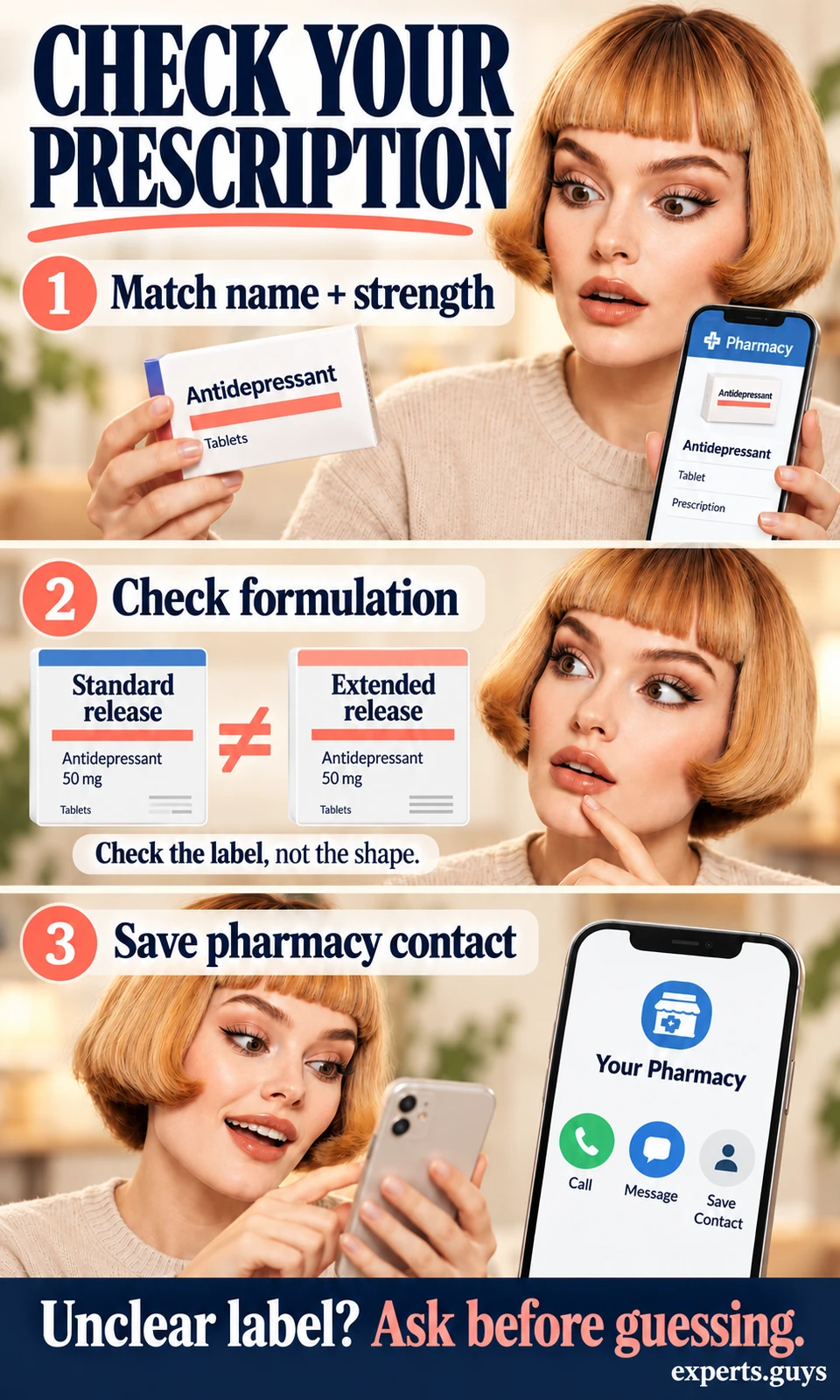
Match your prescription to the instructions
A medicine name alone is not a complete set of directions. The strength, formulation and pharmacy instructions belong together, especially when a refill looks different. This check helps you spot a question before you turn an assumption into a dosing mistake.
- Open your pharmacy app or photograph the dispensing label privately. Keep your name, address and prescription number out of anything you post publicly.
- Compare the medicine name, strength and formulation with the current instructions. Ask the pharmacy to explain an unfamiliar abbreviation such as extended release.
- Save the pharmacy contact beside the label photo. If the label and the plan you remember disagree, resolve the discrepancy before guessing what to take.
Example: A refill has a different manufacturer and tablet appearance. That alone does not prove an error; compare the identifying details and have the pharmacist confirm any uncertainty. Do not identify a medicine by color alone.
Make it easier: Ask the pharmacist to explain the directions aloud, then repeat them back. A private voice note can help if typing is difficult. The checkpoint is being able to explain your own current instructions, not memorizing a drug list.
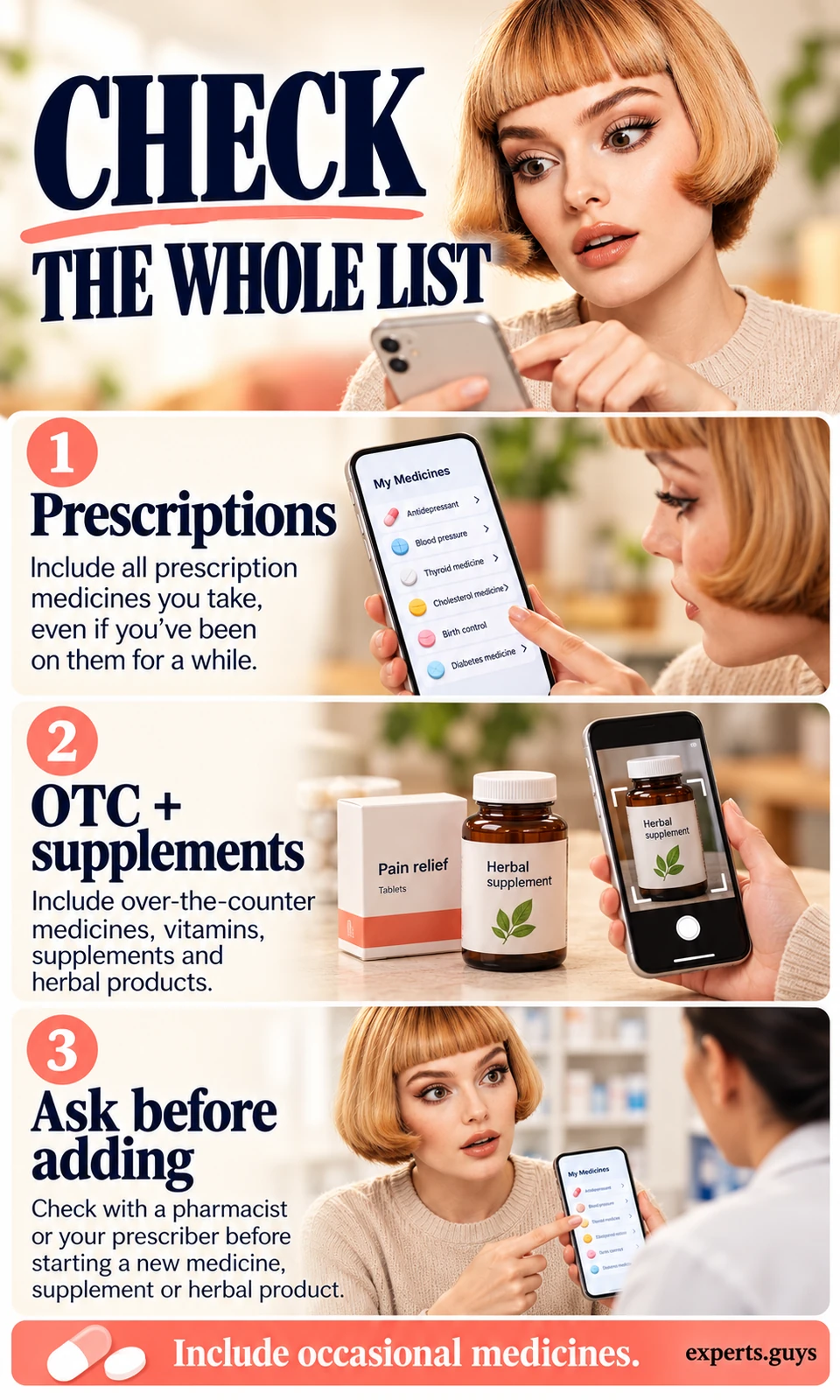
Bring the whole medicine list into one view
An interaction check is only as useful as the list supplied. Include products you use occasionally, because a cold remedy or supplement may be missing from the regular prescription list. The FDA specifically advises disclosing nonprescription medicines and herbal products when discussing antidepressants.
- Create one private phone note with separate lines for prescriptions, over-the-counter products and supplements. Include alcohol or other substances in the conversation without hiding occasional use.
- Add the name, strength and how often you actually use each product. A photograph of the ingredients label is useful when the product name is unclear.
- Show the complete list to the pharmacist before adding a new product. Ask which combinations need avoidance, a different choice or monitoring.
Example: You are choosing a cough medicine and already take an antidepressant. Show the pharmacist the actual ingredients and your existing list instead of asking whether “cold medicine” is safe. The ingredient, not the marketing name, is what needs checking.
Common mistake: Treating “natural” as another word for compatible. If gathering every item is tiring, photograph the containers first and organize the list later. Success means the person checking interactions has the whole picture; it does not mean a website has cleared every combination.
How can you tell whether treatment is helping?
A treatment review asks two different questions: is life becoming more manageable, and is the treatment burden acceptable? Neither a single good day nor an unpleasant first day settles both questions. Use the examples below to make the review more specific without turning your phone into a constant symptom-surveillance system.
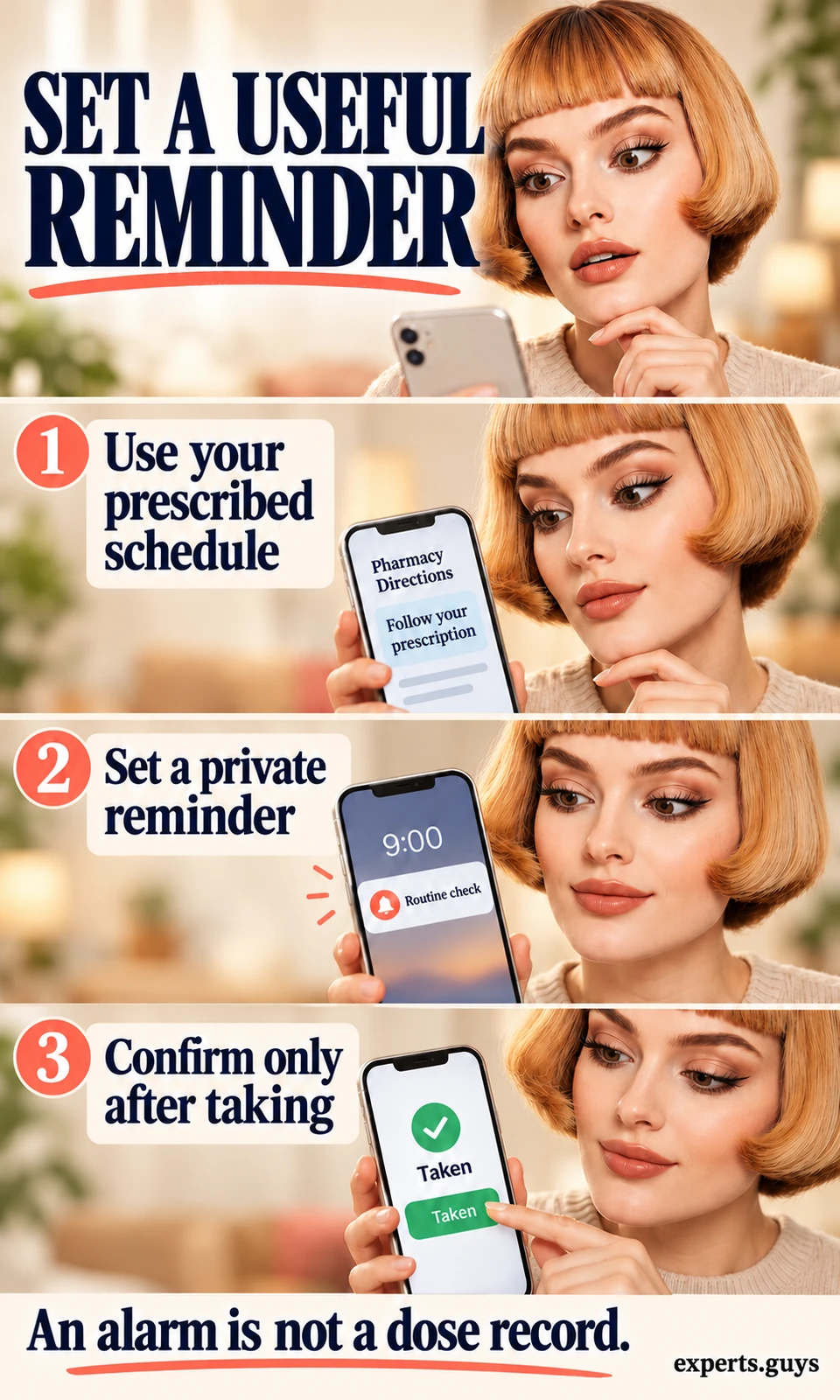
Make reminders reflect the prescribed routine
A reminder should support the instructions you were given, rather than create a new schedule. A dismissed alarm also does not prove that a dose was taken. Separating the prompt from the confirmation reduces the ambiguity of “Did I already do that?”
- Use your current pharmacy directions to set the reminder schedule. If the timing is unclear or clashes with shift work, ask the pharmacy to clarify it.
- Choose neutral notification text, such as “Routine check,” if other people can see your lock screen. Use a medication app only if you are comfortable with its privacy settings.
- Confirm completion only after taking the medicine as directed. When you are uncertain whether you took it, use medicine-specific advice rather than taking an extra dose just in case.
Example: You dismiss an alert during a meeting. Leave the completion entry unconfirmed until the action has actually happened. A dismissed notification and a completed dose are different events.
Adaptation: If apps are distracting, use one ordinary phone alarm and the pharmacy’s instructions. Avoid several competing reminder systems that produce conflicting records. A useful setup makes the next action clearer without changing the prescription.
Compare daily function with treatment burden
Antidepressants do not have one universal start date for benefit. NIMH describes a typical several-week response window, often around four to eight weeks, with sleep or concentration sometimes changing before mood. That is a reason for planned reviews, not a reason to ignore deterioration while waiting.
- Choose one everyday function you want treatment to help, such as starting work or preparing a meal. Add one treatment burden you want to discuss, such as daytime sleepiness.
- Use a brief private phone note or voice memo with a concrete example of each. Compare several observations at the review rather than judging the whole treatment from one unusually good or bad day.
- Confirm the first review date with the prescriber. NICE guidance usually places it within two weeks, or within one week for ages 18 to 25 or particular suicide-risk concerns; individual arrangements may differ.
Illustrative example: “Starting tasks is easier, but I am too sleepy for my morning shift.” This gives the prescriber two separate issues to assess. It is more informative than deciding the medicine either “works” or “does not work.”
When this is difficult: Bring one recent example instead of trying to reconstruct every day. A trusted person can describe a change they noticed if you want their involvement. If symptoms worsen, contact the care team sooner rather than waiting to collect a perfect record.

What should you do when treatment causes a problem?
The right response depends on urgency, the exact medicine and the problem you are facing. Routine side-effect messages and missed-dose questions need different information. For a deeper discussion of feeling emotionally flat, see antidepressant emotional blunting; the immediate communication steps are below.
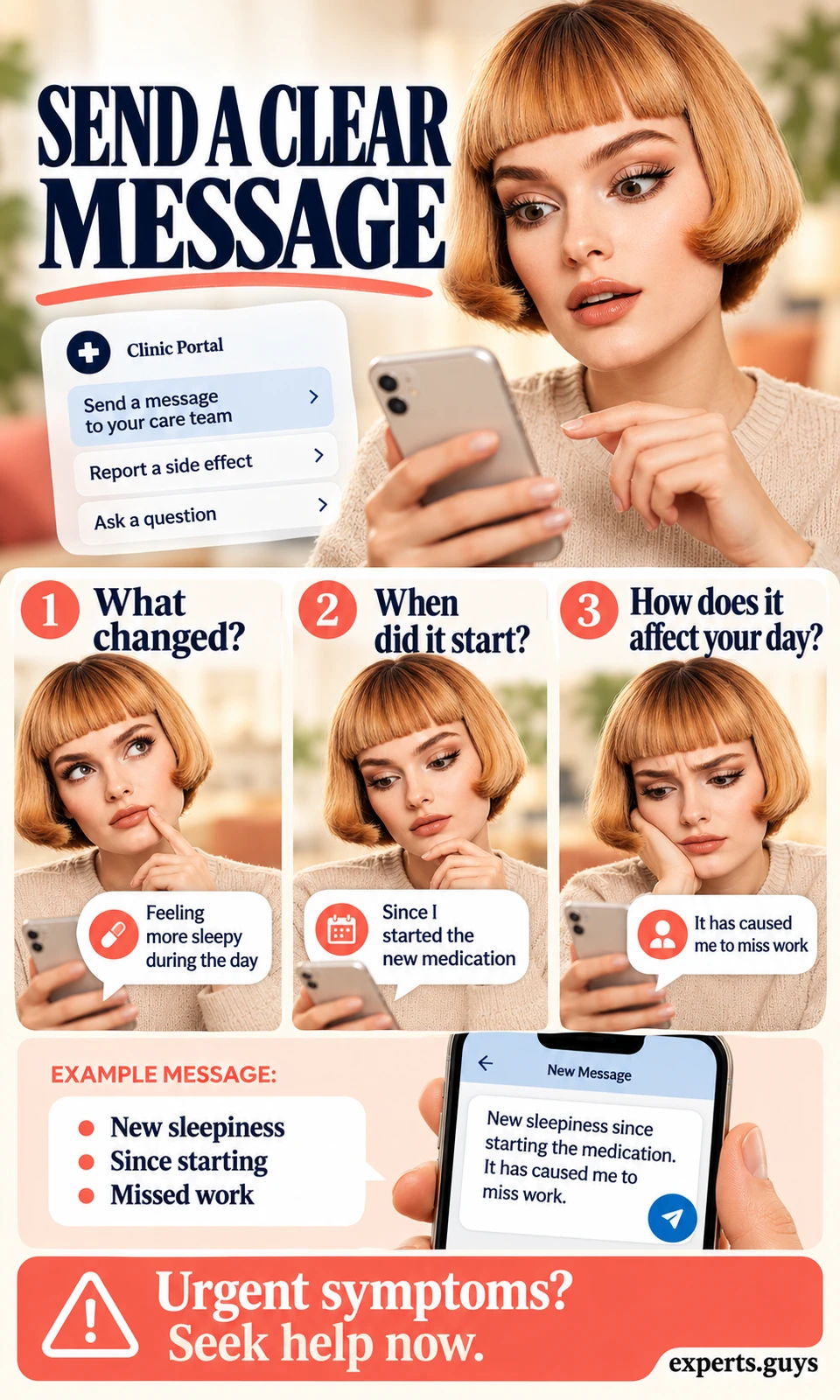
Describe side effects so the next decision is clearer
Nausea, sleep changes, sexual problems and other effects can matter even when mood improves. Some early effects ease, while others need a treatment discussion; being common does not make an effect acceptable for your life. Tell the care team what the symptom prevents you from doing, not just its name.
- For a nonurgent concern, open the secure patient portal or prepare a phone message. Include the medicine, current prescribed dose, symptom and when it began.
- Explain the practical impact and whether it is improving, staying the same or worsening. Mention any recent medicine or supplement changes.
- Ask what to do next and when to expect a reply. Do not use an unread portal message for an urgent problem, and do not change the dose while waiting unless a clinician directs you.
Message example: “Since starting the prescription, I have been sleepy enough to miss my morning work tasks. It began on [date] and is not improving. Can you advise on the next step and how soon I need a review?”
Common mistake: Leaving out sexual side effects or emotional flattening because they feel awkward to mention. A short private message is enough to start the discussion. If sedation or dizziness affects safety, avoid driving or hazardous work and seek advice promptly.
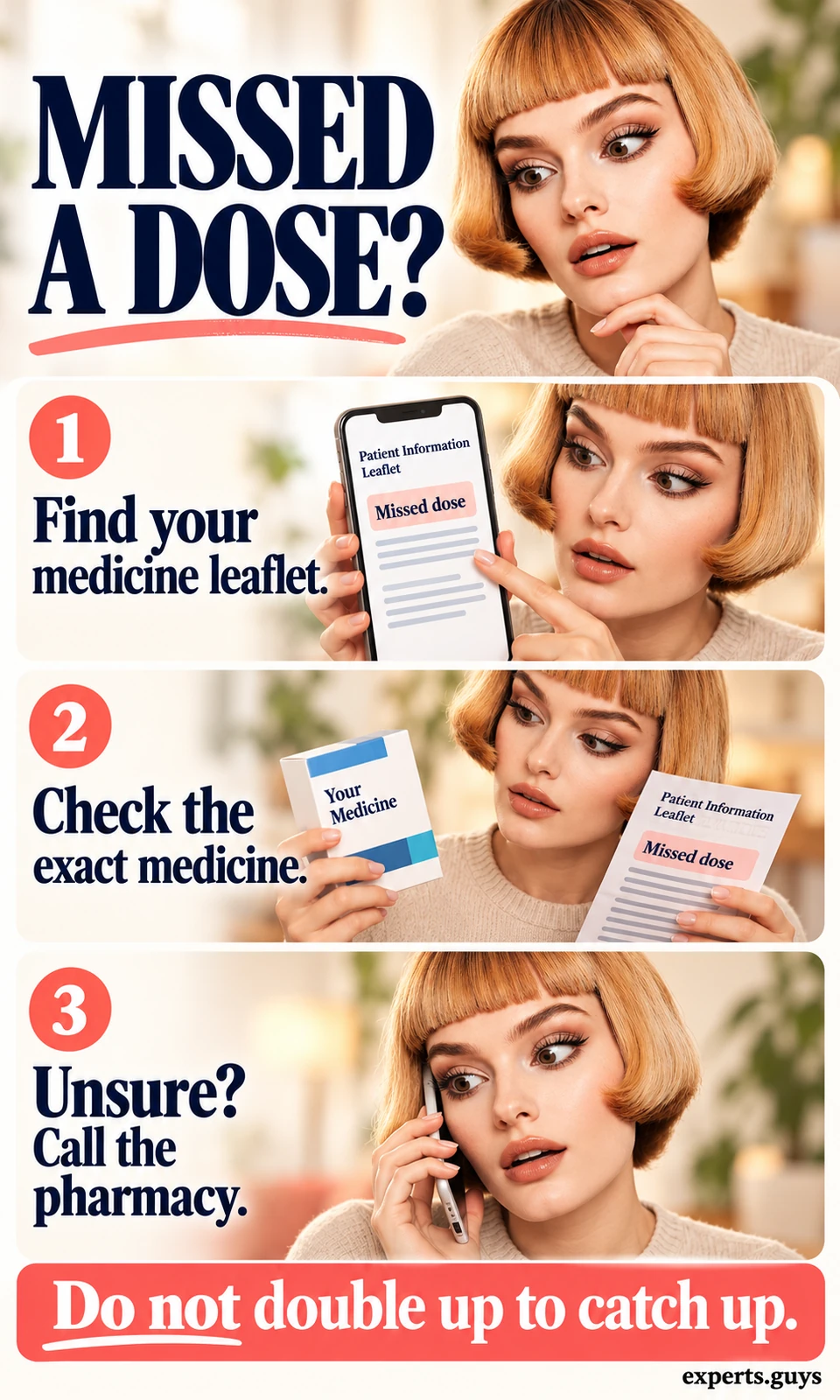
Use the instructions for your exact medicine after a missed dose
Missed-dose advice depends on the medicine and the circumstances. A general antidepressant article cannot safely calculate the replacement timing for every product. The useful skill is finding the right instruction quickly, without inventing a catch-up routine.
- Find the missed-dose section in the leaflet supplied with your medicine. Match the exact medicine and formulation, rather than using directions for another antidepressant.
- If the instruction is unclear, call the pharmacist and explain when the dose was due, when you last took it and what the label says. Do not take two doses together to compensate.
- If you have missed several doses or are unsure what you took, ask for individualized advice before attempting a restart or catch-up plan.
Example: You find advice online for a tablet with a similar name. Close that page and use the leaflet for your actual prescription. Save the correct leaflet link beside the pharmacy contact for future access.
Adaptation: Ask the pharmacy for an accessible electronic leaflet if the printed text is hard to read. If you may have taken too much, seek urgent poison-service or medical advice instead of waiting for symptoms. The goal is a confirmed instruction, not a guessed interval.
How do you avoid gaps and plan later changes?
A supply interruption and an agreed treatment ending are different situations. Handle the first as an access problem and the second as a planned clinical decision. If dizziness or unsteadiness is part of your concern, the separate article on depression, antidepressants and fall risk covers that safety question in more detail.
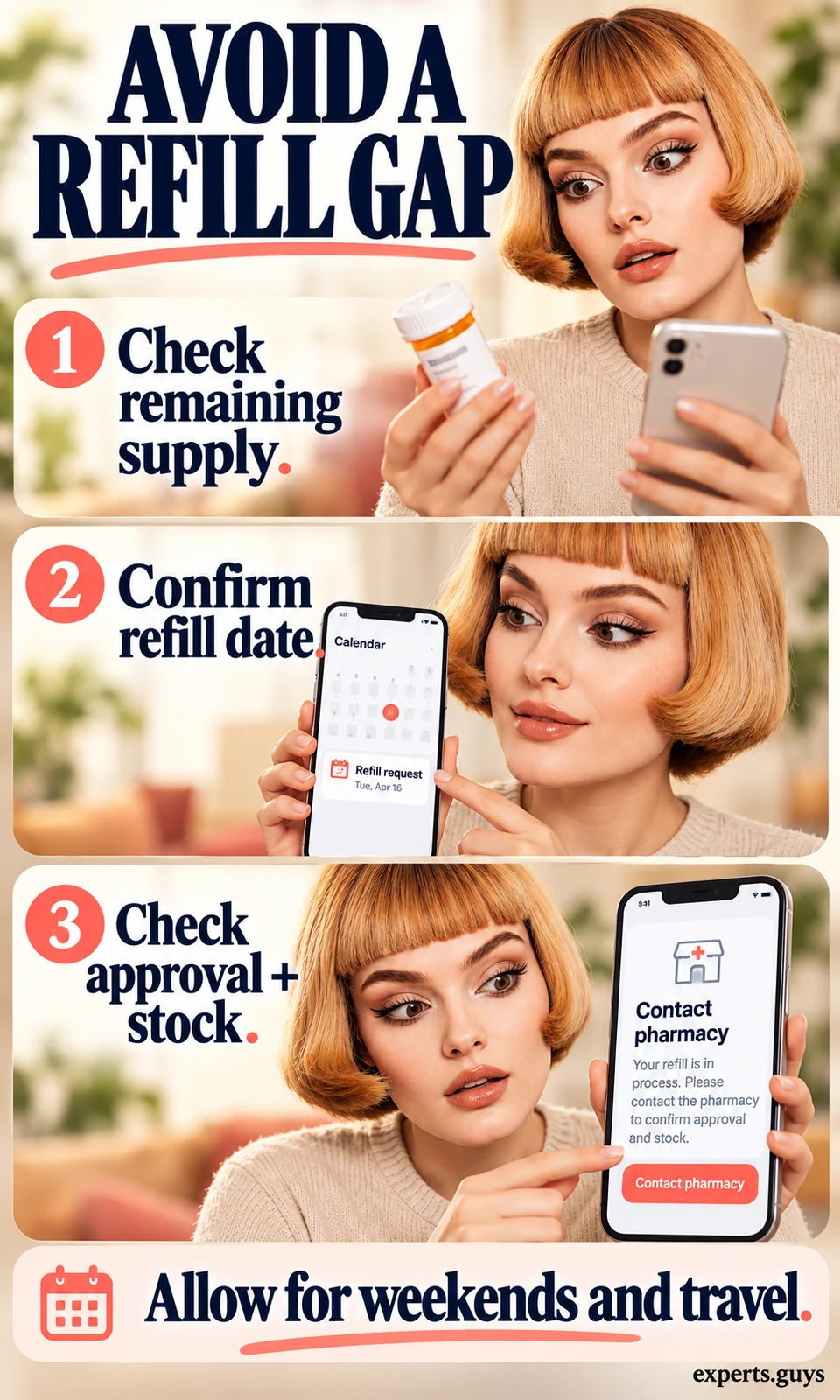
Check refill logistics before the supply ends
A refill problem is a practical barrier, not a sign that treatment has failed. Approval, pharmacy stock, cost and opening hours can each delay access. A small amount of preparation gives you time to resolve the actual barrier without rationing doses yourself.
- Check your remaining supply against the prescribed directions. Confirm when the pharmacy permits a refill and whether the prescriber must authorize it.
- Add a reminder early enough for the pharmacy’s stated processing time, weekends and any travel. Ask about availability before the last dose is due.
- If cost or stock is the obstacle, explain it to the pharmacist or prescriber promptly. Ask what legitimate supply options are available locally rather than borrowing another person’s medicine.
Example: Your prescription needs approval before a holiday closure. A request made only on the last day leaves little room to fix a delay. Confirm both approval and stock instead of assuming an app request means the medicine is ready.
When memory is a barrier: Ask whether the pharmacy offers refill reminders and confirm whether they include prescription renewals. Use one calendar entry that names the next task. The checkpoint is a confirmed supply arrangement, not simply a notification sent.
Prepare for a stopping or switching conversation
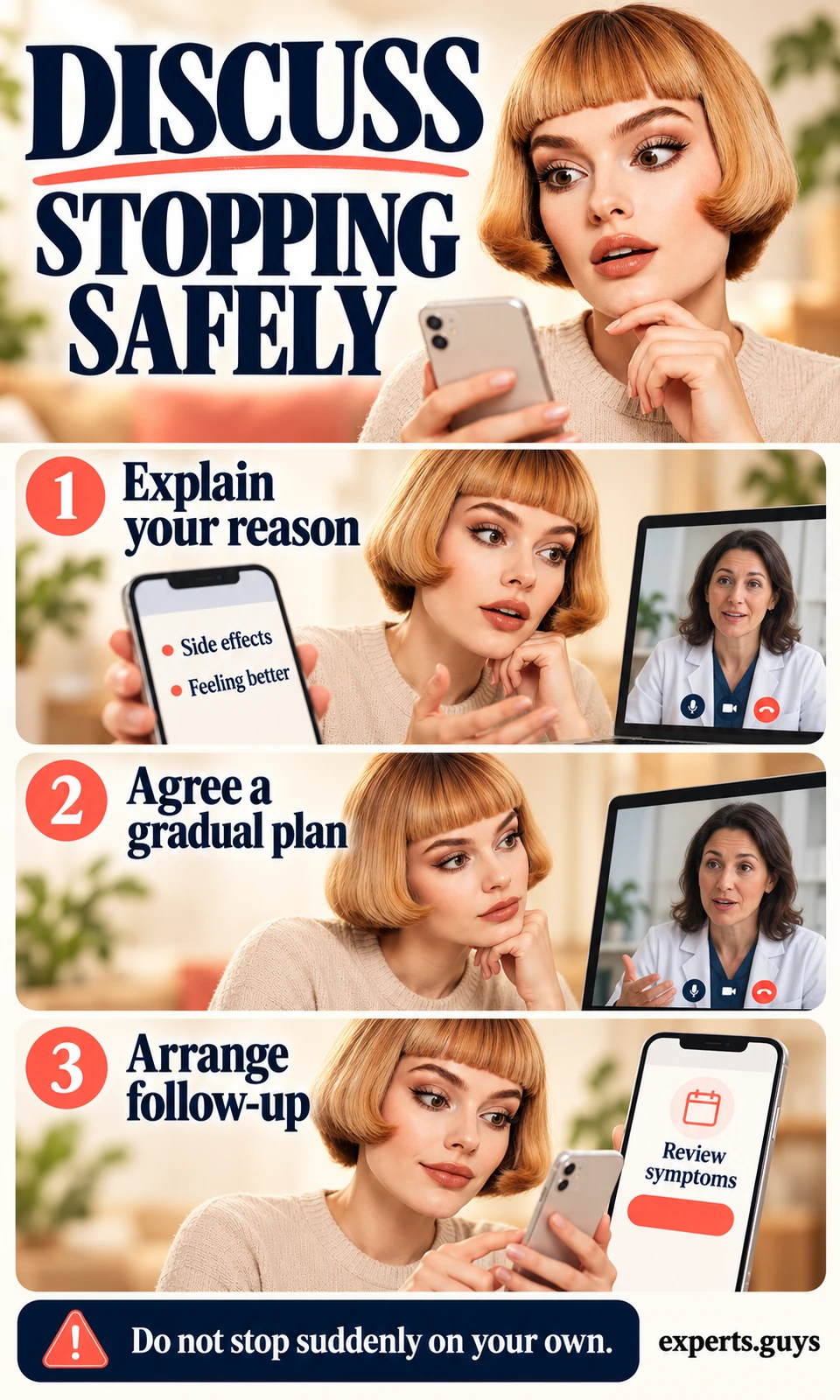
Feeling better can be a reason to review treatment, but it does not automatically mean treatment is finished. Stopping suddenly can cause withdrawal, and symptoms after a change can be difficult to distinguish from returning depression. A personalized gradual plan and follow-up are more useful than a universal taper chart.
- Explain why you want a change: improvement, side effects, cost, pregnancy planning or another concern. Bring the current medicine details and relevant dates to the discussion.
- Ask the prescriber to explain the proposed sequence, what symptoms to watch for and who to contact if problems develop. Do not copy a taper or switching schedule from another person.
- Save the agreed instructions securely on your phone and confirm the follow-up arrangements. If symptoms appear during a prescribed change, report the timing and severity rather than deciding on your own that it must be relapse.
Example: Dizziness begins after a clinician-directed reduction. Tell the prescriber when the reduction happened and when the dizziness started. The timing is useful evidence, but it does not establish the cause by itself.
Common mistake: Skipping alternate days or splitting tablets to invent a gradual reduction. The correct approach depends on the particular medicine, formulation and clinical situation. Ask for clarification whenever the agreed instructions are impractical; do not redesign them yourself.
Questions that often remain
Does an antidepressant prescription always mean depression?
No. Some medicines in this category are prescribed for anxiety disorders or other conditions. Ask which symptoms your prescription is intended to treat; the medicine name alone does not tell you the diagnosis.
Can I drink alcohol while taking an antidepressant?
Alcohol can worsen sleepiness, dizziness or mood, and the interaction depends on the medicine. Check the medicine leaflet and ask the pharmacist before drinking. If you are physically dependent on alcohol, seek medical advice about stopping safely rather than making an abrupt change alone.
Is needing a gradual reduction the same as addiction?
Withdrawal can happen when the body has adapted to a medicine, even without craving or compulsive use. Antidepressant withdrawal and addiction are different concepts. Withdrawal still deserves a careful, individualized plan and attention to symptoms.
Do I have to take an antidepressant for life?
Not necessarily. Duration depends on the condition, recovery and risk of recurrence; some people need longer treatment than others. Ask what would support continuing treatment and what would support reviewing it, rather than setting a stopping date on your own.
What if I become pregnant while taking one?
Contact the prescriber promptly to review the benefits and risks for your particular medicine and situation. Do not abruptly stop because of a positive test. Untreated illness and treatment both need consideration in the decision.
Your next step
Start with the gap that affects you today: an unclear label, a missing review appointment, a troublesome effect or an approaching refill. Use the matching steps and image to prepare the specific information needed. You do not need to complete all eight tasks at once, and urgent changes should never wait for this checklist.
Sources and further reading
- NIMH: Mental Health Medications – mechanisms, response time and treatment context.
- NHS: Antidepressants – common effects, alcohol, pregnancy and stopping guidance.
- NICE NG222: Depression in adults – review timing and individualized treatment follow-up.
- FDA: Depression Medicines – medicine disclosure and questions to ask; this older overview is not used here to establish current product approvals.
- MedlinePlus: Sertraline – an example of a medicine-specific leaflet, not instructions for every antidepressant.
- MedlinePlus: Serotonin syndrome – urgent reaction signs and assessment.
Illustrations are visual-generated teaching examples, not real patients or evidence of treatment results. Phone examples are editorial organization aids, not validated clinical assessments. Your medicine leaflet and prescribing clinician provide the instructions for your treatment.