
Clinical depression is associated with a higher risk of future cardiovascular disease, but taking an antidepressant does not automatically mean it will damage your heart. The useful question is how your particular medicine, medical history and other treatments fit together. Do not stop or change a prescription because of a risk headline; use the checks below to identify what needs review.
Two different questions often get mixed together: whether depression predicts later heart disease, and whether a medicine has a specific cardiovascular side effect. Those questions need different evidence. Keeping them separate avoids both unnecessary alarm and false reassurance.
Does depression itself raise future cardiovascular risk?
Depression and cardiovascular health are linked, even when medication is not the focus. NIMH describes overlapping biological and everyday health pathways, including changes in stress responses, inflammation and the difficulty of maintaining care when depression is severe. These are contributors to a complex relationship, not a forecast that an individual will develop heart disease.
Baseline risk still matters: age, blood pressure, smoking, diabetes, cholesterol and established cardiovascular disease change the starting point. Depression can make managing these problems harder, while heart disease can also worsen mood. Treating either problem in isolation can therefore miss part of the person’s needs; the broader overlap is covered in depression and chronic illness.
A study that follows antidepressant users may include people with more persistent illness or more health conditions than non-users. Researchers can adjust for measured differences, but they cannot guarantee that every relevant difference has been removed. This is one reason an observed association should not become a claim that the prescription caused the outcome.
1. Check the study behind a frightening headline
Use this check when a news story makes you want to change treatment. Open the original study or its abstract and identify the population, the outcome and the time period. If those details are absent, treat the headline as incomplete information rather than a personal warning.
For example, an arrhythmia is an electrical rhythm problem, whereas a heart attack generally involves interrupted blood supply to heart muscle. A result about one cannot simply be relabelled as a result about the other. The same caution applies when a study of older adults or people with existing disease is used to describe every antidepressant user.
| Check | What to find | What it changes |
|---|---|---|
| Population | Age range, depression status and existing heart disease | Whether the comparison resembles your situation |
| Outcome | Heart attack, stroke, rhythm disorder or cardiovascular death | Which risk the finding actually describes |
| Exposure and comparison | Specific drug/class, duration and comparison group | Whether the headline hides important differences |
| Size and time | Absolute event rates, uncertainty and follow-up | How large the difference is and over what period |
Consider a hypothetical result of 2 events per 100 people versus 3 per 100 over the same period. That is a 50% relative increase but a 1 percentage-point absolute difference; neither number proves causation. This is a maths example, not an estimate for any antidepressant or reader.
A large UK primary-care cohort of adults aged 20–64 with depression illustrates why the details matter: the BMJ cardiovascular-outcomes study assessed different medicines and several separate outcomes. It did not find increased arrhythmia, stroke or transient ischaemic attack risk associated with SSRIs as a class over five years. It was observational, so its results do not establish that every SSRI is risk-free or that an association for another drug is causal.
The common mistake is to multiply a headline’s relative risk by an unrelated online heart-risk score. Those figures may concern different populations, outcomes and time horizons. If the abstract is too technical, save its link and bring one precise question to your review: “Does this study change anything for my medicine and history?”

Which antidepressant-related heart effects deserve attention?
Antidepressants differ in their effects on blood pressure, electrical conduction and interactions. Dose, other medicines and existing disease can change the significance of those effects. A discussion about cardiovascular safety should name the medicine and the concern, rather than treating all antidepressants as interchangeable.
| Medicine or situation | Concern to review | Useful question |
|---|---|---|
| Sertraline in established coronary heart disease | Often a preferred option in UK specialist guidance; not risk-free | Does my full medicine combination change that choice? |
| Citalopram or escitalopram | Dose-related QT prolongation in susceptible people | Do my history and other medicines warrant an ECG or blood tests? |
| Venlafaxine or duloxetine | Possible blood pressure increases and other cardiovascular effects | What monitoring schedule fits my treatment? |
| Tricyclic antidepressants | Conduction effects and postural blood pressure drops | Is this still suitable given my cardiac history? |
These distinctions follow NHS specialist guidance for people with coronary heart disease, a particular clinical population. They do not mean everyone taking a less-preferred option needs an immediate switch. Previous response, alternatives and the risks of changing treatment all belong in the decision.
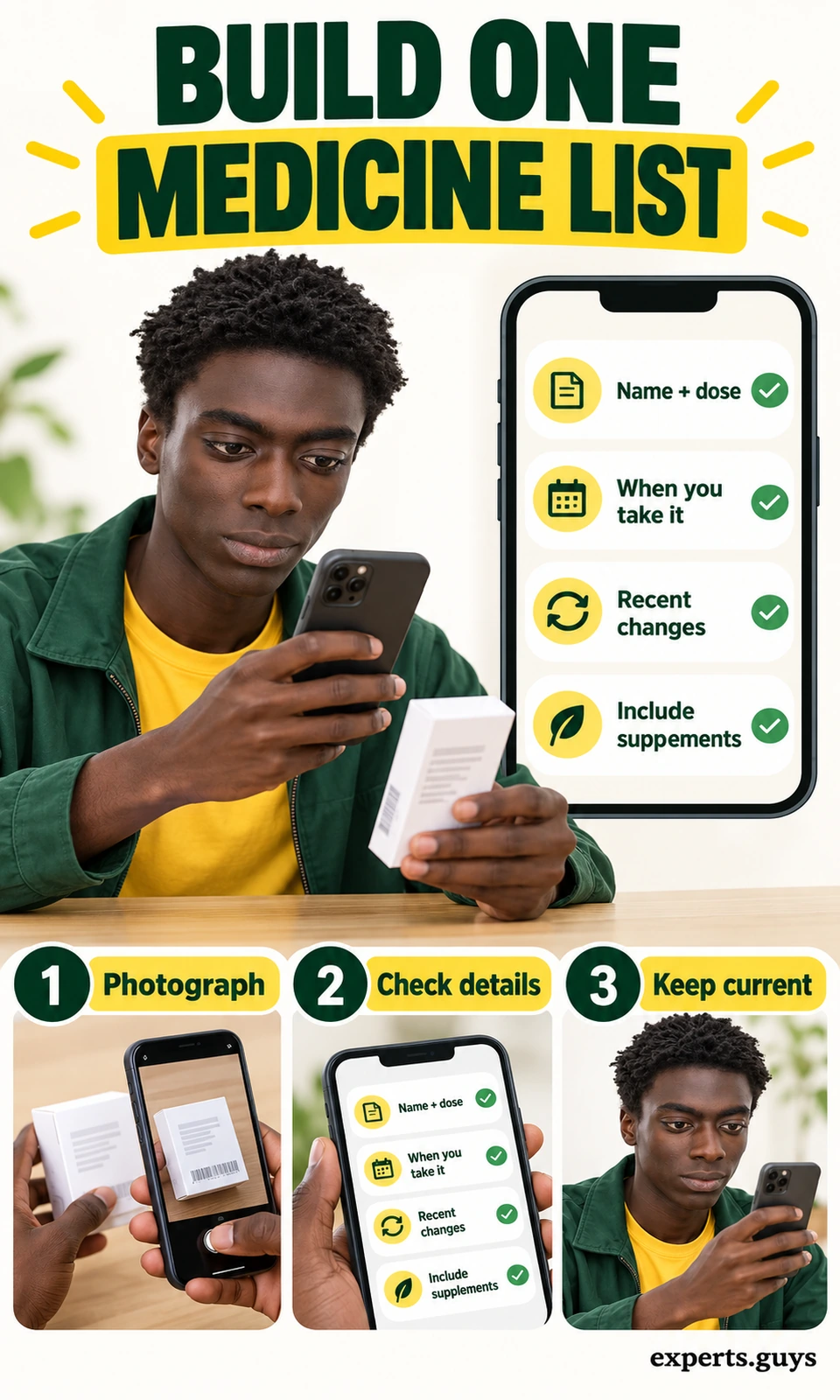
2. Build one accurate medicine list on your phone
A useful medicine review starts with knowing what you actually take. Use a secure phone note or your patient portal and keep current packaging nearby. A dispensing history is a helpful starting point, but it may not include occasional painkillers, supplements or a recent instruction change.
- Photograph the name and strength on each current label; keep personal identifiers out of anything you share publicly.
- Enter the dose you actually take, the timing and the reason it was prescribed, if known. Mark uncertain details for the pharmacist rather than guessing.
- Add non-prescription products, supplements and any recent start, stop or dose-change dates. Update the list when instructions change.
A completed entry might read “medicine name; label strength; actual daily schedule; changed last Tuesday,” without trying to assess its safety yourself. The common error is copying an old repeat list as if it were current. If typing is difficult, bring the packages or show clear photographs; success means the reviewer can reconcile the list with you.
3. Check interactions before adding a product
An interaction review is especially useful before you add a non-prescription product. For example, sertraline prescribing information warns about additional bleeding risk with NSAIDs, aspirin and anticoagulants. Bleeding is a different issue from a rhythm disorder, but both can matter when someone is taking cardiovascular medicines.
- Show the pharmacist your complete current list and the exact new product, including its ingredients.
- Ask whether the combination changes bleeding risk, blood pressure or heart rhythm, and whether a different product or monitoring is appropriate.
- Keep the agreed instructions with your medicine list. Do not independently stop prescribed aspirin, an anticoagulant or your antidepressant.
For an illustrative example, asking about an occasional ibuprofen purchase is more useful than simply asking whether an antidepressant is “heart-safe.” Combination cold remedies can contain several ingredients, so the brand name alone may not be enough. If you cannot reach the pharmacist immediately, postpone an optional new product rather than guess; seek urgent care for vomiting blood or black, tarry stools.

What can you check at home without diagnosing yourself?
Home observations are useful when they answer a defined question. Blood pressure readings can help monitor a prescribed plan, while a short symptom timeline can make an appointment more informative. Neither can rule out a heart attack or tell you that a medicine definitely caused a symptom.
4. Make home blood pressure readings comparable
Use a validated upper-arm monitor with the correct cuff size when your care team recommends home monitoring. Follow the American Heart Association measurement instructions and your agreed schedule. A reading after rushing upstairs is not comparable to a rested reading.
- For 30 minutes beforehand, avoid exercise, smoking and caffeine; empty your bladder.
- Sit quietly for at least 5 minutes, with your back supported and feet flat. Place the cuff on a bare upper arm supported at heart level, following the device instructions.
- Stay still and silent. Take two readings one minute apart and retain both in device memory or a secure app.
If readings seem inconsistent, check cuff fit and positioning before taking repeated extra measurements. Show the monitor and stored readings at your review if technique remains uncertain. If you do not own a suitable monitor, ask your care service where a reliable check is available instead of relying on a phone-camera estimate.

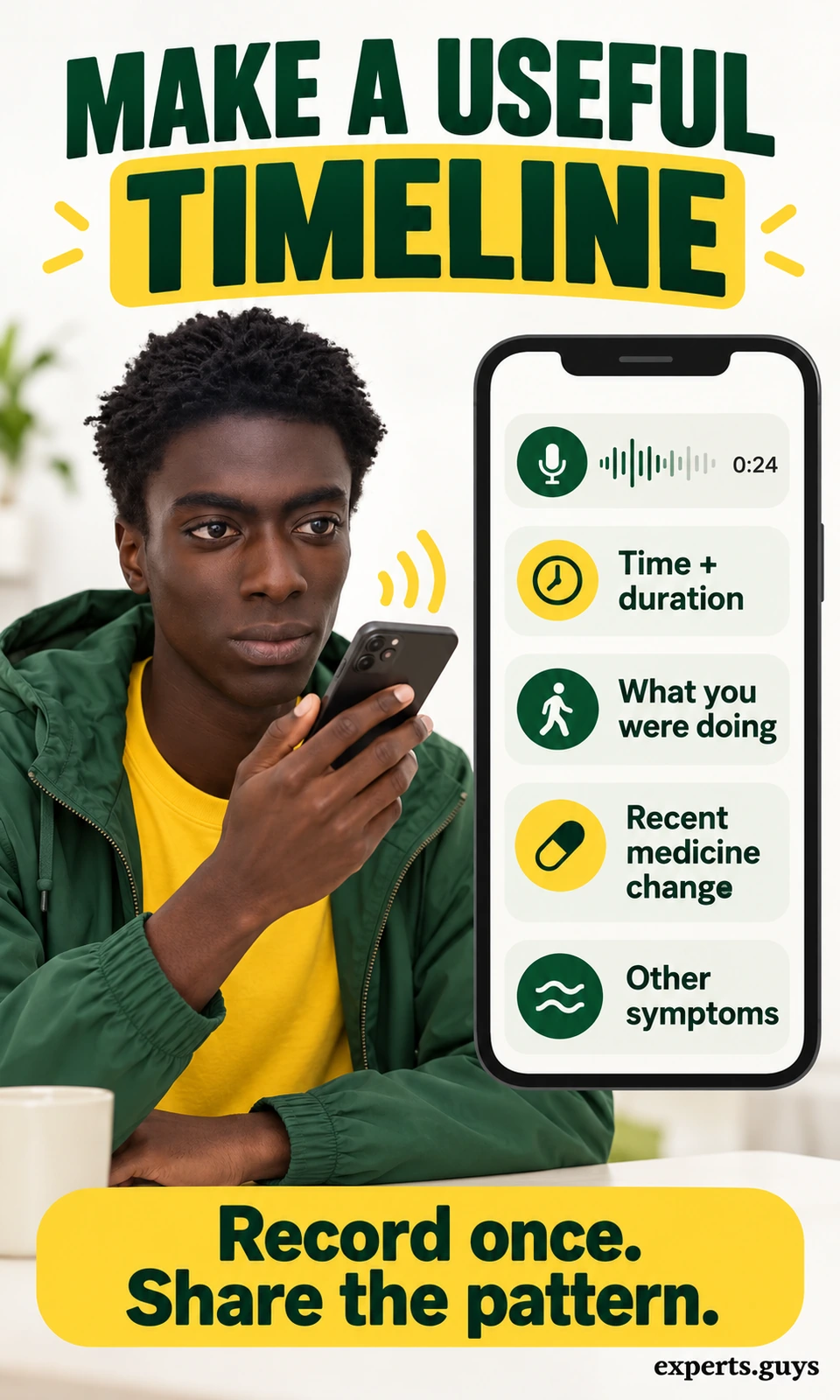
5. Capture a short symptom timeline without constant checking
For non-emergency symptoms, a concise record can show whether episodes began before or after a treatment change. It cannot distinguish anxiety from an arrhythmia on its own. NHS guidance on palpitations recommends assessment when episodes keep returning or worsen, and urgent help when concerning symptoms accompany them.
- After a non-emergency episode, save its time, approximate duration and what you were doing in a secure note or voice memo.
- Add associated symptoms and any recent medicine change; include an available device reading without repeatedly checking for reassurance.
- Share the pattern through the agreed clinical route. Do not deliberately skip a dose or repeat a trigger to test a theory.
An illustrative note could say “fluttering after lunch, lasted about two minutes, no chest pain or fainting, dose changed four days ago.” A useful adaptation is a short voice message to yourself when typing feels tiring. If palpitations occur with chest pain, breathlessness or fainting, seek emergency help; if that combination has stopped, obtain urgent medical advice rather than simply logging it.
How should a heart-safety review change your treatment plan?
A useful review ends with a clear monitoring and follow-up plan, not an unexplained instruction to “keep an eye on it.” The clinician needs to weigh relief of depression against side effects, interaction risks and your cardiovascular history. More tests are not automatically better; each should answer a specific question.
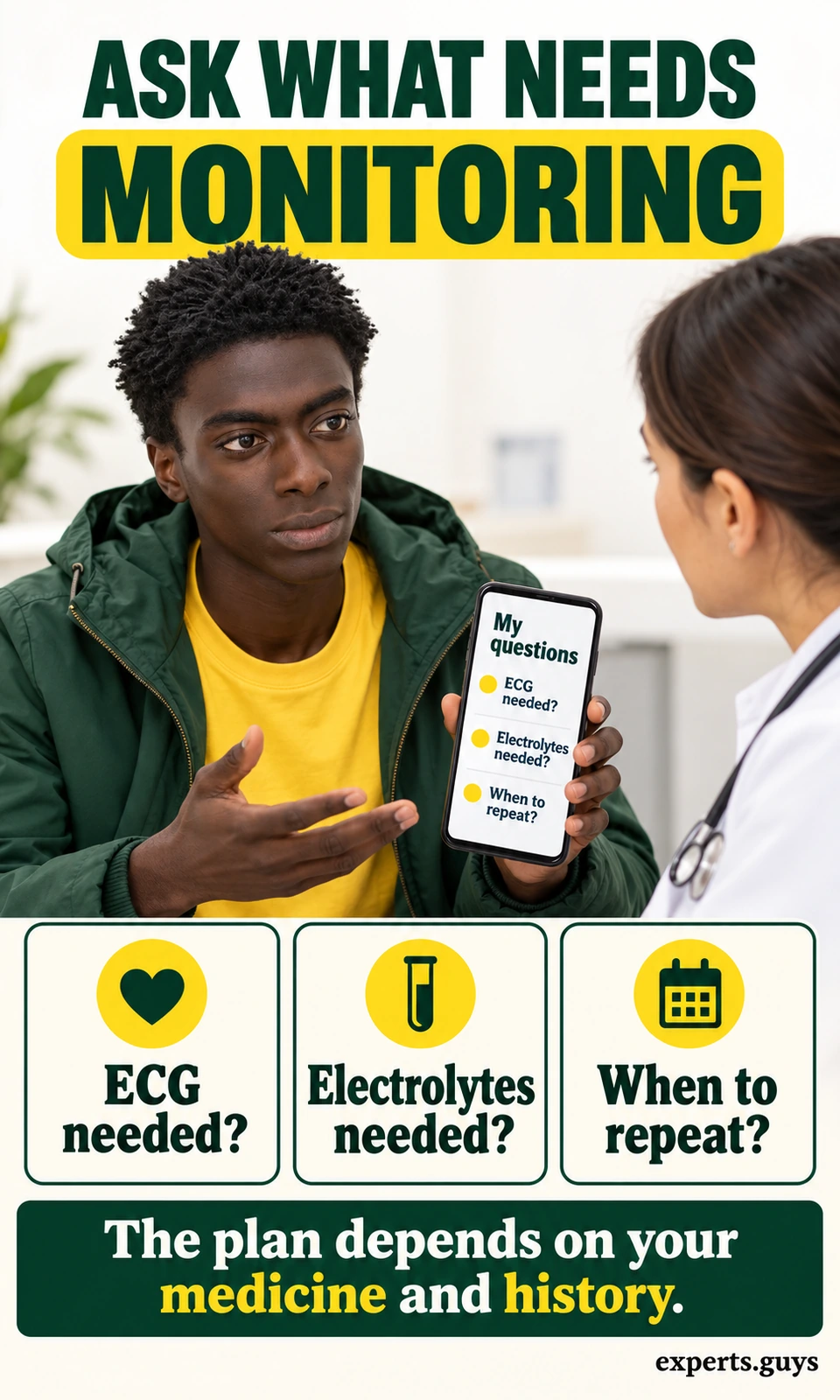
6. Ask whether ECG or electrolyte checks apply to you
An ECG records the heart’s electrical activity; the QT interval concerns part of its electrical recovery cycle. Citalopram and escitalopram require particular attention when QT risk factors are present. UK regulator guidance advises considering an ECG before treatment in people with cardiac disease and addressing low potassium or magnesium.
- Bring your medicine list and mention known rhythm problems, previous unexplained fainting, heart disease and relevant recent illness.
- Ask: “Is an ECG or an electrolyte blood test indicated for this medicine and my history?”
- If testing is arranged, confirm who reviews the result and whether a later dose change requires another check. Do not interpret a QT number or take electrolyte supplements to self-correct it.
For example, someone taking escitalopram who also has cardiac disease has a more specific monitoring question than someone asking for every available heart test. If you cannot remember your cardiac history, your patient portal or previous clinic letters may help. The checkpoint is an explicit testing decision and follow-up owner, not collecting normal results as a guarantee of future safety.
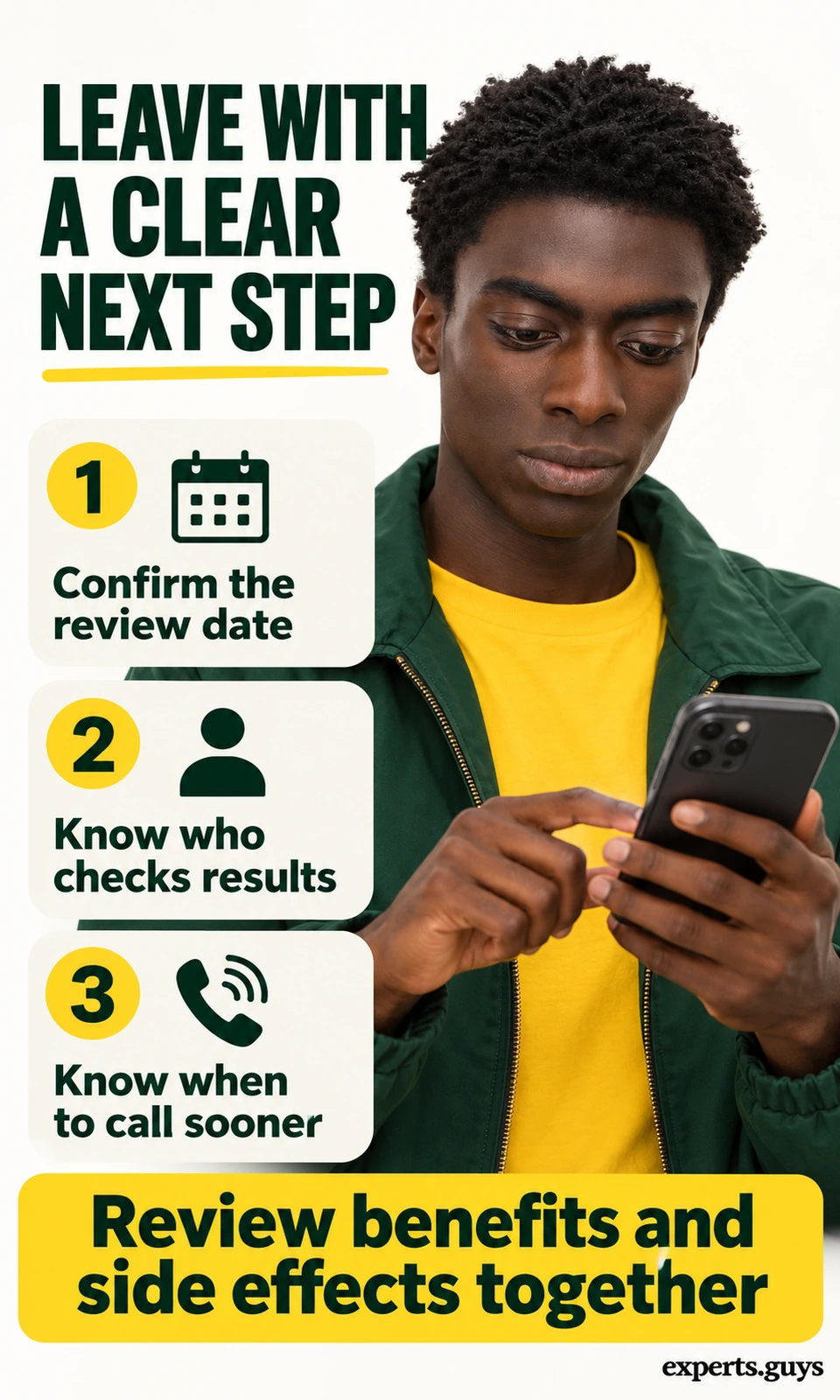
7. Close the follow-up loop
Treatment benefit belongs in the same discussion as tolerability. NICE depression guidance recommends reviewing response and side effects and agreeing how treatment will be monitored. Stopping abruptly or repeatedly missing doses can cause withdrawal, so a change needs an agreed plan rather than an improvised taper.
- Before the review, choose one concrete benefit to describe, such as managing work or meals, alongside any side effects that interfere with daily life.
- At the review, confirm the next contact date, what will be assessed and who will communicate test results.
- Save the appointment and contact details in your phone. Ask which symptoms mean you should contact the service sooner.
A useful closing question is “If the result does not arrive by the agreed date, whom should I contact?” This helps prevent a test order from being mistaken for completed follow-up. If concentration is poor, ask for the instructions in your patient portal or invite a trusted person to help, with your permission.
This approach keeps the cardiovascular question separate from general advice about choosing a depression treatment. New chest symptoms should not be dismissed as anxiety, while a reassuring review should not lead to unnecessary medication disruption. The aim is a workable plan that protects mental and physical health together.
Frequently asked questions
Can a smartwatch show whether my antidepressant affects the QT interval?
An ordinary heart-rate display cannot answer that question. Even a wearable ECG is not a substitute for the clinical assessment required for medication-related QT concerns. Share any available recordings if requested, but do not use a normal watch result to dismiss symptoms.
Should I take aspirin to offset a possible antidepressant heart risk?
Do not start aspirin for that reason. It is not an antidote to antidepressant-related cardiovascular effects and can increase bleeding risk with some medicines. If aspirin is already prescribed, keep following the prescription unless your treating clinician changes it.
Does a normal ECG mean my long-term heart risk is low?
A normal ECG does not measure every contributor to future cardiovascular disease. Blood pressure, cholesterol, diabetes, smoking and established disease require their own assessment. It also cannot exclude every intermittent rhythm problem.
Should I stop an antidepressant before a routine heart check?
Do not alter treatment simply to prepare for an appointment unless the treating service gives specific instructions. Bring the current dose and timing information so the assessment reflects usual use. If a change is needed, ask for a clear plan and follow-up.
Your next step
If you have no urgent symptoms, start with the medicine-list check and bring one specific cardiovascular question to your next review. Use home measurements only when they serve an agreed purpose. The goal is to resolve a concrete uncertainty while preserving effective depression care.
Images are visual-created educational illustrations, not photographs of a real patient’s treatment or results. This article provides general information and does not prescribe, diagnose or replace an individual treatment plan.