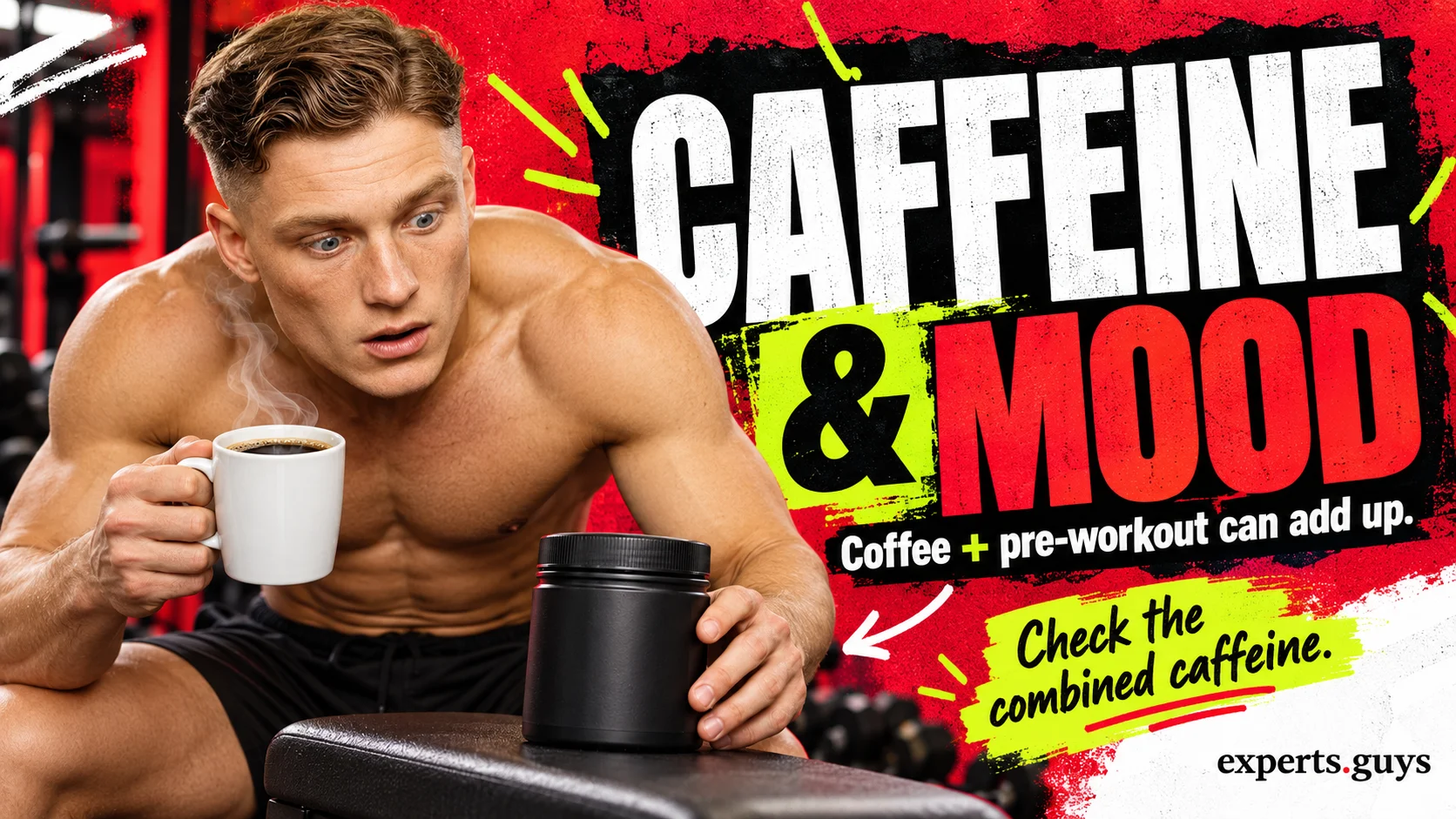
Caffeine is a stimulant found in coffee, tea and many energy or workout products, and it can worsen anxiety or disturb sleep in sensitive people. Its relationship with depression is less direct: feeling more alert is not the same as treating depression, and disrupted sleep can make coping harder. If coffee and a pre-workout product are both part of your day, start by checking their combined caffeine rather than judging each drink separately.
The useful question is not simply whether coffee is “good” or “bad.” It is whether the amount, combination and timing fit your response. A drink that feels manageable on its own may be followed by another product you were not mentally counting as caffeine.
| What you notice | What it may mean | Useful next decision |
|---|---|---|
| Shakiness or feeling unusually keyed up after caffeine | Stimulation may be contributing; symptoms alone do not identify the cause. | Check the combined amount before taking more. |
| An afternoon lift followed by poorer sleep | The immediate benefit may have a later cost. | Consider the dose as well as the time; do not assume earlier always solves it. |
| Tiredness or irritability after suddenly cutting back | Withdrawal can complicate the picture. | Use the separate withdrawal guidance rather than interpreting one rough day as proof you need more. |
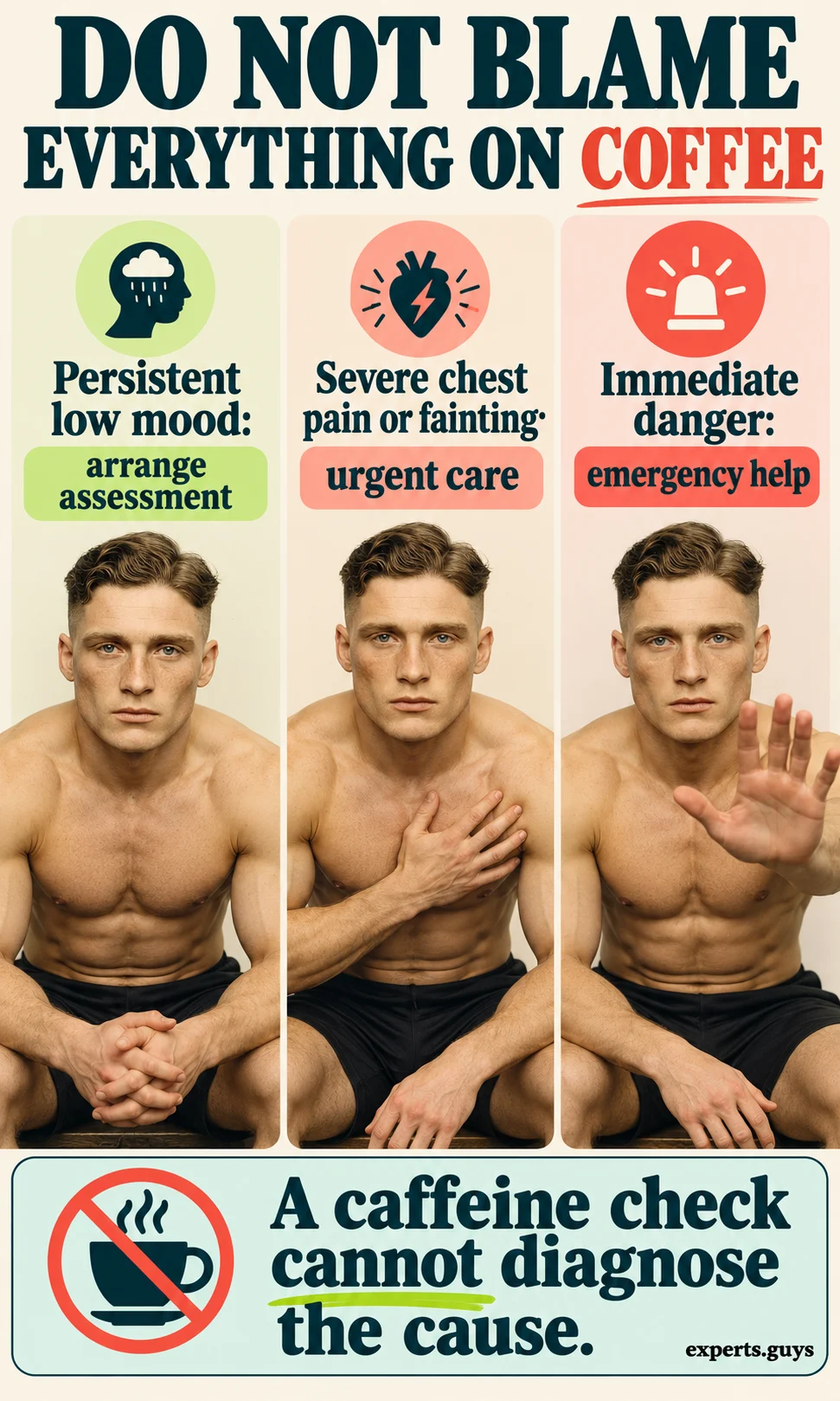
| Low mood or loss of interest that persists | Caffeine may be one influence, not a complete explanation. | Arrange assessment, especially when daily life is affected. |
| Severe chest pain, fainting or immediate danger | A home caffeine experiment is not an appropriate response. | Seek urgent or emergency help. |
Why can caffeine make anxiety feel worse?
Caffeine can increase wakefulness while also making bodily sensations harder to ignore. A faster-feeling heartbeat, trembling or restlessness may resemble sensations that already frighten someone with anxiety. That overlap helps explain why a drink intended to improve concentration can instead leave a person distracted by how their body feels.
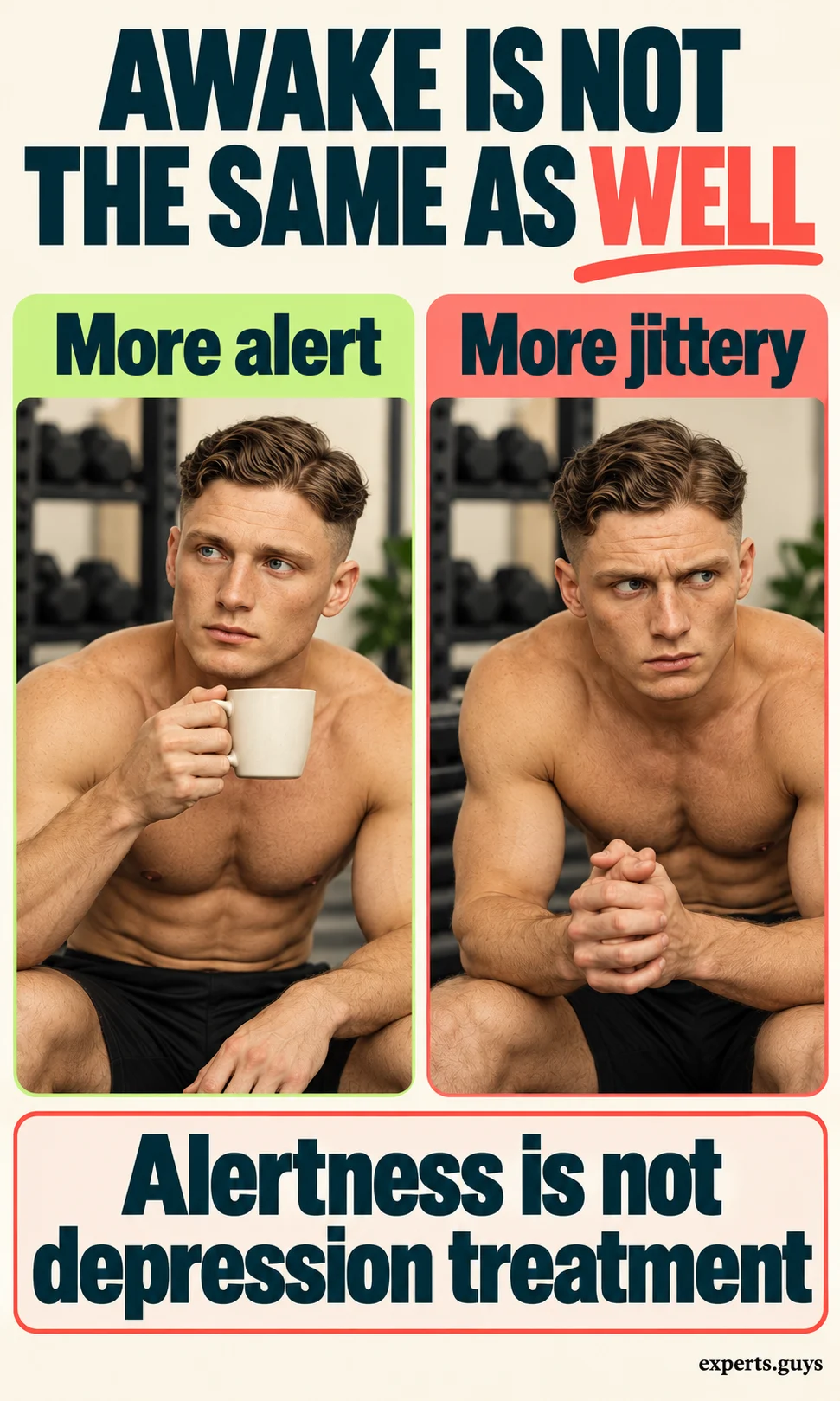
The distinction matters because alertness, anxiety and mood are separate outcomes. You can feel less sleepy yet more tense. You can also have depression and notice a short-lived lift without the underlying condition improving. A productive hour after coffee is therefore useful information about that hour, not evidence that caffeine is an antidepressant.
Controlled caffeine challenges have provoked panic in people with panic disorder, but the research commonly used high doses. The panic-disorder challenge review included doses of 400–750 mg and could not establish how smaller doses compare. That makes it inappropriate to transfer the study percentages to a person drinking a small tea, or to use them to predict your own chance of a panic attack.
Sensitivity matters more than a competitive comparison with someone else at the gym. Another person’s tolerance does not establish yours, and a familiar product name does not establish the amount in a new formulation. The same practical question applies whether the source is coffee, a can, a capsule or a workout supplement: what did you actually consume?
The FDA’s general adult reference of 400 mg a day is not a symptom-free target or permission to take that amount at once. Individual sensitivity, health conditions and medicines can change what is appropriate. If you develop symptoms below that figure, the figure does not invalidate your experience.
A caffeine check also cannot distinguish a panic attack from every other cause of physical symptoms. Avoid using the explanation “it is just coffee” to dismiss something severe, new or unusual. For the broader differences between overlapping mental-health patterns, depression, anxiety and bipolar disorder need their own distinctions; this article addresses a potentially modifiable stimulant exposure.
How do you check coffee and pre-workout without a diary?
Bring the actual products into the same view before the next serving. This makes an overlooked combination visible without keeping a food diary or repeatedly rating your mood. The job is to identify an unplanned extra dose, not to find a maximum amount you can tolerate.
Read the unit attached to the caffeine amount. “Per serving,” “per bottle” and “per scoop” are not interchangeable. A container may hold more than one serving; a labelled serving may involve a specified scoop amount. Do not infer caffeine from the size of a scoop, and do not measure pure caffeine powder at home.
For example, an illustrative bottle labelled 80 mg per serving with two servings per bottle supplies 160 mg if you finish it. That calculation says nothing about any real brand, and it is not a recommended intake. If the label already states the amount per whole bottle, multiplying again by the serving count would double-count it.
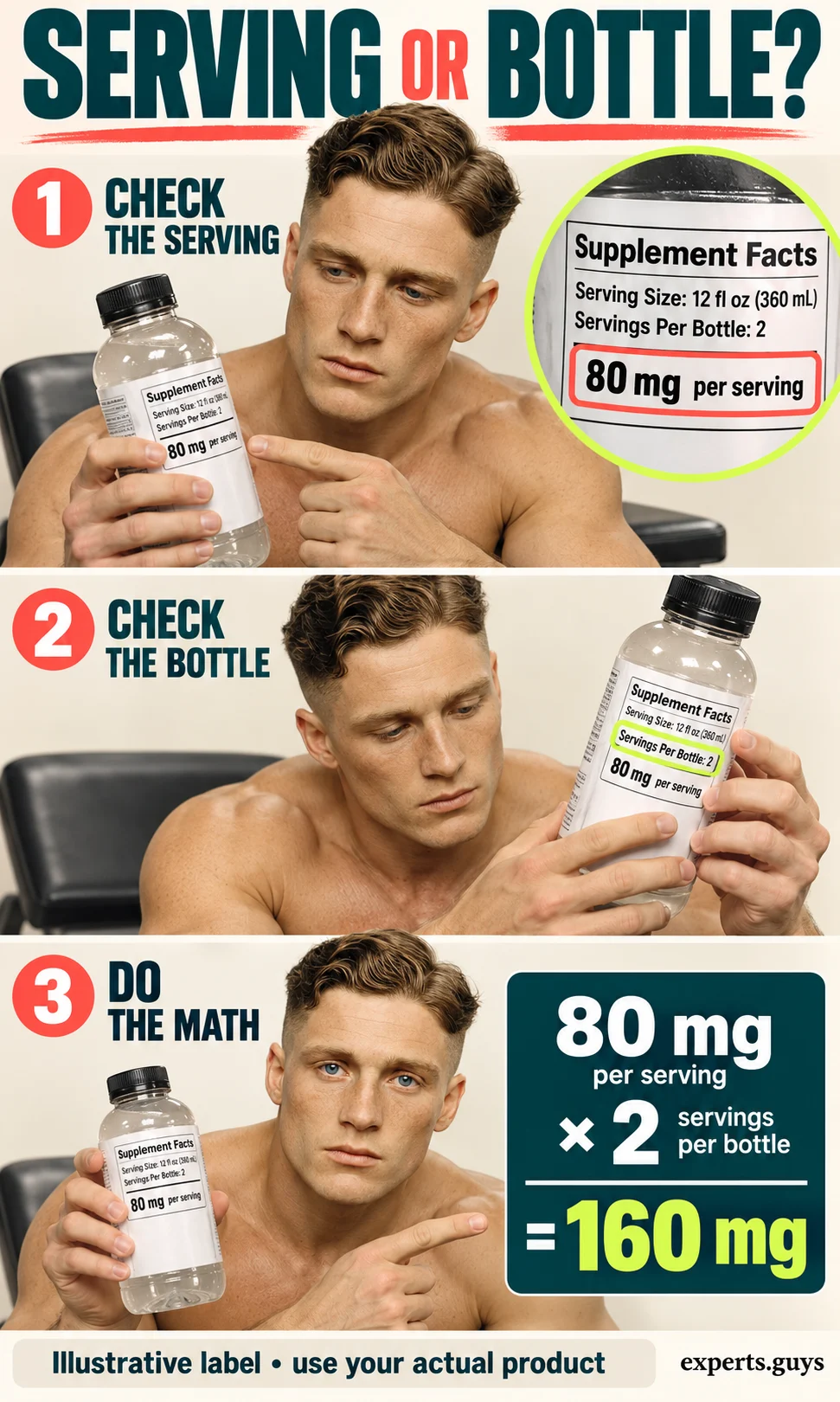
Use the label for the actual product and serving you have, including whether the caffeine figure already combines its sources. “Natural energy,” guarana or a proprietary blend is not a reliable caffeine quantity. If the total is unclear, treat it as unknown rather than zero. An unreadable or incomplete label is a reason to pause the extra product, not to guess a small dose.
- Gather: place the coffee container, energy drink and unopened workout product used or planned for that day on a stable surface. Include the empty container if you still have it; remember anything already consumed elsewhere.
- Identify: find the caffeine amount and its unit on each label. Check how many labelled servings you consumed or intend to consume. For café coffee, use the seller’s information for that exact drink and size when available; otherwise keep the uncertainty explicit.
- Combine: add the known amounts. An illustrative 120 mg coffee plus a 200 mg pre-workout serving equals 320 mg before any other sources. This is arithmetic, not a safety clearance.
- Separate: put an unplanned extra stimulant aside before opening or mixing it. If you are already jittery or feel unwell, do not add more to see whether the feeling passes. Regular high intake may need a gradual reduction plan rather than an abrupt overall stop.
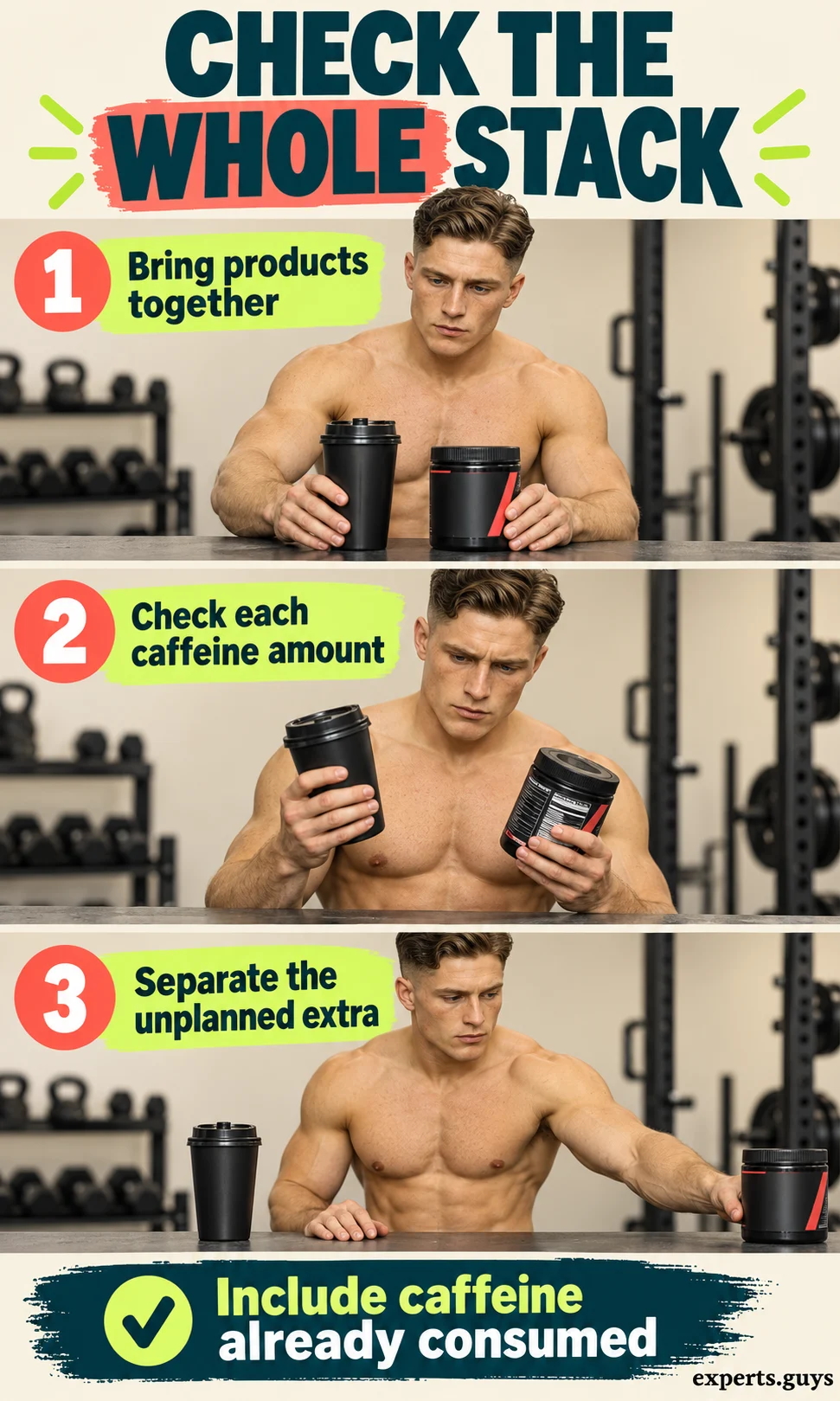
The common mistake is counting only what is in front of you now. A coffee consumed on the journey still belongs in the total even if the cup has gone. Another mistake is counting a supplement’s stated total and then adding its listed caffeine ingredients again. Work from the declared total when that total is clear; keep unknown products out of a supposedly precise sum.
Make the check smaller if concentration is low. Sit at a table and compare only the coffee and the next planned product; ask someone to read small print if needed. You can complete the useful part simply by identifying that the second amount is unknown and setting that optional extra aside. No written record, account or calculator is required.
The observable result is a clarified serving or an avoided unplanned addition. It is not a lower anxiety score, a good workout or proof of recovery. The method is an everyday application of label checking, not a clinical treatment tested as a separate programme. Leave prescribed medicines unchanged; if they contain caffeine or may interact with it, a pharmacist can help establish the relevant contribution.
This article keeps that product-checking job separate from the longer task of changing a regular habit. If symptoms appear after a sudden reduction, the more relevant next topic is caffeine dependence and withdrawal. Reintroducing caffeine just to make a bad day disappear can obscure which problem you are trying to solve.
Can caffeine worsen depression if coffee studies look positive?
Yes, caffeine can be unhelpful for an individual even when a study finds a favourable association between coffee drinking and later depression. Those statements answer different questions. A population finding describes a pattern across people; it does not establish that someone who is already depressed should increase caffeine.
A prospective cohort of women initially free of clinical depression found lower depression risk with greater caffeinated-coffee consumption. It was observational, not a trial prescribing coffee as treatment. Differences between coffee drinkers and non-drinkers, changes in behaviour and the study population limit how the finding can be applied to a particular person.
That distinction changes the practical decision. If a drink reliably leaves you tense, a headline about lower population risk is not a reason to keep increasing it. Nor does an uncomfortable response prove that caffeine caused your depression. The defensible conclusion is narrower: the drink may be adding a problem that deserves attention alongside the mood symptoms.
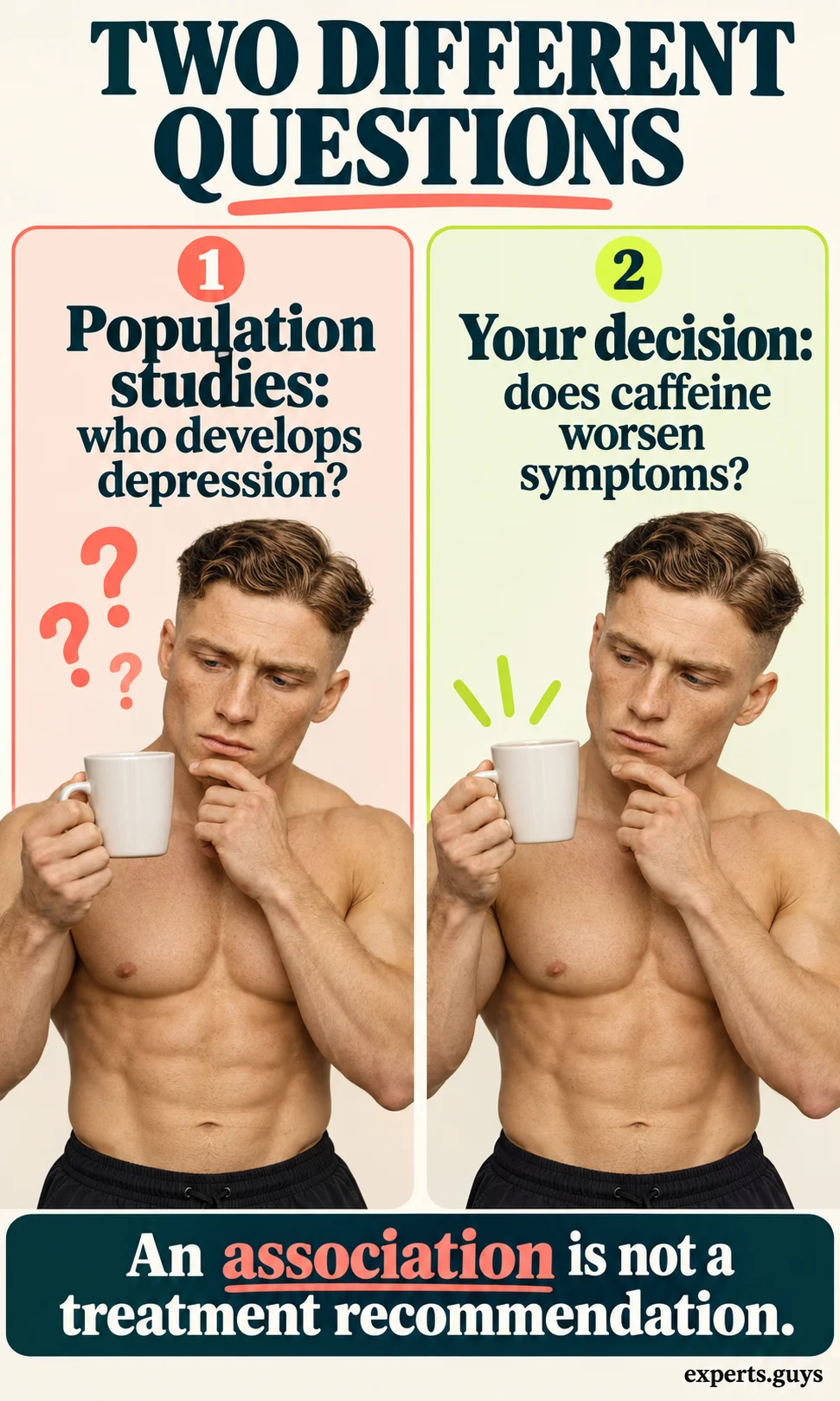
Sleep provides another route by which caffeine can become unhelpful. In a small randomized crossover trial of 23 men, a single 400 mg dose affected subsequent sleep when taken within 12 hours of bedtime; the tested 100 mg dose did not show the same significant effects. The dose-and-timing sleep trial is useful evidence that both variables matter, not a universal cutoff or proof that 100 mg is harmless for everyone.
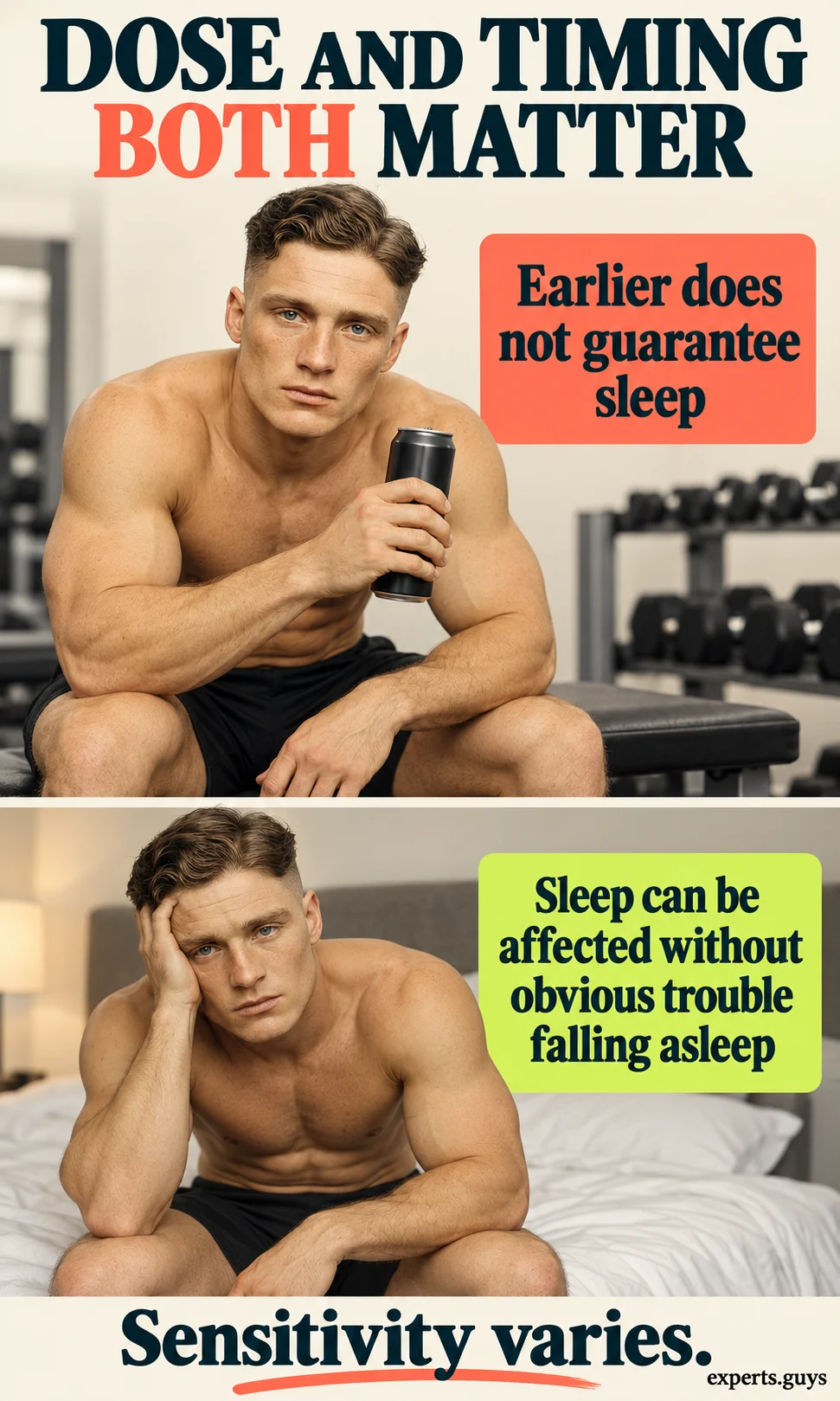
The trial also found a mismatch between some measured sleep changes and what participants perceived. Falling asleep without much difficulty therefore does not settle the question of sleep quality. Equally, one poor night has many possible explanations. A caffeine contribution is a possibility to evaluate, not a diagnosis to attach to every tired morning.
Be careful with the phrase “caffeine crash.” It can refer loosely to feeling tired after stimulation fades, but it does not identify a single medical cause. Sleep loss, an exhausting day, missed meals, withdrawal after a change in routine or a mood disorder may all be relevant. Avoid escalating the next dose solely because the previous lift did not last.
The research question in caffeine use, anxiety and depressive symptoms in students belongs to a different context, where workload and sleep can complicate interpretation. Here the decision remains product-specific: identify avoidable stacking and do not mistake short-term stimulation for improvement in the condition you are concerned about.
What should you change, and when is self-checking not enough?
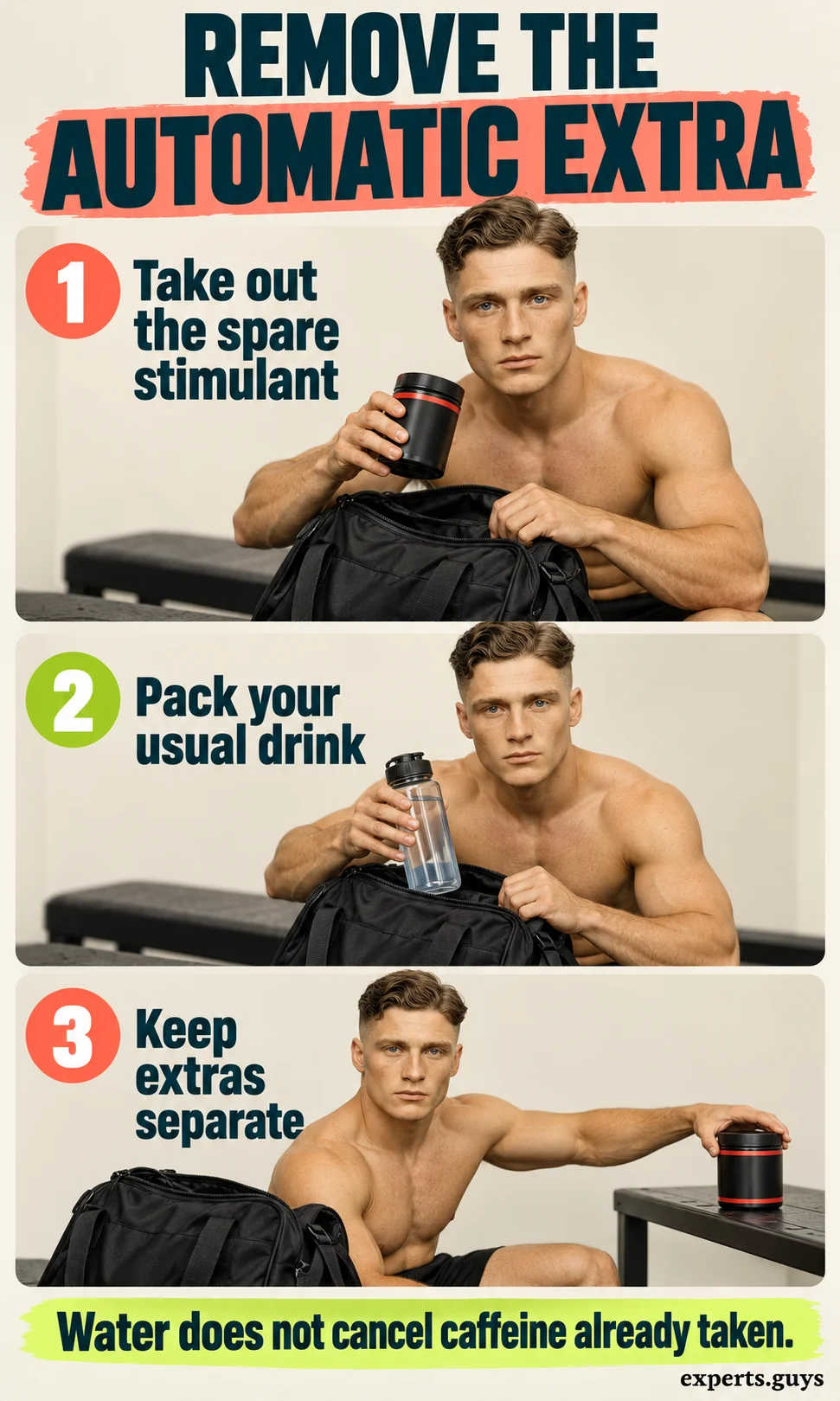
Change the part of the setup that creates the unintended extra serving. If the spare stimulant in your gym bag is an automatic addition to coffee, take that spare out before packing. This is a narrower and more practical goal than trying to redesign every meal, workout and sleep habit at once.
- Open the bag on a stable bench: remove the optional spare stimulant before leaving home. Do not remove prescribed medicines or medically necessary supplies.
- Pack the drink you actually need: use your usual plain water bottle when appropriate. It replaces an automatic extra product in the bag; it does not neutralize caffeine already consumed.
- Store the spare separately: keep it in its original labelled container, out of children’s reach. The point is to stop an unnoticed repeat serving, not to hide essential safety information.
Make the setup easier by moving just the spare product rather than repacking everything. If reaching or lifting is difficult, work seated with the bag at a comfortable height or ask for help. Stop when the next unplanned extra is no longer within easy reach. Feeling calmer is welcome, but it is not required for the action to count.
If the extra product is part of a substantial daily routine, distinguish preventing accidental duplication from stopping all caffeine at once. Withdrawal can bring headache, drowsiness and irritability after a sudden change. A gradual reduction may be more manageable, and the linked withdrawal article owns that separate method. Do not improvise by dry-scooping, splitting pure caffeine powder or compensating with another stimulant.
Medicines, pregnancy, breastfeeding, sleep disorders and heart-rhythm problems can change the advice. Check the relevant combination with a clinician or pharmacist rather than applying a general adult benchmark to yourself. Children and teens should not use adult caffeine limits as a target, and energy drinks are not an appropriate workaround for tiredness.
| Situation | What this article can help with | What it cannot establish |
|---|---|---|
| Two products taken close together | Identify known caffeine and a possible duplicate serving. | Whether the symptoms are caused by caffeine. |
| Amount missing from a label | Expose the uncertainty and prevent a guessed addition. | A safe estimate from marketing language. |
| Low mood continues after a product change | Keep caffeine in proportion as one possible contributor. | Whether depression is present or which treatment is needed. |
| Severe or rapidly worsening symptoms | Recognize that a self-check is insufficient. | Rule out a medical emergency. |
Persistent low mood or loss of interest, especially for roughly two weeks or with impaired functioning, deserves assessment. You do not need to wait for a full two weeks if symptoms are severe or worsening. The broader distinction between clinical depression and temporary low mood matters here: removing one stimulant does not replace a diagnostic evaluation or ongoing treatment.
Do not wait for caffeine to “wear off” if you have severe chest pain, fainting, a seizure, serious breathing difficulty or immediate danger. Seek urgent or emergency care. If you may harm yourself or cannot stay safe, contact emergency services or go to the nearest emergency department and involve a trusted person who can stay with you. These situations take priority over checking labels.
Frequently asked questions
Is decaf automatically caffeine-free?
No. Decaffeinated coffee can still contain some caffeine. Use product-specific information if you need to avoid it closely; do not assume that “decaf” and “zero caffeine” mean the same thing.
Does adding water reduce the caffeine in a drink?
Adding water dilutes the drink, but it does not remove caffeine from the amount you prepared. If you drink the whole diluted mixture, you still consume the original caffeine amount. Dilution should not be used to make an unknown supplement dose seem safe.
Does a sugar-free energy drink avoid this problem?
Removing sugar does not remove caffeine. Check the caffeine statement and serving size separately. A sugar-free label answers a sugar question, not a stimulant-dose question.
Should I stop an antidepressant if coffee makes me jittery?
No. Do not stop or adjust prescribed treatment because of this article. Tell the prescriber or pharmacist what caffeine products you use and what changed; they can assess whether an interaction or another explanation is relevant.
Does being muscular mean I can tolerate more caffeine?
Appearance does not establish an individual safe dose. This guide does not calculate a personal limit from body size, training experience or someone else’s tolerance. Use your actual products, symptoms and medical context.
The useful next step
Before the next optional caffeine product, put it beside the coffee or other source you have already counted. Resolve the serving unit, keep unknown amounts visibly uncertain and separate the unplanned extra. That gives you one concrete improvement in the setup while leaving persistent anxiety, low mood or concerning physical symptoms the attention they deserve.