Caffeine is a stimulant in coffee, tea and many energy drinks that can increase alertness but also worsen anxiety or interfere with sleep. For medical and other health-related students, the useful question is how the amount and timing fit a demanding study day, not whether coffee is universally good or bad for mental health. Check the actual serving, protect your next sleep period, and treat persistent low mood as a separate concern rather than assuming caffeine explains everything.
Do student studies show that caffeine causes anxiety or depression?
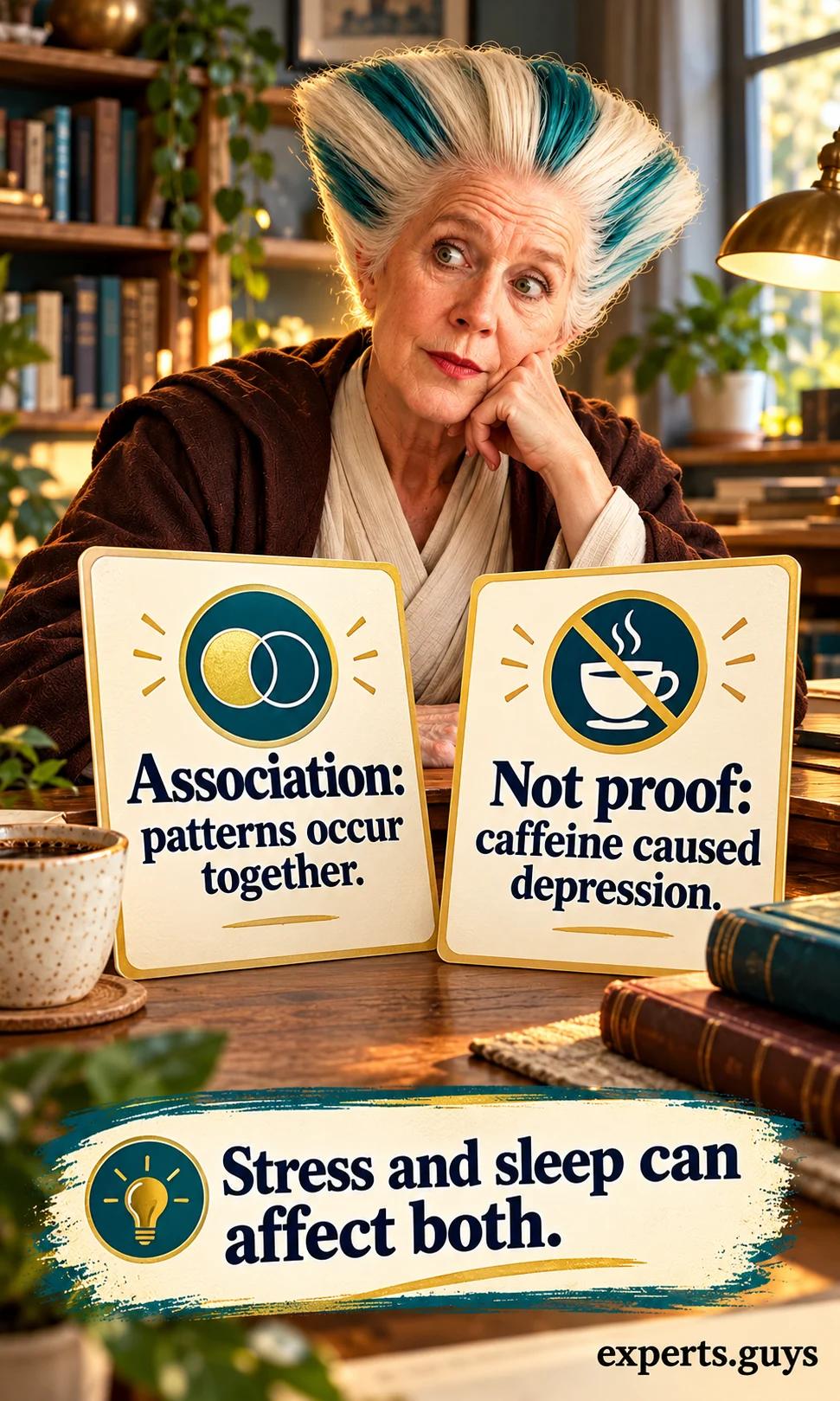
Student studies identify patterns, but a survey cannot establish that caffeine caused a person’s symptoms. Exam stress, short sleep and drink choices may change together; someone who is already exhausted may also reach for more caffeine. That possibility matters because reducing caffeine and treating depression are different decisions.
The medical-student survey behind this topic received responses from 291 of 423 students in Japan. It found a positive relationship between caffeine intake and anxiety symptoms in men after adjustment for smoking and alcohol, but no relationship with depressive symptoms in men. The women’s findings differed: no anxiety association was reported, while higher intake was associated with fewer depressive symptoms after adjustment for alcohol.
Those findings do not justify different caffeine prescriptions for male and female students. They came from a questionnaire study published in 1990, not an experiment assigning drinks or testing treatment. An association with fewer symptoms is also not evidence that starting coffee will prevent or relieve depression; the relevant distinction is between depressive symptoms and a clinical diagnosis.
A newer survey at a Korean medical school, conducted during an examination period in 2023, received 361 responses. About one in five respondents reported an estimated intake of at least 400 mg daily, and improving academic performance was a common reason for use. Its self-reported symptoms and single-school setting make it useful context, not proof of harm in every student or proof that caffeine improves grades.
- Read the outcome: alertness, anxiety symptoms, sleep quality and diagnosed depression are not interchangeable.
- Read the design: a survey describes a relationship; it does not determine which change came first.
- Read the population: findings from one school or subgroup do not automatically apply to every student.
Caffeine blocks adenosine receptors, reducing the signal that contributes to sleepiness. Feeling more awake can therefore coexist with a body that still needs sleep. This is why a late study session can feel productive while creating a problem for the following morning: the immediate feeling of wakefulness is not a measure of recovery or learning.
How much caffeine is actually in your study-day drinks?
Count the caffeine in the quantity you consume, not the number of cups you remember. A cup is a container, not a standard dose, and a bottle may contain more than one labelled serving. The FDA’s adult guidance describes 400 mg per day as an amount not generally associated with negative effects for most adults; it is neither a target nor a guarantee against anxiety or sleep disruption.
Use a packaged drink as a simple serving check. Put the container on a stable surface, turn it until the caffeine information is visible, and distinguish “per serving” from “per container.” If an illustrative label says 80 mg per serving and two servings per bottle, drinking the whole bottle supplies 160 mg. Reading the number correctly is the completion point; no diary or tracking routine is required.
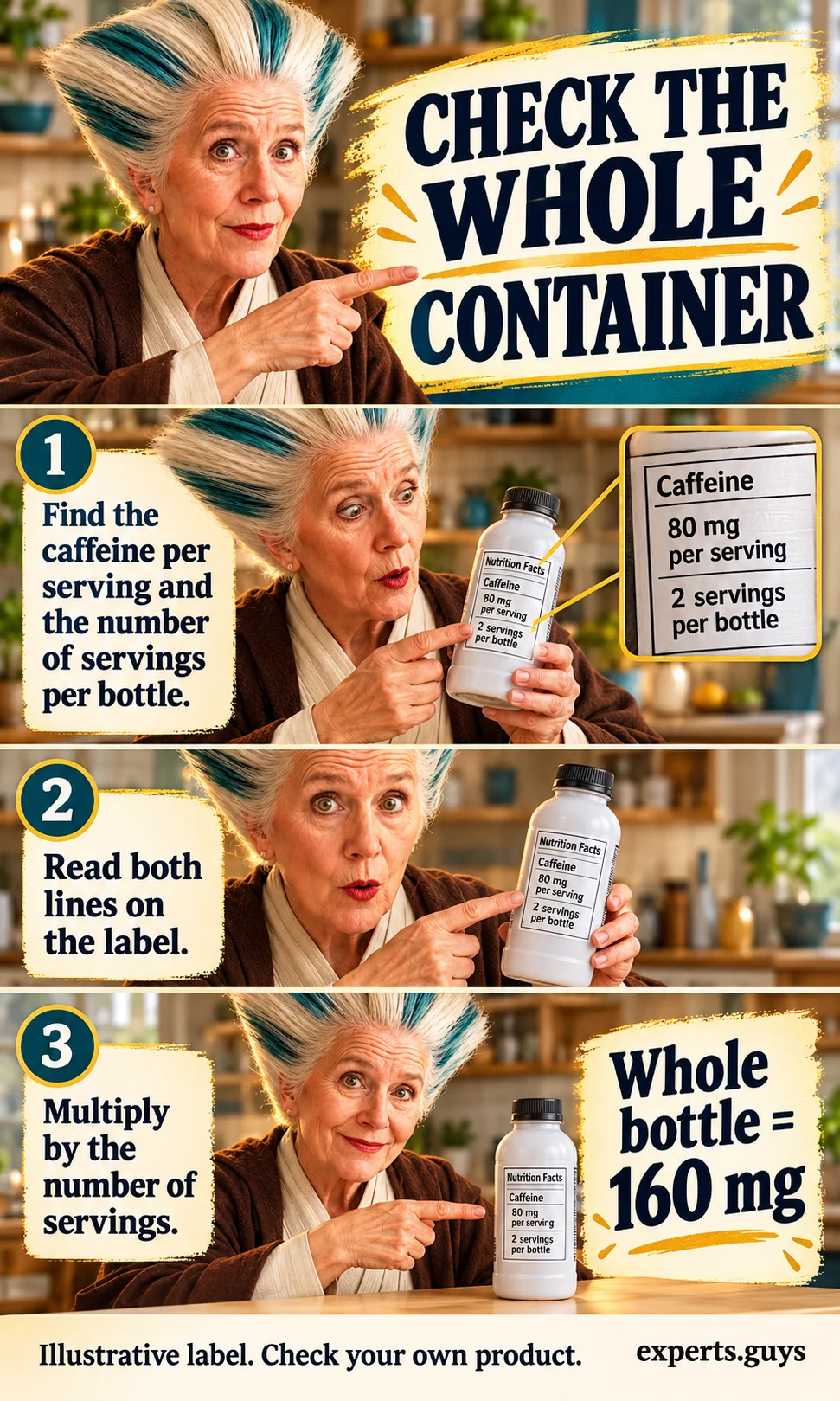
If the label instead gives 32 mg per 100 mL and you drink 250 mL, the arithmetic is 32 × 2.5 = 80 mg. If a café does not provide an amount, ask about the drink size and preparation; do not invent an exact value from taste, colour or price. For a difficult-to-read label, place the container under better light or ask someone to read it aloud. A declared amount is more useful than guessing from a photograph of the cup.
Consider this illustrative study day: one drink labelled 120 mg in the morning, a 160 mg bottle after lunch, and a 60 mg tea later give 340 mg in total. These are example inputs, not typical values for those drink categories. The total answers a quantity question, but it still says nothing about how close the last drink is to bedtime or how sensitive that student is.
Include caffeine from other drinks and relevant medicines or supplements when considering the whole day. Caffeine can interact with medicines, and pregnancy, breastfeeding, heart-rhythm problems, anxiety and sleep disorders can change what is appropriate. Students under 18 should not use adult intake figures as personal guidance. Do not change prescribed medication to make a caffeine routine easier.
Adding water or milk to an entire prepared coffee makes the drink less concentrated without removing its caffeine. To reduce the amount consumed, reduce the regular-coffee portion or replace some of it with a lower-caffeine alternative. This distinction is particularly useful with large travel mugs: a weaker taste can conceal the fact that the original coffee dose is still in the mug.

- Same coffee plus extra water: more liquid, essentially the same caffeine if you drink it all.
- Less regular coffee in the final drink: less caffeine from that regular-coffee portion.
- Regular plus decaf: usually a lower dose than the same volume of regular coffee, but not zero caffeine.
The practical choice depends on the problem. A student with a hidden second serving needs a container check; a student topping up a large mug needs a portion change; a student sleeping poorly after an evening drink needs a timing change. Separating these jobs prevents a complicated routine from replacing one useful action.
| Question | Useful check | What it does not tell you |
|---|---|---|
| How much did I drink? | mg per serving × servings consumed | Whether that amount suits you |
| Did I reduce the dose? | Less regular coffee or a lower-caffeine replacement | Whether water alone removed caffeine |
| Could timing matter? | Last caffeine relative to planned sleep | A guaranteed safe cutoff |
| Why am I still tired? | Consider sleep and symptoms beyond drink choice | A diagnosis from a daily total |
The optional calculator below performs the serving and mixture arithmetic only. Use amounts from a label or a reliable product specification; when the input is uncertain, the result is uncertain too. If tiredness continues despite enough opportunity to sleep, the comparison of depression fatigue and ordinary tiredness explains why a stronger drink may miss the real problem.
Check your caffeine arithmetic
Calculate a serving or compare a regular/decaf mixture. Use your product’s values.
Arithmetic only. No personal safe limit, diagnosis or taper schedule. Nothing is stored or sent.
When can a study-day drink interfere with sleep?
Work backwards from your intended sleep period, including daytime sleep after a night shift. Caffeine’s effects can last up to eight hours, and some people need an even earlier stop. An eight-hour gap is a planning example, not a clearance test or a promise of uninterrupted sleep.
For example, a student planning to sleep at 11 p.m. could use 3 p.m. as an initial point after which drinks are caffeine-free. Someone planning to sleep at 9 a.m. after a shift has a different clock: the same eight-hour example points to 1 a.m. Neither example recommends taking caffeine at that time; both show why “no coffee after dinner” is too vague for changing schedules.
At the point you prepare the late study drink, set the coffee aside and place a caffeine-free choice on the tray instead. Water is a straightforward option; a familiar alternative works if its ingredients suit you. The physical checkpoint is that the late drink has changed. If suddenly removing that serving would be a large reduction from your usual intake, use the gradual substitution method below rather than forcing an abrupt stop before an important assessment.

A randomized crossover trial in 23 men compared 100 mg and 400 mg doses at different times before bed. The larger single dose could impair sleep even when taken 12 hours beforehand; the smaller dose did not show the same measured effect in that sample. The study supports considering dose and timing together, but its small male sample does not establish a universal safe evening dose.
- If the late drink is optional: use the caffeine-free replacement at that existing drink occasion.
- If a shift changes bedtime: anchor your choice to the sleep you actually plan to take.
- If poor sleep persists: consider other causes rather than repeatedly moving a cutoff and expecting certainty.
Feeling able to fall asleep after coffee does not establish that sleep was unaffected. Equally, one poor night after coffee does not prove coffee was the only cause. Exams, unfamiliar sleeping environments and a changing schedule can complicate the picture; persistent sleep problems alongside low mood deserve a broader assessment than drink timing alone.
How can you reduce caffeine without confusing withdrawal with low mood?
For a regular user, gradual reduction is generally more comfortable than suddenly stopping. The hands-on method here is a measured replacement within one existing coffee occasion: keep the final drink size familiar while reducing the regular-coffee portion. It is a practical adaptation of gradual reduction, not a tested treatment for anxiety or depression and not an instruction to begin using caffeine.
Set up two clearly identified jugs of prepared regular and decaf coffee, a small measuring cup, your usual mug and a stable tray. Work with comfortably cooled liquid, keep loose sleeves away from pouring, and sit if standing is tiring. Use the same measure throughout. The example below replaces one quarter of the regular coffee; a smaller change may suit someone who gets withdrawal symptoms easily.
- Measure three equal parts of prepared regular coffee into the mug or mixing jug.
- Add one equal part of prepared decaf coffee, keeping the final drink volume the same as the original four-part drink.
- Use this mixture in place of that usual drink, rather than drinking it in addition to the original. Keep the next change modest and allow time to judge whether the current reduction is tolerable.

For an illustrative 200 mL drink, that means 150 mL regular plus 50 mL decaf. The caffeine remaining is the regular portion’s contribution plus the decaf portion’s contribution: it is not automatically 75% of the original dose because decaf still contains caffeine. The optional calculator makes that distinction visible when both input amounts are known.
A common mistake is making the original full-strength coffee and then adding decaf on top. That retains the original caffeine and increases the drink size. Correct it by measuring the smaller regular portion first. An easier alternative is asking for a smaller regular portion topped up with decaf at the café, if available, or choosing a clearly labelled lower-caffeine version. The result is a changed drink, not a required improvement in mood.
Do not turn the example into a rigid taper calendar. If a reduction causes troublesome headaches or makes studying difficult, pause further reductions and consider a smaller change; significant or unusual symptoms need advice. People with complicated medication regimens, disabling symptoms or high-dose supplement use should get an individualized plan. Avoid trying to measure pure caffeine powder for this method.
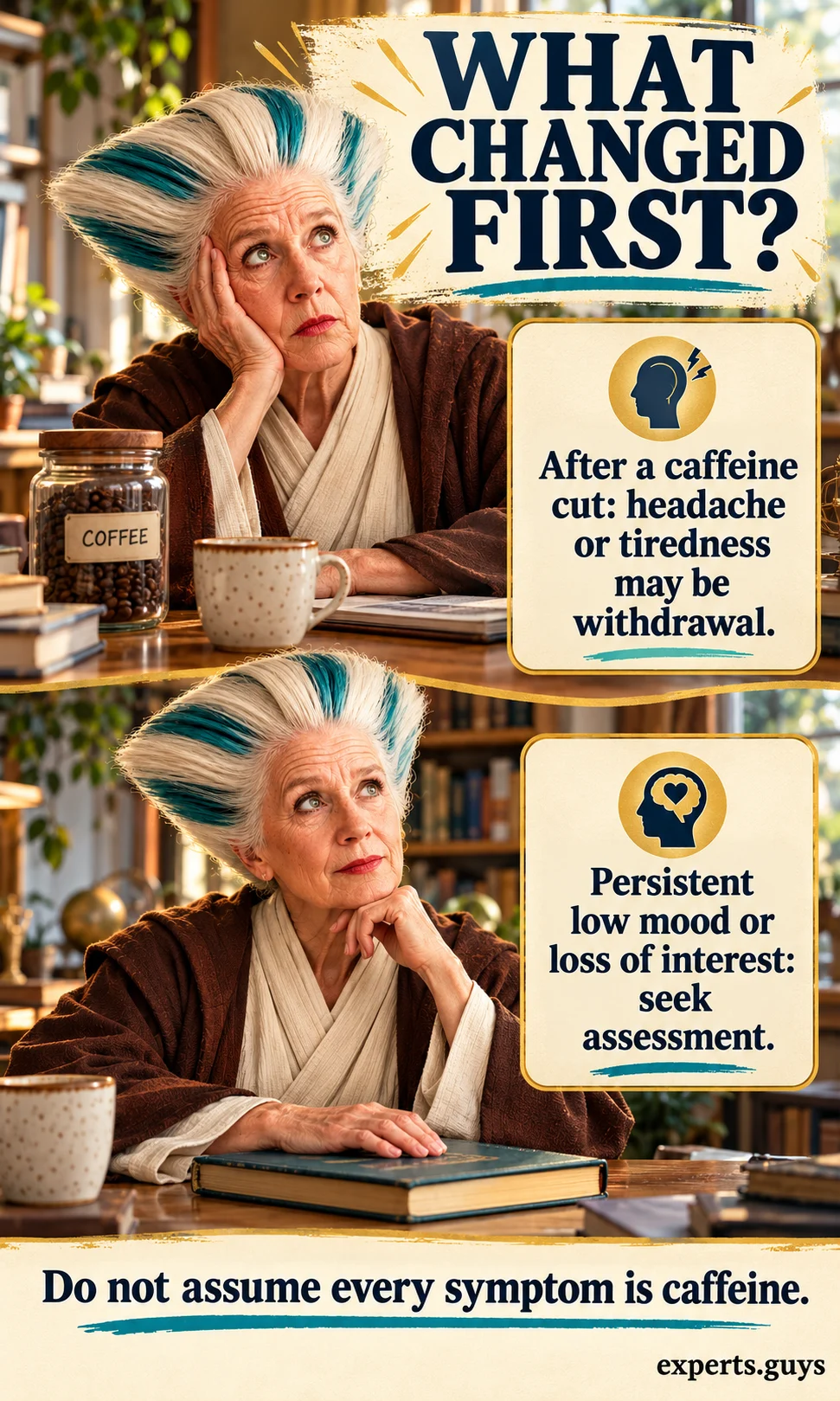
Research on caffeine withdrawal describes symptoms often beginning 12–24 hours after stopping, peaking around 20–51 hours and lasting roughly 2–9 days. Headache, sleepiness, irritability and difficulty concentrating can therefore follow a reduction. Timing is a clue, not a diagnosis, and symptoms can have more than one cause.
| Pattern | Reason to consider | Response |
|---|---|---|
| Symptoms follow a substantial caffeine cut | Withdrawal may contribute | Avoid repeated large changes; seek advice if disabling |
| Low mood or lost interest persists | A separate mood condition may be present | Arrange an assessment rather than waiting for a perfect taper |
| Chest pain, fainting, severe breathing difficulty or seizure | Potential emergency | Seek urgent medical help; do not label it ordinary jitters |
Persistent low mood or loss of interest, especially with difficulty managing daily life, deserves attention even when caffeine is involved. Two weeks is a diagnostic time frame used in assessing depression, not a rule to wait before asking for help. Seek help sooner for severe symptoms; thoughts of self-harm or inability to stay safe require immediate local emergency or crisis support.
Frequently asked questions
Does sugar-free mean caffeine-free?
No. Sugar content and caffeine content are separate properties. Read the caffeine information rather than using a sugar-free claim as a substitute.
Can I use this method with tea?
The same portion principle can apply, but steeping and product differences make an exact caffeine calculation difficult without reliable values. Choose a clearly identified lower-caffeine or caffeine-free replacement rather than assuming a weak-looking tea has a known dose.
Should I start coffee because a study links it with less depression?
No. An observational association does not establish a preventive treatment. Starting caffeine to manage depression can also complicate sleep or anxiety; persistent symptoms need their own assessment.
Can water quickly flush caffeine out?
Drinking water is not an antidote that immediately removes caffeine. Choose normal hydration, avoid taking more caffeine, and seek urgent help for severe symptoms rather than trying to flush them away.
Choose the change that matches your study day
Start with the uncertainty you can actually resolve: read the container if the dose is unclear, replace part of the regular coffee if the portion is too large, or change the late drink if it is crowding sleep. Keep the result concrete and modest. A more deliberate drink choice can remove one avoidable difficulty; it should not become an explanation for every anxious feeling, exhausted morning or period of low mood.