
One problem with persistent depression is that everyday support can become a fixed routine even after a person’s needs have changed. The useful next step is to review one arrangement for its effort, burden and retained choice, while continuing appropriate care. You do not have to remove useful help or prove independence to make that review worthwhile.
This guide is for adults living with persistent depressive symptoms and people they trust. It focuses on arrangements that have become automatic: who decides, who coordinates, what help is welcome and when to revisit it. The examples are practical communication aids alongside care, not tested treatments, diagnostic criteria or instructions to reduce support.
Why can familiar support stop fitting persistent depression?
Long-standing arrangements deserve occasional review because needs, capacity and preferences can change. Persistent depressive disorder (PDD), historically called dysthymia, involves a sustained depressive pattern; its duration does not make it harmless. Adult diagnostic descriptions commonly use at least two years, but that is not a waiting period for care, and a familiar routine cannot establish a diagnosis.
Review one workaround that has become permanent
Start with one arrangement that began as temporary help: delivered groceries, a friend handling bookings, or always declining invitations. Ask whether it still solves the original difficulty and whether you still have a say. The aim is to improve the fit of the support, not prove you can manage without it.
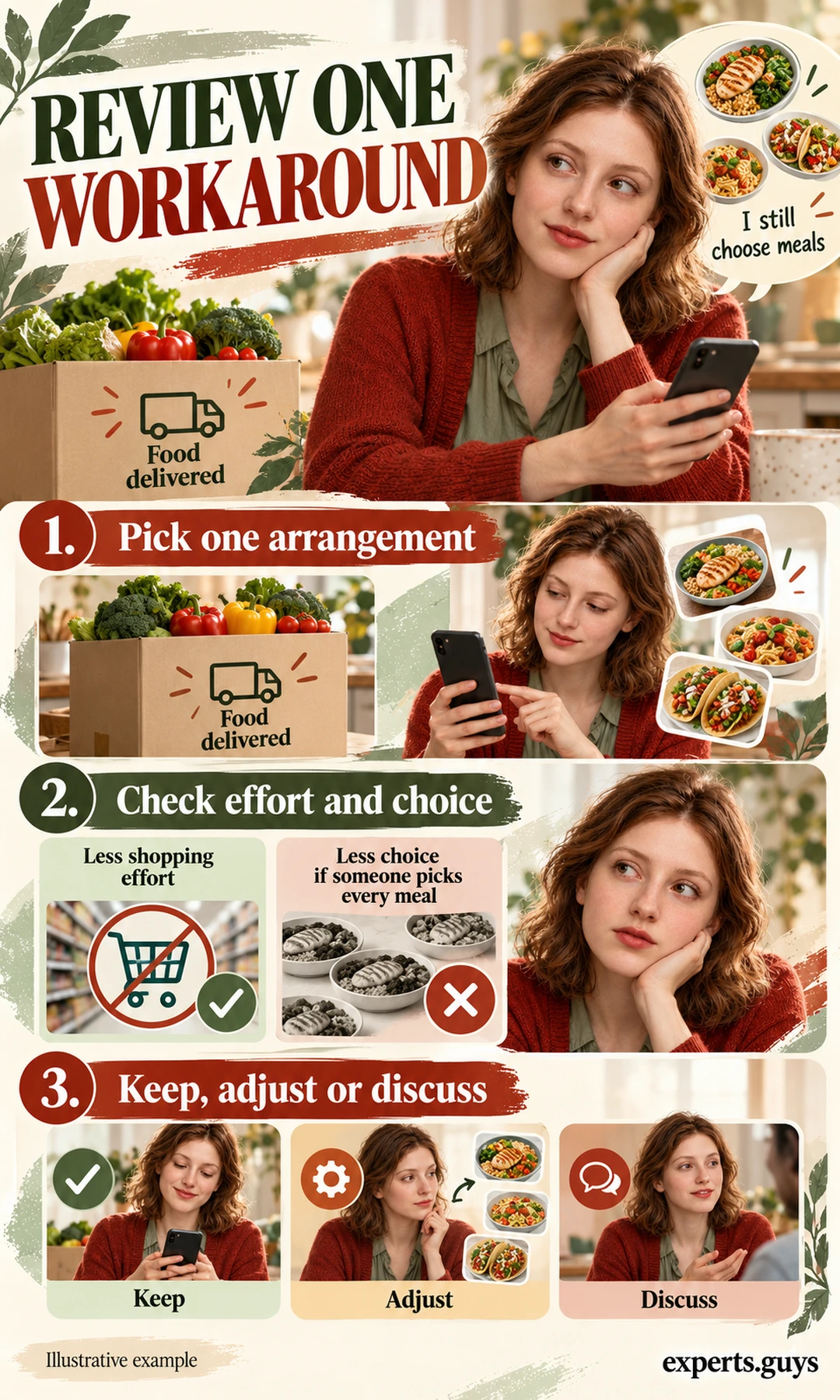
For example, grocery delivery may protect energy while someone else choosing every meal leaves you with little say. Keep the delivery and choose two meals yourself if that feels manageable. This is an illustrative adjustment, not a test of recovery.
- Open the relevant order, calendar entry or message on your phone; no new diary is needed.
- Name what the arrangement makes easier and what, if anything, it removes from your control.
- Choose one response together: keep it, change one part, or discuss it with your care team.
Avoid withdrawing useful help simply because it has lasted a long time. If choosing meals is too demanding, selecting between two suggestions is a smaller alternative. The useful checkpoint is whether the arrangement becomes easier to live with while protecting food, safety and choice.
Share the coordination, not only the visible chore
Practical help can leave the person with depression doing all the noticing, deciding and reminding. A delivery arriving is only the visible end of a larger task. Dividing that coordination explicitly can make the offer of help more usable without assuming either person has unlimited capacity.
- Choose a recurring task and name its actual parts: deciding, arranging, doing and checking.
- Agree who owns each part, including who notices when it needs doing.
- Confirm the next occurrence in an existing shared message or calendar, if both people want that.
For a grocery order, an example agreement is: choose meals together, the helper places the order, and an agreed person receives it. Avoid a vague promise such as “tell me if you need anything” when asking and reminding are themselves difficult. Clear ownership reduces the need to negotiate every small step again.

Do not turn the agreement into surveillance or give someone access to passwords. If a shared calendar feels intrusive, use one direct conversation about the next task. Check whether fewer reminders were needed and whether the arrangement was realistic for both people; revise it if either person becomes overloaded.
The dysthymia guide covers symptoms and mood history if you need that foundation. Here, the decision is narrower: does an existing arrangement still fit the person using it? A support arrangement can be helpful even when symptoms remain, and changing it does not establish what caused those symptoms.
How can help reduce effort without taking away choice?
Useful support is not always the smallest amount of help. It is help that fits the present difficulty, is agreed rather than imposed, and leaves the person involved as far as they wish and are able. Dependence during illness is not a moral failure, and preserving choice does not mean withdrawing essential care.
Choose whether help means alongside, instead of, or later
The same task may need different support on different days. A person might want company while opening an administrative email, practical help completing it, or a check-in later. Asking which kind of help is welcome protects consent and avoids treating a difficult day as a permanent loss of ability.
- Offer three plain choices: “with you”, “for you”, or “check later”.
- Agree on one task and any boundaries before starting.
- Choose a natural review point, such as when that task comes around again.
An illustrative request is, “Could you sit with me while I open the bill? I want to handle the account myself.” Another day, the person may ask for help finding the correct contact details instead. Neither choice establishes how severe their depression is.

Do not insist on independence when a person needs substantial support, and do not take over without agreement. If three options are too much, ask one yes-or-no question about a specific form of help. Stop the task if distress rises sharply; return to the agreed care or support plan rather than pushing through to finish.
On a small screen, swipe the table sideways to see every column.
| Support arrangement | Useful checkpoint | Reason to revisit |
|---|---|---|
| A helper completes a task | The help is wanted and essentials are covered | The person wants a different role, or the helper cannot sustain it |
| A helper works alongside | Company makes starting or deciding more manageable | The company feels like monitoring or adds pressure |
| A later check-in | Both people know when and how to reconnect | An essential need is left uncovered while waiting |
Make connection easier without making it compulsory
Repeated cancellations can leave both people uncertain about how to stay connected. A lower-demand invitation can preserve an opening without turning every interaction into a discussion of symptoms. It should remain an invitation, not a requirement to perform sociability.
- Offer two concrete options, such as a short call or a text exchange.
- Make declining or ending early acceptable; avoid demanding an explanation.
- Afterwards, ask whether that format fitted, rather than whether it made the person happier.
A message could say, “Would a short call or a text be easier today? Either is fine.” If the answer is “text”, respond in that format without repeatedly calling. The point is a mutually manageable connection, not a guaranteed improvement in mood.

A common mistake is to make a small invitation expand into a long visit. Keep the agreed boundary, and offer another occasion if today is not workable. If contact keeps disappearing or distress is worsening, discuss that change with the care team rather than increasing pressure or silently dropping all contact.
These options address the design of help, not whether someone looks productive. For that separate question, see when productivity hides depression. A person’s preference may change, so ask again rather than making one answer permanent.
How do you stop old assumptions from shaping every interaction?
Persistent symptoms can become entangled with what other people expect from someone. That does not mean every disagreement is caused by depression or that depression excuses harmful behaviour. The useful distinction is between a specific difficulty that can be discussed and a sweeping judgment that leaves nobody knowing what to change.
Replace a character judgment with a usable request
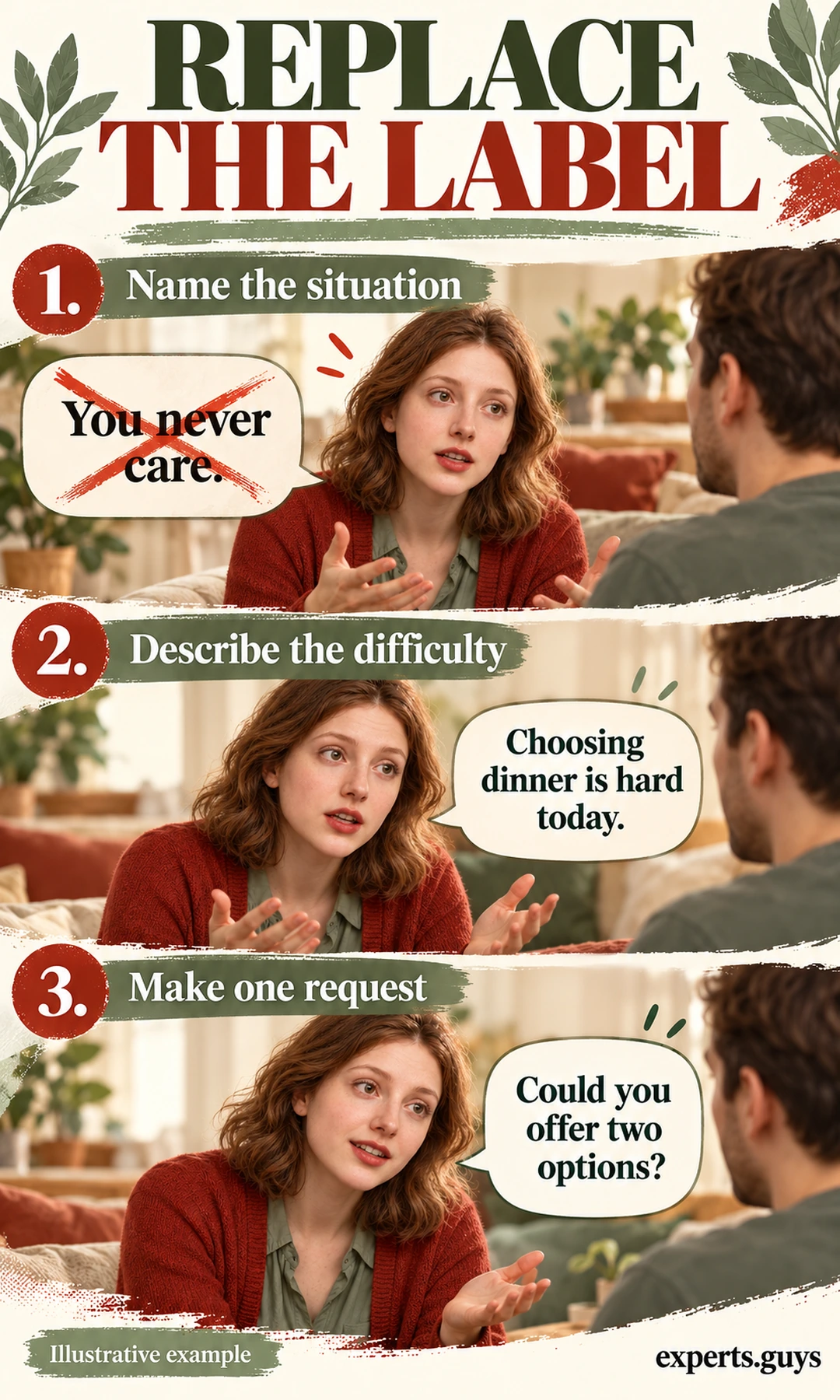
Long-running difficulty can attract labels such as uncaring, lazy or impossible. Those labels do not identify what help would be useful and can turn a practical problem into an argument about character. A specific description makes room for an answer while leaving the other person free to set limits.
- Name one current situation without “always” or “never”.
- Describe the difficulty without claiming to know the other person’s motives.
- Ask for one feasible change, and allow a different suggestion.
Instead of “You never care”, try: “Choosing dinner is hard today. Could you offer two options?” A supporter might say: “I cannot decide all the meals this week. Could we choose two together and repeat them?” These are sample communication scripts, not a therapy protocol.
Do not use a gentler script to excuse insults, coercion or abuse. If talking directly feels unsafe, use a safe support route instead of practising the conversation with that person. If speaking is tiring but the relationship is safe, send the same short request by message and check whether it leads to a clear agreement.
Do not let one good day reset every expectation
A better day can be encouraging without meaning that every support arrangement should end. If expectations suddenly rise, the person may feel pressure to hide the next difficult day. Treat the better experience as useful information about what was possible and what support was present.
- Notice what helped that day, without assuming it caused the improvement.
- Keep the support that is still useful unless you agree a change.
- Revisit one expectation together when you have more than a single experience to discuss.
After attending a family meal, someone might say, “I enjoyed being there, and I still need help with groceries for now.” That preserves both the positive experience and the remaining need. It avoids making a pleasant evening into an obligation to resume everything at once.

Avoid the opposite mistake of treating improvement as meaningless. If the person wants to try more, agree one manageable change with room to revise it. Check how it fitted across comparable situations; do not use a fixed number of good days as a medical rule or change medication because of it.
Where disagreements have become a repeated pattern, depression and relationship conflict addresses that wider issue. This page is about updating specific expectations around persistent symptoms. Neither person should have to accept mistreatment to keep a support arrangement in place.
What should change when the same support no longer helps?
Repeated difficulty is a reason to reconsider the fit of support and care, not proof that the person has failed. Treatment may involve psychotherapy, medication or a combination, with decisions tailored to the person. If symptoms persist or worsen despite care, explain the remaining problems at a review rather than independently starting, stopping or changing medication.
Bring a life outcome into the treatment review
A treatment review can include a personally meaningful outcome alongside symptoms and side effects. This is useful when “better” is too vague or when a completed task hides how difficult it remained. Choose something you value, rather than an outcome selected only to reassure someone else.
- Choose one everyday outcome, such as joining a meal or handling one appointment.
- Compare similar situations using three questions: what did I do, what effort did it take, and what choice did I retain?
- Tell your clinician what improved, what stayed difficult, and what you want the next review to address.
You could dictate a short private phone note: “I joined dinner and chose my meal, but I needed the rest of the evening alone.” That description carries more information than a simple success-or-failure label. It is an illustrative observation, not a validated measurement scale.

Do not use a phone note to replace clinical assessment or a symptom measure your clinician has recommended. If keeping notes becomes burdensome, bring one remembered example instead, and protect sensitive messages on shared devices. The checkpoint is a clearer shared care discussion, not a diagnosis or a promise that a particular treatment will work.
Give support a boundary and an agreed backup
Support is easier to sustain when both people know what is possible. A helper should not have to promise constant availability, and the person receiving help should not have to guess when it will disappear. A bounded agreement can protect the relationship while keeping essential needs visible.
- State the specific help and availability honestly.
- Agree what happens if the helper is unavailable, including whether another person or service can help.
- Keep urgent care separate from ordinary arrangements; a household backup is not a crisis service.
For example: “I can help order groceries on Saturday. If I cannot, we can use delivery or ask the other person we have agreed on.” Check that the backup is affordable, willing and actually available. Do not nominate someone without their agreement or leave food and other essentials dependent on an untested plan.
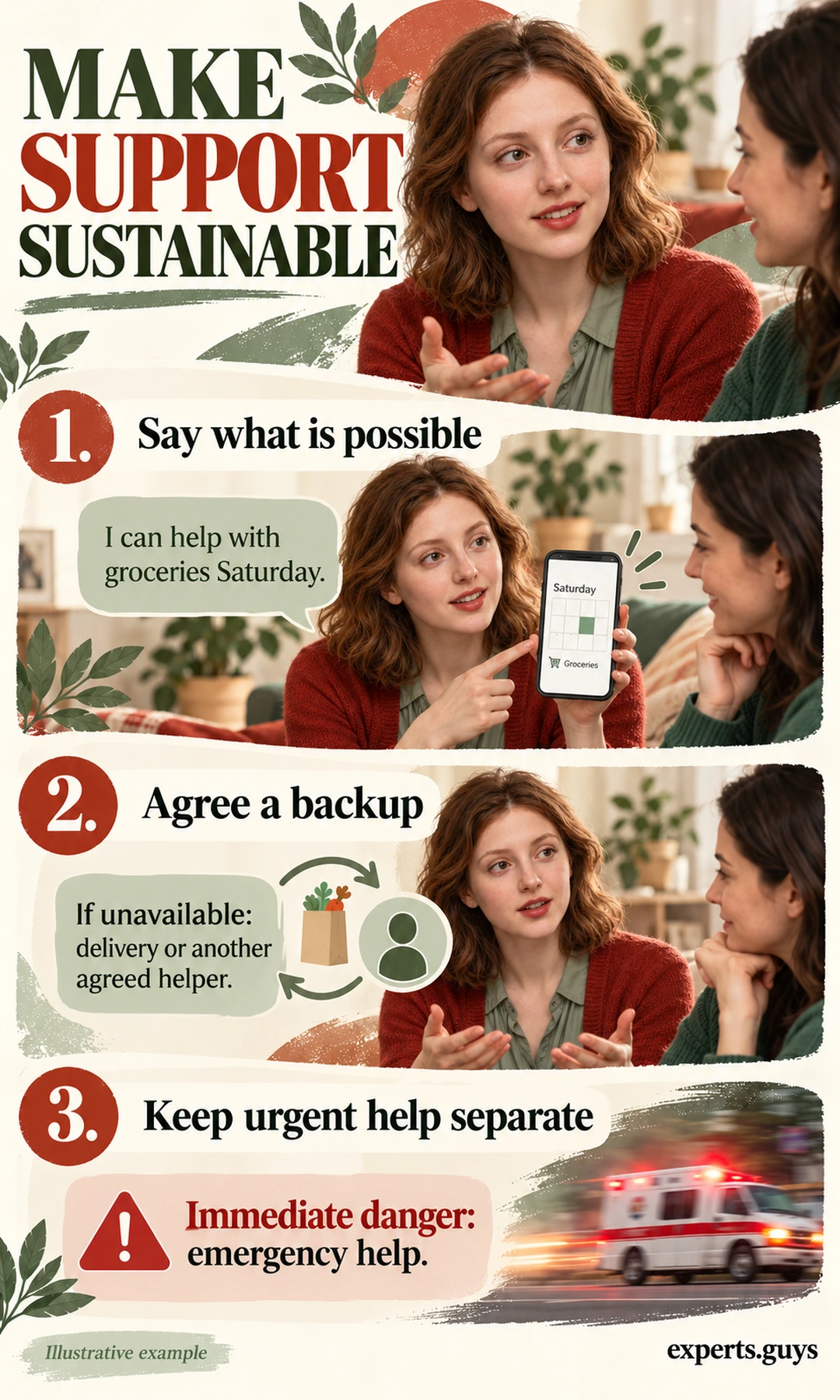
Avoid using a boundary as a threat to remove care. If essential support cannot be covered, bring that concrete gap to the relevant care or community service rather than pretending the agreement is workable. If there is immediate danger, use emergency help; do not wait for the next shopping day or a routine reply.
For a broader care discussion, chronic depression and dysthymia covers history and next steps. Bring the particular gap that remains: an uncovered essential, a support arrangement that has become unsustainable, or symptoms that are getting worse. That gives the review a concrete problem to address without assuming which treatment or service is the answer.
Evidence and limits
Persistent depression is a health condition, not a character defect. Symptoms, health conditions, treatment effects and circumstances can overlap, so the cause of a particular difficulty cannot be inferred from a household example. The MedlinePlus overview of persistent depressive disorder explains its clinical pattern and why ongoing or worsening symptoms deserve care.
Research with adults who have persistent depression and their informal caregivers has described difficulties involving identity, relationships and coping support. The qualitative study of self-management and care needs helps explain why these conversations matter, but it does not prove that the eight examples above improve depression. The examples are editorial applications of consent, clear communication and practical problem-solving, with no promised clinical effect.
Clinical care should consider more than a symptom count, including duration, personal circumstances and functioning. NICE guidance on chronic depressive symptoms describes treatment and additional support options for adults, while the NHS living-with-depression guidance discusses ongoing care and the strain that can affect families. Service pathways differ by country, so use those sources as background rather than a promise of local eligibility.
The WHO depression fact sheet supports the need for appropriate treatment and urgent help when there is immediate danger. All people and scenarios in the images are AI-generated illustrations. They show examples of communication and support, not real patients or evidence of treatment results.
Frequently asked questions
What if I have no trusted person to help?
Choose the support gap that matters most, such as obtaining food or getting to an appointment, and describe it to your care provider or an appropriate community service. Availability, cost and eligibility vary, so ask what can actually be arranged. These examples do not assume everyone has a partner or family member available.
Do I have to tell my employer that I have PDD?
You do not need to share your diagnosis with an employer to use the household examples in this article. If you need a workplace adjustment, the relevant disclosure process and legal rules depend on your country and workplace. Get information about that process before sharing more health detail than it requires.
Should a supporter have access to my phone or medical account?
That is not required for these examples. You can agree on a task or send a brief message without sharing passwords, an entire medical record or unrestricted device access. If you choose to share particular information, agree on its scope and revisit that permission when necessary.
Can these methods replace therapy or medication?
No. They are ways of making everyday support clearer and more workable, not treatments for persistent depressive disorder. Continue your agreed care plan and raise persistent difficulties, worsening symptoms or side effects with the clinician responsible for your treatment.
Choose the arrangement that needs attention first
On a small screen, swipe the table sideways to see every column.
| What is happening | Start here |
|---|---|
| Help works, but choice has disappeared | Keep useful assistance and revisit one decision the person wants to make. |
| The helper still needs constant instructions | Agree who owns the coordination, not only the visible chore. |
| A good day has changed everyone’s expectations | Keep helpful support and discuss one realistic adjustment together. |
| Symptoms or essential needs are worsening | Seek the appropriate clinical or urgent help before optional support exercises. |
Choose one existing arrangement rather than rebuilding every routine. Keep what helps, agree what changes, and revisit whether it fits both people. Progress in this conversation means clearer, more sustainable support; improvement in depression still needs to be considered within the wider care plan.