



Many people spend years believing that happiness is waiting on the other side of their next achievement. They tell themselves that life will finally feel complete after earning a promotion, buying a dream home, growing a successful business, reaching a fitness goal, or achieving financial freedom. The expectation feels logical because success is often presented as the destination where confidence, peace, and fulfillment naturally arrive together.
Yet countless people discover something surprising when they finally reach those milestones. Friends celebrate their accomplishments, colleagues congratulate them, and family members express pride, but internally the emotional transformation they expected never fully appears. Instead of lasting excitement, they experience only a brief sense of relief before asking themselves a question that feels almost uncomfortable to admit: “Why doesn’t this feel as good as I imagined?”
This experience is far more common than many people realise. Success and satisfaction are closely connected, but they are not produced by the same psychological processes. Understanding why achievement sometimes feels emotionally incomplete can help you stop endlessly chasing the next milestone and begin building a life that feels genuinely meaningful rather than permanently unfinished.
Success and Satisfaction Are Different Psychological Systems
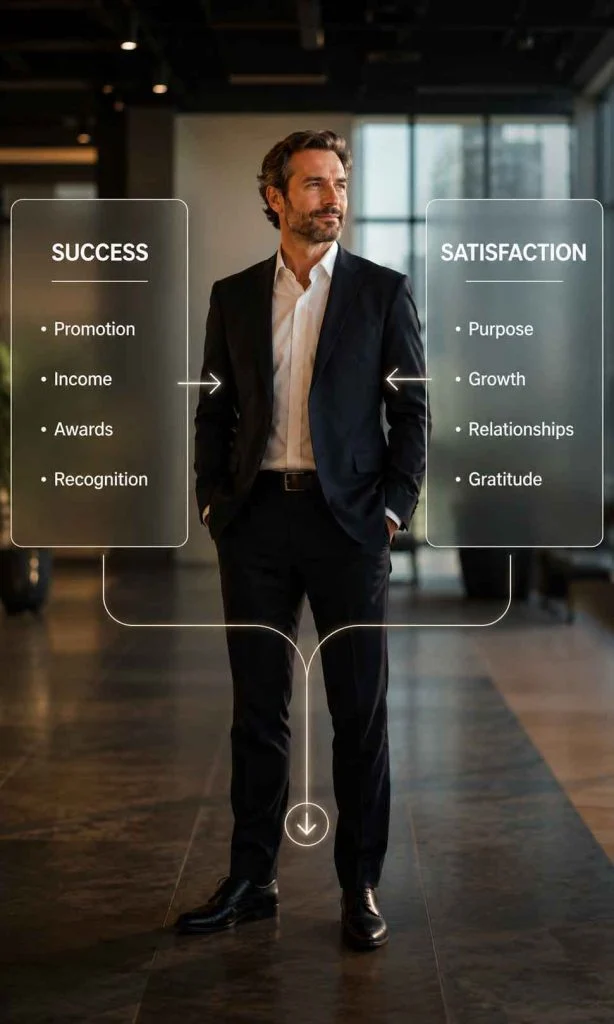
Although people often use the words success and satisfaction interchangeably, psychology treats them as two very different experiences. Success usually measures external progress such as career advancement, financial security, academic qualifications, or personal achievements. Satisfaction, on the other hand, reflects how deeply those experiences align with your emotional needs, values, relationships, and overall sense of purpose.
This difference explains why someone can appear extremely successful while privately feeling disconnected from everything they have worked so hard to achieve. At the same time, another person with fewer traditional accomplishments may experience a much stronger sense of contentment because their daily life feels meaningful and emotionally rewarding.
When the loss of satisfaction extends beyond achievement and begins affecting hobbies, relationships and ordinary experiences, the broader depression symptoms guide can help explain how loss of pleasure fits alongside emotional, physical and cognitive changes.
Satisfaction Gap Intelligence Studio
Explore why achievement may not always create the fulfillment you expected. This guided studio helps you understand your success patterns, hidden satisfaction blockers, motivation style, reflection habits, and next steps for building a healthier relationship with achievement.
One important reason for this difference is the brain’s remarkable ability to adapt. Psychologists describe this process as hedonic adaptation, meaning that positive changes gradually become part of everyday life rather than continuing to generate the same level of excitement. The new salary eventually becomes your normal income, the dream home simply becomes your house, and the career you once imagined slowly turns into another routine workday. This adaptation is not a personal failure or a sign that success is meaningless. Instead, it reflects how the human brain is designed to keep adjusting to new circumstances, making long-term satisfaction depend on far more than achievement alone.
Why Achievement Sometimes Feels Empty
Many people immediately assume that feeling emotionally flat after reaching a major goal means they pursued the wrong ambition. While that occasionally happens, the reality is usually more complicated. Several psychological patterns quietly reduce the emotional impact of success without people even noticing they are happening.
You Were Chasing Relief More Than Happiness
Many ambitious goals begin as attempts to escape uncomfortable emotions rather than move toward genuine fulfillment. Thoughts such as “Once I prove myself, people will respect me,” or “When I finally succeed, I’ll stop feeling behind everyone else,” are driven more by the desire to eliminate emotional discomfort than by the pursuit of lasting joy.
This distinction matters because relief behaves differently from happiness. Relief provides an immediate emotional release, but it naturally fades as the stressful situation disappears. If the original emotional needs remain unresolved, the same feelings of insecurity, comparison, or dissatisfaction often return, encouraging another cycle of chasing the next achievement.
You Never Learned to Enjoy Progress
Highly driven people often become experts at setting goals but surprisingly inexperienced at appreciating what they have already accomplished. Instead of pausing to celebrate progress, they immediately create another target, another project, or another benchmark that needs to be reached.
Over time, life becomes an endless sequence of moving finish lines. Every success is quickly replaced by a new expectation, leaving very little opportunity for satisfaction to develop. Ironically, some of the world’s highest achievers experience this pattern because their ability to pursue excellence grows much faster than their ability to recognise enoughness.
Your Self-Worth Depends on Performance
When personal value becomes closely tied to productivity, achievements stop feeling like celebrations and instead become proof that must be continually renewed. Rather than thinking, “I accomplished something meaningful,” the internal conversation quietly shifts toward “Now I have to keep proving that I deserve this.”
Living with this mindset creates constant psychological pressure because every success feels temporary. Instead of building confidence, achievement becomes another responsibility to maintain, making genuine satisfaction increasingly difficult to experience.
You Expected Success to Heal Emotional Wounds
Achievement can certainly improve many practical areas of life by creating financial security, expanding opportunities, and increasing confidence in your abilities. However, it cannot automatically resolve loneliness, perfectionism, unresolved childhood experiences, chronic anxiety, or deeply rooted negative beliefs about yourself.
Success changes external circumstances, while emotional healing changes your relationship with yourself. Although these journeys often influence one another, they are not the same process. Recognising this difference allows people to appreciate achievement without expecting it to solve every emotional challenge they carry.
The Brain Was Never Designed to Stay Excited Forever

One of the most surprising discoveries in psychology is that the human brain is remarkably efficient at adapting to change. Whether something positive or negative happens, our minds gradually adjust until what once felt extraordinary becomes part of everyday life. This adaptation helps us recover from difficult experiences, but it also explains why exciting achievements rarely continue producing the same emotional intensity over time.
Imagine receiving a significant salary increase after years of hard work. During the first few weeks, the extra income may feel life-changing, bringing a sense of pride, relief, and optimism. Several months later, however, that larger paycheck often becomes the new normal. The same pattern appears after buying a new car, moving into a dream home, completing a university degree, or launching a successful business. What once represented a major life goal gradually blends into the background of daily routines.
This does not mean your accomplishments have lost their value. Rather, it highlights an important truth: the emotional reward generated by success naturally fades unless it is supported by experiences that continue creating meaning, connection, and personal growth. Expecting excitement to remain permanently at its peak places an impossible burden on every future achievement.
Four Hidden Habits That Quietly Steal Satisfaction
People often believe satisfaction disappears because they have not achieved enough. In reality, many unknowingly develop habits that prevent them from fully appreciating what they have already accomplished. These patterns are so common that they often feel completely normal until someone points them out.
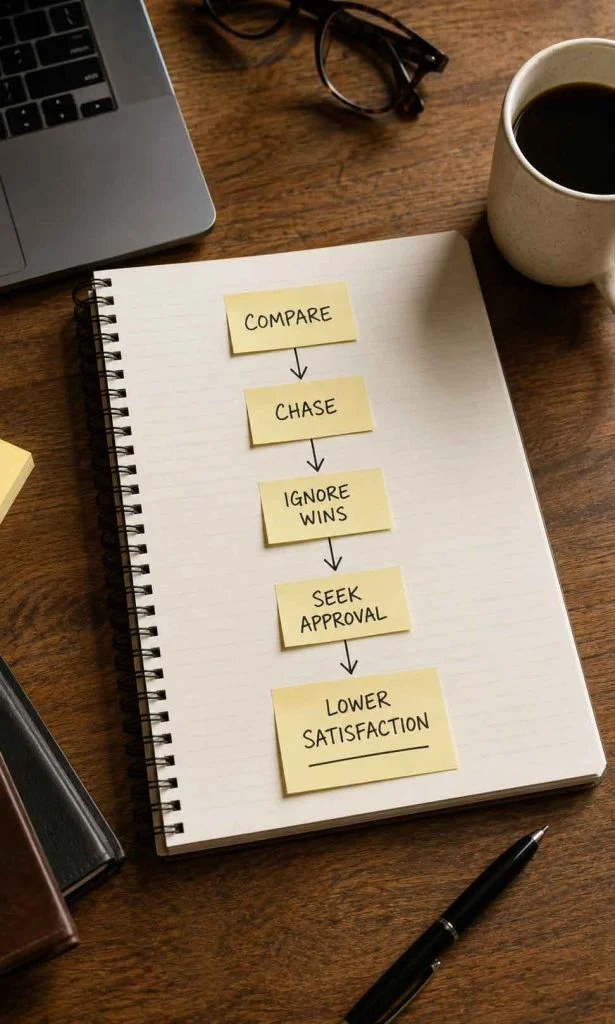
| Habit | What It Looks Like | Long-Term Effect |
|---|---|---|
| Constant comparison | Someone else always appears more successful. | Achievements never feel enough. |
| Moving the goalposts | Every completed goal is immediately replaced with another. | Progress is rarely celebrated. |
| Ignoring small wins | Only major achievements seem worth recognising. | Daily satisfaction gradually disappears. |
| Seeking external approval | Self-worth depends on praise, promotions, or recognition. | Confidence rises and falls with other people’s opinions. |
None of these habits develop overnight. They usually emerge from years of education, workplace expectations, family beliefs, or social comparison. The encouraging news is that once you recognise these patterns, you can begin replacing them with healthier ways of measuring progress.
Why High Achievers Often Feel the Least Satisfied

From the outside, highly successful people appear to have solved many of life’s biggest problems. They may have impressive careers, financial stability, respected reputations, and opportunities that others admire. Yet psychologists frequently observe that many high achievers struggle with chronic dissatisfaction, not because they have failed, but because they have become exceptionally skilled at chasing improvement.
Ambition is a remarkable quality when it motivates learning, creativity, and perseverance. Problems arise when ambition quietly transforms into a belief that happiness must always wait until the next objective has been reached. Every accomplishment becomes another checkpoint rather than a destination worth appreciating.
Over time, this creates a paradox. The more capable someone becomes, the easier it is for them to overlook their own progress because their standards continue rising just as quickly as their achievements. Success begins to feel ordinary, while perfection always remains slightly out of reach.
This pattern shares many similarities with perfectionism, where personal value gradually becomes linked to flawless performance rather than steady growth. If you often notice yourself dismissing your own accomplishments, you may also benefit from understanding how perfectionism changes the way people evaluate themselves and their achievements.
If you often notice yourself dismissing your own accomplishments, you may also benefit from learning how perfectionism affects mental health, because the two patterns frequently reinforce one another.
Satisfaction Grows From Meaning, Not Just Achievement
One of the biggest shifts people make as they become emotionally healthier is changing the question they ask themselves. Instead of constantly wondering, “What should I accomplish next?” they begin asking, “What kind of life am I actually trying to build?”
Although these questions sound similar, they lead to very different decisions. The first focuses almost entirely on external milestones, while the second encourages people to think about relationships, health, purpose, personal values, curiosity, and everyday experiences that make life feel worthwhile long after the excitement of achievement has faded.
This does not mean goals stop being important. Ambition continues to play an essential role in personal growth, career development, and financial security. The difference is that success becomes one part of a meaningful life rather than the only measure of whether life is meaningful.
People who experience lasting satisfaction often describe success as something they enjoy instead of something they constantly chase. They still work hard, set ambitious goals, and celebrate progress, but they no longer expect every achievement to permanently transform how they feel about themselves.
How to Tell Whether You Have a Satisfaction Gap
Not everyone who feels disappointed after reaching a goal is experiencing the same underlying problem. Sometimes the issue is temporary exhaustion after months of hard work. In other cases, it reflects a deeper pattern in which achievement no longer produces the emotional reward it once did.
One useful way to recognise the difference is to look beyond individual accomplishments and instead examine your overall relationship with success. If several of the following statements feel familiar, you may be experiencing what we call the Satisfaction Gap—the growing distance between what you achieve and what you actually feel.
| Reflection | Possible Meaning |
|---|---|
| You rarely celebrate your achievements. | Progress has become something you expect instead of appreciate. |
| Every completed goal is quickly replaced by another. | Your identity may be built around constant productivity. |
| You compare your success with other people’s lives. | External comparisons may be preventing genuine satisfaction. |
| You feel anxious whenever life slows down. | Rest may feel uncomfortable because your value is linked to achievement. |
| Your biggest accomplishments feel surprisingly ordinary after only a short time. | Normal psychological adaptation may be reducing the emotional impact of success. |
Recognising these patterns is not about criticising yourself. Instead, it creates an opportunity to understand why success has gradually become less emotionally rewarding and what you can do to rebuild that connection.
The Satisfaction Loop: Turning Achievement Into Lasting Fulfillment

One pattern appears repeatedly among people who experience lasting fulfillment. They do not simply accumulate achievements; they deliberately transform each accomplishment into something that strengthens their identity, relationships, and future direction.
Rather than treating success as a finish line, they see it as part of an ongoing cycle that continues creating meaning long after the original achievement has passed. This process can be understood as the Satisfaction Loop, a practical way of turning temporary accomplishments into long-term emotional fulfillment.
Step 1 – Notice the Achievement
Many people move so quickly toward their next objective that they never fully acknowledge what they have already accomplished. Taking time to pause is not laziness or complacency. It allows your brain to recognise positive experiences instead of immediately filing them away as “normal.” That simple pause creates space for appreciation before the next challenge demands your attention.
Step 2 – Reflect on What Changed
Instead of asking, “What’s next?”, try asking a different question:
“How has this achievement changed me?”
Perhaps you became more patient during difficult moments, more resilient after setbacks, or more confident in solving problems you once thought were beyond your abilities. These internal changes often become the most valuable rewards because they continue shaping future decisions long after the original goal has been achieved.
Step 3 – Share the Success
Achievements often become more meaningful when they strengthen relationships rather than remaining private victories. Sharing gratitude with family members, mentors, friends, or colleagues allows success to become part of a larger story. It also reminds us that very few accomplishments happen entirely on our own, making success feel less like an isolated event and more like a shared experience.
Step 4 – Build the Next Goal Around Purpose
The healthiest goals rarely grow from fear, comparison, or the need to prove your worth. They are usually guided by curiosity, contribution, personal values, or the desire to keep learning. When purpose becomes the motivation, achievement shifts from being evidence that you are “good enough” to becoming a natural expression of the person you are continuing to become.
Repeating this cycle gradually changes the way success feels. Instead of constantly chasing short-lived excitement, each achievement becomes part of a larger journey that builds confidence, strengthens relationships, and creates a more sustainable sense of fulfillment over time.
When Feeling Empty After Success May Signal Something More
Occasionally, persistent emotional emptiness after success reflects more than ordinary disappointment. If feelings of numbness, hopelessness, loss of motivation, or difficulty enjoying previously meaningful activities continue for weeks or begin affecting work, relationships, or daily functioning, it may be worth exploring whether something deeper is contributing to the experience.
Many mental health conditions can reduce the ability to experience pleasure, including depression, chronic stress, burnout, and persistent depressive disorder. These conditions often change how the brain processes reward, making achievements feel emotionally distant even when life appears successful from the outside.
Feeling emotionally disconnected from success does not automatically mean you have a mental health condition, but it does remind us that emotional wellbeing depends on far more than external accomplishments. Paying attention to persistent changes in mood is an important part of taking care of your overall health, just as you would notice ongoing physical symptoms that deserve attention.
If you have also found yourself losing interest in activities that once brought enjoyment, understanding why you may be feeling empty without reason can provide additional insight into what your mind may be experiencing.
Perfect. This next section is where Kevin Turner’s voice can really shine. Instead of becoming clinical, he becomes the experienced friend who gently helps readers rethink success.
Small Changes That Make Success Feel Meaningful Again
If you’ve realised that your achievements rarely bring the satisfaction you expected, the solution is not to stop being ambitious. Ambition itself is rarely the problem. More often, the issue lies in how we experience success after we reach it.
The encouraging news is that our relationship with achievement is not fixed. Just as habits of constant comparison or relentless productivity can be learned, healthier ways of experiencing success can also be developed over time. Small changes in perspective often create surprisingly large differences in how fulfilling everyday life begins to feel.
Let Yourself Finish Before You Start Again
Many people complete an important milestone on Friday and begin worrying about the next challenge by Monday morning. While planning ahead is valuable, constantly moving forward without acknowledging progress leaves very little room for satisfaction to develop.
Before setting your next objective, spend a little time recognising what you have already accomplished. Think about the obstacles you overcame, the new skills you developed, and the person you became during the journey. Success is not only measured by reaching the destination but also by the growth that happened along the way.
Measure Progress Against Your Past, Not Someone Else’s Present
If your inner voice constantly tells you that your achievements are never enough, learning how to stop negative self-talk can become an important next step toward building healthier confidence.
Comparison has become almost effortless in a world filled with carefully curated social media updates and professional success stories. The difficulty is that we usually compare our ordinary lives with someone else’s highlight reel, creating expectations that are almost impossible to satisfy.
A healthier comparison asks a much simpler question:
“Am I growing compared with the person I was a year ago?”
That perspective shifts attention away from competition and back toward personal development, where lasting confidence is much more likely to grow.
Create More Experiences Instead of Only Collecting Achievements

Achievements are moments. Experiences become memories.
Research consistently suggests that meaningful experiences—such as spending time with loved ones, learning something new, travelling, volunteering, or pursuing hobbies—often contribute more to long-term wellbeing than continually accumulating material possessions or professional accomplishments.
This does not mean success is unimportant. Instead, it reminds us that achievements become far more valuable when they create opportunities to enjoy life rather than simply expanding a list of completed goals.
Allow Yourself to Feel Proud Without Feeling Arrogant
Some people avoid celebrating their own progress because they worry it might appear boastful or overconfident. As a result, every achievement is quietly dismissed before it has any chance to strengthen self-confidence.
Healthy pride is very different from arrogance.
Arrogance places someone above others.
Healthy pride simply recognises honest effort, persistence, and personal growth. Allowing yourself to appreciate your progress does not diminish anyone else’s achievements. In many cases, it creates the confidence needed to continue learning without constantly questioning your own worth.
Professional Perspective
Many people spend years searching for a bigger achievement when what they are truly missing is a deeper connection with the achievements they already have.
Success is often treated as though it automatically creates happiness, yet emotional wellbeing is influenced by many different parts of life, including meaningful relationships, physical health, personal values, rest, and a sense of purpose. When one of these areas is neglected, even remarkable accomplishments may feel surprisingly empty.
If you notice that satisfaction seems increasingly difficult to experience, try resisting the urge to immediately chase another goal. Instead, spend time understanding what you hoped that achievement would change in your life. Sometimes the answer is not another promotion, another qualification, or another financial milestone. Sometimes it is permission to slow down, reconnect with people who matter, or recognise how much you have already grown.
Achievement deserves to be celebrated, but it should never become the only measure of a meaningful life.
Professional Reflection

One conversation has stayed with me whenever I think about this topic.
A reader once shared that after receiving the promotion they had worked toward for nearly ten years, they expected to wake up the next morning feeling like a completely different person. Instead, they described making breakfast, driving to work, and sitting at the same traffic lights they had stopped at thousands of times before. Life looked almost identical, and for a brief moment they wondered whether all those years of effort had really changed anything.
As we talked, something important became clear. The promotion had changed their career, but it hadn’t erased the habits of self-doubt that had quietly followed them for years. They had expected the achievement to transform how they felt about themselves, when in reality it had simply opened the door to a new chapter.
That conversation has stayed with me because it reflects an experience many people never say out loud. Achievements can certainly change our circumstances, but they rarely change our relationship with ourselves overnight. That relationship grows through reflection, gratitude, meaningful connections, and recognising that our worth has always been greater than any single accomplishment.
Perhaps the greatest reward success can offer is not the achievement itself, but the opportunity to discover who we have become while working toward it. Once we recognise that, success stops feeling like the finish line and becomes another meaningful part of a much larger journey.
Success Should Leave You With More Than a Trophy
If there is one idea worth taking away from this article, it is that success and satisfaction are partners, but they are not twins. One reflects what you have achieved in the outside world, while the other reflects how those achievements become part of your inner life.
Many of us spend years believing that one more promotion, one more qualification, or one more financial milestone will finally provide lasting happiness. While those accomplishments can certainly improve our lives, they rarely change how we relate to ourselves unless we intentionally allow them to do so.
The encouraging news is that satisfaction is not reserved for people with extraordinary careers or remarkable achievements. It grows through recognising progress, appreciating meaningful relationships, celebrating personal growth, and building goals that reflect your values rather than your fears.
Success may open new doors, but lasting fulfillment often begins with something much quieter—the willingness to pause, recognise how far you have already come, and allow yourself to believe that your worth has never depended on your latest accomplishment.
Discover Your Personal Satisfaction Pattern
Reading about the psychology of achievement is helpful, but understanding your own patterns is often where meaningful change begins.
Two people can achieve exactly the same goal and walk away with completely different emotional experiences. One person feels energised and fulfilled, while the other immediately starts worrying about the next challenge. The difference usually has less to do with the achievement itself and more to do with the habits, beliefs, and expectations each person brings into the experience.
That is why self-reflection can be so valuable. By recognising the patterns that shape your relationship with success, you can begin identifying what genuinely motivates you, what quietly drains your satisfaction, and which small changes are most likely to help you enjoy your achievements more fully.
The interactive assessment below has been designed to guide you through that process. Rather than producing a simple score, it builds a personalised report that explores how you measure success, how you respond after reaching important milestones, and where the gap between achievement and satisfaction may be developing. It also provides practical recommendations that you can revisit as your goals and priorities evolve over time.
Whether you have just celebrated a major milestone or simply feel that something is missing despite everything you have accomplished, taking a few minutes to reflect on your own patterns may reveal insights that are difficult to recognise during the busyness of everyday life.
Frequently Asked Questions
Does success always lead to happiness?
Not necessarily. Success can improve financial security, career opportunities and confidence, but lasting happiness also depends on meaningful relationships, personal values, physical health, mental wellbeing and a sense of purpose. Many people discover that external achievements alone do not automatically create long-term fulfillment.
Why do I feel empty after reaching an important goal?
Feeling empty after success is more common than many people realise. One reason is psychological adaptation, where the excitement of an achievement naturally fades as it becomes part of everyday life. Other factors, such as perfectionism, chronic stress, unrealistic expectations or tying self-worth entirely to achievement, can also reduce satisfaction.
Can ambitious people still live fulfilling lives?
Yes. Ambition and fulfillment are not opposites. The difference is whether your goals are driven mainly by fear and comparison or by curiosity, purpose, contribution and personal growth. Many fulfilled people remain highly ambitious while also taking time to appreciate progress and maintain balance in other areas of life.
Is feeling dissatisfied after success a sign of depression?
Not always. Temporary disappointment after reaching a major goal can happen to anyone. However, if feelings of emptiness, hopelessness or loss of enjoyment continue for weeks and begin affecting relationships, work or daily life, it may be helpful to speak with a qualified healthcare professional for further assessment.
How can I enjoy my achievements more?
You can enjoy achievements more by slowing down long enough to recognise your progress, reflecting on how you have grown, sharing meaningful moments with others and setting future goals that align with your personal values instead of constant external validation. These habits gradually strengthen the connection between achievement and lasting satisfaction.