The B7-H1 chronic constriction injury study found pain hypersensitivity in mice without a consistent pattern of anxiety-like, depression-like or cognitive impairment in its test battery. That result does not show that chronic nerve pain leaves human mood or memory unaffected. Read it as a finding within a particular experiment, then check the subjects, comparisons and measurements before applying the headline more widely.
This page explains how to read that evidence, rather than offering a treatment or a home experiment. You can work through the checks on a phone, tablet or computer with the research paper open. Start with the comparison table if the title alone has left you uncertain.
| Question | Meaning and next check |
|---|---|
| Does an animal result describe my health? | Evidence in one population does not automatically apply to another. Methods: subjects and setting. |
| Does a test name equal a diagnosis? | An observed task and a clinical condition are different kinds of information. The actual outcome measured. |
| Does no significant difference mean identical? | A result has uncertainty as well as a direction. Effect size, precision and group size. |
| Should a headline change my treatment? | A research interpretation is not an individual care decision. Human evidence and the reason for your existing care. |
What did the B7-H1 nerve-injury study actually examine?
B7-H1 (PD-L1/CD274) regulates immune activity. The B7-H1 study compared knockout and wildtype male mice, aged 8-12 weeks, with behavioral testing 22-29 days after sciatic-nerve constriction or sham surgery. Knockout means the target gene was disabled; wildtype is the genetic comparator, and sham is the surgical control.
The title packs a biological target, an injury model and several outcomes into one sentence. Unpack those parts before deciding whether the finding answers your question. The broader relationship between inflammation and depression belongs to a different question from whether this particular comparison detected a behavioral difference.
Identify who was studied
Use this check when an article sounds as though it describes everyone with pain. Keep the research page open and use its Methods heading, or the browser’s Find in page function. The ARRIVE guidance on experimental animals explains why species, strain, sex and age matter when interpreting animal research.
- Open Methods and find the description of the animals or participants.
- Read the species and relevant characteristics before returning to the conclusion.
- Keep that population in your own wording: for example, “in these animals,” rather than “in everyone with this condition.”

Checkpoint: you can name the population without guessing. If the full text is hard to navigate, read the abstract first and leave unreported details unknown. The common mistake is silently replacing “mice” with “people”; correcting that substitution is useful even before you understand the rest of the paper.
Separate the two comparisons
A study can ask more than one comparison question at once. A genotype contrast concerns genetic groups; an injury contrast concerns experimental conditions. Mixing those contrasts can make a sentence sound stronger than the analysis it describes.
- Find the group labels in the Methods and the relevant figure legend.
- Ask whether the sentence compares genetic groups under the same condition or injury versus control within a group.
- Read the result again using the actual pair of labels instead of a vague phrase such as “the mice were different.”

Worked example: “Group A versus group B after the intervention” is a different sentence from “before versus after the intervention in group A.” If abbreviations are confusing, expand only the two in the comparison you are reading. You have completed the check when the result and its control group match, not when you have memorized every acronym.
What can the behavioral tests tell us, and what do they miss?
A behavioral test measures what an animal does under defined conditions. Its interpretation depends on the task, the measured variable and the circumstances of testing. It is not interchangeable with a human report of distress or a clinical assessment, so a label such as “depression-like” must retain its qualification.
| Study test | Recorded behavior |
|---|---|
| Light-dark box, elevated plus maze, open field | Exploration, entries and time in areas. |
| Forced swim | Immobility. |
| Morris water maze | Platform-finding and spatial preference. |
| Novel object recognition | Exploration of familiar and novel objects. |
Translate the test into an observable measurement
Use this check whenever a test’s name seems to tell the whole story. Open the methods description and ask what was actually counted or timed. ARRIVE’s outcome-measure guidance distinguishes the broad concept from the variable recorded, such as distance traveled versus time moving.
- Find the named test and the sentence defining its outcome.
- Translate the outcome into plain language: time, distance, entries, preference or another recorded quantity.
- Check whether your conclusion names that measurement or jumps to a broader diagnosis.
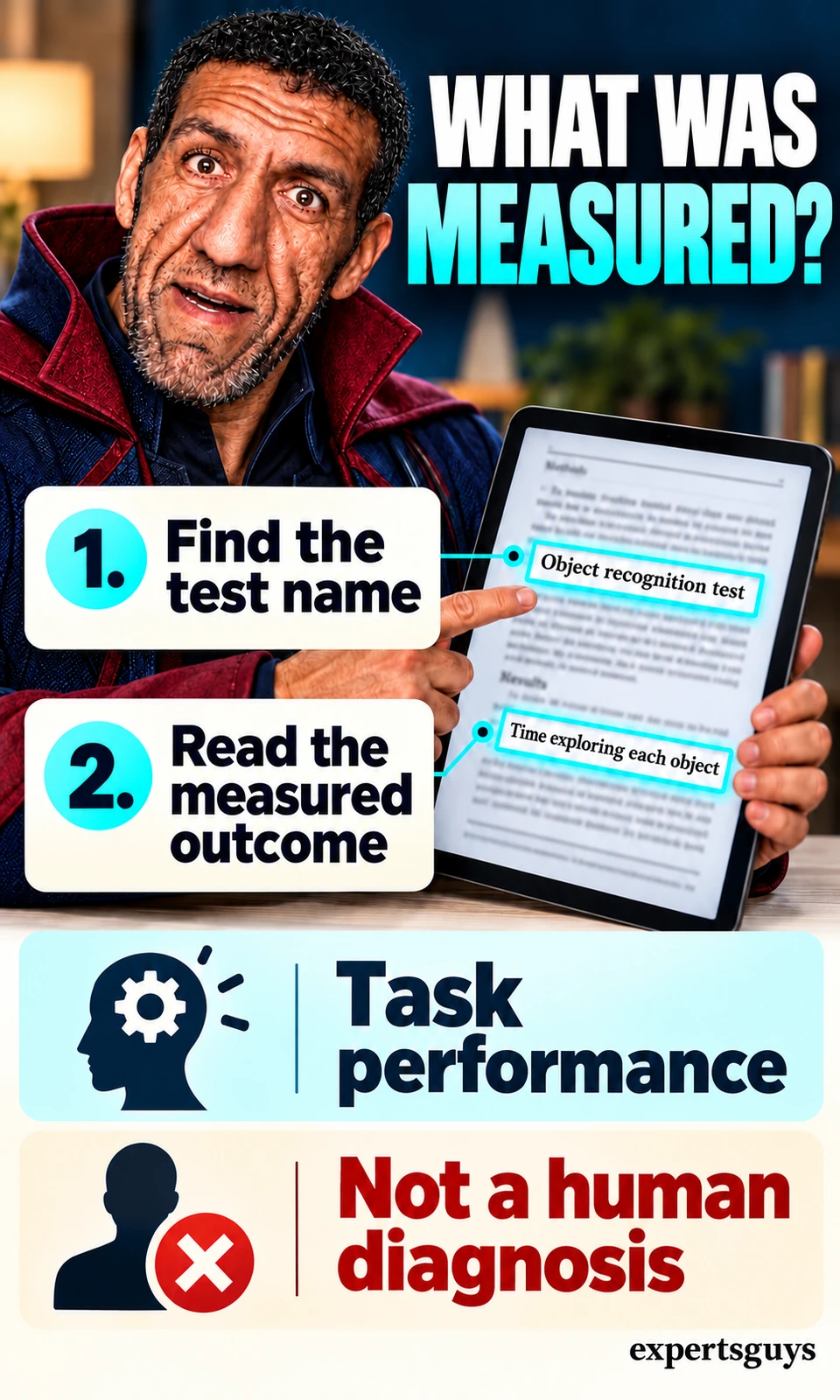
Illustrative example: “time spent exploring an object” describes observable behavior, while “no memory difficulties in everyday life” adds a much broader claim. If the definition is unclear, keep the outcome’s original name and mark its meaning as unresolved. Do not invent a personal test to reproduce an animal experiment.
Human depression and memory problems require their own discussion of attention, symptoms and daily functioning. That is the appropriate next page if your main concern is forgetting appointments or struggling to concentrate. It should not be replaced by the result of a laboratory task.
Keep the time window attached
An observation made during one window cannot establish what happens at every later stage. The same principle applies to a brief product test, a school assessment or a medical study. Preserving timing prevents a limited observation from becoming an unlimited promise.
- Search the paper for “days,” “weeks,” “follow-up” or the named testing schedule.
- Distinguish when the intervention happened from when the outcome was assessed.
- Keep a time qualifier in the takeaway; if no later measurements are described, leave the later outcome unanswered.

Checkpoint: you can finish the sentence “this result describes the observation period…” without adding an unsupported future prediction. If schedules differ across tests, check only the outcome you are discussing. A useful fallback is simply to say “during the study’s testing window” until you have confirmed its exact dates or intervals.
Why does “no clear difference” need careful interpretation?
A statistical result is evidence about a comparison, not a stamp declaring two biological systems identical. Sample size, variation and the estimated difference all affect what can be concluded. The practical task is to distinguish a measured estimate from the certainty you may be tempted to attach to it.
Check uncertainty before declaring equality
Look for the magnitude of the difference and its precision, rather than using a p-value as a complete explanation. ARRIVE’s results guidance recommends effect sizes and confidence intervals where applicable. Those quantities help a reader judge how much uncertainty remains around an estimate.
- Locate the numerical result for the comparison you care about.
- Look for an effect size and confidence interval; identify what the error bars represent before interpreting them.
- If the needed information is missing, avoid claims of equivalence or a precisely known zero effect.

Illustrative example: a measured difference near zero with a wide uncertainty range is not the same evidence as a tightly estimated difference near zero. Do not calculate a new interval from a screenshot or treat every error bar as a confidence interval. If this is more statistics than you need, use the restrained wording “the analysis did not clearly establish a difference.”
Find the sample behind the result
The total number of animals in a paper may be spread across several experiments. ARRIVE’s sample-size guidance therefore asks for the experimental units in each group and experiment, not only a total. Reading the relevant legend helps you avoid attaching the whole study population to a smaller comparison.
- Open the legend beneath the figure that supports the claim.
- Find n for each group and check what n represents.
- Look for exclusions or missing observations before assuming every enrolled subject contributed to that analysis.
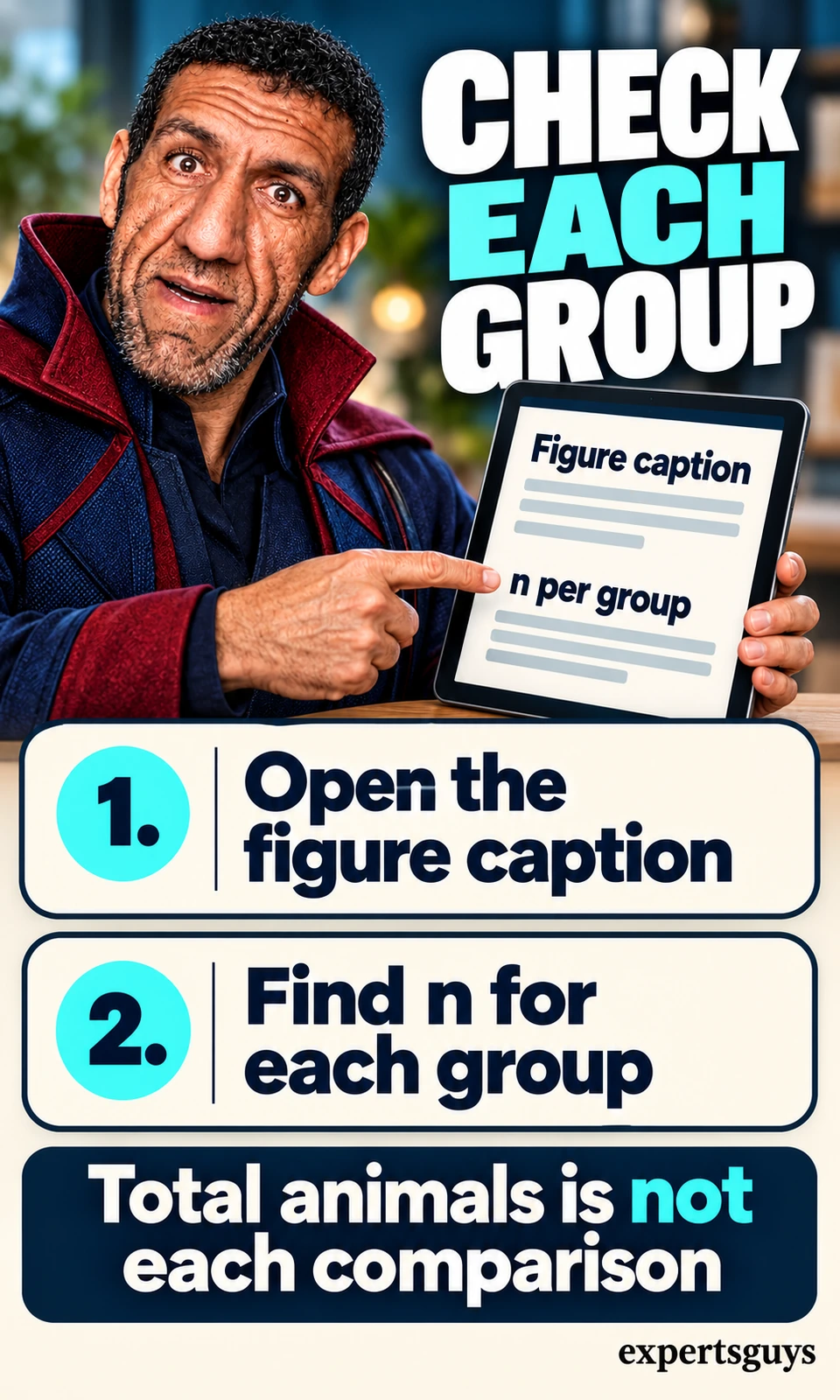
Worked example: a fictional report might involve 60 animals overall but compare two groups of eight for one outcome. The number relevant to that comparison is eight per group, not 60 per group. If the figure is too small on a phone, open the full-size version; if the information remains unavailable, say so rather than estimating from the bars.
A smaller comparison does not automatically invalidate a study, and a larger one does not automatically make every claim sound. Study design and outcome choice still matter. For the separate question of how researchers assess symptoms in people, see depression assessment in clinical trials.
How should you use the finding without overstating it?
Use the paper to understand a bounded scientific question and to improve the questions you ask next. Do not use it as a reason to dismiss an individual’s symptoms or to change treatment. NINDS guidance on pain recognizes that chronic pain can coexist with depression, anxiety and sleep problems.
Look for exceptions without cherry-picking
The full paper contains nuances beyond its headline: knockout mice traveled farther in the open-field center, and wildtype mice showed higher novel-object preference at 24 hours after CCI than after sham surgery. The authors did not treat those isolated results as a consistent impairment pattern. That distinction matters when summarizing the paper.
- Read the full Results section rather than only the title and concluding sentence.
- Check a surprising statement against the relevant legend and comparison.
- Keep the exception and the overall context together; do not turn one favorable or unfavorable result into the entire story.

Checkpoint: your summary does not claim that every measurement was unchanged. The opposite mistake is promoting one exception while ignoring all the other outcomes. When the details are too complex to resolve, link the full paper and leave the disputed interpretation open rather than choosing the most dramatic version.
Make the next action fit the evidence
A useful summary preserves who was studied, what was measured and what remains unknown. ARRIVE’s translation guidance asks researchers to explain how findings might apply to other species or conditions and what further evidence is needed. The same boundary helps a non-specialist decide what to share.
- Before sharing a study on your phone, keep its population and measured outcome in the message.
- Add the limitation that prevents an overbroad conclusion; saying it aloud is enough if you do not want to type.
- Separate any personal care question from the research summary: ask what human evidence is relevant to the decision you face.

Illustrative wording: “This experiment addresses a particular laboratory question; it does not settle what is causing my symptoms.” If your concern is persistent or worsening pain with mood or thinking difficulties that affect daily life, arrange a clinical assessment and explain the functional change. For the broader daily-life relationship, read depression and chronic illness; do not stop or change prescribed treatment because of this paper.
| If you encounter… | Use this response |
|---|---|
| A headline that says a condition has no effect | Find the measured outcome, population and observation window. |
| An abbreviation you cannot decode | Use the paper’s abbreviation list before interpreting the comparison. |
| A small image or inaccessible figure | Try the full-size figure or text legend; leave missing details unknown. |
| A claim that conflicts with your experience | Separate the study’s scope from your own symptoms and care needs. |
Frequently asked questions
Do I need to understand every abbreviation first?
No. Decode the terms in the comparison you are checking, using the paper’s abbreviation list. Leave unrelated technical detail for later rather than guessing its meaning.
Is this a study of a treatment I can use?
No treatment recommendation for you follows from this animal comparison. A biological target can be relevant to research without establishing a useful or safe intervention for an individual.
Does an unchanged laboratory result mean symptoms are imaginary?
No. A measurement and a person’s experience answer different questions. Symptoms that are persistent, worsening or interfering with daily life deserve assessment regardless of an animal-study headline.
Can I judge the study from its abstract alone?
The abstract is useful for orientation, but it cannot hold every comparison, limitation or exception. Use the full Methods, Results and figure legends when making a detailed claim; if you cannot access them, keep your summary correspondingly limited.
Summary
The useful next step is to test the reach of the claim: identify the population, match the comparison and name the outcome before deciding what it means. Keep uncertainty and exceptions attached when you explain it to someone else. A careful reading should leave you with a more precise question, not a blanket judgment about anyone’s pain, mood or memory.