
There is no single 30-year VA cash-out refinance rate that is “best” for every borrower. The best quote is the one that gives you the amount of cash you actually need at the lowest reasonable total cost after you compare the interest rate, APR, points, lender fees, VA funding fee, loan-to-value ratio, monthly payment and how long you expect to keep the new mortgage.
That distinction matters because a lender can advertise a lower rate by charging discount points, while another lender can quote a slightly higher rate with lower upfront costs. A cash-out refinance also increases the loan balance, so the lowest headline rate can still produce a more expensive mortgage if you pull out more equity than you need or restart a 30-year term late in your current loan.
The Fastest Way to Judge a 30-Year VA Cash-Out Rate
Start by asking several lenders for the same scenario: the same estimated property value, the same cash-out amount, the same 30-year fixed term and similar lock timing. The Consumer Financial Protection Bureau’s Loan Estimate comparison guidance is useful here because it focuses the comparison on interest rate, principal-and-interest payment, origination charges, lender credits and cash to close rather than on a single advertised number.
Then compare the quote over the period you realistically expect to keep the loan. If you may refinance, sell or pay the mortgage off in seven years, a lower rate that requires expensive points may not have enough time to earn back the upfront cost.
The same logic applies to lender credits. They reduce the amount you pay at closing in exchange for a higher rate, so a “low-cost” refinance can become more expensive over time if the higher payment continues for years.
A useful quote therefore answers two separate questions: How much cash can I safely access? and What will that cash cost me through this new mortgage? The calculator below is built around those two decisions.
Before using it, gather your current principal balance, estimated home value, current rate, years remaining, desired cash amount and at least one lender quote. If possible, use numbers from actual Loan Estimates rather than rate advertisements.
| Compare | Why it matters | Where to find it |
|---|---|---|
| Interest rate | Drives the principal-and-interest payment, but does not include most fees. | Loan Estimate, page 1 |
| APR | Broadens the cost comparison by reflecting the rate plus certain finance charges. | Loan Estimate, page 3 |
| Points and lender credits | Show whether you are paying more upfront for a lower rate or accepting a higher rate for lower closing costs. | Loan Estimate, pages 2-3 |
| New loan amount | Reveals how much existing debt, cash-out, financed costs and any financed funding fee will sit inside the new mortgage. | Loan Estimate, page 1 |
| Loan-to-value | Limits how much equity can be removed. Lenders may impose a lower cap than the VA program ceiling. | Appraisal + lender guidelines |
| Cash to you | Separates the amount you actually receive from the larger amount added to your mortgage. | Closing Disclosure |
VA EquityRate
Check how a 30-year VA cash-out quote changes your payment, usable equity, funding-fee exposure and long-run borrowing cost before you decide how much cash to pull from your home.
 CURRENT LOAN
NEW 30-YEAR QUOTE
CASH TO YOU
Why the Lowest Advertised Rate May Not Be the Best Rate
A mortgage interest rate measures the cost of borrowing the principal. APR goes further by incorporating the interest rate plus certain points, broker fees and other charges, which is why the CFPB treats APR as a broader borrowing-cost measure. Neither number should be used alone, but the gap between them can tell you that two similar-looking rate quotes are priced very differently.
Suppose one lender offers 6.00% with two points while another offers 6.25% with zero points. The first rate looks better on a comparison page, but two points equal 2% of the loan amount. On a large cash-out refinance, that extra upfront cost can be substantial.
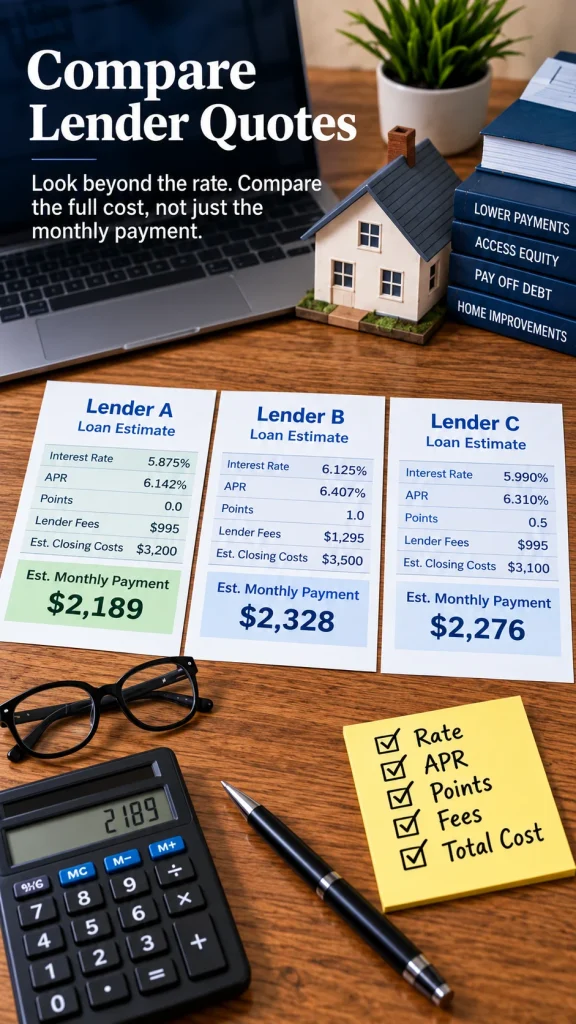
The right test is to ask how long it takes the monthly savings from the lower rate to recover the extra points. If that break-even period is longer than the time you expect to keep the loan, the higher-rate zero-point quote can be the less expensive choice.
CFPB guidance on points and lender credits makes the same trade-off explicit: points generally exchange more cash at closing for a lower rate, while lender credits reduce upfront costs in exchange for a higher rate. Ask every lender to show a zero-point version of the quote so you can see how much of the advertised rate is being purchased.
This is also why comparing rate quotes from different days can be misleading. Mortgage pricing can move with the market, so a lender that appears cheaper on Tuesday may simply have issued its quote after the market changed. Ask for quotes close together in time and make sure the rate-lock status is comparable.
For a broader refinance decision, use the mortgage refinance calculator to compare the new loan against your current mortgage before focusing on the cash-out feature itself.
How Much Equity Can a VA Cash-Out Refinance Use?
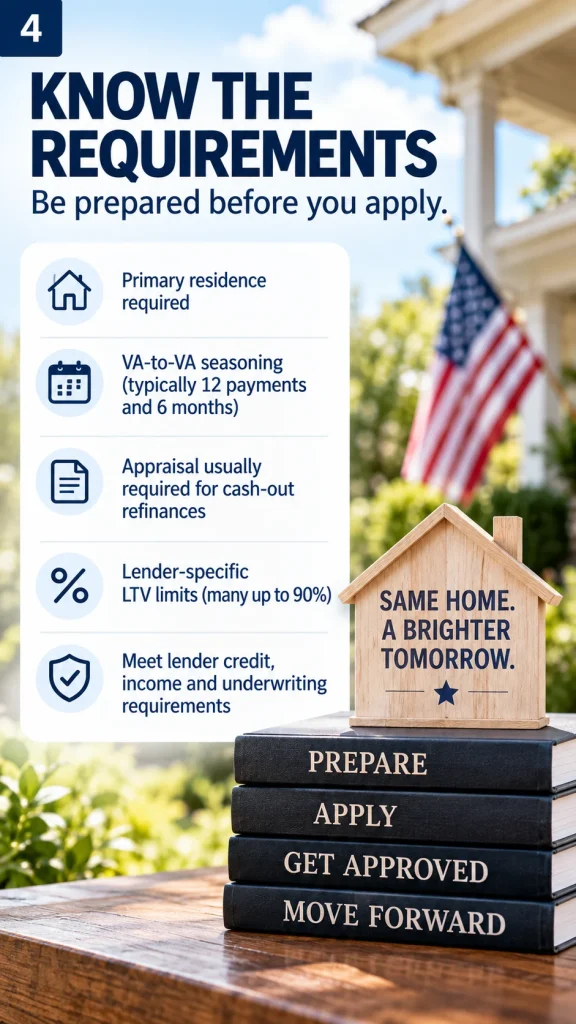
A VA-backed cash-out refinance replaces an existing mortgage or other recorded lien with a new VA-backed loan and can provide additional proceeds from home equity. The VA cash-out refinance guidance also confirms that the transaction can be used to refinance a non-VA mortgage into a VA-backed loan, provided the borrower meets VA and lender requirements and will occupy the home.
VA program rules and lender overlays are not the same thing. The VA Lenders Handbook states that the total cash-out refinance loan, including a financed funding fee, cannot exceed 100% of the property’s reasonable value for VA guaranty purposes. A lender may choose a lower maximum loan-to-value ratio based on its own underwriting, investor or risk requirements.
That means a borrower with a $500,000 appraisal is not automatically entitled to a $500,000 cash-out loan. The existing payoff, financed costs, funding fee, lender LTV cap and underwriting all reduce the amount of equity that may be available as cash.
Appraisal value matters because cash-out refinancing is not the no-appraisal VA refinance path. The VA states that the lender will order a home appraisal during the cash-out process, so the final equity calculation may move up or down from an online estimate.
A simple way to estimate maximum cash
Start with the maximum total loan your lender allows, subtract the current mortgage payoff, then subtract any costs and funding fee that will be financed into the new loan. What remains is the approximate room for cash-out before lender underwriting, title adjustments and final closing figures.
- Higher appraisal: creates more potential borrowing room if the lender permits the resulting LTV.
- Lower existing balance: leaves more equity available for cash-out.
- Financed fees: consume part of the available LTV even though they do not become cash in your bank account.
- Lower lender LTV cap: can reduce available cash even when VA’s program ceiling would permit a larger loan.
- Funding-fee exemption: can materially reduce the balance that needs to be financed.
The VA Funding Fee Can Change the Math
For borrowers who are not exempt, the VA funding fee schedule lists a 2.15% fee for first use of a VA-backed cash-out refinance and 3.3% after first use. The funding fee can generally be paid at closing or financed, while eligible borrowers – including certain borrowers receiving qualifying VA disability compensation and some surviving spouses – may be exempt.
A financed funding fee increases the principal balance and therefore the monthly payment and future interest. It can also reduce cash-out capacity because the financed fee counts inside the total loan-to-value calculation.
For example, imagine a borrower wants enough new principal to pay off the old mortgage, receive $60,000 in cash and finance the closing costs. If the borrower is also financing a 3.3% funding fee, the fee is added on top of that base amount. If the resulting total loan crosses the lender’s LTV limit, something has to change: the borrower may need to take less cash, pay some costs in cash or use a lender with a higher permissible LTV.
Cash-Out Refinance vs VA Streamline Refinance
A VA cash-out refinance and a VA Interest Rate Reduction Refinance Loan solve different problems. The cash-out refinance is for replacing an existing lien while potentially extracting equity or refinancing a non-VA loan into VA financing; it generally involves an appraisal and full credit and income underwriting.
An IRRRL is designed to refinance an existing VA-backed loan, usually to improve the rate or payment without taking meaningful equity out of the home. If your real objective is simply to reduce the mortgage cost and you do not need cash, compare the cash-out quote with a VA streamline refinance before increasing your balance.
That distinction is especially important when the borrower already has a low-rate VA mortgage. Replacing a low-rate loan with a higher-rate 30-year cash-out mortgage can make the cash surprisingly expensive even if the new monthly payment still seems manageable.
| Decision | VA cash-out refinance | VA IRRRL |
|---|---|---|
| Need cash from equity? | Yes, subject to value, LTV and underwriting | Generally no |
| Can refinance a non-VA mortgage? | Yes, if other eligibility requirements are met | No – it refinances an existing VA-backed loan |
| Appraisal? | Normally required | Often streamlined without a new appraisal requirement from VA |
| Funding fee if not exempt? | 2.15% first use / 3.3% subsequent use | 0.5% |
| Best fit | You need equity proceeds or want to move a non-VA mortgage into VA financing | You already have a VA loan and primarily want a rate/term improvement |
What Actually Moves Your 30-Year VA Cash-Out Rate?
The VA does not set one retail mortgage rate for every lender. The VA explains that private lenders determine interest rates, discount points and other closing costs, which is why the same borrower can receive materially different pricing from different companies.
Your quote can change with credit profile, debt-to-income ratio, property value, requested cash-out amount, resulting LTV, loan size, occupancy, points, lender credits and market pricing at the time the rate is quoted or locked. A higher LTV can also reduce the set of lenders willing to make the loan, even if the transaction is technically inside VA’s program ceiling.
Credit score deserves special attention because VA eligibility and lender pricing are separate. VA may not prescribe the same credit-score floor a particular lender uses, but lenders can still impose credit requirements and price higher-risk files differently.
When Taking More Cash Creates a Worse Deal
Cash-out refinancing can lower the interest rate on debt, but it also moves debt onto the home. Paying off credit cards with mortgage proceeds can reduce the monthly interest burden, yet it converts unsecured debt into debt secured by the property and can stretch repayment across many more years.
The same caution applies to home improvements, education, business funding or investing. The loan does not become inexpensive simply because the interest rate is lower than another form of borrowing; the cost depends on how long the new principal remains outstanding and whether the use of the cash is worth that long-term obligation.
A practical rule is to separate cash you need from cash the lender says you can access. Borrowing to the maximum LTV because the equity is available can create a larger payment, higher lifetime interest and less flexibility if home values fall or you need to sell.
Before increasing the cash-out amount, check these five numbers
- New principal: how much debt will exist immediately after closing?
- Monthly principal and interest: how much does the payment change from the current mortgage?
- Equity remaining: how much value remains outside the mortgage after the new loan?
- Interest over your likely holding period: what does the new loan cost over the years you realistically expect to keep it?
- Full-term interest: what happens if the 30-year loan stays in place much longer than planned?
VA-to-VA Cash-Out Refinances Have Extra Rules
When a VA-backed loan is refinanced into another VA-backed cash-out loan, the transaction may be subject to seasoning and other statutory protections. The VA Lenders Handbook cash-out refinance matrix distinguishes Type I and Type II transactions and applies a net tangible benefit requirement across the cash-out categories.
The handbook also shows that seasoning applies to VA-to-VA cash-out refinances. In practical terms, do not assume that having equity and qualifying income automatically means you can close immediately after a recent VA loan; ask the lender to confirm the seasoning test before paying for optional services or making plans around the expected cash proceeds.
A true cash-out transaction is generally Type II because the new loan amount exceeds the payoff of the loan being refinanced. Type I cash-out rules are relevant to certain VA-to-VA rate-and-term refinances that still fall under the cash-out regulatory category even though the borrower is not actually extracting equity.
How to Shop for the Best VA Cash-Out Refinance Rate
Ask three to five lenders for a quote built around the same scenario. Give each lender the same estimated property value, payoff amount, desired cash-out, 30-year fixed term and target lock period, then compare standardized Loan Estimates rather than phone or website rate quotes.
- Request the same cash-out amount. A lender quoting a smaller loan can appear cheaper simply because less money is being borrowed.
- Ask for the rate with zero discount points. Then ask for the lender’s preferred point option separately so you can see what the lower rate costs.
- Compare APR, origination charges and lender credits. These reveal pricing differences that the note rate alone hides.
- Confirm the lender’s maximum VA cash-out LTV. Do not assume every lender will lend to the VA program maximum.
- Confirm the funding-fee treatment. Make sure the lender has correctly applied first-use, subsequent-use or exemption status.
- Check the rate-lock period. A cheaper quote with a short lock can become expensive if an extension fee is needed.
- Review the cash-to-close and cash-to-you figures. These are different numbers and should not be confused.
- Compare the cost over your expected holding period. The cheapest loan at closing may not be the cheapest loan seven or ten years later.
The CFPB Loan Estimate explainer is especially useful for checking origination charges, lender credits, APR and the Comparisons section. If you prefer a refinance with fewer upfront costs, also read how a no-closing-cost refinance shifts costs into the rate or loan structure before assuming the word “no” means free.
Should You Refinance Into a New 30-Year Term?

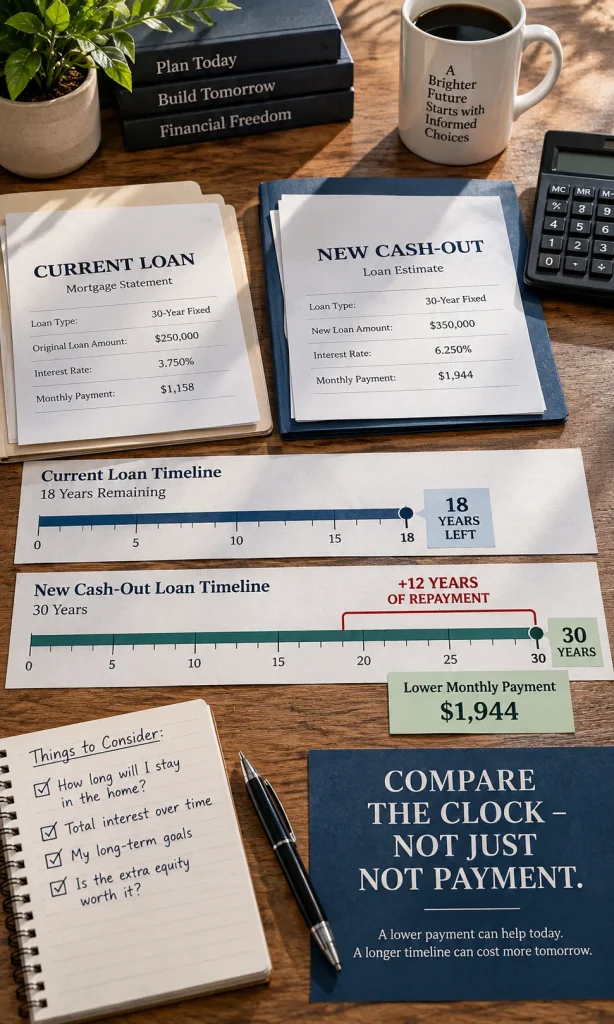
A 30-year term can lower the required payment by spreading the balance over more months, which may be useful when cash-flow flexibility is important. The trade-off is time: restarting the clock can keep a larger balance outstanding for longer and increase total interest even if the new interest rate is lower.
This is easiest to see when the current mortgage has already been paid down for many years. A borrower with 18 years remaining who refinances into a new 30-year loan has added 12 years to the scheduled repayment period unless they voluntarily pay the new loan faster.
If you like the 30-year loan for payment flexibility but do not want the longer payoff schedule, compare the required payment with a voluntary payment that keeps you closer to the original payoff date. The refinance still needs to make sense after points, funding fee and closing costs.
For a broader comparison of term reset and total cost, see the main mortgage refinance guide and the separate 30-year fixed mortgage rate guide.
A Better Definition of the “Best” VA Cash-Out Rate
The best rate is not the smallest percentage printed in the largest font. It is the most efficient quote for the amount of equity you need, with pricing you understand, a payment you can carry, enough equity left after closing and a cost structure that still works over the years you expect to keep the loan.
If two lenders are close, favor the quote that remains clear when you strip away promotional language: same loan amount, same 30-year term, same points, similar lock period, transparent fees and a Loan Estimate that matches what the loan officer actually explained. A lender willing to show the zero-point alternative and walk through the new principal balance is giving you more useful information than a lender selling only the lowest visible rate.
Run each serious quote through VA EquityRate, then use the local-search section to find additional VA cash-out lenders in your area if the pricing does not look competitive. The goal is not to find a magical national “best rate”; it is to identify the best verifiable offer for your actual home, equity, credit profile and cash-out objective.
Frequently Asked Questions
What is a good 30-year VA cash-out refinance rate?
A good rate is one that is competitive for your credit, LTV, loan size and market conditions without requiring excessive points or lender fees. Compare multiple same-day Loan Estimates and judge the rate together with APR, points, closing costs, payment and the amount of cash you actually receive.
Can a VA cash-out refinance go to 100% LTV?
VA guaranty rules can allow the total refinance loan up to 100% of the property’s reasonable value, including a financed funding fee, but lenders can impose lower LTV caps. The appraisal, loan payoff, fees and lender underwriting determine how much cash is actually available.
Does a VA cash-out refinance require an appraisal?
Yes, the normal VA-backed cash-out refinance process includes a lender-ordered appraisal to establish the property’s reasonable value. That value is central to the final LTV and cash-out calculation.
What is the VA funding fee for a cash-out refinance?
For borrowers who are not exempt, the VA funding fee schedule lists 2.15% for first use and 3.3% after first use on VA-backed cash-out refinancing loans. Certain borrowers are exempt, and the fee can generally be paid at closing or financed subject to the loan structure and LTV limits.
Is APR more important than the interest rate?
APR is broader because it reflects the interest rate plus certain finance charges, but it should not replace the rate, payment, cash-to-close or holding-period analysis. Use APR as one comparison measure among otherwise similar 30-year cash-out quotes.
Should I use a VA cash-out refinance to pay off credit cards?
It can reduce the interest rate on the debt, but it also converts unsecured debt into debt secured by your home and can extend repayment over many years. Compare the total interest, new mortgage balance and your plan to avoid rebuilding the credit-card balances before using home equity for consolidation.
Next Steps
Collect two or three same-scenario Loan Estimates, enter them into VA EquityRate and compare the cash you receive with the new principal, payment, LTV and borrowing cost over the years you expect to keep the loan. If you do not actually need equity proceeds, compare the result with a VA IRRRL before choosing a more expensive cash-out structure.