Customer service chatbots answer questions or carry out supported support tasks through a conversational interface. Their value depends on whether customers obtain the right outcome, so assess completed work and repeat contacts alongside the number of chats closed.
Why can a closed chat still leave an unresolved problem?
A closed conversation is an interface state. Resolution is a claim about a customer need. These can diverge when a customer abandons a slow exchange, accepts an explanation while waiting for an action, or changes channels to reach a person.
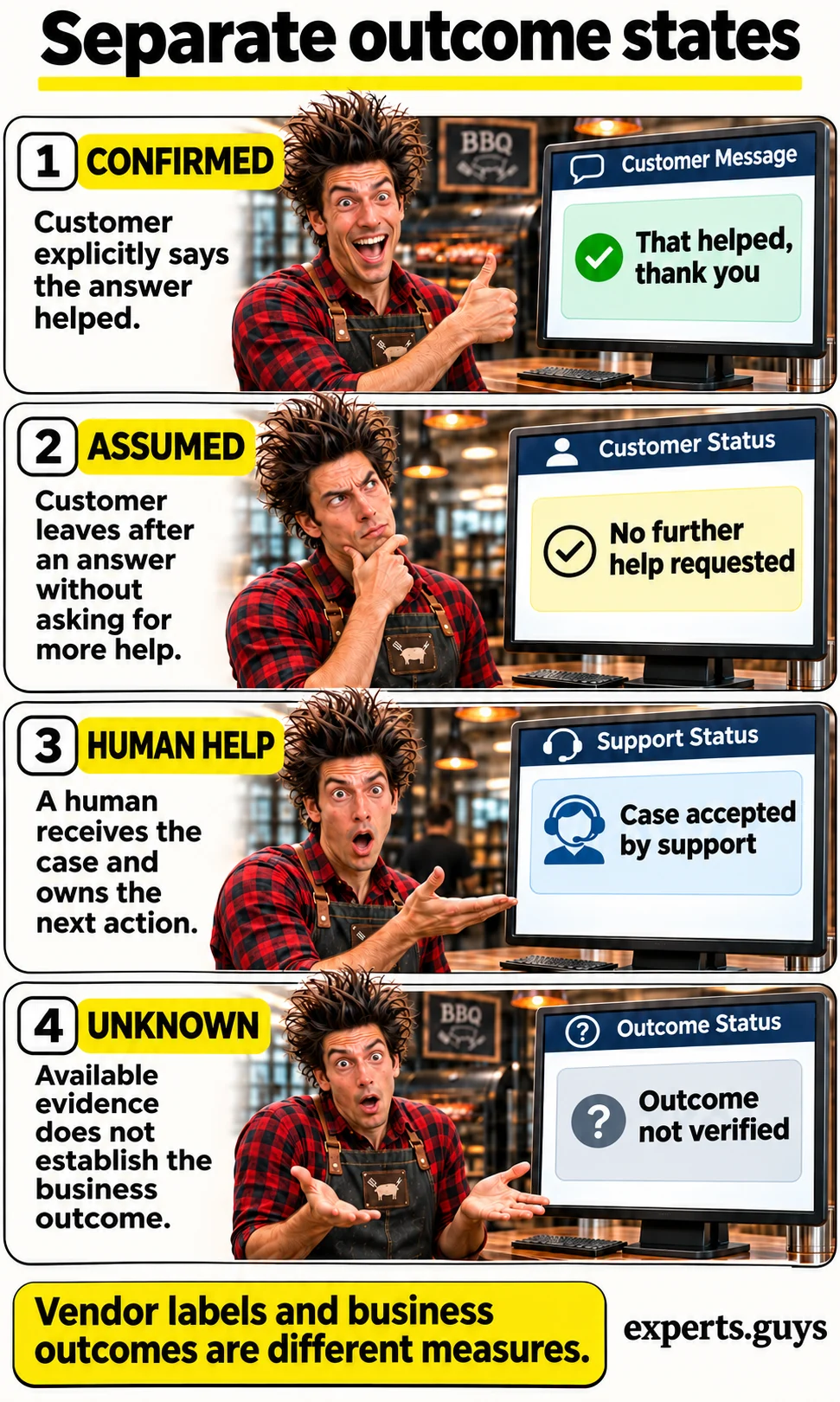
A useful audit therefore separates confirmed outcomes, assumed outcomes, human-assisted outcomes and unknown outcomes. Keep the platform’s original labels as well as your business assessment: overwriting vendor labels makes billing reconciliation harder.
For an informational question, an accurate answer may be the whole task. For a change to an order, the relevant evidence is the saved order record. For a refund, an accepted request may still precede completion. Define the endpoint before judging the conversation.
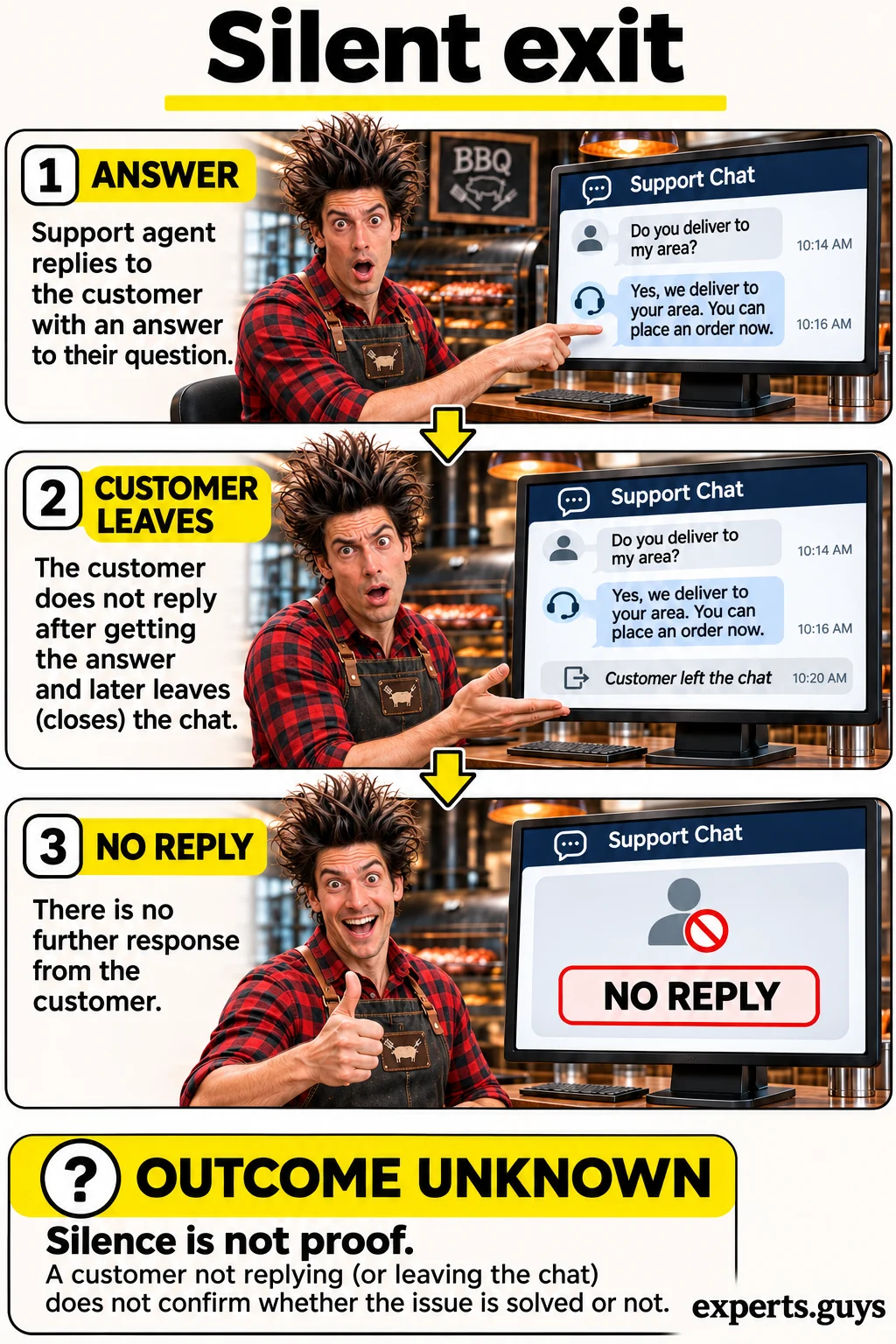
Intercom’s outcome documentation distinguishes confirmed resolution from assumed resolution after a customer leaves without requesting further help. That is a product measurement definition; it does not establish that every silent customer obtained the intended business outcome.
An assumed outcome is not automatically a failure. Some customers leave because the answer is sufficient. The mistake is treating uncertainty as proof in either direction. Keep unknown cases visible rather than reallocating them to make a performance rate look better.
The audit below is for a support owner who can access authorized test records and appropriately redacted cases. It uses existing business evidence, not a diary or a new collection of customer personal information.
- Verify the business record.
- Check repeat contacts about the same issue.
- Confirm handoff receipt and ownership.
- Separate pending and unknown outcomes.
How do you verify what happened after the chatbot replied?
Use one issue as the unit of review. A single customer may send three messages about one order, while one chat may contain two unrelated requests. Choose and state your counting rule before comparing periods.
Begin in a sandbox or a test account. Open a fictional order and request a permitted address change before fulfillment. Compare the bot’s final wording with the saved address in the order system. An acknowledgment such as “I have your request” is not evidence that the address changed.
Refresh the authoritative record after the action completes. If the system uses a queue, inspect the final job result rather than repeatedly issuing the change. Duplicate actions can create a second problem. Use a reversible test record and never conduct this exercise on an unsuspecting customer’s live order.
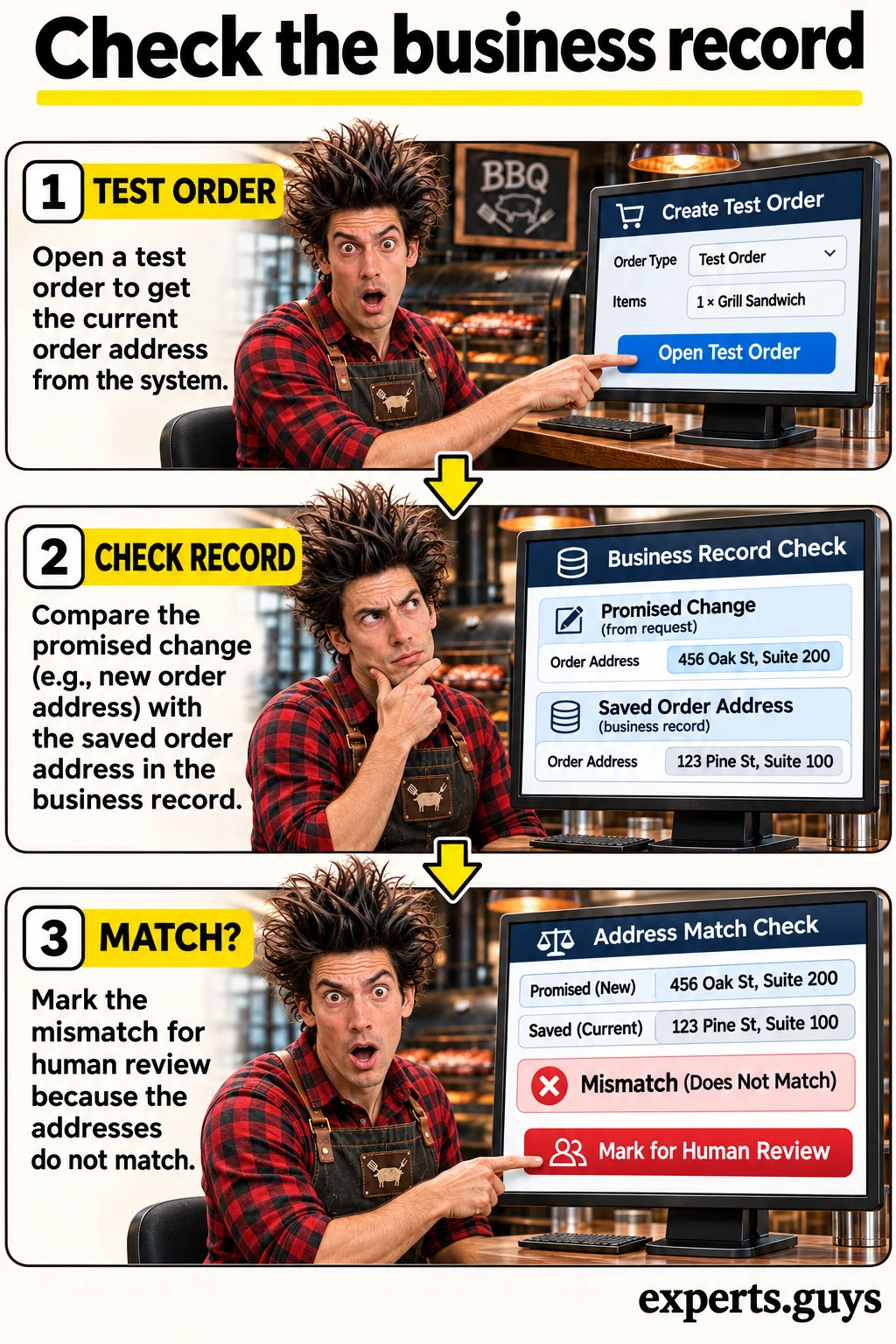
If you do not have permission to inspect the record, ask the responsible operator to verify it. Mark the outcome unknown until evidence is available. Lack of access is a measurement limit, not evidence of success.
Next, look for another contact about the same issue in the channels your organization is authorized to inspect. Match a legitimate case or order identifier and the reason for contact. Do not join people merely because names or message wording resemble each other.
Choose a follow-up period that suits the task. A delivery question and a slow refund do not have the same lifecycle. A seven-day window can be an illustrative audit choice, but it is not a universal support benchmark. Exclude cases whose follow-up window is not yet complete from a mature-cohort comparison.
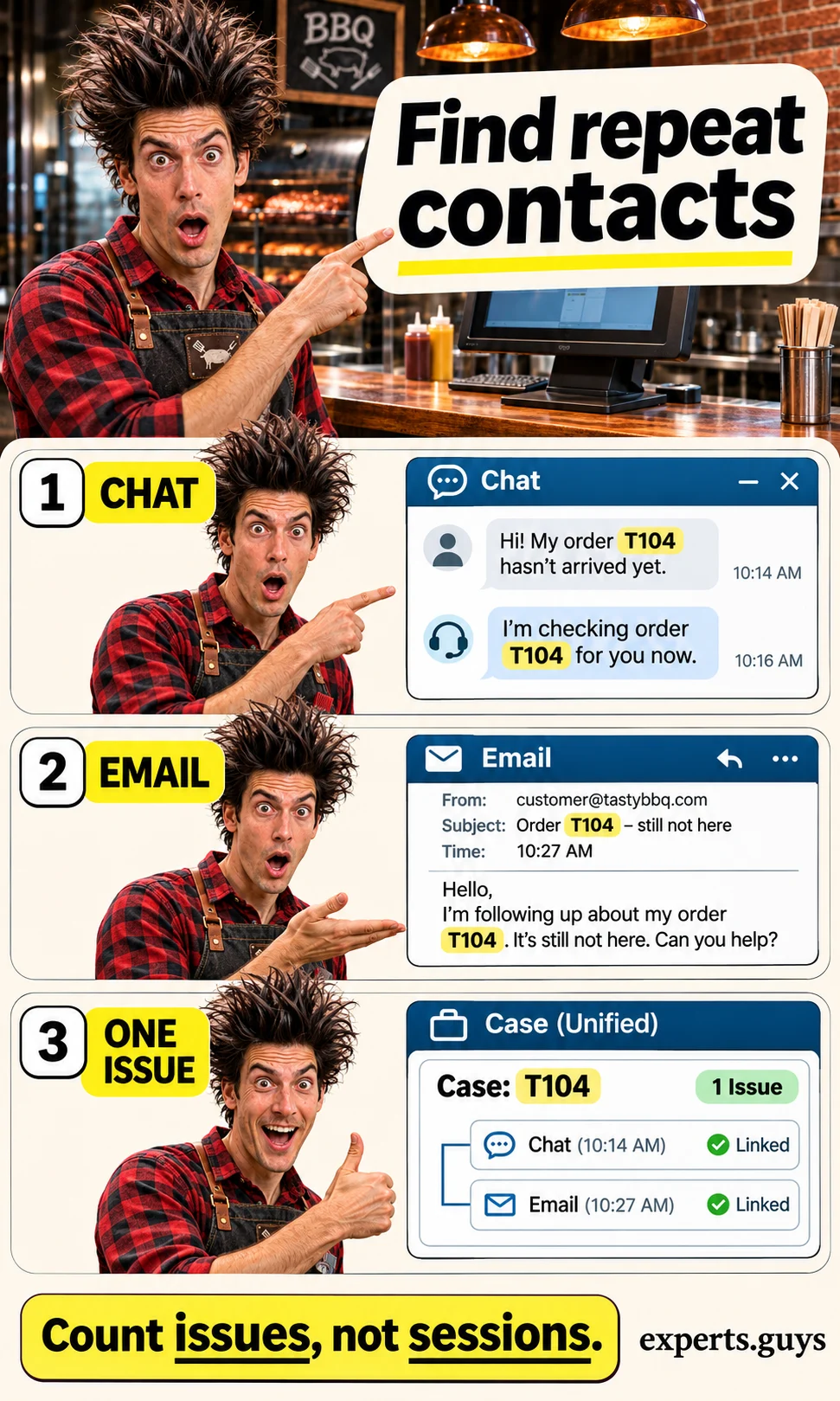
When a second contact appears, inspect its purpose. A thank-you message is not a reopened failure; a request to correct the same unchanged address is. Where cross-channel identity cannot be established reliably, disclose that repeat contacts may be undercounted.
For background on conversational interfaces, use the chatbot examples guide. This audit goes further by following one support issue beyond the chat window.
What counts as a successful human handoff?
A handoff succeeds operationally when the destination receives the case with enough context and a responsible person or queue owns the next action. Showing a “connecting” message alone proves only that the interface displayed it.
In a test conversation, request a person directly. Check the receiving inbox for the original issue, attempted steps, relevant authorized record reference and the reason for escalation. Then verify assignment or acceptance using the destination system. Do not infer receipt from the chatbot’s promise.
| Checkpoint | Required evidence |
|---|---|
| Transfer | Case appears at destination |
| Ownership | Person or accountable queue assigned |
| Resolution | Customer endpoint verified |
Repeat the test when staff are unavailable. The customer should see an honest next route and expected service arrangement, rather than an endless connection animation. Do not invent response-time promises that your staffing cannot meet.
A transfer can be successful without the issue being resolved. Keep “handoff accepted” separate from “customer problem completed.” This makes the human team’s work visible and prevents automation reports from claiming credit for outcomes that required staff.
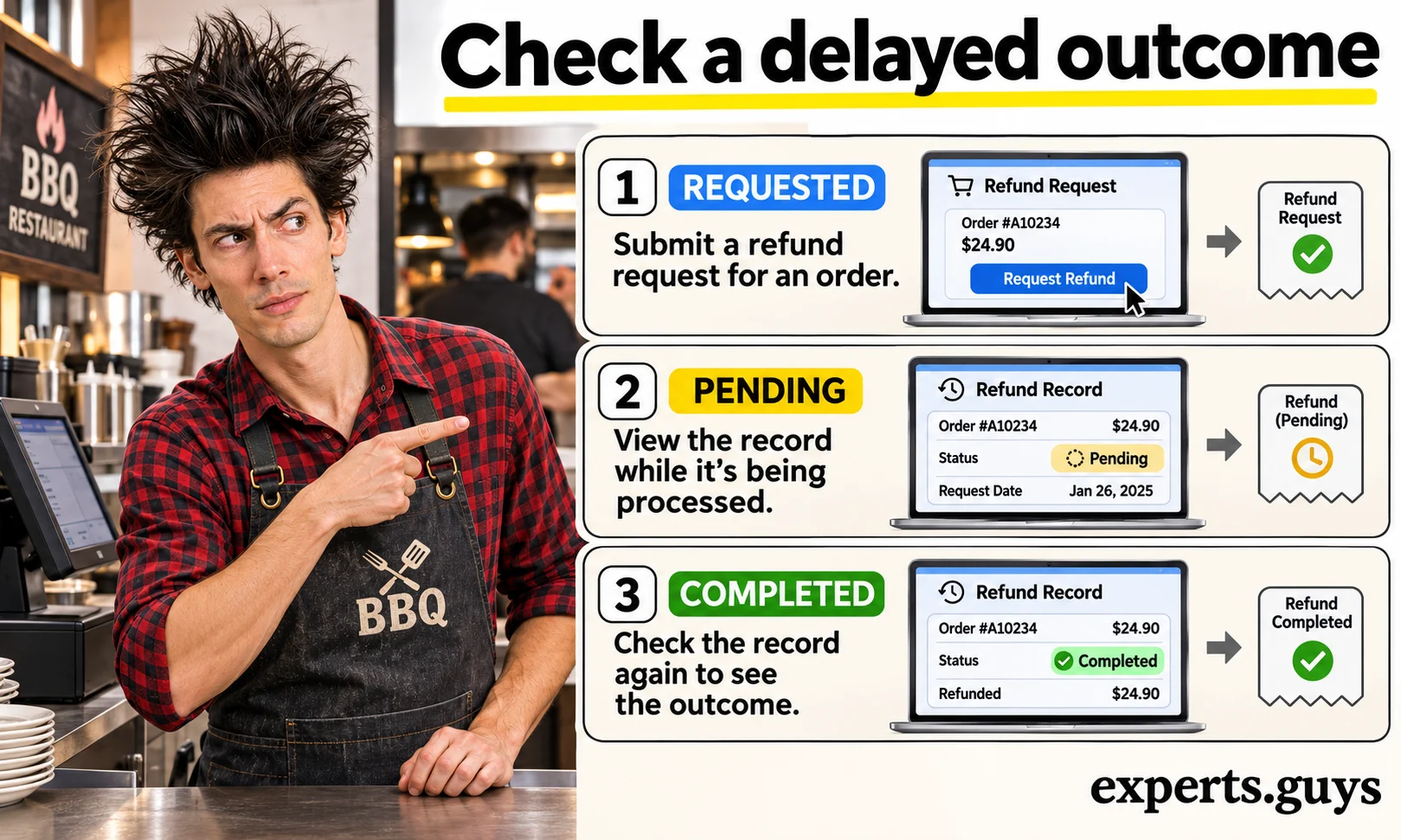
For delayed actions, inspect the business status again when the action is expected to finish. A refund can move from requested to pending to completed; the exact meanings depend on the payment and order systems. If the record remains pending, retain that state and route overdue work to its owner.
Intercom’s conversation guidance notes that willingness to wait can be interpreted as acceptance in some situations. This is a useful reason to test waiting-language cases explicitly, not a claim that all chatbots behave identically.
For deployment controls and authority boundaries, see using AI in customer service without losing control. Here the teaching job is to verify receipt and eventual outcome after the interaction.
Which numbers tell you what to repair first?
Report counts beside percentages. Ten verified successes out of twenty eligible issues is a 50% observed verified-success share. It is not proof of the same rate across all traffic, especially when the sample contains only easy cases or selected complaints.
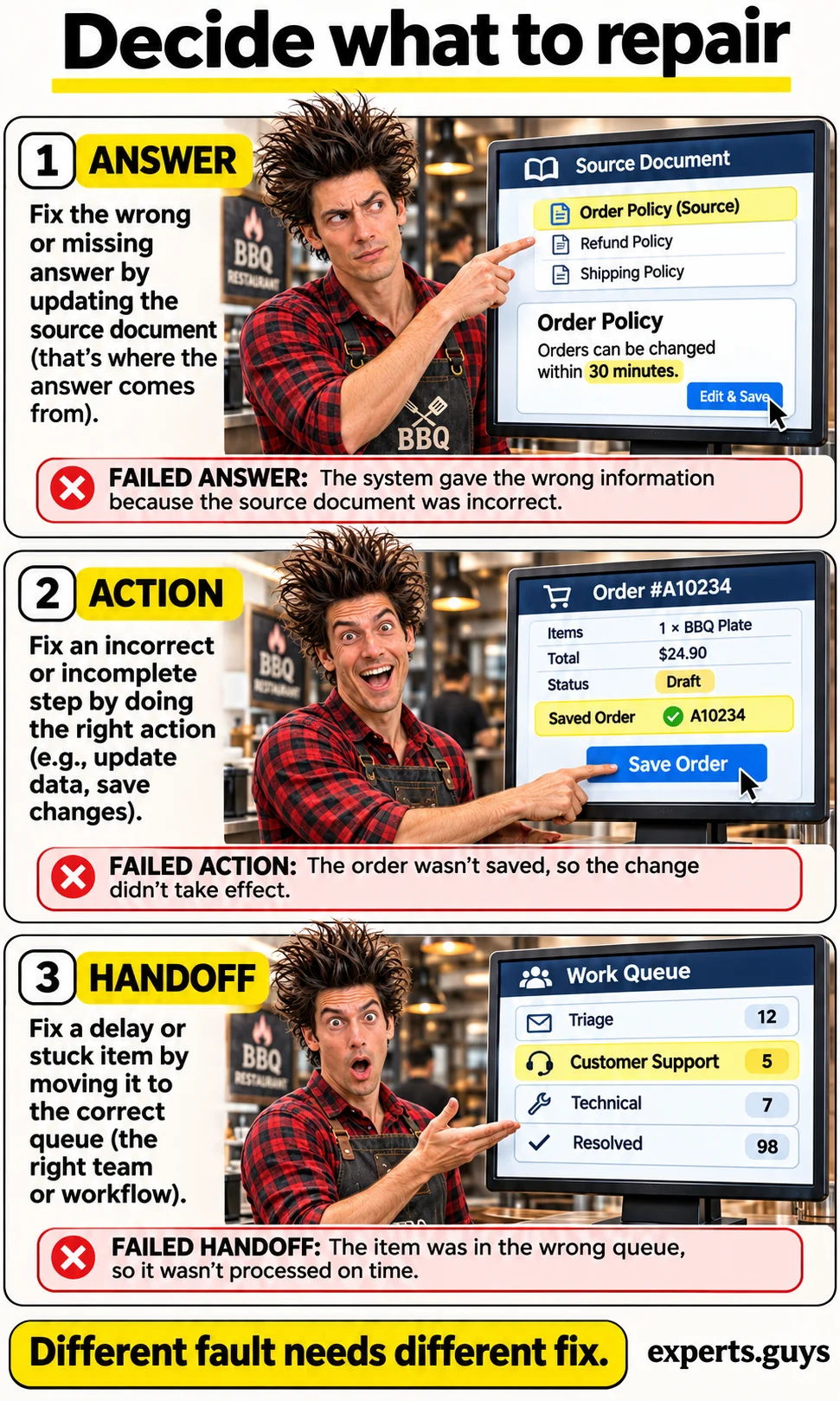
Use mutually exclusive final audit states for the same cohort: verified bot-only success, verified human-assisted success, unresolved and unknown. Retain vendor resolution labels as a separate dimension. This prevents one case being counted as both assumed success and human-assisted success in the same total.
For example, a fictional mature cohort of 100 issues might contain 40 verified bot-only successes, 20 human-assisted successes, 15 unresolved issues and 25 unknowns. Verified bot-only success is 40% of the cohort. Dividing 40 by only the 75 known outcomes gives about 53.3%, a different measure that must be labeled accordingly.
The repair illustration uses fictional examples, including a sample 30-minute policy; it is not a recommendation to adopt that limit. Classify failures by where evidence breaks. A wrong policy answer points toward content or retrieval review. A correct promise with no saved change points toward the action integration. A transfer with no recipient points toward routing. Repairing the prompt alone will not necessarily repair the latter two.
Compare similar issues, channels and observation windows before attributing improvement to a change. A busier season, new policy, different language mix or larger share of complex requests can alter results without any change in model quality.
Keep an unresolved high-impact case out of an experiment when continued automation could worsen it. Route it to the accountable support owner. For routine cases, change one relevant component, rerun the failed test and inspect its downstream result before broadening traffic.
An offline calculator can help reconcile aggregate counts, but it cannot validate the underlying cases. Use the included outcome checker only after the evidence review; it does not connect to customer systems or make a production rollout decision.
Does an unknown outcome mean the bot failed?
No. It means the available evidence does not establish the result. Keep it separate from both success and failure.
Can I compare resolution rates between vendors?
Only after aligning definitions, eligible populations, human involvement and observation windows. Vendor billing units are not automatically interchangeable quality measures.
Do I need to export full transcripts?
No. Use the minimum authorized evidence needed for the review. Prefer redacted cases and aggregate counts; follow your organization’s access and retention rules.
Next steps
Choose one support issue with an observable endpoint. Follow its answer, business record, later contacts and handoff evidence. Repair the first broken link, retest it, and keep unresolved or unknown cases visible in the report.