
A chatbot is software that lets people ask questions or request help through a conversation. Chatbots are popular because they can reduce waiting and searching for users while giving businesses another way to handle repeated demand. Those advantages depend on the task: a readily available reply can still leave the actual problem unresolved.
The useful explanation has two sides. People may choose chat because it feels easier than navigating a service; businesses may offer it because one automated entry point can serve many requests. Neither side establishes that every customer prefers a bot, or that a business will save money simply by installing one.
For a practical judgment, separate the attraction of the interface from the work behind it. Ask what effort the conversation removes, who still handles the difficult parts, and whether a simpler route would give the same answer with less trouble.
| Attraction | Why it appeals | What it does not prove |
|---|---|---|
| Less searching | Start with the question instead of the website category. | That the answer is supported or complete. |
| Access outside staffed hours | Begin a request when it suits you. | That an exception will be resolved overnight. |
| Repeated-demand capacity | Reuse supported answers across requests. | Unlimited backend or human capacity. |
| Potentially less handling | Remove some routine work from staff. | A fixed saving after review and maintenance. |
| Flexible wording | Clarify the request within one conversation. | Understanding, permissions or competence on every task. |
Why does asking a chatbot feel easier than searching?
Chat feels easier when it lets the user describe a need without first learning how the website organizes its information. The attraction is a lower starting effort: instead of guessing a category or search phrase, a person can begin with ordinary language. This advantage is strongest when the right information exists but its location or vocabulary is unfamiliar.
Consider a fictional visitor trying to find out when a collection counter closes. The site may organize opening hours under locations, customer services or store information. The visitor knows the question but not the site’s filing system. A conversational entry point can bridge that mismatch if it retrieves the relevant counter’s hours and preserves the conditions that matter.
That is a navigation benefit, rather than evidence that conversation is always the best interface. If the same hours already appear clearly beside the collection address, opening a chat window adds an unnecessary step. The value comes from removing a real obstacle, not from turning an easy lookup into a more elaborate exchange.

Ordinary wording can reduce the translation burden
A person might ask, “Can I collect it after work?” while the service labels the information “collection desk opening times.” A language-capable chatbot may connect these expressions. A fixed menu can also help when its options are obvious. The important distinction is how much translation the user must do before the service recognizes the need.
In a well-matched exchange, the bot asks only for a missing detail that changes the answer, such as which branch the visitor means. In a poorly matched one, it asks for an account number before answering a public question. The second design shifts effort onto the visitor without improving the information required for that task.
The freedom to rephrase also helps explain why conversational interfaces attract attention. A user can ask for a shorter explanation or clarify an ambiguous term in the same place. However, a request for simpler wording does not repair a wrong underlying answer. Ease of expression and factual reliability are separate properties.
For readers unfamiliar with the different exchanges, the guide to what a chatbot example actually demonstrates explains the boundaries. Here, the point is why that conversational surface is appealing: it can let a person start with the problem they have, rather than the categories a service has chosen.
Availability lowers one barrier, but may leave another
A chatbot can offer an entry point outside staffed hours, subject to service availability. That matters to someone who wants a public answer at night or needs to begin a request without making a phone call. The benefit is access at a convenient moment; it should not be confused with a promise that every request can be completed immediately.
There are at least three different states behind the phrase “always available.” The service may receive a message, provide an answer, or resolve the problem. A system that accepts a complaint overnight but waits for a staffed queue has delivered the first state. It has not necessarily delivered the second or third.
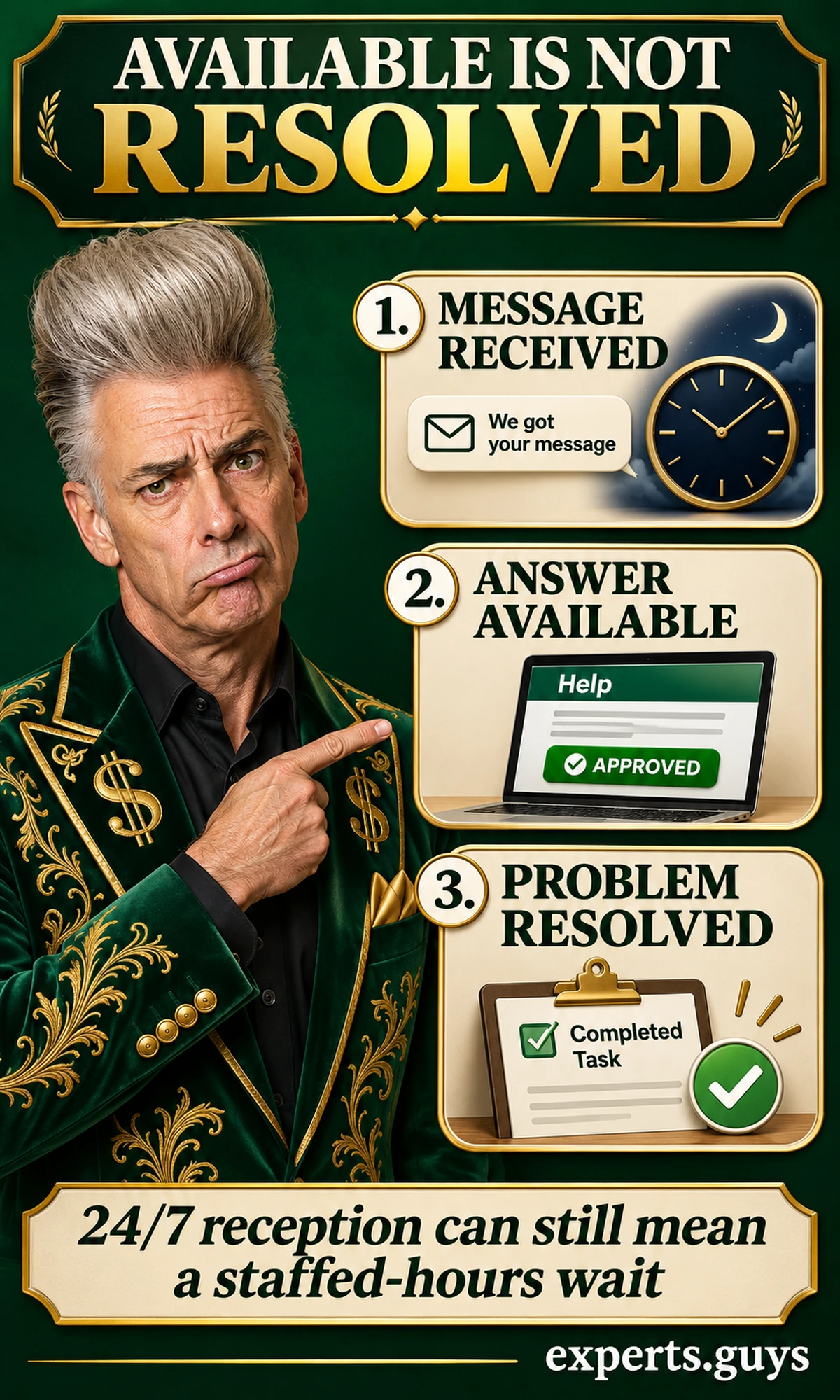
This distinction changes how an honest service describes its offer. “Send your question at any time” can be accurate even when an agent replies later. “Get your dispute resolved at any time” requires much more. The wording should reflect the actual outcome available, including the limits of connected systems and the people responsible for exceptions.
Text also offers a practical option when a call is inconvenient: the user can read at their own pace or interact in a place where speaking aloud would be difficult. But text is not universally accessible. Small controls, inaccessible chat overlays, reading demands and language limitations can make another channel easier for a particular person.
Multilingual responses can widen access when the relevant language and task are supported adequately. The presence of a language option alone does not prove equivalent service quality. A fluent translation of an incomplete policy remains incomplete, and a handoff to a team that cannot continue in that language may break the apparent convenience.
Practical takeaway: the conversational advantage is strongest where users know what they need but struggle to locate or phrase it in the service’s terms. If the information is already obvious and short, a direct page or visible label may serve them better.
Why do businesses keep adding chatbots?
Businesses have a different incentive: chatbots offer a way to receive and process repeated requests without assigning every initial exchange to a person. This makes them attractive when many visitors ask similar, answerable questions. The potential benefit is service capacity, although the amount depends on how much work the bot genuinely completes.
A shared answer source can support many conversations, and software can handle concurrent requests within its infrastructure limits. That differs from a person taking every inquiry separately. Yet additional capacity at the conversational layer does not create unlimited capacity in the order system, booking service or human team that follows it.
Imagine a store receives a rush of collection questions before a holiday. Reusing a correct public answer could help many visitors quickly. If the holiday schedule is missing, the same distribution advantage spreads the wrong answer more efficiently. Repetition creates an opportunity for automation and also magnifies the consequences of a weak source.
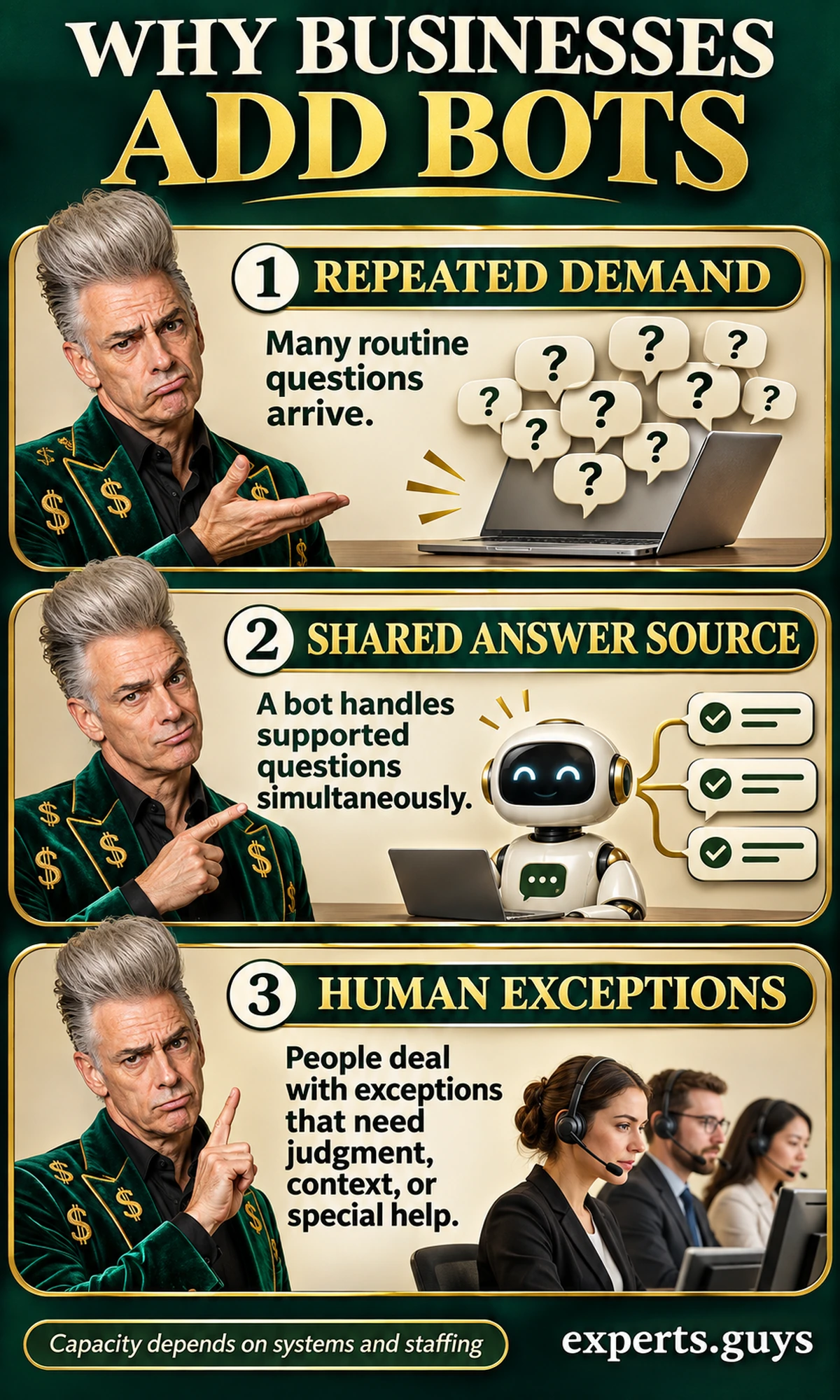
The business case starts with demand that has a useful common answer
Not every frequently repeated message is easy to automate. “Where is my parcel?” may have a common form but require an authenticated lookup, a carrier record and a clear interpretation of its status. “Why was my claim refused?” may require an individual explanation and an accountable decision-maker. Similar wording does not mean the underlying work is interchangeable.
The distinction matters because a chatbot can look productive while doing only the first part of a job. It may recognize the request and produce a friendly acknowledgement, then leave staff to investigate everything else. That can still be useful if it reduces routing work, but the business should describe it as routing rather than complete automation.
There is also a difference between a bot speaking directly to customers and software helping employees prepare replies. Generative AI at Work studied an assistant used by 5,172 customer-support agents and reported a 15% average increase in issues resolved per hour in the revised paper. Effects varied across workers. That result supports interest in assistance for people; it does not establish equivalent gains from replacing them with an autonomous chatbot.
For this article’s question, the research is evidence of a plausible operational attraction, not a savings forecast. A business looking at that finding still needs to establish which work resembles the studied setting. An inexperienced employee receiving useful suggestions is a different arrangement from an unattended bot making commitments to a customer.
Recovered time is not automatically money saved
A simple illustrative calculation shows why the distinction matters. Suppose a service receives 200 eligible routine cases in a week, and each would otherwise require four minutes of direct human handling. If all 200 are correctly completed without that handling, the gross avoided work is 800 minutes. These are assumptions for an example, not observed performance.
Now suppose the service uses 100 minutes to review outputs, 180 minutes on additional escalations attributable to the arrangement, and 120 minutes maintaining its answers. Those added activities total 400 minutes. On the example’s assumptions, net recovered capacity is 800 minus 400, or 400 minutes, which is six hours and forty minutes.

The calculation is useful because it makes shifted work visible. It is deliberately incomplete as a financial model: software charges, integration, training, management and other costs still need consideration. If any of the 200 cases were not actually completed, the gross avoided-work assumption also needs to be reduced. Counting a closed chat as a resolved case would overstate the benefit before any subtraction begins.
Even a genuine reduction in work may free employees to do other tasks without reducing expenditure. A team paid for the same hours might use that capacity to clear a backlog or improve exception handling. That can be valuable, but it is different from an actual fall in payroll or operating expenses.
A useful rule for interpreting a savings claim is to ask what its unit means. Messages processed, conversations contained, cases correctly resolved and paid staff hours removed are different quantities. A large number in one category does not convert into another without a demonstrated relationship. The denominator matters as much as the percentage.
There can also be a distribution effect. A benefit concentrated in easy requests may leave the remaining human queue with more demanding cases. Average handling time for the people can rise even if the overall operation improves. Conversely, a faster front end may hide additional rework elsewhere. Looking only at one team or one stage can give the wrong explanation.
Familiar software packaging makes experimentation easier
Chat functionality is often offered inside software a business already uses. That can make an initial experiment seem manageable: the organization has a channel, an administrative interface and a vendor relationship. The important commercial attraction is a shorter route to trying the idea, rather than proof that the entire service is ready.
A quick installation does not supply missing policy ownership, reliable account access or someone to receive an escalation. Those are organizational requirements. This is one reason chatbots can spread faster than the practices needed to operate them well. Ease of acquisition and ease of successful operation should be evaluated separately.
The customer-service implementation guide owns the detailed work of defining permissions, testing boundaries and planning a pilot. This page’s narrower conclusion is that repeated demand, potential capacity and relatively accessible distribution explain business interest. None is a universal instruction to install a bot.
Practical takeaway: interpret the business appeal in terms of the work that moves or disappears. A credible explanation identifies the task, the avoided handling and the new work created; a vague promise that chatbots are inexpensive leaves the most important question unanswered.
Does popularity mean people prefer chatbots?
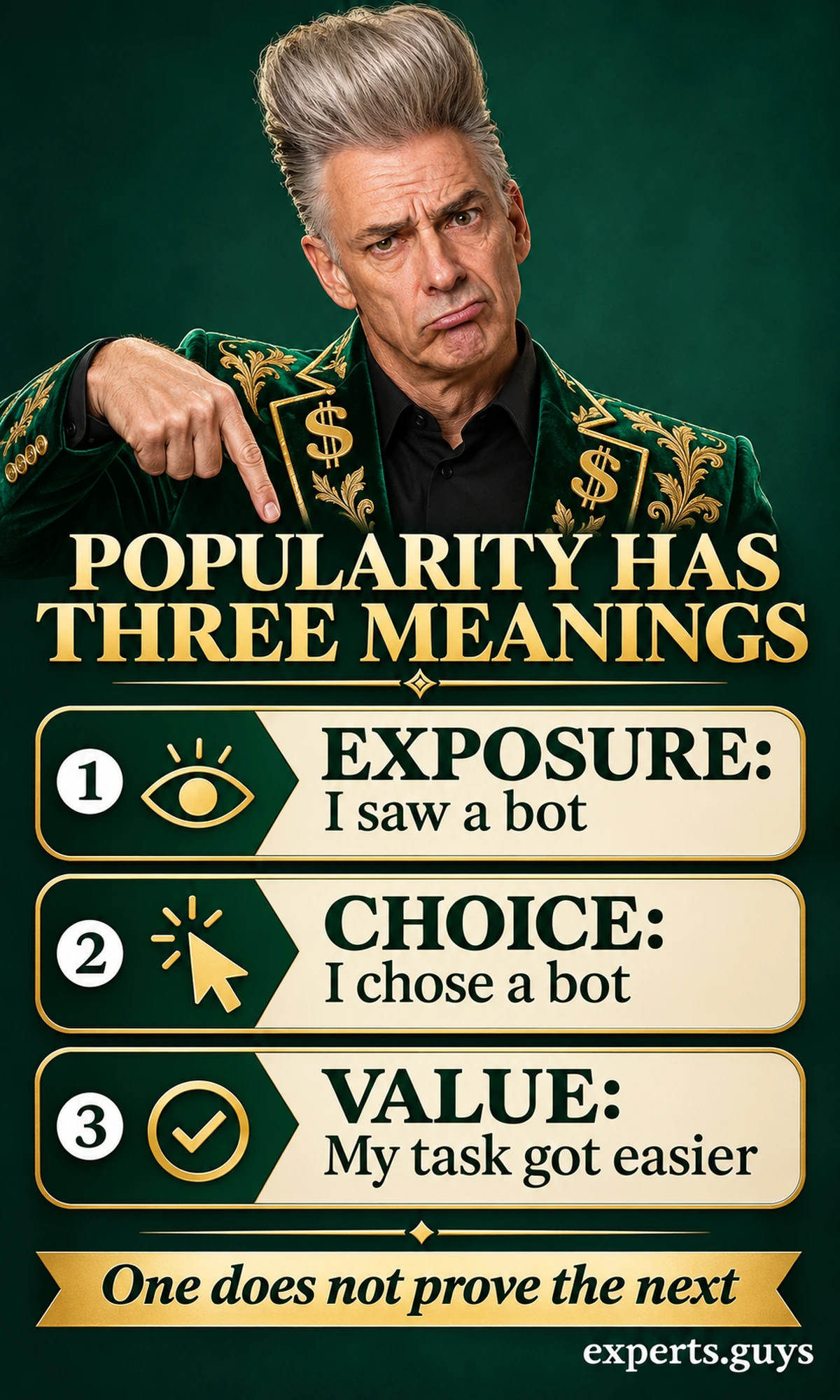
No. A service can expose many people to a chatbot even when they would choose another channel. Popularity may mean visibility, frequent use, deliberate preference or a useful result. These are different claims, and evidence for one does not automatically establish the others.
A prominent chat button increases the chance of starting a conversation. A required automated step increases exposure further. Neither observation tells you what the same customer would choose if a direct answer and a human route were equally visible. The design of the choice changes the meaning of the usage count.
For that reason, the word “popular” is most useful when its meaning is specified. A widely deployed interface has broad distribution. A frequently selected interface attracts voluntary use in the offered conditions. A service that helps customers complete tasks delivers value. Those statements can all be true, but they require different evidence.
People may reject the gatekeeping process rather than the technology
A customer anticipating a difficult exception may see a bot as a compulsory preliminary conversation before reaching someone who can help. The anticipated effort is not just typing the first message. It includes the possibility of repeating the problem after a transfer and explaining why the ordinary answer does not apply.
An experimental study of chatbot adoption hurdles describes reluctance toward an imperfect first service stage followed by possible expert transfer as gatekeeper aversion. Its online experiments found that capability transparency and waiting-time information could affect uptake. The paper is an arXiv preprint; these findings do not supply a universal estimate of customer preferences across businesses.
The useful implication is narrower than “customers dislike bots.” A person may be willing to use a bot for opening hours and unwilling to use it for a dispute. That can be a sensible judgment about the route, rather than inconsistency or resistance to technology. The task and expected consequences change the preference.
Likewise, a person may choose text support because a call would be difficult, then dislike the automated part of the experience. A channel preference and a provider preference are not the same thing. Treating all text conversations as enthusiasm for automation would hide that distinction.
Speed can look impressive while total effort rises
A reply in a few seconds feels responsive. But if it points the visitor back to a broad help center, the search problem remains. Add several clarification turns, a repeated explanation and a later call, and the immediate reply may be the shortest part of a long task.
In the collection example, compare two fictional replies. “You can find our hours in the help center” moves the work back to the visitor. “Collection closes at 6 pm at the selected location” can remove the lookup if it is correct and applicable. Both responses can arrive quickly; only the second necessarily contains the requested fact.
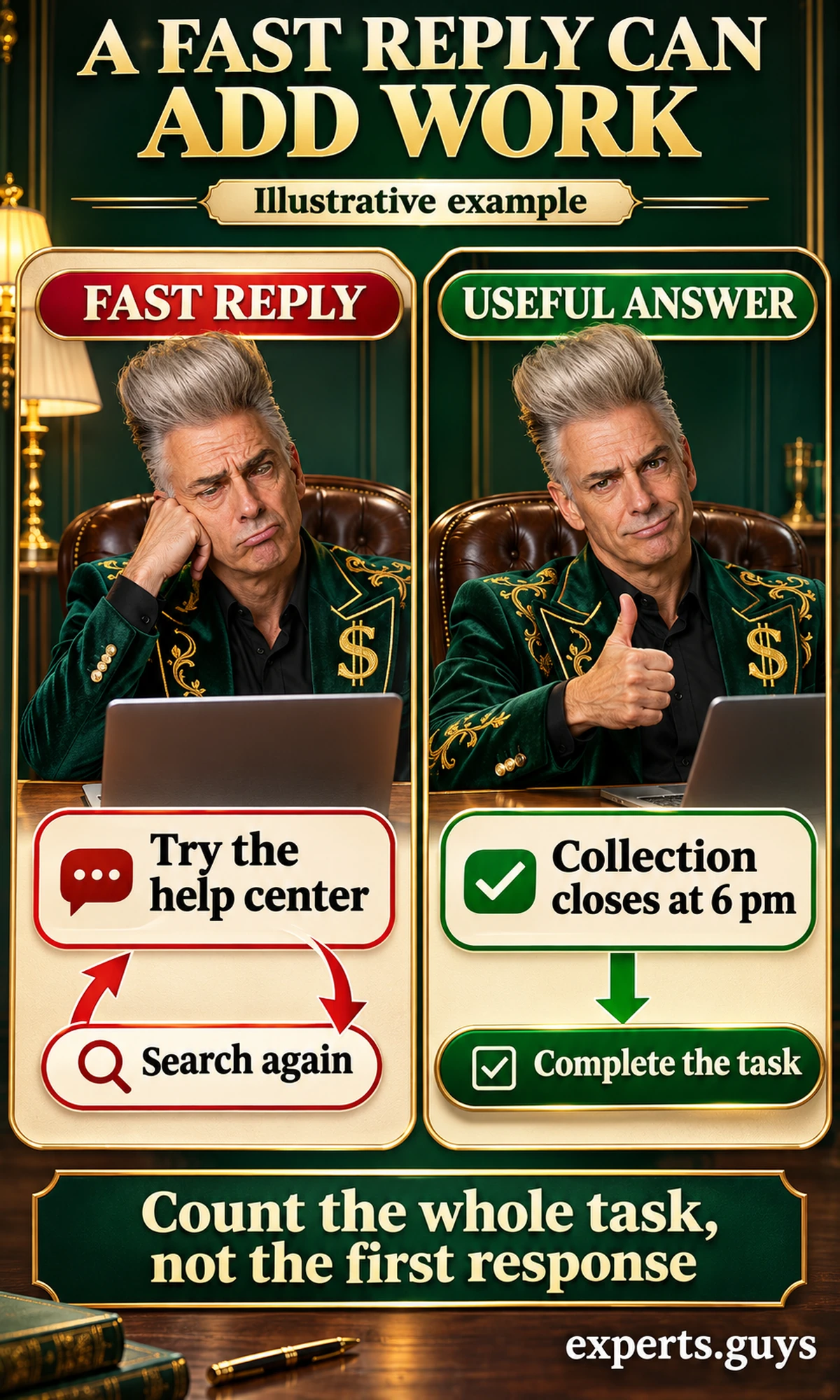
This is why response speed should be interpreted alongside task completion. The first reply is an event within the service journey, not the whole journey. Counting it as the outcome rewards the appearance of attention even when the visitor must do everything that prompted the question.
Generated language adds another complication: an answer can sound reassuring without being supported. The NIST Generative AI Profile identifies confidently stated false content and human overreliance among relevant risks. The consequence here is straightforward: smooth wording can explain why an interface feels capable, but cannot establish that its answer is correct.
A useful answer also has to preserve the question’s conditions. A statement about ordinary opening hours may omit a holiday exception. A response about delivery in general may not apply to a particular product or destination. More natural wording can make those omissions harder to notice because the sentence sounds complete.
Novelty and familiarity can coexist
Conversation is familiar as a human activity, while a machine producing flexible replies can feel novel. Together these features make the interface easy to try and easy to demonstrate. A short exchange can communicate its appeal more quickly than a description of the systems behind it.
That observation explains attention, not durable usefulness. A striking demonstration may use a well-supported question under ideal conditions. Everyday use includes ambiguity, missing information and requests the service cannot fulfill. The quality of the less impressive exchanges matters more to repeat usefulness than a single polished example.
It is also possible for the conversational form to become ordinary without becoming preferred for everything. People already switch between search, menus, forms and direct communication depending on the job. A chatbot can join that set of options without becoming the default answer to every information problem.
Practical takeaway: when someone says chatbots are popular, ask whether they mean organizations deploy them, people voluntarily choose them, or customers achieve better outcomes. Do not let one meaning stand in for another.
When does chat actually deserve a place?
Chat deserves a place when it removes more task effort than it introduces and can provide a dependable result for that purpose. For a public information question, the strongest alternative may be a clear page or button. For a request needing judgment or an exception, it may be a direct human route.
This is an editorial decision rule, not a scientifically validated score. Its purpose is to compare interfaces against the same reader need. A conversation that adds an avoidable step should not be preferred simply because it appears modern; a useful conversation should not be rejected simply because an easier case can be answered without one.
Compare one public question with the direct route
Use this small comparison when you want to understand whether the conversational attraction helps with an ordinary lookup. Choose a low-stakes public question whose correct answer is available, such as a fictional collection counter’s closing time. Keep account details, personal information and requests to change anything out of the exercise.
- Choose one question. Keep the location and meaning the same for both routes. For example: “When does collection close at this location?”
- Compare the chat route with the direct page. Notice whether each route produces the applicable answer, needs extra clarification or sends you somewhere else. You do not need a timer, screenshot or written log.
- Prefer fewer steps to a correct answer. A short route to the wrong hours is not a success. A longer route may be justified if it establishes a detail that genuinely changes the answer.
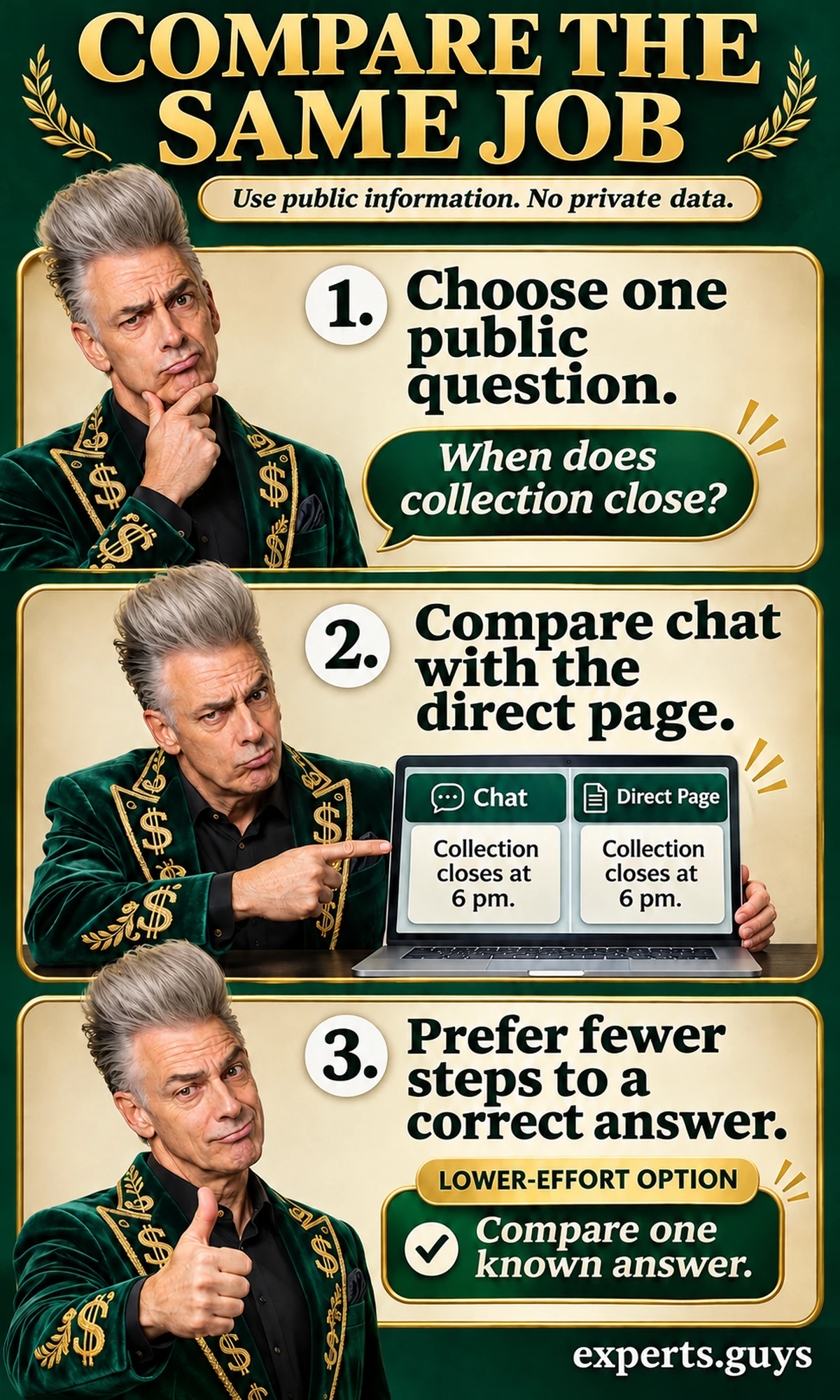
The observable result is a comparison of the effort required for that question. In the fictional example, a visible location page stating “Collection closes at 6 pm” may be the easier route. If the page buries the collection hours among unrelated information and the bot surfaces the correct location-specific fact directly, chat may remove the obstacle.
The common mistake is comparing different jobs. A general opening-hours page and an account-specific delivery inquiry require different information, so their apparent speeds cannot settle the same question. Keep the task matched. If the direct route is unavailable, describe that limit instead of assuming chat would beat a route that does not exist.
For a lower-effort version, compare one known public answer with the bot’s response rather than navigating several pages. This still reveals whether the conversation adds useful clarity, although it is a narrower check. If the response requires unsupported assumptions or private data, stop that comparison; supplying more information is not necessary for this learning task.
A single result does not certify the bot, measure population preference or predict performance on another question. It gives a concrete example of where effort was removed or added. That is enough for the article’s purpose: understanding why the interface appeals, and recognizing when the appeal corresponds to useful work.
Match the interface to the shape of the task
Chat can be useful when there are several ways to phrase a need, a short clarification changes the answer, or the reader benefits from an explanation at a different level. A direct page is often stronger when there is one stable fact to display. A structured form can be stronger when every required field is known and the user needs to inspect the whole submission.
For an exception or dispute, a person may need someone who can interpret context, accept responsibility and explain a decision. An automated entry point can still help route the request, but forcing a long conversation before that route can undermine the convenience that made chat attractive in the first place.

| Task shape | Useful starting route | Reason |
|---|---|---|
| One fixed public fact | Clear direct page or visible label | The answer can be available without a conversation. |
| Unfamiliar wording or category | Chat, if supported | Clarification can connect the need to the right information. |
| Known required fields | Structured form | The person can inspect the complete input together. |
| Exception, dispute or individual judgment | Accountable human route | The request needs more than the ordinary published answer. |
The choice also depends on the user’s circumstances. A person who cannot comfortably type may need voice or another accessible route; a person in a noisy environment may prefer text. The comparison of chatbots, voice bots and virtual assistants offers a starting point for channel differences. Capabilities overlap, so the interface label alone should not determine the choice.
From a publisher or service owner’s perspective, fixing the underlying information can sometimes be the better investment. If visitors repeatedly ask where the collection hours are, making those hours obvious may remove the need for the conversation. This does not make the bot useless; it identifies a friction problem that should not be preserved merely to generate chats.
There is no contradiction between using chat selectively and recognizing its broad appeal. An interface can be valuable precisely because it is reserved for tasks where conversation helps. Maintaining direct information and accountable alternatives makes that value easier to see, rather than forcing all demand through the same window.
Practical takeaway: use chat where clarification or navigation is the real obstacle. Keep a short route for a fixed fact and an accountable route for exceptions. Judge the choice by what the person can finish, with the necessary conditions intact.
Frequently asked questions
Do all chatbots learn from every conversation?
No. A conversation can supply context for the current exchange without changing the underlying model. Some services retain information or use conversations for later improvement under their own settings and policies; others do not. Do not assume that correcting one reply permanently updates the system or the business’s approved information.
Is a free chatbot free for the business to operate?
A free tier may remove an initial subscription charge while leaving limits, integration work and staff responsibilities. Knowledge maintenance, answer checking and exception handling can still require resources. Compare the work and charges attached to the intended use rather than treating the advertised entry price as the full operating cost.
Can chatbot conversations reveal why customers need help?
They can contain useful clues, but they represent people who reached that channel and chose to interact. People who found the answer directly, abandoned the site or used another route may be absent. Treat conversation patterns as a partial view of demand, with appropriate privacy controls, rather than a complete survey of customers.
Does a friendly bot need to pretend to be a person?
No. A clear identity and a useful answer can make an exchange approachable without implying human judgment. A name or conversational tone does not establish that a person is present. The service should make the available capabilities and route to accountable help understandable.
Does fewer support messages always mean better service?
No. Fewer messages can mean that information became easier to find, but they can also mean that visitors gave up or moved to another channel. The interpretation depends on what happened to the underlying task. A message count alone cannot distinguish those explanations.
What to take from chatbot popularity
Chatbots attract interest because conversation is an accessible starting point and automation can help distribute useful answers. Their lasting value depends on the specific obstacle they remove. For your next ordinary lookup, compare the conversation with the direct route and ask whether it made the correct answer easier to reach.