A chatbot is software that exchanges messages with customers or employees and can answer questions, collect necessary details or connect a request to a business system. It helps your business when that conversation removes a real obstacle, produces a verifiable outcome and costs less than the value it creates. Start by choosing the work it should own, rather than assuming that every enquiry needs an automated conversation.
The strongest first use case usually has repeatable demand, a dependable answer source and an outcome someone can check. A chatbot may explain a product, qualify an enquiry or retrieve an authenticated order status, but each job needs different information and authority. If a clearer product page, search result or short form would remove the same obstacle more directly, improve that route first.
This guide focuses on the business decision before implementation: what the bot would actually complete, which work should stay elsewhere and whether the recovered capacity justifies the total cost. The examples use a fictional office-chair retailer; they are decision illustrations, not reported company results or product tests.
What work can a chatbot actually complete?
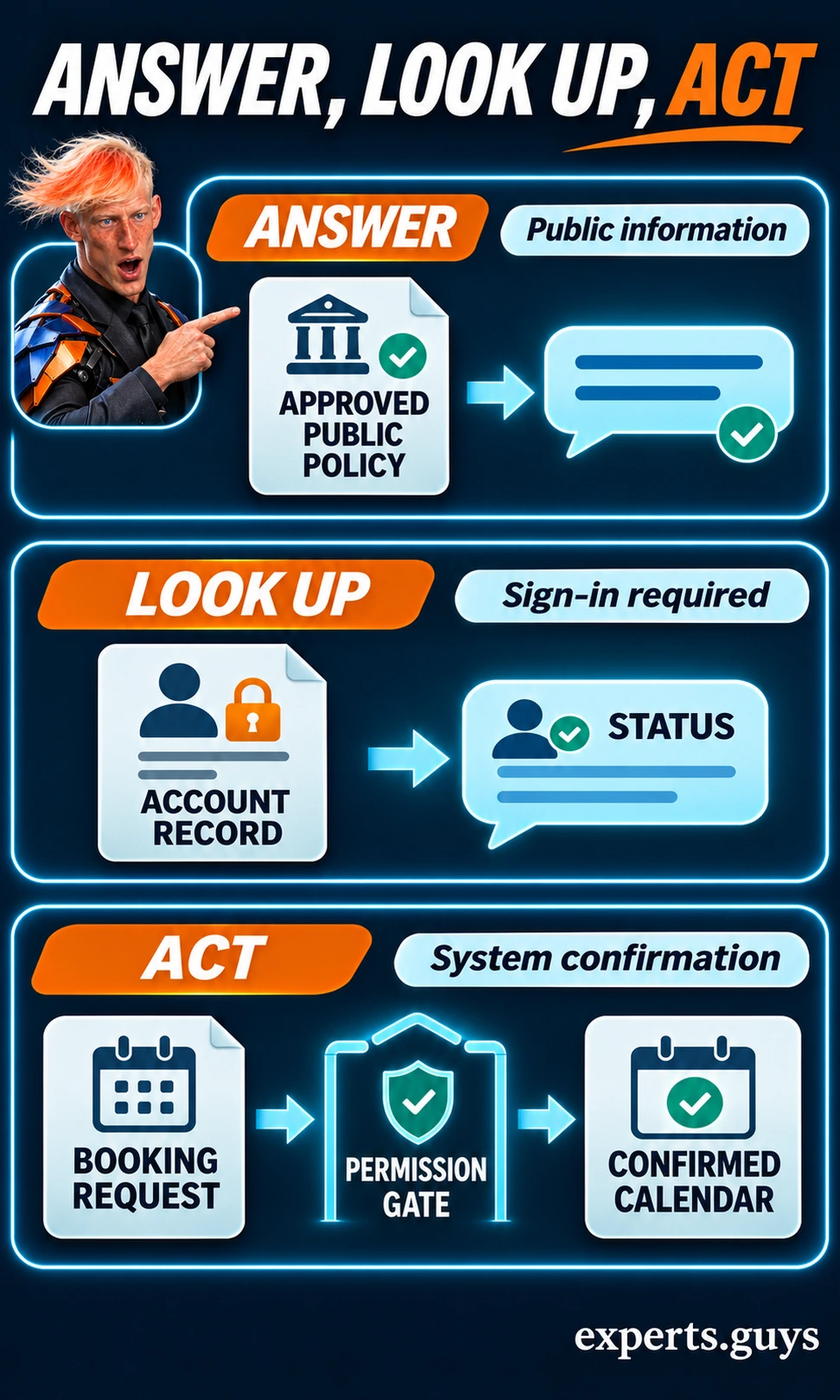
A chatbot can provide an answer, retrieve a record or initiate an action, depending on the systems connected to it. Those are different deliverables. A fluent response proves only that the interface returned text; the business needs to know whether that text answered the right question, reflected a current record or described a transaction that really succeeded.
The distinction is easy to miss when all three results appear inside the same chat bubble. A statement about the delivery policy can come from approved public information. An answer about a particular customer’s parcel needs access to the relevant record. Changing that parcel’s address requires a further capability, including permission to make the change and confirmation from the system responsible for the order.
| Task | Evidence needed | Observable endpoint |
|---|---|---|
| Public answer | Approved information that applies to the specific question. | A supported explanation with uncertainty visible. |
| Private lookup | Authenticated identity, authorized record access and a usable system response. | The relevant record is returned, with freshness limits where material. |
| Business action | Valid inputs, permission and confirmation from the responsible application. | The system confirms the action; a request to act is not reported as success. |
Separate an answer from a lookup and an action
Use this separation when a proposed chatbot brief contains broad verbs such as help, manage or handle. Begin with one ordinary customer request, identify what information would resolve it, then name the observable endpoint. Classify that endpoint as an explanation, a retrieved fact or a completed action before deciding which integration the chatbot needs.
- Explanation: identify the approved source and the question it can answer.
- Lookup: identify the authorized record and what its response establishes.
- Action: identify the permission and system result that proves completion.
For the chair retailer, “What does the warranty cover?” is an explanation task. “Is my warranty claim open?” is a record lookup. “Submit my claim” is an action that needs the appropriate details, consent and system result. Combining these under “warranty support” hides the work involved and makes it difficult to judge whether the bot has finished anything useful.
The simplest version is to keep the chatbot at the explanation level and link to the existing claim process. A common mistake is letting its friendly wording imply that a claim was filed when it only displayed instructions. Correct that by making the endpoint visible: explanation delivered, claim status retrieved, or submission confirmed with an actual reference returned by the receiving system.
Not every chatbot uses generative AI. A fixed flow can present approved choices; an intent classifier can route varied wording to a known answer; a language model can compose a response from supplied context. IBM’s overview of chatbot approaches describes these distinctions. For a business decision, flexibility of language matters only when it improves completion of the intended task.
A generated answer also needs a reliable information supply. Connecting a model to retrieved documents can help it use company-specific material, but the source might be incomplete, stale or interpreted too broadly. A document explaining typical dimensions cannot establish that a particular chair fits beneath a customer’s particular desk. That requires the relevant dimensions and an appropriate allowance for how the furniture will be used.
A chatbot is also different from live chat. A human may enter the same conversation, and a support widget can offer either mode. Explain which service is being provided and make the transition clear; a customer should not have to infer it from a typing indicator. A shared interface does not make the software and the employee interchangeable.
Give one request a completion contract
A completion contract is an editorial planning aid: one request, the evidence needed and the result that counts as done. It is useful when a team agrees that a chatbot could help but different people mean different outcomes. Build it from a real service task using appropriately protected information already held in the business, without collecting extra customer data merely for the exercise.
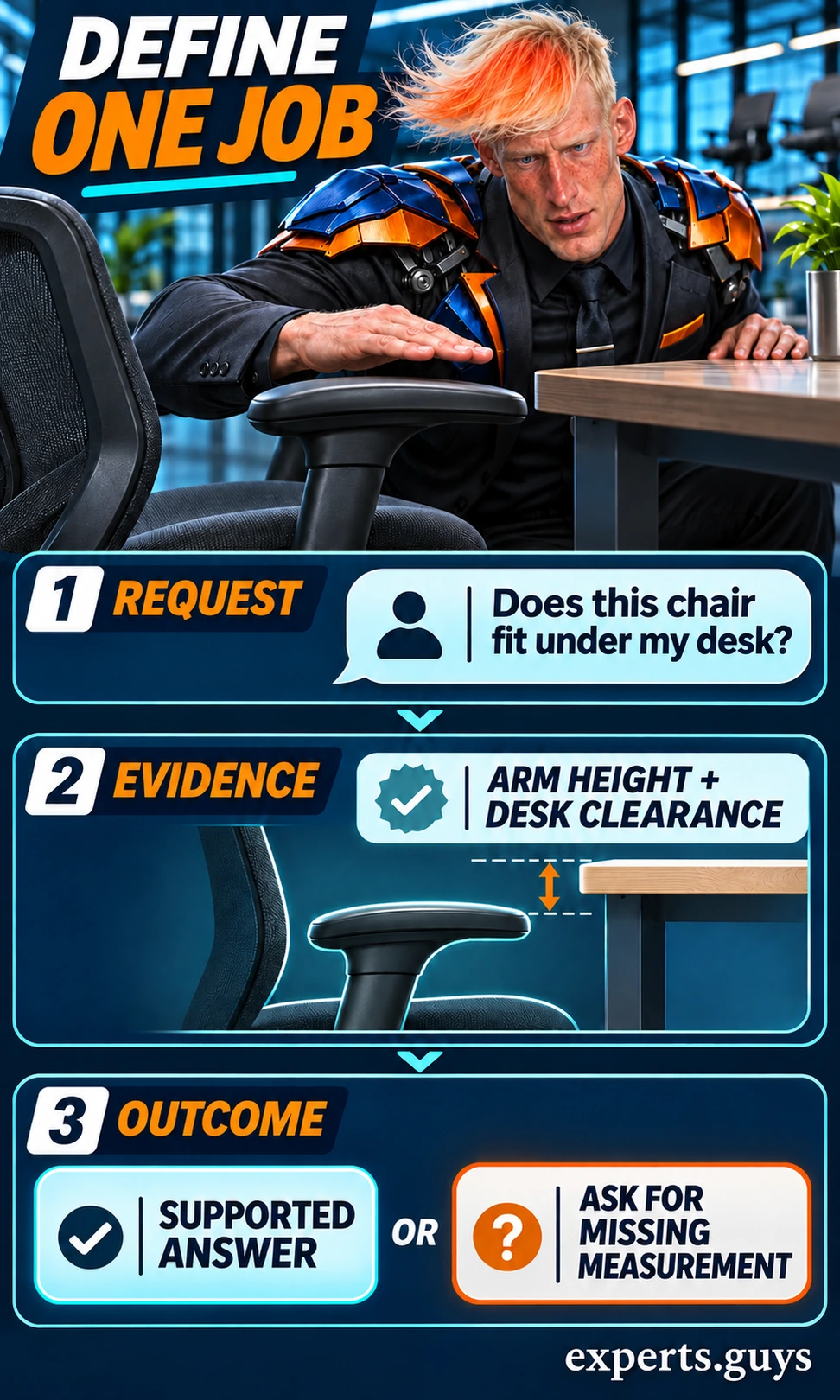
First choose the customer’s immediate question. Next identify the minimum evidence that supports a useful answer. Finally specify what happens if that evidence is missing. For “Does this chair fit under my desk?”, the contract requires the relevant chair configuration and arm height, the available desk clearance and a clear statement of any measurement uncertainty. Without those facts, asking a focused follow-up question is more useful than asserting a fit.
Completion might be a supported comparison of the two dimensions, with the source and remaining clearance explained. It does not mean guaranteeing comfort, suitability or clearance while the chair moves. Those are different claims. This keeps one useful answer from becoming an unsupported recommendation about the entire purchase.
- Request: name the customer question in ordinary language.
- Evidence: identify facts needed to support the answer, including configuration and relevant measurements.
- Endpoint: define a supported answer or a specific request for missing information.
The common failure is defining completion as “the bot responded.” Replace that with an endpoint the business can inspect. If the task is too broad, reduce it to one product range or one public question. A smaller accurate service is easier to evaluate than a conversation that appears to cover everything but cannot establish its own boundaries.
For readers who want to understand what a conversational exchange actually demonstrates, the separate guide to reading chatbot examples examines the interface and the claims it makes. Here the practical takeaway is different: decide what work the business is buying before judging how natural the conversation sounds.
Which business jobs deserve a chatbot first?
Give priority to work where a short conversation resolves uncertainty that would otherwise require staff effort or cause customers to stop. Frequency helps the case, but a frequent question can still be unsuitable if its answer depends on negotiation, inconsistent records or an exception nobody is authorized to approve. Consider suitability before estimating scale.
A useful candidate has a recognizable request, dependable inputs, a bounded result and a destination for exceptions. These conditions can exist in sales, service or employee support. Conversely, moving a confusing process into chat can preserve the confusion while adding a new maintenance obligation. A chatbot should remove friction from a sound process, not conceal the absence of one.
Sort candidates by readiness rather than popularity
Use the readiness comparison when several departments propose their own chatbot project. Inspect how each task is completed today and place it into one of three groups: repeatable with verifiable facts, blocked by missing or conflicting information, or dependent on judgment and negotiation. The group determines the next action; it is not a numerical maturity score.
A chair shop might have a strong candidate in explaining published care instructions for an identified fabric. Questions about stock availability are weaker if inventory updates are unreliable. A request for a discount on a damaged display item requires commercial discretion. All three may arrive often, but their frequency does not make their information and decision requirements equivalent.

Start with the first group when there is enough demand to justify maintenance. Repair the information source for the second group. Keep the third human-led unless the business has an explicit, appropriate rule that genuinely covers the decision. If no candidate meets the conditions, the useful result is a clearer problem definition rather than an obligation to launch a bot.
| Candidate job | Potential benefit | Condition that changes the decision |
|---|---|---|
| Product care | A consistent explanation outside staffed hours. | Conflicting instructions need correction first. |
| Commercial enquiries | Sales receives details needed for a relevant next conversation. | A long sequence can lose a buyer who could complete a short form. |
| Appointment requests | Customers express the service and preferred time. | A request is not a booking until the scheduling system confirms it. |
| Employee knowledge | Staff can find the applicable process with fewer searches. | Audience restrictions and document ownership must remain enforceable. |
| Disputed exceptions | A bot can collect context for the responsible person. | A fluent reply cannot create authority to negotiate or approve. |
This comparison avoids a familiar trap: choosing the most visible customer complaint even when the chatbot cannot influence its cause. If delayed dispatch is the problem, a bot may explain status but cannot create warehouse capacity. If customers repeatedly miss the same size information, improving the product page may prevent more enquiries than answering them individually. Prevention should remain an eligible investment.
Lead qualification can be suitable when each answer changes the next relevant question. For example, a retailer serving commercial buyers may need to distinguish a single replacement chair from a multi-site office order. The useful result is enough relevant context reaching the appropriate team, with a permitted contact route. More captured names are not automatically better leads, and an abandoned qualification sequence has created no completed sales opportunity.
Employee support follows the same reasoning but has different access boundaries. Public assembly instructions and an employee’s individual HR record should not share an unrestricted answer source. A convenient chat interface does not remove the need for the business to decide which audience may see which material. Keep the comparison focused on the intended task rather than promising one universal assistant for every department.
Compare conversation with a form, search and a human
Use this method before committing to a new interface. Take the same customer job and imagine it completed through each available route. Compare how many decisions the customer must make, what information is required and where an exception goes. Judge the shortest reliable path to completion, including what happens when the first attempt fails.
A form is often strong when the required fields are known and stable. Search is useful when the customer knows which manual or product name to find. Conversation earns its place when an answer changes which question should come next. A human is valuable when priorities conflict, the customer needs reassurance grounded in judgment or the business must negotiate an exception.

For the chair retailer, an enquiry containing a model number, quantity and contact address may fit a short quotation form. A person unsure which chair adjustment solves a specific seating problem may benefit from follow-up questions, while a complex accessibility requirement may call for informed human help. The interface should reflect the uncertainty in the request, not the company’s wish to appear technologically advanced.
The common mistake is comparing an excellent chatbot demonstration with a neglected form or an unusable search page. Improve the simplest plausible alternative before judging the incremental benefit. Where resources are limited, compare just two credible routes for one task. Completion is a justified interface choice, including the decision to keep a form or improve existing content.
A rules-based conversation may still be the best fit for predictable branching. The deeper distinction between fixed automation and AI interpretation helps when a proposal uses “AI” as a substitute for a specific capability. Do not pay for open-ended generation when clearly labeled choices already resolve the customer’s uncertainty.
How does chatbot help turn into business value?
Chatbots create value by removing avoidable effort, improving access to a useful service or supporting a commercially relevant outcome. These benefits need separate measures. Recovered staff capacity, additional contribution from sales and a reduction in actual cash spending are not interchangeable, even when all appear in the same business case.
Availability is a good example. A chatbot may return approved information outside staffed hours, which can be helpful on its own. It cannot promise that a warehouse will investigate a missing parcel or that a specialist will answer immediately. The benefit is access to the tasks that truly work at that time, with honest expectations for everything else.
Subtract the work that comes back
Use a before-and-after work comparison when a proposal claims that every automated conversation saves the full time of a human interaction. Compare a relevant task completed through the existing route with the chatbot route. Follow the work far enough to include a repeat enquiry, correction, escalation or back-office step attributable to that interaction.
In the chair example, a chatbot could tell a customer that an unsuitable model will fit beneath the desk. The customer then contacts support, an employee corrects the answer and the business may need to address an avoidable return. The first reply was fast, but the complete process created additional work. A short conversation is not evidence of a short resolution.
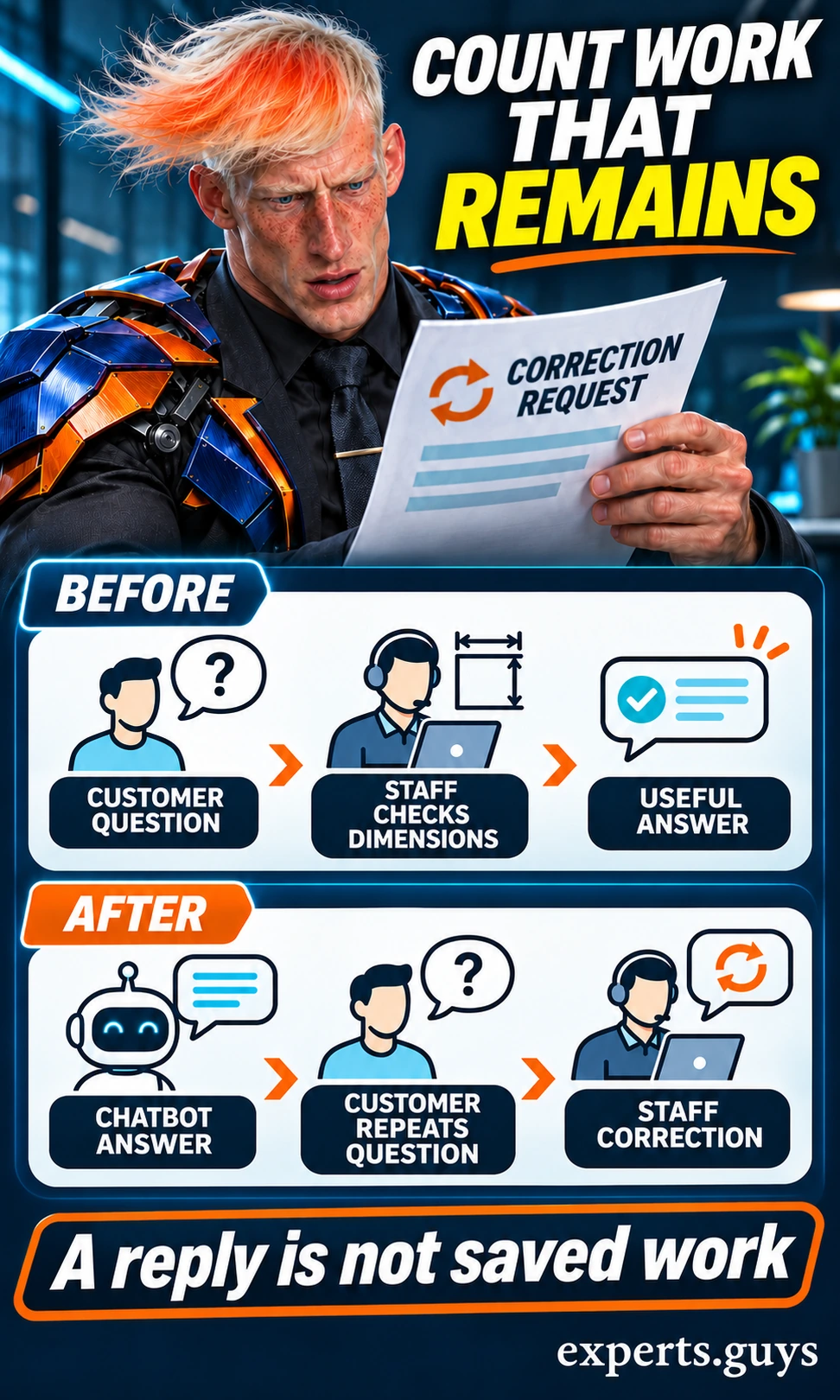
For an easier comparison, choose one narrow request category and inspect the actual receiving queue alongside the chat outcome. Avoid pooling simple public questions with complex returns, since a shift in the case mix can make the figures look better without improving either task. Completion is a credible view of the work remaining, not the disappearance of a chat window.
The cost of review belongs somewhere as well. If employees read every answer before it reaches a customer, the arrangement is assistance rather than full self-service. That may be an excellent choice, but the saved time is the difference between the old handling process and the new assisted process. Count the review step instead of treating it as free.
Accuracy also has a business dimension that average speed cannot capture. A single unauthorized disclosure or unsupported commitment can matter more than many correct routine replies. Treat consequential failures as reasons to investigate the scope and controls, rather than assuming they are cancelled out by a favorable average. Generative systems can produce convincing false content; the NIST generative AI risk profile provides a broader basis for examining that risk.
Calculate recovered capacity with explicit assumptions
Use this calculation for a task that displaces identifiable human handling time. Start with eligible requests during a stated period, multiply by the share correctly completed without later human handling, then multiply by baseline minutes per request. Convert the minutes to hours and subtract ongoing review, upkeep and correction time that is not already included in the success definition.
Keep the categories mutually consistent. A request requiring later human correction should not count as successfully completed without human handling. If upkeep includes routine quality sampling, do not subtract the same sampling time again under another label. If you lack reliable completion data, calculate a range of scenarios and label the rates as assumptions rather than estimates established by a trial.
- Eligible demand: include requests the proposed service is intended to handle.
- Correct completion: exclude cases needing later human handling.
- Time displaced: use a comparable baseline rather than the longest case.
- Remaining effort: subtract additional upkeep and correction once.
For an illustrative month, suppose 400 requests are eligible, 60% are correctly completed and each would otherwise take six staff minutes. That gives 240 completed requests and 24 gross hours of avoided handling. Subtract eight hours of additional monthly upkeep and the result is 16 net hours of capacity. These inputs demonstrate the arithmetic; they are not a typical result or an industry benchmark.
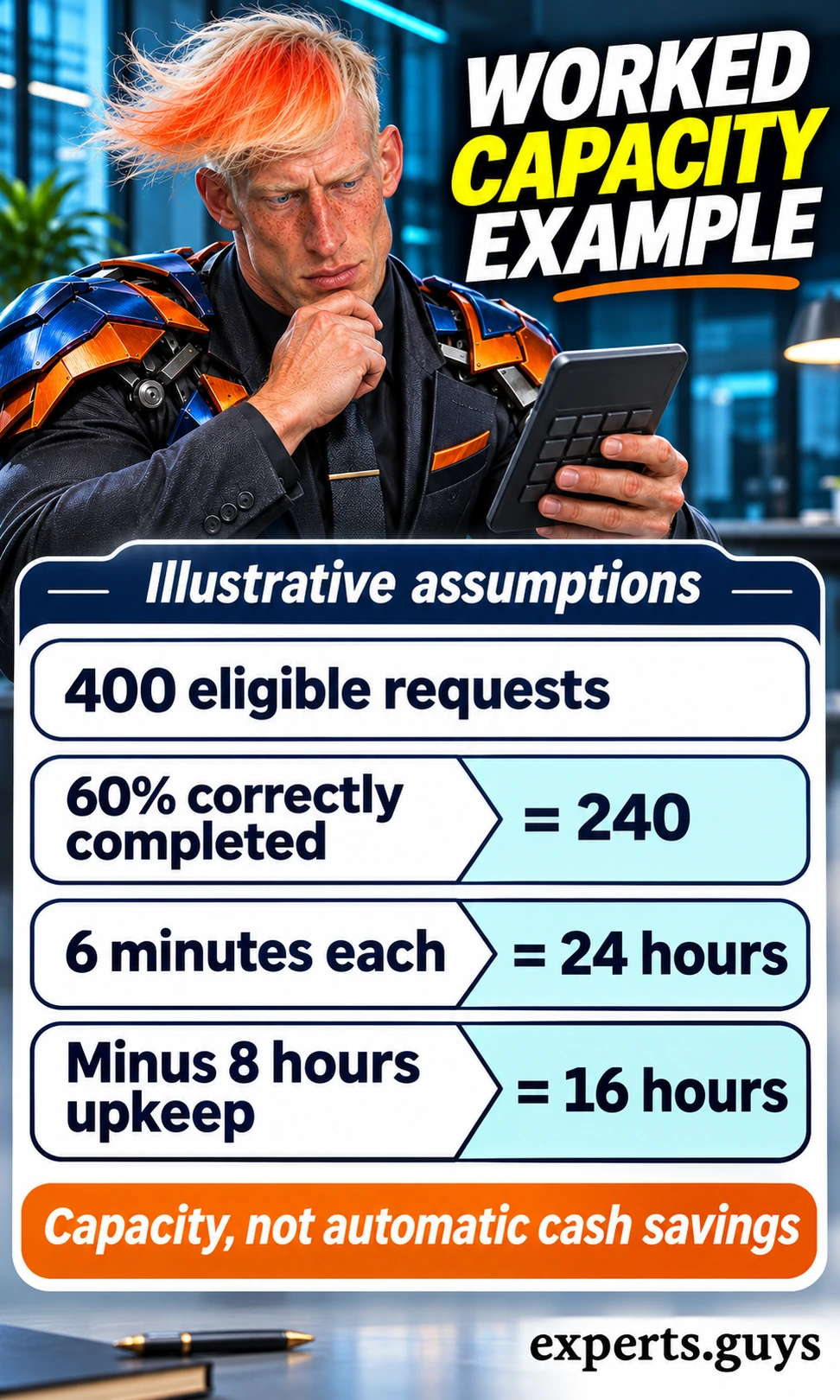
At a capacity valuation of 30 money units per hour, those 16 hours represent 480 units of modeled capacity value. This is not automatically 480 units of cash saved. A fixed salary still has to be paid unless an actual spending change occurs. The useful question is whether those hours can support a specific benefit, such as reducing a genuine backlog or avoiding paid overtime that would otherwise be needed.
Revenue needs a different calculation. If a chatbot helps shoppers select a product, evaluate completed purchases and contribution after returns, fulfilment and relevant acquisition costs. Counting every purchase that follows a conversation as additional revenue confuses sequence with causation. Where a fair comparison is unavailable, describe the uncertainty instead of adding a speculative sales uplift to a precise-looking total.
If both service capacity and sales benefits are included, check that they represent different effects. Do not value the same freed hour once as staff savings and again as revenue-producing sales time without explaining the actual operational change. A conservative case that separates these effects is more useful than a large combined figure whose components cannot be reconciled. For broader evaluation questions, the guide to assessing AI and human collaboration considers the team relationship; the capacity calculation here isolates the narrower business case.
When is the investment worthwhile, and when should you wait?
Proceed when a bounded task has a credible completion outcome, a maintainable information source and a conservative value case that covers the full cost. Wait when the case depends on unsupported success rates, unavailable data, undefined ownership or a capability the connected systems cannot deliver. The decision can change as those conditions change.
The financial comparison is only one gate. A positive modeled result cannot compensate for an unacceptable disclosure risk, misleading advice or a service that customers cannot escape. Equally, a negative labor-only calculation does not prove the project has no value if a different, real objective justifies the spending. State that objective separately and decide how it will be assessed.
Set the cost boundary before comparing quotes
Use a common cost boundary whenever vendors describe different packages. Separate one-time preparation and integration from recurring software, usage and operating work. Add the costs of maintaining the intended service, including changes to its information supply and handling failures. Compare the same task, channels, volume assumptions and support responsibilities across proposals.
Ask what counts as a billable unit. A conversation, message, automated resolution, model call and active user describe different things; a plan priced around one unit cannot be compared fairly with another by looking only at the headline fee. Verify the current definition and treatment of retries, handoffs, overages and connected services in the actual quote. This article does not assume a universal vendor rate.

For a small first service, preparation may be more important than the model bill. Someone has to approve the answer source, resolve contradictions and keep product details current. Integration can also be the dominant burden if a useful answer requires an authenticated system that lacks a suitable interface. A no-code editor reduces some implementation work, but it does not remove these business dependencies.
Choose a consistent planning horizon for setup costs. Spreading setup over twelve months is a scenario convention, not a claim about accounting treatment or how long the investment will remain useful. A shorter expected useful life increases the monthly burden. Include the person responsible for updates and incident handling even if the business handles that work internally rather than paying an external supplier.
The easier alternative is a quote comparison for one public-information task without transactional access. Its scope can expose what the base service actually includes before the business commits to more integrations. The mistake to avoid is treating an introductory subscription as the all-in cost of an operational service. Completion is a comparable total with exclusions visible.
Stress-test the break-even point
Use a sensitivity check when the result looks attractive but depends on uncertain completion or maintenance assumptions. Calculate the net monthly capacity value, subtract recurring and allocated setup costs, then change one uncertain input at a time. Lower correct completion, increase upkeep or reduce eligible demand to see which assumption changes the decision first.
In the illustrative case, 16 net hours valued at 30 units per hour produce 480 units of capacity value. If monthly all-in cost is 600 units, the modeled net is minus 120. A different scenario with 30 net hours produces 900 units and a modeled net of 300. Neither result is a forecast, and the positive scenario still needs a practical way to use the recovered time.

The accompanying Chatbot Capacity Check lets you change eligible demand, correct completion, baseline handling time, upkeep, hourly capacity value, running cost and setup horizon. It keeps calculations in the browser and requires no customer transcripts or account details. Use one currency or money unit consistently across the monetary inputs; the arithmetic does not convert currencies or retrieve vendor prices.
The break-even completion rate can be calculated by dividing the combined monthly cost and valued upkeep hours by the potential gross capacity value at 100% completion. A result above 100% means the stated labor-capacity assumptions cannot cover the cost even if every eligible request completes correctly. When volume, handling time or hourly value is zero, there is no finite break-even rate under this model.
| Finding | Interpretation | Next action |
|---|---|---|
| Positive balance | Capacity value exceeds stated monthly cost. | Check how time will actually be used and validate quality separately. |
| Negative balance | Labor-capacity value alone does not cover cost. | Reduce scope or cost, improve the alternative, or justify another measurable objective. |
| Break-even above 100% | Full completion cannot cover cost under these assumptions. | Reconsider task economics instead of projecting impossible performance. |
| No finite break-even | Demand, handling time or hourly value provides no positive gross capacity value. | Use another justified benefit model; this does not mean zero cost. |
| Uncertain assumptions | Completion or upkeep materially changes the result. | Compare conservative scenarios and evaluate a bounded task first. |
Use that result to narrow the next commercial question. If setup dominates the case, simplify the integration scope or revisit the chosen horizon. If upkeep consumes most avoided handling, investigate whether the source material changes too often for the intended service. If the volume is too low, a clearer help page or existing form may achieve the practical goal with less ongoing work.
A decision that passes these checks is ready for implementation planning, not unrestricted deployment. The separate guide to implementing AI customer service with explicit controls covers knowledge preparation, access, handoff and staged evaluation. Use it after the business has established why this particular task deserves automation.
Frequently asked questions
Can a small business use a chatbot without coding?
A visual builder may make conversation design accessible without programming, particularly for a narrow public-information service. Authentication, connected records and transactional actions can still require integration and operational ownership. Ask which parts the platform supplies and which remain with your team before treating no-code as a complete implementation promise.
Does a chatbot need every customer conversation?
No. It needs appropriate information for its approved task, not unrestricted access to historical messages. Old conversations may contain private details, exceptions and outdated advice. Use the minimum suitable information, define access and retention responsibilities, and evaluate the service without importing extra data merely because it is available.
Can one chatbot serve several languages?
It may, but support needs checking for the actual tasks and language combinations. Fluent wording does not prove that policy meaning, product details or escalation instructions survived translation. Treat another language as a meaningful scope change, including source content and the receiving team, instead of assuming the first-language result transfers unchanged.
Should a chatbot replace the contact page?
Keep a clear alternative contact route. Some customers need an accessible form, direct contact details or a person, and the bot itself may be unavailable. Making it compulsory can turn a convenience into an obstacle for requests outside its scope. Show customers how to reach the route that can actually address their need.
How should conversation data inform business decisions?
Treat conversations as a partial sample of people using that channel. Repeated questions can reveal missing information, but do not by themselves measure the whole market or establish a new preference. Check whether the pattern reflects page design, a temporary operational problem or who chooses chat before changing a product strategy.
Is a free plan enough to judge the business case?
It can help explore a bounded workflow if its limits match the task, but may not represent production usage, support, integrations or operating work. Compare the service you would actually run, including what happens after limits are reached. A low subscription price does not settle the total cost or quality of the outcome.
Action checklist
- Choose one customer job with a verifiable endpoint and dependable source.
- Compare it with the strongest simple alternative, including a clearer page or form.
- Run a conservative capacity scenario with correction, upkeep and setup included.
- Identify who will use the recovered time and who owns failures.
- Proceed to controlled implementation when the business case and service boundaries are defensible.