Antidepressants include SSRIs, SNRIs and medicines with other mechanisms, and several types can reduce depression symptoms. Their effectiveness is best judged by meaningful benefit, side effects and whether treatment remains suitable over time; a drug class or a ranked list cannot predict the best medicine for an individual.
For adults with major depressive disorder, the useful comparison is not simply which tablet is strongest. It is what outcome was measured, how convincing the comparison is, and whether its benefits are usable in everyday life. This guide focuses on interpreting effectiveness; it does not provide a prescription, a dose schedule or instructions for changing medication.
What does antidepressant effectiveness actually measure?
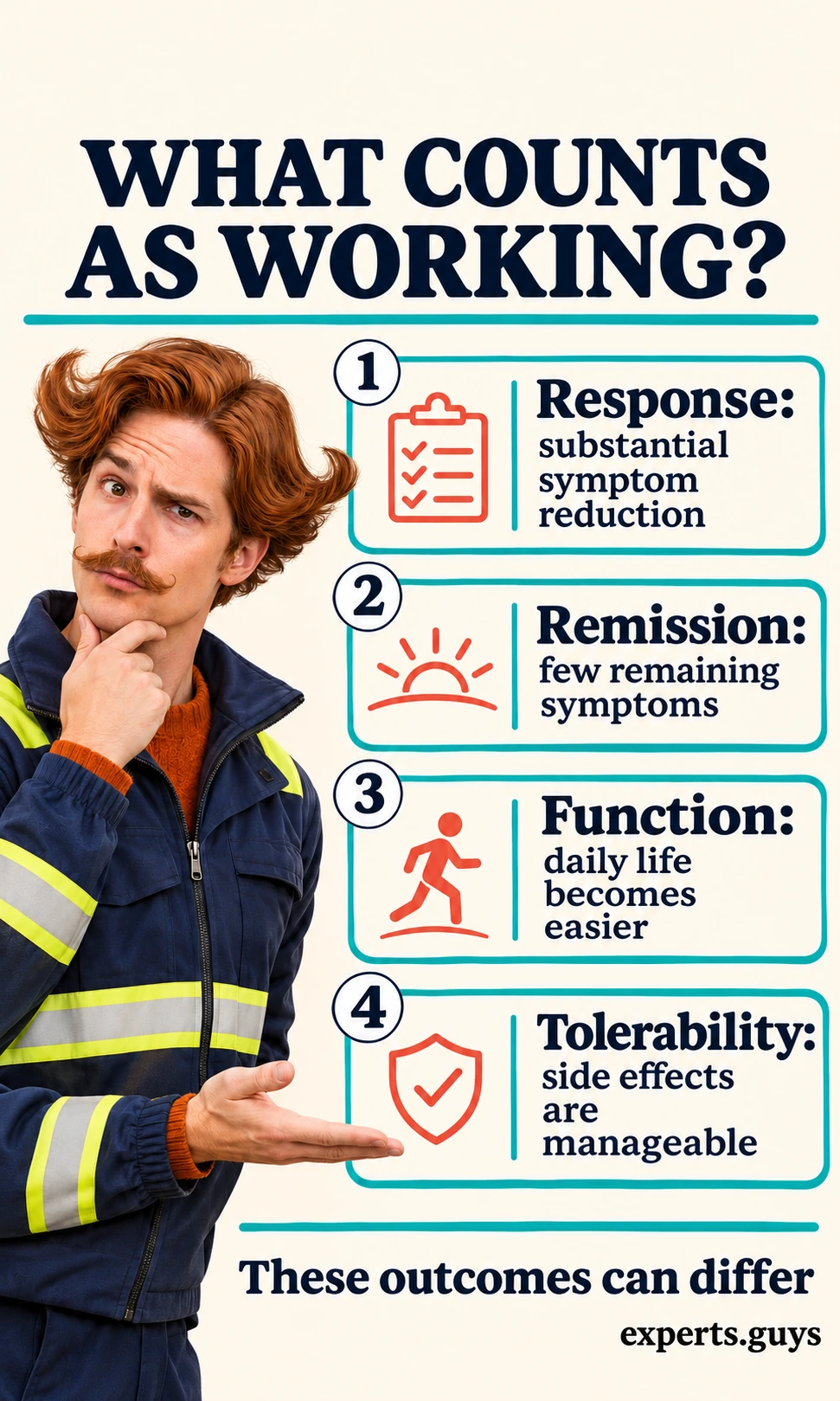
Effectiveness can refer to a reduction in symptoms, reaching remission, returning to ordinary activities or remaining well after an episode. Those outcomes overlap, but they answer different questions. Before accepting a claim that a medicine works, identify which outcome the claim describes and when it was assessed.
An early improvement in one symptom may matter without settling the whole question. Someone might sleep more consistently while still feeling little interest in other people. Another person might feel less distressed but find daytime drowsiness difficult to manage. Both accounts contain useful information that disappears when the result is reduced to a single yes or no.
Swipe horizontally to compare on smaller screens.
| Outcome | What it answers | What it leaves open |
|---|---|---|
| Response | Have symptoms fallen substantially from their starting level? | A response can leave significant symptoms and practical difficulties. |
| Remission | Are symptoms below the study's defined threshold? | Remission does not establish that every aspect of daily life has returned to normal. |
| Function | Has the person regained abilities or participation that matter? | Visible activity alone cannot establish how the person feels or whether symptoms remain. |
| Tolerability | Can unwanted effects be managed within the treatment plan? | A tolerable medicine is not necessarily effective, and tolerability does not rule out important safety risks. |
In research, response commonly means a substantial reduction on a depression rating scale, often at least half the starting score. Remission means symptoms have fallen below a defined threshold, as illustrated in NICE’s evidence-review definitions. The exact instrument and cutoff matter: these terms are study definitions, not universal descriptions of how recovered someone feels.
Function deserves separate attention because a symptom total does not describe every practical consequence. Returning to a usual responsibility, taking part in a conversation or managing an ordinary journey may matter greatly. Conversely, appearing productive does not prove that depression has resolved. The question is how the person’s experience and ability have changed, rather than how convincing their outward performance looks.
Tolerability describes whether unwanted effects can be lived with; safety asks whether a treatment carries unacceptable risks in the person’s circumstances. A medicine can produce symptom improvement and still be a poor overall fit. Benefits do not cancel out a serious adverse effect, and a frightening list of possible effects does not mean everyone will experience them.
Why a response rate is not a recovery rate
Imagine an illustrative study that reports how many participants met its response threshold after a defined treatment period. That tells you something about the probability of substantial symptom reduction under those conditions. It does not tell you how many had no remaining symptoms, how many returned to their previous routines or how many remained well a year later.
This distinction becomes especially useful when comparing headlines. One article might describe a medicine as effective because symptoms improved during short-term treatment. Another might discuss preventing a return of depression after improvement. The two articles can both be accurate while examining different phases. A short-term result cannot establish a long-term advantage without follow-up evidence.
A trial also measures people at scheduled points. An average change across a group can conceal a mixture of marked improvement, partial improvement and little improvement. It is therefore misleading to imagine that the average is a typical individual journey or a promise that every reader will feel the same amount better.
Read improvement alongside the comparison group
In placebo-controlled trials, people in both groups can improve. A placebo group is not necessarily a group receiving no attention: participants may have assessments, follow-up and expectations of benefit, and symptoms can change over time. The relevant drug comparison concerns the difference between the groups, not simply whether some treated participants improved.
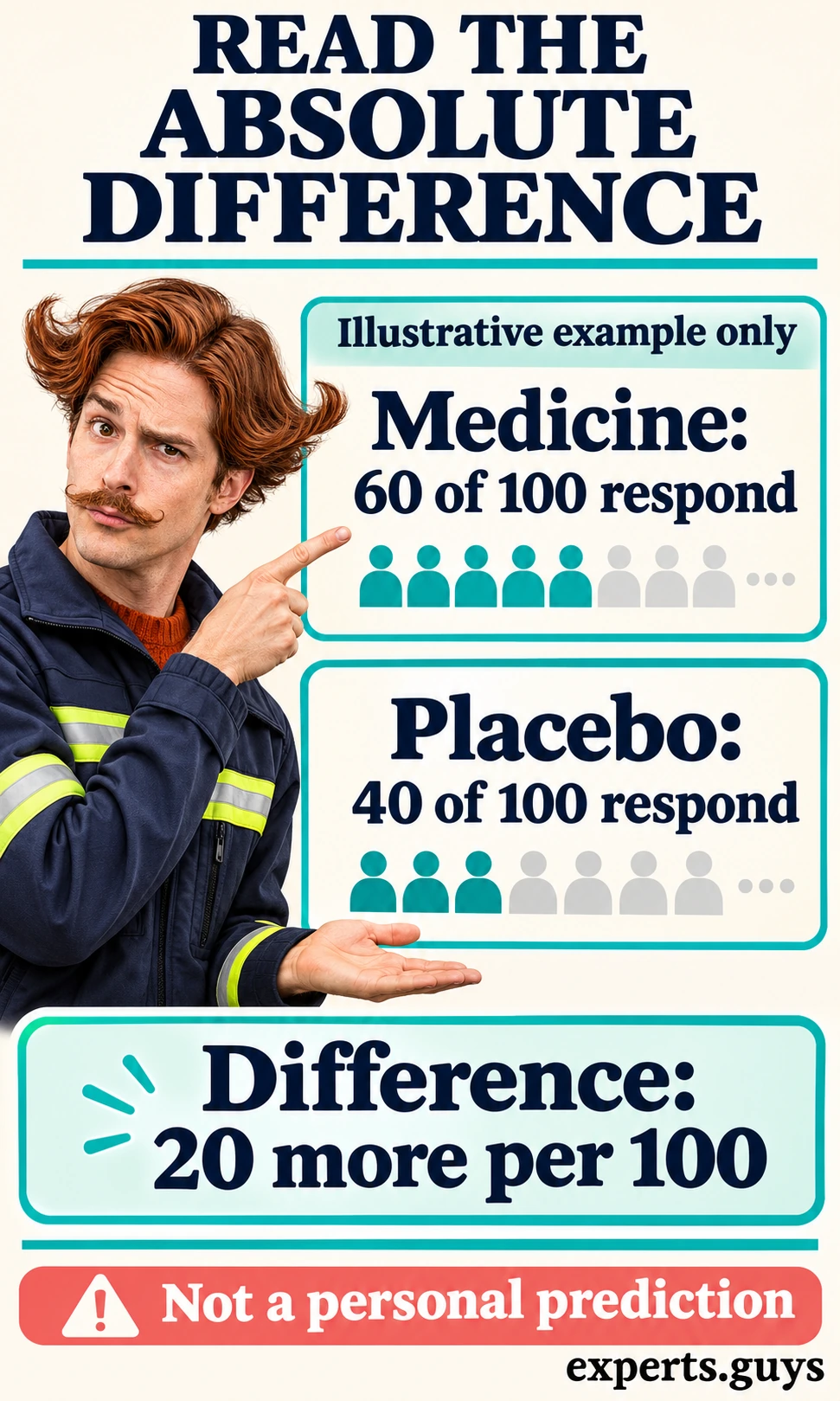
Consider a deliberately invented arithmetic example: 60 of 100 people respond with a medicine, compared with 40 of 100 with placebo. That is 20 additional responders per 100 treated under the example’s conditions. It is also a relative increase of 50 percent compared with 40, because 20 divided by 40 is one-half. The relative figure sounds larger, but both describe the same hypothetical comparison.
These numbers are teaching assumptions, not a reported trial or an expected antidepressant success rate. They show why the denominator and comparison matter. You would still need the actual study population, treatment duration, outcome definition, uncertainty and adverse effects before using a real numerical result to inform a discussion.
A result expressed as an odds ratio needs still more care. Odds and probability are different quantities, so an odds ratio of two does not simply mean that your personal chance of recovery doubles. If a source provides only a relative measure, look for the actual event rates or an absolute presentation before translating the finding into everyday expectations.
The practical takeaway is to separate four questions: did symptoms improve, did they improve enough, did daily life become easier, and was the cost in unwanted effects acceptable? You do not need a notebook or a self-designed scoring system to understand those distinctions. They are a way to read evidence and describe experience accurately, not another task you must complete while unwell.
Are some antidepressant types more effective than others?
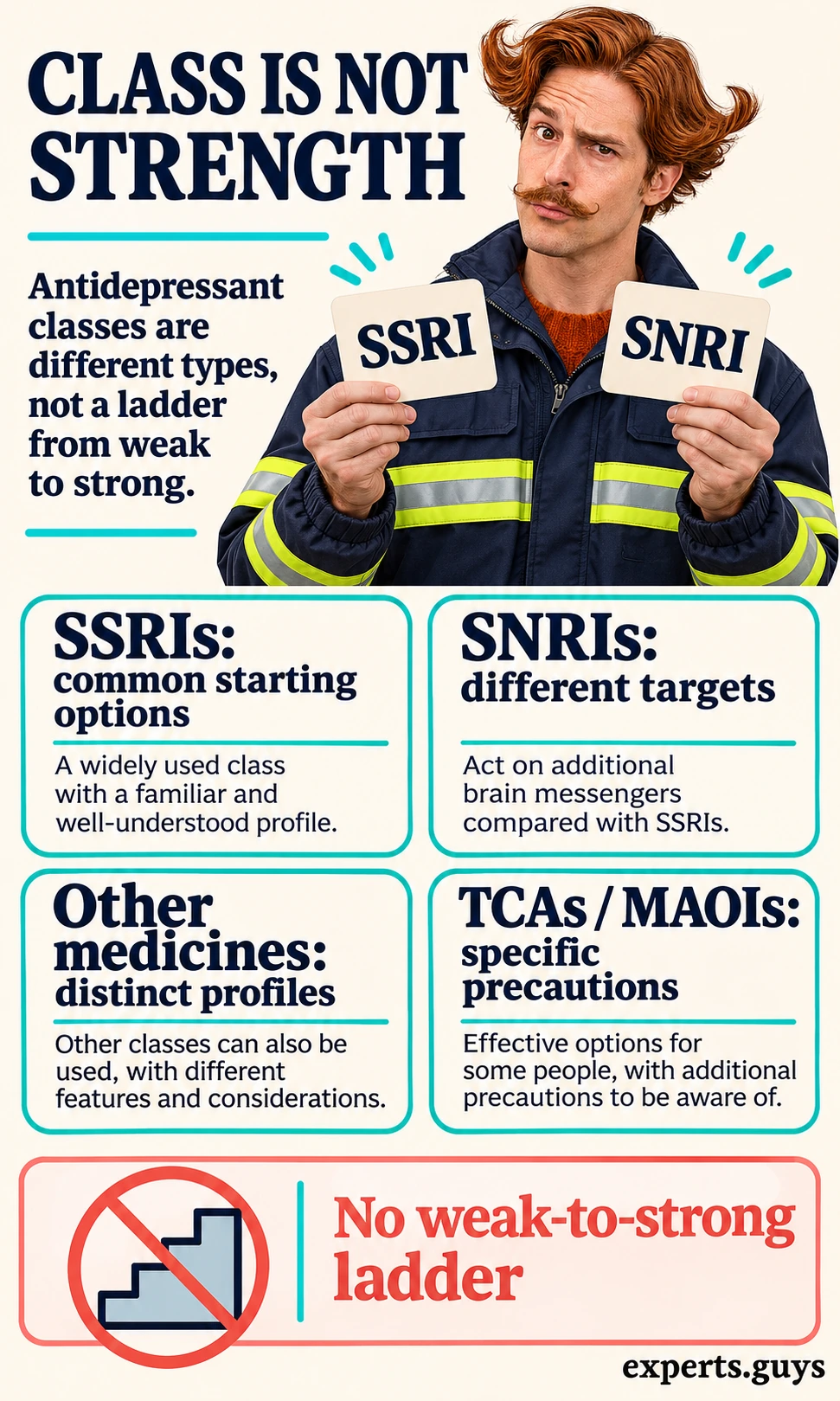
Some named antidepressants differ in average study outcomes, but there is no reliable class ladder from weak to strong. SSRIs are commonly considered first because their balance of tolerability and safety suits many adults, not because everyone should progress through increasingly powerful drug classes. The named medicine, diagnosis, prior response and risks matter more than the apparent complexity of its label.
The broad class names are useful orientation. SSRIs affect serotonin reuptake; SNRIs affect serotonin and noradrenaline reuptake. Other medicines have different actions, while the term atypical groups together drugs that do not share one uniform profile. If the abbreviations themselves are the obstacle, the guide to antidepressant classes and their differences explains that vocabulary in detail.
Swipe horizontally to compare on smaller screens.
| Type and examples | Useful orientation | Effectiveness limit |
|---|---|---|
| SSRIs: sertraline, escitalopram, fluoxetine | Common initial options affecting serotonin reuptake. | Being commonly offered first does not mean weak or suitable for everyone. |
| SNRIs: venlafaxine, duloxetine | Affect serotonin and noradrenaline reuptake; individual indications differ. | Two named signaling targets do not mean twice the benefit. |
| Other mechanisms: mirtazapine, bupropion | Different actions and precaution profiles; these are not one uniform class. | A shared atypical label cannot predict one shared outcome or adverse-effect pattern. |
| TCAs: amitriptyline, nortriptyline | Older medicines that can still be relevant in selected treatment plans. | Additional safety considerations, including overdose risk, affect their place in treatment. |
| MAOIs: phenelzine, tranylcypromine | Medicines requiring particular attention to interactions and dietary precautions. | Later use in a treatment pathway does not establish a universal strength ranking. |
This comparison deliberately avoids attaching one success percentage to each class. Such a table would mix medicines, populations, doses and outcome definitions into an unjustifiably simple ranking. It would also imply that the class average can choose a treatment for someone whose medical history was never represented by that average.
What the major comparative evidence supports
The large network meta-analysis of 21 antidepressants included 522 trials and 116,477 adults with major depressive disorder. All studied medicines performed better than placebo for response in acute treatment. Differences between medicines were also observed, but the certainty of the comparisons varied and the findings do not establish one universally best prescription.
Its scope matters as much as its size. This was evidence about acute treatment in adults, not a ranking validated for children, bipolar depression or every person with complicated medical illness. Its acceptability outcome concerned discontinuation for any reason, which is broader than discontinuation caused specifically by side effects. A popular ranking can lose these distinctions while retaining the appearance of scientific precision.
A network comparison can combine direct trials between two medicines with indirect evidence linking them through other comparisons. That helps researchers examine a larger set of treatments, but it also relies on whether the studies are sufficiently comparable. Confidence should follow the quality and relevance of the evidence, not simply the size of a league table.
An indirect comparison is easier to understand with an illustrative structure. If one set of trials compares A with placebo and another compares B with placebo, researchers may estimate how A compares with B. That is a useful analytical method, but it is not identical to observing every participant in one common trial with the same entry criteria and follow-up. The connection between the studies needs scrutiny.
Why the apparent winner can change
A ranking depends on what you ask it to optimize. The medicine with the highest estimated response may not have the most favorable discontinuation result. A short follow-up may miss a later difficulty. Participants who entered a particular trial may differ from the reader in age, illness history or accompanying conditions. Changing the question can change which comparison is useful.
Uncertainty also matters when medicines sit close together. A list has to put something first, even when the evidence cannot confidently separate neighboring entries. Treating every position as a meaningful clinical gap turns an ordering device into a false promise. A small apparent advantage should be weighed against how certain it is and how relevant it is to the actual person.
Newness is another poor shortcut. A recently introduced medicine may offer a different mechanism, indication or delivery method, but being new does not by itself establish better outcomes for ordinary first treatment. Similarly, the continued use of older drugs does not mean that all newer options are unnecessary. The useful question remains what particular problem the treatment addresses and what evidence supports that use.
Use individual differences without turning them into a quiz
Mirtazapine can cause sleepiness and increased appetite, as described in the NHS medicine information. Those effects may be relevant when comparing options, but a symptom such as poor sleep cannot choose the drug on its own. Daytime alertness, other medicines, previous treatment and the reason for prescribing still need to be considered.
Bupropion has a different precaution profile. Its official patient information highlights seizure history and anorexia or bulimia among important matters to disclose. It is not a generic answer for everyone worried about another medicine’s unwanted effects. Availability and licensed indications also differ between countries.
Duloxetine illustrates a different comparison: it can be used for depression and certain pain conditions, according to the NHS duloxetine guide. When both are relevant, the assessment involves more than a depression ranking. The presence of pain does not make every SNRI interchangeable, and improving pain alone should not be mislabeled as complete recovery from depression.
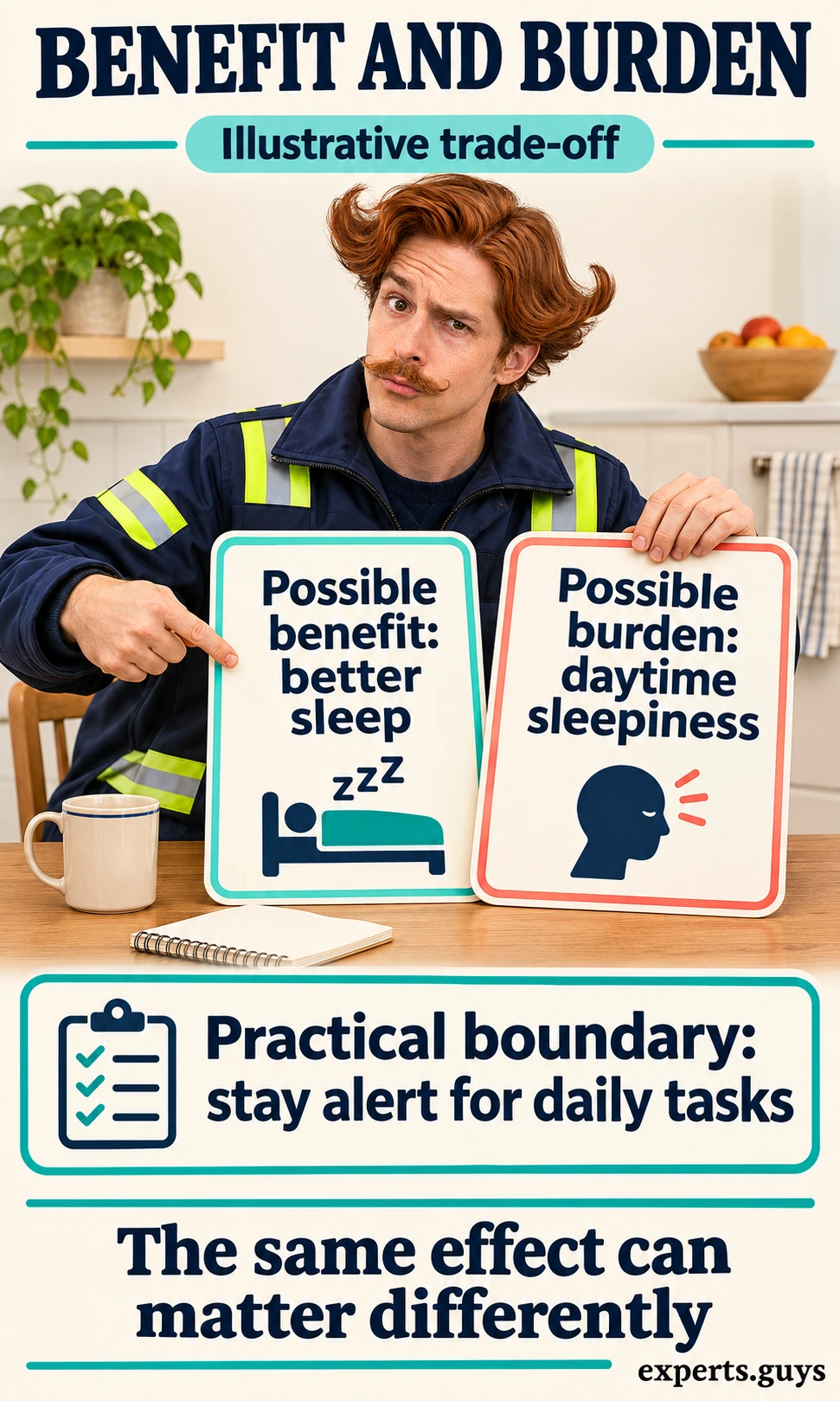
Consider an illustrative trade-off rather than a treatment recommendation. One person values being able to sleep through the night but must remain alert while operating equipment. Another has no driving duties yet finds appetite changes especially troubling. The same adverse-effect profile creates different practical costs. Neither person’s priorities can be inferred from a list of class names.
Medicines change signaling processes, but treatment response does not diagnose a missing chemical. Feeling better with a medicine is evidence about the treatment experience, not proof that the original cause was low serotonin. The explanation of neurotransmitters and depression explores that separate question without using symptoms as biochemical test results.
The editorial recommendation is to use comparative research as a conversation aid, with safety constraints and personally important outcomes visible beside it. A ranking becomes useful when it helps clarify an option; it becomes misleading when it claims to remove the need for clinical context. Keep the evidence and the individual decision connected, without pretending they are the same thing.
How long does a fair antidepressant trial take?
A fair trial gives the prescribed treatment an appropriate opportunity to work while reviewing safety and tolerability early. It is not a rule to wait silently for a fixed number of weeks. The medicine, dose history, regularity of use and degree of change all affect how the interval should be interpreted.
The NHS antidepressant overview describes early effects often beginning after one to two weeks, with fuller effects potentially taking up to eight weeks. These are general expectations rather than deadlines or permission to endure worsening symptoms. An early change in sleep or appetite can precede broader improvement, and lack of an immediate mood lift does not settle the outcome.
Treatment has more than one clock. Time since the first tablet is not always the same as time at a dose intended to treat the condition. An introductory period, a planned increase and an interruption can change what the calendar represents. Readers should not translate this distinction into a self-directed dose change; it is a reason to clarify how the existing prescription is being assessed.
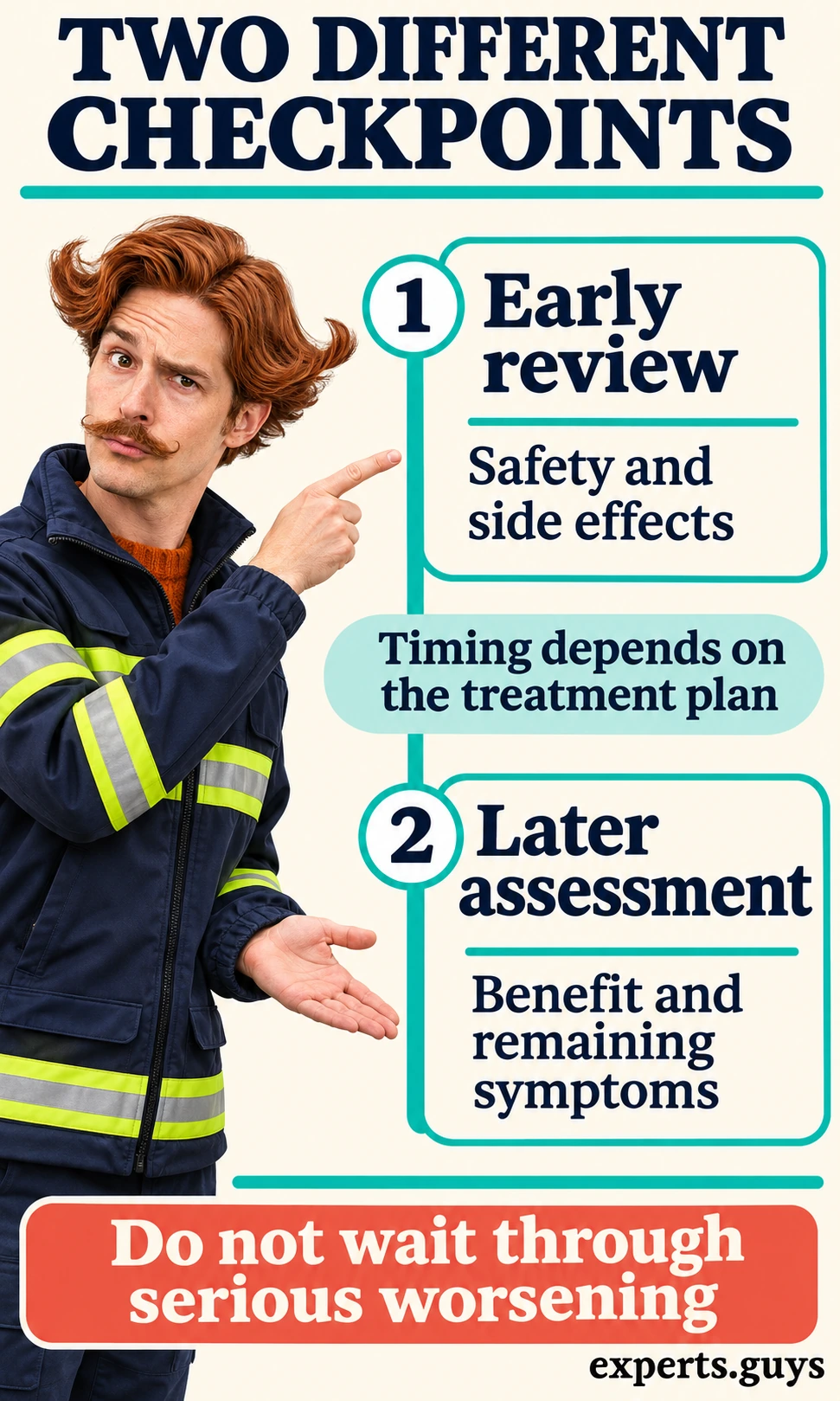
In UK guidance, the NICE recommendations for adults with depression generally place the first antidepressant review within two weeks, or after one week for a new prescription in someone aged 18 to 25 or with particular suicide-risk concern. They advise reassessing no response after four weeks at a recognized therapeutic dose. These checkpoints serve different purposes: early safety review and later evaluation of response.
Why early review and full benefit are different questions
An early review can resolve a problem before its effect is mistaken for treatment failure. Unclear directions, a troublesome adverse effect or difficulty obtaining the medicine can interfere with the plan even before an antidepressant benefit is expected. The review is useful because it examines whether treatment is feasible and safe, not because recovery must already be complete.
Suppose, illustratively, someone started a prescription several weeks ago but had an interruption because a refill was delayed. Saying that the medicine has had several uninterrupted weeks to work would misdescribe the exposure. Equally, describing the gap as personal failure would miss the practical problem. Access and treatment experience both belong in the assessment.
A partial response is also different from no response. If distress has eased but pleasure and concentration remain limited, the next discussion needs that detail. The decision could involve continuing, changing the plan or adding another form of treatment, depending on the assessment. A reader cannot infer the correct next prescription from the word partial alone.
What to check before calling treatment ineffective
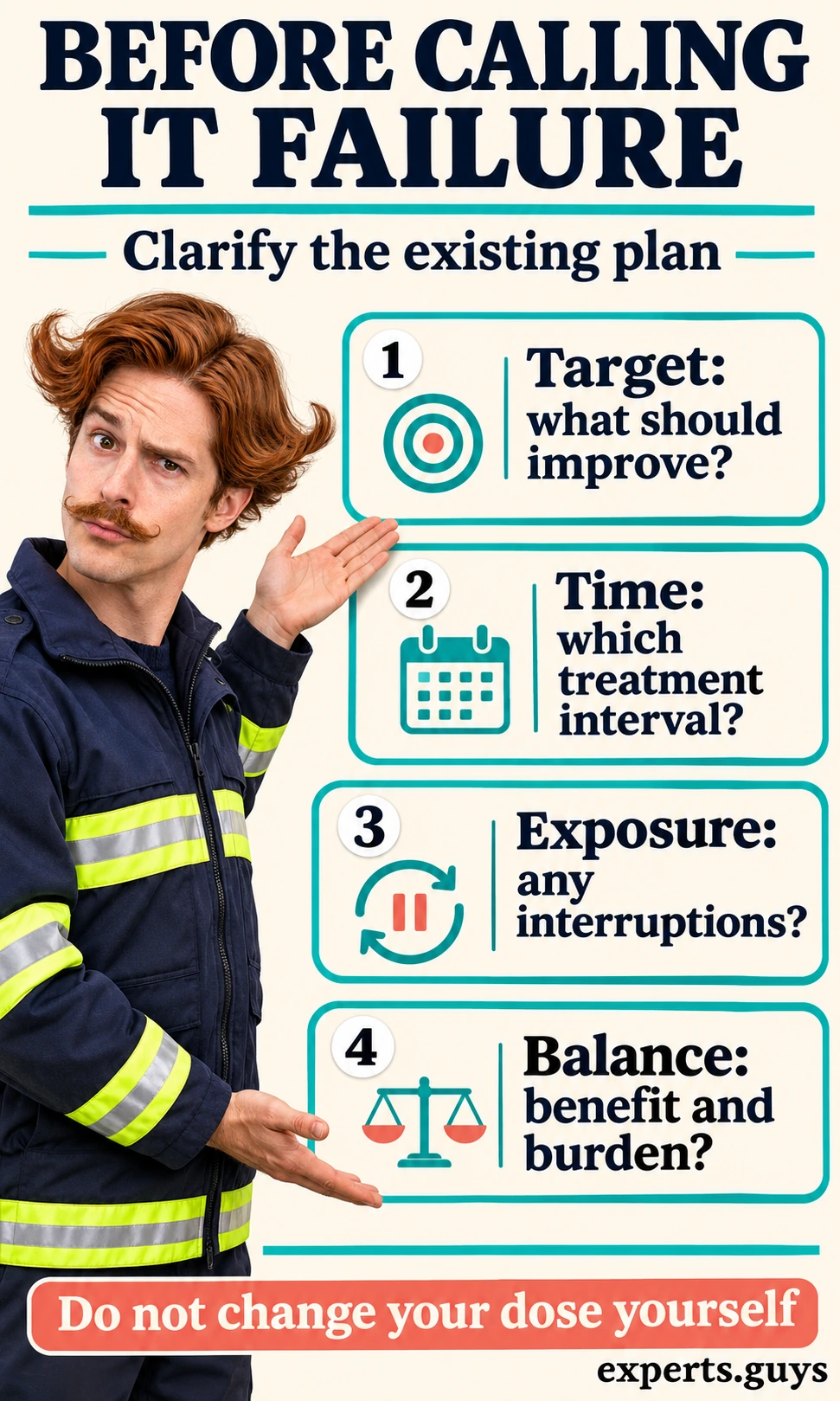
- Confirm the target: is the prescription intended for depression, another condition or more than one problem?
- Clarify the treatment interval: which part of the dose history is being evaluated?
- Describe the actual exposure: include interruptions, missed doses or trouble following unclear directions.
- Separate benefit from burden: a welcome change and a troublesome effect can both be true.
- Check the context: new illness, other medicines, substance use or major changes in circumstances may affect interpretation.
This is an assessment framework, not a form to fill out or an invitation to alter treatment. If concentration is limited, start with just one uncertainty: what was this prescription expected to improve? A pharmacist can clarify medication directions and interactions, while the prescriber evaluates whether the treatment plan needs to change.
An illustrative mismatch makes the point. A person judges an antidepressant solely by whether a pain symptom improves, although the prescription discussion focused on mood. Without clarifying the intended outcome, both a favorable and an unfavorable judgment may be answering the wrong question. The correction is to identify the treatment target before declaring success or failure.
Dose numbers are particularly easy to overread. Milligrams are not a shared measure of antidepressant strength across different medicines, and a lower number does not automatically mean a weaker treatment. The guide to what a low antidepressant dose means explains starting, continuing and reducing doses without treating the label as a verdict on effectiveness.
What if the first medicine does not help?
An unsuccessful first trial does not establish that every antidepressant will fail. Possible next steps include a different medicine, a psychological treatment or a combined approach, guided by what actually happened in the first trial. The NHS treatment overview explains why more than one treatment may be tried and why talking therapy can be combined with medication.
The distinction between a trial stopped for side effects and a completed trial with little benefit remains valuable. In the first situation, the medicine may never have been usable long enough to answer the benefit question. In the second, its effect was assessed under a more sustained plan. Neither outcome should be concealed by the single phrase it did not work.
Repeated inadequate trials warrant a broader reassessment rather than a search for the next internet winner. Diagnosis, adequacy of previous treatment, physical health, interacting medicines and access barriers may all matter. Specialized treatments have their own indications and monitoring requirements; they are not interchangeable additions to an ordinary class comparison.
A history suggesting mania or hypomania changes the treatment question. Depressive symptoms alone do not establish whether the broader illness pattern is unipolar or bipolar. The comparison of unipolar and bipolar depression explains why episode history belongs in an assessment rather than being treated as a minor exception to a drug ranking.
How can you use effectiveness evidence without choosing your own prescription?
Use a study claim to clarify what is known and what remains uncertain. A practical reading method is to identify the population, comparison, outcome and follow-up before considering how closely the finding matches your question. The result is a better interpretation of evidence, not a medicine selected by an online checklist.
Read one treatment claim in four passes
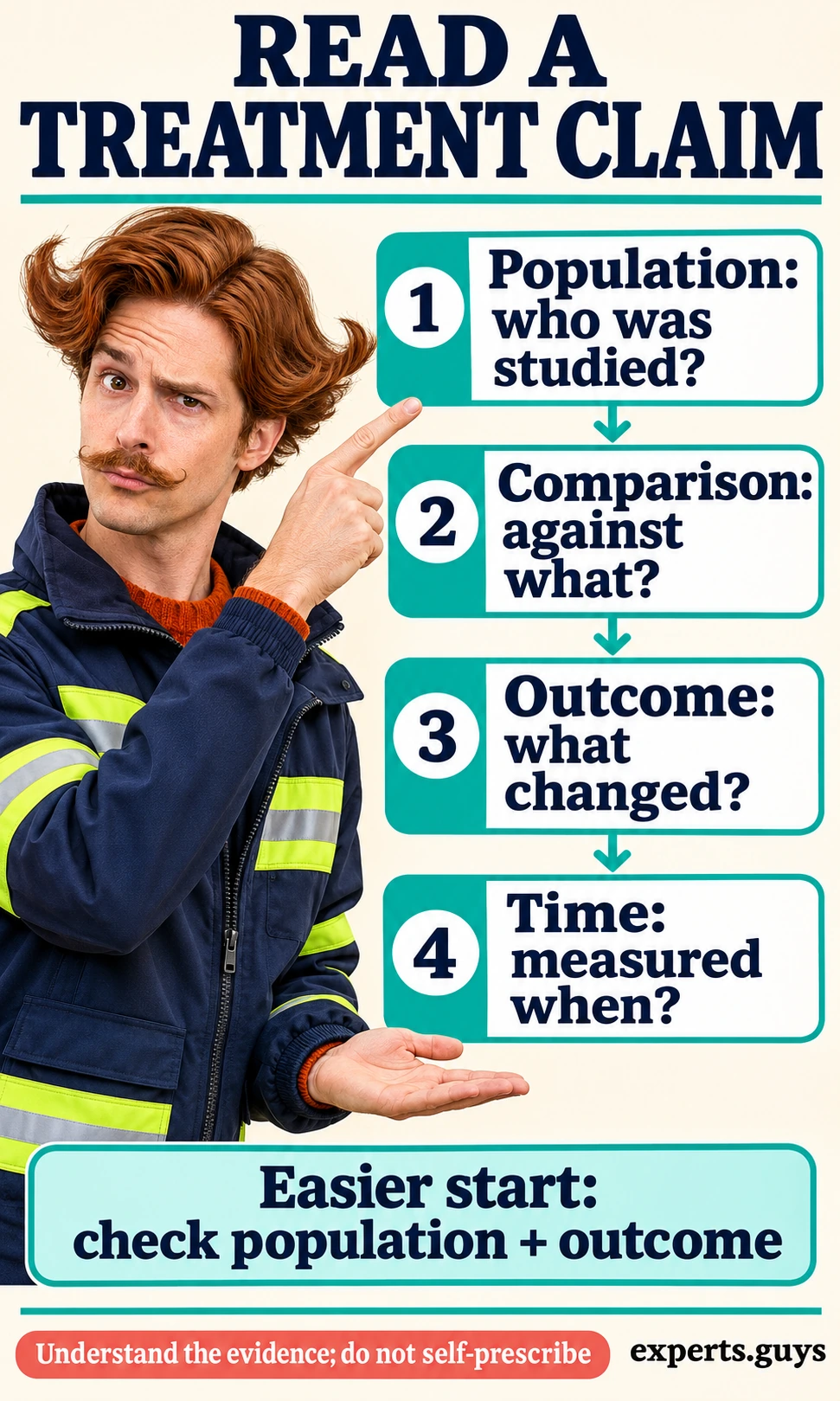
- Population: identify who was included and which important groups were excluded.
- Comparison: establish whether the medicine was compared with placebo, another treatment or a previous state.
- Outcome: identify response, remission, functioning, discontinuation or another defined result.
- Time and relevance: check when the outcome was measured and which parts apply to the actual decision.
Try this with an illustrative headline: Medicine A works better than Medicine B. First ask whether the participants were adults with major depressive disorder or another group. Next ask whether A and B were compared directly. Then identify what better means and when it was measured. A difference in short-term response is not automatically an advantage in remission, long-term wellbeing or tolerability.
A common mistake is to read the headline as if it said that A will work better for you. Correct that by completing a narrower sentence: in this population, on this outcome, at this time, the study estimated this difference. If the source cannot supply those details, the confident headline has not supplied enough information for the proposed conclusion.
The lower-effort version is to check just the outcome and population. Those two details can already reveal whether an adult response study is being stretched into a claim about children or complete recovery. Completion means you can state what the evidence actually addressed and name a relevant limit. It does not require memorizing statistics or feeling more certain than the evidence allows.
Keep your priorities visible without making a scoring system
Priorities help interpret trade-offs, but they should not be converted into an invented numerical drug score. A work schedule, need for alertness, previous adverse effect or difficulty with a particular formulation can change the practicality of a treatment. These are concrete constraints to discuss, not inputs that allow an article to calculate the correct prescription.
For example, consider the illustrative statement: less distress would matter, but daytime sleepiness would make my usual journey unsafe. It identifies both a desired benefit and a practical boundary. It is more informative than asking for the strongest antidepressant, because it reveals what a proposed advantage would have to achieve without creating another problem.
The same approach applies when the benefit is real but incomplete. Naming the remaining difficulty helps distinguish a useful partial change from an acceptable overall result. There is no requirement to keep a daily written record. If recalling details is hard, one recent example or support from a trusted person, with your agreement, can make the conversation more concrete.
Which changes need prompt attention?
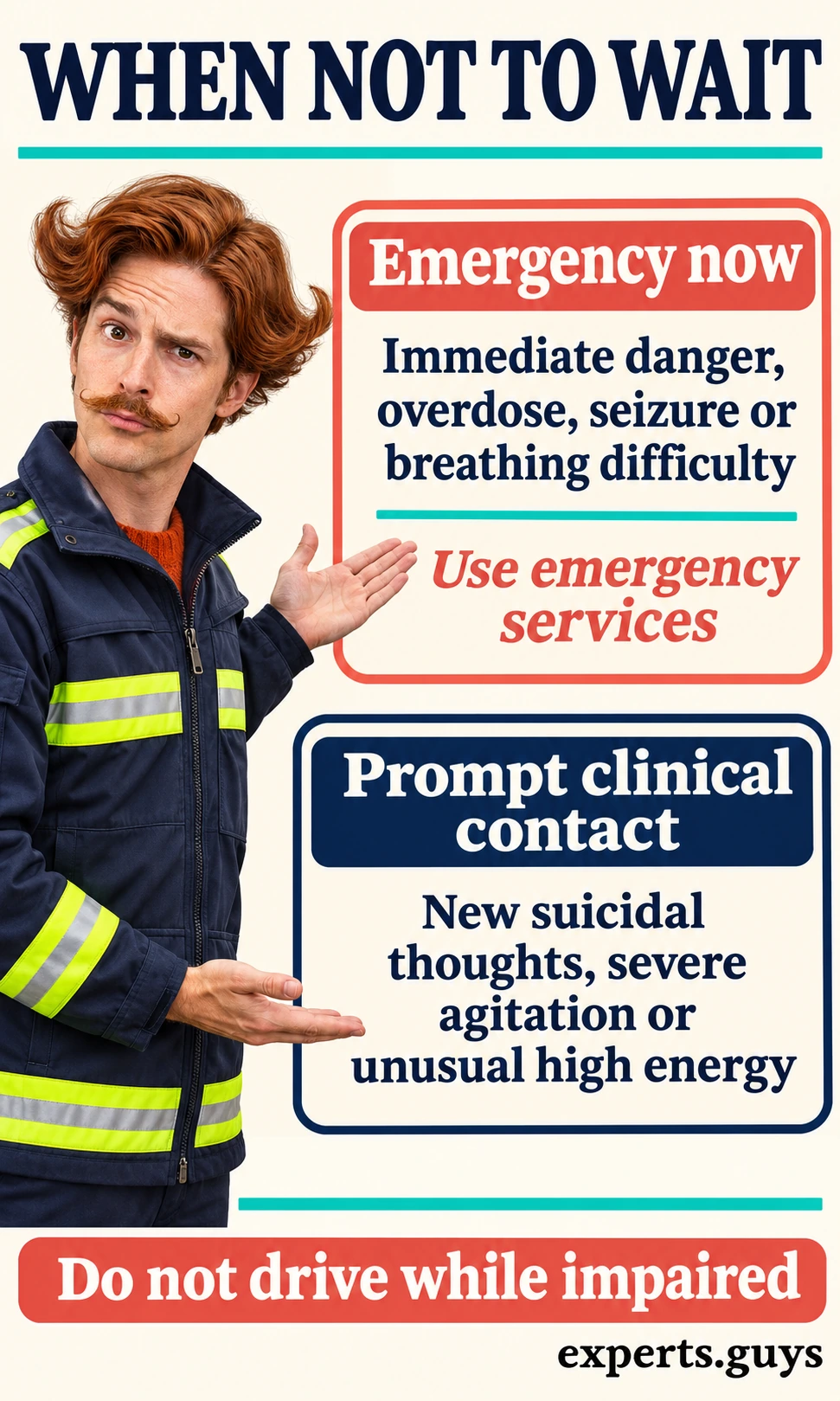
New or worsening suicidal thoughts, severe agitation or an unusual surge in energy and risky behavior need prompt clinical attention, particularly after starting treatment or a dose change. If there is immediate danger, an overdose, a seizure, breathing difficulty or collapse, use emergency services or the nearest emergency department. Do not drive yourself when impaired or acutely unwell.
A combination such as fever, confusion, sweating and muscle twitching can indicate a serious reaction and needs urgent assessment. Do not assume that every new symptom is an ordinary adjustment effect. The NHS sertraline safety information illustrates important adverse reactions and the distinction between routine effects and urgent problems; the leaflet for the actual prescribed medicine remains essential.
Medicines and supplements can interact. Include over-the-counter products, herbal preparations and other prescriptions when checking safety; do not add St John’s wort as a supposedly harmless way to improve antidepressant effectiveness. The NIMH medication overview explains the risk of serious serotonin-related reactions with certain combinations. A change that creates more risk is not an improvement in treatment, regardless of how persuasive its marketing sounds.
Stopping or switching also belongs to the treatment plan. Withdrawal can follow abrupt stopping or reductions, and it can be confused with a return of symptoms. Follow an agreed individualized reduction or switching plan rather than copying a schedule online. This article intentionally gives no taper or cross-taper instructions because the appropriate sequence depends on the medicines and circumstances.
Questions that often remain
Does feeling better mean I can stop taking an antidepressant?
Improvement is a reason to review the longer-term plan, not to stop abruptly. Treatment may continue after symptoms improve to reduce the risk of their return. The appropriate duration depends on the illness history, remaining symptoms, treatment experience and preferences; the timing and reduction plan should be agreed with the prescriber.
Do adult antidepressant rankings apply to children?
No. Evidence about adults cannot establish the same balance of benefit and risk in children or adolescents. Younger people have different prescribing and monitoring considerations, and approvals vary by medicine and country. A large adult trial total does not remove that population limit.
Does a generic antidepressant mean a less effective version?
A generic label does not mean a deliberately weaker treatment. In the United States, FDA-approved generics must meet requirements for the same active ingredient, strength and dosage form, including bioequivalence. Formulation details still matter: do not assume immediate-release and extended-release products can be exchanged without checking the actual prescription.
If a medicine helped a relative, will it help me?
A relative’s experience can be worth mentioning, but it is not a dependable personal prediction. Their diagnosis, other treatments, health conditions and unwanted effects may differ from yours. Use that history as context rather than a reason to obtain or share their prescription.
Is needing another treatment proof that the first one was pointless?
No. A first treatment can provide a partial benefit, reveal a tolerability problem or help clarify what needs further assessment. The next decision should preserve that useful information. Adding or changing treatment does not retrospectively prove that no benefit occurred, and it does not justify combining medicines without a prescribing plan.
The useful next step
Choose the uncertainty that is actually blocking understanding: an unclear study outcome, a comparison that seems too confident, an incomplete treatment interval or a benefit that comes with an unacceptable burden. Resolve that question before accepting a ranking or deciding that every option is exhausted. The aim is a treatment discussion grounded in the right evidence and the person’s actual circumstances.