




Cognitive behavioral therapy (CBT) is a structured talking treatment that helps people with depression examine unhelpful interpretations and change patterns of behavior. It can reduce symptoms, but the work is more specific than positive thinking: with a therapist, you identify a problem, try a manageable response and review what happens. The right level of support depends on your symptoms, safety, preferences and previous treatment.
A useful starting question is, “What does this thought stop me from doing, and what small, safe experience could help me examine it?” This guide focuses on that connection between a prediction and an action. You do not need a pen, a phone diary or a better mood before the example can make sense.
The examples here are for adults learning about CBT, not a way to diagnose depression or replace a treatment plan. Depression has biological, psychological and social contributors; working on a thought or an action does not mean you caused the illness.
Choose the part that matches your current question. A small practice example can clarify a therapy principle, while treatment decisions need a broader view of your health and circumstances.
| Your question | Useful focus | What this does not establish |
|---|---|---|
| “Is CBT just positive thinking?” | How interpretations and actions interact | That every negative thought is wrong |
| “What would I actually do?” | A low-stakes prediction test | A complete course of therapy |
| “I tried, but still feel low.” | What happened and what the attempt can show | That you failed or recovered |
| “Do I need more support?” | Symptoms, functioning, safety and treatment fit | A self-selected diagnosis or prescription |
How does CBT change the patterns that keep depression going?
CBT helps make a difficult moment more understandable and gives you a way to respond differently. For example, “Unless I do this perfectly, it is pointless” can turn an ordinary task into a verdict on your ability. Avoiding the task may then leave the rule untested. The target is not simply the sentence in your head; it is the connection between the thought and what you do next.
- Cognitive work: examine the meaning you gave an event, including evidence that does not fit your first conclusion.
- Behavioral work: try a feasible action that can reveal something discussion alone cannot establish.
- Clinical context: keep real obstacles, illness, loss and unsafe circumstances in the explanation; do not relabel every difficulty as a thinking error.

The purpose of a behavioral experiment is learning. Behavioral activation places more emphasis on re-engaging with meaningful activity; the two can overlap within CBT, but “do more” and “test this particular prediction” are not identical instructions. A therapist should be able to explain what an assignment is meant to help you understand or change.
A full pattern record belongs in the separate depression cycle worksheet guide. Here, the narrower job is to move from one all-or-nothing rule to one observable test, without recording a whole day or repeatedly rating your mood.
Separate a fact from a prediction
A fact describes what could be observed; a prediction says what you expect that fact to mean or cause. “The towel edges are uneven” is an observation. “That makes the towel useless” is an interpretation that can be checked. “I am useless” is a much wider personal judgment, and no household task can establish a person’s worth.
- Name the observation silently or aloud: “The edges are uneven.”
- Name the added prediction: “I expect an uneven fold will not be usable.”
- Ask a narrow question: “Will it fit where I keep it?”
If finding the words is difficult, use just “What happened?” and “What am I predicting?” You can discuss the example with your therapist rather than solve it alone. Avoid replacing the harsh statement with an equally absolute promise such as “Everything I do is fine”; the useful shift is toward a fair, checkable statement.
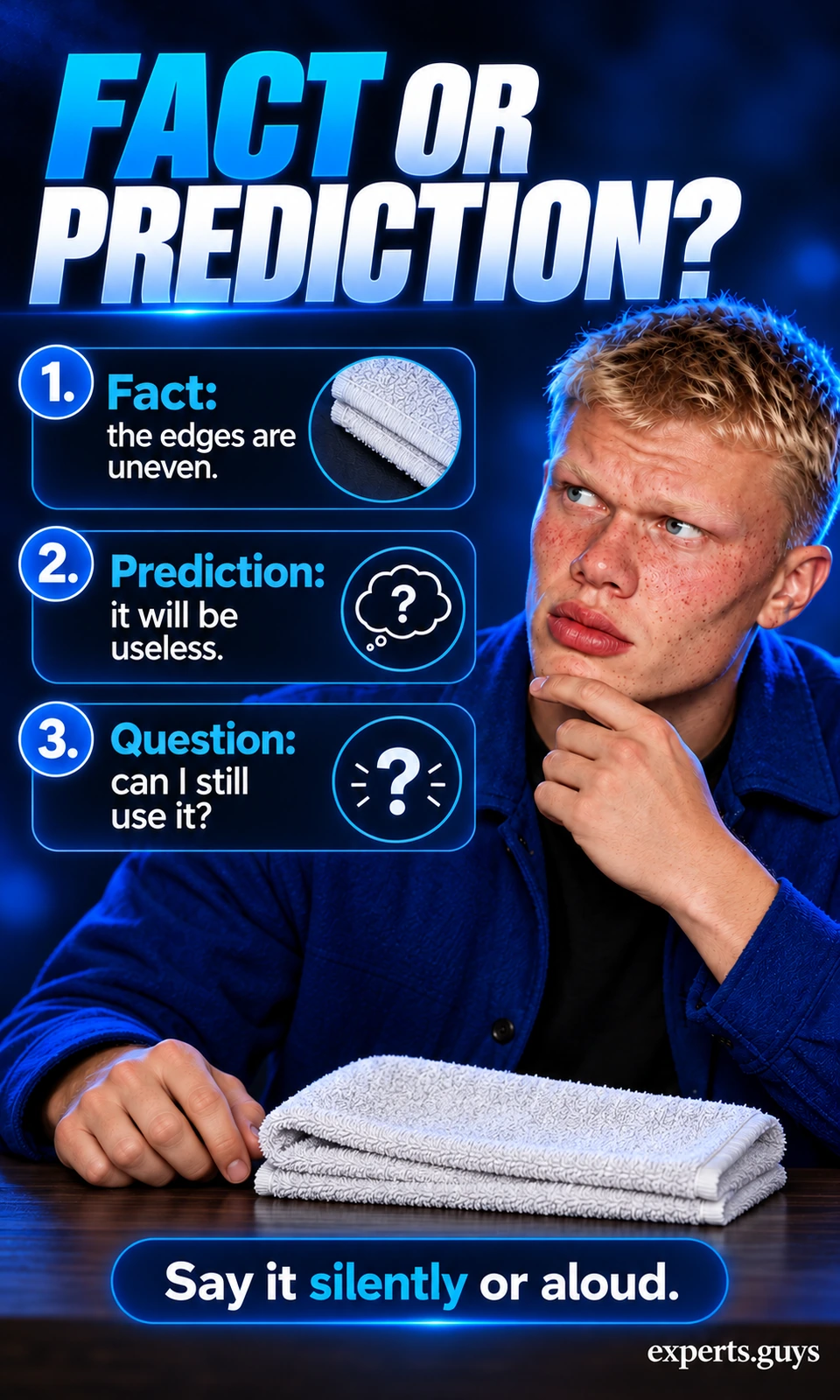
This spoken distinction is an adaptation of examining evidence for unhelpful thoughts. It is not a separately validated treatment. If questioning a thought turns into an exhausting argument, pause and bring that difficulty to therapy; the aim is useful inquiry, not winning a debate with yourself.
How can you test a harsh prediction without a worksheet?
Test something small enough to be safe and specific enough to answer. The example below suits a person whose all-or-nothing standard blocks an ordinary task: “If the fold is not neat, the towel will not fit on the shelf.” It does not suit every person with depression, and it is not an instruction to start doing laundry when you need rest or care.
Set a narrow question and a safe stopping point
Use a clean, lightweight hand towel, a stable surface within easy reach and an accessible shelf. Sit or stand comfortably; do not bend, lift or reach through pain. Decide that this attempt ends after one ordinary fold and one shelf-fit check. The question is about this towel and this space, not whether you are competent, lovable or recovering.

This is an illustrative application of behavioral experiments for rigid perfectionistic beliefs, adapted to avoid written records. It is not evidence that folding treats depression. Do not use experiments to test medication changes, dangerous situations, someone’s willingness to hurt you, or a belief involving self-harm. Compulsive rituals or severe distress call for an individualized clinical approach.
Try one ordinary fold
- Set up: place the towel on the stable surface, with both hands able to reach it comfortably. Let a helper position it if access is difficult.
- Make one usable fold: bring one side over the other. The edges can be a little uneven; there is no need to create a deliberate mess or a perfect rectangle.
- Check the actual question: place the folded towel on the accessible shelf and notice whether it fits. Do not keep refolding to remove every trace of discomfort.
- End the attempt: rest your hands and compare the prediction with what you saw. “It fit with uneven edges” is enough information for this trial; you do not have to feel pleased.
For an easier version, use a smaller cloth and make one fold while seated. If a shelf is out of reach, use a clear section of the table as the intended storage space and change the prediction to match that space before starting. Stop if pain, dizziness or distress rises; a smaller version is an option only if it is comfortable and wanted.

The completion point is a brief attempt and an observation, not the rest of the laundry. If you feel pulled into rechecking repeatedly, stop the exercise and discuss that pattern with a clinician instead of making the test more demanding. If the task has no personal relevance, skip it and ask your therapist for an example that addresses your actual difficulty.
If the main obstacle is initiating activity rather than a rigid prediction, a different approach may fit better. The guide to depression practice exercises covers other difficulties, including task initiation and support requests. Those methods are not extra requirements to complete alongside this example.
What if the result is disappointing or your mood stays low?
An unchanged mood does not erase what happened, and an unsuccessful attempt does not establish a negative judgment about you. Ask what the test actually measured. A towel fitting on a shelf can inform a belief about that fold; it cannot tell you whether depression is improving or whether all future tasks will go smoothly.
Keep the conclusion as small as the evidence
Suppose the prediction was “Uneven edges mean this towel cannot fit here,” and the towel fits. A fair conclusion is “This fold worked for this shelf.” That is more precise than “My thoughts are always wrong,” and more useful than dismissing the result because you still feel low. The example illustrates reasoning, not a report of someone’s treatment response.

If it does not fit, keep that observation too. The shelf might be too narrow or the towel too large; the answer might simply be that this particular fold did not suit this space. You do not need to turn an inconvenient result into a positive story. Equally, it does not justify “Nothing I do works.”
Repeatedly replaying the attempt can replace learning with another demand for certainty. The distinction between reviewing useful evidence and depressive rumination matters here. A short factual conclusion can be enough to bring to a session; this article does not require a log, screenshot or repeated test.
Correct the design instead of blaming yourself
| What happened | What it may mean | Useful adjustment |
|---|---|---|
| You never started | The task, access or current capacity did not fit | Explain the barrier; do not label it laziness |
| The trial became a whole laundry session | The stopping point was lost | Return to one clearly bounded attempt |
| Pain or distress increased | This version is unsuitable now | Stop and seek advice appropriate to the symptoms |
| You kept perfecting or rechecking | The question was displaced by a need for certainty | Discuss the pattern with your therapist |
| The result was unclear | The prediction or observation was too broad | Clarify what the test could actually answer |
An adaptation should reduce the demand while preserving the question. A smaller towel can still test whether an ordinary fold is usable; merely looking at the towel does not answer that question. If even the smaller version is too much, no test is required today. The useful next information may be that fatigue, pain or distress needs attention before this kind of practice.

Manageable activity is an established part of depression care, but the exact size of a task is individual. Guidance on behavioral strategies for depression supports starting within present capabilities. It does not make a household exercise a substitute for assessment, or make increased activity appropriate through pain or illness.
When is CBT enough, and when should the care plan change?
CBT is an evidence-based treatment option, but no exercise or therapy name determines the right care on its own. Severity, previous response, other health problems, preferences and practical access influence the plan. Depression treatment guidance describes psychotherapy, medication and other options when initial treatment is insufficient.
Match the level of support to the problem
Guided self-help includes practitioner support for structured material; individual CBT allows a more tailored formulation and ongoing clinical review. For some people, especially with more severe depression, therapy is combined with medication. An unsupported article or app does not provide the same assessment, relationship or monitoring. Do not stop or alter prescribed medication to “give CBT a fair chance.”
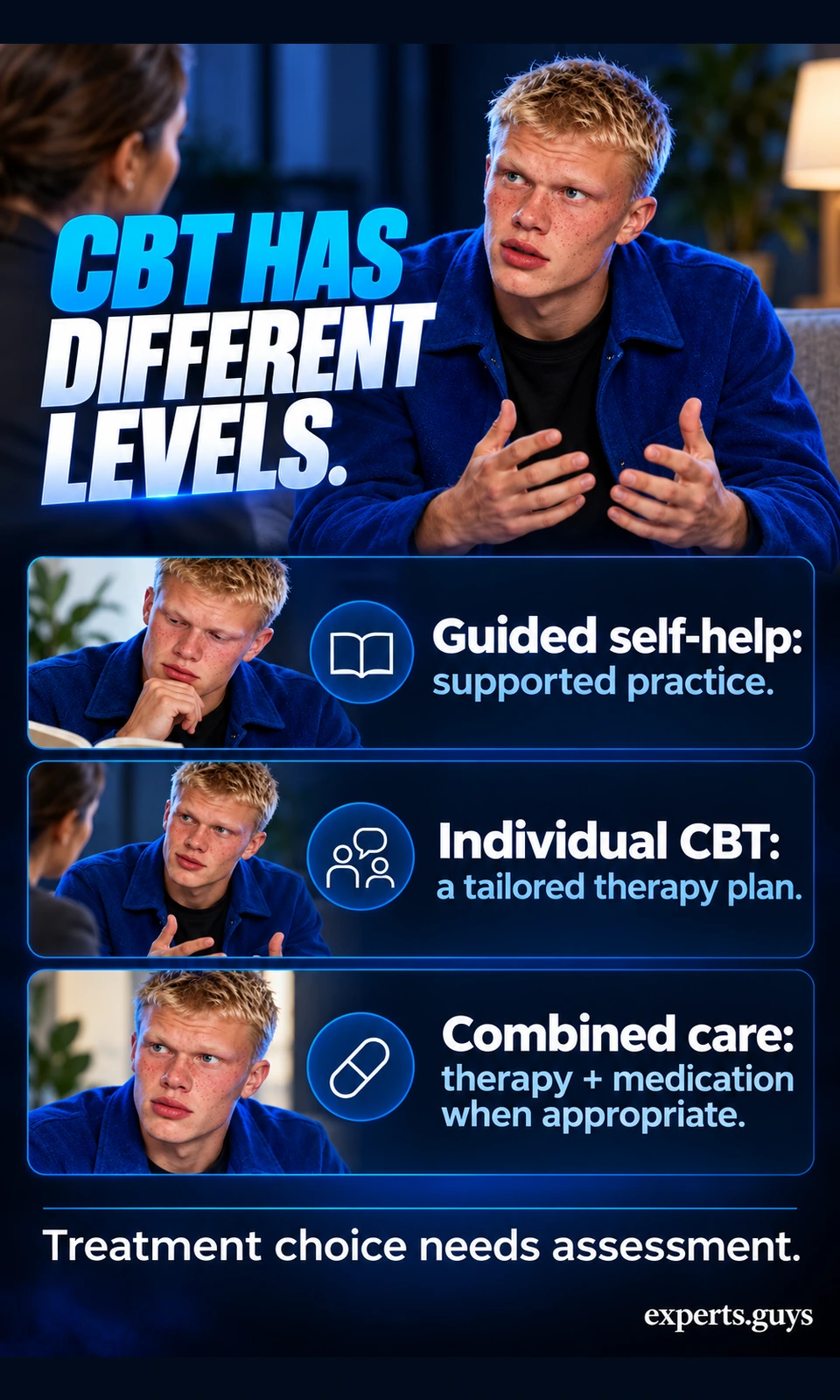
Sessions generally connect a specific current problem with discussion, practice and review. CBT can consider past experiences when they help explain present patterns; it is not a rule that your history must be ignored. Practice between sessions should have an understandable purpose and a realistic form, with room to discuss why it did not happen.
There is no universal recovery timetable. NICE describes individual CBT for more severe depression as usually involving 16 regular sessions, with additional sessions sometimes needed; that is a treatment-format guide, not a deadline for feeling better. The adult depression recommendations also emphasize reviewing how treatment is working rather than assuming a fixed course suits everyone.
If you are still choosing an approach, the comparison of psychotherapy options for depression owns that broader decision. This page concentrates on understanding what cognitive and behavioral work can look like once CBT is being considered or used.
Look for a useful pattern over time
Progress reviews consider symptoms, functioning, safety and your experience of treatment. Examples might include whether ordinary tasks have become more manageable, whether harsh judgments have less influence over decisions, or whether practice is consistently overwhelming. One easier day or one completed exercise is not sufficient evidence of recovery.
Persistent lack of benefit deserves a discussion about fit, intensity, barriers and other contributors, rather than an instruction to try harder. Worsening symptoms or new safety concerns need earlier contact. Periods of unusually high or irritable mood with much less need for sleep, or psychotic symptoms, require assessment that goes beyond a routine self-help plan.
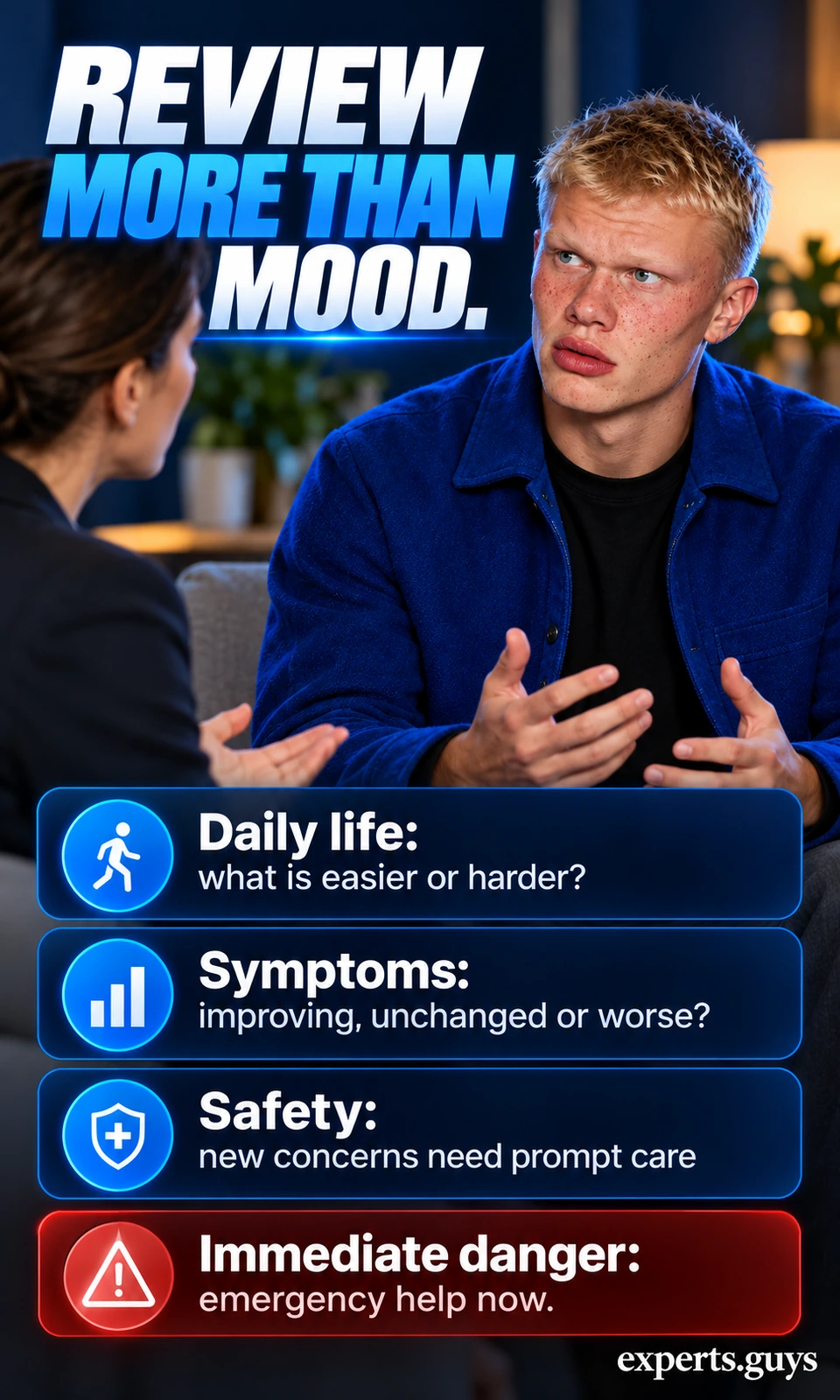
A clinician may use validated symptom measures alongside the conversation; you do not have to build your own scoring system. For help with the therapeutic relationship and making sessions workable, use the separate guide to making talk therapy sessions more useful. The practical aim is a clear next care decision, not accumulating perfect practice records.
Frequently asked questions
Can CBT be done online?
Yes. CBT can be delivered in person, by video or by phone, and some services offer guided digital programs. The method and level of professional support matter as well as the format. A general wellness app is not automatically a course of CBT.
Do I have to complete written homework?
Written records are common, but discuss barriers with your therapist rather than assuming that writing is the only way to participate. Spoken review or a real-world practice task may be suitable adaptations. Agree how the alternative will preserve the purpose of the work; some assessments or treatment protocols still use forms.
What if a negative thought is true?
CBT does not require denying a genuine loss, unsafe situation or practical problem. The useful work may involve a more precise interpretation, problem solving, support or a different response. An accurate observation does not automatically validate every broader judgment attached to it.
Can this approach help if I have bipolar disorder?
Psychological therapies may be part of care for bipolar disorder, but the assessment and treatment plan differ from a self-help approach to unipolar depression. Tell your clinician about any past high-energy periods, reduced need for sleep or unusual changes in behavior, and keep medication decisions with the prescribing clinician.
Summary
CBT for depression connects understanding with practice: examine a specific prediction, choose a safe and relevant action, and interpret the result without turning it into a verdict on yourself. An ordinary fold can demonstrate that principle when perfectionistic rules are the obstacle; it is not a treatment by itself. Keep the exercise optional and bounded, and judge the wider care plan through symptoms, daily life, safety and clinical review.










