
Travel nursing places experienced nurses in temporary assignments, often through a staffing agency. It can offer location choice and a different pay package, but a worthwhile offer must fit your clinical experience, cover the real cost of working away and remain manageable if the schedule changes. Start with the unit and written terms, then compare money over the same hours and dates.
A job advertisement is an invitation to investigate. Its weekly estimate does not establish your take-home pay, guarantee the assignment will continue or describe every cost of living elsewhere. This guide focuses on US registered-nurse travel assignments, with Aya Healthcare as one agency example; other countries and professional roles have different rules.
The most useful way to evaluate travel nursing is to connect decisions that are often discussed separately. A higher-paying location can have a more expensive lease. A short assignment can create a longer housing obligation. An attractive start date can be impractical if the required licence or facility clearance is unfinished. Those dependencies determine whether an offer works in practice.
There is no need to turn the decision into a diary or a complicated scoring exercise. Use the actual vacancy, itemised offer, relevant licensing record and proposed accommodation. Where a term is missing, the useful outcome is a specific answer from the responsible party before you commit money or leave your current position.
- Clinical fit: can you perform the unit’s expected work with the orientation offered?
- Financial fit: what remains after assignment costs, and what cash is needed before the first payment?
- Contract fit: what happens to wages, allowances and housing if work changes?
- Practical fit: can you sleep, commute and reach appropriate support on the proposed shift?
1. Is this travel nursing assignment a good fit?
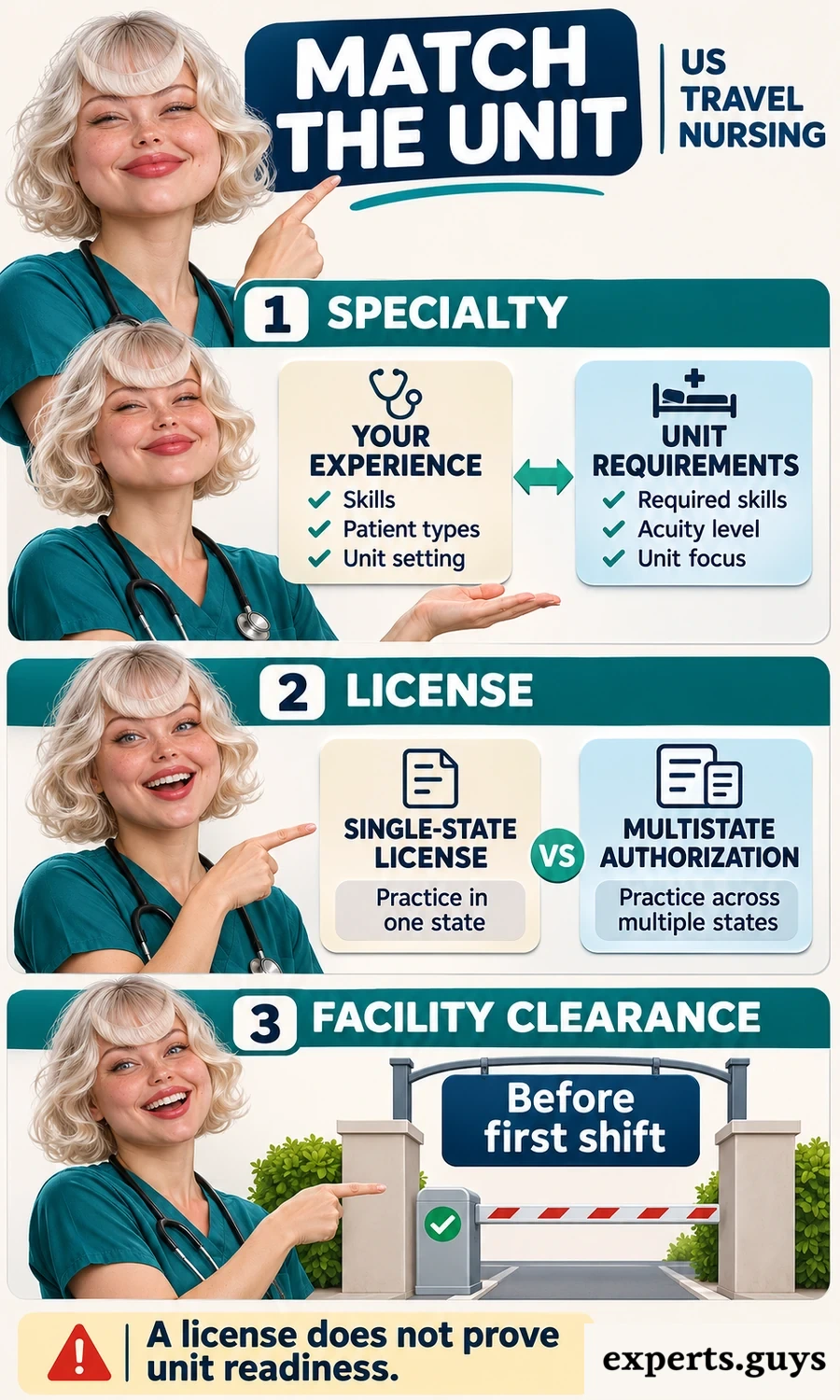
A suitable assignment matches your recent specialty experience and lawful authority to practise, with a realistic orientation plan. Begin with the actual unit rather than the destination. A familiar city cannot compensate for an unfamiliar clinical workload, and a recruiter saying that a role is “nursing” is not enough to establish the fit.
Match the work before choosing the city
Ask the facility about the patient population, typical duties, shift pattern, floating expectations and systems you will use. Separate something you have done independently from something you have only observed. For example, experience on an adult medical-surgical unit does not by itself demonstrate readiness for an unfamiliar intensive-care assignment. Travel work should not depend on concealing a gap and hoping orientation will resolve it.
Aya’s published travel-nursing requirements include at least one year of experience in the specialty, an active nursing licence and role-related certifications. Those are agency entry conditions, not a promise that every facility accepts the same profile. Ask which requirements belong to the specific opening and which must be complete before submission or the first shift.
For the first assignment, reduce the number of unfamiliar elements you accept at once. Keeping the specialty familiar while changing the location can be easier to evaluate than changing the unit, shift and clinical environment together. This is an editorial risk-management approach, not a validated readiness score. A shorter commute or preferred location does not override competence requirements.
Check the licence and facility clearance separately
Use the licensing route appropriate to the state where you will practise. The Nurse Licensure Compact FAQ explains that an eligible multistate licence permits RN or LPN/VN practice in participating jurisdictions. Simply holding a licence issued by a compact state does not prove that it is multistate. Confirm the actual status and whether it authorises the planned work.
Legal primary residence for compact eligibility and a federal tax home answer different questions. Do not treat one address decision as proof of both. A move that changes legal residence may require licensing action; an assignment extension may change a tax analysis without changing your clinical duties. Resolve each through the relevant official rules, rather than relying on a single “traveller” label.
Finally, distinguish a valid licence, an accepted job offer and facility clearance. They are separate gates. A hospital may still need to approve credentials, complete its checks or settle an orientation date after you have agreed to the proposed assignment. Ask which gate remains open and who will confirm that it has closed.
Find out what orientation actually includes
“Orientation provided” leaves several practical questions unanswered. Ask about its length, unit-specific teaching, access to electronic records and equipment, who evaluates readiness and who can help if an essential system is unfamiliar. Confirm the pay treatment for orientation and required learning separately from the routine shift rate. Do not assume an advertised weekly amount includes every onboarding hour.
Use a concrete question: “I have experience with this patient group, but your documentation system is new to me. What instruction and supervised access are provided before independent use?” The answer is more useful than asking whether the hospital is welcoming. If the response reveals a missing essential skill, pause the placement discussion rather than interpreting the pay premium as compensation for unsafe practice.
For the broader agency relationship, the healthcare staffing guide supplies background. This page’s narrower job is to connect clinical fit with the financial and timing commitments of a travel assignment. The practical stopping point is clear: do not progress to nonrefundable arrangements while an essential role or authorisation question remains unresolved.
2. What does the weekly pay package really leave you?
Compare the amount left after assignment costs over matching hours and dates, then examine taxes, benefits and unpaid time separately. A weekly package is a collection of components and assumptions. It is not automatically the amount deposited into your bank account or an amount that continues between contracts.
Separate wages, allowances and conditional payments
Request the taxable hourly rate, scheduled hours, estimated weekly allowances, eligibility conditions and reimbursement arrangements. Keep bonuses separate until you understand when they are earned and whether an early end affects them. If a quote includes overtime, identify how much of the apparent advantage disappears without those extra hours.
| Component | What to establish | Comparison limit |
|---|---|---|
| Taxable wages | Hourly rate and hours used in the estimate | Separate normal hours from overtime assumptions. |
| Allowances | Amount, eligibility and effect of absence or cancelled hours | The label does not establish tax treatment. |
| Reimbursements | Eligible expense, cap, evidence and payment date | Money paid later does not remove an upfront cash need. |
| Bonuses | Conditions, earning date and any repayment clause | A conditional payment is not certain weekly income. |
| Housing choice | Company arrangement versus self-arranged accommodation | Compare the corresponding version of the package. |
Aya’s pay and benefits page says compensation varies with specialty, location and selected benefits. It describes possible housing, meal and incidental stipends as expense-related support. That is a reason to obtain a personalised breakdown, rather than repeat an old website-wide average or promise that travel nursing always pays more than a permanent role.
Ask for two quotes only when they answer the same question. A 48-hour schedule and a 36-hour schedule represent different amounts of work. A quote with company housing and one with a housing allowance have different expense assumptions. First align the hours, dates and housing choice; otherwise the larger number may mostly reflect a different package design.
Work through a cost-adjusted comparison
Consider two illustrative 36-hour offers. Offer A lists $2,400 a week and requires $900 in assignment costs. Offer B lists $2,600 and requires $1,250. Subtraction leaves $1,500 for A and $1,350 for B before income taxes, payroll deductions and expenses outside this example. These are invented arithmetic inputs, not current vacancies or pay benchmarks.
The $200 advantage in the second headline is outweighed by $350 more in assignment costs. That makes A stronger on this particular comparison, not necessarily better overall. B might have a clinical or personal advantage worth the difference. The calculation exposes the trade-off so you can make it deliberately instead of discovering it after signing a lease.

The included comparison experience applies this same subtraction and adds two timing checks: spreading one-time costs over the proposed paid weeks and spreading assignment income across paid weeks plus a planned unpaid gap. It deliberately excludes taxes. Entering an allowance does not establish that the allowance is tax-exempt, and a positive result does not approve the contract.
The tool is a sensitivity check rather than a ranking system. Change the cost input to see how a dearer apartment affects the balance, or add a planned unpaid gap to see the effect of time between roles. Do not enter a bonus you have not earned as certain weekly income. If a critical payment remains uncertain, compare a conservative scenario without it as well as the proposed one. A result that only works with extra shifts or a conditional bonus deserves a closer look at how you would pay ordinary bills if that assumption fails.
Do not put a refundable security deposit into recurring housing expense unless you expect to lose it. It is still cash you may need upfront. Conversely, a nonrefundable booking fee is a cost even if the advertisement calls the accommodation affordable. Treat “how much will this cost?” and “how much cash must I have available?” as related but different questions.
Avoid shortcuts about tax-free stipends
Under IRS Publication 463, a tax home is generally your regular place of business, not necessarily your family address. Temporary versus indefinite work also matters; the publication describes the general one-year expectation rule and how changed expectations or successive assignments can affect it. A short contract or a recruiter using the word “stipend” does not settle your eligibility.
Keep the limitation next to the budget decision: do not count an assumed exemption as spendable income before the relevant facts are resolved. A supposed mileage threshold alone cannot establish the complete federal tax treatment. For a consequential uncertainty, take the itemised package, work locations and assignment history to a suitably qualified tax adviser. The objective is an answer to that specific uncertainty, not a generic instruction to outsource the entire decision.
Compare housing as part of the offer
Ask for the available company-housing arrangement and the alternative package if you arrange accommodation yourself. Aya describes both routes, but the details of your assignment still control what is available. An agency paying for an apartment does not make housing an extra cash benefit you can add to a quote that already assumes that option.
For self-arranged housing, obtain the total for the actual dates: rent, mandatory fees, utilities, parking and any pet charges relevant to you. Compare the total with the corresponding allowance and your other obligations. A monthly rent divided by four can distort a weekly budget because calendar months are longer than four weeks. For an actual booking, use its total cost divided by the assignment weeks it covers.
Check that the accommodation supports the shift. A room that looks appealing in an evening photograph may be bright or noisy during daytime sleep. Ask about access, cooling or heating, shared spaces and the realistic journey to the correct staff entrance. If an in-person inspection is impossible, request a live walkthrough through a verified accommodation contact and keep the booking terms in view.
The lease can outlast the work. Before paying, ask how a delayed start, early cancellation or extension affects the accommodation dates and any refund. Do not assume that an employer ending the assignment releases you from a separate landlord agreement. A cancellable initial stay may reduce exposure while details settle, although its nightly cost can be higher; compare that extra cost with what you would otherwise risk losing.

Include unpaid time without disguising it as salary
A weekly contract figure describes a working period. If you plan breaks or anticipate time before the next role, include those weeks when considering annual affordability. Thirteen paid weeks followed by two unpaid weeks distribute that assignment’s earnings over fifteen calendar weeks. That arithmetic does not predict whether work will be available or whether benefits continue.
Compare a permanent role on a like-for-like basis: expected earnings, paid leave, benefits, retirement contributions where applicable, commuting costs and the value you place on stability. Do not compare travel gross income against a permanent employee’s net deposit. An offer can be worthwhile for exploration or schedule choice even when it does not produce the greatest annual cash surplus.
3. What happens if the assignment changes?
Read the agreement for ordinary work and for interruption. The crucial distinction is between a proposed schedule, a limited hours guarantee and an assurance of continued employment. Those are different commitments. Ask the contracting party to explain the applicable wording before you organise your finances around it.
Check three interruption scenarios
Use three specific questions: what if the facility cancels a shift, delays the start or ends the assignment early? For each, identify the effect on wages, expense payments, housing, benefits and any charge claimed against you. A clear response should point to the relevant agreement or policy and explain which exceptions apply. A reassuring phone call alone does not tell you how the term operates.
For cancelled hours, ask whether the guarantee is weekly or calculated over another period, whether specified cancellations are allowed, and what happens if you decline a proposed replacement shift. Also ask whether an allowance changes with hours worked. These are questions to resolve for the actual contract; there is no universal package rule that this article can substitute for the document.
A delayed start creates a different problem. You may already be in the destination with accommodation costs and no assignment earnings. Find out what “start date” means in the agreement, whether final clearance remains conditional and what support is available if the facility changes the date. An offered reimbursement that arrives after work begins may not help you pay the first accommodation bill.

| Scenario | Contract question | Practical consequence |
|---|---|---|
| Facility cancels a shift | Which hours are guaranteed, and what are the exceptions? | Check both wages and expense-payment treatment. |
| Start moves | Who confirms clearance, and who bears costs during the delay? | You may have housing expense before assignment income. |
| Assignment ends early | What notice, charges and benefit-end rules apply? | A separate lease can remain an obligation. |
| You request time away | How are schedule, pay and allowances affected? | Agree the treatment before budgeting for the absence. |
| Extension offered | Which dates, pay and housing terms change? | Do not assume the old arrangement continues unchanged. |
An early end can be initiated by different parties for different reasons. Ask which notice provisions and cost-recovery clauses apply, what specific amount or calculation is stated and who decides whether a clause has been triggered. Do not assume a recruiter can waive a clause verbally. If a consequential provision remains unclear, seek a written explanation or appropriate legal review before accepting it; enforceability depends on the facts and applicable law.
Settle floating and schedule boundaries
A shift label such as “nights” does not answer whether weekends rotate, how holidays are allocated or whether the nurse may float to other units or sites. Ask about those boundaries during the facility discussion, then compare the answers with the written offer. A new site can change the commute, and a different unit can change the clinical fit.
Describe the competence issue precisely if a floating expectation is unclear. “I can work in these settings; I have not independently performed that work” gives the facility something concrete to address. Do not agree to an unfamiliar clinical task because an extra payment is available. Use the facility’s appropriate escalation process for a real-time concern rather than treating the recruitment discussion as clinical authorisation.
If a pay amendment is proposed, compare the revised component breakdown with the previous one, the effective date and the choices available under the agreement. A lower wage, reduced allowance and fewer scheduled hours have different effects. Avoid accepting a revised total without understanding which input changed. This is also why saving the actual employment documents matters, even though the decision itself does not require a recording exercise.
Confirm benefits across the transitions
Benefits are part of the offer, but enrollment, eligibility, start dates and end dates matter more than a broad statement that coverage is “excellent.” Check premiums, dependent costs, relevant provider networks, prescriptions you already use and what happens during a gap. If access to a particular service matters, verify it against the plan’s own current documents.
Aya publicly describes medical, dental and vision options beginning with the assignment, along with other benefits subject to conditions. Obtain the applicable plan and employment details instead of carrying an old benefits list into a new contract. In particular, sick-time accrual, permission to use accrued time and cash available during an absence are separate questions.
Place the current job’s coverage end beside the new assignment’s coverage start. Then ask what happens when that assignment ends. If the dates leave a gap, find the relevant continuation or replacement route and the actual deadline and cost before relying on it. Do not assume every break is covered, and do not cancel existing coverage solely because a recruiter has mentioned day-one benefits.

Retirement eligibility also deserves a separate comparison from weekly earnings. Ask when you can contribute, when an employer match becomes available and what vesting rules apply. A benefit advertised on a website may not be earned during a short first assignment. Include only the benefit you can reasonably expect under the applicable rules, rather than adding its maximum marketing value to your budget.
What Aya can and cannot establish for you
Aya is one route to finding assignments and coordinating support. A recognisable agency name can simplify the search, but it does not make every facility, recruiter interaction, housing arrangement or contract interchangeable. Judge the response to the particular vacancy: are the component figures clear, are clinical questions answered and are important uncertainties resolved before commitment?
If you are researching an alternative reached through the former Aureus name, the Aureus and Medical Solutions explanation addresses that brand transition. Keep agency identity research separate from this page’s assignment-economics comparison. Neither a brand history nor an anonymous positive review can determine which specific offer is right for you.
4. How do you get from an accepted offer to a workable first shift?
Treat acceptance, departure and independent work as separate decisions. Complete the necessary onboarding, confirm the start and practical arrival details, then use orientation to establish how work and support operate locally. Being willing to travel is different from being cleared and prepared to begin.
Complete onboarding through the verified route
Use the agency’s independently verified official contact and secure process for sensitive documents. Ask the credentialing contact which items remain outstanding, which are facility-specific and which must be complete before travel. Required checks may involve licence verification, certifications, screening or health documentation; use the actual requirement rather than ordering tests or paying for a course because an old article mentioned it.
Sequence dependencies sensibly. Confirm the required certification type before booking a class, ask who pays and when reimbursement occurs, and clarify the appointment deadline before choosing travel dates. Keep unrelated personal information out of ordinary email when a secure channel exists. If a message changes payment instructions or requests sensitive information through an unfamiliar link, verify it through the known official route first.
Ask for explicit start confirmation after the responsible team has addressed the requirements. “I uploaded everything” is a statement about your action; it is not confirmation that the facility has accepted the material. If one item is delayed, identify whether the date can move and what that means for any booking. The completion outcome is clearance and a confirmed arrival instruction, not merely a completed application.

Test the arrival route before the first shift
When feasible, visit the relevant entrance and parking or transport connection before the reporting day. Do it safely without handling a phone while driving. Find the entrance named in your instructions, identify where badge pickup occurs and check whether the route is available at the hour you will arrive. A public hospital entrance and a staff reporting point may be different places.
If you cannot visit beforehand, get a specific entrance description, transport or parking instructions and an arrival contact from the verified facility representative. Allow a practical buffer for unfamiliar access arrangements. This smaller alternative answers the same problem without requiring an additional journey. Reaching the hospital area is not the same as reaching the orientation room on time.
Bring only the documents and equipment the facility has asked for, along with appropriate work clothing and personal essentials. Do not buy unfamiliar clinical equipment on the assumption that travellers must supply it. Ask about local requirements first. The useful result is a workable arrival route and known reporting location, with a way to resolve an access problem if it occurs.

Establish the help route during orientation
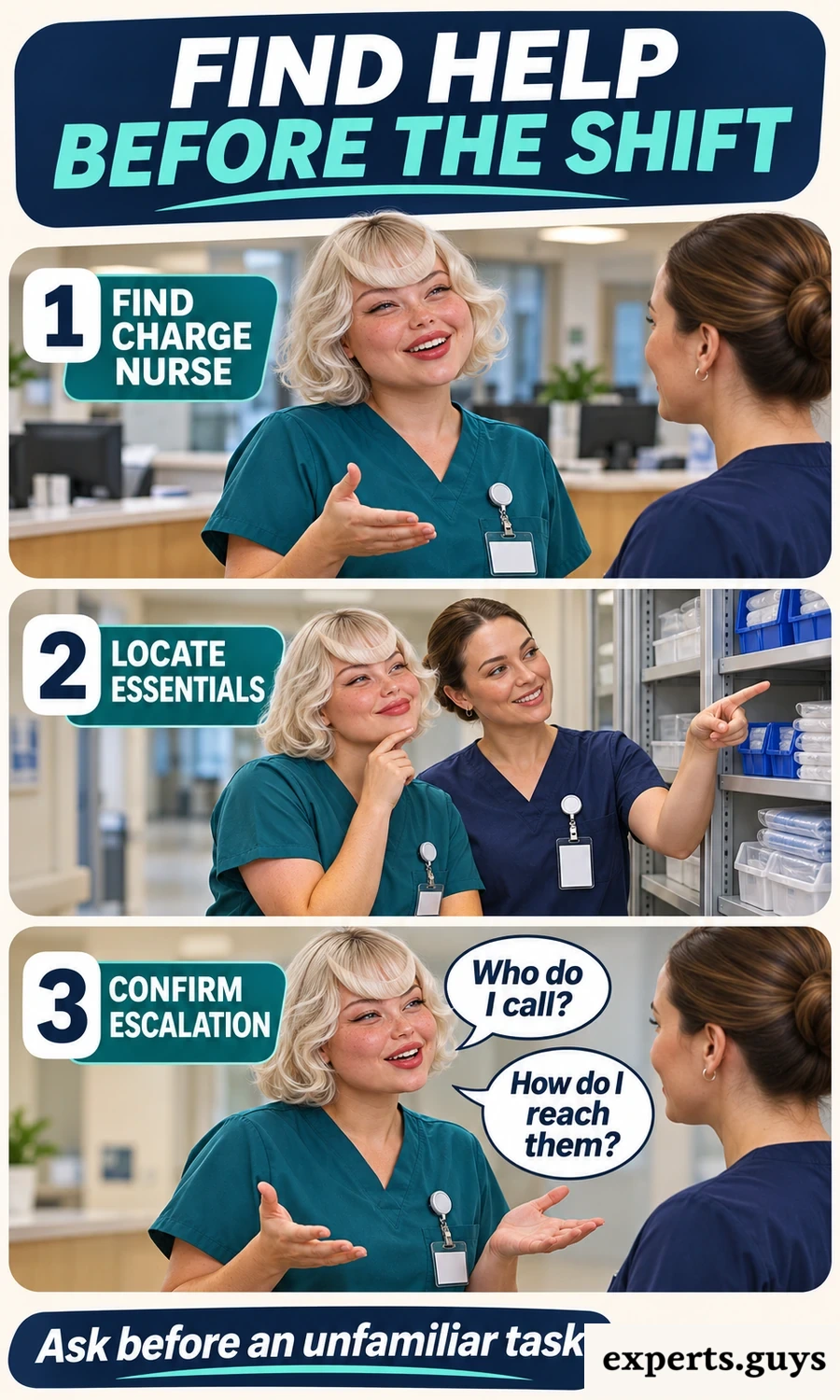
Find out who is coordinating the shift, how to contact that person and what the escalation route is for an unfamiliar situation. Ask where essential supplies are kept and how access to required systems is arranged. This is a local orientation task, not a lesson in clinical procedures; it should occur through the facility’s own process.
Use specific questions while the appropriate person is available: “Who is my first contact if I cannot access the documentation system?” and “How do I reach the charge nurse on this unit?” If an explanation assumes a system you have not used, ask for the relevant demonstration or instruction before relying on it. Knowing the name of a system is not the same as being able to use it safely.
A lower-effort starting point is to establish the first contact and immediate reporting route, then work through the remaining unit orientation with that person. If something essential remains unavailable, raise it before the unfamiliar task rather than quietly improvising. Completion means knowing the local support route and having the necessary instruction, not proving that you can manage alone.
Choose an outcome rather than a perfect advertisement
A sensible offer can still involve compromises. You may accept a less fashionable destination to keep housing manageable, or choose a familiar unit over a higher headline rate. Make the compromise explicit: what benefit are you gaining, what cost or uncertainty are you accepting and can you absorb it if the assignment changes?
Proceed when the clinical work fits, lawful authorisation and clearance are in place, the cost comparison is workable and the important interruption terms are understood. Pause when one of those conditions is unresolved. Declining a particular contract does not mean travel nursing is unsuitable; it may mean that this combination of unit, timing and obligations is unsuitable now.
Before the first payment, check the actual payroll cutoff, first eligible pay date and reimbursement timing. A weekly pay schedule does not necessarily mean you receive money immediately after arrival. Ask which accommodation payments, transport costs and refundable deposits fall due first. The simplest fallback is to delay a discretionary commitment until its dependency is resolved; avoid financing a nonrefundable booking solely on an unconfirmed start.
Travel nursing FAQs
Can a new graduate start with a travel nursing assignment?
Do not assume an agency travel contract is a substitute for a supported first nursing role. Aya’s published entry requirement includes specialty experience, and facilities may require more. A structured graduate position and an experienced-nurse travel placement have different support assumptions.
Can I bring a partner or pets?
Ask about the actual accommodation and charges before accepting. A partner’s space needs, pet restrictions, deposits and transport arrangements can change which housing option is workable. Permission in one property does not establish permission in another.
Can I return home between shifts?
That depends on distance, schedule and your ability to obtain adequate rest. Include the real journey in the decision rather than counting every day off as usable travel time. Returning home also does not, by itself, settle tax-home or reimbursement eligibility.
Is an extension guaranteed if the first assignment goes well?
No. Treat an extension as a new proposal requiring confirmation of dates, unit, pay and housing. Revisit any tax or licensing issue affected by the changed circumstances. Do not extend accommodation solely on an informal expectation of more work.
Does working through a large agency guarantee a better assignment?
No agency name can establish the suitability of every vacancy. Evaluate the actual unit, support, written terms and responsiveness to unresolved questions. A recruiter can coordinate a placement, but the facility still controls important parts of day-to-day work.
A sound travel nursing decision
Start with the real job, compare the whole package and settle the commitments that survive a change in work. The next useful action is to resolve the first material unknown in the proposed assignment, whether that is clinical fit, an itemised quote, a housing exit term or final clearance. When those answers align, travel nursing becomes a deliberate employment choice rather than a decision driven by a weekly headline.