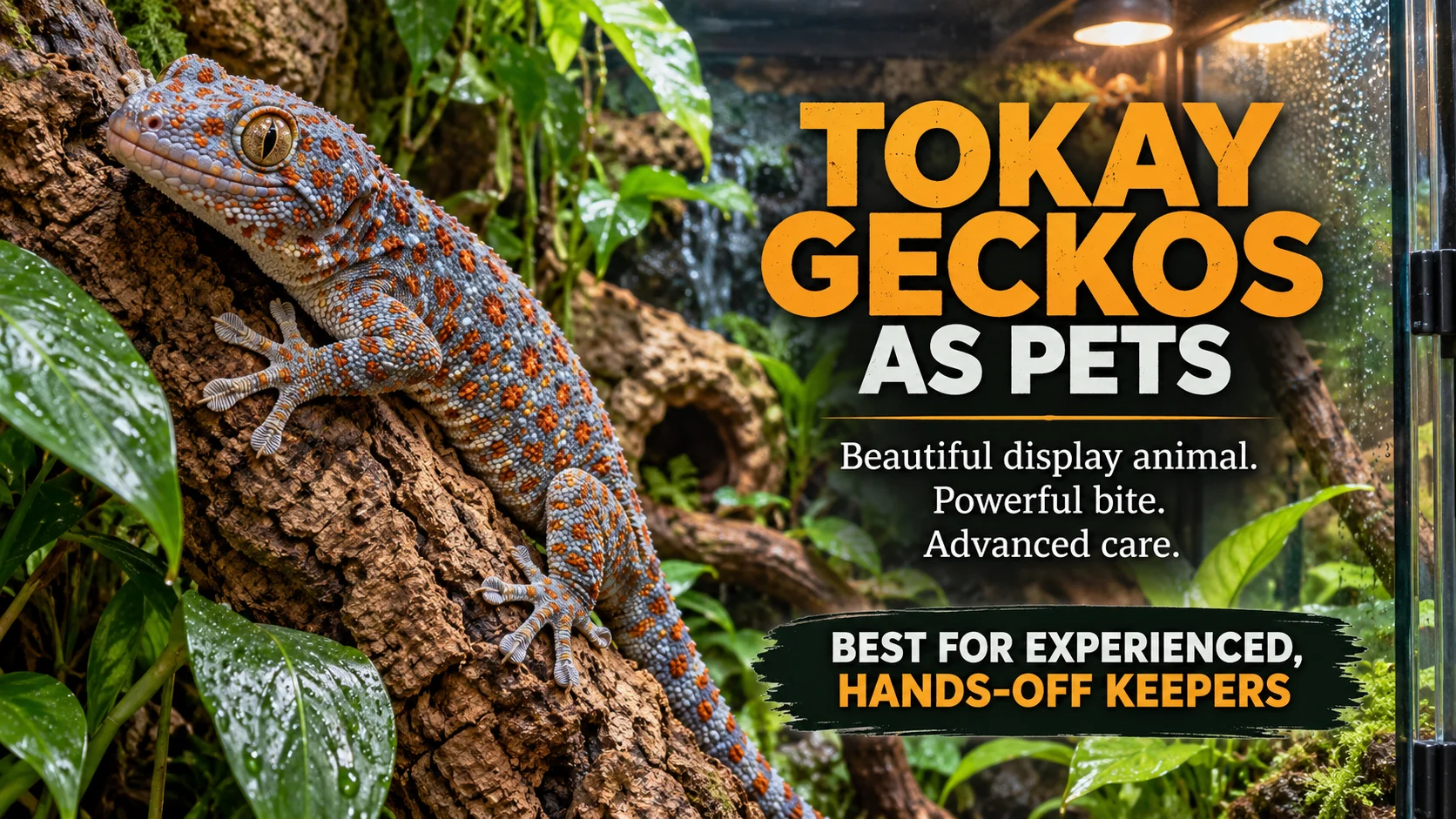

Tokay geckos can be rewarding pets for experienced reptile keepers who want a striking display animal, but they are a poor match for anyone expecting frequent handling. Their strong defensive bite, territorial behavior, nighttime calling, and tropical husbandry needs mean the decision should start with temperament and setup readiness, not color or price. If you are comfortable with a mostly hands-off pet and can maintain a tall, warm, humid, well-ventilated enclosure, a captive-bred Tokay can be an absorbing long-term animal.
Are Tokay geckos good pets?
They can be, but only for the right keeper. A Tokay is best viewed as an advanced display reptile: you observe it, feed it, maintain a carefully controlled enclosure, and allow trust to develop without assuming the animal will ever enjoy being picked up.
That distinction matters because many purchase mistakes begin with the wrong expectation. Someone who wants a calm gecko to hold several times a week is likely to find a Tokay frustrating, while a keeper who enjoys natural behavior, nighttime activity, vocalizations, and a planted vertical vivarium may find the species unusually engaging.
Before you buy one, treat four points as non-negotiable: handling expectations, enclosure readiness, legal and ethical sourcing, and access to a reptile-experienced veterinarian. If one of those is still unresolved, delay the purchase rather than assuming it can be fixed after the gecko arrives.
| Decision point | Good fit | Poor fit |
|---|---|---|
| Handling | You are happy with mostly hands-off observation and voluntary contact. | You want a reptile you can routinely pick up and hold. |
| Experience | You already understand reptile heat, humidity, feeding, shedding, and stress behavior. | This would be your first reptile and you want a forgiving learning curve. |
| Habitat | You can prepare a secure vertical enclosure with climbing structure, hides, heat, humidity control, and ventilation. | You have limited vertical space or do not want ongoing environmental monitoring. |
| Feeding | You are comfortable keeping and feeding live insects. | Live feeders are a deal-breaker. |
| Commitment | A decade-plus pet fits your housing and life plans. | You expect a short-term pet or may need to rehome it soon. |
TOKAY SUITABILITY
Tokay Keeper
Reality Check
See whether your expectations, husbandry setup and long-term commitment match this powerful display gecko before you buy one.
A decision check, not a personality quiz
Start with the parts that actually change the answer
This experience does not give a novelty score. It looks for genuine compatibility and hard mismatches: handling expectations, live-food readiness, enclosure control, legal sourcing and a decade-plus commitment.
YOUR RESULT
Result
Why this result
Your next actions
Care baseline to verify before purchase
LOCAL HELP
Find the right support before you bring one home
Enter a city, ZIP/postcode or neighborhood. The buttons open direct searches; no provider names, ratings or availability are invented.
This experience supports pet-suitability decisions; it does not replace a reptile veterinarian, local wildlife authority, or species-specific legal advice.
Set up the enclosure before you choose the gecko
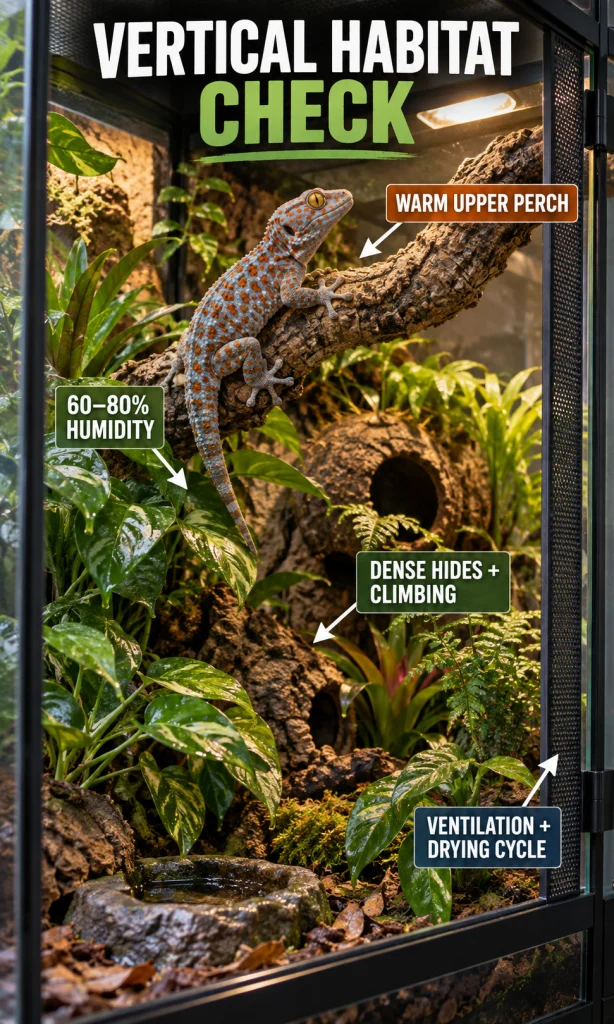
Tokay geckos are arboreal, so the enclosure must work vertically rather than simply offering floor area. The animal needs secure branches, cork bark, foliage, elevated hides, and usable routes from warmer upper areas to cooler lower areas, with doors and vents that remain escape-resistant when you feed or clean.
Published veterinary Tokay gecko care guidance commonly places daytime ambient temperatures around 80–85°F (27–29°C), with a warmer basking zone above that and nighttime temperatures kept from dropping too low. The same guidance uses a humidity range of roughly 60–80%, but the important practical point is not to keep the enclosure permanently wet: high humidity still needs airflow and a drying cycle.
A useful enclosure is also visually dense. Elevated cover reduces the need for the gecko to cross open space, while sturdy perches let it thermoregulate without being forced onto the floor. If you are still learning the basics of heat gradients, humidity, substrate, and reptile-safe furnishings, start with our guide to how to care for reptile pets before buying an advanced species.
Build the habitat, turn on the heat and lighting, run the misting routine, and monitor it for several days before the animal arrives. That dry run tells you whether the warm zone overheats, the lower enclosure stays too cool, humidity crashes too quickly, condensation lingers too long, or the doors and cable openings create an escape route.
- Use a tall, secure enclosure. Height, climbing structure, and escape control matter more than decorative floor space.
- Create more than one usable perch. The gecko should be able to move between warmer and cooler positions without leaving cover.
- Provide elevated hides. A Tokay that can retreat without being grabbed is easier to maintain with less stress.
- Measure instead of guessing. Use reliable digital thermometers and a hygrometer rather than judging conditions by how the enclosure feels.
- Balance moisture with airflow. Humid does not mean stagnant, soaked, or constantly dripping.
- Secure every opening. Tokays are fast climbers with adhesive toe pads; a small maintenance gap can become an escape route.
A planted or naturalistic enclosure can be excellent, but appearance comes after function. Plants should not block the keeper’s ability to inspect the gecko, remove waste, check shedding on the toes, or reach food and water safely.
Temperament is the real ownership test
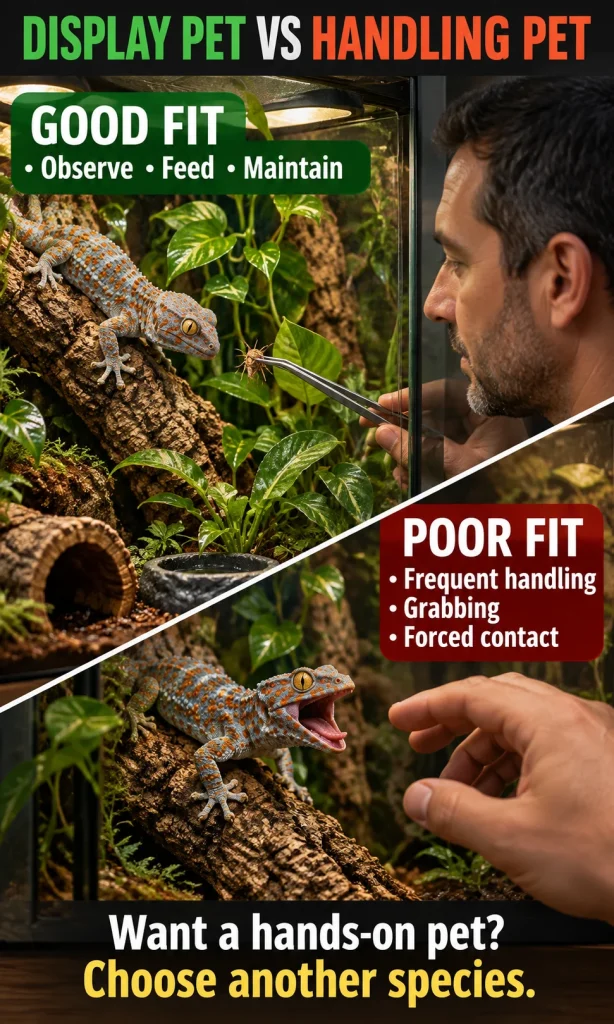
Tokays are famous for being defensive because the reputation is grounded in real behavior. They can gape, hiss, lunge, bite, and hold on when they feel cornered, especially when a hand enters the enclosure quickly or tries to grab them from above.
That does not make them a bad animal; it makes them a species with clear boundaries. A keeper who reads posture, distance, escape behavior, and threat displays can usually complete routine maintenance with far less conflict than someone who treats every defensive response as a taming challenge, which is why understanding your pet’s body language matters even with reptiles.
Some captive-bred individuals become calmer around familiar keepers, and patient feeding-tong work can create useful trust. The safer assumption, however, is that your Tokay may remain a display animal for life; buy the species only if that outcome still sounds worthwhile.
Handling rule: Do not buy a Tokay because you plan to “make it tame.” Buy one only if you would still be satisfied with a gecko that prefers not to be handled.
If a bite occurs, do not yank your hand away or pry the jaws apart. The Smithsonian National Zoo advises placing the gecko on a stable surface near a retreat and waiting for it to release rather than pulling against the bite; afterward, clean any broken skin thoroughly and seek medical care when a wound is deep, will not stop bleeding, or develops signs of infection.
Feeding is straightforward, but it is not low-effort
Tokay geckos are primarily insect-eaters in captivity, so a varied supply of appropriately sized live prey should form the core of the diet. Crickets, roaches, locusts, and other suitable feeder insects are commonly used, with gut-loading and a species-appropriate calcium and vitamin routine to support bone health.
The practical workload is more than dropping insects into the enclosure. You have to keep feeders healthy, remove uneaten prey that may harass a resting gecko, monitor body condition, and make sure reduced appetite is not being caused by low temperature, chronic stress, dehydration, retained shed, parasites, or another health problem.
Fresh water should remain available even if the gecko also drinks droplets after misting. Clean feeding and water equipment routinely, remove waste promptly, and wash your hands after touching the gecko, food items, substrate, or enclosure surfaces because reptiles can carry Salmonella and other microorganisms without looking ill.
Health problems often start with husbandry
Many common reptile problems are easier to prevent than to treat. Poor calcium and vitamin D management can contribute to metabolic bone disease, excessively dry conditions can worsen shedding problems, while cold or persistently stagnant wet conditions can increase respiratory and skin-health risks.
Wild-caught animals also carry a higher risk of arriving stressed, dehydrated, injured, or parasitized. That is one reason a verifiable captive-bred animal from a responsible source is generally the better route for both welfare and husbandry predictability.
Know your veterinarian before you need one. A general dog-and-cat clinic may not routinely treat geckos, so call ahead and ask whether the practice sees reptiles, performs fecal testing, handles emergency trauma, and has experience with arboreal geckos.
Buy captive-bred, verify legality, and ignore dramatic marketplace claims
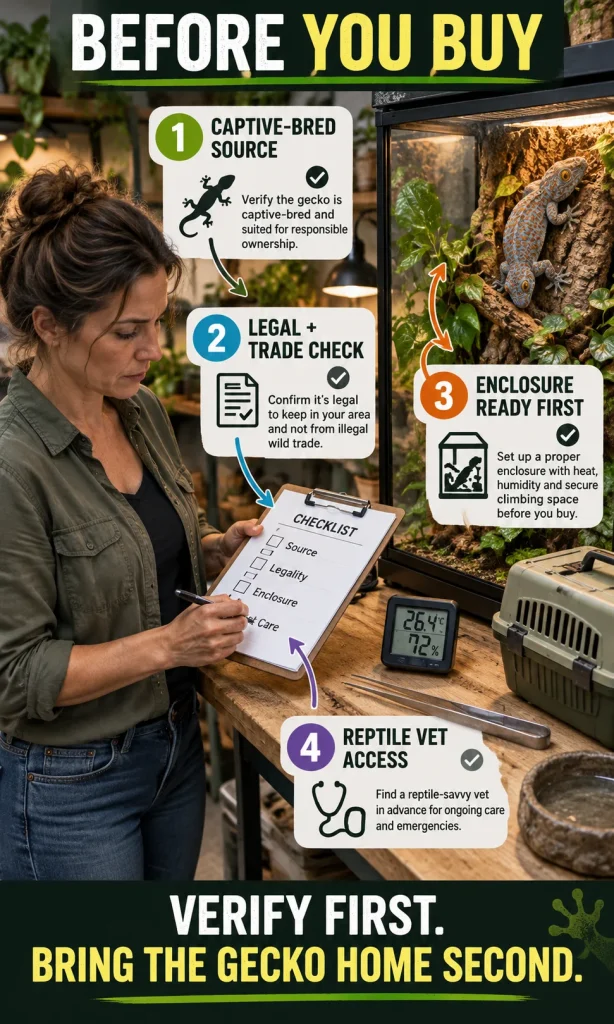
The old version of this article focused heavily on where to buy Tokay geckos and repeated sensational price and size claims that should not guide a real purchase. A safer buying framework is simpler: verify the animal’s origin, verify the seller, verify local legality, and have the enclosure and veterinary plan ready before money changes hands.
Gekko gecko is listed in CITES Appendix II, which means international trade is controlled. Appendix II listing does not automatically mean private ownership is illegal everywhere, but countries, states, provinces, or local authorities can impose additional import, possession, permit, transport, or sale rules, so check the rules that apply where you live rather than relying on a seller’s assurance.
The WWF responsible pet guide for Tokay geckos also flags sourcing and international trade as important welfare and conservation considerations. Ask for clear captive-bred history and documentation, avoid sellers who cannot explain origin, and be cautious when a low price is paired with an animal that looks thin, dehydrated, heavily scarred, unusually lethargic, or covered in mites.
Who should choose a Tokay gecko – and who should skip one
| Your situation | Decision | Why |
|---|---|---|
| Experienced reptile keeper who enjoys natural behavior | Good candidate | Your expectations are likely to match a display-oriented, defensive species. |
| First-time reptile owner | Usually choose another gecko first | The species is less forgiving of handling mistakes and husbandry gaps. |
| Family wants a reptile children can hold | Poor match | A defensive bite and stress from forced handling make that expectation inappropriate. |
| Keeper wants a dramatic planted vivarium animal | Potentially excellent | Tokays are active climbers with distinctive appearance and behavior. |
| Household is sensitive to nighttime noise | Think carefully | Their vocal calls can be loud and may occur after dark. |
What to do before bringing one home
A responsible purchase should feel almost boring because the exciting decisions have already been made. The enclosure is stable, the seller can explain the animal’s origin, the local rules are clear, a reptile veterinarian has been identified, and you already know how you will feed and service the enclosure without repeatedly cornering the gecko.
- Finish and test the enclosure. Check daytime and nighttime temperatures, humidity rise and fall, ventilation, door security, and access for cleaning.
- Confirm captive-bred origin. Ask direct questions about breeder history, age, feeding response, sheds, health issues, and how long the seller has had the animal.
- Check your local rules. Confirm possession, transport, import, sale, and permit requirements where relevant.
- Locate a reptile veterinarian. Do this before the first emergency, not after.
- Plan for minimal handling. Use feeding tongs, removable hides or cork tubes, and enclosure access that lets you work around the gecko rather than grabbing it.
- Prepare a long-term backup plan. Know who could care for or responsibly rehome the animal if your circumstances change.
Once the gecko arrives, give it time to settle instead of immediately testing its tolerance for handling. Appetite, hiding choices, nighttime movement, posture, shedding, droppings, and body condition are more useful early indicators than whether the animal will sit on your hand.
Frequently asked questions
Are Tokay geckos good for beginners?
Usually not. Their defensive temperament, fast movement, strong bite, live-food needs, and requirement for controlled tropical husbandry make them a better fit for keepers who already understand reptile care.
Can a Tokay gecko be tamed?
Some captive-bred individuals become calmer and may voluntarily climb onto a familiar keeper, but there is no guarantee. Buy a Tokay only if you would still be happy with an animal that remains mostly hands-off.
Do Tokay gecko bites hurt?
Yes. An adult can bite hard enough to break skin and may hold on, so routine husbandry should be designed to reduce forced contact. If bitten, avoid pulling against the jaws, clean the wound after release, and seek medical care when the injury is significant.
Are Tokay geckos loud?
They can be. The species is named for its distinctive “to-kay” call, and vocalizations may occur at night, so enclosure placement matters in bedrooms, apartments, or noise-sensitive households.
Should two Tokay geckos live together?
For ordinary pet keeping, house Tokays individually. They are territorial, and cohabitation can create stress, fighting, injury, and competition unless a highly experienced breeder has a specific controlled breeding setup.
Where should I buy a Tokay gecko?
Prefer a reputable source that can document captive-bred origin and answer detailed questions about feeding, age, health, and history. Verify local legality and any permit requirements yourself rather than relying only on the seller.
The bottom line
A Tokay gecko is a compelling pet when you want an impressive animal to observe and are comfortable building your care routine around its boundaries. It is a poor choice when your main goal is frequent handling, simple setup, low noise, or a forgiving first reptile.
If the display-animal lifestyle still appeals to you after the habitat, feeding, bite, sourcing, and veterinary requirements are clear, prepare the enclosure first and source the gecko second. That order protects both the keeper and the animal, and it removes most of the avoidable problems before they begin.