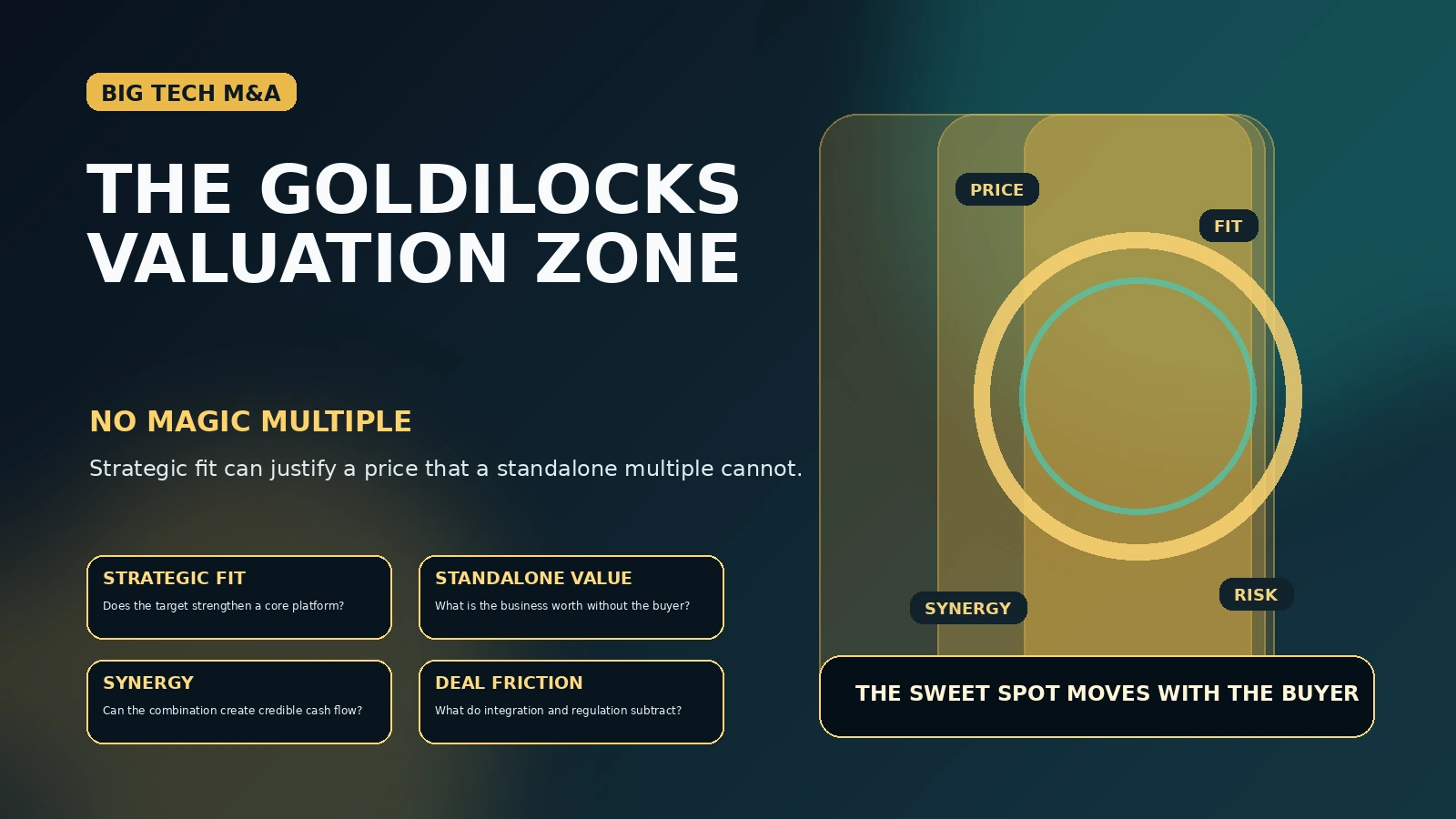

There is no permanent market-cap range or sales multiple where a technology company suddenly becomes an obvious acquisition target. A workable “Goldilocks” zone is buyer-specific: the price has to fit the target’s standalone economics, the buyer’s strategic need, the synergies the combination can credibly create, and the friction that could destroy those benefits.
The “Goldilocks zone” is a decision framework, not a fixed number
The original version of this idea was built around a historical screen: roughly $5 billion to $30 billion in market capitalization, preferably below 10 times forward price-to-sales, plus disruptive potential. That was a useful snapshot of one market moment, but it was never a universal law of technology M&A. The original 2022 thesis itself was anchored to then-current market conditions and a possible Cisco-Splunk transaction.
A strategic acquirer does not start with “Is this company below 10x sales?” and stop there. It starts with a capability gap: cloud security, data management, developer infrastructure, enterprise search, distribution, AI functionality, customer access, or another asset the buyer believes is faster or more valuable to acquire than to build.
Valuation matters because it determines how much future value the buyer must create to justify the purchase price. But the same headline multiple can mean very different things when revenue quality, gross margins, growth durability, customer concentration, product defensibility, integration effort, and regulatory exposure differ.
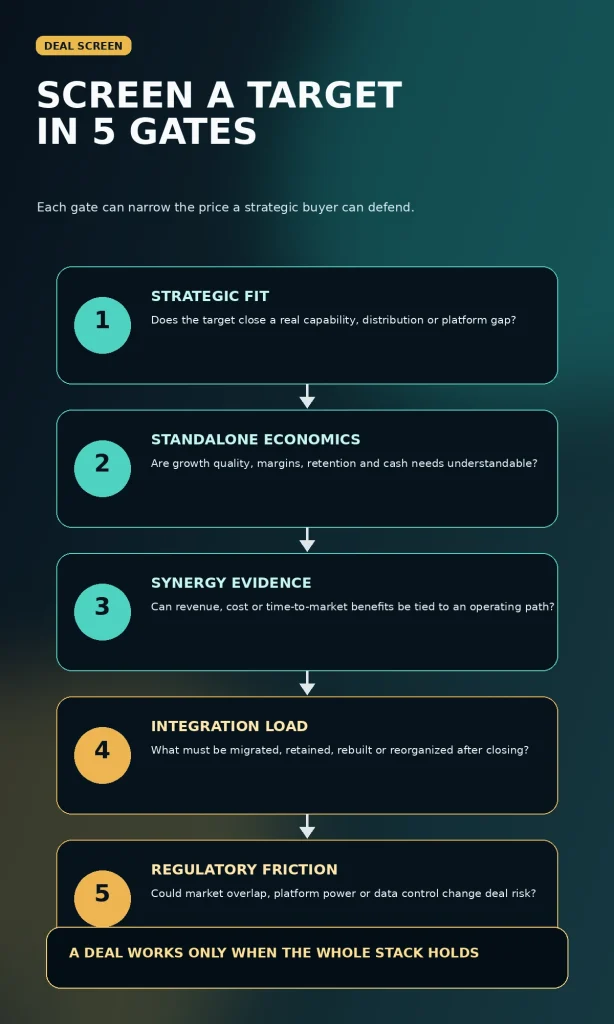
Five gates determine whether a valuation is strategically workable
| Gate | What the buyer is testing | Why it changes value |
|---|---|---|
| Strategic fit | Does the target close a real product, platform, distribution, data, talent, or infrastructure gap? | A closer fit creates more ways for the buyer to earn back the premium. |
| Standalone economics | How strong is the target without the acquisition? | Weak underlying economics force the buyer to depend more heavily on synergy. |
| Synergy evidence | Can the buyer identify credible revenue, cost, infrastructure, or time-to-market benefits? | Strategic value can justify a premium only when there is an operating path to capture it. |
| Integration load | What has to be migrated, retained, consolidated, or reorganized? | Execution cost subtracts from the value the deal appears to create on paper. |
| Deal risk | Could competition concerns, platform power, data control, financing, or closing conditions alter the deal? | A higher probability of delay, remedies, or failure reduces what the buyer can rationally pay. |
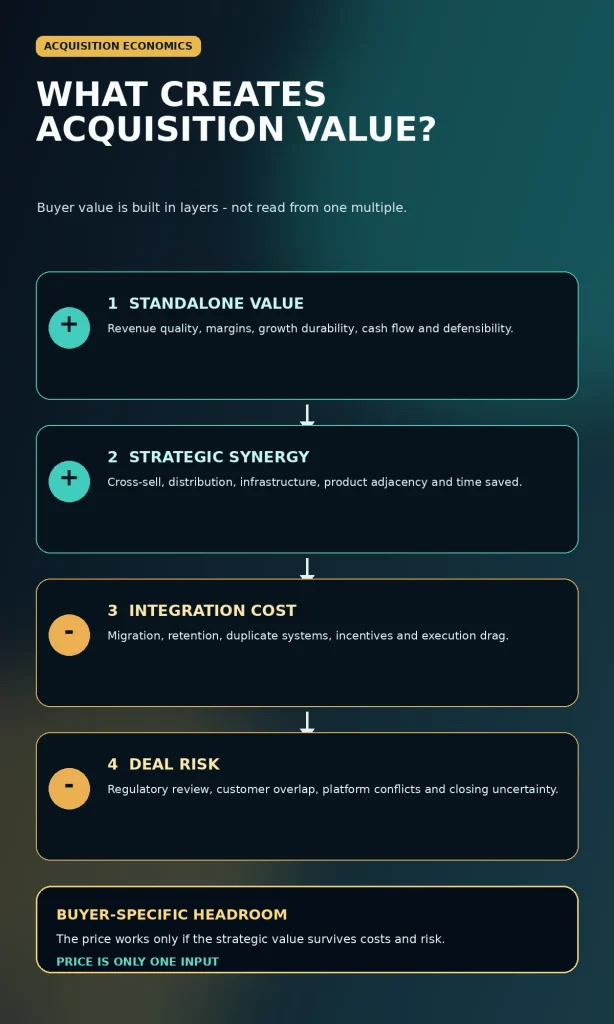
A practical acquisition screen therefore works from the inside out. First understand the business on its own; then add buyer-specific benefits; then subtract the costs, delays, and risks required to capture those benefits.
This is also why platform economics matter. A target can look more valuable when it strengthens distribution, data access, retention, or an ecosystem relationship, but those same advantages can raise competition concerns. For adjacent background, see how digital marketplaces become concentrated and how platforms predict user lifetime value.
Why a single sales multiple can mislead
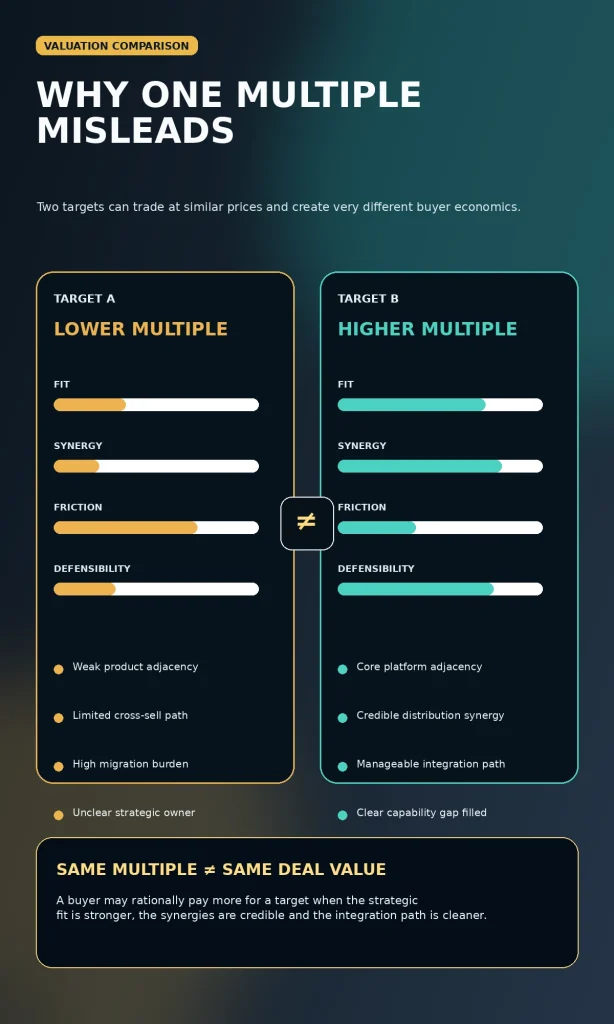
Revenue multiples are convenient because they are fast, especially for software businesses whose earnings can be depressed by heavy investment. The problem is that revenue is not interchangeable: $1 of high-retention, high-margin revenue is not economically identical to $1 of concentrated, low-margin, promotion-dependent, or rapidly decelerating revenue.
A buyer also cares about what happens after closing. If the target can be distributed through an existing sales channel, run on existing infrastructure, or accelerate a roadmap that would otherwise take years, the combination may create value that is absent from the target’s standalone financial statements.
- Lower multiple, weak fit: a target can look “cheap” but still create little strategic value.
- Higher multiple, strong fit: a target can look expensive on a standalone basis yet be more defensible if the buyer has credible synergies.
- High growth, low durability: rapid revenue growth does not automatically justify price if retention, unit economics, or cash needs are weak.
- Excellent product, difficult integration: a technically attractive company can lose value when systems, teams, contracts, or customer workflows are hard to combine.
- Powerful adjacency, high regulatory friction: strategic logic can increase both the business case and the scrutiny around the transaction.
Innovation can command a premium, but innovation alone does not set the price
Research on U.S. technology transactions supports the idea that innovation can have acquisition value. A study of 786 public-to-public technology deals found that more innovative targets tended to receive higher takeover premiums, and that more innovative acquirers were willing to pay more for innovative targets. The useful lesson is not that patents or R&D create a guaranteed premium; it is that a buyer may value innovation more when it can absorb and use that innovation effectively. See the peer-reviewed study on acquiring for innovation in the U.S. technology industry.
That creates a distinction between standalone value and strategic value. Standalone value asks what cash flows the target can generate as an independent company. Strategic value asks what additional cash flows, cost savings, distribution, infrastructure efficiency, or time-to-market advantages a particular buyer can create after the combination.
Strategic buyers still have to decide how much of that extra value to share with the seller. A synergy model that ignores execution probability, time to realization, integration costs, and dis-synergies can make almost any price look rational. A more defensible approach discounts the expected benefits before they are allowed to support a higher bid; this is also the logic behind current work on building acquisition value through cost, capital, and revenue synergies.
Recent tech deals show why the valuation zone moves
Recent transactions span values below, inside, and above the old $5 billion-to-$30 billion screen. These figures are not directly comparable because announcements may quote enterprise value, equity value, or another transaction measure, but they make one point clearly: strategic technology acquisitions do not stop at one fixed size band.
| Transaction | Announced value | Strategic rationale described by buyer |
|---|---|---|
| IBM – HashiCorp | $6.4B enterprise value | Hybrid-cloud infrastructure automation and strategic fit across IBM’s cloud and AI portfolio. |
| Salesforce – Informatica | About $8B equity value | Data management, governance, integration, and metadata capabilities for an AI-focused platform. |
| Cisco – Splunk | About $28B equity value | Security, observability, data, and AI-related platform expansion. |
| Google – Wiz | $32B all-cash transaction | Cloud and AI security across multi-cloud environments. |
| ServiceNow – Moveworks | $2.85B | Agentic AI, enterprise search, and employee-facing workflow expansion. |
The range is not the signal; the economics are. A $3 billion target can be too large if the buyer has little ability to integrate it, while a $30 billion-plus transaction can still be rational when the strategic gap is important enough and the buyer can support the cost, integration, and regulatory path.
How to evaluate a target without pretending to predict a takeover
A useful framework should explain what could make an acquisition logical without turning the exercise into a list of “companies likely to be bought.” Deal timing depends on confidential strategy, board decisions, financing, negotiations, regulation, and alternatives that outsiders cannot reliably observe.
Instead, screen the business through five questions:
- What capability would a buyer actually be acquiring? Name the product, data, distribution, engineering talent, customer base, infrastructure, or operating advantage.
- What is the target worth without an acquirer? Separate the independent business case from takeover speculation.
- Which buyer could create the most incremental value? Synergy is buyer-specific; a capability can be worth far more to one platform than another.
- What would be difficult after closing? Look for product overlap, architecture migration, customer disruption, talent retention, duplicate cost structures, and cultural friction.
- What could stop or reshape the transaction? Competition review can matter especially when the buyer is a platform operator, a close rival, or controls an important input.
Regulatory friction belongs inside the valuation model
Competition risk is not a footnote added after a financial model is complete. In the United States, the DOJ and FTC Merger Guidelines describe how agencies evaluate whether a transaction may substantially lessen competition, including issues involving platforms, potential entrants, dominant positions, and acquisitions of important inputs.
That matters because a deal with stronger strategic overlap can sometimes create more value for the buyer while also creating more competition concerns. A realistic model therefore treats regulatory exposure as a factor that can affect timing, remedies, closing probability, integration planning, and ultimately the price a buyer can defend.
Use the acquisition screen instead of a takeover watchlist
The interactive experience below is designed to separate observable deal economics from speculation. It calculates the revenue multiple from values you enter, compares it with an optional reference multiple, and then walks through strategic fit, synergy evidence, integration load, and regulatory friction without assigning a fake “probability of acquisition.”
BUYER-SPECIFIC DECISION SUPPORT
Acquisition Value Reality Check
Test whether a proposed tech acquisition price has an explainable economic story beyond a headline multiple.

Step 1
Set the deal economics
Step 2
Describe the buyer-specific case
Calculated deal multiple
6.0x EV / revenue
Buyer-economics pattern
Value depends on synergy proof
The target is strategically adjacent, but directional synergies still need owners, operating assumptions and a path to cash flow.
What must be true
Before the price is defensible
It does not estimate takeover probability, future share price, legal clearance, or investment return. It only organizes the assumptions that can make the same headline valuation look different to different buyers.
Common failure modes in “cheap acquisition target” analysis
| Failure mode | Why it fails | Better check |
|---|---|---|
| Using one historical multiple as a rule | Market conditions and business quality change. | Compare the multiple with revenue quality, growth durability, margins, and buyer-specific synergy. |
| Assuming a price decline makes a takeover likely | A falling price can reflect deteriorating fundamentals that also make the target less attractive. | Check whether the strategic asset has remained valuable while price changed. |
| Treating every synergy as cash | Benefits can arrive late, cost more to capture, or fail entirely. | Attach timing, probability, cost-to-achieve, and operating ownership to each synergy. |
| Ignoring integration architecture | Product and infrastructure conflicts can erase expected value. | Map systems, data, customer workflows, people, and migration dependencies before counting the upside. |
| Reading public M&A logic as an investment recommendation | A plausible acquisition case does not establish that a deal will happen or that a security is attractive. | Evaluate the company on its standalone merits and treat takeover value as uncertain. |
What the Goldilocks idea is still useful for
The phrase remains useful if it describes a zone of defensible buyer economics rather than a fixed market-cap band. It forces the analyst to ask when a price becomes manageable enough, the strategic gap important enough, and the integration path credible enough for acquisition to beat the buyer’s alternatives.
That framing also connects acquisition analysis with broader platform economics. A buyer may be seeking better retention, more valuable user relationships, a new distribution layer, or control of a strategic capability; related background includes how subscription platforms engineer retention and how ad allocation models price visibility.
Frequently Asked Questions
What is the Goldilocks valuation zone in tech M&A?
It is best understood as the range where a specific buyer can justify the target’s price after considering standalone value, strategic fit, synergies, integration costs, and deal risk. It is not one permanent market-cap range or revenue multiple.
Is 10x forward sales a reliable acquisition cutoff?
No. A revenue multiple is only a starting reference because revenue quality, margins, growth durability, strategic fit, and synergy potential differ sharply between companies and market cycles.
Why can a strategic buyer pay more than a financial buyer?
A strategic buyer may be able to create buyer-specific benefits such as cross-selling, infrastructure savings, distribution gains, faster product development, or elimination of duplicated costs. Those benefits can create value that is not available to every bidder.
Does a lower valuation make a company more likely to be acquired?
Not by itself. A lower price can improve affordability, but the target still needs strategic relevance, acceptable standalone economics, manageable integration, and a deal structure the buyer can defend.
Can investors use this framework to predict takeover targets?
The framework can explain why a deal might make strategic sense, but it cannot establish that a takeover will happen. Confidential negotiations, buyer priorities, financing, regulation, and competing alternatives make acquisition outcomes uncertain.
Action checklist
- Calculate the target’s current valuation using a measure appropriate to the business.
- Separate standalone value from buyer-specific strategic value.
- Write down each synergy and the operating action required to capture it.
- Subtract integration cost, time, execution risk, and likely dis-synergies.
- Check whether competition or platform concerns could change the deal path.
- Do not treat “possible acquisition target” as a substitute for a standalone investment thesis.
This article is educational and is not investment, legal, tax, or transaction advice. M&A outcomes and valuation depend on facts that can change materially by company, buyer, jurisdiction, and market conditions.