

Visibility Is No Longer Neutral
In early digital platforms, visibility often appeared organic.
Content was displayed chronologically.
Distribution felt neutral.
Modern systems operate differently.
Visibility is now dynamically allocated.
Allocation depends on:
- Bid value
- Engagement probability
- Historical performance
- Quality signals
- Predicted click-through rate
Exposure becomes a variable.
Variables can be priced.
Pricing converts attention into market structure.
Visibility is no longer a baseline.
It is an asset.
What Ad Allocation Really Means
Ad allocation models determine:
- Which advertisement appears
- In which position
- For which user
- At what price
- With what predicted probability of interaction
Allocation systems operate through probabilistic ranking.
Advertisers submit bids.
Platforms estimate engagement likelihood.
The final placement often depends on a composite score rather than bid alone.
Composite scores typically combine:
- Bid amount
- Quality score
- Expected click-through rate
- Historical relevance
Allocation becomes multi-dimensional.
Price interacts with probability.
Probability interacts with relevance.
Relevance interacts with ranking.
Ranking determines exposure.
Auction Systems and Attention Pricing
Most modern digital advertising platforms use auction-based allocation.
Common auction models include:
- Second-price auctions
- Modified generalized second-price systems
- Real-time bidding frameworks
In second-price systems, the highest bidder wins but pays slightly above the second-highest bid.
This mechanism encourages truthful bidding.
Truthful bidding increases allocation efficiency.
Efficiency improves revenue predictability.
Predictability stabilizes platform economics.
Allocation pricing interacts closely with predictive revenue forecasting systems. Exposure pricing depends on estimating future engagement and monetization probability.
Auction systems price visibility based on expected performance.
Performance expectations rely on behavioral data.
Behavioral data improves prediction accuracy.
Prediction accuracy increases allocation precision.
Quality Score and Engagement Probability
Bid value alone rarely determines placement.
Platforms assign quality scores.
Quality scores estimate:
- Relevance to user intent
- Expected click-through rate
- Historical engagement
- Landing page experience
Higher quality scores can reduce cost per click.
Lower quality scores increase required bid to win exposure.
Quality scoring aligns economic incentive with engagement probability.
Engagement probability influences allocation efficiency.
Efficient allocation maximizes total revenue per impression.
This dynamic parallels engagement-weighted exposure systems across digital ecosystems. Allocation rewards probability rather than static priority.
Visibility therefore becomes conditional.
Condition depends on predicted performance.
Predicted performance depends on data history.
History shapes opportunity.
Redistribution of Attention Through Bidding
When exposure is auctioned, distribution shifts dynamically.
Higher bids increase exposure likelihood.
Improved engagement history reduces required bid.
Lower predicted engagement requires higher economic input.
Visibility redistribution becomes strategic.
Advertisers optimize:
- Bid timing
- Audience targeting
- Creative refinement
- Budget pacing
Optimization adjusts exposure probability in real time.
Real-time redistribution changes competitive landscape.
Competition influences pricing intensity.
Pricing intensity affects visibility stratification.
This pricing logic resembles algorithmic incentive structures observed in platform-based matching systems. Exposure becomes adjustable rather than neutral.
When visibility is priced, behavior adapts.
Adaptation reinforces strategic optimization.
Optimization reshapes attention flow.
Real-Time Bidding Mechanics
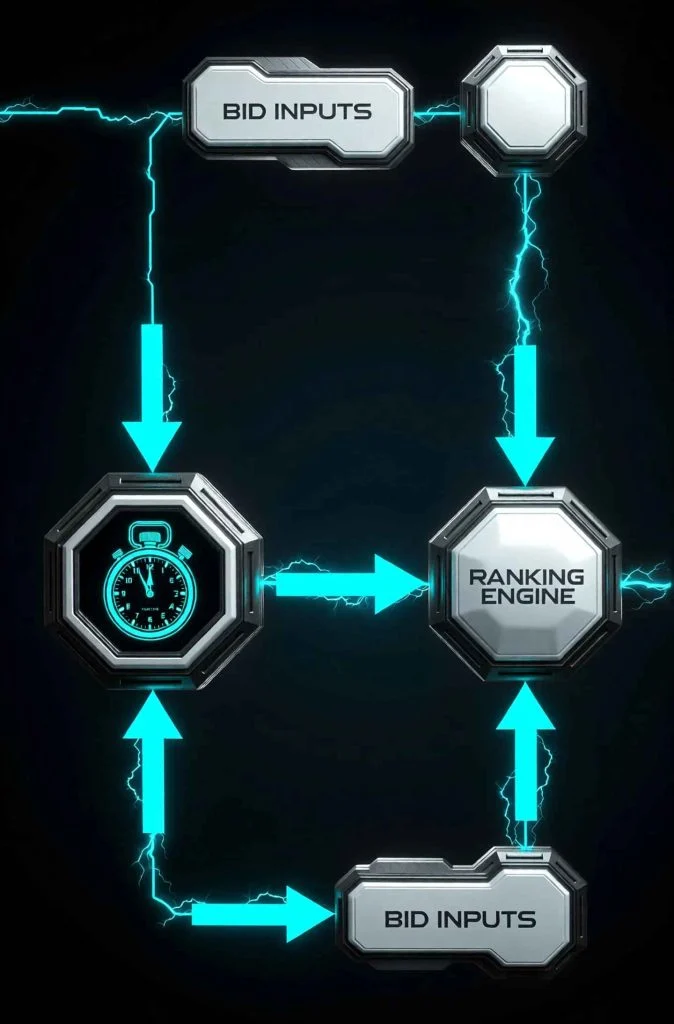
Ad allocation does not occur once per day.
It occurs continuously.
In real-time bidding systems, auctions may execute within milliseconds.
When a user opens an app or webpage:
- The platform identifies contextual signals.
- Eligible advertisers are selected.
- Bid values are retrieved.
- Quality and engagement predictions are calculated.
- Composite scores are generated.
- The highest-ranked ad is displayed.
This process happens instantly.
Instant allocation increases precision.
Precision improves monetization density.
Monetization density strengthens revenue efficiency.
Real-time bidding transforms exposure into micro-auctions.
Each impression becomes a market event.
The Ad Rank Formula
Most allocation systems use an ad rank formula.
Ad rank typically combines:
- Bid value
- Quality score
- Expected click-through rate
- Ad relevance
- Predicted conversion probability
The formula often resembles:
Ad Rank = Bid × Engagement Probability × Quality Factor
Higher rank wins exposure.
However, the final price paid may depend on the next highest rank.
This prevents excessive overpayment while maintaining competitive pressure.
Competitive pressure influences bid escalation.
Escalation increases pricing intensity.
Intensity redistributes visibility among participants.
Budget Pacing Algorithms
Advertisers rarely want to spend their entire budget immediately.
Budget pacing algorithms distribute spend across time intervals.
Pacing considers:
- Daily budget constraints
- Peak user activity windows
- Conversion timing probability
- Competitive bid density
If budget depletes early, visibility disappears.
If pacing is too conservative, exposure opportunity may be lost.
Platforms often optimize pacing automatically.
Automated pacing adjusts bids in response to:
- Performance signals
- Competitive fluctuations
- Conversion likelihood
These pacing decisions rely on dynamic value adjustment systems tied to predicted monetization outcomes. Allocation becomes data-responsive rather than static.
Budget pacing shapes exposure timing.
Timing influences engagement probability.
Engagement influences future bid efficiency.
Exposure Volatility Under Competition
Auction systems introduce volatility.
Volatility increases when:
- Many advertisers target similar audiences
- Seasonal demand rises
- High-value conversion events occur
- Competitive bids escalate
Exposure cost per click may fluctuate rapidly.
Fluctuation changes allocation probability.
Allocation probability reshapes visibility hierarchy.
Hierarchy shifts influence strategic bidding behavior.
Behavior responds to cost signals.
Cost signals adjust competitive positioning.
Over time, this process reinforces visibility concentration dynamics across digital markets. Larger advertisers may sustain higher bids, increasing exposure stability.
Volatility affects smaller participants disproportionately.
Sustained bidding capacity influences long-term reach.
Reach compounds.
Compounding strengthens advantage.
Behavioral Feedback Loops in Auctions
Auction systems generate behavioral loops.
If an advertisement performs well:
- Engagement probability increases.
- Quality score improves.
- Required bid decreases.
- Exposure increases.
If performance declines:
- Quality score drops.
- Required bid rises.
- Exposure decreases.
Performance feedback shapes allocation trajectory.
Trajectory influences strategic optimization.
Optimization influences creative design.
Creative design influences engagement.
Engagement feeds the system again.
This loop parallels incentive structures in other algorithmic systems.
The same incentive-driven exposure loops appear in algorithmically ranked platforms. Performance shapes opportunity.
Opportunity shapes behavior.
Behavior shapes performance.
Allocation Efficiency and Revenue Maximization
Auction systems aim to maximize:
- Revenue per impression
- User relevance
- Long-term advertiser retention
- Platform stability
Efficiency requires balancing:
- Bid intensity
- Engagement probability
- User experience quality
If ads become irrelevant, engagement drops.
If engagement drops, allocation efficiency declines.
Efficiency depends on predictive accuracy.
Accuracy depends on behavioral data.
Data strengthens allocation stability.
Strategic Bidding Behavior
When visibility becomes auction-based, behavior adapts.
Advertisers rarely bid randomly.
They optimize.
Optimization includes:
- Audience segmentation
- Time-of-day targeting
- Conversion probability modeling
- Bid multipliers for device types
- Geo-based bid adjustments
Strategic bidding transforms exposure into a calculated lever.
Levers are pulled when predicted return exceeds cost.
Return depends on engagement probability.
Engagement probability depends on behavioral alignment.
Alignment influences quality score.
Quality score influences cost efficiency.
Cost efficiency influences scale.
Scale increases exposure stability.
Strategic behavior therefore compounds.
Paid Visibility vs Organic Exposure
Digital platforms operate with two primary exposure pathways:
- Organic ranking systems
- Paid allocation systems
Organic exposure depends on:
- Engagement signals
- Historical performance
- Algorithmic relevance
Paid exposure depends on:
- Bid value
- Quality score
- Expected performance
Although these systems appear separate, they often interact.
Strong organic performance can improve paid efficiency.
High paid visibility can increase brand recognition, influencing organic engagement.
This overlap reinforces performance-based visibility systems across digital ecosystems. Paid and organic pathways increasingly reflect probabilistic allocation models.
Exposure becomes conditional in both pathways.
Condition depends on measurable performance.
Performance influences future opportunity.
Behavioral Impact of Auction Systems
When exposure can be purchased, behavior shifts.
Advertisers:
- Optimize creative design for higher click-through rates
- Experiment with headline structure
- Adjust visual hierarchy
- Refine audience targeting
Creative decisions increasingly align with algorithmic signals.
Algorithmic signals shape creative style.
Style converges toward formats that maximize engagement probability.
Convergence may reduce stylistic diversity.
However, it increases predictability.
Predictability supports allocation efficiency.
Efficiency stabilizes platform revenue.
Incentive Shifts Created by Visibility Pricing
In neutral distribution systems, content visibility depends primarily on chronology or baseline ranking.
In auction systems, incentives expand.
Incentives include:
- Bid optimization
- Quality score enhancement
- Conversion tracking
- Engagement refinement
Pricing introduces economic hierarchy.
Participants with greater capital can sustain longer bidding intensity.
Sustained intensity increases exposure frequency.
Exposure frequency reinforces brand recognition.
Recognition increases engagement probability.
Engagement probability reduces required future bid.
The compounding effect strengthens dominant participants.
This dynamic contributes to capital-driven concentration patterns within digital markets. Exposure compounds for participants able to sustain optimization.
Auction systems therefore influence structural hierarchy.
Hierarchy shapes competitive landscape.
Structural Asymmetry Between Participants
Auction systems introduce asymmetry.
Large advertisers may benefit from:
- Greater data access
- Advanced analytics teams
- Higher sustained budget
- Diversified campaign testing
Smaller advertisers may face:
- Higher cost volatility
- Limited optimization capacity
- Narrow audience targeting
- Budget exhaustion risk
Asymmetry affects long-term exposure stability.
Stability influences brand durability.
Durability affects market positioning.
Market positioning influences acquisition cost.
Acquisition cost shapes growth trajectory.
Exposure markets therefore reshape competitive dynamics.
Allocation Feedback and Market Maturity
As markets mature:
- Bid competition intensifies
- Quality thresholds rise
- Engagement expectations increase
- Cost efficiency becomes critical
Mature markets reward:
- Data-driven optimization
- Creative performance alignment
- Audience modeling precision
- Conversion tracking accuracy
Immature markets may allow broader visibility.
Mature markets compress opportunity.
Compression increases efficiency pressure.
Pressure accelerates innovation.
Innovation influences creative evolution.
Evolution feeds allocation systems.
The cycle continues.
Long-Term Equilibrium of Priced Visibility Markets

Auction-based visibility systems rarely remain static.
They evolve toward competitive equilibrium.
In early-stage markets:
- Bid density is low
- Cost per impression remains moderate
- Visibility distribution is less concentrated
As participation increases:
- Bid competition intensifies
- Cost per click rises
- Quality thresholds increase
- Performance expectations tighten
Equilibrium forms when:
- Average bid aligns with expected conversion value
- Engagement probability stabilizes
- Cost volatility narrows
- Allocation efficiency maximizes revenue per impression
At equilibrium, exposure is no longer random.
It reflects probabilistic optimization under budget constraints.
Stability does not imply fairness or equality.
It reflects systemic balancing between bid pressure and engagement probability.
Revenue Durability Under Auction Systems
Auction-based pricing contributes to revenue durability.
Durability depends on:
- Continuous advertiser participation
- Predictable conversion probability
- Stable engagement signals
- Retention of high-value advertisers
If advertisers achieve consistent return on spend, they remain active.
Active participation sustains auction liquidity.
Liquidity stabilizes pricing structure.
Stable pricing improves forecast confidence.
Forecast confidence strengthens platform investment.
Investment enhances allocation infrastructure.
Infrastructure improves predictive precision.
Predictive precision increases monetization density.
The cycle compounds.
These allocation systems rely on monetization predictability models to maintain pricing efficiency. Visibility pricing depends on estimating future performance probability.
Prediction anchors pricing.
Pricing anchors exposure.
Exposure anchors revenue.
Revenue anchors durability.
Behavioral Implications Across Ecosystems
When visibility is priced, behavior adapts beyond advertising.
Auction logic influences:
- Content formatting
- Platform design
- User experience structures
- Engagement measurement systems
Creative teams optimize for measurable performance.
Performance measurement shapes creative evolution.
Evolution influences audience expectation.
Audience expectation influences engagement probability.
Engagement probability influences allocation efficiency.
This recursive loop reshapes digital behavior across ecosystems.
This mirrors algorithmic behavior shaping observed in incentive-based matching platforms. Exposure pricing influences interaction patterns.
Auction systems extend beyond advertising.
They represent a broader allocation philosophy.
Allocation philosophy reshapes digital structure.
Visibility Under Scarcity
Across digital ecosystems, several structural principles converge:
- Attention is finite.
- Visibility can be priced.
- Probability drives allocation.
- Performance shapes cost efficiency.
- Capital capacity influences stability.
- Data improves prediction precision.
Visibility becomes a strategic lever.
Levers influence competitive hierarchy.
Hierarchy shapes market concentration.
Concentration influences entry barriers.
Barriers influence innovation pressure.
Innovation feeds allocation systems.
Understanding visibility pricing clarifies why exposure distribution often appears unequal.
It reflects probabilistic auctions under scarcity.
Scarcity necessitates allocation.
Allocation introduces pricing.
Pricing transforms attention into market structure.
Conclusion
Ad allocation models convert exposure into a priced variable.
Bidding systems redistribute visibility dynamically.
Quality scoring aligns economic incentive with engagement probability.
Auction systems introduce volatility, hierarchy, and optimization pressure.
Visibility is no longer a neutral baseline.
It is strategically adjustable.
Pricing exposure influences:
- Creative design
- Behavioral adaptation
- Competitive dynamics
- Market concentration
- Revenue durability
Auction-based allocation reflects a structural response to finite attention.
When attention is scarce, exposure must be allocated.
Allocation under scarcity becomes market-driven.
Market-driven allocation reshapes digital ecosystems.
FAQs
What is ad allocation in digital platforms?
Ad allocation refers to the probabilistic system that determines which advertisement is shown to a user based on bid value, engagement probability, and quality scoring metrics.
How does real-time bidding work?
Real-time bidding executes instant auctions when a user opens a webpage or app, selecting the highest-ranked ad based on composite scoring that includes bid amount and predicted engagement.
Why is visibility no longer neutral online?
Visibility is increasingly determined by auction-based allocation systems where exposure is priced and redistributed according to engagement probability and bidding intensity.
Do auction systems affect digital behavior?
Yes. Auction systems influence creative optimization, bidding strategy, and engagement measurement, shaping how advertisers and platforms adapt their behavior under competitive attention markets.