

Artificial intelligence has become one of the biggest priorities in enterprise technology, yet successful implementation remains far less common than many executive presentations suggest. Organizations across finance, healthcare, manufacturing, logistics, retail, and professional services continue investing millions of dollars into AI initiatives with the expectation of improving efficiency, reducing costs, accelerating decision-making, and creating new competitive advantages. While some achieve remarkable results, many projects quietly stall, fail to deliver measurable business value, or disappear altogether after the initial excitement fades.
The challenge is rarely the AI technology itself. In many organisations, AI reporting blind spots prevent leaders from seeing weak adoption, unreliable metrics, and operational risks until the consequences become expensive. Modern large language models, machine learning platforms, predictive analytics, and workflow automation have matured rapidly. More often, failure begins much earlier through decisions involving leadership alignment, governance, business objectives, organizational readiness, data quality, employee adoption, and unrealistic expectations. These underlying weaknesses create recognizable enterprise AI failure patterns that appear repeatedly regardless of industry, company size, or technology vendor.
One of the biggest misconceptions is believing that AI projects fail because algorithms are inaccurate or software platforms are immature. In reality, experienced transformation leaders frequently discover that organizational decisions made before the first model is trained determine much of the project’s eventual outcome. Poor ownership structures, fragmented data ecosystems, unclear success metrics, insufficient change management, and disconnected business processes often introduce risks that no amount of technical optimization can fully overcome.
Enterprise AI Prevention Engine
Enterprise AI Prevention Assessment
Evaluate whether your organisation is prepared to prevent common enterprise AI failure risks before they become costly governance, operational, data, security, or employee adoption problems.
Understanding these recurring failure patterns gives executives, department leaders, project managers, and AI governance teams an opportunity to identify problems while they remain manageable. Instead of reacting after budgets have been exhausted and confidence has declined, organizations can build governance frameworks that encourage sustainable adoption, measurable business outcomes, and continuous operational improvement.
This guide examines the most common enterprise AI failure patterns observed across modern organizations, explains why they emerge, explores their long-term business impact, and provides practical governance strategies that help organizations improve the likelihood of successful AI implementation. Rather than focusing solely on technology, the discussion approaches enterprise AI as a business transformation initiative where leadership, people, processes, and governance ultimately determine whether artificial intelligence becomes a strategic asset or an expensive lesson.

Why Enterprise AI Projects Fail More Often Than Organizations Expect

Enterprise AI failures rarely begin with a catastrophic technical mistake. Instead, they usually develop through a series of small business decisions that appear reasonable in isolation but gradually weaken the entire initiative. By the time visible problems emerge, budgets have already been committed, employee confidence has declined, and leadership teams begin questioning whether artificial intelligence was ever the right investment.
One of the reasons these failures surprise executives is that early project milestones often create a false sense of progress. Demonstrations work well, pilot programs produce encouraging results, and vendors showcase impressive capabilities. However, moving from a controlled proof of concept to enterprise-wide deployment introduces a completely different set of challenges. Existing business processes, legacy systems, regulatory requirements, data governance, cybersecurity policies, and organizational culture suddenly become just as important as the AI technology itself.
Many organizations also underestimate how interconnected enterprise operations actually are. A workflow that appears simple within one department may depend on information managed by finance, human resources, legal, customer service, procurement, or external partners. When AI is introduced without understanding these dependencies, automation frequently exposes hidden operational weaknesses rather than improving productivity.
Another contributing factor is the expectation that AI can compensate for inefficient business processes. In reality, artificial intelligence usually amplifies whatever already exists. Well-designed workflows become faster and more scalable, while poorly designed processes become more complicated, more expensive, and more difficult to troubleshoot. AI rarely fixes broken operations on its own; it often makes their limitations more visible.
Many organizations first improve their operational foundations by developing a structured AI productivity system before expanding AI across enterprise workflows, helping teams establish repeatable processes that automation can enhance rather than complicate.
Perhaps the most overlooked issue is organisational readiness, particularly when the hidden costs of AI adoption emerge through training demands, workflow redesign, data preparation, governance, and ongoing human supervision. Successful AI adoption requires executives, managers, technical teams, and frontline employees to share a common understanding of project objectives, responsibilities, governance standards, and expected outcomes. Without this alignment, departments begin making independent decisions that gradually pull the initiative away from its original business goals.
This explains why experienced enterprise AI consultants often spend considerably more time evaluating governance, leadership commitment, process maturity, and business readiness than selecting algorithms or software platforms. Technology may enable transformation, but organizational capability determines whether that transformation delivers lasting value.
Enterprise AI Success vs Failure
| Business Characteristic | Higher Probability of Success | Higher Probability of Failure |
|---|---|---|
| Executive sponsorship | Active leadership with clear ownership | Leadership support fades after launch |
| Business objectives | Clearly defined KPIs and measurable outcomes | AI adopted because competitors are using it |
| Data quality | Governed, consistent, trusted data | Fragmented, duplicated, inconsistent data |
| Department collaboration | Cross-functional planning | Departmental silos |
| Governance | Formal AI policies and accountability | Undefined ownership and responsibilities |
| Employee adoption | Ongoing training and communication | Resistance and uncertainty |
| Process maturity | Existing workflows already optimized | Broken processes automated too early |
| Long-term planning | Continuous improvement roadmap | One-time deployment mentality |
Transition to Next Section
Understanding why enterprise AI projects struggle provides important context, but executives can prevent many of these problems by recognizing the warning signs before implementation begins. The next section explores the recurring failure patterns that consistently appear across organizations, regardless of industry or AI platform.
Common Enterprise AI Failure Patterns You Can Prevent
Enterprise AI projects rarely fail for a single reason. Most unsuccessful initiatives accumulate multiple weaknesses over time until the combined effect overwhelms the expected business benefits. Although every organization has unique objectives, industries, and technology environments, experienced transformation teams repeatedly observe the same patterns emerging across AI implementations. Recognizing these warning signs early allows leaders to intervene before problems become significantly more expensive to resolve.
Failure Pattern 1 – AI Solves a Technology Problem Instead of a Business Problem
One of the earliest indicators of project risk appears when discussions revolve around AI capabilities instead of measurable business outcomes. Leadership teams become excited about generative AI, predictive analytics, or automation platforms without first identifying which operational challenge actually requires improvement.
Projects that begin with questions such as “How can we use AI?” often struggle more than projects asking, “Which business bottleneck costs us the most money today?” This subtle difference changes the entire planning process. Business-first initiatives naturally develop measurable objectives, while technology-first initiatives frequently expand in scope without demonstrating clear value.
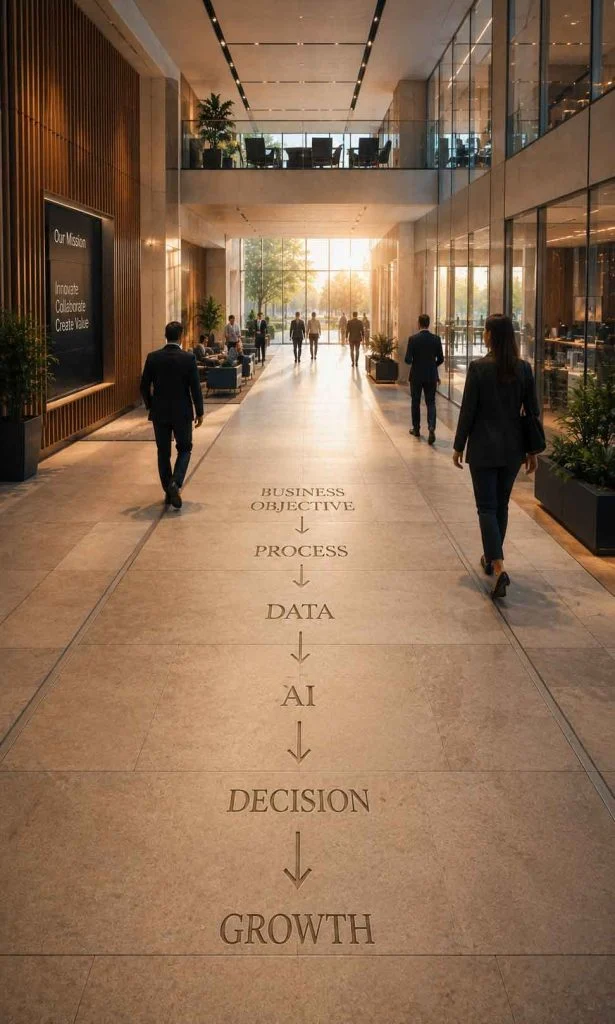
Organizations that consistently succeed with enterprise AI usually define business success before selecting technology. They establish performance indicators, financial targets, customer experience improvements, or operational efficiencies that AI must achieve before implementation begins.
Failure Pattern 2 – Poor Data Quality Is Discovered Too Late
Artificial intelligence depends on reliable information, yet many organizations only begin examining data quality after development has already started. Duplicate records, inconsistent naming conventions, missing historical information, disconnected systems, and outdated databases gradually reduce model accuracy and employee confidence.
Technical teams often spend far more time cleaning and integrating data than building AI models themselves. In some enterprise projects, data preparation consumes the majority of implementation resources because governance standards were never established before automation planning began.
Rather than viewing data preparation as an IT responsibility, successful organizations treat data governance as a strategic business capability. Finance, operations, compliance, human resources, and customer service all contribute to maintaining information that AI systems eventually depend upon.
Failure Pattern 3 – Executive Sponsorship Exists Only During Launch
Many AI projects receive enthusiastic executive support during budget approval but lose visible leadership involvement once implementation begins. Without continuous executive sponsorship, project priorities become fragmented as departments pursue competing objectives.
Employees quickly recognise when leadership attention shifts elsewhere, which is why executive accountability for AI risk must continue after launch rather than disappearing once implementation milestones have been reached. Adoption slows, governance meetings become less frequent, accountability weakens, and difficult implementation decisions remain unresolved because no executive is actively coordinating cross-functional priorities.
Organizations achieving sustainable AI adoption usually maintain executive oversight throughout planning, deployment, measurement, and continuous improvement. Leadership remains involved not because executives manage technical details, but because AI transformation continuously affects business priorities, investment decisions, and organizational change.
Failure Pattern 4 – Departments Build Independent AI Solutions
Many enterprise leaders begin identifying these recurring enterprise AI failure patterns before investing further in automation because the same warning signs repeatedly appear across organizations regardless of industry or technology platform.
Enterprise AI frequently expands faster than governance frameworks. Marketing experiments with content generation, finance automates reporting, customer service deploys conversational AI, and operations develops workflow automation independently. While each initiative may produce local improvements, the organization gradually accumulates disconnected AI ecosystems that are difficult to govern.
This fragmented approach introduces duplicated software subscriptions, inconsistent security policies, incompatible datasets, conflicting performance metrics, and unnecessary operational complexity. Eventually, leadership struggles to understand which AI initiatives genuinely contribute to enterprise objectives.
A centralized governance framework does not prevent innovation. Instead, it provides common standards that allow departments to innovate while maintaining security, compliance, interoperability, and long-term scalability.
Organizations planning long-term AI expansion often benefit from establishing a formal enterprise AI governance framework that defines ownership, approval processes, security standards, and ongoing accountability across every department.
Many organizations discover these governance issues only after reviewing common enterprise AI failure patterns that repeatedly emerge during large-scale digital transformation initiatives.
Failure Pattern 5 – Employees Are Excluded From AI Transformation
Technology adoption is ultimately driven by people rather than software. Organizations sometimes assume employees will automatically embrace AI once new systems become available. In practice, uncertainty about changing responsibilities, job security, performance expectations, and daily workflows often creates hesitation.
Successful organizations involve employees throughout implementation by explaining project objectives, gathering operational feedback, providing practical training, and encouraging continuous improvement after deployment. Employees who understand how AI supports their work are far more likely to contribute valuable insights that improve both adoption and long-term business performance.
Rather than replacing organizational knowledge, effective enterprise AI initiatives capture, enhance, and distribute that knowledge across the business. This collaborative approach transforms AI from a standalone technology project into an ongoing capability that strengthens decision-making, operational consistency, and sustainable business growth.
How to Identify Enterprise AI Failure Risks Before They Become Expensive
The most successful organizations do not wait until an AI initiative begins missing deadlines or exceeding budgets before evaluating its health. Instead, they build structured review processes that identify early warning signals while corrective action is still relatively inexpensive. Because enterprise AI projects typically involve multiple departments, vendors, data sources, and governance teams, small operational weaknesses can compound quickly if they remain unnoticed.
Risk identification should therefore become a continuous management activity rather than a milestone completed during project planning. Executive leaders who regularly review governance, adoption, operational performance, and business outcomes are often able to redirect projects long before major financial losses occur.
Leadership Cannot Clearly Explain the Business Outcome
One of the strongest indicators of future failure is when executives and department managers describe the AI initiative differently. Some may believe the objective is cost reduction, while others focus on customer experience, operational efficiency, compliance, or innovation. Although each goal may be valuable, conflicting priorities make success difficult to measure.
Healthy AI projects begin with a shared definition of success that every stakeholder understands. Business objectives should remain stable even if the underlying technology evolves throughout implementation.
Questions leadership should answer consistently include:
- What business problem are we solving?
- How will success be measured?
- Which departments own the outcome?
- What happens if AI delivers only partial improvements?
- When will we review business value?
Organizations unable to answer these questions consistently often struggle with scope changes and conflicting executive expectations later in the project.
AI Performance Metrics Focus Only on Technology
Many implementation teams celebrate technical achievements such as model accuracy, response speed, or automation rates while paying much less attention to measurable business improvements. Although technical performance remains important, executives ultimately invest in AI to improve business outcomes rather than software benchmarks.
A balanced governance framework measures both operational and commercial performance.
Organizations that consistently review both groups of indicators develop a much clearer understanding of whether AI is generating genuine business value or simply operating efficiently without meaningful commercial impact.
Employees Create Their Own AI Workarounds
Growing use of unofficial AI tools often signals broader shadow AI risks in business, making governance and employee engagement essential parts of enterprise AI strategy.
Another warning sign appears when employees begin bypassing approved enterprise AI platforms in favor of personal AI accounts, unofficial browser extensions, or consumer-grade automation tools. While these decisions are often made with good intentions, they usually indicate that official systems are too restrictive, difficult to use, or poorly aligned with daily work.
Shadow AI introduces several enterprise risks, including inconsistent outputs, fragmented governance, unmanaged security exposure, and loss of organizational knowledge. More importantly, it signals that employees have identified productivity opportunities that the official implementation has not yet addressed.
Rather than responding with stricter restrictions alone, mature organizations investigate why unofficial AI usage is increasing. Understanding employee behavior often reveals workflow improvements that strengthen future governance while improving adoption.
Governance Reviews Become Less Frequent
AI governance should become more active after deployment rather than less active because sustainable AI oversight after deployment is what keeps governance connected to changing risks, business outcomes, and employee behaviour.
In reality, deployment marks the beginning of continuous optimization. Models require monitoring, regulations evolve, business priorities change, employees discover new use cases, and operational risks emerge over time. Organizations that stop governance discussions shortly after launch frequently encounter avoidable compliance issues, declining performance, and inconsistent decision-making months later.
Sustainable enterprise AI adoption depends on continuous governance rather than one-time implementation. The organizations achieving the highest long-term return on investment usually treat AI as an evolving business capability that requires ongoing leadership attention, regular performance reviews, and structured operational learning rather than a technology project with a fixed completion date.
The Four Stages of Enterprise AI Failure Prevention
This section doesn’t exist in the Failure Patterns article, making it a strong differentiator.
Instead of treating prevention as one activity, experienced organizations usually approach it as a continuous process that evolves alongside AI adoption. Prevention begins long before software selection and continues throughout deployment, governance, and ongoing optimization. Organizations that consistently achieve successful AI outcomes rarely rely on a single review or approval process. Instead, they build prevention into every stage of the AI lifecycle.
Understanding these four stages helps executives identify where investment, governance, and organizational attention should be focused before small operational weaknesses become expensive enterprise problems.
Stage 1 – Prevention Before Investment
Before budgets are approved, leadership should confirm that artificial intelligence is solving a genuine business problem rather than responding to industry hype or competitive pressure.
Key questions include:
- What measurable business outcome do we expect?
- Which department owns success?
- What existing process will AI improve?
- How will we measure return on investment?
Organizations that answer these questions early are less likely to pursue AI projects without clear strategic direction.
Stage 2 – Prevention During Planning
Once the decision to proceed has been made, governance becomes the primary safeguard against future implementation problems.
Planning should include:
- Executive ownership
- Data governance
- Security review
- Regulatory compliance
- Cross-functional collaboration
- Employee communication
- Success metrics
The objective is to establish a stable operational foundation before implementation begins.
Stage 3 – Prevention During Deployment
Deployment is often viewed as the finish line, but it is actually the point where many preventable risks first become visible.
Leadership should continuously evaluate:
- User adoption
- Workflow effectiveness
- Data quality
- AI accuracy
- Business performance
- Compliance
- Operational feedback
Small adjustments during deployment frequently prevent much larger organizational disruptions later.
Stage 4 – Prevention Through Continuous Improvement
Successful organizations understand that enterprise AI is never “finished.”
Business priorities change.
Technology evolves.
Employees discover better workflows.
Regulations develop.
Continuous governance allows organizations to improve AI performance while maintaining security, accountability, and measurable business value.
Rather than treating AI as a completed project, mature organizations manage it as a continuously evolving business capability.
Best Practices That Prevent Enterprise AI Failure

Preventing enterprise AI failure is not about eliminating every possible risk before implementation begins. Large transformation initiatives will always involve uncertainty because business priorities, technology capabilities, customer expectations, and regulatory requirements continue evolving throughout the project lifecycle. The organizations that consistently succeed are not those that avoid challenges altogether, but those that establish governance systems capable of identifying, managing, and adapting to change before small issues become strategic failures.
Experienced enterprise leaders generally view AI implementation as an ongoing business capability rather than a one-time technology deployment. This mindset influences every major decision, from executive sponsorship and budget planning to employee training and performance measurement. Instead of asking whether an AI project has been completed, successful organizations continually evaluate whether AI continues creating measurable business value.
Begin With Business Strategy Before Technology Selection
Many AI initiatives start by comparing software platforms, evaluating model capabilities, or reviewing vendor demonstrations. While these activities are important, they should occur only after leadership has agreed on the business outcomes the organization wants to achieve.
A strategic planning process typically answers several fundamental questions before any technology is purchased:
- Which business processes currently limit organizational performance?
- Which problems create the highest operational cost?
- Which repetitive tasks consume significant employee time?
- Where can AI improve decision quality without increasing risk?
- How will business value be measured over the next 12 to 24 months?
Organizations that establish these objectives first generally make technology decisions with greater confidence because software becomes a tool supporting an existing business strategy rather than the strategy itself.
Build Governance Before Large-Scale Deployment
Governance should not be viewed as an administrative requirement that slows innovation. Instead, it creates the structure that allows organizations to expand AI safely across multiple departments while maintaining consistency, accountability, and regulatory compliance.
Effective governance frameworks usually define:
- Executive ownership
- Department responsibilities
- Data governance standards
- Model approval processes
- Security requirements
- Compliance procedures
- Performance review schedules
- Risk escalation pathways
Organizations with clearly documented governance policies often expand AI initiatives more quickly because decision-making becomes predictable instead of requiring repeated executive intervention for every implementation question.
Treat Employees as Contributors to AI Success
Successful AI adoption depends on a structured AI change management strategy that prepares employees, managers, and executives for continuous operational transformation rather than one-time software deployment.
Artificial intelligence changes daily work patterns, making employee participation one of the strongest predictors of implementation success. Workers who understand how AI supports their responsibilities are more likely to identify workflow improvements, detect unexpected issues, and recommend practical enhancements that leadership may overlook.
Successful organizations therefore invest heavily in communication, education, and continuous feedback throughout implementation. Employees are encouraged to report operational challenges, suggest automation opportunities, and share lessons learned across departments.
This collaborative approach produces two significant benefits. First, adoption improves because employees understand the purpose behind organizational changes. Second, leadership gains valuable operational insights from the people who interact with AI systems every day.
Measure Business Outcomes Continuously
Building an effective enterprise AI ROI measurement framework helps executives evaluate financial impact, productivity improvements, operational efficiency, and long-term business value using consistent governance metrics.
AI implementation should never conclude with deployment. Business conditions change, customer expectations evolve, regulations expand, and organizational priorities shift over time. Without continuous measurement, leaders cannot determine whether AI continues supporting long-term strategic objectives.
Many mature organizations establish quarterly governance reviews covering:
| Governance Review Area | Purpose |
|---|---|
| Business KPIs | Confirm measurable business value continues to improve. |
| Data Quality | Identify inconsistencies before model performance declines. |
| Security & Compliance | Review regulatory obligations and organizational policies. |
| Employee Adoption | Measure practical usage and identify training opportunities. |
| Operational Performance | Evaluate workflow improvements and identify bottlenecks. |
| Future Opportunities | Prioritize the next AI initiatives based on business value. |
Continuous review transforms AI governance from a reactive activity into a strategic management process that supports long-term organizational resilience.
Professional Perspective
Organizations often assume enterprise AI projects fail because algorithms become inaccurate or technology evolves too quickly. In practice, experienced transformation leaders usually observe a different pattern. AI succeeds when governance, business strategy, operational processes, employee engagement, and executive accountability mature alongside the technology. The strongest implementations are rarely the ones with the most advanced models; they are the ones where leadership consistently aligns artificial intelligence with measurable business outcomes. When AI is treated as an organizational capability rather than a standalone software investment, it becomes significantly more adaptable, easier to govern, and more likely to generate sustainable competitive advantage over many years.
Enterprise AI Failure Prevention Checklist
Organizations uncertain about their preparation can complete an enterprise AI readiness assessment before approving major implementation budgets to identify governance, operational, and organizational gaps.
Before expanding AI across multiple departments, organizations should pause and evaluate whether the underlying business environment is truly prepared for enterprise-scale adoption. Many implementation problems can be prevented through structured planning rather than expensive remediation after deployment. The following checklist summarizes the governance, operational, and leadership practices discussed throughout this guide and provides executives with a practical framework for assessing organizational readiness.
| Assessment Area | Key Question | Ready? |
|---|---|---|
| Business Strategy | Does AI solve a clearly defined business problem? | ☐ |
| Executive Alignment | Do senior leaders share the same definition of project success? | ☐ |
| Data Governance | Are enterprise data standards documented and maintained? | ☐ |
| Governance Framework | Are ownership, approvals, and accountability clearly assigned? | ☐ |
| Employee Readiness | Have affected teams received training and communication? | ☐ |
| Security & Compliance | Have regulatory and security requirements been reviewed? | ☐ |
| Performance Metrics | Will business outcomes be measured continuously after deployment? | ☐ |
Organizations able to answer “yes” to most of these questions generally enter implementation with stronger governance foundations than those focusing primarily on software features. Although no checklist can eliminate every implementation challenge, structured preparation significantly reduces avoidable risks while improving executive confidence and long-term adoption.

Conclusion
Enterprise AI projects rarely fail because artificial intelligence is incapable of delivering value. More often, failure reflects weaknesses in organizational planning, leadership alignment, governance, data management, and operational readiness that existed long before AI entered the discussion. Technology simply exposes these underlying issues more quickly because automation depends on consistency, accountability, and reliable business processes.
Recognizing enterprise AI failure patterns allows organizations to shift from reactive problem-solving to proactive governance. Instead of waiting for declining adoption, budget overruns, or disappointing business outcomes, leaders can identify early warning signals and intervene while corrective action remains manageable. This proactive approach reduces financial risk, strengthens executive decision-making, and creates greater confidence across departments participating in AI transformation.
Perhaps the most important lesson is that successful enterprise AI implementation is not defined by deploying the most advanced models or adopting the newest platforms. Sustainable success comes from aligning technology with business strategy, maintaining strong governance throughout the project lifecycle, investing in employee readiness, and continuously measuring business outcomes rather than technical performance alone.
As enterprise AI continues evolving over the coming years, organizations that develop disciplined governance capabilities will likely adapt more effectively than those relying solely on rapid technology adoption. Artificial intelligence should be viewed not as a destination but as an ongoing organizational capability that grows stronger through continuous learning, responsible leadership, and measurable business improvement. Those principles ultimately separate AI initiatives that become lasting competitive advantages from those remembered only as expensive experiments.
Professional Review
Reviewed by Evan Brooks — Enterprise AI Governance Editor
Enterprise AI initiatives are often evaluated through technical milestones such as deployment speed, model performance, or automation coverage. While these measurements are useful, they rarely determine whether an AI programme ultimately succeeds from a business perspective. Long-term value is more commonly created through disciplined governance, executive consistency, and the organisation’s ability to adapt AI capabilities as business priorities evolve.
One observation appears repeatedly across successful enterprise transformations. Organisations that achieve sustainable results usually spend considerably more time defining ownership, decision-making responsibilities, and measurable business outcomes than selecting AI vendors or comparing technical features. This preparation creates a stable operating environment where technology supports business strategy rather than dictating it.
Another important consideration is organisational maturity. AI does not operate independently of existing workflows, company culture, or management practices. Instead, it magnifies both strengths and weaknesses already present within the business. Mature organisations typically experience faster adoption because employees understand decision-making processes, leadership communicates consistent objectives, and governance structures provide confidence when introducing new technologies.
Enterprise leaders should also recognise that AI transformation is rarely linear. Initial deployment often reveals unexpected operational challenges, additional automation opportunities, and evolving regulatory requirements. Viewing implementation as an ongoing capability rather than a completed project encourages continuous learning, stronger governance, and more resilient business outcomes.
Ultimately, enterprise AI should be judged by its contribution to organisational performance rather than technological sophistication. When artificial intelligence consistently improves decision quality, operational efficiency, customer experience, and strategic flexibility while remaining aligned with governance and business objectives, it becomes a sustainable competitive capability rather than a short-lived technology initiative.
FAQ
What is enterprise AI failure prevention?
Enterprise AI failure prevention is the process of identifying governance, leadership, data, employee adoption, security, and measurement risks before an AI project becomes expensive, ineffective, or difficult to control.
Why do enterprise AI projects fail?
Enterprise AI projects often fail because organizations start with technology before defining business outcomes, governance ownership, data readiness, employee adoption plans, and long-term performance measurement.
How can companies prevent AI implementation failure?
Companies can prevent AI implementation failure by defining clear business objectives, assigning executive ownership, building AI governance before deployment, improving data quality, training employees, using controlled pilots, and reviewing AI performance continuously.
What are the early warning signs of enterprise AI risk?
Early warning signs include unclear business objectives, weak executive sponsorship, poor data quality, missing AI governance policies, low employee trust, shadow AI usage, unclear KPIs, and reduced governance review frequency after launch.
Who should own enterprise AI governance?
Enterprise AI governance should usually be shared between executive leadership, IT, legal, compliance, cybersecurity, data owners, and business department leaders. A single executive sponsor should remain accountable for long-term direction and decision-making.
Is AI failure prevention only an IT responsibility?
No. AI failure prevention is a business responsibility as much as a technical one. IT supports implementation, but leadership, operations, finance, legal, HR, and department managers must also define outcomes, risks, workflows, adoption, and governance.