
PeopleReady is a staffing company that connects people with temporary and other job assignments, often through JobStack for Work. It can suit someone who wants flexible local work, but the useful decision is whether a particular shift matches your abilities, travel arrangements and payment needs, rather than whether the company has an appealing national reputation.
Start with the assignment, not a promise of instant work. Finish onboarding, establish what the work actually involves, and confirm the pay schedule before accepting a shift. An available account does not guarantee available hours, and a headline hourly rate does not tell you how much time or money the assignment will require.
This guide focuses on associate assignments in the United States. It is a practical assessment of the hiring route and its constraints, rather than a report of first-hand employment, a branch rating or a recommendation of every job advertised under the PeopleReady name.
PeopleReady belongs to TrueBlue and uses local teams alongside its job-search app. That structure matters because the person supervising you at a customer’s site and the team handling your assignment or payroll questions may be different contacts. Sorting out those responsibilities before the first shift is more useful than relying on a general review score.
The strongest reason to consider this route is access to assignments you can evaluate individually. The main limitation is that flexibility in choosing work does not create a reliable supply of suitable work. If you need a fixed weekly income, treat repeated hours as something to establish through actual offers, rather than something to assume from registration.
Use the following distinctions to decide what to resolve first. They separate the process of becoming eligible to work from the much narrower question of whether one assignment will work for you.
| What you know | What remains to confirm |
|---|---|
| You have registered | Confirm completed onboarding and the assignment’s current status; an account does not guarantee work. |
| A job has an hourly rate | Confirm paid time, travel cost and any minimum-hours commitment; scheduled duration may differ. |
| The site has an address | Confirm the worker entrance, access instructions and reporting contact. |
| A role advertises quick pay | Confirm the assignment’s schedule, payment method and processing time. |
| A customer directs work | Confirm PeopleReady’s assignment and payroll contact; site supervision is a different responsibility. |
The recommendation here is to accept the first assignment whose essential details you can verify and whose practical demands you can meet. Do not select an unsuitable shift simply to become active in the app. A workable start gives you useful experience of the process without depending on a job duration, payday or future conversion that nobody has confirmed.
How do you apply for PeopleReady jobs and know whether the work fits?
You can begin through JobStack for Work or the official online job route. Complete the onboarding requirements, then evaluate the assignments available to you; creating a login and being ready to start a specific job are separate stages. PeopleReady’s associate FAQ describes these entry routes and identifies PeopleReady as the employer during assignments for its customers.
Move from registration to an eligible assignment
Use an official PeopleReady website to reach the worker app or job listings. JobStack for Work is the worker route; a business-facing account serves a different purpose. Starting from the company’s own navigation reduces the chance of confusing a recruiter advertisement, customer portal or imitation message with the application itself.
Follow the onboarding instructions for your account, including the employment-verification requirements that apply to you. Submit sensitive identity information only through the verified process. A job advert being visible is not evidence that your own onboarding is finished, and an incomplete step should be resolved before you plan around a start time.
Describe your availability and experience accurately. Being willing to learn is different from already having the training or authorization needed for a particular task. Choose preferences that reflect where you can reliably travel and when you can actually work, rather than selecting every category in the hope that more matches will automatically mean better opportunities.
Finally, distinguish a job you are browsing from an assignment you have accepted and are expected to attend. Check the current assignment details rather than relying on an older invitation. If the status is unclear, ask the local team which action, if any, is still needed before you travel.
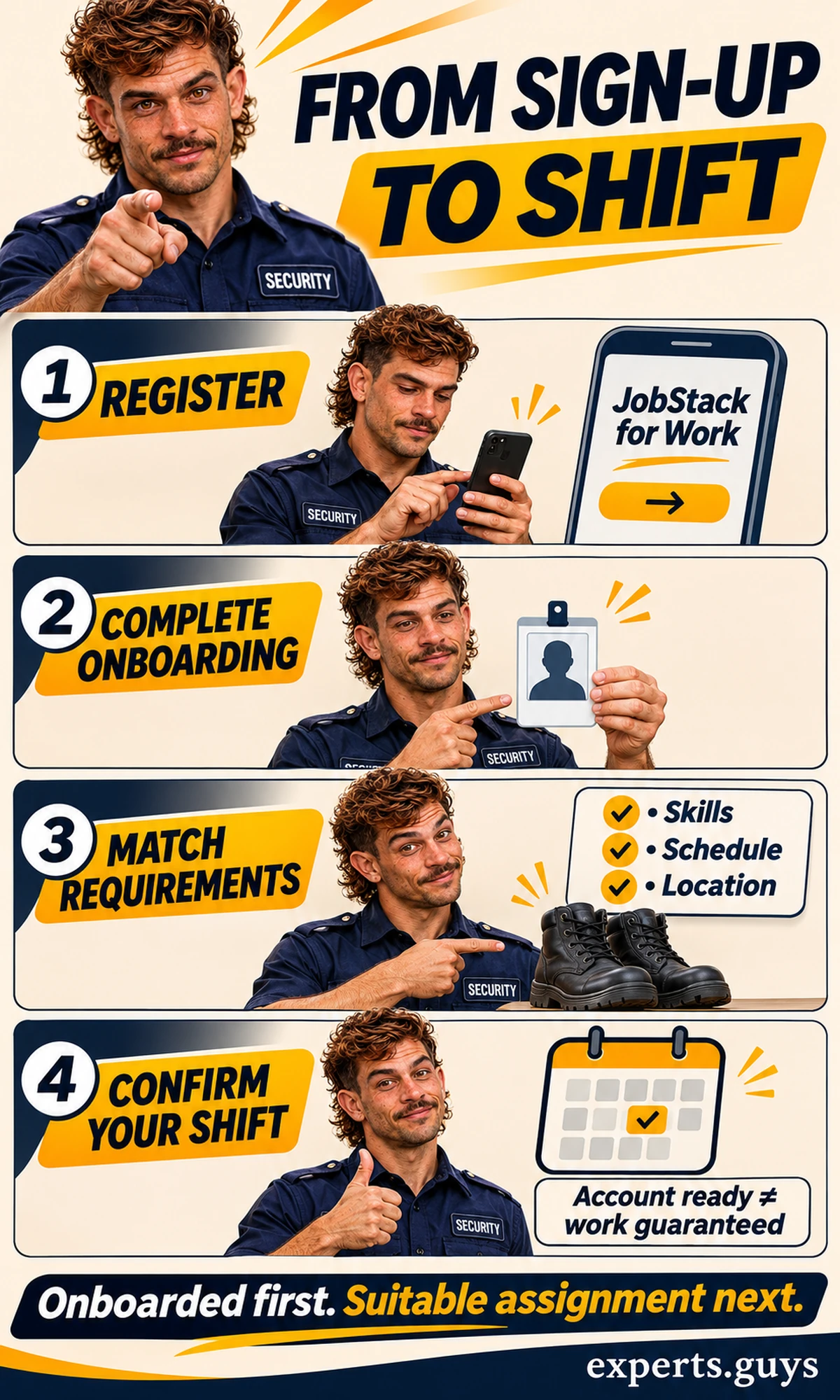
- Enter through the official worker route. Use PeopleReady’s navigation to reach the app or online listings.
- Finish the required onboarding. Resolve any outstanding eligibility step through the verified channel.
- Match the assignment requirements. Compare the actual duties, location and schedule with your circumstances.
- Establish your assignment status. Know whether you are still browsing or have committed to a shift.
The completion point is a clear answer about your readiness and one assignment’s status, not simply a downloaded app. If you cannot use a smartphone, the company also provides an online application route and local-team assistance. You can ask the team how assignments and changes will be communicated without assuming that every app feature has an identical offline substitute.
Screen the task behind the job title
A broad label such as general labor, warehouse or event support does not tell you everything needed to judge the work. PeopleReady’s work-ticket guidance identifies requirements such as lifting, dress, protective equipment, contact details and additional job conditions. Read those details together; one familiar word in the title is not enough.
Before accepting, establish the actual tasks, the required physical demands and any prerequisite experience or screening. If a requirement is unclear, ask a question tied to the task: whether you will move stock by hand, use equipment, work outside or spend the shift in a particular position. Do not demonstrate ability by trying an unfamiliar hazardous task.
Compare the answer with what you can safely do and with the training you actually have. For example, an illustrative warehouse assignment involving sorting small packages is materially different from one requiring equipment operation. Prior experience in a warehouse does not, by itself, establish competence for every machine or responsibility at a new site.
If the description and your ability do not match, leave that assignment for another worker and ask about a suitable alternative. If the description changes after you arrive, pause the unfamiliar task and use the changed-duty procedure discussed later. The aim is a workable match, not a test of how much uncertainty you can tolerate.

The security uniform in the illustrations is a recurring visual theme. It does not identify a real PeopleReady employee, establish a security qualification or indicate that a security vacancy is available. Any regulated or specialist duty needs its own verified requirements; clothing and a generic job category cannot establish eligibility.
This assignment-level approach differs from comparing the staffing industry as a whole. If you need the broader distinction between temporary placement, direct hire and other recruitment arrangements, the guide to how staffing agencies work supplies that background. Here, the decision is whether you can complete the specific work being offered.
Practical takeaway: resolve an unclear prerequisite before committing. If the local team cannot yet identify the tasks, required equipment or start arrangements, you do not have enough information to treat the shift as a dependable plan.
How should you compare a shift’s earnings and payment timing?
Compare the paid hours, unavoidable costs and total time away from home, then separately confirm when wages should reach you. These are different decisions: a shift may offer worthwhile earnings but unsuitable cash timing, or rapid payment but too little work to justify the journey.
Compare the whole trip, not just the hourly rate
Begin with the stated rate and the paid hours you have been told to expect. Ask whether the advertised span includes an unpaid break and whether the stated duration is an estimate or a confirmed commitment. Do not multiply an hourly rate by all the hours between leaving home and returning, because those hours are not automatically paid work.
Next, subtract the unavoidable costs that differ between the assignments you are considering, such as a transit fare or parking. Include only costs relevant to your own comparison. A meal you would buy either way and a new expense caused specifically by the shift are different assumptions; mixing them can make a seemingly precise result misleading.
For a personal comparison, divide that remaining pre-tax amount by the total time the trip would occupy. Include your expected outward and return travel, known waiting and any unpaid interval. Call this a comparison of your time commitment, not an employment wage, a legal minimum-wage calculation or an estimate of take-home pay.
| Assumption | Shift A | Shift B |
|---|---|---|
| Hourly rate and paid time | $19 × 8 hours | $21 × 5 hours |
| Gross earnings | $152 | $105 |
| Travel expense in this example | $8 | $20 |
| Gross less that expense | $144 | $85 |
| Total time away | 9.5 hours | 7 hours |
| Pre-tax amount per hour away | $144 ÷ 9.5 ≈ $15.16 | $85 ÷ 7 ≈ $12.14 |
In this hypothetical example, Shift A has the lower posted hourly rate but leaves more pre-tax cash after the stated travel expense and more value per hour away. The figures do not quote PeopleReady rates or predict what any worker will receive. They illustrate why a shorter shift farther away can lose its apparent advantage.

There is still a legitimate reason to choose Shift B: it may fit around an obligation that makes the longer assignment impossible. The comparison makes that trade-off visible; it does not dictate the answer. A worker with free transport, a different route or a firm time limit could reach a different decision using the same reasoning.
The common error is to compare eight paid hours with five hours on site while overlooking the break or trip. Correct it by using the same definitions for both choices. If the duration is uncertain, ask how early release is handled and whether any minimum-hours commitment applies; do not invent a guaranteed floor from the scheduled end time.
An easier version is to compare only three facts aloud: expected gross pay, the extra cost of getting there, and whether the return journey works. You do not need a worksheet or an app-based score. When one missing assumption could reverse the choice, resolve that assumption rather than calculating more decimal places.
Separate the pay schedule from bank availability
Do not budget on guaranteed same-day wages. PeopleReady’s current public pages describe both weekly assignments and assignments eligible for payment within 24–48 hours, but differ over which schedule applies to most jobs. That inconsistency makes the specific assignment’s stated schedule and confirmation from the local team more useful than a general claim about “daily pay.”
The official payment-timing guidance also distinguishes payroll from direct-deposit processing. It describes 24–48-hour timing for eligible next-day-pay assignments, a designated day for weekly pay, possible weekend effects and up to two or three business days for direct-deposit processing. These are not a universal promise that money will be spendable at a particular hour.
- Ask which schedule applies to this assignment. Establish whether it is weekly or eligible for the faster payment route.
- Confirm the payment method. Ask how the method you selected affects availability after processing.
- Check the relevant dates. Ask how a weekend or bank-processing interval affects your particular shift.
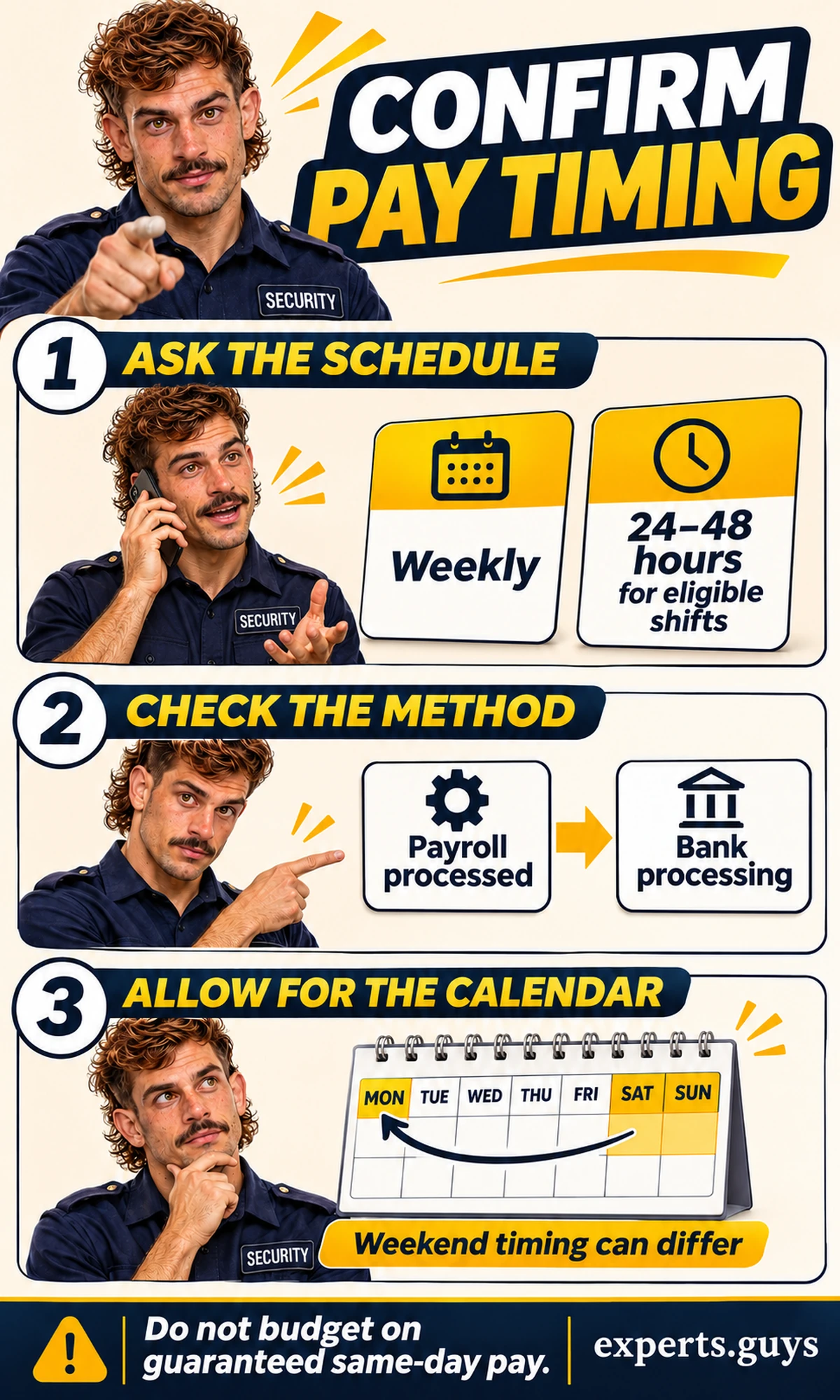
For example, someone choosing a Friday shift to cover an essential Saturday expense should resolve that timing before accepting. A label such as next-day pay does not settle weekend processing or bank availability. If the timing remains uncertain, plan the expense around money already available rather than spending against an unverified arrival date.
Also separate a payroll question from an hours question. A payment that has not yet reached the bank may involve processing; a payment based on the wrong approved hours involves a different correction. Check the information that is actually available before choosing the question to raise, and direct pay concerns to PeopleReady rather than expecting the customer to change payroll.
The general local-agency selection process belongs in the local employment agency comparison guide. Use that when you need another source of assignments. For this decision, the useful outcome is narrower: you understand the assumptions behind the shift’s value and its expected payment route.
What should you prepare before travelling to the first assignment?
Prepare the equipment and clothing the assignment actually requires, then establish the worker entrance, reporting contact and return journey. A correct street address is not enough if you arrive without required equipment or at a customer entrance that does not admit workers.
Check required equipment before departure
Read the ticket’s protective-equipment and dress requirements before assembling what you need. Different jobs can have different demands, and a uniform, ordinary shoes or a high-visibility item does not automatically satisfy them. Follow the specified requirement rather than copying the clothing in an illustration.
Place the required items together and check that you have the correct type, that they are usable and that any unfamiliar equipment can be supplied and explained through the proper process. This is an inventory of readiness, not a tutorial in fitting specialist protective equipment. Do not improvise a substitute for an item you have been told is necessary.
If something is missing, resolve where and when it will be supplied before making the trip. PeopleReady’s protective-equipment pickup guidance says pickup is usually through the local branch, with some site arrangements, and asks for at least 48 hours when equipment must be ordered. A last-minute shift may therefore be impractical if its required equipment is not already available.
- Match the ticket. Identify the required clothing and protective equipment for that assignment.
- Check the actual items. Confirm they are available, suitable and usable; flag uncertainty rather than guessing.
- Resolve any missing item. Establish the approved supply and pickup arrangements with the local team.
- Leave only when the requirement is met. An unresolved equipment gap means the assignment is not ready for you.

Imagine an illustrative assignment starting early in the morning while required footwear is still unavailable. Travelling first and hoping somebody has a spare pair transfers the unresolved problem to the site. The better adjustment is to establish an approved supply arrangement beforehand or ask for a different suitable assignment.
A useful accessible alternative is to ask the team to confirm the requirement verbally while you check the items you have. If the specification is unfamiliar, seek a clear explanation of the exact requirement. Completion means the required items are ready and the supply arrangement is settled, rather than simply having packed a bag.
Rehearse the arrival and return journey
Find the worker entrance and reporting location, not only the business’s main address. A warehouse, hotel or event venue can have several entrances with different access arrangements. Ask which entrance temporary associates should use, whom to report to and whether any approved parking or access instructions apply.
Work backward from the required reporting time using your actual transport options. Allow for the walk from the stop or parking place to the entrance and any stated check-in process. Any personal travel margin is a planning choice; do not confuse it with an instruction to perform unpaid work before the shift.
Then check how you will get home after the expected finish. A route available in the morning may not run late at night, and a ride from another person is not dependable until that person has agreed. A slightly better hourly rate can be a poor choice when the return trip is uncertain or unusually costly.
- Locate the worker entrance. Resolve gates, parking and the walk from your arrival point.
- Confirm whom to meet. Have the assignment contact details available through the agreed communication route.
- Check both journeys. Make sure the outward and return services fit the expected times.
- Report a problem promptly. Notify the PeopleReady team as soon as you know you may be late or unable to attend.
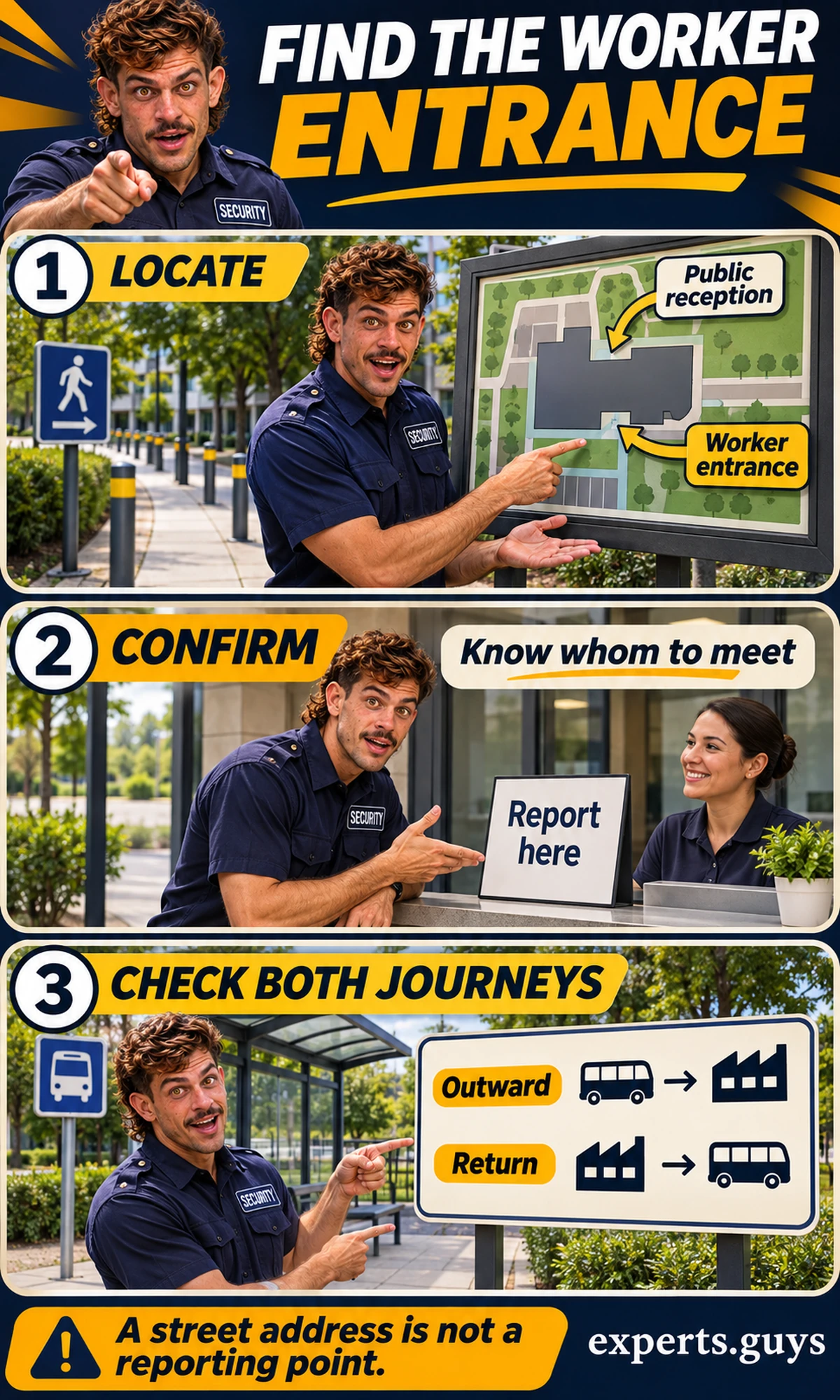
A common mistake is treating a map’s arrival time as the moment you are ready for work. The route may end at the street or public reception, leaving an additional walk and reporting process. Correct that gap by identifying the actual access point; the completion checkpoint is knowing where to arrive, whom to meet and how to leave afterward.
If you cannot confidently navigate the site information, ask the local team to explain the approach in plain language before departure. If you have already arrived at a locked gate or the wrong entrance, remain in a safe public area and use the confirmed contact route. Do not follow vehicles through a controlled entrance or enter a restricted area to save time.
For broader work-type comparisons, the verified guide to employment agencies by industry may help you identify a better-fitting recruitment category. It cannot resolve one site’s gate, equipment or reporting instructions; those need assignment-specific answers.
What should you do if the duties, hours or job message are wrong?
Identify which part is wrong before acting: the task at the site, the hours or pay information, or the authenticity of the contact. These problems have different remedies. A repeated login attempt cannot fix an hours discrepancy, and a friendly message cannot make an unfamiliar payment demand legitimate.
Pause a task that differs from the assignment
When someone asks you to do work outside the description, explain the mismatch before beginning the unfamiliar task. For example: “My assignment describes sorting; this requires equipment operation. I need that clarified before starting.” State the relevant difference rather than debating whether the request is a small favor.
Move to a safe position away from the task if necessary, tell the site supervisor what is unclear and notify the local PeopleReady team immediately. The company’s changed-duty guidance specifically directs associates to notify the team, particularly when safety is involved. A reassignment needs clarification, not an assumption that acceptance of one shift covers any work at that site.
The earlier task-screening illustration shows the same stop-and-clarify boundary at stationary equipment. It does not teach machine operation. The result you want is a clarified, appropriate assignment with the necessary training and equipment, or an instruction about a suitable alternative; finishing an unagreed hazardous task is not the completion goal.
Separate an hours discrepancy from a payment delay
When hours are available to review, compare the stated work period, applicable unpaid breaks and rate with the assignment you actually worked. Do not approve a figure you believe is wrong just to clear a notification. Equally, do not assume every difference is missing wages until you have identified whether you are comparing scheduled hours, recorded hours or money already processed.
Here is an illustrative arithmetic check. Attendance from 08:00 to 16:30 is an eight-and-a-half-hour span. If, for that example, a 30-minute break is unpaid under the applicable arrangement, the resulting paid time is eight hours. At an illustrative $19 hourly rate, that gives $152 gross before taxes and other applicable payroll items; it does not predict the bank deposit.
If the record instead shows seven paid hours, you have a specific one-hour discrepancy to explain. Use the shift date, site, relevant times and the difference you see when you contact PeopleReady. The objective is not to make a diary; it is to give the payroll or assignment team enough existing information to investigate the correct shift.
- Identify the shift. Confirm that the date and assignment match the work you are checking.
- Compare the time basis. Distinguish the attendance span from paid time and applicable unpaid breaks.
- Check the rate and status. Separate a wrong calculation from a payment still being processed.
- Raise the specific mismatch. Ask PeopleReady to investigate the detail you cannot reconcile.

The common mistake is comparing gross earnings directly with the net amount received and calling the difference an hours shortage. Correct it by checking hours, rate and payroll deductions separately. An easier first step is to ask the team to explain the hours and rate used for that shift aloud, then identify the one item that does not match.
Do not share identity documents or bank details with a customer contact to resolve the discrepancy. Payroll questions belong with the verified employer channel. If the expected processing period has passed, ask what stage the payment has reached and what needs correcting, rather than accepting another broad promise of immediate payment.
Verify a suspicious offer independently
A real staffing company can be impersonated. If someone asks you to send money to apply, get hired or receive wages, stop the transaction. PeopleReady’s payment-scam guidance says neither the company nor its customers will ask for those payments.
Close the message and reach the company through its official website or a contact you established independently. Describe the claimed assignment and the request, without sending the requested payment or sensitive documents. A displayed sender name, logo or familiar job title is not sufficient confirmation of the person behind a message.
For a contact asking for sensitive information, verify the route before supplying it. PeopleReady’s official-communications guidance distinguishes its verified channels from unsecured requests. Do not use a phone number or verification link supplied only inside the suspicious message as your independent check.
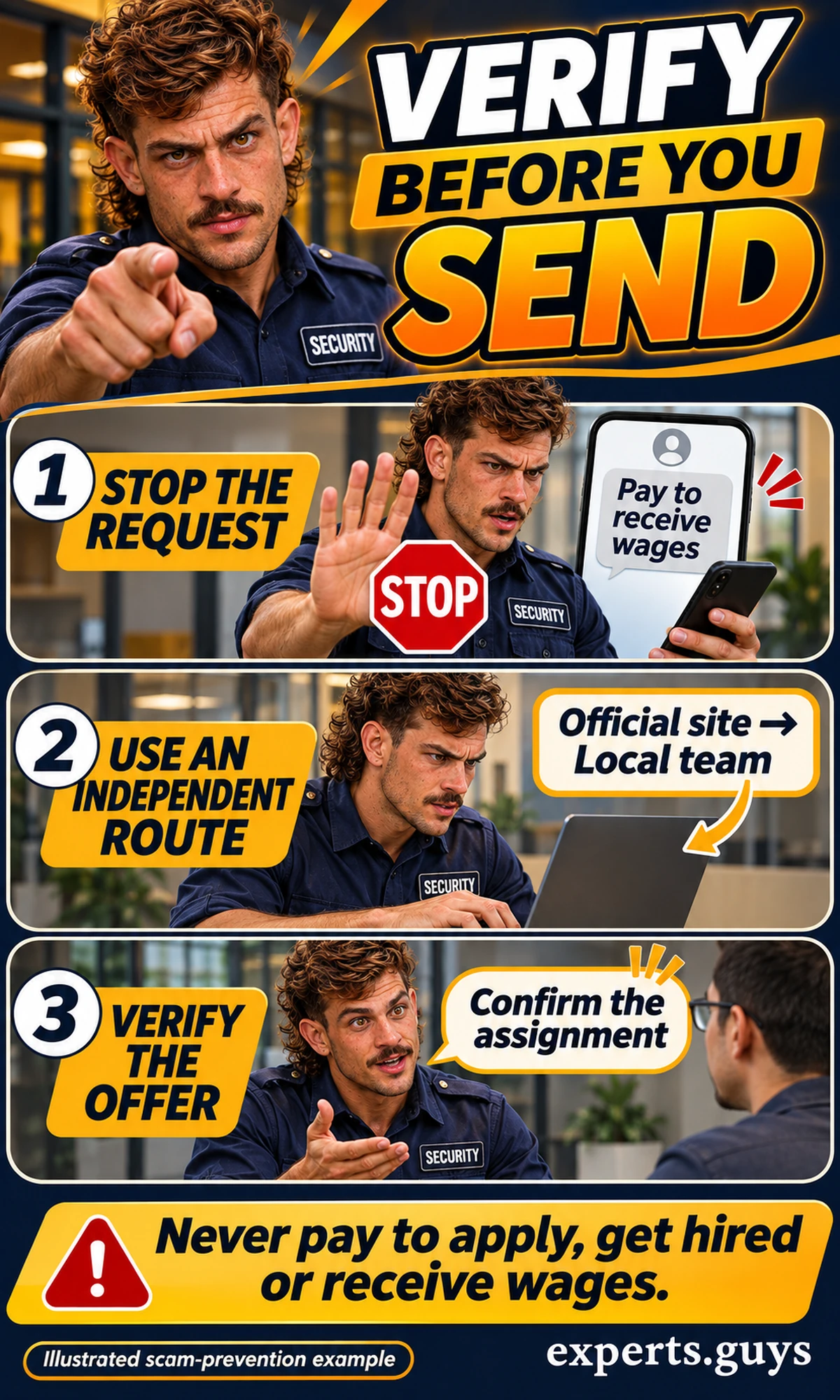
If the offer checks out, return to the legitimate application or assignment route; do not continue through an unexplained payment channel. If the contact cannot be verified, do not proceed. This is a different decision from whether the shift pays enough: first establish that the offer is authentic, then assess its terms.
Once a problem is resolved, return to the specific assignment details rather than relying on a general reassurance about the company. A corrected rate does not settle an equipment gap, and an authentic offer does not establish a workable journey. Recheck only the conditions affected by the correction; there is no need to repeat the entire application process.
Questions that remain before you commit
Does PeopleReady require a resume?
The official getting-started guidance says a resume is not required for becoming an associate and identifies employment-verification documentation as part of entry. That does not remove an assignment’s experience, training or other prerequisites. Use the requirements for the specific role rather than interpreting a simple application route as proof that every vacancy is entry-level.
Does a simple application mean there are no background checks?
No. A short application or no-resume entry route does not establish that screening is absent. Ask the local team which checks apply to the particular assignment and how they are completed. This guide does not establish a universal background-check policy, automatic eligibility after a conviction or a promise that any applicant will be accepted.
Can a temporary assignment become a permanent job?
Some assignments can lead to direct employment, depending on the customer’s needs and the worker’s performance. Possibility is not an offer. If a long-term role matters to you, ask whether conversion is genuinely part of that assignment and what would need to happen before a direct offer is made; do not budget around a conversion that has not been offered.
Are benefits automatically included in every shift?
PeopleReady describes an Associate Benefit Program that newly hired associates can enroll in. Enrollment eligibility is different from automatic coverage, free coverage or identical terms for every worker. Check the current plan information, costs, deadlines and effective dates before treating a benefit as part of the assignment’s value.
Can I review the company without having worked there?
You can compare verified application routes, assignment conditions and stated policies without claiming first-hand experience. A personal employee review, a star-rating verdict or a claim about a branch’s behavior requires evidence this guide does not have. Judge the particular offer on verified facts rather than treating an illustrative example as a reported worker experience.
Your next step
Choose one assignment you can realistically complete and resolve the missing detail most likely to make it fail: an unclear duty, unavailable protective equipment, an unreliable journey or a payment schedule that does not meet your needs. Accept only once the essential conditions are clear; if they cannot be established, keep looking for a suitable assignment rather than treating registration as a reason to take the wrong one.