Dysthymia is the older term commonly used for persistent depressive disorder (PDD), a form of depression involving a long-lasting low mood and other symptoms that affect daily life. Adults can still meet responsibilities while struggling, so the useful next step is to describe the burden and discuss a workable care plan rather than dismiss it as personality. This overview explains the condition and seven practical ways to make that conversation more useful.
What does persistent depressive disorder mean in everyday life?
In adults, the duration criterion includes depressed mood for much of the day, more days than not, over at least two years. Other symptoms can include low energy, low self-esteem, changes in sleep or appetite, difficulty concentrating, and hopelessness. Duration alone does not establish the diagnosis, and the two-year wording is never a reason to postpone asking for help.
The condition is not defined by whether someone looks sad or misses work. A person may feel emotionally flat, find ordinary decisions unusually difficult, or lose the capacity for relationships after completing essential duties. These experiences deserve assessment, but none is specific enough to diagnose PDD by itself.
PDD and major depressive episodes can overlap, so persistent depression should not automatically be described as mild. An assessment also considers mood history, physical illness, medicines and other possible explanations. Periods of unusually high or irritable mood with increased energy and little need for sleep are especially important to mention because they can change the assessment.
There is no single known cause that explains every case, and a brain-scan illustration cannot tell a reader why they feel this way. Biological, psychological and social factors can interact, while ongoing difficulties may also make daily life harder to manage. The MedlinePlus overview of persistent depressive disorder provides background on symptoms, assessment and care.
Method 1: Describe a difficulty without making it your identity
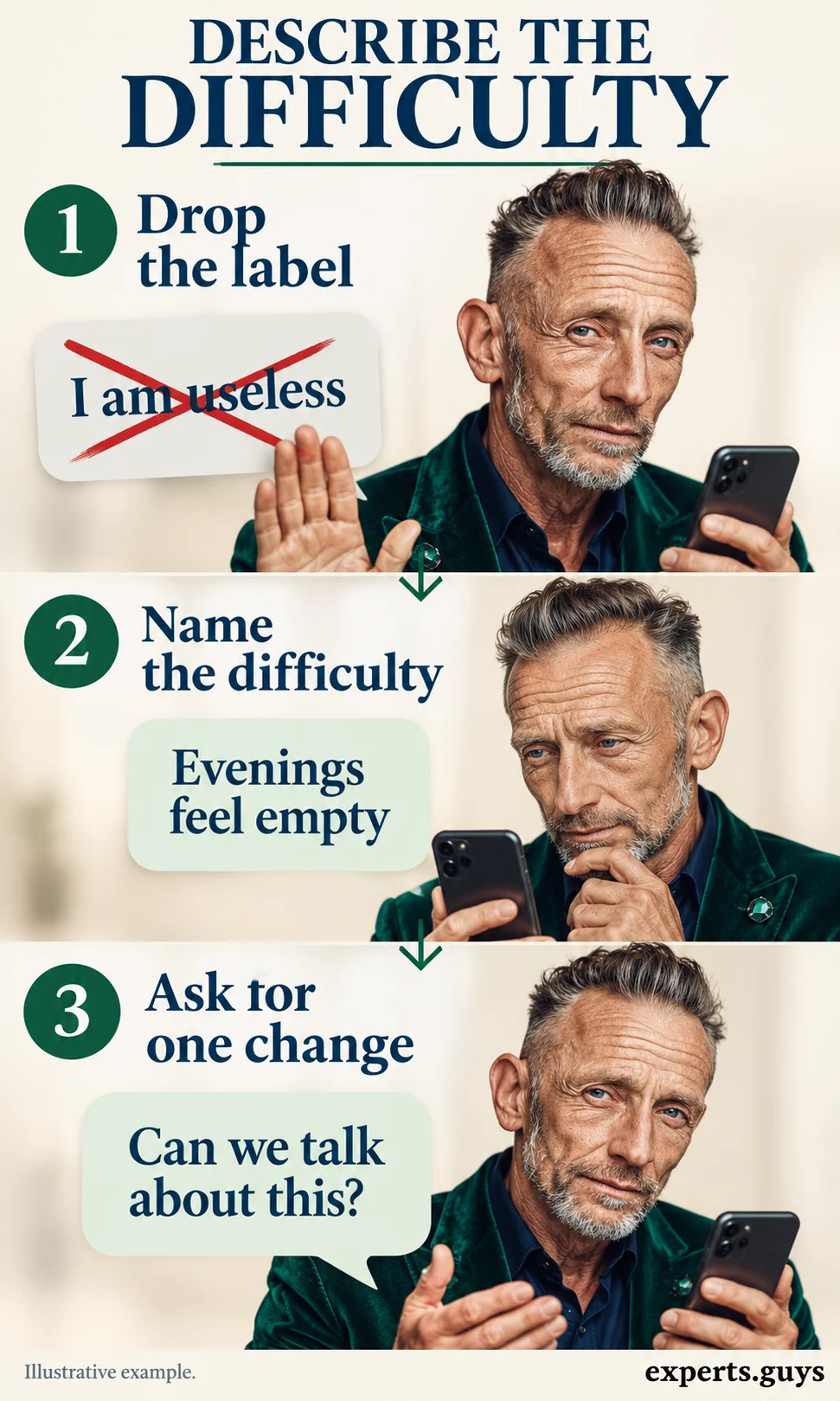
If “I am just a negative person” ends the conversation, replace that global label with one concrete difficulty. This is a communication exercise, not a claim that changing a sentence treats depression. Its purpose is to make the next question answerable: what is difficult, and what kind of help would make that difficulty easier to discuss?
- Open a private phone note, use device dictation if comfortable with its privacy settings, or simply say the sentence aloud.
- Replace the character judgment with a specific experience: “Evenings feel empty, and I keep turning down company.”
- Add one request: “Could we talk about what is making this difficult?”
Illustrative example: “I am useless” becomes “I am struggling to start dinner, and I want help understanding why.” Avoid forcing a cheerful replacement such as “Everything is fine,” which hides the concern. If words are hard to find, use only “This has become difficult”; completion means you have a usable starting sentence, not that your mood has changed.
A familiar difficulty can still be changeable, but improvement does not require proving that every part of your personality was caused by depression. Keep the discussion focused on distress, choices and daily function. For the separate task of explaining symptom duration and better stretches, use how to log the gaps in a two-year low mood before a depression visit.
How can you make the impact visible without another mood diary?
Method 2: Choose a life goal before choosing a progress measure
Choose one part of life you would like care to make more manageable. A goal such as “take part in a short family meal” gives a conversation more direction than “be a better person,” because both you and the clinician can explore what currently gets in the way. It remains a discussion goal, not a test of effort or a deadline for recovery.
- Choose one personally meaningful area, such as connection, self-care or access to care.
- Describe what participation would look like in ordinary language, without setting a mood target.
- Ask whether the goal fits the current care plan and how you will revisit it.
Worked example: “I want to join a family meal without feeling I must host or entertain.” If that feels too demanding, the first version could be joining briefly while someone else handles the food. The common mistake is choosing a goal to satisfy somebody else; revise it if it adds pressure without representing something you value.
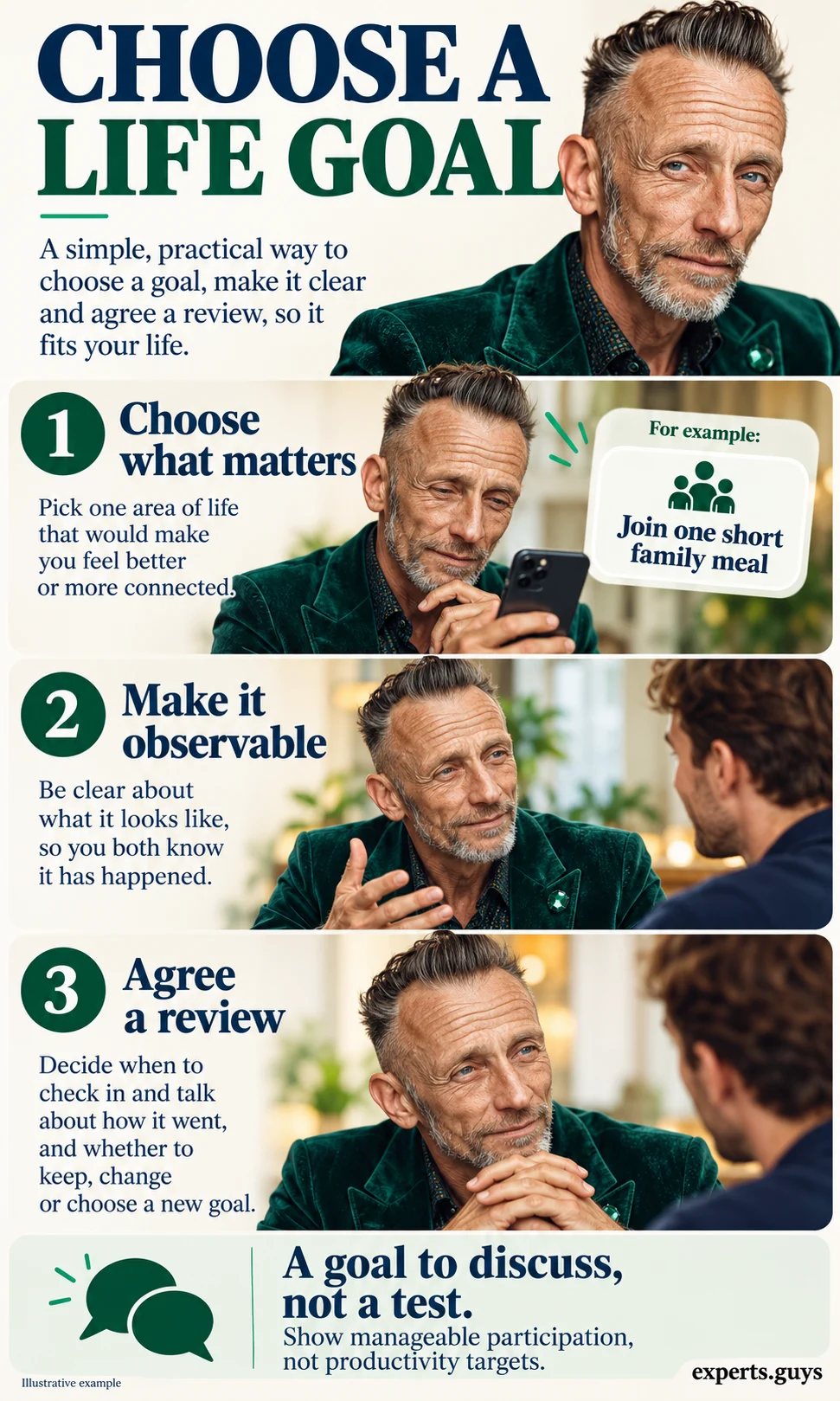
At review, the useful question is whether the chosen activity is becoming more possible, less costly, or better supported. A goal may need to shrink or change when symptoms, disability or circumstances make the original version unrealistic. Shared decision-making guidance supports bringing personal priorities into care choices; the exact examples here are editorial adaptations, not validated PDD exercises.
| Vague goal | More useful discussion goal | What the change clarifies |
|---|---|---|
| “Get my old self back” | “I want ordinary time with my family to feel possible again.” | Which part of life matters most. |
| “Do more every day” | “I want to complete essentials without losing the whole evening to exhaustion.” | Whether effort and recovery need attention. |
| “Find the best treatment” | “I want to understand the options that fit my symptoms and circumstances.” | What a useful treatment discussion must resolve. |
Method 3: Explain the cost of functioning
Describe one activity together with its cost when “I still work” makes the burden hard to see. This is a short explanation for a care conversation, not a new productivity audit. One example is enough; collecting a long list can become an extra demand without improving the decision.
- Name one ordinary activity you completed.
- Describe what it required or displaced, using an observation rather than an invented rating.
- Ask for discussion of the load, symptoms or support need revealed by that example.
Illustrative example: “I finished my shift, but I had no capacity left to speak to anyone that evening.” Avoid presenting this as proof of depression, since poor sleep, illness and other pressures can create similar difficulties. If remembering details is tiring, use the most recent clear example and say what is uncertain; success is a clearer account, not an argument that you are ill enough.
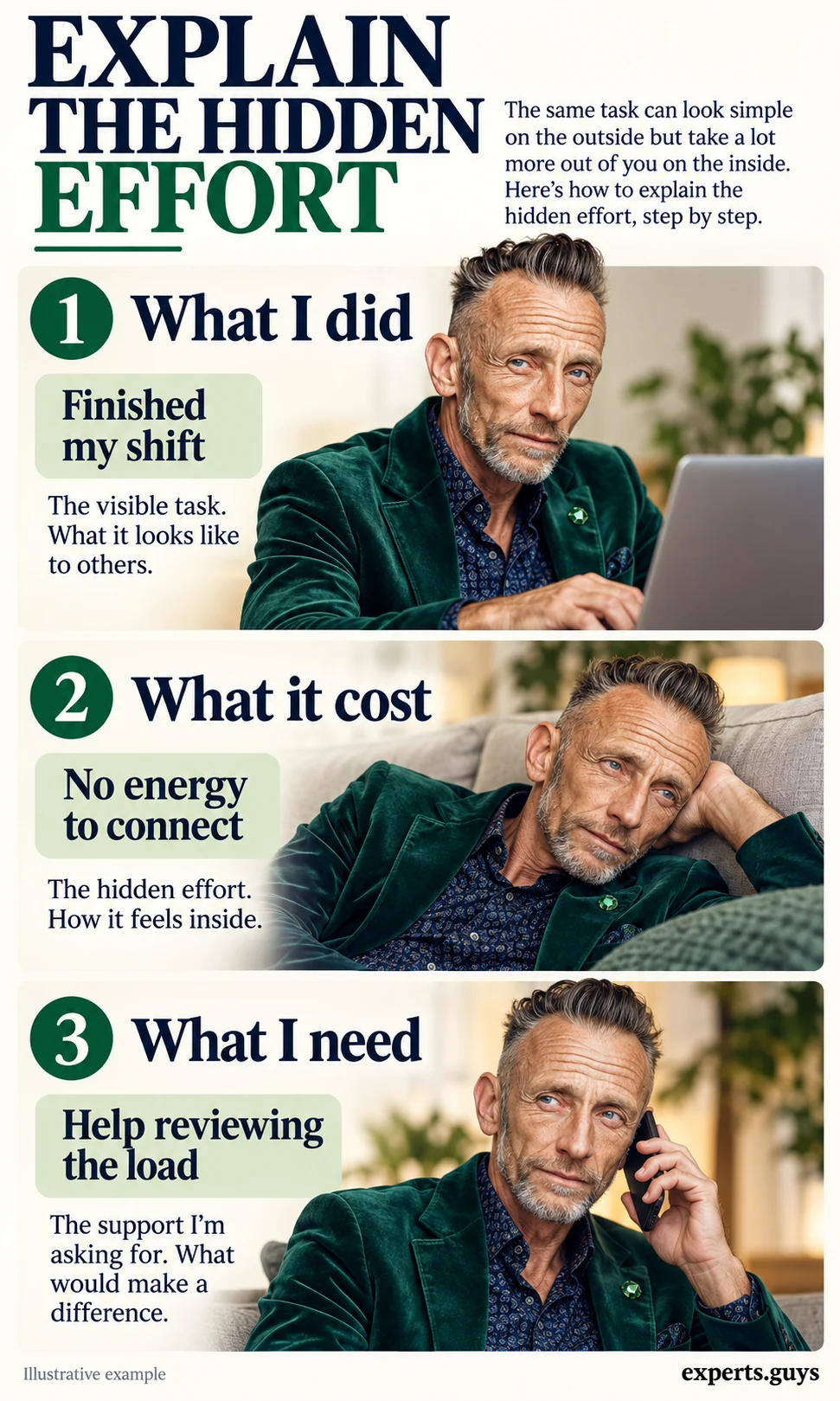
Once the hidden cost is clear, the next step is to explore it rather than assume a cause. Your clinician may ask about sleep, symptoms, health conditions or demands outside work, and the answer may involve more than one factor. The wider workplace pattern belongs in when productivity hides depression; here, one example serves the care discussion.
What makes a care plan usable over time?
A usable plan explains what is being addressed, what options fit, and how decisions will be revisited. Treatment may involve psychotherapy, medication or both, depending on assessment and preference. Evidence for chronic depressive symptoms has limits, including uncertainty about which combinations work best for particular people; the NICE discussion of chronic depressive symptoms describes these limits.
- Target: What problem are we trying to change?
- Fit: Does this option suit my health, preferences and practical circumstances?
- Review: What should I report, and when will we revisit the decision?
Method 4: Turn a vague treatment discussion into a usable question
Before a visit, choose the one uncertainty that would most affect your understanding of the plan. You do not need to research every therapy or decide which medicine to request. Bringing a focused question makes space for an explanation that relates the treatment to your own priorities.
- Name your priority from Method 2, or say which daily difficulty matters most.
- Ask, “How is this option intended to help with that difficulty, and what are the main downsides or alternatives?”
- Before finishing, ask when the plan will be reviewed and which changes should prompt earlier contact.
Worked example: “We are discussing therapy, but I do not understand how the sessions connect to my difficulty engaging with people.” An easier version is to show that sentence on your phone. The common mistake is leaving with a treatment name but no shared purpose; completion means you can explain the next step in your own words, or know which question remains unanswered.
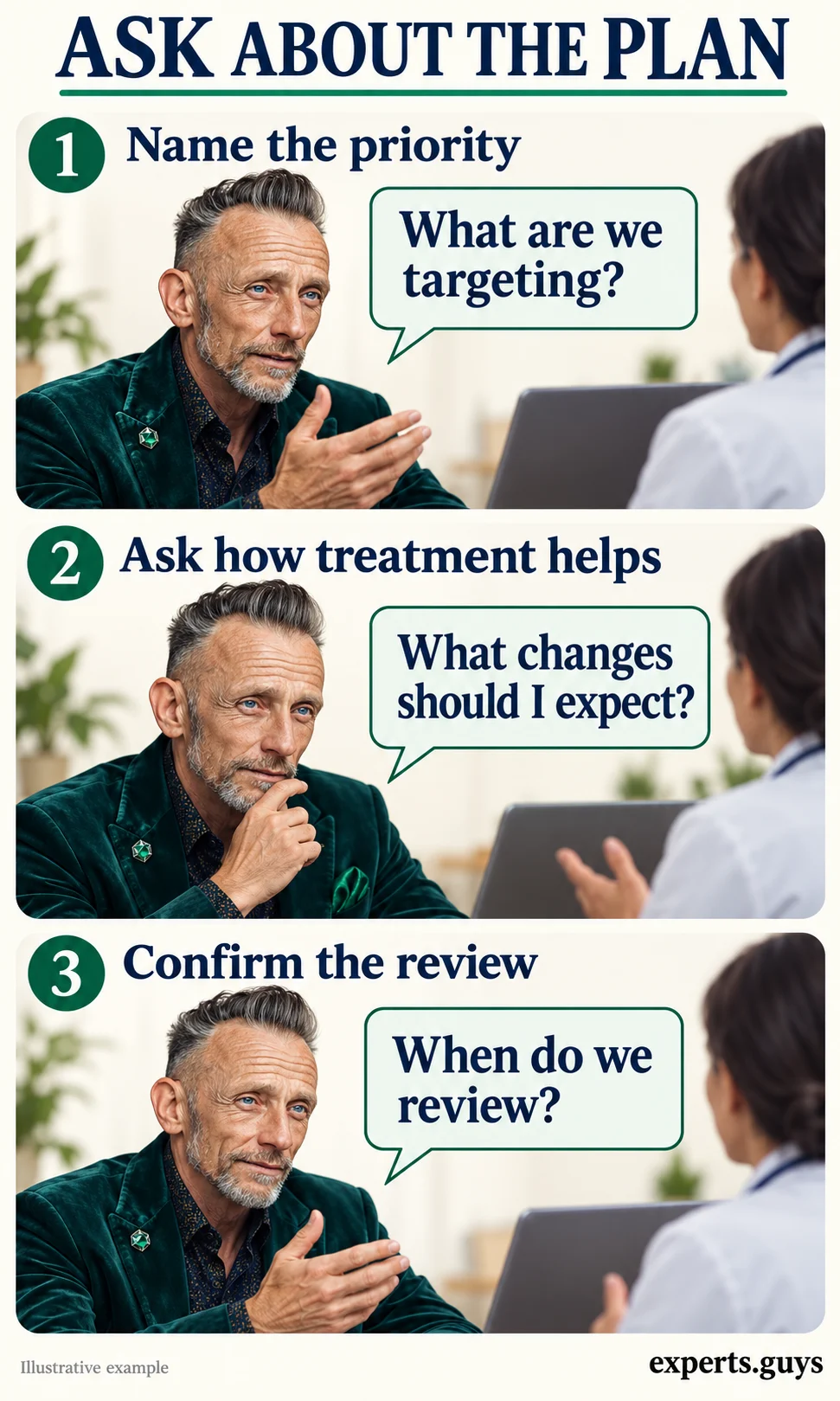
A medication decision needs an individual discussion of expected benefits, adverse effects and follow-up. Do not start, stop or change a dose because of this article or a studio result. The NIMH depression guide explains treatment choices, while psychotherapy for depression covers the separate question of what talk therapy involves.
Method 5: Remove one care-access barrier
A plan that cannot be attended is not yet workable, even when the clinical idea is reasonable. Identify the obstacle to the next step instead of treating a missed appointment as evidence that you do not care. Availability differs by service and country, so ask what can be changed rather than assume a particular accommodation exists.
- Choose the immediate barrier: travel, cost, timing, privacy, communication or booking difficulty.
- Contact the service through its official channel and ask about one relevant adjustment.
- Confirm the practical details of any offered option, including cost, time, access requirements and privacy.
Illustrative example: “Travel is difficult. Is a remote visit clinically suitable, and is a phone appointment possible if video is not?” Do not book a remote session you cannot attend privately; ask for another arrangement if needed. If contacting the service is the barrier, ask a trusted person to sit beside you while you make the request; completion is a confirmed next step or a clear answer about what remains unavailable.
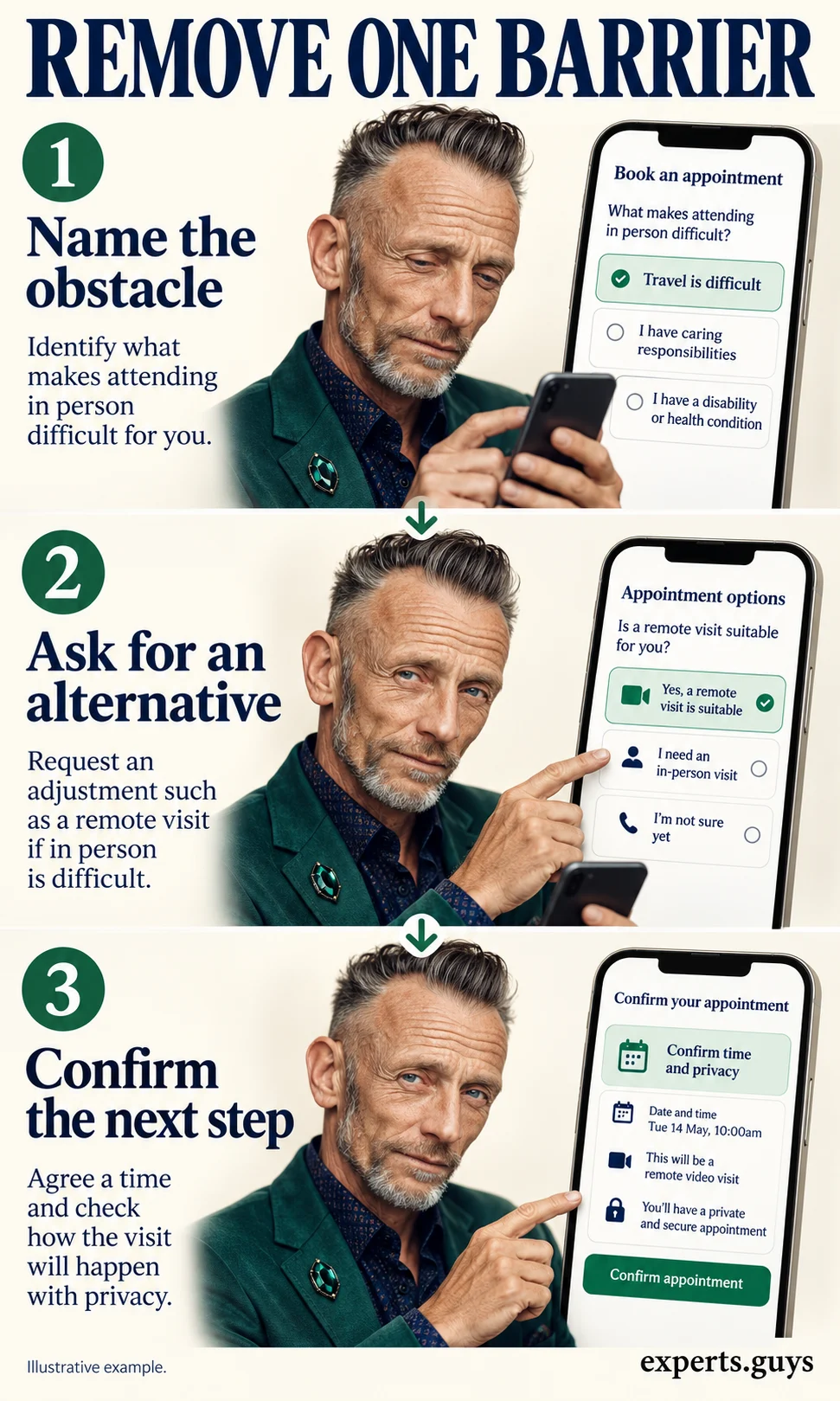
| Obstacle | Question worth asking | Check before agreeing |
|---|---|---|
| Cost | “Are there lower-cost or publicly funded routes?” | Eligibility, total costs and waiting time. |
| Transport or mobility | “Is a remote appointment suitable for this visit?” | Clinical fit, privacy and connection needs. |
| Communication | “Can we arrange an interpreter or another accessible format?” | How it will be arranged and whether any charge applies. |
| Booking overload | “What is the smallest next step to arrange this appointment?” | Who will do it and how confirmation will arrive. |
If an option is unavailable, ask which alternative route the service can actually offer. Do not spend weeks repeatedly trying the same blocked route while symptoms worsen. Care barriers are a recognised problem in the WHO overview of depression, and an access difficulty is not a personal failing.
Method 6: Ask for bounded support
Choose a person who feels safe and ask for one concrete action rather than asking them to manage your whole recovery. A specific request makes it easier for both people to understand the role and its limits. Practical support can help you take a step, but it does not replace treatment or make a friend responsible for your safety in an emergency.
- Choose the task you want help with and a person you trust.
- Send or say a short request that names the task and a manageable time.
- Allow a different time or a decline, then choose another route if the person cannot help.
Worked example: “Could you sit with me for ten minutes while I book the appointment? Another time is okay.” The ten minutes is an illustrative boundary, not a therapeutic dose. If a message is too much, ask “Can you stay while I make this call?”; avoid relying on someone who makes you feel unsafe, and assess completion by whether the practical task became easier to attempt.

Support also needs consent and privacy. You can choose whether a companion attends a whole visit, joins only for the discussion of next steps, or simply helps with getting there. The NIMH guide to talking with a health care provider explains preparation, questions and the possible role of a trusted companion.
How do you review uneven progress without judging yourself?
Method 7: Review mixed progress without calling it success or failure
Bring one improvement and one remaining difficulty to the planned review, if both are present. Different parts of life can change at different times, so a single better day or a completed task cannot settle whether care is working well enough. You also do not need to manufacture an improvement when none is apparent.
- Choose an example of what is easier, unchanged or harder since the last discussion.
- Keep daily function and how you feel separate: both deserve attention.
- Ask what the combination means for the plan, including barriers or adverse effects that need attention.
Illustrative example: “Starting meals is easier, but enjoyment is still low. What should we review?” If recall is uncertain, say so rather than assigning a precise percentage or score. The mistake is either dismissing the improvement or letting it erase the remaining difficulty; completion is an honest discussion that can guide the next decision, not a verdict of recovery.
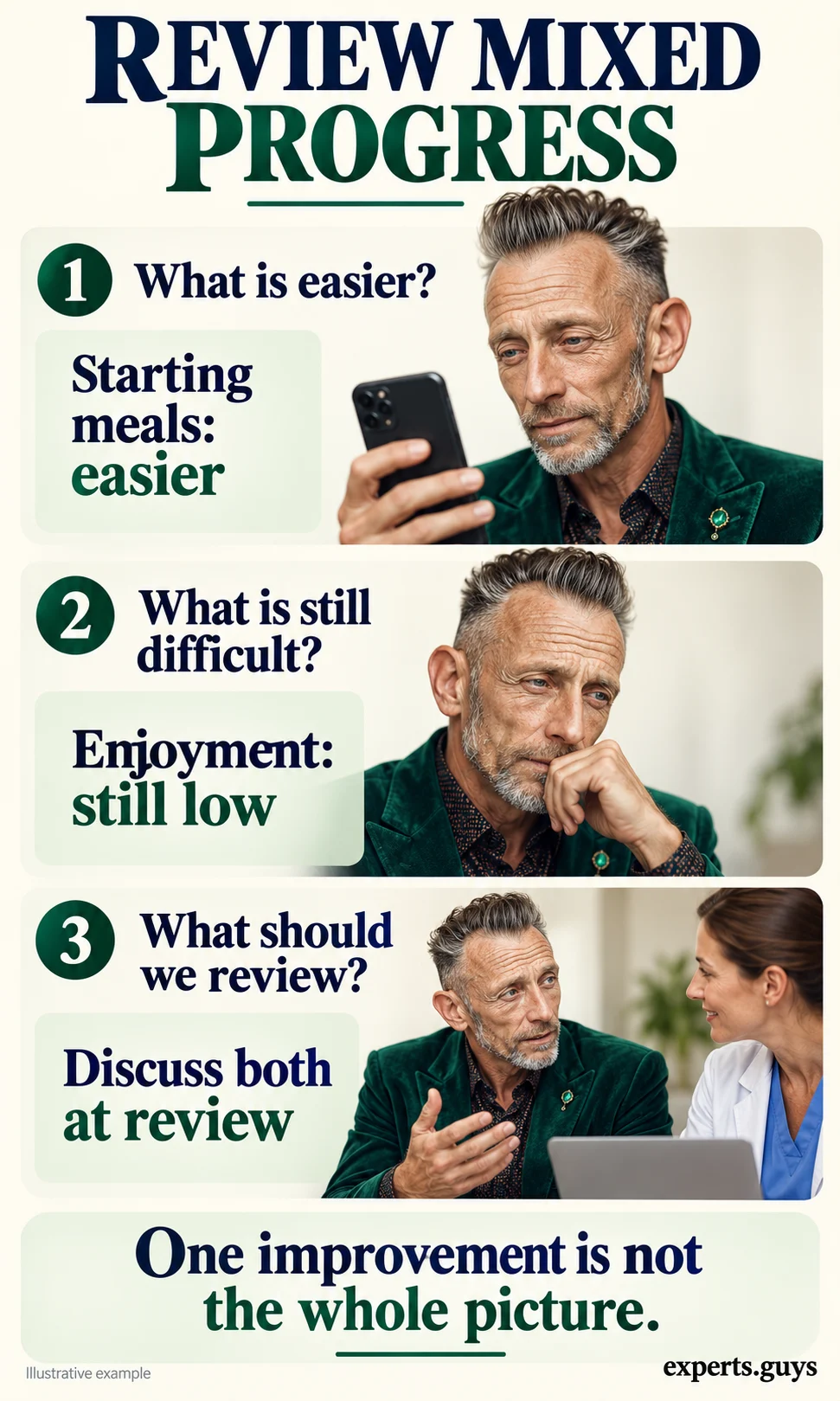
Use the follow-up timing agreed with your clinician, and ask for clarification if no review has been arranged. New suicidal thoughts, major deterioration or severe adverse effects need earlier help rather than waiting for that date. Longer-lasting symptoms do not mean improvement is impossible, but the course varies and no image, checklist or article can predict your recovery.
| What you notice | Useful question at review |
|---|---|
| Some activities are easier; mood remains low | “What has changed, and what still needs attention?” |
| No clear benefit; attendance was difficult | “Did the access barrier prevent a fair opportunity to try the plan?” |
| A new difficulty or possible adverse effect | “Could this be related, and how soon should it be assessed?” |
| You cannot judge the change | “What would be a useful, manageable way to assess this together?” |
These seven methods are communication and access supports, not a treatment programme for PDD. Their value is a clearer explanation, a more workable next step or a better question; there is no claim that the exact scripts have been clinically tested. You can choose just one method and stop there rather than turn the page into another set of obligations.
Prepare one conversation starter
Use the studio if choosing words is the main obstacle. Select a person, the concern you want to explain and a priority, then edit the suggested text before copying, downloading or opening the A4 card. You can make the same draft without the studio: “The difficult part is ___. What matters to me is ___. Could we discuss one helpful next step?”
Support Conversation Studio
Choose the point you want to explain. Make a short draft you can change before sharing.

For adults preparing a conversation. This is not a diagnosis, screening score, treatment recommendation, or emergency service.
If you may harm yourself, cannot stay safe, or cannot eat or drink, seek urgent local help now. Do not wait to complete this form.
Your conversation starter
These are suggested words, not conclusions about your health. Remove anything that does not fit. No information is sent by this studio or saved automatically; copied and downloaded text is stored wherever you put it.
The studio does not send your answers to a server or save them automatically. A copied message or downloaded file may be accessible to anyone who can access that device or account, so choose where to keep it. The A4 card is optional and can be saved as a PDF through your browser; no handwriting is required.
Frequently asked questions
Does enjoying something mean I cannot have PDD?
A pleasant moment does not, on its own, rule out a longer depressive pattern. Equally, one difficult period does not establish PDD. Assessment considers the wider history and other symptoms.
What if I cannot remember when the low mood began?
Say that the timing is uncertain rather than guessing. An approximate history can still begin a useful conversation. You do not need a complete diary before requesting an assessment.
Is persistent depressive disorder the same as high-functioning depression?
High-functioning depression is an informal phrase, not a separate diagnosis. It describes an outward appearance of coping that can occur in different situations. PDD requires a clinical assessment of a specific longer-term pattern.
Does this advice apply to teenagers?
This page and studio are designed for adult care conversations. Assessment in children and teenagers uses age-specific considerations, including a shorter duration criterion and the possible role of irritability. Arrange age-appropriate help rather than applying the adult overview as a self-test.
What if I disagree with the label in my records?
Ask which findings led to the diagnosis and what alternatives were considered. Explain what seems inconsistent with your experience and request clarification or another opinion if needed. Do not change treatment on your own while resolving the question.
Next steps
Choose the method that removes today’s main obstacle: describing the difficulty, making the care plan clearer or arranging practical support. Use the resulting sentence or action in a real conversation rather than collecting more entries. If you have not had an assessment and low mood is persistent, worsening or limiting your life, arrange one without waiting for a diagnostic time threshold.
Sources and further reading
- NICE: Shared decision making, rationale and impact — why personal goals, priorities and review discussions belong in care decisions.