
You finally make the decision, close the laptop, send the message or tell someone what you have decided. For a few minutes, there may even be relief. Then your mind turns around and begins inspecting the choice from the opposite direction. Maybe the alternative job would have been better. Maybe you should have waited before ending the relationship. Maybe the purchase was foolish. Maybe you said yes too quickly, said no for the wrong reason or overlooked something that should have been obvious.
That experience can be especially confusing during depression because the decision may already be finished while the evaluation continues for hours, days or much longer. Depression can affect concentration, confidence, motivation, expectations about the future and the ability to make decisions in the first place. Once a choice has been made, those same difficulties can influence how the decision is remembered and judged. The result can be a persistent feeling that something went wrong even when there is no important new evidence showing that it did.
Decision regret deserves to be taken seriously, because sometimes regret really does point toward information that should change what you do next. A decision may have been rushed, circumstances may have changed, another person may have provided information you did not previously have, or the consequences may reveal a risk that was impossible to see earlier. At other times, however, the mind is reviewing exactly the same evidence again and arriving at greater distress rather than greater clarity.
The difficult question is therefore not simply “Do I regret this decision?” A more useful question is “Has anything important changed since I made it?”
That distinction becomes particularly important for someone dealing with depression. Feeling uncertain after a decision is information about your emotional state, but the feeling itself does not automatically prove that the original decision was wrong.
Can Depression Make You Regret Decisions More?
Depression can make decision regret more difficult to interpret because several symptoms can affect the process surrounding a choice. The National Institute of Mental Health describes difficulty concentrating, remembering or making decisions as a common symptom of depression. Someone may therefore enter a decision with less cognitive energy than usual, struggle to compare options, feel unusually pessimistic about likely outcomes or have less confidence in their own judgement once the choice has been made.
That does not mean depression creates every episode of regret. People without depression regret decisions, and a person with depression can make a genuinely poor choice that deserves reconsideration. The clinically safer interpretation is that depression may alter some of the conditions under which decisions are made and reviewed. It can make uncertainty harder to tolerate, intensify self-critical interpretations and increase the amount of attention given to negative possibilities.
Consider a person choosing between two jobs. They compare salary, commute, workload, management style and long-term opportunity, then accept one position for reasonable reasons. Several days later, their mood drops and the disadvantages of the chosen job become easier to imagine. The rejected job begins to look cleaner and more promising because its inconveniences were never experienced. Nothing about the actual offers has changed, yet the emotional certainty attached to the decision has collapsed.
This is one reason decision regret can feel so convincing. The mind is not necessarily producing an obviously irrational thought. It may be using real facts, real disadvantages and real uncertainty, then repeatedly returning to those facts until the emotional weight of the evidence becomes very different from the evidence itself.
The Choice Can End While the Evaluation Keeps Going
A completed decision does not automatically stop cognitive processing. People naturally reflect after important choices, especially when the outcome remains uncertain. Useful reflection may identify something overlooked, reveal a lesson for future decisions or lead to a practical correction. The problem begins when repeated review stops producing meaningful new information.
Research on rumination helps explain why this can happen. Rumination generally involves repetitive negative thinking that is difficult to disengage from, and it has been studied extensively in relation to depression. A particularly relevant experimental study on abstract rumination and post-decisional regret found that participants instructed to think about a regretted decision in a more abstract way reported greater regret than participants encouraged to process the decision more concretely. The studies were relatively small, so they should not be treated as proof that one thinking style explains every person’s regret, but they illustrate an important possibility: the manner in which a decision is repeatedly processed may affect how regret feels afterward.
Abstract regret often circles questions that cannot be fully answered.
“Why am I always like this?”
“What does this decision say about me?”
“Why didn’t I know better?”
“What would my entire life look like if I had chosen differently?”
Those questions can expand indefinitely because there is rarely a final piece of evidence capable of resolving them. Concrete reflection is narrower. What information did I have at the time? What happened afterward? Is there something I can change now? What should I remember the next time I face a similar choice?
The distinction is important because two people can spend the same twenty minutes thinking about a decision while doing very different psychological work. One may finish with a clearer next step. The other may finish with the same evidence, lower confidence and another reason to begin the review again.
Decision Regret Is Different From Decision Paralysis
Decision regret and decision paralysis belong to the same broader decision-making territory, but they occur at different stages. With depression and decision paralysis, the person may struggle to commit before the choice is made. Options remain open, comparisons multiply and the cost of choosing can begin to feel larger than the cost of remaining undecided.
Decision regret begins after commitment. The restaurant has been chosen, the email has been sent, the offer has been accepted or rejected, or the relationship decision has been communicated. The central difficulty becomes whether the completed choice can be trusted.
Someone can experience both patterns. A person may spend three days unable to choose, finally make the decision and then spend another three days wishing they had selected the alternative. That sequence can make ordinary choices disproportionately exhausting because the mental workload occurs on both sides of the decision.
Understanding the broader pattern of depression and decision-making can help when the difficulty is not limited to regret. Some people notice slower comparison, reduced confidence, difficulty prioritizing, trouble holding multiple pieces of information in mind or an unusually strong need for certainty before acting. Decision regret is one part of that larger system, but it deserves separate attention because the intervention point changes once the choice has already been made.
| Pattern | When It Happens | Dominant Question | What Usually Needs Attention |
|---|---|---|---|
| Decision difficulty | While evaluating options | “How do I know which choice is better?” | Priorities, available information, cognitive load and acceptable uncertainty |
| Decision paralysis | Before commitment | “What if I choose the wrong one?” | Fear of commitment, excessive comparison and the demand for certainty |
| Decision regret | After commitment | “What if the option I rejected was better?” | New evidence, repeated checking, counterfactual thinking and self-criticism |
| Useful reconsideration | After meaningful circumstances change | “Does this new information change what I should do?” | Updated risks, benefits, values, consequences and reversibility |
Why Regret Can Feel Like Proof That the Decision Was Wrong
One of the most persuasive features of regret is how easily emotional intensity can be mistaken for evidence. If the regret is strong enough, a person may reason that there must be a good reason for feeling it. The mind then begins searching backward through the decision for something capable of explaining the discomfort.
That search can uncover genuine mistakes, but it can also create a different problem. Every uncertain detail starts receiving more attention simply because the mind is trying to explain why the decision feels bad now. A minor disadvantage that originally carried little weight becomes central. An ordinary trade-off starts looking like a warning sign. Information that supported the choice becomes easier to dismiss because the current emotional state no longer matches the confidence present when the decision was made.
This matters because decision quality and outcome quality are separate questions. A thoughtful decision can produce an unpleasant outcome because people make choices without complete knowledge of the future. A careless decision can occasionally produce a favorable outcome because luck intervenes. Judging the quality of the original reasoning only from what happened afterward therefore creates a distorted standard – one in which good judgement would require predicting events that were unknowable at the time.
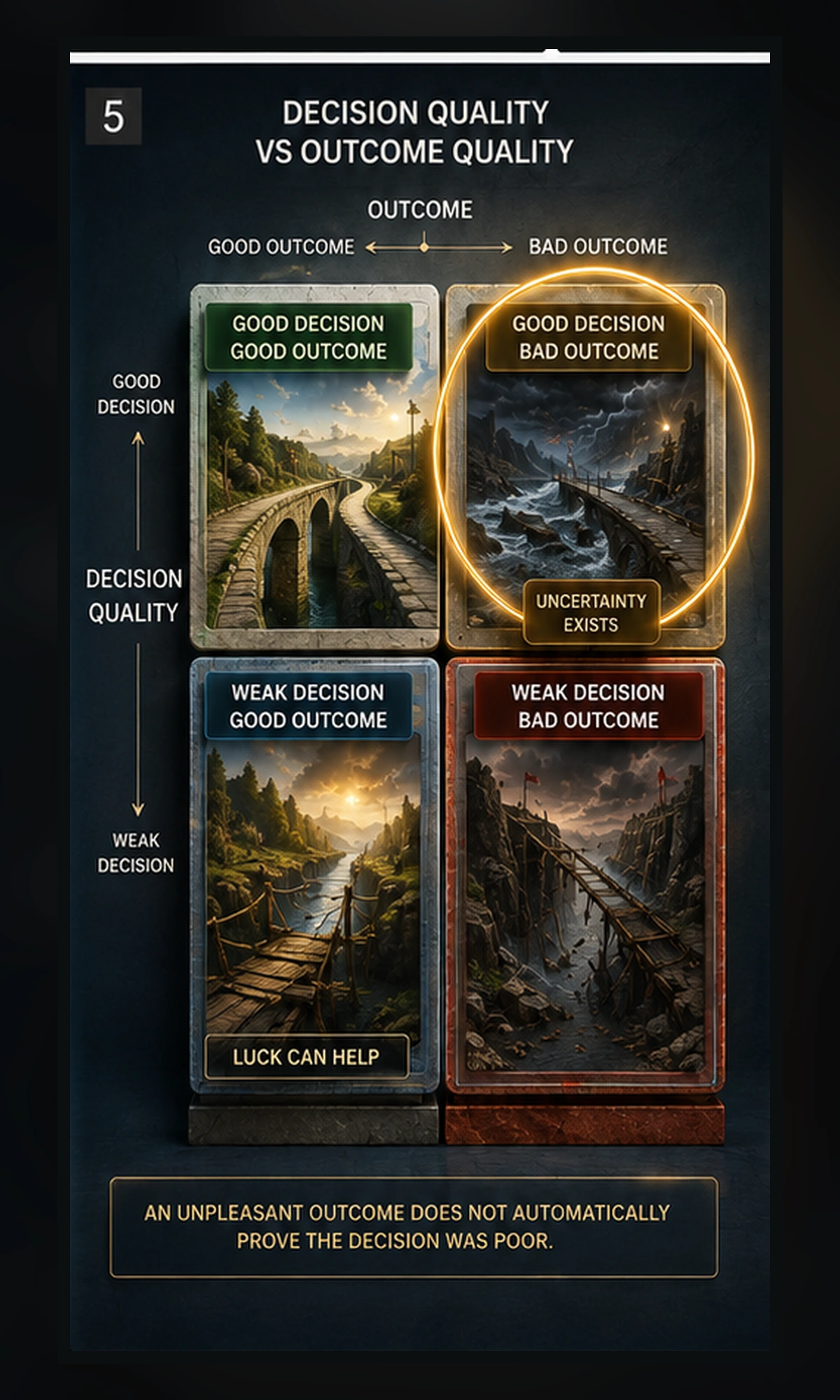
Imagine choosing the safer of two travel routes because severe weather is forecast. The supposedly safer route later becomes blocked by an unexpected accident, while the route you rejected remains open. The bad outcome does not retroactively mean the original reasoning was foolish. You could only work with the information available when the decision was made.
The same principle applies to more personal choices. A job accepted after careful research may turn disappointing because a manager leaves two months later. A relationship given another chance may still end. A medical appointment scheduled with a respected clinician may produce an unsatisfactory experience. An investment in education may take longer to create opportunities than expected. Outcomes provide information, but hindsight can make them seem far more predictable than they were.
A Better Question Is: Was the Reasoning Reasonable at the Time?
Instead of asking whether the result feels good today, reconstruct the decision using the information available when it was actually made. What did you know? What could you reasonably have known? Which priorities mattered then? Did you ignore an important risk, or did the risk simply become visible later? Did somebody pressure you into the choice, or are you judging yourself because the future did not cooperate?
This approach does not require defending every past decision. Sometimes the reconstruction reveals that important information was dismissed, values were compromised or urgency led to a choice that deserves correction. The advantage is that the conclusion comes from examining the decision rather than from treating regret as the verdict.
Depression can make that reconstruction harder because negative information may feel more credible than neutral or positive information. Someone who currently feels hopeless about work may review an earlier career decision through the assumption that neither path would have worked. Someone who feels worthless may interpret an ordinary mistake as evidence that they cannot trust themselves. Someone who has lost interest or pleasure may judge an activity, relationship or opportunity according to how emotionally flat it feels during the depressive period rather than how well it fits their longer-term values.
That is why major irreversible decisions deserve particular care when depression is substantially affecting judgement, functioning or the person’s sense of the future. The goal is not to assume that a depressed person cannot make legitimate decisions. It is to recognise when additional time, professional input, trusted perspective or a more structured review could reduce the chance that a temporary state is being treated as permanent information.
Why the Choice You Did Not Make Can Start Looking Better
Every option contains disadvantages, but after a decision you experience the disadvantages of only one of them.
If you accept Job A, you discover its long commute, difficult colleague, slow computer system and frustrating meetings. Job B remains hypothetical. You never experience its manager’s communication problems, the project that would have been cancelled two months later or the promotion you might also have missed there. The chosen option becomes increasingly detailed because you live inside it, while the rejected option can remain selectively imagined.
That creates an uneven comparison: reality versus possibility.
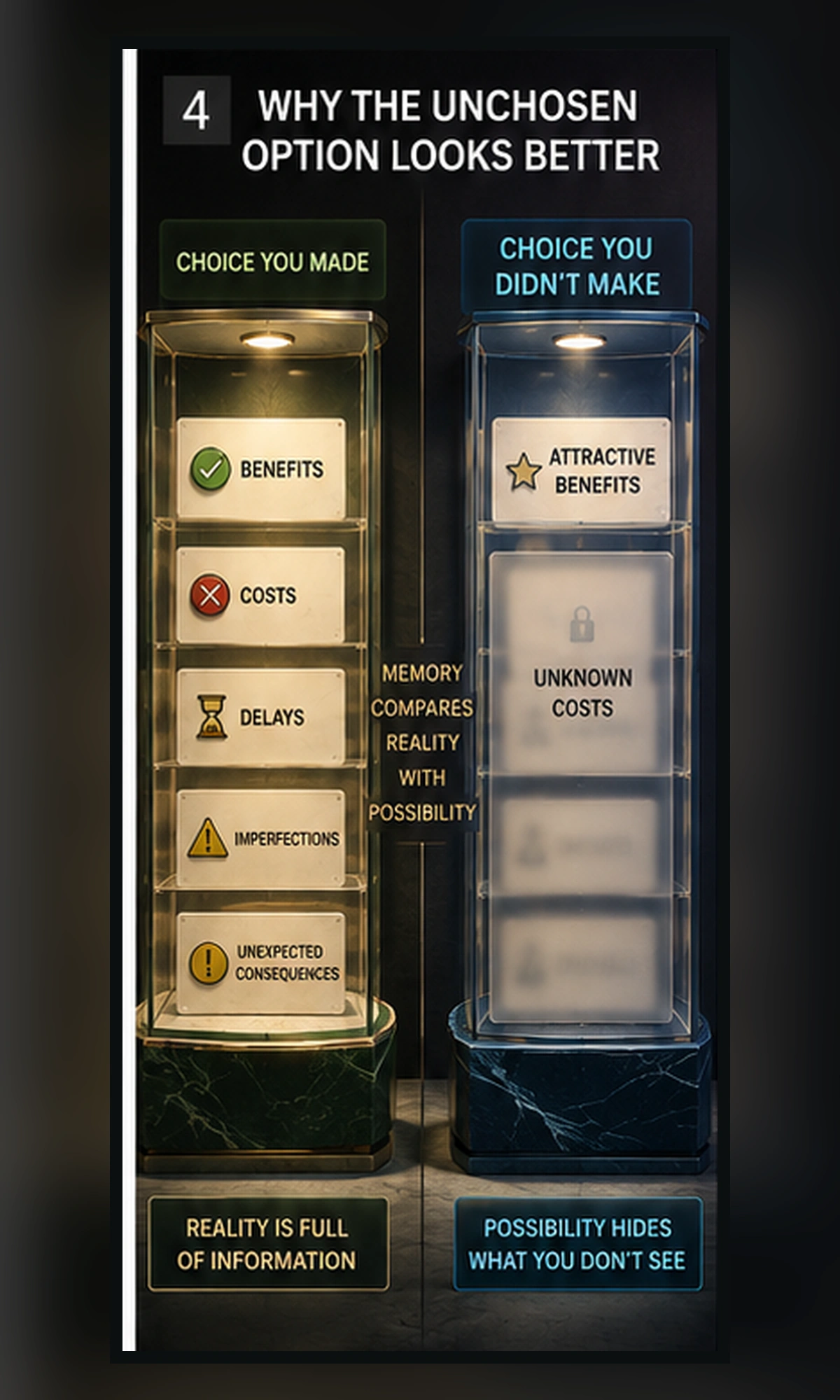
Reality contains inconvenience, delay, boredom, conflict and unexpected consequences. Possibility can be mentally edited. The mind can keep the attractive salary, pleasant interview and shorter commute from the rejected job while leaving its unknown difficulties blank. Over time, the alternative may become less like a real option that carried trade-offs and more like an imagined version of life in which the current disappointment never happened.
Counterfactual thinking – imagining how events could have unfolded differently – is a normal part of human cognition. It can be useful when it helps identify a lesson. If missing an appointment teaches you to leave earlier next time, thinking about the alternative outcome has produced something actionable. The process becomes less useful when the alternative cannot be tested, the same comparison repeats and every imagined version ends with the rejected option winning.
Depression can make this particularly painful when the alternative is used to criticize the self.
“I would have been happier if I had taken the other job.”
“My life would be better if I had stayed.”
“I ruined everything when I said yes.”
“Other people would have known what to do.”
These statements contain far more certainty than the evidence usually allows. You know what happened after the choice you made. You do not know the complete life that would have unfolded after the alternative.
The Missing Costs of the Unchosen Option Matter
A useful review deliberately restores the information missing from the imagined alternative. If you are comparing your current choice with another path, ask what difficulties, compromises and uncertainties the alternative also contained.
Suppose someone regrets buying a smaller apartment because they now want an extra room. The larger apartment they rejected may be remembered mainly for its space. A complete comparison would also restore the higher mortgage payment, maintenance expense, longer commute or renovation work that mattered during the original decision.
The same principle applies to relationships, education, careers and major purchases. An alternative becomes psychologically seductive when its benefits remain vivid while its costs disappear.
This does not mean the original choice was necessarily better. It means the comparison should use equivalent information on both sides.
Useful Review and Regret Rumination Do Different Jobs
Reviewing a decision can be healthy. In fact, refusing to reconsider anything would create its own problems. New information sometimes deserves a changed decision, an apology, a course correction or a completely different plan.
The more informative distinction is whether reflection is moving toward a decision or repeatedly returning to the same starting point.
Useful review usually has a question that can be answered. You check a contract because a new clause has come to your attention. You reconsider travel because a weather warning changed. You reopen a financial decision because your income changed. You reconsider a relationship boundary because a new event changed your understanding of the situation.
Rumination tends to operate differently. Research describes repetitive negative thinking as a process associated with depression and other forms of psychological distress, and contemporary work continues to examine how difficult-to-disengage thinking can maintain negative emotional states. Recent research on repetitive negative thinking in depression and anxiety reflects this broader view of rumination as a process rather than simply the presence of one negative thought.
A practical marker is whether another round of thinking produces new information.
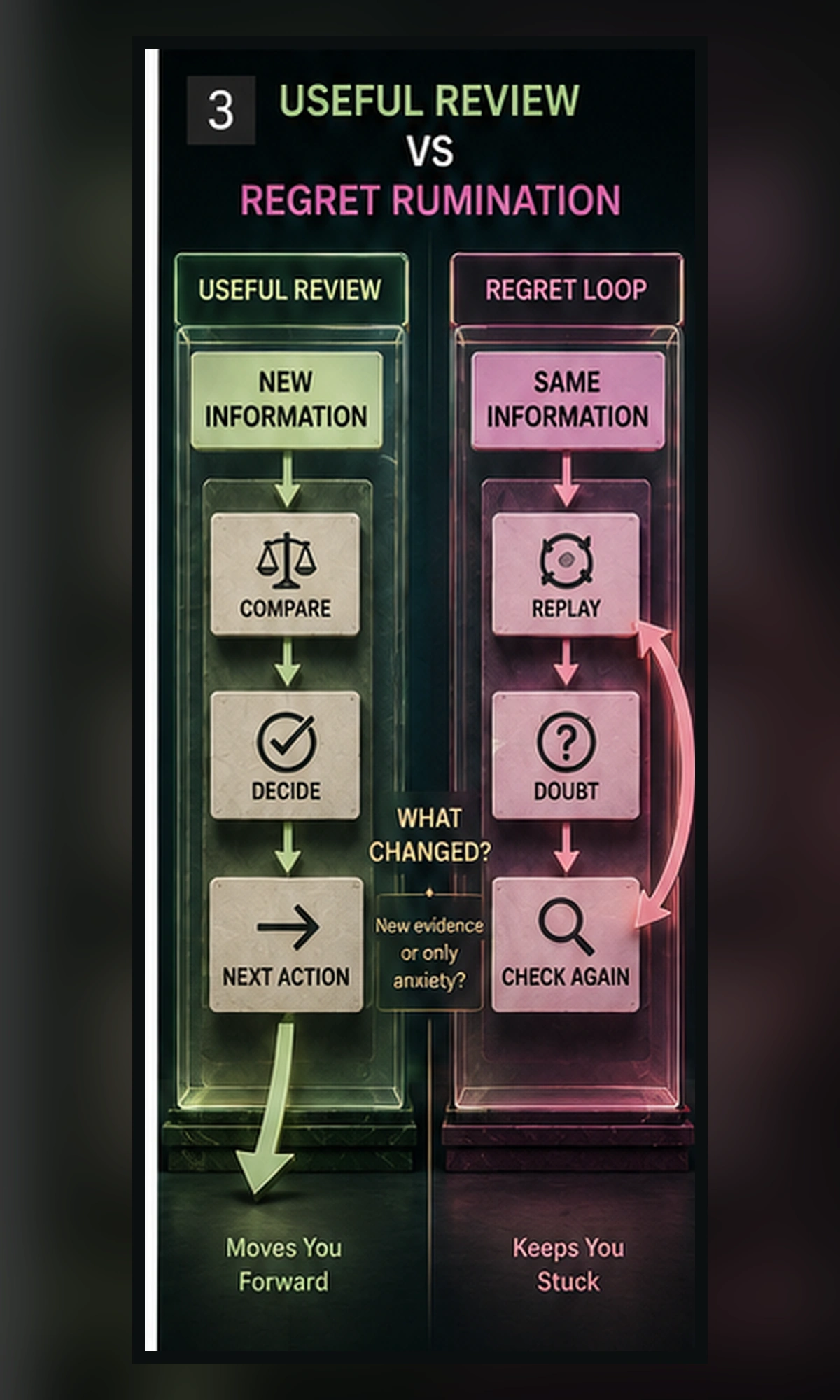
If the first review tells you, “I chose this because A, B and C mattered,” and the fifteenth review tells you exactly the same thing while making you feel increasingly incapable of trusting yourself, the additional processing may no longer be functioning as problem-solving.
The New Information Test
Before reopening a decision, work through these questions slowly rather than answering from the first surge of regret.
1. What specific new fact has appeared since the decision?
Name the information. “I feel terrible about it” describes an emotional state. “The employer changed the salary after I accepted” describes new decision-relevant information.
2. Does that information materially change the risks, benefits or values involved?
A new fact can be real without being important enough to alter the decision. Try to identify what weight it deserves rather than treating every surprise as decisive.
3. Am I reviewing new evidence or reviewing the same evidence while feeling differently?
This is one of the most important distinctions in the entire process. Mood changes can alter how convincing an existing fact feels even when the fact itself has not changed.
4. Is the decision reversible, partly reversible or effectively irreversible?
Reversibility changes the amount of urgency required. A restaurant order and a house purchase should not receive identical decision processes. If correction is easy, there may be little benefit in hours of anticipatory regret. If reversal carries serious consequences, a slower structured review may be appropriate.
5. What action would become different if I finished thinking about this successfully?
If there is no identifiable action, the thinking may be seeking emotional certainty rather than solving a practical problem. Complete certainty is rarely available for meaningful decisions because alternatives always contain unknown outcomes.
This test cannot determine whether a particular choice was correct, and it should not replace professional advice when legal, medical, financial or safety consequences are involved. Its purpose is narrower: to separate a decision that genuinely has new information from a decision that is being repeatedly reopened without a meaningful change in evidence.
Why Depression Can Make You Stop Trusting Your Own Judgement
Regret becomes more disruptive when the problem shifts from one decision to a broader conclusion about the person making it. After enough second-guessing, the internal question may stop being “Was this choice right?” and become “Can I trust myself to make any choice at all?” That change matters because future decisions are then approached with a history of self-doubt already attached to them.
Depression can affect attention, memory, motivation, future expectations and confidence. When several of those difficulties occur together, a person may remember the uncertainty surrounding a decision more vividly than the reasoning that supported it. They may also give greater weight to mistakes than to decisions that turned out reasonably well. Over time, this selective record can create the impression that poor judgement is a stable personal trait.
There is another complication. Some decisions genuinely are harder to make during periods of depression and brain fog because information can feel harder to organize or hold in mind. Others may become difficult because of cognitive slowing in depression, where evaluating several factors takes more mental effort than usual. A person who notices these changes may reasonably become cautious, but caution can turn into global mistrust if every uncertain feeling is interpreted as evidence of incompetence.
A more accurate approach is to judge decisions individually. Some choices may need more structure, more time or another person’s perspective. Others may be perfectly manageable even during a difficult period. The goal is to identify which conditions make your judgement less reliable rather than assuming that every decision you make while depressed is suspect.
Confidence and Accuracy Are Not the Same Thing
People often use confidence as a shortcut for judging decision quality. If a choice feels certain, it seems more trustworthy. If it feels uncomfortable, it seems questionable. Depression can disrupt that shortcut because confidence may fall even when the reasoning itself has not materially changed.
Imagine choosing between two service providers after comparing cost, qualifications, availability and reviews. You choose the provider who best fits your needs. The next morning, you feel much less confident. If there is no new information, the drop in confidence may say more about your current emotional state than about the original comparison.
The reverse can also happen. A person can feel completely certain and still make a weak decision. Confidence is therefore one piece of information, not a substitute for evidence.
This becomes especially important when someone repeatedly asks other people for reassurance. A friend says the decision sounds reasonable, so anxiety drops for twenty minutes. Then uncertainty returns and the person asks someone else. Each reassurance episode briefly improves confidence without resolving the underlying need to feel completely certain.
That pattern can gradually teach the mind that uncertainty itself is dangerous and must be eliminated before moving forward. Since most real decisions contain some uncertainty, the search for reassurance can become almost endless.
Why Major Life Decisions Can Trigger Stronger Regret
Regret tends to become more intense when the decision feels difficult to reverse, highly consequential or closely tied to identity. Career moves, relationship decisions, relocation, education, financial commitments and major medical choices often carry more emotional weight because the alternative path may remain imaginable for years.
The mind can therefore keep running comparisons long after the original decision point has passed. Someone who moved to a new city may imagine the career they would have had if they stayed. Someone who ended a relationship may selectively remember the best periods of the relationship when loneliness appears. Someone who accepted a demanding promotion may imagine that declining it would have produced a calmer life.
The problem is that these comparisons usually combine two different kinds of information. The chosen path is judged using real consequences that have actually occurred. The alternative is judged using a hypothetical future constructed from incomplete information. That makes the rejected option unusually easy to idealize.
If you are considering a major decision while depression is substantially affecting concentration, motivation, hopefulness or your ability to function, the more detailed guide to depression and major life decisions can help distinguish decisions that genuinely require action from those that may benefit from more time or structured review.
A Major Decision Does Not Need to Feel Perfect to Be Reasonable
People sometimes expect the right major decision to produce relief. That expectation can create trouble because even a sensible choice can involve grief, uncertainty and lost alternatives.
Accepting a new job means giving up the old one. Moving closer to family may mean leaving friends behind. Ending an unhealthy relationship can still involve missing the other person. Choosing one educational path means abandoning another. A decision can fit your values while still creating an emotional cost.
This is particularly relevant to regret because emotional pain after a choice can be mistaken for evidence against the choice.
Suppose someone decides not to renew a work contract after months of burnout, limited progression and repeated conflict with management. The decision may have been carefully considered. A week later, uncertainty about income creates anxiety and nostalgia for the familiar workplace. Those feelings deserve attention, but they do not erase the reasons the person decided to leave.
The better question is whether the reasons have changed.
When Should You Actually Reconsider a Decision?
There are situations where regret should lead to another review. The important point is that the review should be triggered by something identifiable rather than by the intensity of discomfort alone.
New information deserves attention when it materially changes the balance of the decision. A job offer may change. A medical test may provide information that was unavailable earlier. A financial commitment may become unaffordable after an unexpected change in income. Someone involved in a relationship decision may disclose information that changes the context completely.
Values can also change. A decision that made sense when career advancement was the highest priority may deserve reconsideration after caregiving responsibilities change. A living arrangement that once worked may become unsuitable after health, work or family circumstances shift.
The presence of new information does not automatically mean the decision should be reversed. It means there is now a legitimate reason to evaluate it again.
Four Reasons a Decision May Deserve a Fresh Review
A structured review is especially reasonable when one or more of the following conditions appear:
- Material new evidence: information has emerged that could reasonably have changed the original decision.
- A major change in circumstances: finances, health, responsibilities, safety or practical constraints have shifted.
- The consequences differ substantially from what was represented: the actual situation is materially different from what you agreed to or expected.
- Your values or priorities have genuinely changed: the decision no longer fits what matters most to you now.
These are very different from repeatedly reviewing the same choice because the feeling of certainty disappeared.
If nothing meaningful has changed, another full analysis may simply reproduce the same information.
When Regret Is Mostly Replaying the Same Evidence
One of the clearest signs that reflection has become repetitive is that the questions remain the same while the emotional urgency increases.
You read the same message again.
You reopen the same comparison page.
You reconstruct the same conversation.
You search for another opinion that confirms what you already heard.
You imagine the alternative again, using almost the same scenario as yesterday.
At first, each round may feel like additional research. After enough repetition, however, it becomes useful to ask whether the review is producing anything that could change your next action.
This pattern can overlap with rumination in depression, where attention becomes repeatedly captured by negative thoughts, past events or unanswered questions. Decision regret can become one particular subject around which that broader rumination process organizes itself.
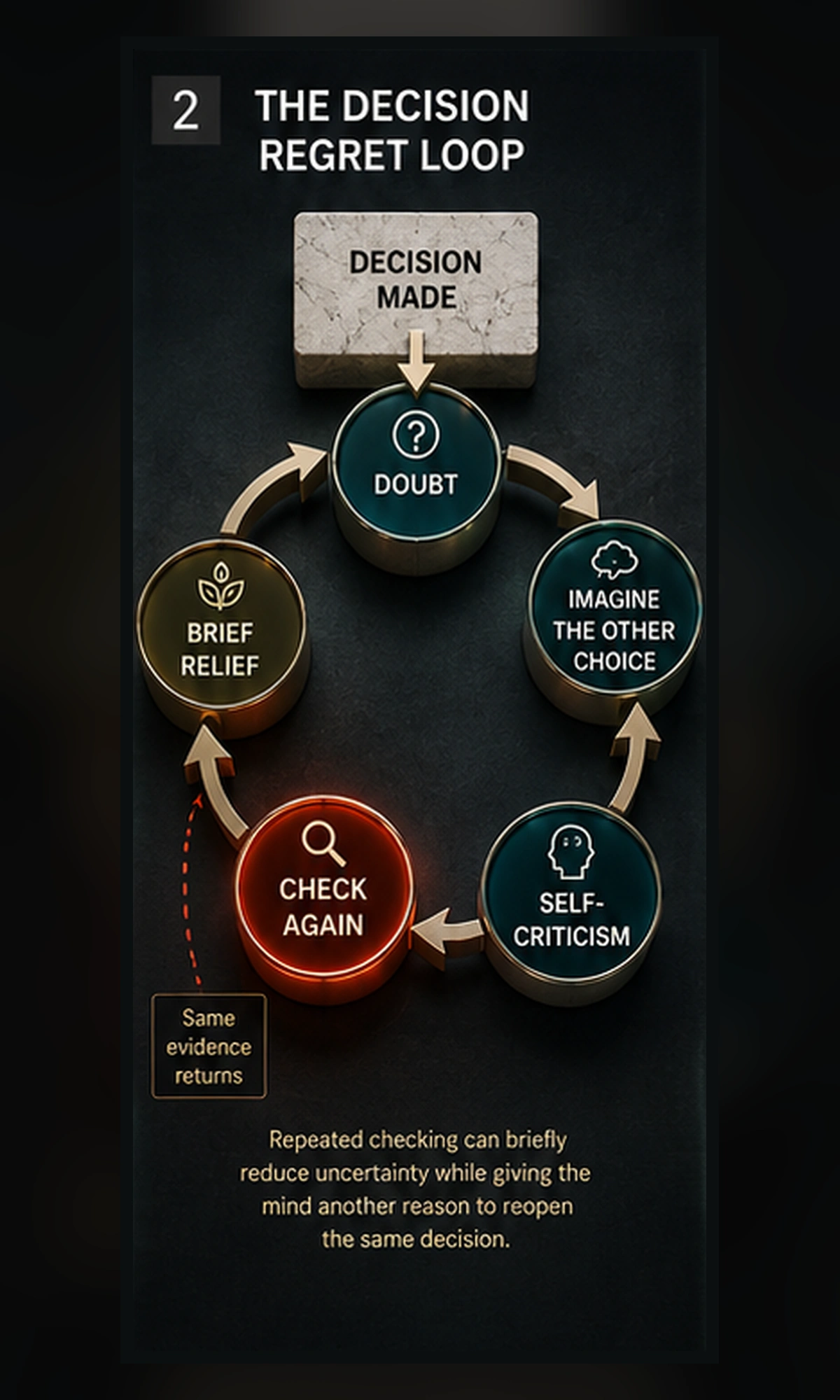
Repeated Checking Can Create a Short-Term Reward
Checking often persists because it works briefly.
You reopen the email and confirm that you did not say anything obviously offensive. Relief appears.
You search the rejected product and convince yourself that your purchase was reasonable. Relief appears.
You ask a friend whether leaving the job was sensible. They agree. Relief appears.
That temporary reduction in uncertainty can make checking feel useful. The difficulty is that the relief may fade, which creates another urge to check.
Over time, the mind may learn a simple association:
uncertainty -> check -> temporary relief
The next wave of uncertainty then triggers the same response more quickly.
Breaking this pattern does not mean refusing to think about the decision. It means creating a clearer boundary between useful review and automatic rechecking.
Use a Review Point Instead of Reviewing Continuously
A practical way to manage repeated decision regret is to decide when the decision will be reviewed rather than allowing every uncomfortable feeling to trigger another analysis.
For a small reversible decision, the review point may be unnecessary. You can correct the choice if needed and move on.
For a medium-stakes decision, you might choose a specific time to review whether anything material has changed. Until that point, new facts can be noted without reopening the entire decision.
For a larger or difficult-to-reverse decision, the review may deserve more structure. You may want written criteria, professional input or a trusted person who understands the situation.
The central idea is simple: review according to evidence and timing rather than according to every fluctuation in anxiety.
The 24-Hour Rule Is a Tool, Not a Universal Rule
A short waiting period can sometimes help when someone feels an immediate urge to reverse a decision after making it. Twenty-four hours is easy to remember, but it should never be treated as a clinical rule or applied rigidly.
Some decisions cannot wait. Safety issues, medical concerns, legal deadlines or rapidly changing financial situations may require immediate action.
Other decisions may benefit from far more than a day.
The useful principle is to create enough distance to distinguish new information from an emotional rebound, while respecting the actual urgency of the situation.
For ordinary reversible decisions, that may mean waiting until the next morning before reopening the analysis. For major choices, it may mean scheduling a deliberate review later in the week with the original reasons written down.
Write Down the Reasons Before Your Mood Rewrites Them
Memory is reconstructive. When mood changes, the reasons that once felt important may become less accessible or emotionally convincing.
A simple written decision record can help preserve the context.
Before or immediately after a meaningful decision, write:
What am I deciding?
What information do I have?
What matters most in this decision?
What are the strongest advantages of each option?
What trade-offs am I knowingly accepting?
What would cause me to reconsider later?
This record becomes especially useful when regret appears several days afterward. Instead of reconstructing the original reasoning entirely from memory, you can compare your current concerns with what you actually knew and valued at the time.
The purpose is not to force yourself to defend the old decision. A written record may reveal that something genuinely important has changed. It simply gives you a more stable reference point.
Separate “I Would Choose Differently Now” From “I Chose Badly Then”
This distinction can reduce unnecessary self-criticism.
You may know something today that you did not know six months ago.
That can make a different decision reasonable now without making the earlier version of you foolish.
A person who changes career direction after gaining new experience may reasonably say, “I would choose differently today.” That does not mean the earlier choice was irrational based on the information available then.
This is one of the most useful ways to think about regret because it allows learning without turning every lesson into a personal indictment.
How to Stop Rechecking Without Ignoring a Real Problem
Trying to suppress regret completely can backfire. The goal is not to force yourself never to think about the decision again. It is to give decision-related thinking a useful job.
Start by naming the concern specifically.
Instead of “I think I made a mistake,” identify the actual issue:
“The salary may be lower than I expected after deductions.”
“The commute is taking longer than the estimate.”
“I learned something new about the contract.”
“I am frightened because the decision now feels permanent.”
These statements are easier to evaluate because they describe different problems.
Next, determine whether the concern contains new evidence.
If yes, review it.
If no, ask whether another round of analysis would reasonably change an action.
If the answer is still no, redirect attention toward the next concrete step rather than trying to reach complete emotional certainty.
This is also where behavioral activation for depression can become relevant. When rumination occupies large amounts of time, returning to a planned activity, responsibility or meaningful routine can sometimes prevent the entire day from becoming organized around another round of internal review.
Use a “Next Action” Question
Decision regret naturally looks backward.
A next-action question shifts the direction of attention.
Instead of:
“Was this definitely the perfect choice?”
ask:
“What is the most useful thing I can do with the situation I have now?”
If you accepted a job, the next action may be preparing for the first week.
If you chose a treatment option with a clinician, the next action may be following the agreed plan and noting effects or concerns for the next appointment.
If you purchased something, the next action may be testing whether it actually meets the need rather than repeatedly comparing it with alternatives.
If you ended a relationship, the next action may involve boundaries, practical arrangements or support.
This approach does not declare the decision permanently correct. It keeps the person’s life moving while leaving room to reconsider if meaningful evidence later appears.
When Decision Regret Is Connected to Perfectionism
Some people experience regret because they are trying to make decisions that contain no downside.
That standard is almost impossible to satisfy.
Every meaningful choice usually sacrifices something. A higher-paying job may reduce free time. A cheaper home may increase commuting. A stable option may offer less excitement. A more ambitious choice may carry more uncertainty.
When perfectionism enters the process, the presence of any disadvantage after a decision can feel like proof that the choice was defective.
Someone who struggles with perfectionism and depression may also review decisions according to an unrealistic hindsight standard: “I should have predicted this,” “I should have known how I would feel,” or “I should have found an option without these problems.”
A more realistic decision standard asks whether the choice was good enough given the information, values and constraints available at the time.
That standard leaves room for trade-offs.
The Best Option May Still Contain Something You Dislike
This can sound obvious until someone is living with the consequence.
You can choose the better of two jobs and still dislike your manager.
You can choose the better apartment and still hate the traffic.
You can make the healthier relationship decision and still feel lonely.
You can choose an educational path that suits you and still wonder about the field you left behind.
These experiences do not automatically invalidate the decision. They reveal that decisions operate inside imperfect circumstances.
How Depression Can Distort Future Comparisons
Depression can affect how the future is imagined. Negative outcomes may feel more probable, positive outcomes may feel less believable and uncertainty can become harder to tolerate.
That matters because decision regret often depends on comparing two futures:
the future produced by the choice you made, and the imagined future produced by the choice you rejected.
Only one of those futures is being observed.
The other is being constructed.
If the imagined future is consistently edited to contain better outcomes, more confidence and fewer trade-offs, regret becomes almost inevitable.
This is why it can help to deliberately add uncertainty back into the unchosen path.
Instead of:
“If I had taken the other job, I would be happier.”
use:
“If I had taken the other job, some things may have been better and some may have been worse. I do not know the complete outcome.”
That statement is less emotionally satisfying because it removes certainty, but it is usually more faithful to reality.
What If the Decision Really Was a Mistake?
An article about regret should never imply that every decision should be defended.
People make mistakes.
Sometimes the useful conclusion really is:
“I should change this.”
The important difference is what happens after that realization.
Constructive regret identifies the problem, extracts information and changes the next action.
Destructive regret repeatedly punishes the person without improving the decision.
If you realize you accepted a commitment you cannot sustain, the useful question becomes how to renegotiate or leave it responsibly.
If you discover that a purchase was unsuitable, the useful question becomes whether it can be returned, sold or replaced.
If you recognize that a relationship decision harmed someone, the useful question may involve accountability, communication or changed behavior.
If the decision cannot be reversed, the work becomes different. The goal shifts toward learning, repair where possible and adapting to the current situation.
Self-Punishment Does Not Improve Decision Accuracy
People sometimes believe harsh self-criticism will prevent future mistakes.
It can feel like accountability.
“If I make myself feel bad enough about this, I will never do it again.”
The problem is that intense self-criticism can make future decisions harder by increasing fear of failure and reducing confidence. The person enters the next choice with the expectation that another mistake will be psychologically expensive.
Learning requires specificity.
“What did I miss?”
“Was there a warning sign?”
“Did I rush?”
“Did I ignore my own priorities?”
“Did circumstances simply change?”
Those questions can influence future behavior.
“I am terrible at decisions” cannot.
When to Ask Someone Else for Perspective
Outside input is most useful when it adds information or helps organize information you already have.
A trusted person may notice a practical issue you overlooked. A professional may understand risks you cannot reasonably evaluate alone. Someone who knows your values may help separate your long-term priorities from the intensity of today’s mood.
Perspective becomes less useful when its main job is providing repeated reassurance.
If you have already asked several people the same question and the relief disappears shortly after each answer, another opinion may not solve the underlying problem.
Before asking, try defining what you actually need:
Information: “Do you know whether this contract clause means what I think it means?”
Perspective: “You know how important family time is to me. Do you think I am underestimating this schedule?”
Professional expertise: “What medical risks should I consider before changing this treatment?”
Reassurance: “Please tell me again that I didn’t make a mistake.”
The first three can meaningfully improve a decision. The fourth may provide temporary comfort without creating new understanding.
When Professional Help May Be Worth Considering
Decision regret becomes more concerning when it is part of a broader pattern of depression that is interfering with daily functioning.
Consider seeking professional support if regret or repetitive thinking consumes large portions of the day, repeatedly disrupts sleep, prevents ordinary decisions, contributes to significant work or relationship problems, or occurs alongside persistent low mood, loss of interest, marked hopelessness or other depressive symptoms.
A mental-health professional can help examine whether the main difficulty involves depression, rumination, anxiety, perfectionism, obsessive checking, another condition or several interacting factors. The appropriate approach depends on the pattern rather than on the label “decision regret” alone.
Psychotherapy may help people examine thinking patterns, reduce unproductive rumination, improve problem-solving and develop more workable responses to uncertainty. Treatment for depression can also involve medication, psychotherapy or a combination depending on the person’s symptoms, history, preferences and clinical assessment.
If decision-making itself has become unusually difficult, it may also help to explore whether executive dysfunction in depression, concentration problems, sleep disruption or other symptoms are contributing to the difficulty.
Major Medical, Legal and Financial Decisions Need the Right Expertise
A mental-health article can provide a framework for recognising regret, but it cannot determine whether a particular medical treatment, contract, investment, legal agreement or other high-stakes decision should be reversed.
When the subject carries substantial consequences, use the relevant qualified professional.
For medical decisions, speak with the clinician involved or seek an appropriate second opinion.
For legal decisions, consult a qualified legal professional.
For significant financial decisions, use appropriately regulated financial or tax advice where needed.
The emotional question and the technical question are often different. Someone may need help managing repetitive regret while also needing expert information about the decision itself.
A Practical Decision-Regret Review
When you notice yourself reopening the same decision, use this sequence:
Step 1: Name the decision clearly.
Describe what was decided without adding judgement.
Step 2: Identify what triggered the regret.
Was there a new event, new information, an unpleasant consequence, a mood change or simply another wave of uncertainty?
Step 3: Compare the current information with the information available at the time.
Write down what actually changed.
Step 4: Decide whether the change is material.
Would a reasonable person have considered this information important before making the choice?
Step 5: Check reversibility.
Can the decision be adjusted easily, partly adjusted or not realistically reversed?
Step 6: Choose one review point.
If no urgent action is needed, decide when you will reconsider rather than reviewing continuously.
Step 7: Identify the next useful action.
Move from evaluating the past toward managing the present.
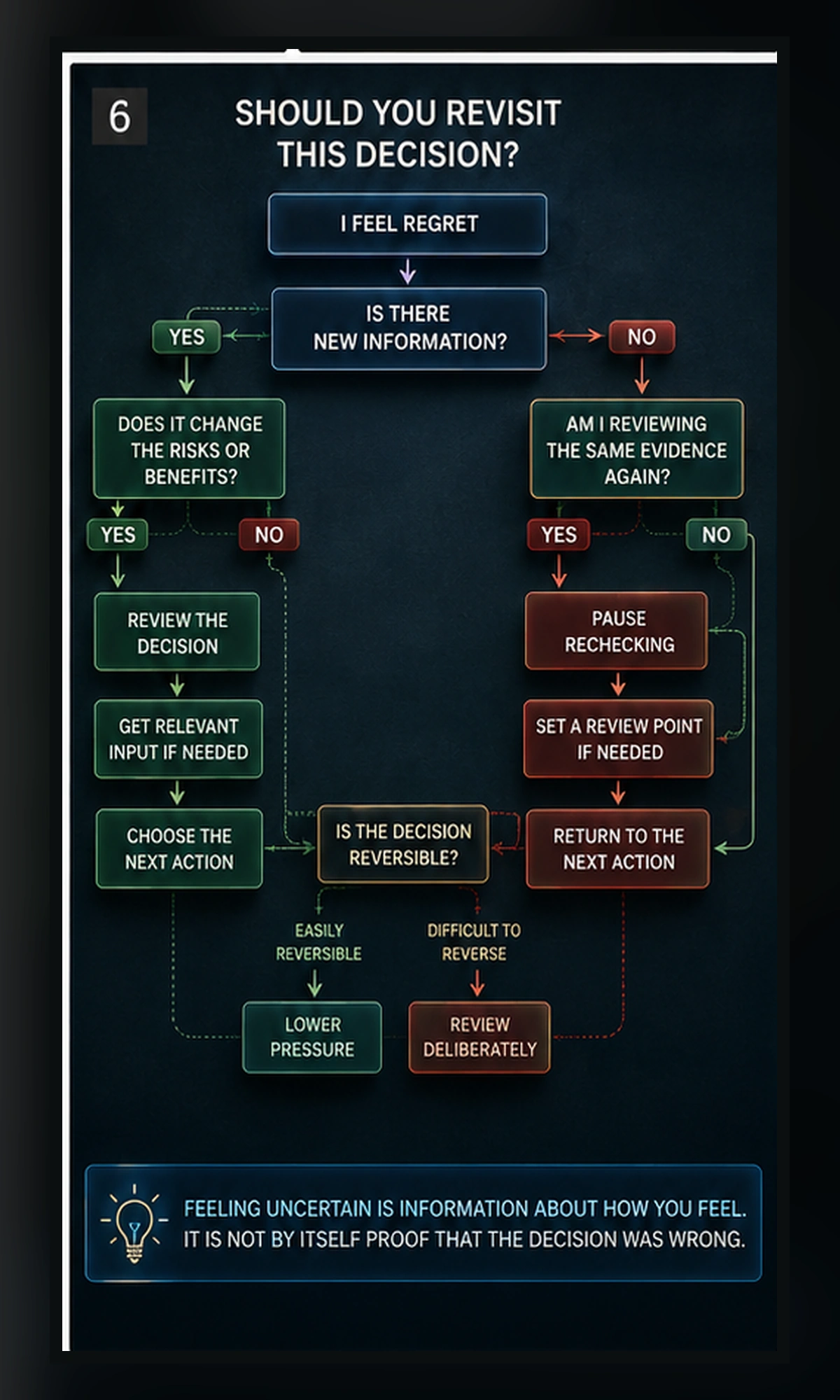
This process does not promise certainty. Its purpose is to prevent uncertainty from becoming the sole reason a decision is repeatedly reopened.
The Question That Often Matters More Than “Was I Right?”
Some decisions never produce a satisfying verdict.
You may never know whether another career would have been better.
You may never know what would have happened if a relationship continued.
You may never know whether another city, degree, house or opportunity would have produced a happier version of your life.
In those situations, the question “Was I right?” may be impossible to answer because the comparison requires access to a future that never occurred.
A more useful question is:
“Given what I knew then and what I know now, what is the best action available to me next?”
That question accepts that the past cannot always be conclusively judged while preserving the possibility of changing course when new evidence genuinely warrants it.
Decision regret becomes less powerful when it stops being treated as a final verdict on the past and becomes one source of information among several. Sometimes it reveals a real problem. Sometimes it reveals a lesson. Sometimes it reveals that uncertainty is uncomfortable. Sometimes it reveals that depression has made every path appear worse than it did before.
The work is learning which of those situations you are actually in.
Can Treatment Reduce Decision Regret When Depression Is Driving It?
There is no treatment whose purpose is specifically to erase regret. The more useful clinical question is whether depression, rumination, anxiety, perfectionism, repetitive reassurance seeking or another problem is making ordinary uncertainty unusually difficult to tolerate. When the underlying condition improves, the decision may become easier to evaluate because the person is no longer trying to judge it from the same level of exhaustion, hopelessness or self-criticism.
Psychological treatment can be particularly relevant when the problem involves repetitive negative thinking. Cognitive behavioral approaches may help a person examine the assumptions attached to a decision, distinguish evidence from prediction and identify behaviors such as repeated checking that keep uncertainty active. Other therapeutic approaches may focus more heavily on acceptance, attention, self-criticism, values or the ability to continue functioning even when certainty remains incomplete.
Treatment for depression may also include medication when clinically appropriate. Medication decisions should be made with a qualified healthcare professional because the suitable treatment depends on symptoms, severity, medical history, previous response, other medications and individual preferences. The National Institute of Mental Health overview of depression and its treatment provides a useful evidence-based starting point for understanding psychotherapy, medication and other treatment approaches.
Improvement also does not necessarily mean that every old decision suddenly feels correct. A person may still conclude that some choices deserve changing. The difference is that the conclusion can increasingly come from evidence, values and practical consequences rather than from an automatic assumption that feeling bad means choosing badly.
Therapy Can Help With the Process Around the Decision
Consider someone who spends an hour each evening reviewing whether leaving a previous job was a mistake. The content of the thought concerns employment, but the clinically useful target may be the process surrounding it: replaying the same evidence, idealizing the alternative, asking others for reassurance and postponing current career actions until the past feels resolved.
A therapist does not need to decide which job the person “should” have chosen in order to help. The work may involve clarifying what was known at the time, identifying distorted hindsight assumptions, reducing repetitive checking and helping the person redirect attention toward choices that still exist.
This distinction matters because people sometimes wait for the past to feel settled before they permit themselves to move forward. For some decisions, that feeling of complete resolution may never arrive.
What to Do When Regret Hits Late at Night
Decision regret often becomes louder when there are fewer competing demands on attention. Late at night, a conversation from the afternoon can suddenly feel catastrophic. A decision that seemed reasonable at breakfast can feel obviously wrong at midnight.
Sleep deprivation itself can also make emotional regulation and cognitive functioning more difficult. If the decision is not urgent, repeatedly analyzing it while exhausted may provide poor conditions for a reliable review.
A practical response is to capture the concern without trying to solve the entire decision immediately. Write down the new information, if there is any, and identify what specifically needs checking later. If there is no new information, record the thought anyway and return to it at the planned review point.
This can be particularly useful when depression and sleep problems are occurring together. A person who repeatedly uses bedtime for unresolved decision analysis can end up worsening sleep, then approaching the next day’s decisions with even less cognitive energy.
Do Not Turn Every Emotional Spike Into a New Decision
An uncomfortable evening does not necessarily require reversing the morning’s decision.
Neither does one difficult conversation, one disappointing day at work or one moment of loneliness.
Meaningful decisions should be responsive to meaningful information. If every temporary emotional shift reopens the choice, the person may never accumulate enough experience with any path to evaluate it fairly.
This is especially important when the chosen option requires an adjustment period. Starting a new job, moving home, beginning a course or leaving a familiar routine can feel uncomfortable before the long-term value of the choice becomes visible.
When Regret Becomes a Sign That More Support Is Needed
Decision regret becomes more clinically important when it is no longer confined to one choice and begins affecting daily functioning. A person may become unable to make ordinary decisions, spend hours mentally replaying previous choices, repeatedly seek reassurance, lose sleep or avoid commitments because every choice is expected to produce another period of regret.
Broader depressive symptoms matter as well. Persistent low mood, loss of interest, hopelessness, major changes in sleep or appetite, substantial difficulty concentrating and withdrawal from ordinary life deserve attention even if decision regret is the symptom that first brought the problem into focus.
The NHS overview of clinical depression explains that depression can affect thoughts, behavior and physical functioning and recommends seeking professional help when symptoms are persistent or significantly affecting life.
If someone is experiencing thoughts of suicide, feels unable to remain safe or believes they may act on thoughts of self-harm, the priority is immediate safety rather than continued analysis of the decision. Seek urgent professional or emergency assistance in the person’s location.
A Final Way to Judge the Regret
When regret returns, try separating four questions that are often blended together:
What happened?
Describe the actual outcome.
What did I know when I decided?
Reconstruct the information available at the time.
What do I know now that I genuinely did not know then?
Identify new evidence.
What can I still influence?
Move attention toward the remaining decision rather than the closed alternative.
This framework allows regret to contain information without giving it complete authority.
Sometimes the answer will be that the decision deserves changing.
Sometimes the answer will be that the decision was reasonable and the outcome was disappointing.
Sometimes the answer will be that no one could have known what would happen.
Sometimes the most difficult answer will be that there is no reliable way to know whether the abandoned option would have produced a better life.
That last situation is where repeated analysis can become especially costly. The mind keeps searching for certainty about a comparison that reality can never provide.
The Most Important Distinction to Remember
Regret is a real emotional experience. It deserves attention.
It is also only one source of information.
The useful question is whether the regret reveals new evidence, changed circumstances, violated values or a correctable problem. When it does, reconsideration may be appropriate. When the same information is being replayed with increasing distress, the more useful response may involve reducing rechecking, addressing depression or rumination and returning attention to the decisions that still remain open.
A person does not need to prove that every previous choice was correct before making the next one.
Learning from a decision and condemning yourself for it are different processes.
The first can improve what happens next.
Frequently Asked Questions About Depression and Decision Regret
Can depression make every decision feel like a mistake?
Depression can affect concentration, confidence, motivation and expectations about the future, which may make decisions harder to evaluate and easier to second-guess afterward. That does not mean every regretful feeling is caused by depression or that every decision was reasonable. The more useful test is whether meaningful new evidence has appeared since the decision or whether the same evidence is being reviewed while confidence continues to fall.
Why do I regret decisions immediately after making them?
Committing to one option closes another possibility, and that loss can make the rejected alternative suddenly more noticeable. If you are already prone to rumination, anxiety or self-doubt, the mind may begin checking whether the choice was correct almost immediately. A rapid increase in uncertainty does not automatically mean that new evidence has appeared.
How do I know whether decision regret is useful or rumination?
Useful review tends to identify new information, clarify priorities or produce a different next action. Rumination more often repeats the same evidence, questions and imagined alternatives without improving the decision. If another round of analysis leaves you with no new information and simply restarts the urge to check again, the process may no longer be functioning as effective problem-solving.
Should I reverse a decision if I feel strong regret?
Strong regret deserves attention, but emotional intensity alone cannot determine whether reversal is the best action. Look for material new information, changed circumstances, unexpected risks, values that have genuinely changed and the practical consequences of reversal. High-stakes medical, legal and financial decisions should be reviewed with the appropriate qualified professional.
Can a good decision still lead to a bad outcome?
Yes. Decisions are made with incomplete information, so a reasonable choice can produce an unfavorable outcome because circumstances change or an unpredictable event occurs. The reverse is also possible: weak reasoning can occasionally produce a good result through luck. Evaluating the quality of a decision therefore requires looking at the information and reasoning available when the choice was made, not only at what happened afterward.
Why does the option I rejected look better afterward?
You experience the real inconveniences and consequences of the option you chose, while the rejected option remains hypothetical. Its disadvantages can therefore stay unknown or become less vivid, making the comparison uneven. Restoring the likely costs, uncertainty and trade-offs of the unchosen option can create a more realistic comparison.
Why do I keep asking people whether I made the right decision?
Reassurance can temporarily lower uncertainty, which makes asking again feel useful when doubt returns. If multiple people have already given similar answers and the relief repeatedly disappears, another opinion may provide comfort without resolving the underlying difficulty tolerating uncertainty. Professional or expert input remains valuable when it adds genuinely new information.
Can therapy help with constant decision regret?
Therapy may help when decision regret is connected with depression, rumination, anxiety, perfectionism, repetitive checking or severe self-criticism. Treatment can focus on the process surrounding the decision, such as how evidence is evaluated, how uncertainty is handled and what keeps repetitive review active. A mental-health professional can also assess whether another condition is contributing to the pattern.





/the-chemistry-of-depression-1065137_final_logo-d18c69cd1a814e36bace2244ac3a0f2a.png)