
If you searched for an “occasion staffing agency,” the company you may mean is Occasions Staffing, a provider that advertises temporary hospitality and event support. Its published services make it worth considering for a matching assignment, but a booking decision should rest on confirmed local capacity, an itemized quote and the actual replacement terms.
The most consequential distinction is between a promise to replace an unsuitable worker and a promise about when the replacement will arrive. Those are different commitments, and a busy registration desk cannot run on a billing remedy alone. This review explains how to separate published information from the terms that must be agreed for your event.
This is a public-information assessment, not a report of a booking or service test. Company descriptions establish what the provider advertises; they do not independently establish attendance, service quality or suitability for a particular venue.
What can you verify about Occasions Staffing?
Start with the official business identity and service pages, then confirm the details of your assignment. The existing article URL uses the singular “occasion,” while the provider uses the plural “Occasions.” That spelling difference matters when comparing search results, contact details and a quotation, because a generic event-staffing phrase is not a unique company identifier.
- Identify the provider: match the website, quoted business name and contracting entity before agreeing to payment.
- Separate a listing from availability: a role on a services page is not confirmation that qualified people are available on your date.
- Check the service boundary: supplying people and managing an entire event are different scopes. Establish which one you are buying.
The official staffing page lists roles including greeters, exhibit-booth attendants, registration management, housekeeping and setup or teardown. These descriptions support a conversation about event and hospitality assignments. They are not evidence that every listed role is available in every city, or that a broad category covers every specialist task within it.

A useful review therefore asks a narrower question than “Is this a good agency?” Ask whether it can supply the particular role, at the particular place and time, with a workable supervision and recovery arrangement. A supplier could be suitable for daytime registration support and unsuitable for a late-night technical changeover at the same venue. The company name has not changed; the assignment has.
Services, screening and location mean different things
The company homepage describes applicant screening, payroll administration and a performance policy. Treat these as provider statements. Screening is a process description, not a measured prediction of how an individual will perform, and payroll administration does not answer who will direct daily work at your venue.
The published locations directory includes Houston, Oceanside and other U.S. cities. A directory entry is a contact starting point, not a live roster. Ask whether the team serving your event has already accepted the request, which contact controls dispatch, and whether travel or access restrictions affect the shift. Do not turn an office listing into a claim of nationwide immediate coverage.
| Information | What it supports | What remains to confirm |
|---|---|---|
| Service listing | The provider advertises a type of work. | Availability and task-specific qualifications for your assignment. |
| Screening description | The provider describes its selection process. | Which checks fit this role and what information can appropriately be shared. |
| Location entry | A published route to a regional contact. | Actual service coverage for the venue and date. |
| Accepted order | An agreed assignment scope. | Any exclusions, cancellation terms and unresolved conditions. |
Ask about role-relevant competence without demanding private background reports. An event organizer usually needs confirmation that a required qualification was checked, who checked it and whether it remains applicable. A broad claim that everyone is “vetted” does not explain a worker’s familiarity with your registration system or authority to carry out a controlled task. Avoid expanding screening requests beyond a legitimate job need.
Turn a role label into an observable assignment
For a reception or convention assignment, the useful lead skill is to demonstrate the handoff that the worker must complete. Before seeking a final quotation, put the real station into a safe demonstration state: display a sample badge, identify the guest entrance and establish where unresolved questions go. Use fictional guest details in a rehearsal so no attendee information is exposed.
Run one ordinary arrival verbally with the person responsible for the venue: a guest approaches, the greeter directs them, the registration worker checks the booking, and an exception goes to the designated lead. Identify the action at each handoff and the point where authority ends. This is a scope rehearsal, not unpaid productive work or a substitute for required training.
- Show the starting point: where the guest or work item arrives.
- Demonstrate the permitted action: what the assigned worker actually does.
- Introduce one exception: a missing booking, an access question or another realistic interruption.
- Name the receiving person: who takes over when the worker cannot resolve it.

For example, a greeter may direct guests toward registration but must not decide whether an unlisted visitor can enter a restricted session. If the brief simply says “manage arrivals,” both the supplier and venue might assume the other has provided someone with admission authority. A short rehearsal exposes that missing responsibility before it becomes an argument at the door.
If the venue is unavailable, conduct the same sequence verbally with the venue lead and one representative work item. Do not invent technical tasks merely to make the brief look comprehensive. Completion means that the beginning, action, exception and handoff are clear enough for both parties to describe consistently. If they disagree, narrow the task or identify the missing lead before confirming headcount.
The same demonstration also reveals whether two requests describe different jobs. A person who welcomes guests while a colleague resolves admission issues has a bounded front-of-house task. A person expected to welcome guests, authorize entry, troubleshoot registration and supervise others has a larger responsibility, even if the requester uses the same “event staff” label. Explain that distinction to the supplier so it can accept the scope or propose another role. Combining responsibilities without naming them makes it harder to tell whether a later performance concern comes from an unsuitable assignment or an unclear brief.
The related hospitality recruitment agency comparison covers a broader supplier-selection question. This page focuses on what makes an Occasions assignment sufficiently defined to accept. A permanent management vacancy and a one-day guest-service shift need different arrangements, even when both sit inside hospitality.
What does the three-hour performance policy mean?
The important clock is the notification window. The provider’s published policy ties its replacement and charging remedy to notification of dissatisfaction within the first three hours after the assignment starts. It does not, in that wording, promise a replacement will reach the venue within three hours. Obtain the applicable terms for your booking rather than treating a short website statement as a complete service agreement.
A notice deadline governs when you must raise the issue to invoke the stated remedy. A response target governs acknowledgment. A dispatch estimate concerns sending someone. An arrival commitment concerns reaching the site, and an effective handover may require access checks and briefing after arrival. Collapsing those stages into “three-hour replacement” hides the period during which the station may still be uncovered.

Consider an illustrative shift starting at 08:00. A concern raised at 08:40 falls within the first three hours; that fact says nothing by itself about a replacement arriving before doors open at 09:00. The example is a timing explanation, not an account of this provider’s performance. Do not wait until the last moment of a policy window when the operational problem is already clear.
Agree how an issue becomes an acknowledged request
Before the shift, establish the authorized recipient and channel for a performance concern. Clarify what counts as received notice, which assignment details identify the worker, and who can approve a replacement. An unanswered call to an office number may not accomplish the same thing as an acknowledged request to the assigned coordinator. The contract should remove that ambiguity rather than leave it for an invoice dispute.
When a problem occurs, describe the observable task mismatch and the assistance already provided. “The worker cannot operate the agreed badge lookup after the station briefing” is more useful than “bad attitude.” It gives the coordinator a specific issue to resolve and avoids treating a preference or misunderstanding as evidence about a person’s character. Immediate safety concerns require stopping the unsafe task first.
| Term | Question to resolve |
|---|---|
| Notification | Who receives it, through which channel, and how is receipt acknowledged? |
| Arrival | Is there an agreed arrival commitment, an estimate or no time commitment? |
| Original worker | Which charges are waived or credited, and under what conditions? |
| Replacement worker | When does replacement billing begin, and is another minimum charge triggered? |
| No available replacement | What service or billing remedy applies if nobody suitable can attend? |
The wording about not charging for the replaced employee does not establish that the replacement shift is free. Ask how the original time, replacement time, travel and any minimum booking interact. Also distinguish dissatisfaction from a no-show, late arrival or venue cancellation; these are different events and may fall under different clauses. A clear commercial remedy does not automatically resolve every category of disruption.
Protect the critical handoff while a replacement is pending
A replacement policy is more valuable when the venue can continue safely during the gap. Use the earlier scope rehearsal to identify the one handoff that cannot be left unowned, then agree a temporary service reduction with the venue lead. This is an operational contingency chosen for the event, not a claim about the supplier’s standard response.
In the registration example, suppose one of two lookup stations becomes unavailable before opening. Keep the active station for ordinary arrivals and assign the existing authorized lead to exceptions. Redirect the queue using the venue’s approved layout; do not block accessible routes or emergency exits. The response is to simplify service within available competence, not to hand admission authority to an unbriefed helper.
- Stabilize: pause the affected task if it cannot be done safely or correctly.
- Reduce: keep the essential guest route operating with authorized, briefed people.
- Escalate: ask the coordinator for acknowledgment and a realistic replacement update.
- Restore: brief any replacement before reopening the affected station.
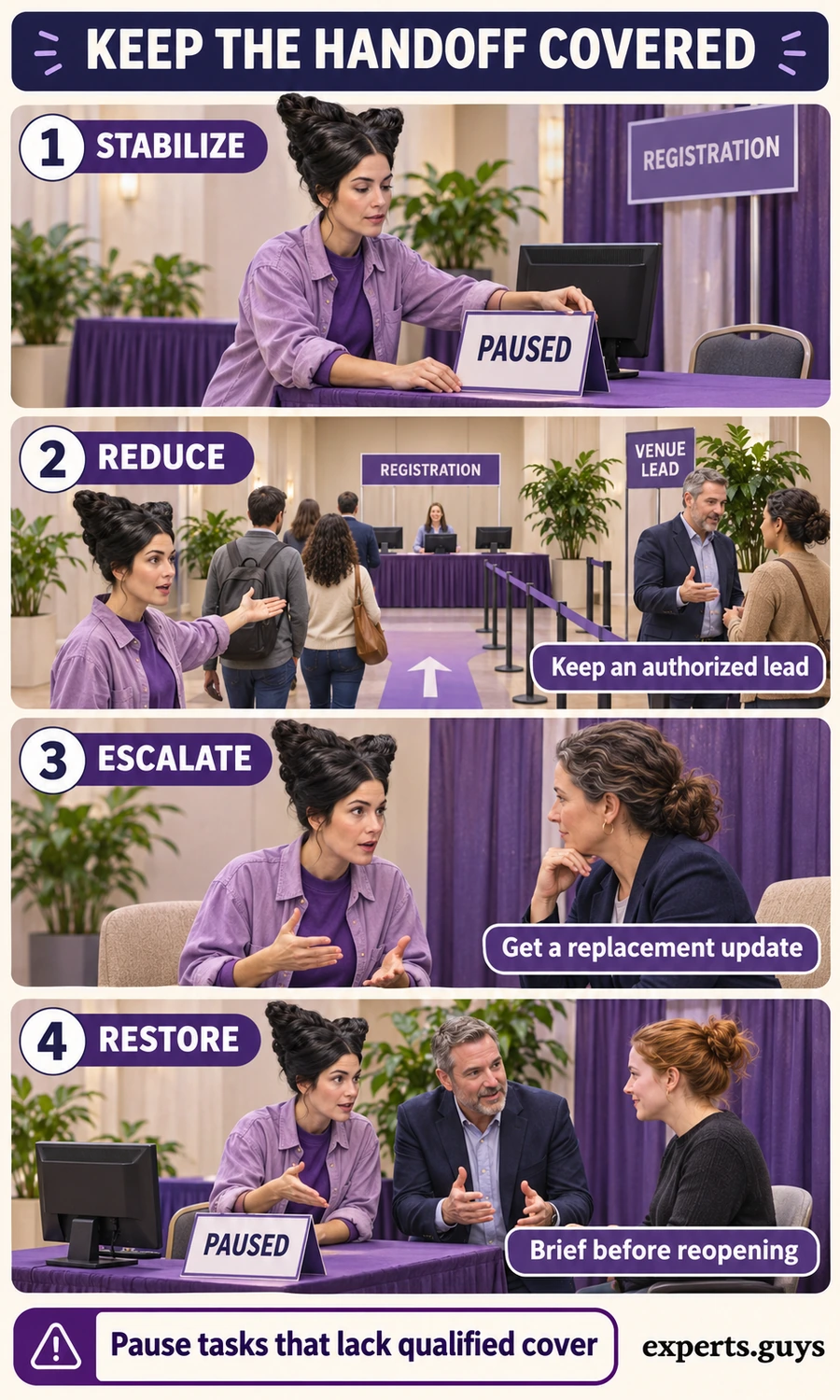
Do not take the only authorized exception handler away to cover a general greeting position if that leaves access decisions unmanaged. Moving one person may make the entrance look staffed while shifting the failure downstream. The useful test is whether the whole guest journey still has an accountable owner at each necessary decision, rather than whether every original position has a person standing beside it.
For a smaller event, the adaptation may be one combined station operated by the existing trained lead, with a slower intake rate agreed by the organizer. For a task requiring a qualification or special authorization, the correct adaptation may be to suspend that task until a suitable person is available. A backup arrangement is complete when everyone knows which service is reduced and who can authorize its restoration.
Keep the contingency proportionate to the consequence of the gap. A delay in handing out a conference bag may allow a temporary pause; an unowned access decision at a restricted entrance may require a different response. These examples do not prescribe crowd-control staffing ratios or security procedures. They explain why a general replacement promise cannot decide your operating plan. The venue lead must determine what can remain open under its actual rules, layout and staffing conditions, and the supplier must understand which work has been paused rather than assuming the original service continues unchanged.
For other sourcing routes, the event staffing overview discussing GigSmart addresses a different hiring channel. Another source can widen your options, but a newly sourced person still needs the same task definition and site handover. Changing the channel does not eliminate the work required to integrate a replacement.
How should you compare the cost of a booking?
Compare the total charge for the same usable assignment, not the hourly headline alone. A quotation should identify the role, headcount, billable duration, minimum hours, applicable premiums and additional charges. No independently verified rate card for this particular booking is available here, so the calculations below use invented figures solely to explain the comparison.
A staffing bill rate is what the client is charged; it is not automatically the worker’s hourly pay. The difference between the two can include employment-related costs, administration, insurance and operating margin, depending on the arrangement. This article does not estimate the provider’s margin. A percentage markup without the underlying pay rate and cost definition cannot establish the final client price.
Normalize minimum hours before judging the hourly rate
Use the same number of workers and the same service window for both quotes. For each role, multiply headcount by the greater of planned billable hours and the quoted minimum hours, then multiply by the bill rate. Add only the separately identified charges that actually apply. This simplified model assumes one ordinary rate and no overtime, premium, tax or other fee; use the supplier’s terms when those conditions differ.
| Assumption | Quote A | Quote B |
|---|---|---|
| Hourly client bill rate | $30 | $34 |
| Minimum per worker | 4 hours | 3 hours |
| Billable worker-hours | 6 × 4 = 24 | 6 × 3 = 18 |
| Base charge | 24 × $30 = $720 | 18 × $34 = $612 |
| Difference for this scope | $108 more | $108 less |

Quote A has the lower hourly rate but the higher base total for the assumed three-hour assignment. That conclusion reverses when the same six workers are needed for five billable hours: A becomes $900 and B becomes $1,020, assuming the same ordinary rates and no other charges. There is no universal cheaper choice; minimum duration changes which price matters.
Now consider a fourth hour added to the original three-hour booking. Under these assumptions, Quote A remains $720 because the fourth hour was already inside its minimum. Quote B becomes $816. This is a sensitivity check, not a prediction that the event will overrun. It reveals why you should confirm the boundary between an anticipated finish time and an approved extension before choosing between offers.
Where several roles have different rates, calculate each role separately and add the results. Do not average the hourly rates and multiply by total headcount if the roles have different shift lengths or minima. If a supplier offers a package price, ask what headcount, service duration and contingencies it covers; forcing a package into an hourly model can hide its exclusions.
A minimum may also apply per person or per assignment rather than to the crew as one pool. Suppose one worker’s station closes early while another station runs late: do not assume the unused time transfers between them. Whether time can be pooled is a contractual question. The same applies to staggered starts, split shifts and replacement workers. A quote comparison becomes reliable only when these charging units match the intended deployment. If a supplier changes the unit from hourly to daily or per event, compare the resulting total and included scope rather than treating the numerical rates as directly interchangeable.
The common mistake is to compare a fully described total with another supplier’s bare rate. Correct it by asking both parties to price the same scope, including paid or billable briefing and any required setup or closeout time. If one extra charge remains unknown, keep it visibly unresolved. A provisional subtotal should never be presented as the final price.
Which extras can change the decision?
Ask about a supervisor, parking, transport, equipment, uniforms, special access, late changes, cancellation and any role-specific requirement. These are questions to resolve, not assertions that Occasions applies those charges. Clarify whether each item is included, separately priced or excluded, and whether the client must arrange it directly with the venue. A low quote that excludes an essential function is not an equivalent offer.
Treat an extension rate as its own term. Do not assume an additional client-billed hour uses the ordinary rate, and do not infer a worker’s pay entitlement from the agency invoice. Wage obligations depend on applicable law and employment facts; commercial billing depends on the agreement as well. When a premium applies, ask which hours trigger it and which approvals are required.
If you only have one quotation, the useful alternative is not an invented market average. Compare its total with the cost and practical feasibility of the scope you actually need. Can a start time be staggered without leaving setup uncovered? Is an agency supervisor replacing a responsibility the venue can genuinely supply? Remove a cost only when the associated work still has a competent owner.
For readers deciding between general temporary labor and more specialized assignments, the short-term labor staffing article covers a broader labor context. Do not transfer a general labor rate, qualification assumption or equipment task into a hospitality quotation merely because both use temporary staff.
What must be agreed before the first shift starts?
The order is ready only when the staffing commitment and the worksite handover fit together. A confirmed number of people does not establish that they can gain access, understand the permitted tasks or reach the person who can resolve an exception. Agree the receiving supervisor, reporting point and practical orientation before the first arrival, then demonstrate the actual station at handover.
The event and venue staffing overview discusses the broader organizer–supplier relationship. For this assignment, make that relationship concrete by separating the provider’s staffing commitment from the venue’s authority over the guest route, access decisions and worksite briefing.
For U.S. assignments, OSHA’s temporary-worker guidance explains that staffing agencies and host employers share workplace safety responsibilities, with the division depending on the circumstances. A contract should clarify each party’s role; it does not make workplace hazards disappear. General agency preparation cannot replace instruction about the specific conditions at the host site.
Walk the station before releasing it for service
For the registration example, the receiving lead meets the worker at the agreed reporting point and walks the guest route to the station. Show the normal task using fictional information, the person who handles exceptions, relevant emergency arrangements and any restricted area. Confirm that necessary equipment and access work before guests arrive. Follow the venue’s actual safety procedures rather than treating this example as a complete safety checklist.
- Meet: identify the receiving lead and permitted work area.
- Show: demonstrate the normal task and the exception handoff.
- Check: confirm usable access, relevant site instruction and emergency arrangements.
- Release: begin the assigned task only after the worker can explain the handoff.
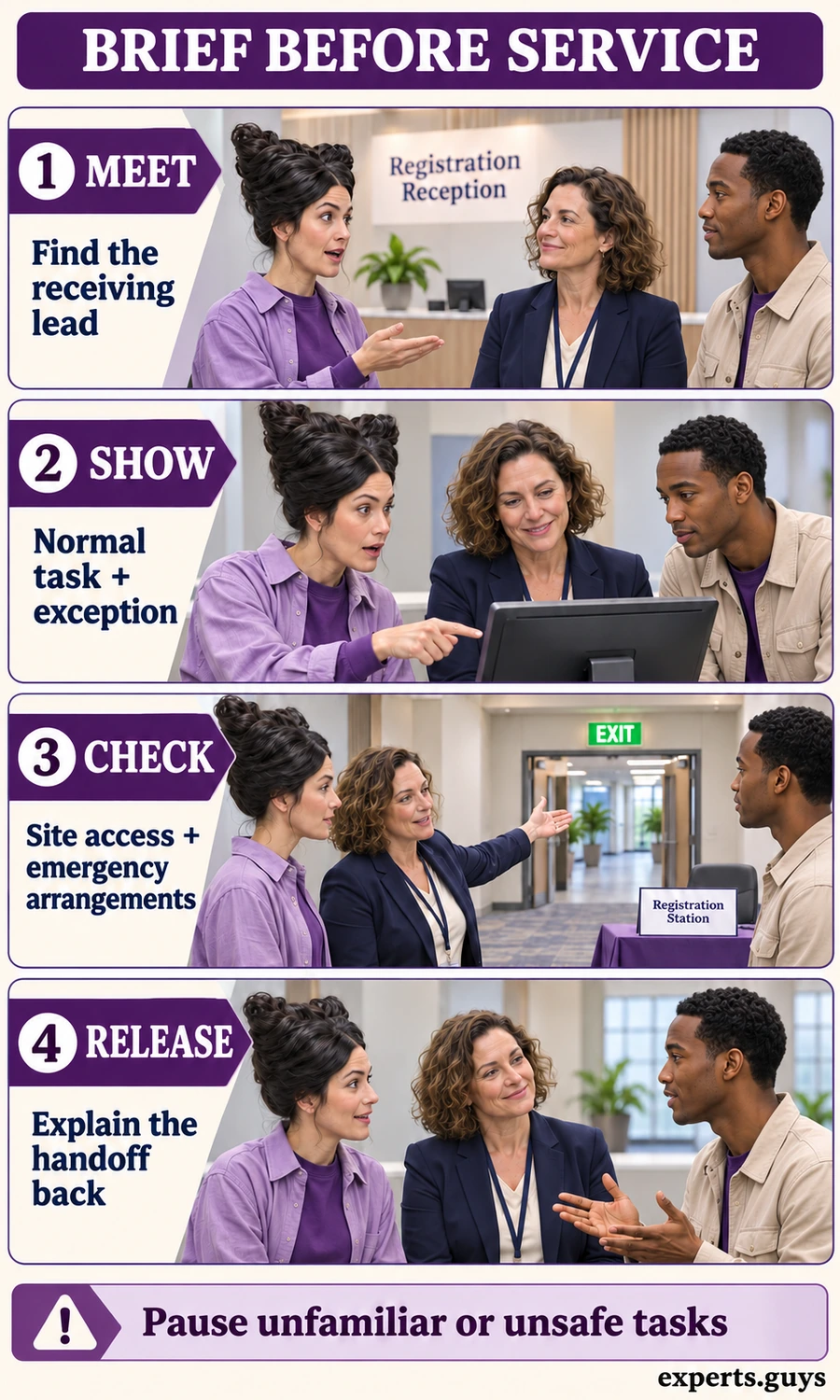
A verbal repeat-back is useful here: ask the worker to explain what happens when a guest’s booking cannot be found. The answer should identify the authorized lead, not an improvised workaround. This checks whether the briefing communicated the workflow; it is not a certification or evidence that all possible incidents have been covered. Repeat the relevant instruction if the explanation shows a misunderstanding.
A worker should not be sent to operate unfamiliar equipment, lift an unsuitable load or handle a hazardous substance simply because the role label includes setup or housekeeping. Pause the particular task and have the responsible supervisor resolve competence, equipment and instruction. The safer correction is a bounded task or suitable trained support, rather than an assurance that someone will learn while doing it.
Where a worker needs a different communication format or an accessible reporting route, arrange that with the appropriate lead before the handover. Demonstrate one task at a time and provide the relevant site information in a usable form. An easier briefing changes how the instructions are communicated; it does not remove the essential requirements for safe work or authority to make access decisions.
Reconcile the invoice against the accepted scope
After the assignment, compare the accepted order, authorized changes and invoice before concluding that a difference is an error. Check each role’s headcount, applicable billable duration and rate. Then identify minimum-hour adjustments, agreed extras and any replacement credit separately. Use the normal business records already created for the booking; this is not a request to start a personal diary or pen-and-paper exercise.
In an illustrative four-hour-minimum booking, a worker released after three hours may still generate four billable hours if that is the agreed minimum. Conversely, an invoice that applies a new premium without the agreed trigger needs clarification. An apparent discrepancy should be linked to the particular line and term, not to a general belief that agency fees are too high.
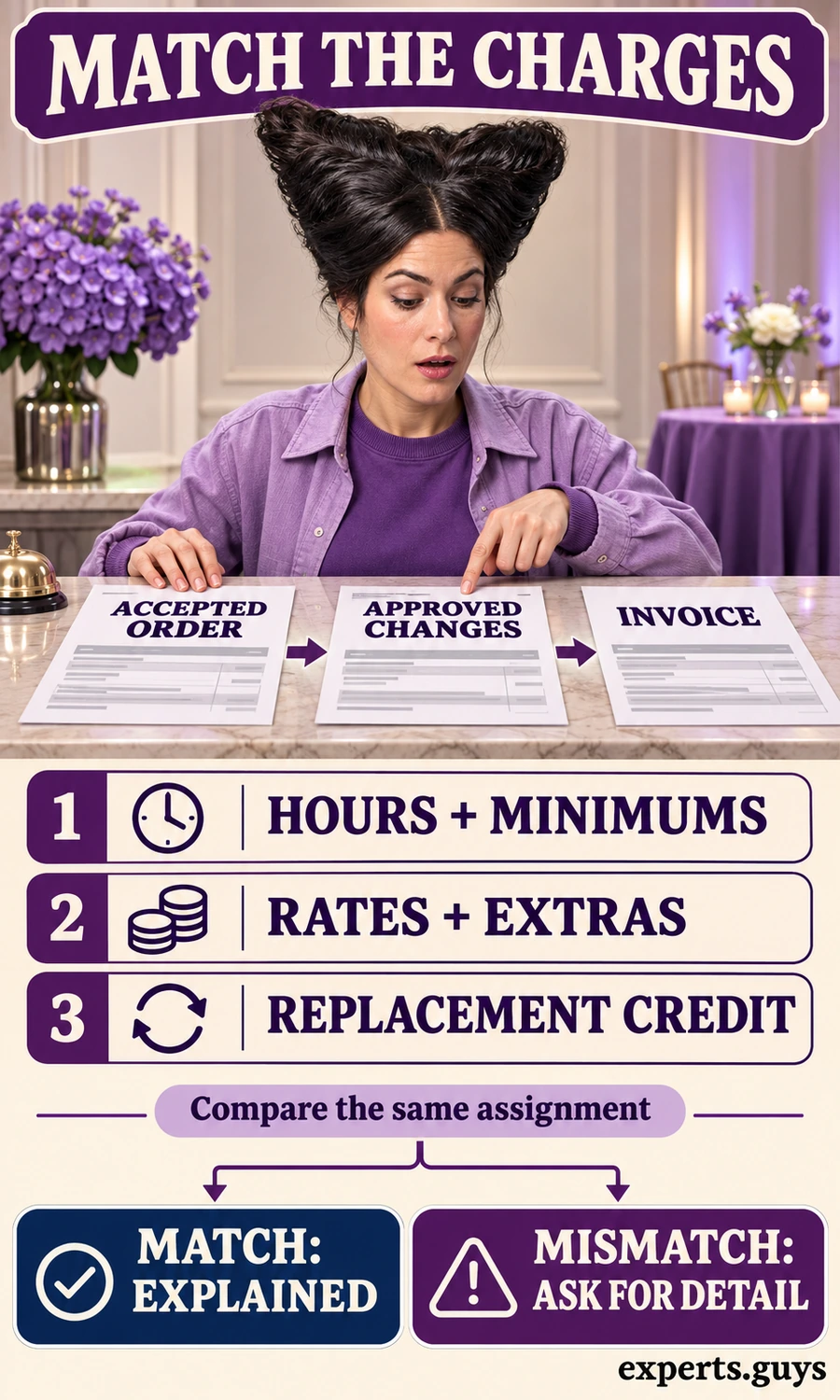
If a worker was replaced, trace the credit and replacement charge as separate items. A waived original-worker charge and a paid replacement shift can coexist. Establish whether a credit is already shown, will appear separately or remains disputed, and ask for the contractual basis of any unresolved item. Ask the coordinator to explain the undisputed items and the credit process separately; this general explanation does not determine the terms of a dispute.
Completion is an invoice whose quantities, rates, changes and credits can be explained by the agreed documents. If the billing basis cannot yet be reconciled, ask for an itemized clarification rather than silently changing the figures yourself. The practical result is a specific issue both parties can investigate, with the scope of the disagreement kept clear.
Separate commercial reconciliation from feedback about the work. A correctly calculated invoice can accompany disappointing service, and an arithmetic error can occur after a well-run shift. Describe service concerns against the agreed task and raise billing differences against the relevant quantity, rate or clause. Keeping those questions distinct helps the coordinator respond to the actual issue. It also prevents a late billing conversation from being mistaken for timely notification under a performance policy. The agreed notice route and the invoice review serve different purposes, even when the same assignment gives rise to both.
Questions that can still affect your booking
Does a careers page prove that jobs are open today?
No. A standing role description can remain online between assignments. Applicants should confirm the actual location, shift, pay terms and application route for a particular opening before making travel or availability commitments.
Does staffing include full event management?
Only if that scope is expressly agreed. Supplying assigned workers does not by itself include venue management, admission policy, production control or authority to change the event schedule. Identify the person who retains each of those decisions.
Can I hire an assigned worker directly afterward?
Check the agreement for conversion terms before making an offer. A temporary assignment does not establish whether a later direct hire carries a fee or a restricted period. Ask for the applicable clause and the circumstances that trigger it.
Should an organizer collect applicants’ identity documents?
Use the provider’s confirmed onboarding process and the venue’s legitimate access requirements. Do not collect sensitive documents merely to duplicate the agency’s employment checks. Clarify what information is necessary, who is authorized to receive it and how it is handled.
Does a replacement policy prove service quality?
No. It describes a possible remedy under stated conditions. It does not measure attendance, guest experience or the availability of an equally qualified replacement. Evaluate the actual scope and recovery arrangement alongside the policy.
Choose on the terms your event depends on
Occasions Staffing is a candidate when its advertised services match the assignment you need. Ask it to confirm the local role, the total price and the response arrangement for the period your event cannot afford to leave uncovered. Those answers establish whether the offer is usable for your venue; a performance slogan alone cannot do that.
If availability and scope are confirmed but replacement timing remains uncertain, decide whether the venue can safely absorb that uncertainty through the reduced-service arrangement described above. If an essential task would have no competent owner, hold that part of the booking until the gap is resolved. A clear acceptance decision is more useful than a star rating built from information that has never been tested.