


Finance recruiters help employers find and assess people for accounting, planning, treasury and other financial roles. The strongest match starts with the work a person must perform, the evidence needed to judge it and the supervision available after joining. Define those conditions before asking a recruiter for a shortlist.
This guide is for a hiring manager who already has a finance vacancy and wants to distinguish a credible match from a persuasive CV. The recommendation is to assess essential responsibilities separately: an impressive qualification or employer name should not cancel an unresolved gap in work the new hire must own immediately.
What should a finance recruiter understand before searching?
A recruiter needs to understand the role’s operating responsibilities, not simply its title or the fact that the employer handles money. A finance analyst in one organisation may build forecasts; another may reconcile balances. The same search term can therefore produce candidates with genuinely different experience, even when every CV appears relevant at first glance.
An accounting role might centre on accurate records, reconciliations, reporting and the close process. Financial planning and analysis, often shortened to FP&A, focuses more on forecasts, performance drivers and decision support. Treasury work concerns cash, funding and liquidity. These boundaries overlap in smaller teams, but overlap is a reason to describe the mix clearly rather than combine every finance skill into one requirement.
Financial services is a different kind of label: it describes an industry context rather than one universal occupation. A bank can employ accountants, analysts, product specialists and operations staff with different responsibilities. Experience working at a financial institution does not by itself establish suitability for every financial role, and corporate finance experience does not automatically establish the product knowledge required for a particular banking position.
Start with the result the business needs. A reconciliation vacancy should identify what must be reconciled, how exceptions are investigated and who approves corrections. A planning vacancy should identify which assumptions the analyst must build, which decisions the forecast informs and who challenges the recommendation. Those details change the evidence a recruiter should seek.

The reporting environment also matters. A person accustomed to one entity with straightforward transactions may need support in a group with several entities and intercompany balances. Someone who has used a large enterprise system may still need training in your approval workflow. Neither difference automatically rules a person out; the hiring question is whether it affects a responsibility that must be performed independently from the start.
Describe the working conditions alongside the technical work: reporting line, location, close timetable, team support and the intended employment arrangement. Keep conditions accurate and job related. If the business is still deciding whether the need is durable enough for employment, the separate guide to when a business is ready to hire addresses that earlier decision.
Turn the vacancy into a usable brief
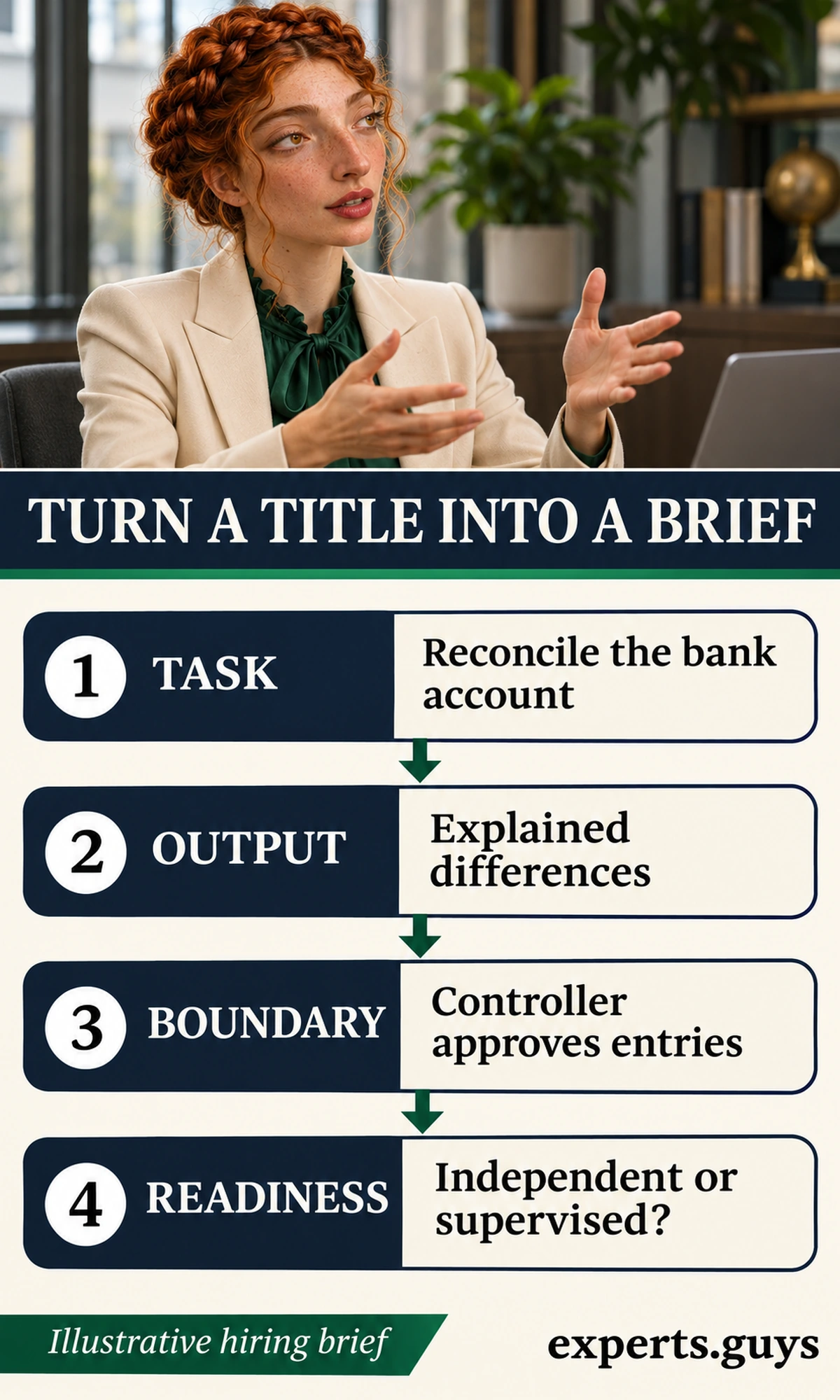
Use the existing digital requisition or discuss the role on a screen with the manager who owns the work. For each essential responsibility, settle the task, the output that shows completion, the limit of the employee’s authority and the readiness needed on entry. This is a role-design conversation, not a request for candidates to produce a diary or disclose confidential employer documents.
The logic follows the distinction in the U.S. Office of Personnel Management’s job-analysis guidance between tasks, the competencies needed to perform them and their relationship. The four-part brief below is an editorial application to finance recruitment, not an official assessment instrument or a guarantee of hiring success.
| Brief element | Decision and example |
|---|---|
| Task | What must the person do? Example: Reconcile the bank account and investigate exceptions. |
| Output | What shows that the work is complete? Example: A reconciliation that explains supported differences and identifies unresolved items. |
| Authority boundary | What can the employee prepare, recommend or approve? Example: Prepare explanations and proposed corrections; the controller approves entries. |
| Entry readiness | What must already be demonstrated? Example: Independent investigation, if the manager cannot provide daily technical supervision. |
For an illustrative reconciliation vacancy, the task is to reconcile the bank account; the output is a reconciliation with explained differences; the boundary is that the controller approves entries; and the readiness question is whether the employee can investigate independently. “Good with numbers” does not tell a recruiter any of this. The completed brief does, while leaving the manager accountable for what the role actually requires.
- Identify the recurring responsibility that the vacancy must cover.
- Define an inspectable output and the person who will review it.
- Separate preparation, recommendation and approval authority.
- Decide what must be demonstrated now and what the team can teach.
A common mistake is labelling every preference essential. Requiring the same software, sector, qualification, transaction volume and job title as the previous employee may exclude people who could perform the work with reasonable training. Keep a requirement essential when a specific responsibility or applicable rule makes it necessary, and explain that connection. Keep the remaining preferences open to evidence and discussion.
A qualification requirement needs the same specificity. If the appointment includes a duty that requires a particular authorisation, identify the duty and verify the applicable jurisdiction and current requirement through the appropriate official route. Do not assume that one accounting designation, financial-services licence or overseas credential grants every form of practice authority. Where no such requirement applies, explain which knowledge the qualification is intended to establish and consider whether the evidence being requested actually examines it. This prevents a preferred credential from becoming an unexplained proxy for unrelated work.
For a simpler start, brief just the responsibility whose failure would cause the most immediate operational problem. Confirm its output and reviewer before extending the brief to the rest of the role. You have enough to begin calibration when the recruiter can explain what would count as relevant experience without borrowing the vacancy’s adjectives.
How do you tell whether the recruiter understands the role?
Ask the recruiter to translate the brief back into candidate evidence and explain a plausible near miss. A recruiter who understands the vacancy should be able to distinguish relevant responsibilities from adjacent experience, identify uncertainties and challenge an unrealistic requirement. Familiarity with finance terminology is useful, but the explanation is what makes that familiarity inspectable.
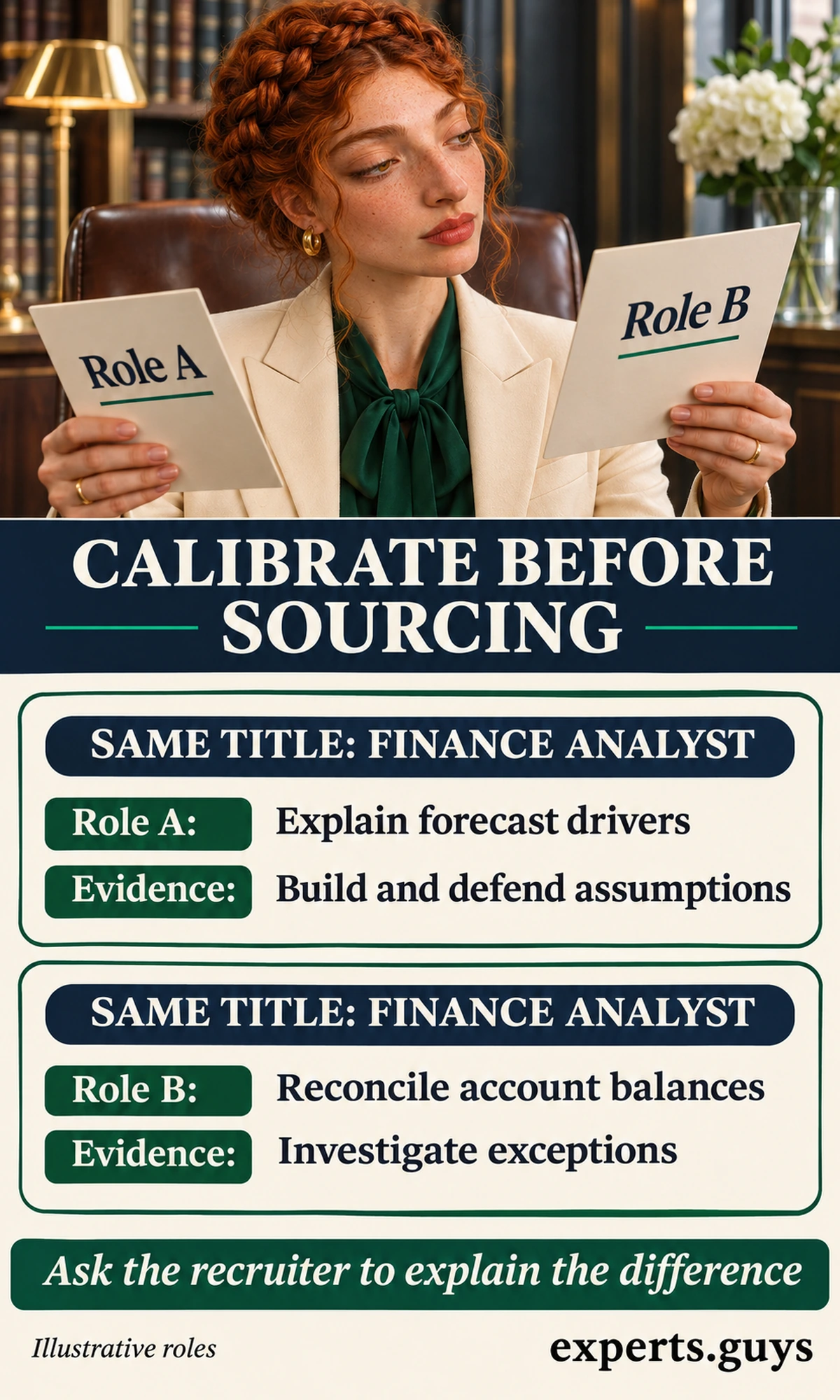
For example, suppose two illustrative roles share the title “finance analyst.” Role A needs someone to explain forecast drivers and defend assumptions; Role B needs someone to reconcile account balances and investigate exceptions. A CV showing budget presentation experience is more directly relevant to the first responsibility. It may still contain useful transferable skills for the second, but that possibility needs evidence rather than an automatic match.
Calibrate with a match and a near miss
Use anonymised example profiles or role descriptions during the first briefing conversation. Explain why one profile appears relevant, then ask the recruiter what evidence would be missing from a similar-looking profile. There is no need to expose real candidate data to create this comparison. The aim is to agree the distinction before live applications are screened against it.
The recruiter should connect each recommendation to work: “This person investigated unreconciled items and prepared corrections for review” is useful for the reconciliation brief. “This person worked at a famous bank” leaves the essential question unanswered. A capable recruiter can also say that the available profile does not establish ownership and that a specific follow-up question is needed.
Finish calibration by agreeing what the first candidate presentation should contain. Ask for the relevant responsibility, the evidence available, any important uncertainty and the candidate’s understanding of the opportunity. A short explanation with a clearly identified gap is more useful than a long sales paragraph that makes every candidate sound interchangeable. Do not require the recruiter to claim checks that have not happened.
If the conversation remains vague, simplify the example rather than adding more jargon. Compare just one task in the two profiles and ask who performed it, under what supervision and with what output. If the recruiter still cannot explain the distinction, consider a different recruiting team or a narrower search brief before expanding the search.
Pay attention to who will carry out the search. An impressive agency presentation does not establish that the person screening your vacancy understands it. Ask the actual recruiting contact to take part in calibration, and clarify how a handover to another consultant would preserve the agreed brief. If technical screening is performed by someone else, establish what that stage examines and what feedback reaches your hiring team. This keeps responsibility clear without requiring a recruiter to claim expertise beyond their service.
Agree responsibilities between the agency and employer as well. Initial screening, technical assessment, reference coordination and final selection are separate activities. An introduction service should not be mistaken for a completed technical evaluation. The broader guide to staffing agency arrangements explains the service models; here the important point is knowing which evidence your own team still needs to obtain.
A recruiter should be able to discuss constraints without claiming a perfect candidate is waiting. If the combination of responsibilities appears difficult to source, ask which requirement creates the constraint and what changing it would mean. Removing an unnecessary software preference is different from removing responsibility for independent close work. One can expand the search without changing the role’s core output; the other can create a different job.
Diagnose the search stage before changing the requirement
When a search stalls, review the stage at which useful candidates disappear. Discuss the actual reasons available through the approved recruitment system and verified conversations. Avoid deciding from a small batch that a whole market lacks talent. Stage information helps frame a question; it does not establish a universal benchmark or prove a cause on its own.
If submissions repeatedly show the wrong work experience, return to the task and evidence brief. If relevant people decline before interview, check the role’s conditions and how accurately they were explained. If candidates interview convincingly but struggle with the work sample, inspect both the interview’s evidence standard and the sample’s relevance before assuming the same remedy applies to everyone.

For example, imagine a reconciliation search where the candidates all discuss commercial forecasting. Increasing CV volume would probably repeat the mismatch until the brief or search interpretation changes. In another illustrative search, candidates have appropriate experience but decline a schedule they only learn about late. The correction there is an accurate conversation about the schedule and whether it can change, rather than a harder technical test.
Make one targeted revision, explain it to the recruiter and keep the essential work constant unless the business deliberately redesigns the role. You can then see whether the next group is relevant under the revised brief. If several conditions change together, it becomes harder to tell whether the role, the sourcing or the offer caused the difference.
What evidence makes a finance shortlist worth interviewing?
A useful shortlist connects each candidate to the essential work and distinguishes demonstrated ability from an assertion, an assumption and an unanswered question. Relevant experience, a structured conversation and a suitable work sample can each contribute different evidence. None should be treated as a complete picture of future performance, and an attractive CV is not a substitute for assessing the responsibilities that matter.
Before interviewing, decide which responsibility each stage will examine. Otherwise several interviewers may repeat the same career-history conversation while no one checks exception handling, forecasting judgment or the limits of the person’s authority. Use the brief to give each stage a purpose, while keeping the assessment conditions consistent for candidates applying for the same work.
Ask what the candidate personally owned
Choose one real responsibility from the brief and ask a job-related question about comparable past work. Then probe the candidate’s own actions: what they received, what they checked, what they could decide and when they involved someone else. Keep the main questions and answer standards consistent. Follow-up clarification should help establish the evidence rather than quietly give one person a different test.
The OPM structured-interview guidance describes predetermined questions and common evaluation standards. Applying that principle here means agreeing what counts as a sufficiently specific account of ownership before comparing candidates. It does not mean accepting a polished rehearsed answer without clarifying what the person actually did.
- Ask: “Describe an unexplained difference you had to investigate. What part did you personally own?”
- Probe: “What did you check first, what remained uncertain and who approved any correction?”
- Compare the answer with the same expectations for investigation, authority and explanation used for other candidates.

In the illustrative reconciliation role, “our team completed the close” does not identify the candidate’s contribution. A more informative answer distinguishes retrieving the balances, identifying timing items, investigating an exception and preparing a correction for approval. A candidate who explains that a supervisor owned the judgment may be accurate and suitable for a supported role. The answer simply does not establish independent ownership of that judgment.
Do not turn the discussion into a demand for customer names, account numbers or screenshots from a previous employer. A person can explain the logic and their responsibility using anonymised details. Treat a sensible confidentiality boundary as something to work with, rather than pressuring applicants to expose information they should protect.
If the candidate cannot access comparable past experience, use a relevant hypothetical question and identify the evidence accordingly. Describing how someone would respond is different from establishing what they have already performed. For a junior role, that distinction can support a fair discussion of learning and supervision; for an immediate independent responsibility, it may leave an important question unresolved.
Use a work sample that resembles the actual responsibility
A work sample should examine a competency the role requires on entry, using invented or safely prepared information and a clear task. Tell candidates what output is expected, which resources are permitted and how the result will be considered. Keep the exercise proportionate to the vacancy and avoid asking applicants to complete productive client work for free under the label of assessment.
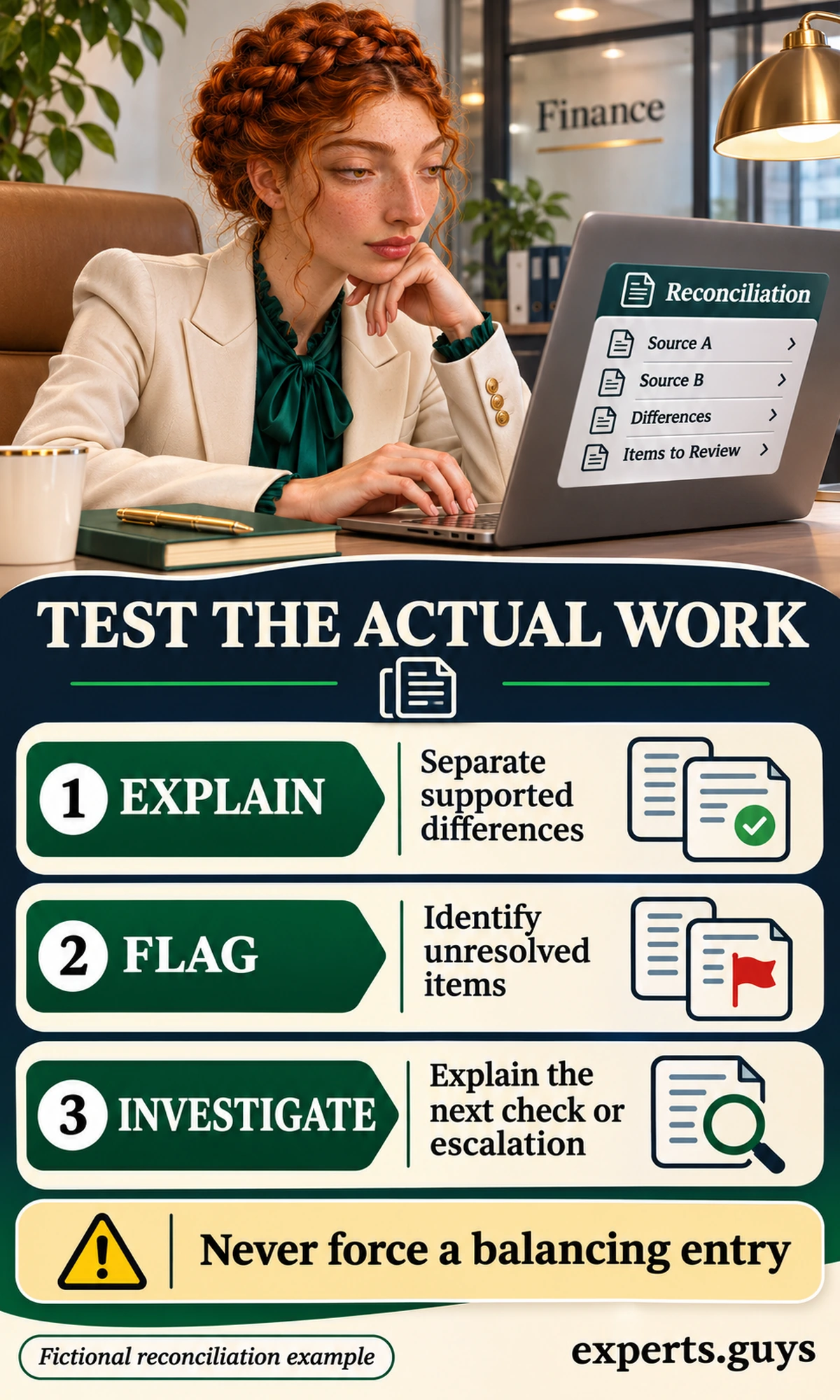
For the reconciliation example, provide a small fictional set of balances and supporting items. Ask the candidate to identify explained differences, flag what remains unresolved and describe the next investigation or escalation. Do not encourage an entry that makes the totals agree without support. The useful signal is the reasoning around the remaining difference, together with an accurate account of what the candidate can and cannot conclude.
The same format would be a poor test for an FP&A role whose central task is evaluating forecast assumptions. That role needs an exercise exposing the relevant planning judgment, not a borrowed accounting puzzle merely because it is easy to mark. Similarly, testing a system-specific task that will be taught after appointment may measure prior exposure rather than the intended entry requirement.
The OPM explanation of work samples makes the entry-competency limitation explicit. A sample also covers only the task and conditions it actually presents. A successful exercise does not establish expertise in every close process, accounting standard, reporting system or difficult stakeholder conversation the role might eventually involve.
Agree the interpretation before candidates attempt the sample. For this illustrative task, an adequate response separates supported explanations from unanswered items and identifies an appropriate next step. A concern would be concealing uncertainty or forcing a balancing correction without evidence. These are example observations for designing a discussion, not a validated pass mark or a universal rejection rule.
If accessibility or unfamiliar presentation interferes with the task, address the assessment conditions through the appropriate process. In the United States, the EEOC’s guidance on employment tests explains the relevance of anti-discrimination requirements, job relatedness and accommodation. Other jurisdictions have their own requirements. Consistency means applying appropriate standards fairly, not refusing adjustments that a lawful assessment process requires.
For a smaller exercise, examine one representative exception rather than an entire month-end pack. The task is complete when you have enough job-relevant evidence to discuss the candidate’s reasoning and limitations, not when every candidate has spent the same arbitrary number of hours. Where a formal assessment is consequential, its design and use need appropriate expertise; these examples do not establish that a bespoke test is legally or professionally validated.
When is a candidate ready for an offer?
A candidate is ready for an offer decision when the employer has enough relevant evidence about essential responsibilities, understands any remaining conditions and can provide the support the appointment assumes. A missing trainable skill and an unverified critical responsibility are different problems. Decide which one you have before treating a candidate as ready or unsuitable.
This distinction prevents a common shortcut: adding up attractive features until the total feels reassuring. Several strengths do not establish an unrelated essential capability. Equally, one unfamiliar system does not necessarily outweigh evidence that the person understands the underlying work and can be supported while learning the local workflow. The decision depends on the actual requirement and available supervision.
Compare evidence, gaps and support separately
Consider an illustrative direct-hire vacancy: the person must independently investigate reconciliation exceptions, prepare a clear explanation and submit any proposed entry to the controller. The business can teach its software workflow, but the controller cannot provide daily investigative supervision. These assumptions determine what can be trained; they are not claims about every employer or finance role.
Candidate A explains comparable independent investigation and handles the fictional sample appropriately, but has not used the employer’s software. Candidate B knows the software but describes only supervised processing and has not demonstrated independent investigation. Candidate C explains the relevant experience, but the agreed sample has not yet been completed. Their gaps require different responses.
| Candidate | Evidence and next action |
|---|---|
| A: software gap | Comparable investigation and sample reasoning demonstrated; local software unfamiliar. Next action: Confirm suitable onboarding and remaining appointment conditions. |
| B: ownership gap | Software familiarity established; independent investigation not demonstrated. Next action: Clarify capability and available support; do not assume the essential work is covered. |
| C: evidence gap | Relevant experience described; agreed assessment unfinished. Next action: Complete the proportionate check before making the comparison. |

A sensible next step for A is to evaluate the remaining appointment conditions and confirm that software onboarding is genuinely available. For B, clarify the missing evidence and whether the role can be redesigned with support; do not silently remove the essential responsibility. For C, complete the proportionate assessment before deciding. None of these labels is a personal judgment or an automatic hiring recommendation.
The sequence is straightforward: compare each essential responsibility with the evidence, classify the remaining issue, and choose an action that resolves that issue. Use “demonstrated,” “not yet verified” and “requires support” precisely in the hiring discussion. If there is direct contrary evidence, discuss that separately rather than hiding it behind an ambiguous “potential” label.
When evidence conflicts, examine the conflict. A convincing interview and a poorly explained sample might reflect rehearsed language, misunderstood instructions, an unsuitable exercise or a genuine capability gap. Ask a relevant clarification and review the conditions before concluding. Repeating interviews until someone gives the preferred answer is not the same as resolving the uncertainty.
Make the appointment match the support promised
Before confirming an appointment, carry the agreed responsibilities into the offer and onboarding discussions. The recruiting process may have assumed a particular reviewer, a limited approval role or a supported start. If those conditions disappear after selection, the business is accepting a different operating arrangement from the one it assessed.
Confirm the manager, the initial outputs, the review route and the access needed for those outputs. Separate preparation of payments or journals from authority to approve them according to the organisation’s actual controls. Do not grant broad financial access simply because a recruiter described the candidate as senior. A title is not an access-control specification, and the recruiter does not replace the employer’s approval process.

For the illustrative reconciliation hire, the initial output could be one prepared reconciliation reviewed by the controller before the person takes responsibility for the wider schedule. The manager should explain which exceptions can be investigated independently and which must be escalated. If the controller is unavailable, identify an authorised alternative or revise the start arrangement rather than leave the new employee to guess.
This is where the distinction between work and accountability becomes practical. The broader article on business roles and decision responsibilities addresses that organisational question. The finance recruitment application is narrower: carry the role’s assessed authority and supervision into the actual working arrangement, so a strong shortlist does not end in an unsupported appointment.
An urgent deadline changes scheduling, but it does not establish missing capability. If the required support is unavailable, the options may include narrowing initial responsibilities, obtaining appropriate cover or continuing the search. Each has a cost. Hiring someone into an independent role while privately planning to teach its essential work later hides that cost instead of resolving it.
After joining, use the ordinary work-review process to check whether the assigned outputs and support match the agreed role. A problem may arise from missing access, unclear instructions or workload as well as capability. Return to the responsibility and the actual obstacle before asking the recruiter to replace someone. A replacement clause, if one exists, is a contractual term rather than evidence of what caused a working problem.
Frequently asked questions
Does this guide verify an agency called Monetary Solutions Recruiters?
No. If you are considering an agency under that name, first establish its exact official business identity and the services it actually provides. This guide explains finance recruiting and does not verify or endorse a particular company, its client history or its placement results.
Does every finance vacancy need a particular qualification?
No single credential establishes suitability for every finance vacancy. The duties, seniority and jurisdiction determine whether a particular authorisation or qualification is required. Where a credential is a preference, explain the knowledge it is intended to demonstrate rather than treating it as proof of unrelated responsibilities.
Should a recruiter provide confidential candidate work samples?
Do not request confidential material from an applicant's current or former employer. Use an appropriately prepared fictional exercise or an explanation with sensitive details removed. Agree how assessment material will be handled and shared through the approved recruitment process; assess the relevant reasoning without collecting unnecessary private information.
Does a replacement guarantee establish that the hire will succeed?
No. Any replacement provision depends on the actual agreement, its conditions and its limits. It does not prove a candidate's capability or guarantee performance. Clarify the service terms separately from the evidence used for the hiring decision, and do not assume a future replacement resolves a missing essential skill today.
Can an internal applicant be assessed with the same approach?
Yes, provided the process suits the vacancy and is applied fairly. Familiarity with colleagues should not substitute for evidence of a newly required responsibility. Existing work may supply useful evidence, but distinguish what the applicant already owns from what the proposed appointment would newly require, including any change in supervision or authority.
Next steps
Take the responsibility that would be most difficult to leave uncovered and settle its output, authority boundary and entry requirement with the hiring manager. Use that brief to calibrate the recruiter, then obtain the specific evidence still missing from the shortlist. Proceed with an appointment only when the role you can support matches the role you have assessed.