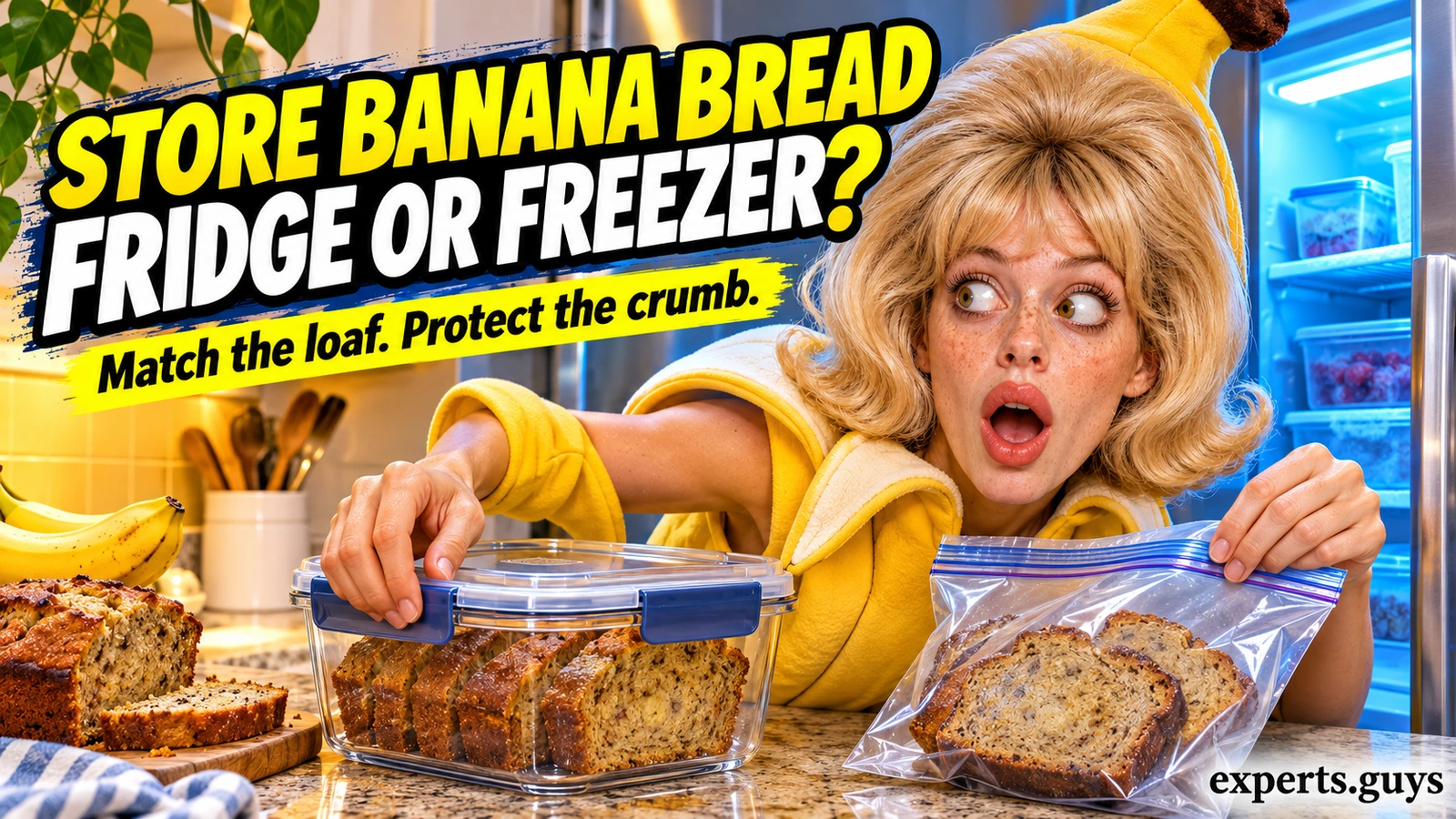
Storing banana bread means protecting its moist crumb while choosing a temperature that suits the recipe, topping and time until serving. Follow the recipe or package directions, refrigerate loaves with perishable toppings, and freeze well-wrapped portions you will not use soon rather than giving every loaf the same countertop deadline.
Which banana bread needs cold storage?
Start by separating three questions: what is in the finished loaf, how it has been handled, and when you intend to eat it. Words such as healthy, oat, whole-grain or low-sugar do not establish a safe storage period. A homemade loaf and a commercially packaged product may have different formulations and instructions.
For a moist homemade loaf with no clear storage guidance, refrigeration is a practical default and freezing is useful for the surplus. A moist oat-banana bread may specifically require refrigerator or freezer storage, even when it has no frosting. Cold storage slows deterioration; it does not reverse poor handling that happened earlier.
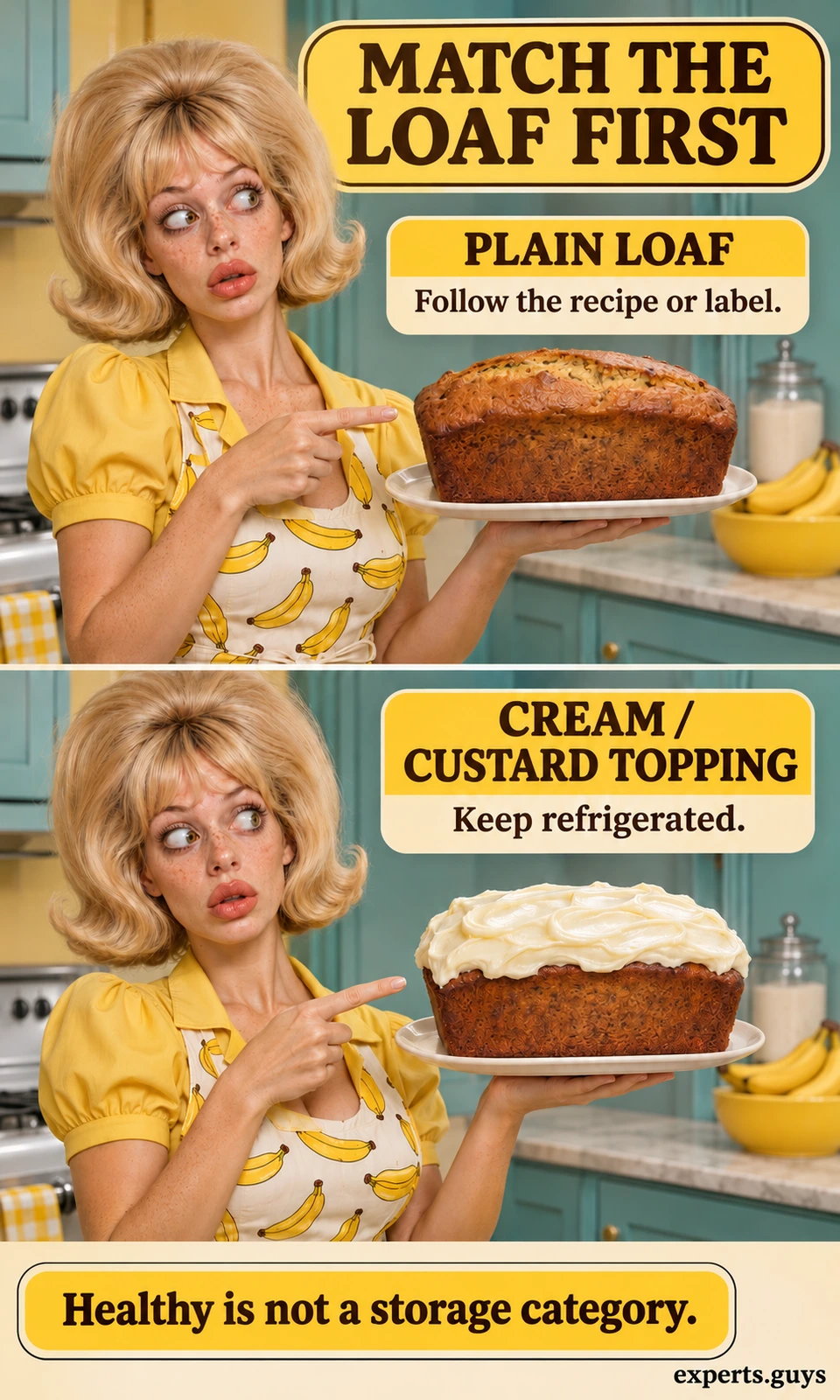
A cream-cheese frosting, whipped-cream topping or custard filling changes the decision. Keep these perishable versions refrigerated unless the exact product or professionally validated formulation explicitly allows another approach. For perishable foods, the usual room-temperature limit is two hours, shortened to one hour above 90°F / 32°C; refrigeration does not reset time already spent warm.
- Plain homemade loaf: use the recipe’s storage instructions; if they are missing, refrigerate after cooling and freeze the surplus.
- Cream, custard or other perishable topping: keep refrigerated and follow its handling limits.
- Packaged loaf: follow the label, including instructions that change after opening.
- Mold or an unsafe storage history: discard rather than trying a different package.
Why “never refrigerate banana bread” is too broad
Refrigeration can make some breads feel firmer, but firmness and unsafe spoilage are different problems. Changes in starch structure can affect texture even when the package has retained moisture. That quality trade-off does not justify leaving a perishable topping on a warm counter.
Eggs, milk or yogurt baked into a loaf are not the same situation as a fresh cream topping added afterward. The finished recipe matters, including its formulation and how thoroughly it was baked. Do not try to infer shelf stability from one ingredient or from how dry the surface feels.
Counter storage can be appropriate for some plain quick breads when the recipe or manufacturer explicitly permits it. A cool room is also different from a kitchen heated by sunshine or cooking. Avoid transferring a room-temperature recommendation from one recipe to another wetter or heavily modified loaf.
For planning, keep only the amount you expect to eat over the next few days in the refrigerator and freeze the rest early. This is a household-use strategy, not a laboratory-validated shelf life. Without recipe-specific guidance, a promise such as “safe for ten days” is more precise than the evidence allows.
A useful freezer target for plain quick bread is two to three months for flavor and texture, with an intact package and continuous frozen storage. That quality window is not a countdown that proves safety before its final day. An already spoiled loaf does not become acceptable when frozen.
Start with the label or recipe category, then choose a package that supports it. The image below makes the main distinction visible: a plain loaf follows its own instructions, while a perishable topping needs cold storage. You do not need to change the bread recipe to make this storage decision.
Check the temperature where you store the bread
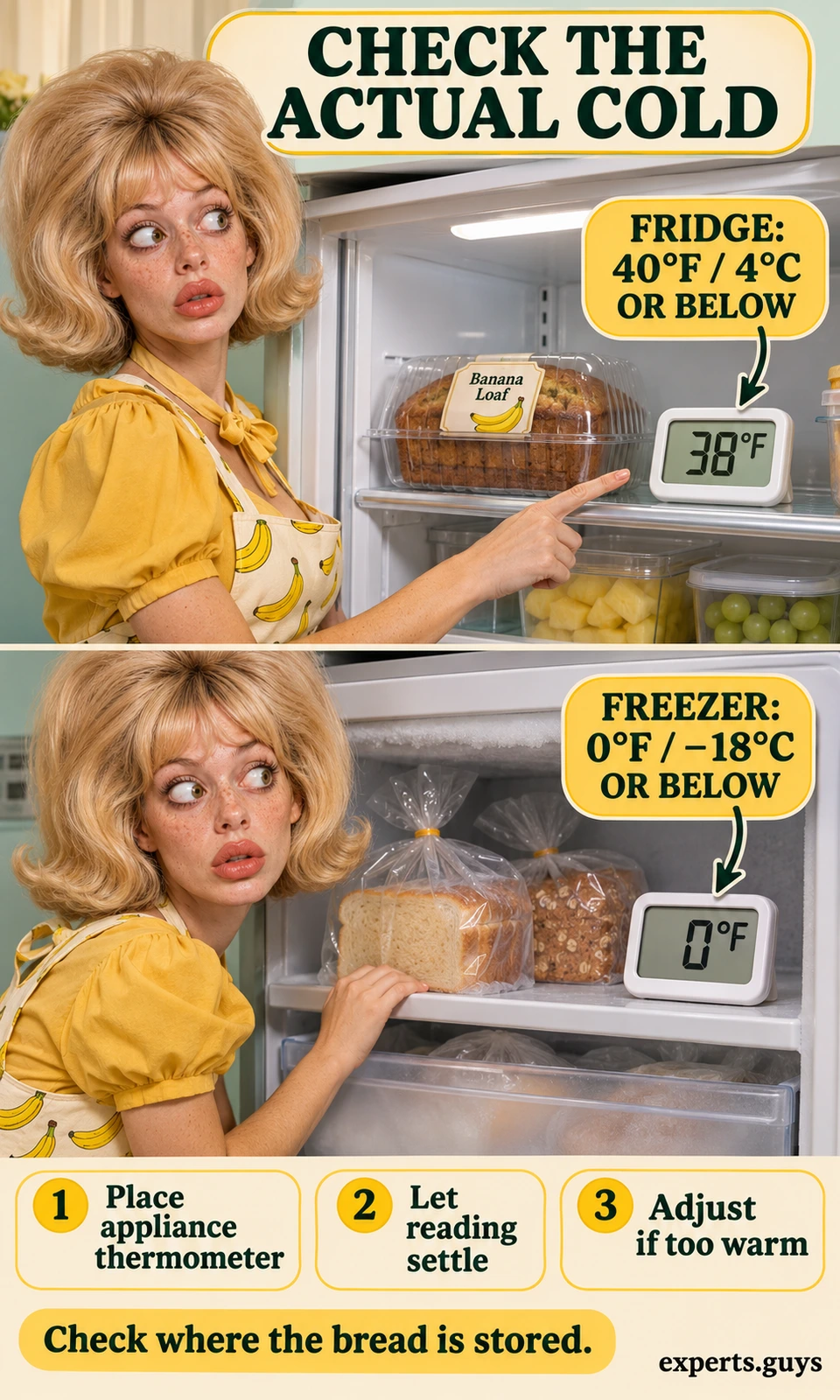
Place an appliance thermometer near the packaged bread, let its reading settle with the door closed as the thermometer instructions specify, and compare it with the target. Keep the refrigerator at 40°F / 4°C or below and the freezer at 0°F / −18°C or below. An appliance control marked “3” or “colder” does not tell you the actual temperature.
If the reading is too warm, adjust the appliance using its instructions and recheck after it stabilizes. Do not pack food so tightly that air cannot circulate, and keep the closed bread container away from raw-food drips. A better reading afterward does not establish that a previously warm perishable loaf was safe throughout.
How do you package banana bread without trapping water?
Protect the cut face, then check the closure
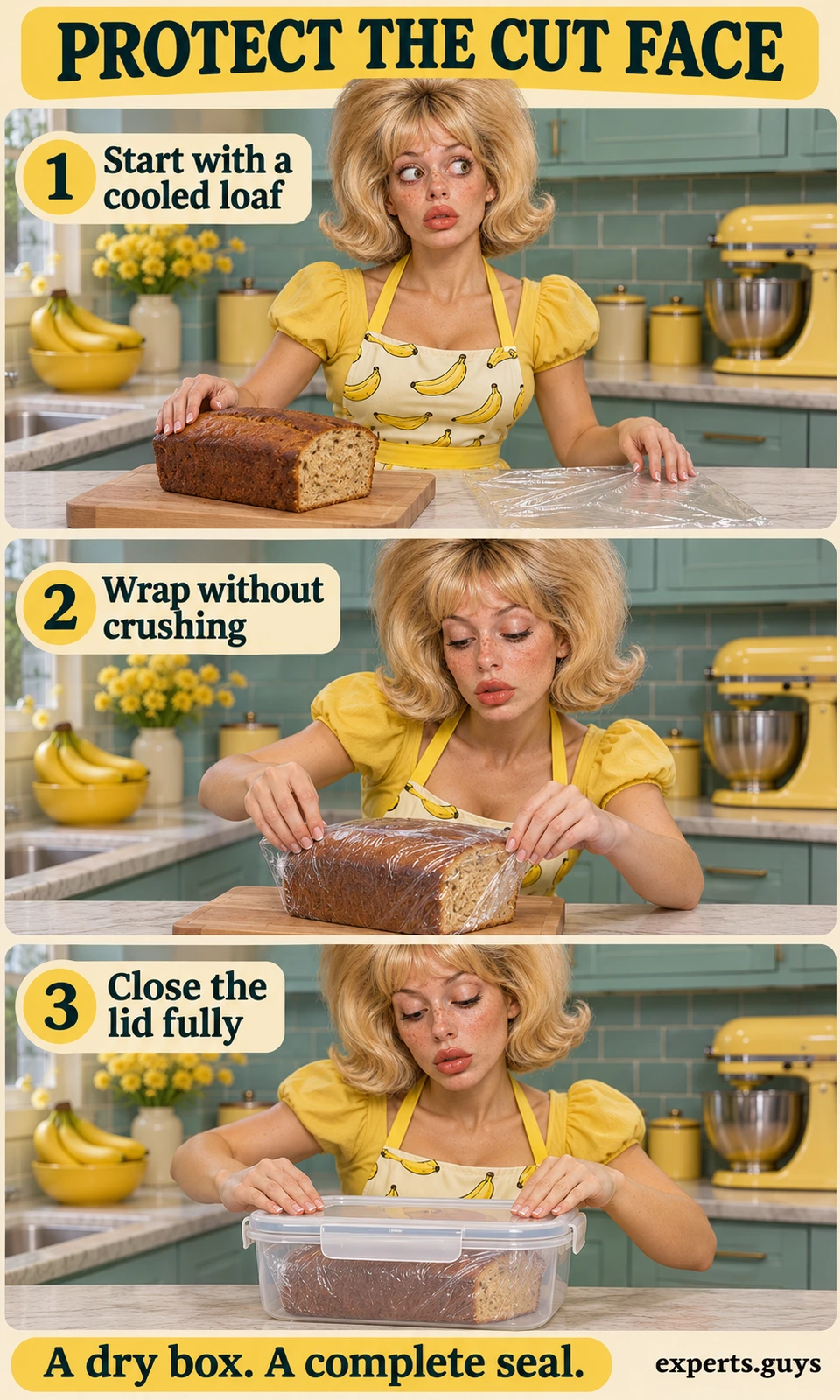
Begin with a fully cooled, fully baked plain loaf and clean, dry packaging. The baking and center-doneness checks belong with the oat-banana-bread preparation guide; storage starts after that stage. A wet, underbaked center is not a problem that wrapping can solve.
Place food-safe wrap against the exposed cut end and bring it around the loaf, closing the seams without compressing the crumb. The cut face loses moisture readily because it lacks the crust’s partial barrier. Keeping the remainder in one piece reduces exposed surfaces; cut extra portions only when you intend to freeze them separately.
Set the wrapped loaf in a clean, dry lidded box and check that each latch or edge closes completely. A box should fit without pressing the bread against its lid. For short refrigerated storage, a well-sealed food bag or suitable airtight box can also work; the extra wrap is useful protection for the cut face, not a requirement to use endless layers.
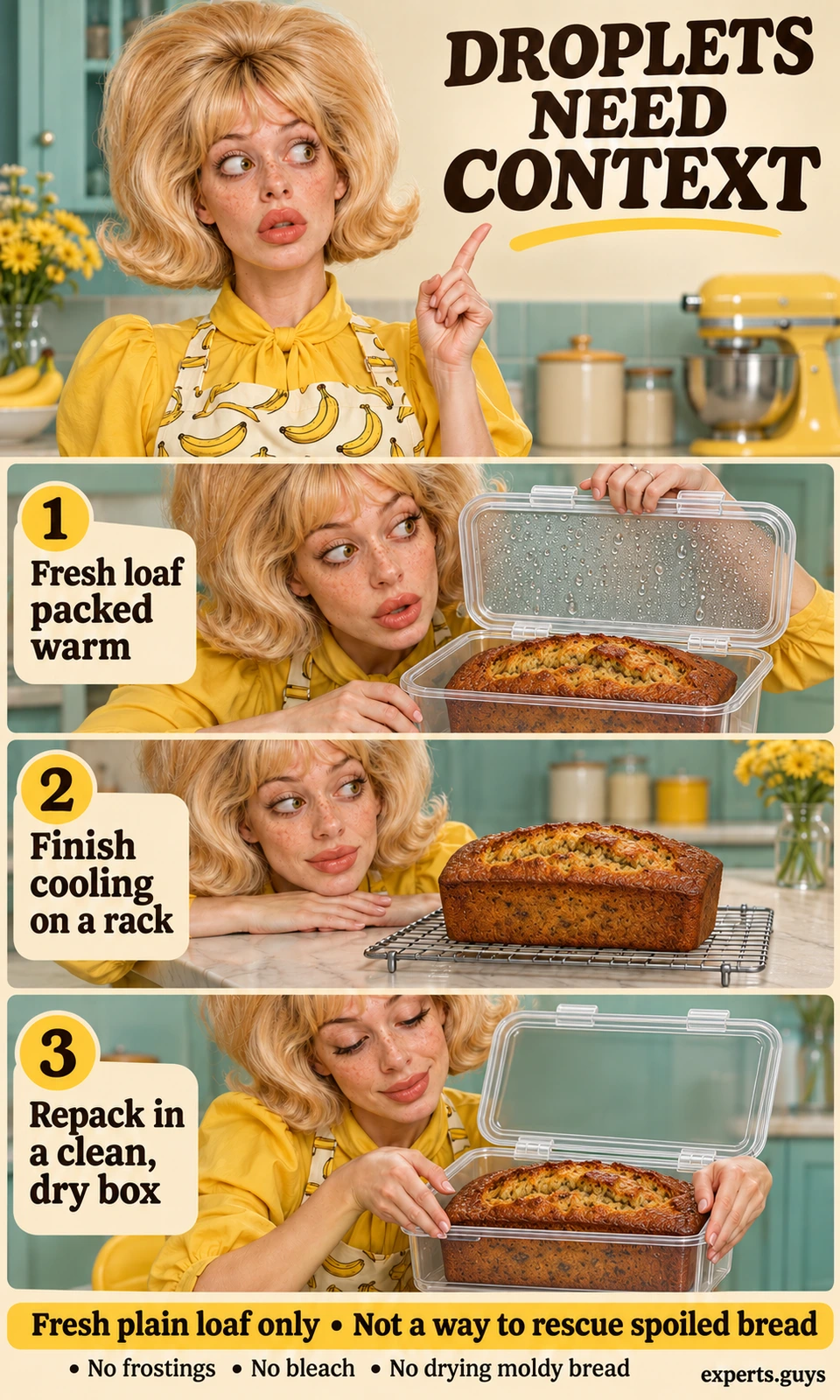
What if droplets appear inside the lid?
Droplets can form when warm, moist air meets a cooler lid. They do not automatically prove mold, but they also do not prove the food is safe. The explanation of refrigerator condensation covers the wider moisture mechanism; here the important question is whether this is a freshly baked plain loaf packed too soon or food with an uncertain history.
If you have just packed a fresh plain loaf while it is still warm, remove it from the box and finish cooling it on a clean rack. Replace the wet packaging with a clean, dry container before resealing. Do not leave a cream-topped or custard-filled loaf out merely to dry its surface, and do not apply this procedure to old bread that has developed unexplained wetness.
The completion check is simple: the plain loaf has cooled, the package is dry and the lid closes properly. A paper towel can absorb some droplets, but it cannot correct a warm refrigerator or extend a food’s safe life. If the loaf is questionable, stop treating moisture control as a rescue method and use the discard guidance below.
| Packaging choice | Useful job | Important limit |
|---|---|---|
| Close food-safe wrap | Protects the cut face and reduces moisture exchange. | Do not squeeze the loaf flat; remove before heating. |
| Dry lidded container | Protects the bread and keeps its shape. | A loose lid or a damaged seal defeats the purpose. |
| Freezer-rated bag or container | Adds a moisture-vapor barrier for frozen portions. | A thin bread bag or parchment alone is not equivalent. |
| Parchment between portions | Keeps slices from sticking to one another. | It separates slices; it is not the main freezer barrier. |
| Paper towel | May absorb small amounts of surface condensation. | It does not prevent mold or establish a longer shelf life. |
How do you freeze, thaw and serve portions well?
Pack portions behind a freezer barrier
Freeze bread while its quality is still good, rather than waiting until you are uncertain about it. Decide whether you normally eat one slice or share several, then package that serving size. The useful change from storing a whole loaf is that the remaining bread can stay frozen while you take only what you need.
Use packaging intended for freezing: moisture-resistant freezer wrap, a freezer-rated bag or a suitable rigid freezer container. Parchment can sit between slices but should remain inside that barrier. Freezer packaging needs resistance to moisture loss; a package that looks closed is not necessarily suitable for months in the freezer.
- Wrap each cooled serving portion closely with food-safe wrap, or separate portions inside a suitable freezer container.
- Place wrapped portions in the freezer bag, gently move surplus air toward its opening and close the zipper fully. Press the empty part of the bag, not the bread.
- Arrange the packets flat in the freezer so soft slices are not crushed beneath heavier food. Keep the portions accessible without repeatedly opening every packet.
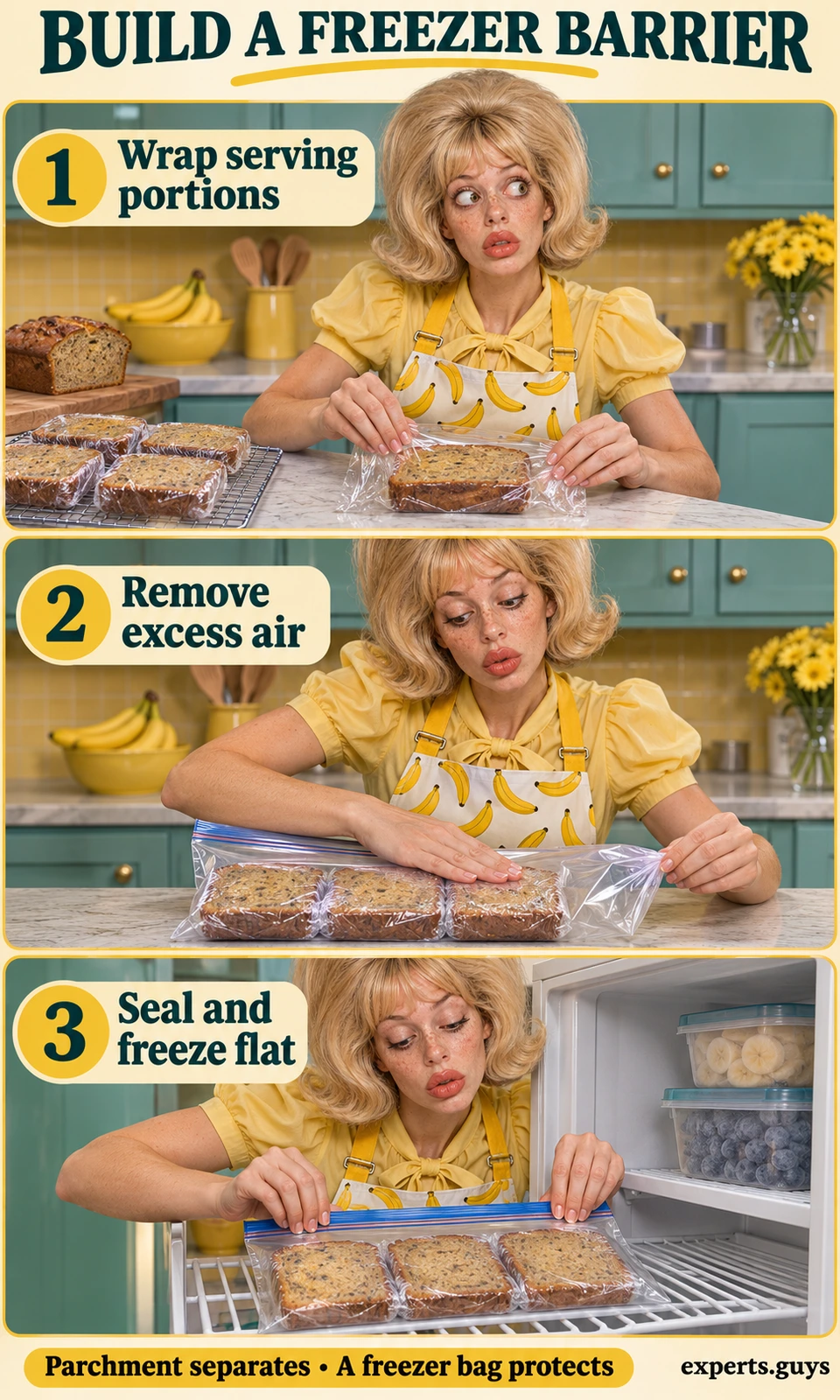
For example, if a loaf gives twelve slices and you normally eat one at a time, twelve small packets let you remove one serving without thawing the other eleven. If that is more packaging than you want, group two or three slices per packet and choose a serving plan that uses the group. The packaging decision follows how you eat, not a compulsory slice count.
The two-to-three-month freezer target is about retaining eating quality. Storage temperature, air leaks and handling affect the result, and some recipes deteriorate sooner. Dry freezer-burned patches can reflect moisture loss rather than mold, but unfamiliar discoloration or an uncertain storage history should not be diagnosed confidently from appearance alone.
Thaw a serving, not the whole supply
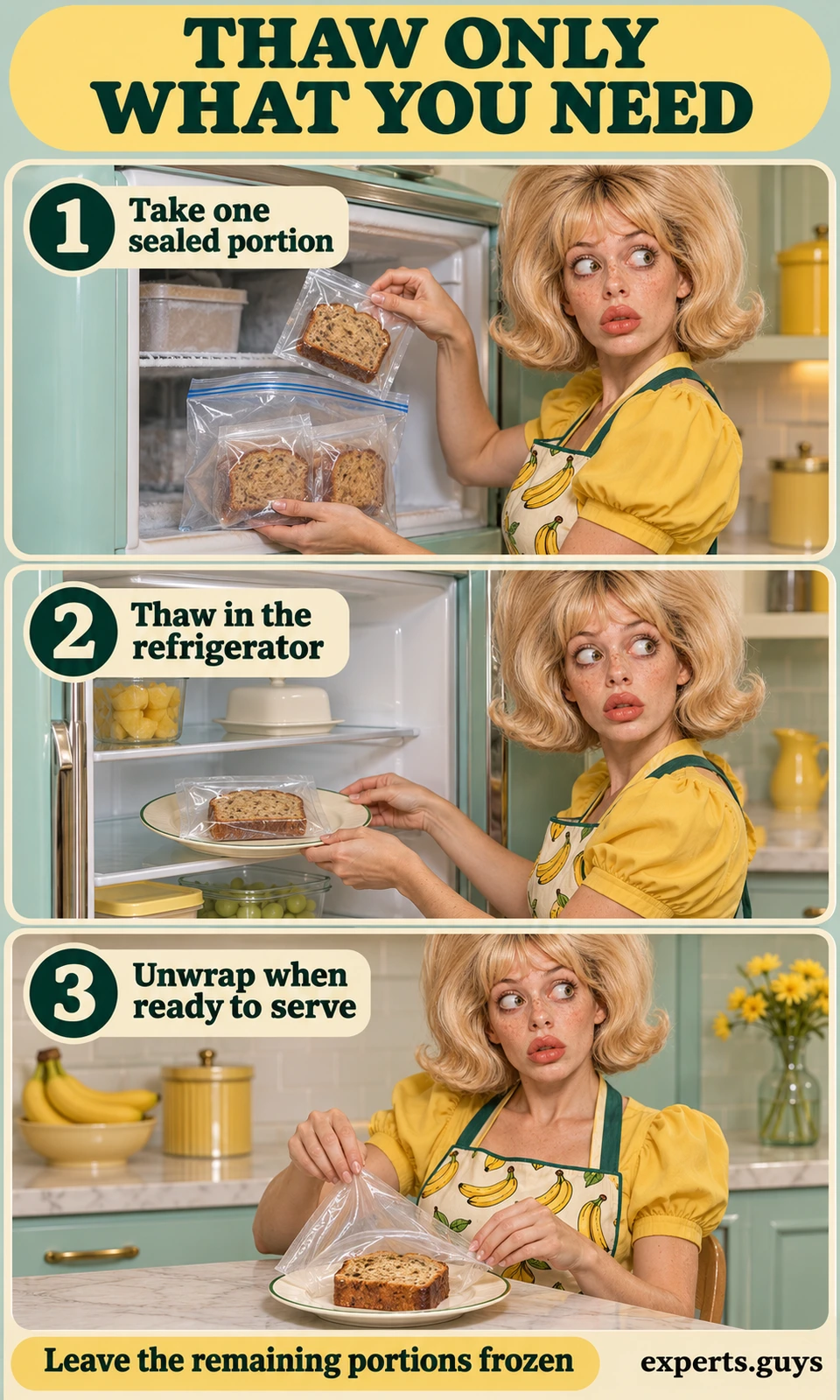
Take out one sealed portion, put it on a plate in the refrigerator and leave the other packets frozen. Keep the thawing portion protected in its food-safe package; open it when it has thawed and you are ready to serve it. Thin slices thaw sooner than a whole loaf, so allow time based on the portion rather than promising a fixed number of minutes.
Refrigerator thawing is a straightforward option for this guide and keeps perishable versions cold. Some plain quick-bread recipes permit room-temperature thawing, but that permission does not automatically apply to cream or custard toppings. Follow the recipe and topping instructions if they are more specific, and do not repeatedly warm and chill the entire supply.
Refresh a firm slice without overheating it
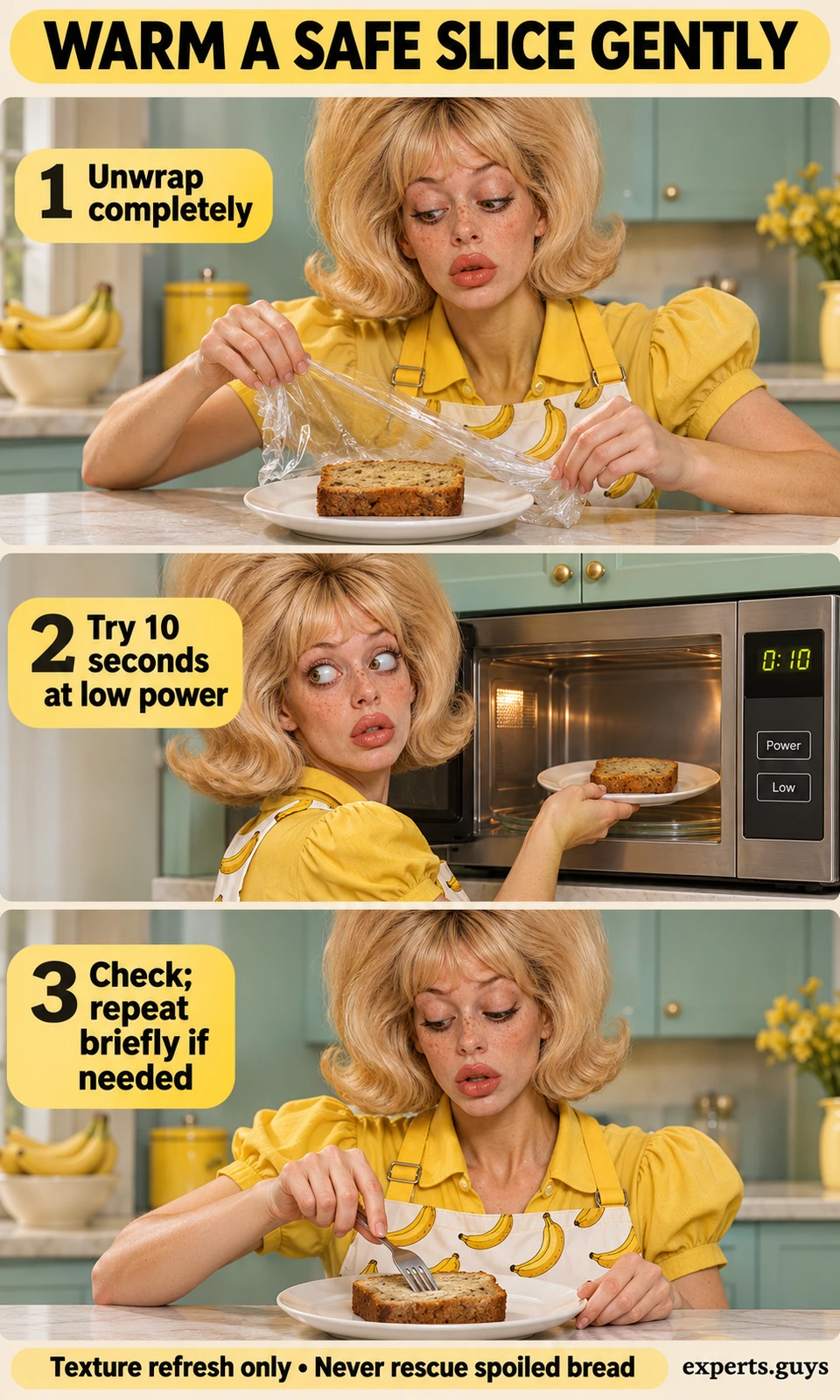
For a fully thawed, properly stored, plain slice, remove every piece of wrap and place it on a microwave-safe plate. Try a short ten-second interval at low power, then check the texture; repeat briefly only if it still needs warming. This is a cautious starting point for a small slice, not a universal heating time, because microwave power and slice thickness vary.
Stop when the slice feels pleasantly warm rather than steaming hot. Long heating can make the edges tough as the slice cools, so the first interval should be a trial. Keep foil, ordinary plastic wrap and the storage bag out of the microwave; this step changes texture and does not disinfect moldy or mishandled food.
What changes mean discard rather than refresh?
A firmer crumb after chilling, a little dryness or a softened crust can be a quality change. Fuzzy growth, suspicious new patches, an unexplained off odor or a known unsafe handling history call for a different decision. Banana fibers and baked-in ingredients can leave dark marks, so color alone is not a reliable identification test.
If there is visible mold, discard the entire loaf rather than cutting around it. Bread is porous, and contamination can extend beyond the patch you can see. Do not sniff it closely or taste a small piece to decide whether the rest is acceptable.
Keep the loaf contained, close it in a disposal bag and put it in the bin; then wash the reusable container and any affected food-contact surface before using them again. Do not wash bread, apply cleaners to it or rebake it as a mold remedy. Heating a spoiled loaf is not a substitute for discarding it.
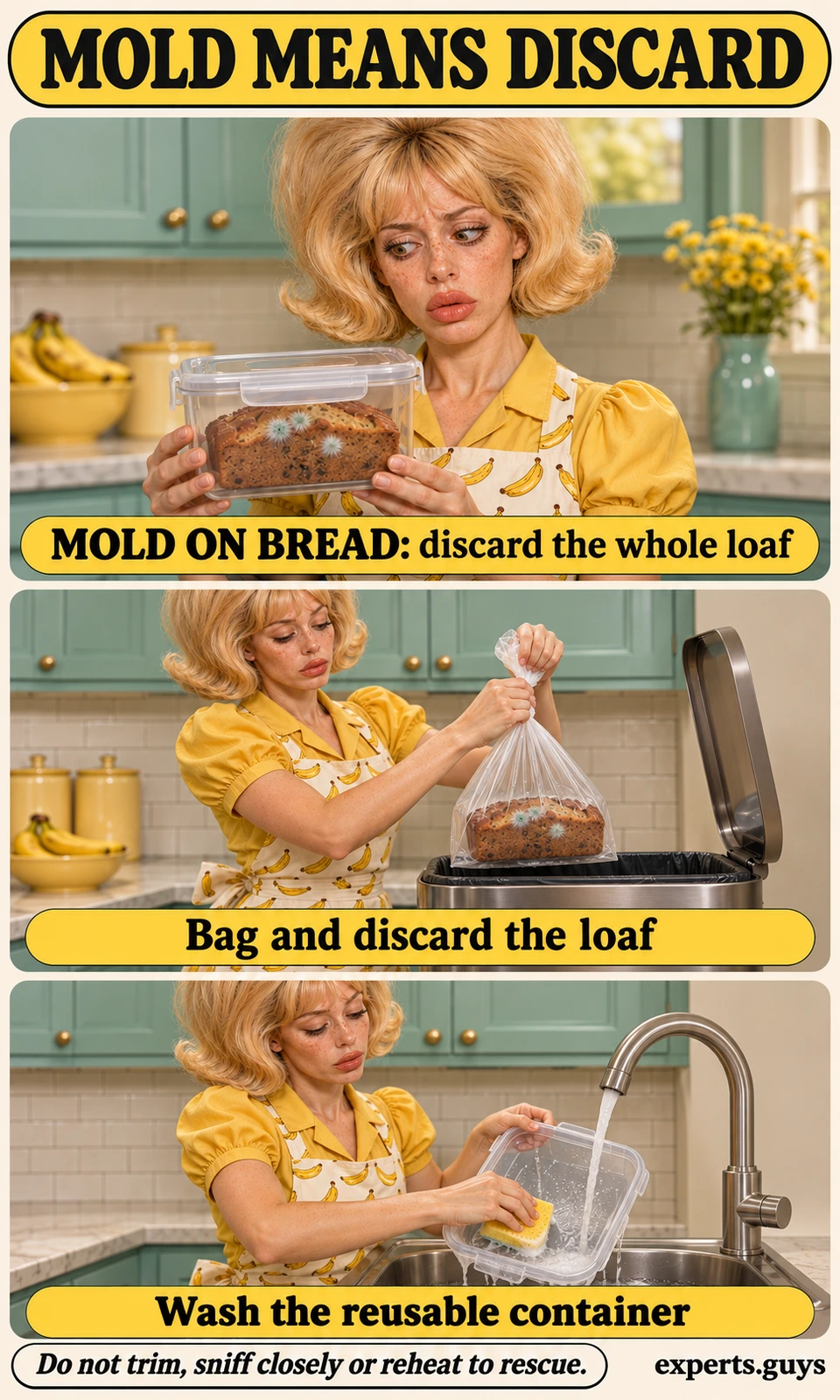
The absence of mold or a bad smell is not proof of safe storage. In particular, a cream-topped loaf left out beyond its applicable time limit cannot be cleared by a photograph or a sniff. The broader discussion of texture changes before visible spoilage explains why visible condition and the history of a food are separate pieces of information.
| What happened | What it may mean | Decision |
|---|---|---|
| The fridge-cooled slice is firm, with a known proper storage history. | A texture change; firmness alone does not establish spoilage. | A brief warming trial may improve eating quality. |
| Droplets appeared soon after a fresh plain loaf was packed warm. | Steam condensed inside the container. | Finish cooling that fresh loaf and use clean, dry packaging. |
| A frozen packet has dry, pale surface patches. | Possible freezer burn or another change; appearance alone is not enough. | Consider packaging and storage history; discard if uncertain. |
| There is fuzzy mold on any part of the loaf. | Spoilage can extend beneath the visible surface. | Discard the whole loaf; do not trim or reheat. |
| A perishable topping spent too long warm. | The time-and-temperature history is unacceptable. | Discard even if it still looks normal. |
Frequently asked questions
Can banana bread stay on the counter overnight?
It depends on the exact loaf. A plain recipe may allow it, while a perishable topping may not. Follow the recipe or label; if the storage category is unclear, do not assume that an overnight stay is acceptable because the loaf looks normal.
Does banana bread taste better the next day?
Some people prefer its more settled texture and flavor, but that preference is not a safety rule. Store it appropriately while it rests rather than leaving it warm to try to improve the taste.
Can I refreeze banana bread after thawing?
Plain bread can sometimes be refrozen after appropriate handling, although repeated freezing can reduce quality. That is not blanket permission for cream-filled bread or food with an uncertain history. Freezing serving portions from the start avoids most of this problem.
Will a paper towel stop mold?
No. It may absorb some moisture, but it cannot sterilize bread, compensate for unsuitable storage temperature or guarantee a longer shelf life. A wet towel is not evidence that the loaf has been preserved safely.
Does gluten-free or low-sugar banana bread last longer?
Neither label establishes a longer storage life. Changes to flour, sugar and moisture can change the finished loaf, so follow a recipe or product-specific instruction instead of borrowing a storage time from another version.
Can I store banana bread in the baking pan?
A clean pan can hold a cooled loaf, but the pan by itself is not a complete moisture barrier. Use a suitable cover and follow the same temperature decision; leaving the pan uncovered in a refrigerator can dry the exposed bread.
Keep the storage decision simple
Match the loaf to its recipe or label, protect the cooled crumb with a complete seal, and freeze serving portions early when you will not use them soon. Use actual cold-storage temperatures, thaw only what you need and reserve gentle warming for bread with a sound storage history. Mold or unsafe handling calls for disposal, not a better wrapper.