
Express Employment Professionals offers a route to owning a local staffing business through a new office or an existing franchise resale. The useful question is whether the local client opportunity, operating obligations and cash needs fit you; a recognizable brand and a large sales figure cannot establish that the investment will pay you.
Start with the ownership route and the current disclosure documents, then work through the money that remains after delivering the staffing service. This guide focuses on a U.S. franchise purchase: the cost figures are U.S. dollars, and the federal disclosure timing discussed below applies to the United States. A Canadian or other-market proposal requires its own local offering documents and rules.
What are you buying, and what must you operate yourself?
You are buying the right to operate within a franchise system, subject to an agreement, rather than purchasing a stream of guaranteed job orders. Express markets both new offices and resales, with training and operational support. Your local business still needs employers who will buy its service and suitable people who can reliably perform the work those employers require.
That creates two connected markets. A strong employer pipeline is insufficient if the available workers cannot reach the sites, work the shifts or meet the requirements. A large applicant pool is insufficient if employers will not pay rates that cover the service. The owner has to develop both sides while keeping the promises made to each realistic.
Separate support from responsibility
Express describes training, back-office assistance and payroll funding among its support services. Those can remove substantial administrative work, but the practical question is which decisions, costs and risks remain with the office. Ask how a client becomes approved, who can authorize credit, how an invoice dispute is handled and what happens when a client pays late or never pays.
A useful way to assess the proposition is to follow one ordinary order through the business. An employer needs people, the office clarifies the requirement, candidates are matched, work is performed, time is approved and the client is billed. At every handover, identify who does the work and who bears the financial consequence if it goes wrong. Corporate processing and local commercial accountability can exist together.
Swipe horizontally on narrow screens to compare.
| Decision | New office | Resale |
|---|---|---|
| Client base | Build relationships and orders. | Verify what will continue after transfer. |
| Local team | Recruit and develop your team. | Check who stays and what they cost. |
| Cash challenge | Fund opening and an uncertain ramp-up. | Fund the price, transition and remaining operating needs. |
| Main mistake | Treating available territory as proven demand. | Treating historical sales as guaranteed future income. |
A support description is evidence of an offered service, not a complete allocation of legal responsibility. The current FDD, franchise agreement and related agreements determine what you are actually accepting. For example, funding payroll can solve the timing problem between paying workers and collecting invoices without necessarily eliminating deductions, eligibility conditions or collection exposure; obtain the applicable terms rather than inferring them from a headline.
The owner’s daily fit also matters. Express’s comparison of new and resale ownership describes a hands-on, sales-minded operator and support for both routes. Consider whether you want to spend substantial time building employer relationships, managing a local team and resolving service problems. Enjoying the idea of helping people is useful motivation, but it is a different test from being comfortable making commercial decisions every day.

There is also a difference between operating the business and personally performing every task. An office can have employees and still depend heavily on its owner for sales, decisions and escalation. Ask what a normal week requires before assuming the support package makes the role remotely manageable or suitable alongside another full-time occupation. If a manager is part of your plan, include that manager’s cost and confirm the participation rules that apply to the offer.
Choose the risk you can investigate
A new office gives you the opportunity to establish the team and client base, with the uncertainty of building them. A resale offers existing operations that can be investigated, alongside a purchase price and transition risk. Neither route removes uncertainty; the difference is what evidence is available and what must be created after completion.
For a new territory, the central concern is the path from available market to profitable accounts. Employers may already use competitors, have approved supplier lists or recruit internally. The presence of factories, warehouses or offices does not establish an addressable client base. Ask which employers fit the proposed service, how purchasing decisions are made and why they would consider switching or adding a supplier.
For a resale, the key concern is whether reported business will continue under new ownership. A relationship held personally by the seller may not transfer as easily as an invoice history. Identify concentration, contract terms, key staff dependencies and the proposed handover before treating last year’s sales as next year’s starting position. An established office can still require additional cash and management attention immediately after purchase.
Compare the two routes using the same ownership horizon and cost categories. A lower opening price can be offset by a longer period before the business supports its overhead. A higher resale price can be justified only by the quality and durability of what transfers, not simply by describing the office as established. Include transition costs and any changes to staffing, rent or systems that your plan requires.
In an illustrative comparison, a new office may require several months of client development while a resale begins with current billings. The resale’s advantage weakens if one large customer is already reducing work or the key recruiter intends to leave. Conversely, a new territory can be the more demanding option even when the setup expenditure is lower. Ask what you are paying to avoid and whether the evidence shows that the resale actually avoids it.

This is an ownership decision rather than an agency-selection exercise for a job seeker. If you need the underlying employment-service distinction, the staffing-agency guide explains the worker, agency and host relationship. Keep that operational context separate from the additional capital, contract and business-development commitments of buying a franchise.
The practical takeaway is to choose a route you can substantiate. A new office requires a defensible acquisition plan and sufficient room for a slow start; a resale requires convincing evidence that its client relationships and operating results can survive a transfer. If you cannot explain the relevant risk in those terms, more marketing information will not resolve the decision.
How much capital does an Express franchise actually need?
The published initial investment is a starting estimate, while your funding requirement depends on the actual opening or purchase costs, the operating shortfall before self-sufficiency and the personal money you must keep available. Treat these as separate questions. Passing a financial qualification screen does not show that your preferred office is affordable under your own circumstances.
Read the cost figures without double counting
Express’s published franchise cost page lists an estimated initial investment of $131,000–$287,700 for a new office, including a $40,000 franchise fee. It also lists minimum net worth of $250,000 and access to $200,000 in liquid capital. Confirm the current offer, location and applicable FDD before relying on these figures; a resale price varies by office.
The distinction between net worth and accessible money matters. Property equity or retirement assets may contribute to an overall balance sheet without being immediately available for operating bills. Accessing them can involve borrowing costs, tax consequences or restrictions. Ask how Express assesses the proposed funding source, then assess the consequences of using it independently of whether the franchisor accepts it.
- Franchise fee: one component of the amount needed to start, not the full investment.
- Estimated initial investment: the published bundle of opening and early operating allowances; check its inclusions.
- Liquid capital: accessible resources, subject to the franchisor’s qualification definitions and your own restrictions.
- Net worth: assets less liabilities; it does not measure the cash you can safely spend today.
The same official cost breakdown includes $75,000–$175,000 for nine months of working capital within its total estimated initial investment. Do not add that amount to the total a second time. Equally, do not assume the allowance will cover your actual shortfall: the staffing plan, lease, financing and sales ramp may differ from the assumptions behind the estimate.

A fee discount or performance incentive should be examined at the point it changes cash. An upfront discount, a reimbursement earned later and a loan are different arrangements. For any proposal, ask what must be paid at completion, which conditions must be met later and what happens if the conditions are missed. Do not reduce the cash needed today by a future benefit that is not yet earned or certain.
Avoid building a funding plan around the bottom of every published range. That quietly assumes several favorable outcomes will happen together: cheaper premises, limited improvements, a lean team and an adequate ramp-up allowance. Use actual quotes where available, identify unresolved amounts and see whether an unfavorable combination still leaves enough room to operate. The decision is stronger when the sources of uncertainty are visible rather than averaged away.
Separate committed cash from contingent spending as well. A signed lease deposit and a planned future marketing campaign do not have the same flexibility. Ask which payments occur before opening, which recur regardless of sales and which can be delayed without damaging the business. This makes a budget useful for a decision: it shows the obligations you would be unable to unwind if the commercial case weakened shortly after signing.
Turn a reserve into an operating horizon
Reserve divided by monthly cash shortfall gives a simple operating horizon. This is a limited arithmetic comparison, not a forecast: a $90,000 reserve supports nine months at a constant $10,000 monthly shortfall, or six months at $15,000. The reserve in this example is the amount genuinely available for that shortfall after opening commitments, not the entire initial investment or an unspent credit limit assumed to be unrestricted.
Use consistent periods and a cash definition. A shortfall includes the cash payments that must be made in the month less the cash actually available from operations. If you are using an accounting profit figure instead, reconcile payment timing, debt principal, capital purchases and other cash movements before calling it runway. A profitable invoice on paper may still leave a payment due before its collection arrives.
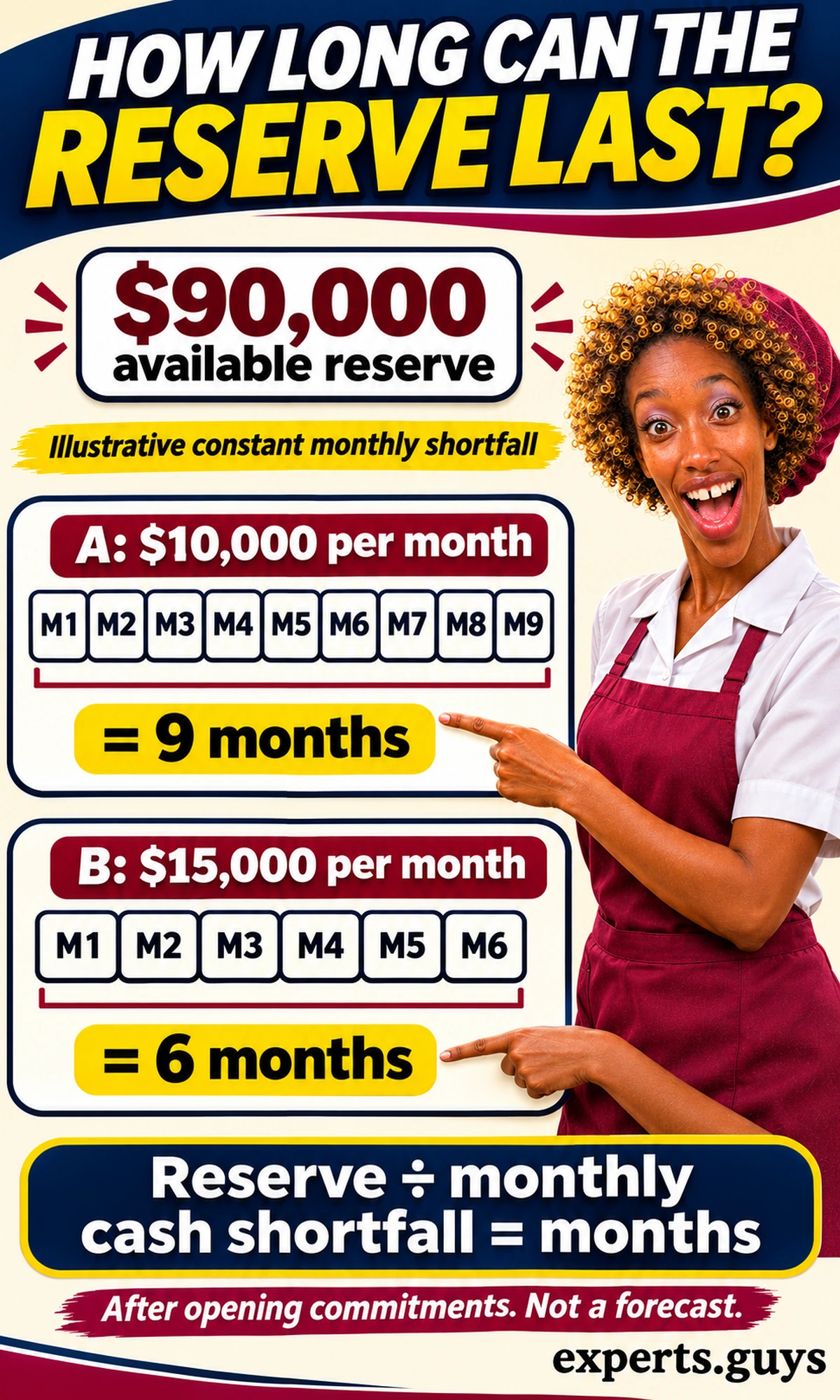
A simple stress case is more revealing than an elaborate growth curve with unsupported precision. Hold monthly outgoings at a plausible amount and reduce the expected contribution from sales. Ask when a hiring delay, slower client approval or weaker early demand would consume the reserve. Then identify which costs can actually be reduced and which are already committed under leases, contracts or employment arrangements.
Keep personal living money separate from the office reserve. If the owner needs distributions immediately, that requirement affects the business from its first month even if the formal plan omits a salary. An owner who can defer pay has a different funding problem from an owner who must replace an existing income, but neither should treat unpaid work as evidence that the operation produces a sustainable return.
Borrowing changes timing and obligations rather than removing cost. Loan proceeds can fund opening expenditure, while repayments create future cash demands. Distinguish interest from principal in the accounting discussion and include both when assessing payments you must meet. Do not count the same borrowed money as both spent on completion and still available as an untouched reserve.
Your next action is to reconcile the funding requirement with accessible funds after all commitments. If the plan works only when sales arrive quickly, the issue is the operating cushion, not merely the ability to pay the franchise fee. Resolve the gap by changing the proposal, funding or timing before treating a financing approval as an investment recommendation.
How do you test profit potential instead of headline sales?
Test what remains after the staffing service and the local business have been paid for. Staffing revenue can be large because client invoices include the economic cost of the labor supplied. Sales are therefore a poor substitute for gross profit, office surplus or owner take-home income, and a system-wide average cannot tell you what your proposed territory will produce.
Follow the money through one comparable period
Start with client billings for a defined week or month. Subtract the direct costs included in the model, such as worker pay and the relevant employment costs. Then account for franchise-related charges and office overhead without putting any charge in two categories. Only after those definitions agree can two offices or two scenarios be compared usefully.
The precise treatment of payroll, insurance, fees and allocations must come from the actual financial records and agreement. A label such as gross profit is not sufficient if the seller and buyer include different costs beneath it. Ask for a reconciliation from billed sales through the reported result, and separate a commercial illustration from the way the business must account for and pay its obligations.
Consider an illustrative week with $10,000 in revenue and $8,000 in direct service costs. That leaves $2,000 of contribution in this simplified example. If all remaining fees and local overhead total $1,700, the residual is $300 before owner compensation, debt payments and tax. These are invented teaching inputs, not Express rates, an observed office or a prediction of earnings.

That small residual shows why a revenue headline can be misleading. A change of $1 in revenue is not automatically a change of $1 in money available to the owner, because delivering the associated work also costs money. Conversely, an unplanned fixed cost can reduce the residual even while the office reports stable sales. The useful question is which part of a change reaches the final cash position.
Be precise about the owner’s work when evaluating a resale. If reported profit benefits from the seller doing a full-time role without a market-rate expense, a buyer who hires a replacement faces a different cost base. If the buyer takes that role personally, the return still combines payment for work with a return on invested capital. Separating the two avoids presenting an intensive job as passive investment income.
A comparable issue arises with debt. Two owners can operate an identical office and receive different cash after financing because one borrowed more to acquire it. An attractive operating result does not establish an attractive acquisition return at any price. Examine the purchase terms and payment commitments alongside the business’s ability to produce a surplus, rather than treating them as an unrelated funding detail.
The service mix can change the explanation, too. Temporary staffing billings and a direct-hire placement fee do not have identical cost patterns or payment timing. Keep the simplified weekly example within its stated assumptions rather than treating one contribution percentage as universal. The overview of staffing models explains those service distinctions; this purchase analysis asks how the proposed office’s actual mix affects the money retained.
A resale with irregular placement fees needs more than a smooth monthly average. Identify when those fees were earned, whether any replacement or refund obligation remains and how the purchase terms treat amounts collected after completion. The aim is to understand recurring capacity separately from unusual income. Do not count a fee in both a seller’s historical result and a buyer’s available opening cash without understanding the transaction’s allocation.
Check how fragile the surplus is
Now keep the same illustrative $10,000 revenue, 20% contribution rate and $1,700 remaining cost base. If one client supplies 40% of revenue, losing all that work removes $4,000 of sales and $800 of contribution under the assumed rate. The residual moves from $300 to a $500 shortfall while the remaining cost base is held unchanged. This is a sensitivity example, not a forecast or a claim about typical client concentration.
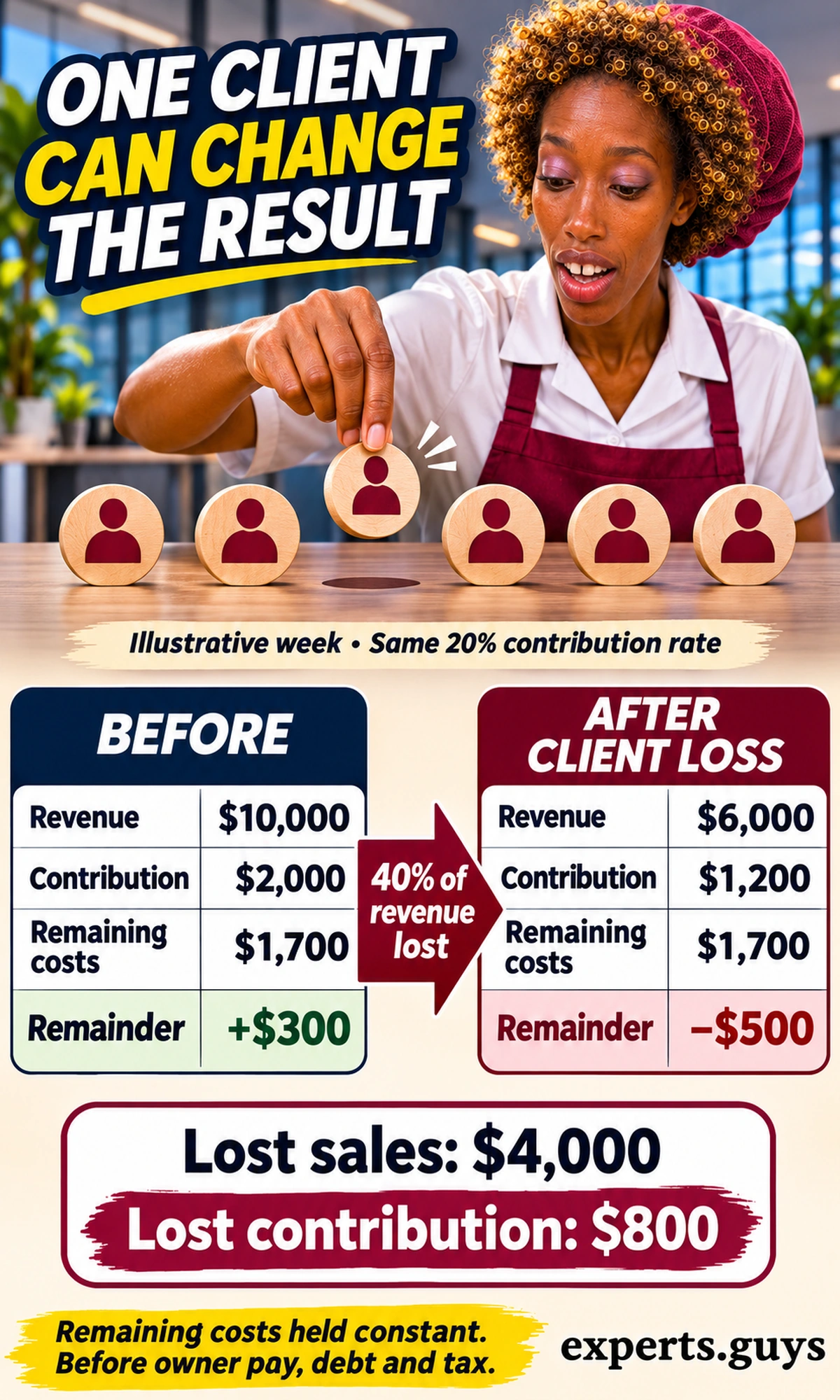
The lost contribution is the key connection. Subtracting all $4,000 from the original $300 would ignore the direct costs that disappear in this simplified model. Assuming every cost disappears with the client would make the opposite mistake. Real costs may adjust slowly, and different clients may have different contribution rates; replace the illustration with account-level evidence when the decision depends on it.
Ask how quickly a large account could reduce orders and how long replacement business normally takes to become productive in the proposed market. A contractual relationship, a recurring purchase history and a guaranteed volume commitment are different kinds of evidence. A customer can be happy with the service and still reduce demand because its own workload changes.
Swipe horizontally on narrow screens to compare.
| Figure | Useful meaning | Limit |
|---|---|---|
| Sales | Client billings for the stated period. | Not owner income; direct service costs still matter. |
| Contribution in this example | Revenue minus the entered direct costs. | Its definition must match across comparisons. |
| Office remainder | Contribution less the remaining entered costs. | Incomplete if owner pay, debt, tax or other costs are missing. |
| Historical average | A summary of the included offices and period. | Not a minimum, forecast or purchase-price justification. |
For a resale, inspect revenue and contribution by client over time rather than relying on a single annual total. A recent improvement might reflect a durable account, a temporary project or a one-off placement. The interpretation changes the purchase case. Ask which costs and relationships would remain after the exceptional work ends, and whether the seller’s explanation matches the underlying records.
For a new office, do not borrow the most mature office’s volume as your starting assumption. A territory with years of relationships, a stable team and established local recognition has a different position from a launch. Use the current FDD’s financial performance information for what it actually describes, including the included population and measurement period, rather than treating an average as a minimum outcome.
Try the same assumptions in Franchise Margin
Franchise Margin lets you change the weekly revenue, direct-cost percentage, remaining fees and overhead, owner pay requirement, debt payments and largest-client share. It reports the simplified weekly cash remainder and the result after removing that client while holding the contribution rate and remaining costs constant. It does not use an Express fee schedule, approve an investment or estimate future sales.
Enter figures from one consistent period and definition. Put franchise-related charges in the remaining-cost field only if they are not already included in direct costs; add owner compensation only if it is excluded elsewhere. The base and client-loss results are arithmetic consequences of your inputs. A positive result remains incomplete if an important cost, tax payment, collection delay or capital requirement is absent.
The practical result should be a better question, not a score. If a small change turns the remainder negative, investigate pricing, cost definitions and client dependence before relying on the base case. If the result stays positive, check whether the sales and contribution assumptions are supported. Robust arithmetic cannot turn an unverified commercial assumption into reliable income.
What evidence should change your decision before you sign?
Move forward when the documents, local opportunity and financial explanation agree well enough to understand the downside you are accepting. Pause when a consequential claim cannot be reconciled, a territory right remains unclear or the funding case depends on an unexplained result. The purpose of diligence is to resolve a purchase decision, not to collect a large pile of reassuring material.
Match each promise to the right evidence
Request the current FDD and the agreements that apply to the specific offer. For a U.S. purchase, the FTC’s franchise buying guidance explains the requirement to receive the FDD at least 14 calendar days before signing a binding franchise agreement or paying the franchisor or its affiliate. That is a disclosure interval, not a guarantee that the business or contract has been approved for you.
Review the cost items against the amounts you expect to pay, then compare assistance and territory provisions with what has been described. Examine the conditions governing renewal, termination and transfer before assuming you can operate indefinitely or sell freely. Financial performance representations and outlet information answer different questions: a sales claim needs its stated basis, while outlet history helps identify businesses and owners to investigate.
Use the agreement to resolve the exact rights, restrictions and obligations. A brochure can explain an opportunity attractively without answering what happens to a disputed account, a protected boundary, an overdue payment or an attempted resale. When a verbal explanation matters to the decision, ask where it appears in the applicable documents or obtain clarification in the appropriate contractual form before relying on it.

Test whether the territory can support the proposed business
A territory boundary describes rights within the franchise system; it does not make local employers buy from the office. Ask how national accounts, cross-boundary customers, online leads and multi-site employers are handled under the actual terms. Then connect the permitted opportunity to employers you can plausibly serve, rather than treating a population figure as demand.
Examine the intersection of employer requirements, reachable workers and viable commercial terms. A night-shift client can look attractive until transport makes the role difficult to fill. A large employer can be inaccessible if supplier approval is closed. A willing employer can still be unsuitable if the required price or payment terms leave too little contribution or too much exposure. These are reasons to test the proposed business mix, not reasons to dismiss an entire market.
For broader candidate-market context, the industry-based employment-agency overview provides a route into sector differences. It does not establish demand in your proposed territory. Local validation must concern the services, employers and workers relevant to the actual purchase rather than a general claim that staffing is a large industry.
Also distinguish a prospect from a committed order. An employer willing to take an introductory meeting is useful evidence of access, but it is weaker than an approved supplier relationship with workable terms and an actual need. Ask what must happen between that first conversation and paid work. A plan that compresses every stage into immediate revenue may understate the time needed for approval, recruitment and a successful first assignment.
Territory evidence should match the intended services. A general count of businesses may include many that use different skills, recruit centrally or buy through channels unavailable to the proposed office. Begin with the actual permitted service and the customers it can serve; then consider reachable workers and economic terms. If that intersection is narrow, expanding the list of nearby company names will not fix the underlying fit.
Use owner conversations to challenge the model
Speak with current owners and, where available through the disclosure information, former owners. Ask concrete operating questions: what took longer than expected, which support they used, what local work still required the owner’s attention and what consumed cash early on. Their accounts can reveal questions you would otherwise miss, but an individual experience does not establish what your office will earn.
Choose conversations that illuminate the proposed route. A newly opened office may clarify ramp-up difficulties, while a resale buyer may clarify staff retention and client handover. An established owner can explain recurring management work. Ask about differences between their circumstances and yours before transferring an answer across markets, purchase prices or stages of development.
For a resale, reconcile the financial story across statements, invoices, collections and the relevant supporting records made available in diligence. Check whether the proposed price depends on work that has already ended or on relationships that have not agreed to continue. Handle customer and worker information through authorized, confidential channels; buying a business does not justify unrestricted access to personal data before completion.
For example, a seller might describe a fall in sales as a deliberate decision to leave an unprofitable account. That explanation could improve the case if contribution and collections support it, or weaken it if other clients are also declining. Ask what changed in costs and retained contribution after the account left. The same revenue movement can have different meanings, so investigate the mechanism rather than treating growth as automatically good and contraction as automatically bad.
- Cost claim: reconcile the applicable FDD, current agreement and actual opening or purchase commitments.
- Territory claim: confirm boundaries, account rules and the permitted services, then test local commercial fit.
- Earnings claim: establish the population, period, cost definitions and supporting records.
- Resale continuity: investigate clients, staff, seller dependence and the specific handover arrangements.
A useful clarification has a stopping point. If a cost is missing, obtain its amount and payment timing; if an account is material, establish the relevant retention and volume evidence; if a right is unclear, resolve its contractual meaning. Repeated assurances do not close an unresolved question. Where the answer remains unavailable, price and fund the uncertainty explicitly or postpone the commitment.
Specialist help is most useful when it addresses the actual unresolved issue. A franchise lawyer can examine obligations and rights; an accountant can reconcile the cost and earnings definitions. Give them the proposal and the specific questions that change your decision. Their work supports your judgment, while the commercial choice and the capital at risk still belong to you.
Frequently asked questions
Is Express Employment Professionals the same as American Express?
No. The staffing franchise discussed here is Express Employment Professionals. American Express is a separate business; its card, travel and employee-benefit information does not describe this franchise opportunity.
Do employee reviews establish whether an office is a good franchise purchase?
No. They may raise questions about local management or service, but they do not show the purchase price, contractual obligations, client retention or reconciled cash result. Investigate a specific concern and keep worker experience separate from investment evidence.
Does financing approval mean the franchise is affordable?
No. Approval concerns the lender’s or program’s requirements. Your decision still depends on the cash needed after completion, repayment obligations, personal income needs and the resilience of the proposed business.
Can I rely on another owner’s tax return to predict my take-home pay?
A historical return can be one diligence input when lawfully supplied, but its entity structure, deductions, financing and owner arrangements may differ from yours. Reconcile the underlying business and transaction rather than transplanting the final income figure.
What if I cannot obtain the current FDD or a material clarification?
Keep that part of the decision unresolved. A brochure, verbal assurance or sample calculation cannot replace the relevant disclosure and agreement. Do not make a commitment that depends on a fact you still cannot establish.
Next steps
Decide which missing fact could most change the purchase case, then resolve it before advancing to the next commitment. For one buyer that may be the cash needed through a slow opening; for another, the dependence of a resale on one client or one departing owner. Proceed only when the local opportunity, contractual responsibilities and money left after costs form a coherent explanation you can defend without relying on the headline sales number.