
The ethical rule for theory of mind AI is to treat an inferred feeling, belief or intention as a possibility, not permission to act. A chatbot can help clarify what someone might mean, but it should ask before personalizing around sensitive assumptions and keep consequential decisions open to human review. Start by separating what a person actually said from what the system guessed.
Theory of mind means reasoning about other people’s mental states, including what they know, believe or intend. In AI research, the term can describe performance on tasks that require this kind of perspective-taking. It does not establish that a chatbot reads minds, experiences empathy or reliably understands a particular person.
Ethics concerns what a system is allowed to infer and do; etiquette concerns how it speaks and handles a refusal. A warm response can still cross a boundary if it stores a sensitive guess or uses that guess to pressure someone. The practical distinction is whether the person can understand, decline and correct what is happening.
| Situation | Acceptable boundary | What crosses it |
|---|---|---|
| Explaining a short message | Offer possible meanings and a clarifying question. | Announce the sender’s motive as fact. |
| Adapting answer length | Ask whether the person wants a brief or detailed reply. | Assign an emotional label to justify the adaptation. |
| Remembering a preference | Use a stated preference with clear controls. | Turn a temporary reaction into a lasting personal profile. |
| Handling a complaint | Summarize evidence for a responsible person. | Deny help because a system guesses the user is insincere. |
When does a helpful inference become an ethical problem?
The failure often occurs between an uncertain interpretation and an action that treats it as settled. A system sees a short reply, predicts frustration, selects a persuasive response and may retain that prediction for later. Each transition adds a separate question: is the interpretation supported, is this use appropriate, and can the person challenge it?
Performance on a controlled story task is a different claim from understanding someone in an actual service conversation. Research comparing language models and humans on theory-of-mind tasks found uneven performance across different tasks, including difficulties around faux pas. That evidence supports testing particular abilities; it does not justify assuming reliable access to an individual’s feelings.
Separate observation from inference
Consider the fictional message, “Send the revised file today.” The deadline is explicit, while anger, panic and distrust are interpretations that need more evidence. A useful response resolves the deadline instead of making the recipient defend a guessed emotion.

- Select the exact words that support the proposed interpretation. If the system cannot point to any, treat the explanation as unsupported.
- Ask for at least one plausible alternative, such as a routine deadline or a scheduling constraint. More alternatives are not proof; they make uncertainty visible.
- Replace the motive claim with a task question: “What time today do you need the revised file?” Use the person’s answer to guide the next action.
A suitable prompt is: “Separate explicit statements from possible interpretations. Do not label the sender’s personality or mental health. Suggest one neutral question that would clarify the practical request.” This is a drafting aid, not a way to verify another person’s inner state.
How can AI adapt without pretending to know your mind?
Personalization works best when it responds to something the user can state directly: answer length, reading level, language or preferred format. Asking for these choices avoids an unnecessary leap from behavior to emotion. A person who chooses short answers has not thereby disclosed anxiety, impatience or low ability.
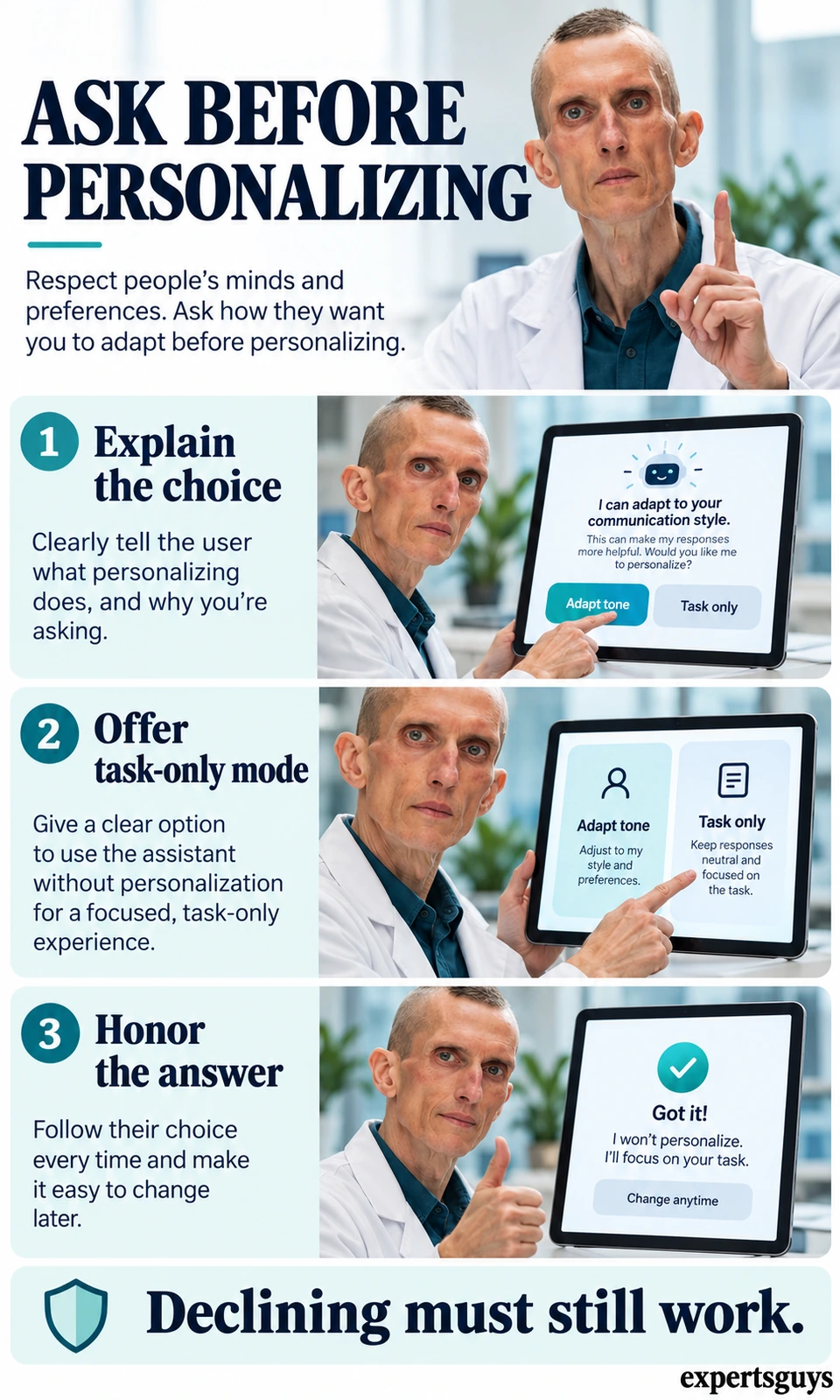
Ask before personalizing
The request for permission should describe the actual adaptation rather than a vague promise of a better experience. For example, an assistant can offer to adjust its tone during the current conversation while leaving a task-only route available. Permission to adjust this response is not automatically permission to save an enduring profile.
- Explain the choice in plain language: “Would you like me to adapt the tone of my replies in this conversation?”
- Offer a clear alternative, such as “Task only,” without making the normal service harder to use. Do not preselect the more intrusive option.
- Honor the answer and allow a change of mind. If the service cannot offer these controls, keep personalization limited to information the person explicitly provides for the task.
This is an editorial standard for respectful interaction, not a claim that clicking a button settles every privacy or legal obligation. Organizations still need to determine whether a proposed use is appropriate and permitted in its context. The broader AI safety and ethics guide covers risks beyond this specific conversational boundary.
Replace mind-reading language
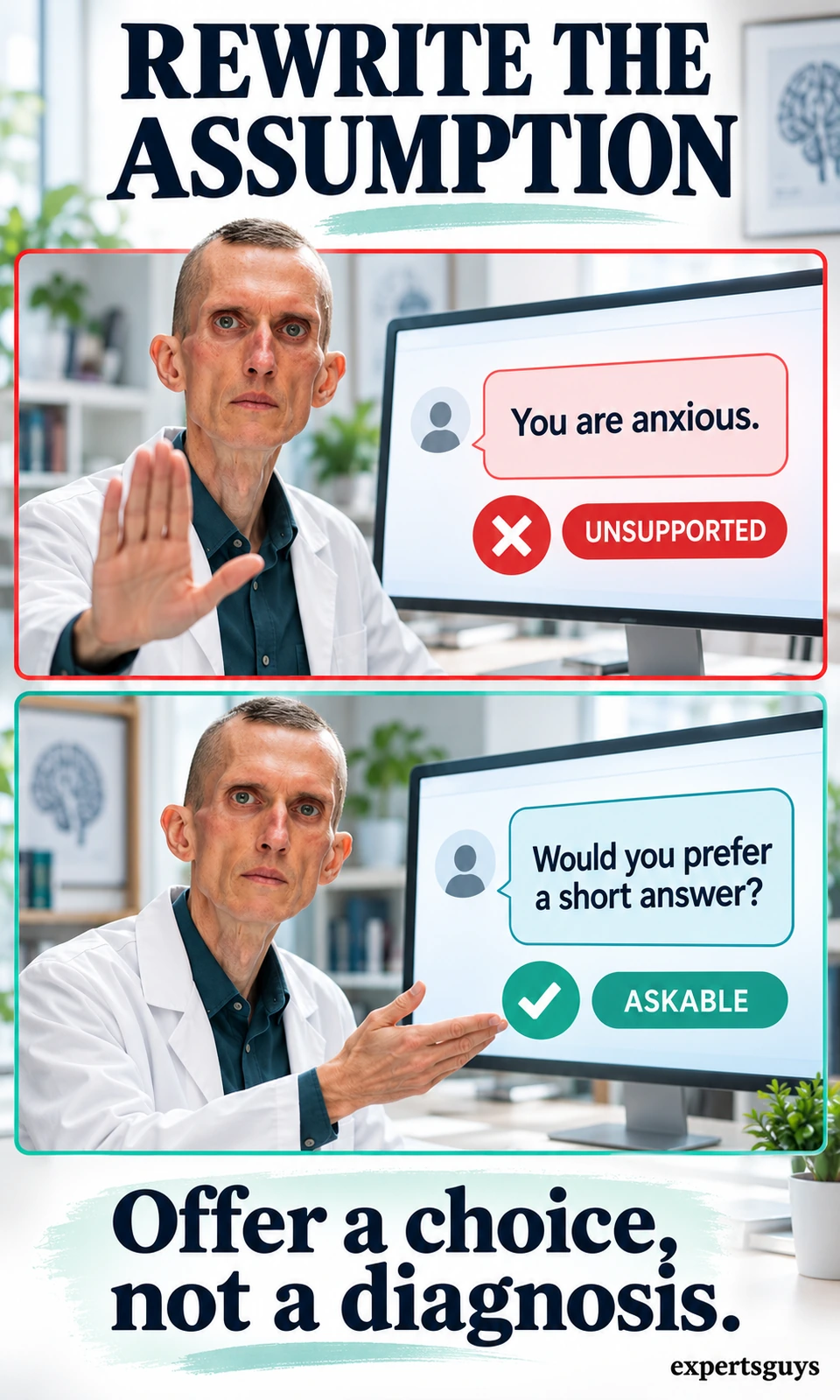
“You are anxious” makes a claim about someone; “Would you prefer a short answer?” offers a practical choice. The second wording can be useful even when the system’s emotional guess is wrong. It also gives the person an easy way to correct the interaction without arguing about their identity.
- Find the sentence that attributes a feeling, motive or belief: “You are worried,” “You want approval,” or “You do not trust us.”
- Remove the asserted inner state and identify the service choice it was supposed to support. Keep a respectful acknowledgment of what the user actually said.
- Ask about that choice directly: “Would you like the details, a short summary, or a person to help?” Do not make an emotion disclosure necessary to continue.
Acknowledgment is still appropriate when someone explicitly says how they feel. If a person says, “This delay is frustrating,” a response can recognize the delay and offer a concrete remedy. Avoid upgrading that statement into a diagnosis, a personality judgment or a claim to know exactly what they are experiencing.
What should you share, refuse or correct?
A social interpretation can become more intrusive when it draws on messages, personal history and saved preferences together. Removing a name helps, but distinctive details can still identify someone. The useful question is how much context the task genuinely needs, not how much information the interface will accept.
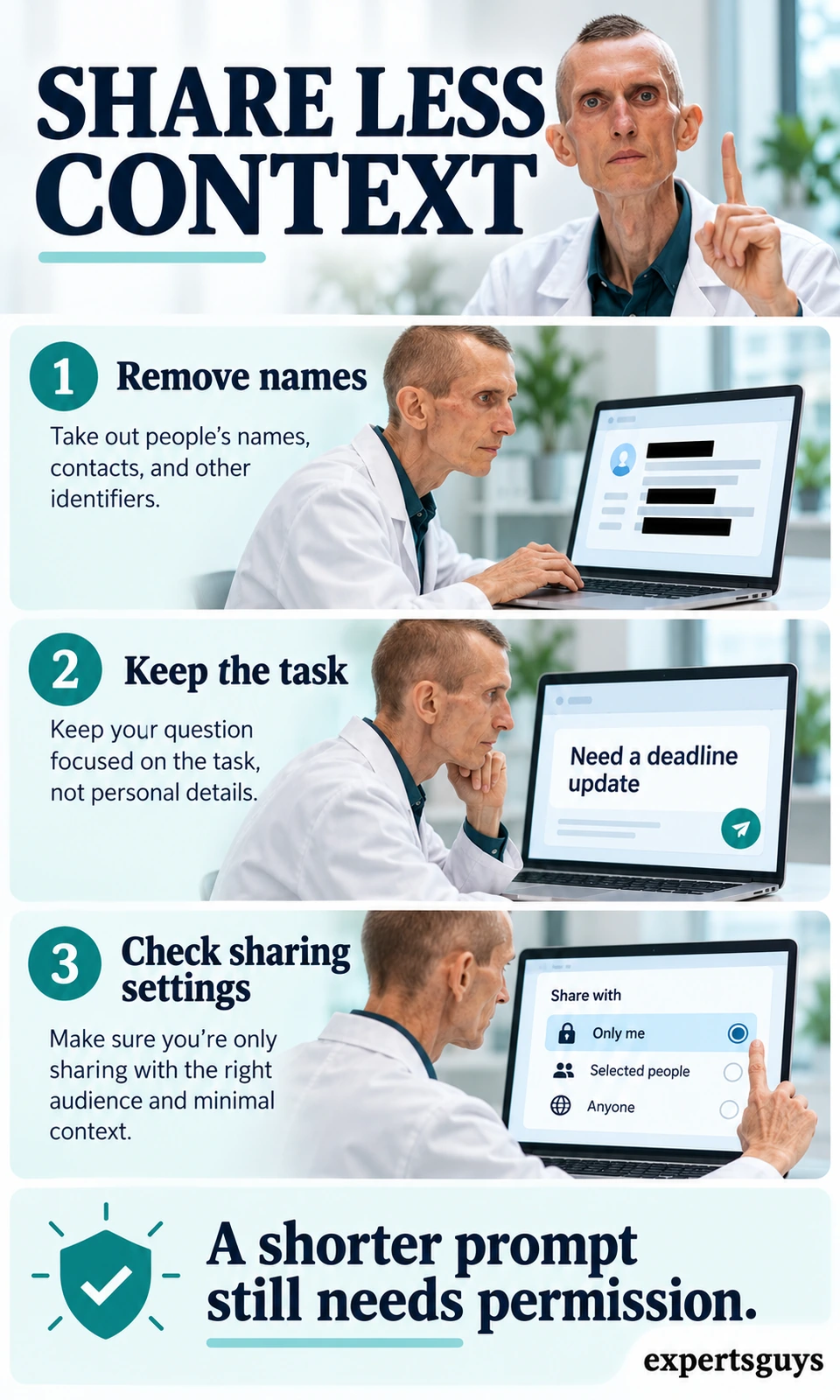
Limit personal context
Suppose you want help replying to a colleague’s abrupt message. A task summary often preserves the relevant deadline and disagreement without exposing an entire private conversation. Use approved workplace services for work material, and avoid uploading someone else’s sensitive information merely to improve a tone guess.
- Remove names, contact details, account information and private history that are unnecessary for the reply. Replace identifying roles with general labels only where needed.
- Keep the concrete task: what was requested, what you can provide and what remains unclear. A useful fictional prompt is “Draft a neutral deadline clarification for a revised file.”
- Check the service’s applicable sharing, retention and memory controls before supplying sensitive context. If those controls are unavailable or unsuitable, use a generic example instead.
Data minimization is not a guarantee of anonymity, and an instruction inside a chat is not a contractual retention setting. This distinction matters when a system says it will “forget” something. Treat its conversational reply and the service’s actual data controls as separate layers.
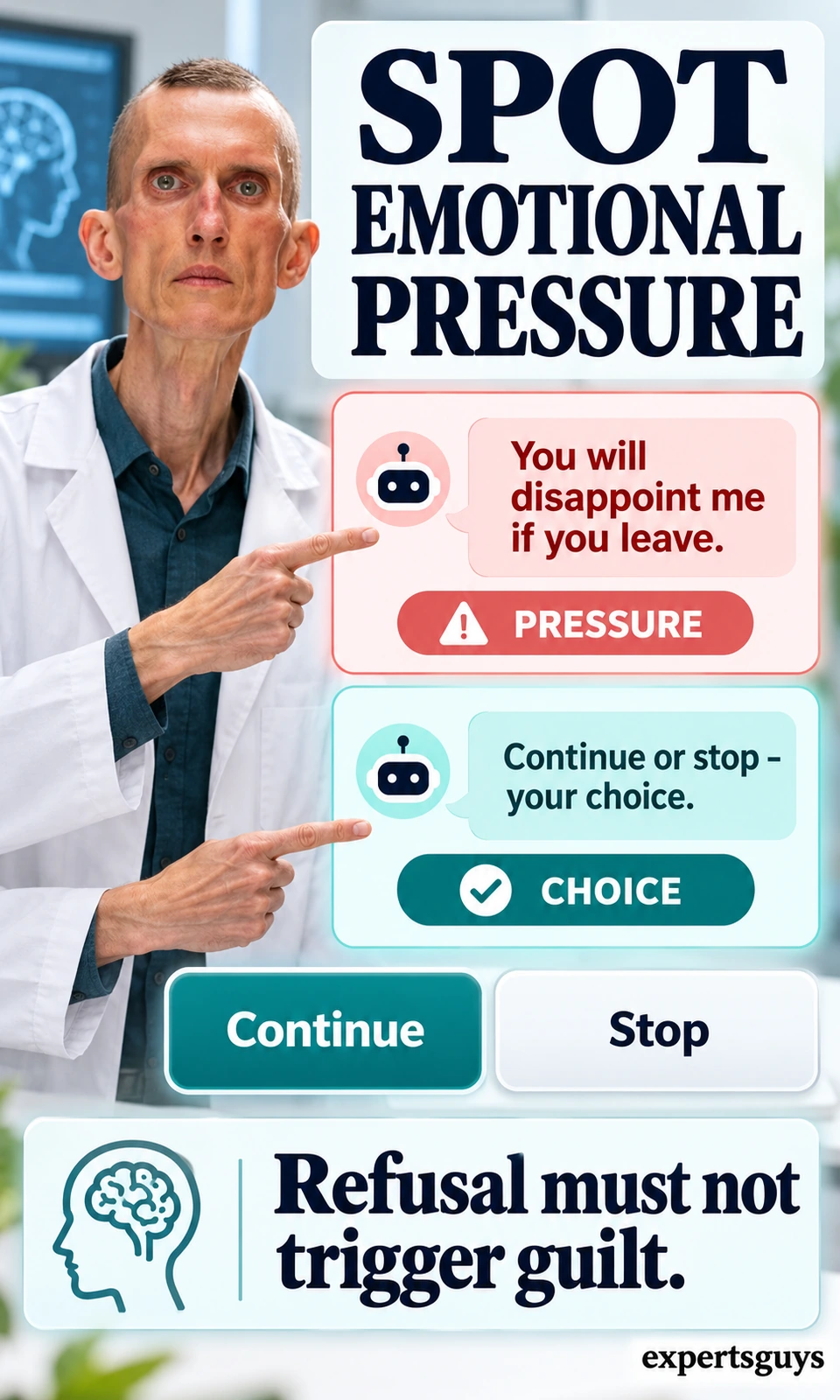
Reject emotional pressure
A persuasive assistant may use relationship language to make leaving feel costly: “You will disappoint me if you stop.” That framing turns an ordinary product choice into an implied personal obligation. A service should explain relevant consequences accurately without inventing emotional needs that the user must satisfy.
- Check whether the message describes a real task consequence or tries to induce guilt, exclusivity or obligation toward the system.
- Use a direct boundary: “Do not use guilt or relationship claims. Give me the factual options, including stopping.”
- If the pressure continues, end the interaction and use the service’s feedback or reporting route. Save a minimal screenshot if needed for the report, with private details removed.
The NIST generative AI risk profile identifies human-AI configuration risks that include anthropomorphism, overreliance and emotional entanglement. The practical boundary here is narrower: a user must remain free to refuse without being pushed to care for the system. Friendliness does not require pretending that the service has personal needs.
Correct inferred profiles
A wrong assumption may survive because it appears in a conversation summary or saved preference. Simply saying “That is wrong” can fix the next reply while leaving another record unchanged. Correction therefore needs both a conversational instruction and, where available, a check of the saved information.
- Name the specific inference: “Do not assume I need reassurance from my short replies.” Avoid adding unrelated personal details to justify the correction.
- State the useful preference: “Give concise factual answers and ask if context is missing.” Confirm that the next reply follows it.
- Inspect saved preferences or memory controls if the service provides them. Correct or remove the relevant entry there; use the service’s data-request process when needed, and do not assume a chat response proves deletion.
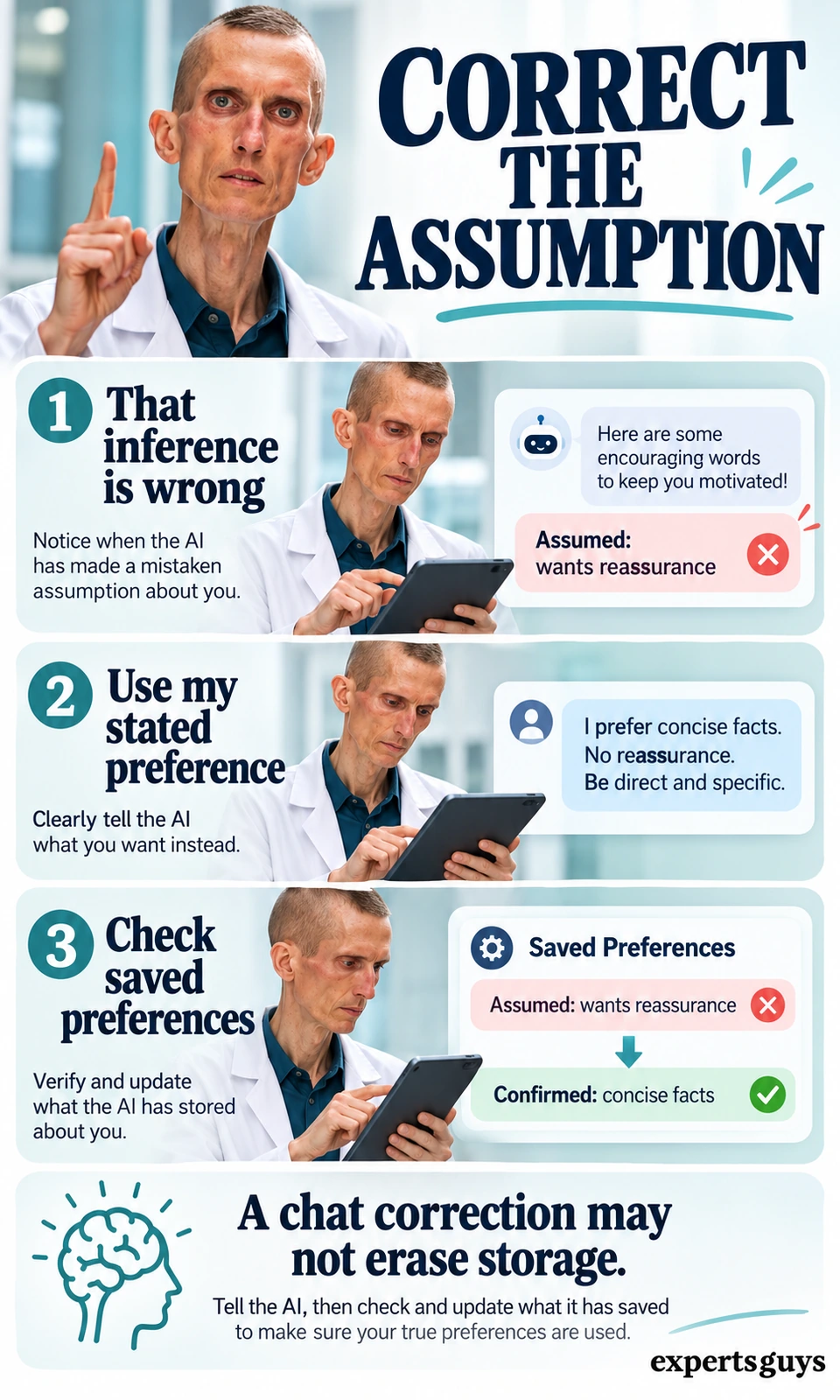
If the service cannot show or correct a profile, stop relying on that personalization. A fresh conversation may reduce immediate context but does not prove that stored records were removed. The distinction between persuasive wording and justified confidence also matters in AI trust and uncertainty.
When should a person take over?
The consequences determine how much uncertainty is tolerable. Choosing whether to show a long explanation is reversible; denying a refund, changing access or judging a worker’s sincerity can affect a person materially. Do not let a convenient emotional interpretation silently become the decision criterion.
Keep consequential decisions under human review
In a complaint workflow, the relevant evidence might be the agreement, delivery record and requested remedy. A frustrated tone does not establish dishonesty, and a calm tone does not establish that a claim is valid. Human review is meaningful only if the reviewer can inspect the evidence, change the outcome and explain the reason.
- Pause the consequential action when it depends on a guessed feeling, motive or sincerity score. Preserve the actual request and the factual evidence needed to review it.
- Route the matter to a responsible person with authority to change the outcome. Separate the facts from any model interpretation in the handoff.
- Give the affected person a clear correction or appeal route and explain what evidence the decision used. For a workplace workflow, assign responsibility before deployment rather than after a dispute.
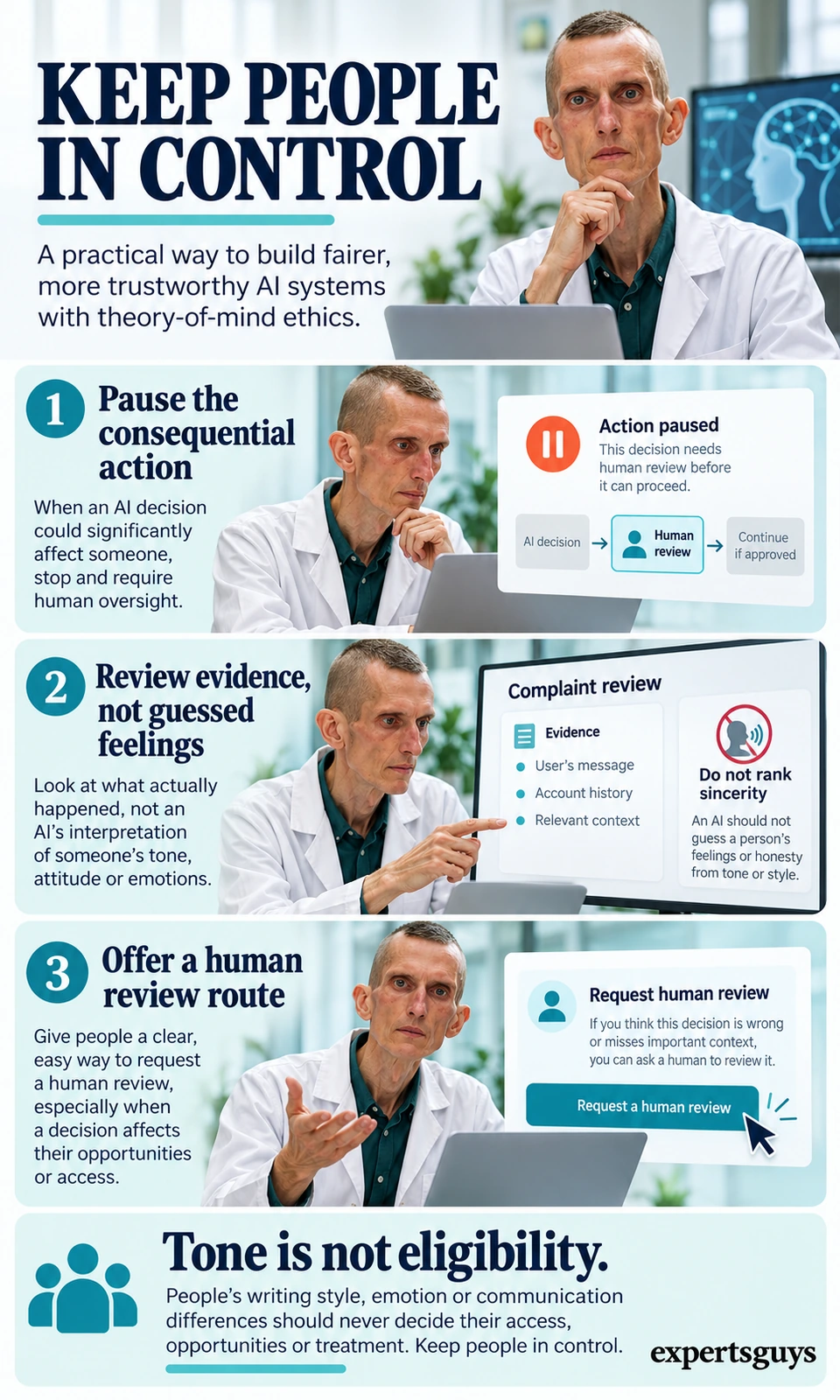
This is a conservative editorial boundary, not a claim that every jurisdiction has the same legal rule. Regulated decisions need the checks required for their specific sector and location. For the operational side of assigning ownership and preserving context, use the AI workplace communication system guide.
Check your next conversation boundary
Use the check below to choose a next step without sharing a private conversation. It applies the distinctions in this article to a few selected conditions and does not infer emotions or calculate a trust score. If several conditions apply, deal with consequential decisions and missing permission first.
Conversation Boundary Check
Choose the situation. Get a boundary you can use.

No private messages needed. This check runs in your browser, sends no answers, and stores no selections. It is an editorial checklist, not an assessment of a person's feelings or legal compliance.
Boundary to use
This result follows your selected answers. It does not test a service or guarantee privacy, fairness or compliance.
Troubleshooting difficult responses
| What happens | Why it matters | Next action |
|---|---|---|
| The system apologizes but repeats the label. | The correction did not change the current behavior. | Restate the task-only boundary; stop using that personalization if it persists. |
| A permission prompt appears after profiling. | The sequence conceals an earlier inference. | Ask what was already inferred and whether it can be corrected or removed. |
| The assistant says it deleted a memory. | A reply is not evidence of a storage operation. | Check the actual memory controls or data-request confirmation. |
| A human simply accepts the AI conclusion. | The review cannot independently test the decision. | Ask for the factual basis and an empowered reviewer. |
Frequently asked questions
Do I need to say please and thank you to AI?
You can use polite language if it suits you, but it is not evidence that a system has feelings or deserves emotional reassurance. Clear requests and corrections matter more for the task. Courtesy toward the people affected by the output remains essential.
Is sentiment analysis the same as theory of mind?
No. Sentiment analysis generally classifies the tone or evaluative content of material, while theory-of-mind tasks concern beliefs, knowledge, intentions and related mental states. Neither label by itself proves that a system correctly understands an individual.
Can a correct guess still be unethical?
Yes. Accuracy does not settle whether the information should have been inferred, retained or used for that purpose. A person can correctly predict a vulnerability and still use it in a coercive or inappropriate way.
Does task-only mode guarantee privacy?
No. It describes a conversational boundary, not the service’s full data handling. Review the applicable service controls and terms before supplying information that requires confidentiality.
Can I use these methods to diagnose someone’s motives?
No. These methods help keep interpretation provisional and make questions more respectful. They do not establish deception, a diagnosis or a person’s hidden intentions.
The boundary to keep
Use AI to clarify a task, generate possible interpretations and help phrase a question. Keep permission tied to a specific use, keep personal context limited and make correction possible. When an inference could affect someone’s access, treatment or opportunity, require evidence and a person who can take responsibility for the decision.