
Staffmark is the staffing company discussed on this page, whose older title was “Employees Mark.” Before accepting an assignment, confirm the actual worksite, shift, pay rate and timekeeping route; registering or completing screening does not by itself establish a start date. This guide helps US job seekers check the handoff from recruiter to workplace and identify what to clarify when the assignment or paycheck differs from expectations.
The most useful question is whether the particular assignment is clear enough to accept. A national company name cannot tell you who will meet you at the gate, which hours have been offered or how a missed clock-out will be corrected. Those details connect the recruitment conversation to the work you are about to do.
Treat the assignment as a chain of connected instructions: the role discussed, the terms confirmed, the work performed, the hours submitted and the wages shown. A difference between two links tells you where to ask a specific question. It does not, by itself, establish misconduct or prove that everything is correct.
Start with the link closest to your present situation. If you have not travelled to the site, settle conflicting arrival details first. If you have already worked, check the relevant pay period and time entries before comparing the bank deposit with a figure remembered from an advert.
The examples below are illustrative. Their dollar amounts, schedules and messages are teaching assumptions, not current Staffmark vacancies, guaranteed hours, company-wide policies or reports from actual employees. Use your own confirmed assignment details when making a decision.
| Where you are in the assignment | What to establish | Useful next action |
|---|---|---|
| A recruiter has discussed a role | Which vacancy, location and shift are being discussed | Match the discussion to the specific assignment |
| Screening is under way | What is complete and what remains conditional | Ask whether a start is actually authorised |
| You have arrival instructions | Whether site, duties and pay match the agreed role | Resolve a changed term before travelling |
| You have finished a shift | Which time-entry system and approval route apply | Check the submitted period and exceptions |
| A wage statement looks wrong | Whether the difference is hours, rate or deductions | Ask for the particular field to be checked |
| An assignment has stopped | What ended and what contact comes next | Clarify final hours and future availability separately |
What must be confirmed before a Staffmark assignment starts?
Confirm the same identifiable assignment across the recruiter conversation and the start instructions. At minimum, you should understand the role, worksite, reporting time, shift pattern, offered rate and person or team handling questions. An instruction to arrive somewhere is much less useful if it belongs to a different shift or an earlier version of the opportunity.
Keep the existing listing, offer communication and onboarding instructions available for comparison; there is no need to create a separate worksheet. Look for terms that disagree, rather than treating every missing detail as evidence of a problem. A listing may describe a range, while an assignment communication identifies the rate actually offered to you.
Match the role and site before debating small details
Compare the role title or available identifier first, then the site address and shift. If two messages concern different locations, a pay difference may reflect two separate opportunities rather than a changed promise. Establishing the same assignment prevents you from asking payroll to resolve what is actually a recruitment misunderstanding.
Use a direct clarification: “The role discussed was the afternoon shift at Site A, but the arrival message says Site B. Which assignment am I being offered, and do the duties and rate change?” That question gives the recruiter a defined difference to resolve. A broad “Is everything correct?” can receive a reassuring answer while leaving the contradiction untouched.
If reading several documents is difficult, ask the recruiter to confirm the role, site, shift and rate together in one accessible communication. The result you need is a coherent assignment, not a larger collection of messages. If the answers still conflict, explain which term prevents you from agreeing rather than pretending the uncertainty has disappeared.

Separate registration, screening and a confirmed start
A profile is a way to enter a recruiting process. Screening is a condition being evaluated. A confirmed start requires an actual instruction for the assignment, with any remaining conditions made clear. Treating those stages as interchangeable can lead to unnecessary travel or a premature decision to leave another job.
Staffmark’s official FAQ directs applicants to their local office for application status. Use that route to ask a stage-specific question: “Is this application still being considered, is a check outstanding, or am I cleared to report for this assignment?” An application status answer should resolve what happens next, rather than simply repeat that your details are on file.
Do not infer the result of a check from silence. Ask which step remains, who can confirm completion and whether any proposed date is conditional. If a test or appointment is required, follow the verified instructions for that process; an older article cannot establish its timetable or outcome.

The distinction is especially important when you already have work. A hopeful conversation about an opening is a different basis for planning from an assignment whose start has been confirmed. Decide what level of certainty you need before changing an existing commitment, and make that dependency explicit to the recruiting contact.
Know which employment arrangement is being discussed
Ask which organisation will employ and pay you, where the work will be performed and who directs the daily tasks. Those answers help you route questions without assuming every person at the client site can change the staffing company’s payroll information. The arrangement should be explained for your role rather than inferred from the word “temporary.”
A possible route to a client’s permanent workforce is a future condition to clarify. Ask what would have to happen, who makes that decision and what the initial assignment offers if conversion never occurs. Accept the initial work only if its current terms are workable for you; a possible later appointment should not be used to fill gaps in today’s offer.
For the broader distinction between assignment work, temp-to-hire and direct hiring, the guide to choosing a US recruitment route provides the wider framework. Here, the practical job is narrower: ensure the route being discussed matches the specific instructions you receive.
When the same title appears in several vacancies, a role name alone is a weak match. Two warehouse-associate roles can have different buildings, supervisors or working patterns. An identifier, where available, and a matching location help the contact distinguish them. If no identifier exists in your communication, use the combination of role, location and shift rather than guessing that the newest message automatically supersedes everything earlier.
A start decision is ready when you can explain what you are accepting and what remains conditional. If the site, schedule or offered rate is still disputed, that is the unresolved item. Completing more profile fields cannot answer a conflicting assignment term.
How do you compare the real value of two assignments?
Compare expected paid hours and unavoidable work-related costs alongside the hourly rate. A higher rate can produce less weekly gross pay when fewer hours are available. Use confirmed details where possible and label estimates clearly; an estimate helps you consider a trade-off but cannot turn an uncertain schedule into guaranteed income.
Begin with an ordinary week, without assuming overtime, attendance bonuses, conversion or future raises. This gives you a base case you can understand. Add a conditional payment only after checking what triggers it, and consider whether the role is still acceptable without that payment.
Work through one transparent comparison
Suppose Assignment A offers $18 an hour and you assume 40 paid hours in a week. The gross calculation is $18 × 40 = $720. Assignment B offers $20 an hour and you assume 32 paid hours: $20 × 32 = $640. Under those assumptions, A produces $80 more gross pay despite the lower hourly rate.
The result changes if the hours change. If A supplies only 30 paid hours, its gross pay would be $540. That is why the comparison needs a question about how the schedule is set and what is actually confirmed. The arithmetic is exact; the availability of future hours is not established by the arithmetic.

Neither figure is take-home pay. Taxes and applicable deductions can affect the amount deposited, and personal circumstances differ. Do not compare one role’s gross estimate with another role’s bank deposit and attribute the entire gap to the hourly rate. Keep the units on both sides of the comparison consistent.
Next consider a necessary commute or other unavoidable cost. If an illustrative weekly journey costs $45 for A and $20 for B, subtracting those assumed costs leaves $675 and $620 respectively before tax and other costs. This is a planning comparison of gross pay less one cost category, not a prediction of disposable income.
Ask what the shift wording means in practice
A shift label can conceal the detail that matters to you. “Evenings” does not identify a finishing time, and a rotating schedule may affect weekends differently from a fixed one. Ask for the actual pattern, how it is communicated and what changes are possible. Avoid building travel or caring arrangements around a label alone.
The same issue applies to a quoted shift length. Ask which part represents paid work and what meal arrangements apply to that assignment. A ten-hour presence at a site should not automatically be multiplied as ten paid hours unless the relevant terms support that assumption. If a rule or legal entitlement is disputed, check the applicable jurisdiction rather than relying on this example.
Consider whether a schedule is possible as well as financially attractive. A finish after the last available bus can create a cost that did not appear in the advertised rate. A more stable pattern may be worth considering when another obligation requires predictable attendance. That is a personal trade-off, not a universal recommendation to accept lower pay.
Where hours are uncertain, test the decision with a less favourable but plausible case. If the role becomes unaffordable with one fewer offered shift, ask how much schedule certainty exists before committing. This is a way to expose the assumption driving your choice, not a forecast that hours will be reduced.
Keep current terms separate from possible improvements
A verbal prospect of better pay later should be clarified separately from the rate applying now. Ask what event would trigger a change and how you would be told it had taken effect. Do not insert an assumed increase into every future week of your comparison simply because a similar role once had one.
A conditional bonus deserves its own question because its value can depend on a condition you may not meet. An illustrative $100 payment available only after a stated milestone is different from an extra $100 every week. Keep one-off amounts separate from recurring wages, and ask what happens if the assignment changes before the milestone. The point is to compare the offer as written, not to assume a bonus is unavailable or guaranteed.
Benefits also need assignment-specific clarification. If a benefit is decisive for you, ask about eligibility, enrolment and the applicable terms rather than assuming a general recruitment page describes your immediate entitlement. Do not postpone an essential question until after you have made an irreversible change to your own arrangements.
For verification of a recruiter or an unexpected remote-work offer, use the separate guide to checking a remote recruiting opportunity for its general distinctions between company, vacancy and fit. Its Kelly-specific routes do not verify a Staffmark contact; return to Staffmark’s own official channels for this assignment.
My editorial recommendation is to decide from the ordinary schedule you can actually support, then treat overtime and future changes as separate possibilities. That puts the largest uncertainty in view early. A higher rate can still be the better choice when its hours and practical conditions fit your needs, but the rate alone cannot establish that fit.
What should happen at the first-shift handoff?
The arrival handoff should connect your confirmed assignment to the person directing the work and the process for entering time. Before beginning unfamiliar duties, clarify where to report, what you are expected to do and how the relevant training is provided. Do not let a correct address substitute for a clear task and contact.
Have the arrival instructions available and use the designated entrance. If the contact cannot be found, use the verified recruitment or site route rather than following an unknown person into a restricted work area. The useful outcome is that an appropriate person knows who you are and can confirm where the assignment begins.
Confirm the work, training and time-entry route
First, find the named contact or authorised replacement. Second, confirm the duties and any training needed before starting. Third, ask which time-entry system applies and who handles a missed punch or other exception. These are connected parts of joining the assignment, not a reason to delay an urgent safety instruction.
An illustrative handoff might be: “I was assigned to packing on this shift. Can you confirm that is my work area, who will show me the task, and where my hours are entered?” If the answer describes equipment operation instead, explain the difference immediately. A change in duties may change the training or suitability question even when the shift has stayed the same.
The common mistake is treating proximity to equipment as permission to use it. Stay in the designated safe area while the contact resolves an unfamiliar task. Captain fashion in the illustrations is a visual theme; actual work clothing and protective equipment must suit the site and its instructions. Never use these illustrations as an equipment-operation demonstration.

For US temporary workers, OSHA’s temporary-worker guidance explains that staffing agencies and host employers share workplace safety responsibilities, with the details depending on the circumstances. A worker should not have to decide that a hazard belongs to only one organisation before raising it. Report a changed or unsafe task through the appropriate site and staffing contacts.
If language, hearing or another access barrier makes instruction unclear, ask for an accessible explanation or demonstration before attempting the unfamiliar task. Nodding through instructions you cannot understand leaves the central problem unresolved. The checkpoint is understanding the assigned work and its safe starting conditions, rather than merely being present for an explanation.
Resolve differences where they first appear
If the site describes a different shift, rate or assignment, identify the changed term to the recruiting contact and site supervisor. Ask which instruction applies and who will confirm the correction. Avoid assuming the person directing today’s workload has also updated every employment or payroll record.
For example, an earlier message may say 7 a.m. while a site contact expects 6 a.m. Clarify whether the reporting instruction changed and which schedule applies going forward. If work has already occurred, explain the actual time worked through the approved correction route. Changing a calendar expectation is not the same task as correcting a completed time entry.
When someone cannot answer, ask who can. “Who confirms this assignment’s rate?” is a more useful handoff question than repeatedly explaining the entire application history to each available person. Keep the enquiry tied to the term at issue, and do not treat a forwarded message as confirmation that a correction has been completed.
Check the time-entry process before the first pay question
Different assignments can use different systems, deadlines or approval arrangements. Ask how your own work is captured, how to check it and what to do if access fails. Do not copy a timekeeping deadline from another client’s resource page and assume it applies to you.
If you cannot enter time, report that problem promptly through the assignment’s official route and identify the shift affected. An inaccessible system is a problem to resolve, rather than a reason to invent a punch or use another person’s login. Follow the verified correction instructions for your assignment.
You have completed this handoff when you know the actual duties, the appropriate contact and the route for accurate time entry. Those answers reduce ambiguity on the next shift. They do not prove that every later pay field will be correct, which is why the wage-statement comparison remains a separate check.
How do you handle a time, pay or assignment mismatch?
Locate the mismatch before asking for a correction. Compare the relevant pay period and time entries, then separate a difference in paid hours from a difference in rate or deductions. If the assignment itself has ended or changed, clarify that status alongside the final-hours question rather than combining everything into a general complaint.
This approach preserves room for several explanations. A deposit may relate to an earlier period; a time entry may be incomplete; the rate shown may differ from the confirmed term; or gross pay may be correct while net pay reflects deductions. You cannot choose among those explanations from the deposit alone.
Check hours in the correct period
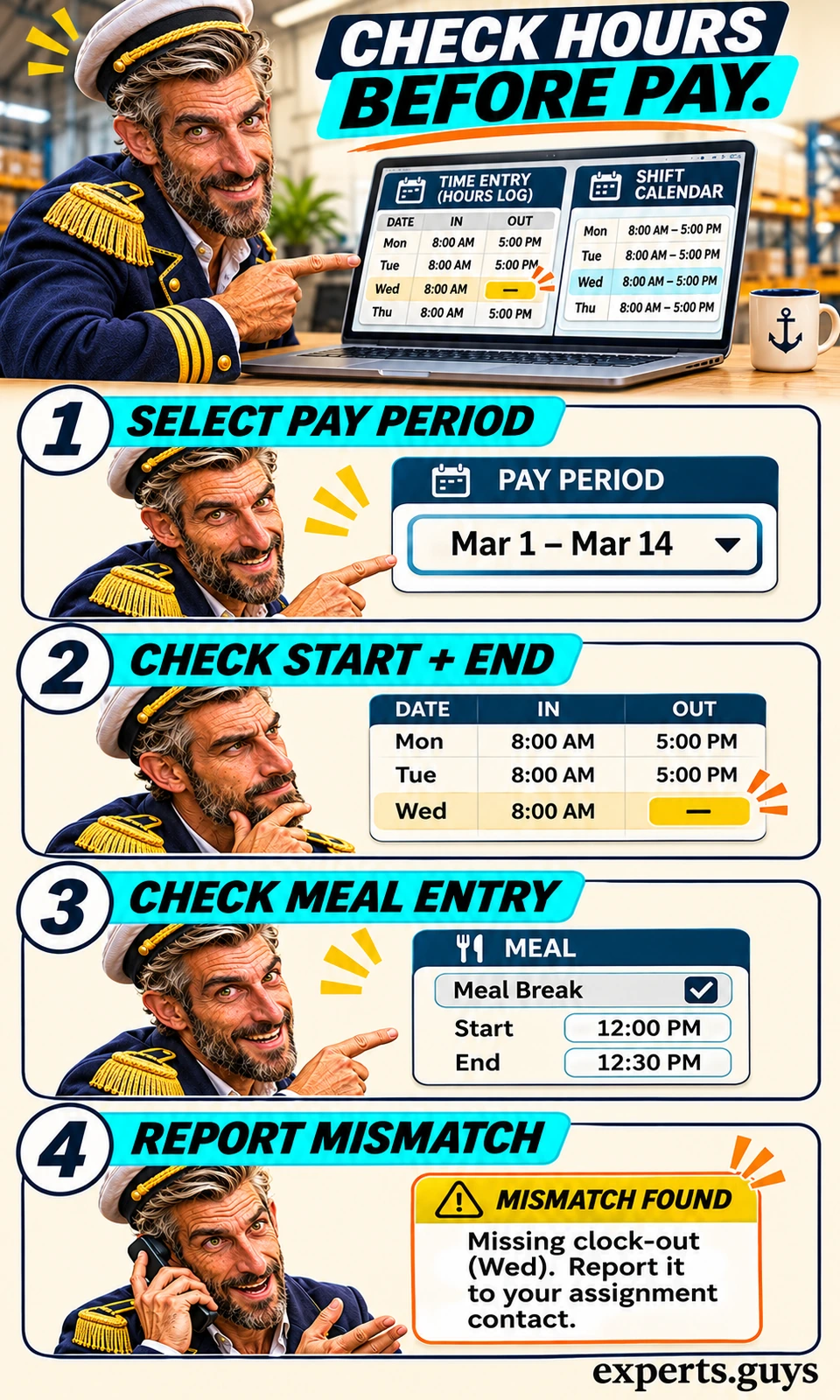
Open the approved time-entry route and select the period corresponding to the wage statement. Check the start and end entries for each relevant shift, including any meal entry that affects the total. Compare what the system shows with the work actually performed and the assignment’s instructions, without substituting scheduled hours for actual work.
An illustrative missed clock-out is a useful example. If a shift’s end entry is absent, identify that specific shift and use the approved correction route. Ask whether the correction needs a supervisor’s confirmation and how you can tell it has been processed. Repeatedly submitting a different total without resolving the missing entry can create another ambiguity.
The easier version is to ask the verified contact to review the affected shift with you when the portal is inaccessible or confusing. Name the period and the problem, and avoid disclosing passwords. The outcome is a complete and accurate time record or a clearly identified pending correction, not simply a message saying that you tried to log in.
Separate hours, rate and deductions on the wage statement
Staffmark’s official employee FAQ identifies Employee Workplace as the route to pay stubs and lists a payroll contact for paycheck concerns. Reach the portal through the official site, and verify current contact instructions there rather than relying on a forwarded login link. The FAQ also provides routes for other employee-document questions.
Start with the statement’s pay-period dates. Then compare the paid hours with the time records for that period and the rate with the confirmed assignment term. Finally, look at gross pay and each deduction separately. This sequence helps you make a precise request while leaving any legal interpretation of a disputed deduction to the relevant facts and rules.
For a simple illustrative example, 40 hours at $18 produces $720 gross before any other applicable pay elements. If the statement shows 38 hours, the first question concerns two hours. If it shows 40 hours at $17, the first question concerns the rate. If it shows $720 gross and a smaller net amount, inspect the listed deductions before deciding that the base calculation is wrong.

The image’s 38-versus-40-hours and $18-versus-$20 labels are separate examples of fields to compare. They are not one real wage statement. In your own enquiry, identify the actual field, expected value and basis for that expectation; do not borrow the example amounts as evidence.
A focused request could say: “For the period ending on this date, the statement shows 38 hours. Please check the missing end entry on the affected shift and confirm whether a correction is needed.” If the rate is the issue, point to the confirmed assignment term instead. Use the secure official route for any documents containing personal information.
After receiving a response, ask how and where the correction will appear. A promise to investigate is useful progress but is different from an adjusted statement or another clear resolution. If the response does not address the identified field, narrow the follow-up to that unanswered point rather than opening several unrelated disputes at once.
If you believe wages remain unpaid after the internal route has not resolved the issue, use the US Wage and Hour Division’s complaint information or the relevant state authority’s official process to understand available options. Requirements vary by jurisdiction and circumstances. This guide’s comparison method can clarify the issue, but it does not determine a legal entitlement, filing deadline or outcome.
Distinguish a fee demand from an ordinary pay question
Staffmark’s job-search safety page states that it does not charge applicants to access employment services, attend interviews or receive job offers, and does not request fees to secure employment or release wages. It also says it does not use WhatsApp for official communications or request sensitive financial information by text.
An unexpected demand to pay before a job or wage payment is released therefore requires independent verification. Use the official company route, rather than the contact details supplied by the person demanding money. Do not treat a familiar logo or knowledge of your application as proof of authority. This is a verification boundary, not an allegation about a particular branch or recruiter.
Close the loop when the assignment ends or changes
Ask what has ended: the particular client assignment, a planned shift or another part of the arrangement. Then clarify how final worked hours will be handled and who is your next contact. Keep the question of future opportunities separate from the pay due for work already performed.
An illustrative end-of-assignment conversation is: “Please confirm whether the assignment has ended, whether all my worked hours have been received, and who I should contact about availability for another role.” This gets three related uncertainties into the same handoff without assuming a new vacancy exists. It is not a request to turn a future possibility into a promised start.

If a new role is suggested, return to the assignment check at the beginning of this guide. A new client, schedule or duty can require new clarification even when the staffing contact is familiar. Do not carry over the previous assignment’s rate, time-entry route or reporting arrangements without confirmation.
For an access barrier, ask the verified office to explain the status and next contact directly. The completion point is knowing what has changed and what remains pending. Being available for work and having a confirmed assignment are still different states.
Questions that may remain
Does the “Employees Mark” URL mean there is a separate agency?
This guide retains the existing page address while clarifying its subject as Staffmark. The URL wording is not evidence of a different employer; verify the organisation named in your own offer and employment documents.
Can an old job advert tell me what the rate should be now?
An old advert can explain where a remembered figure came from, but it does not establish the terms of a current assignment. Identify the particular vacancy and the term offered to you, then ask about any disagreement before relying on the figure.
Should I give a recruiter my banking password to fix a deposit?
No. A banking password is not needed to identify a wage-statement field or ask for a payroll correction. Use the verified employee route for authorised payment-detail updates, and never hand over account login credentials.
Is a client-site supervisor always the right person for every problem?
The supervisor may clarify the daily task or confirm a shift, while another contact handles recruitment or payroll records. Ask who owns the particular correction and how the result will be confirmed. Reporting a safety concern should not wait for that administrative distinction to be settled.
Decision summary
Before starting, settle the assignment terms that would change your decision: the site, actual schedule, offered rate and remaining conditions. At the site, establish the task, training and time-entry handoff. When a statement differs from expectations, identify the period and field so the next conversation can resolve a defined problem.
Choose your next action from the stage you have reached. A pending application needs a status answer; a changed assignment needs confirmed terms; a missing time entry needs the approved correction route. A satisfactory result is a clear answer or completed correction you can identify, rather than reassurance that leaves the original difference unexplained.