



Transcranial magnetic stimulation (TMS) uses magnetic pulses to stimulate brain activity, but its effects on the core symptoms of borderline personality disorder (BPD) remain uncertain. TMS may be considered for a separately assessed depressive illness in someone who also has BPD; that is a different treatment claim from saying it treats BPD itself. Start by identifying which problem a proposed course is meant to address.
The most useful question is therefore not simply whether TMS “works.” Ask what outcome is being promised, what evidence supports that outcome and how the treatment would fit alongside ongoing BPD care. This distinction protects against paying for a broad promise when the available evidence supports a narrower discussion.
| Claim you encounter | What it means for a decision |
|---|---|
| TMS treats depression | Evidence and eligibility must match the depressive condition, device and protocol being offered. |
| TMS treats BPD | This requires BPD-specific evidence; a depression clearance or testimonial does not establish it. |
| Mood improved after treatment | A worthwhile observation, but it does not by itself show that stimulation caused the change. |
| A faster or deeper protocol is better | Speed and coil design do not establish better BPD outcomes; ask for a direct comparison. |
If there is immediate danger, an overdose, serious injury or an inability to stay safe, use local emergency services or the nearest emergency department now. A scheduled TMS assessment is not an emergency response. For everyone else, the sections below explain how to examine a treatment proposal without a symptom diary, self-diagnosis or an invented likelihood-of-success score.
What would TMS be treating: depression, BPD, or both?
A treatment target is the specific difficulty the intervention is intended to change. “Feeling better” matters, but it is too broad to tell whether a treatment is addressing persistent depressive symptoms, emotional reactions during conflict, impulsive behavior or another problem. A person can reasonably want help with several of these while still needing different evidence for each.
Separate the treatment target from the diagnosis label
BPD can involve persistent difficulties with emotion regulation, relationships and self-image, while depression may coexist with it. The presence of one diagnosis does not explain every symptom or exclude another condition. The NIMH overview of BPD describes these overlaps and places psychotherapy at the center of treatment.
A useful opening sentence in a treatment discussion is: “Which problem are we aiming to change with this course?” The answer should be more specific than “your BPD.” If the proposed target is a depressive episode, ask how that was assessed; if it is impulsivity or emotional instability, ask what evidence supports this particular intervention for that outcome. You do not have to choose the diagnosis yourself.
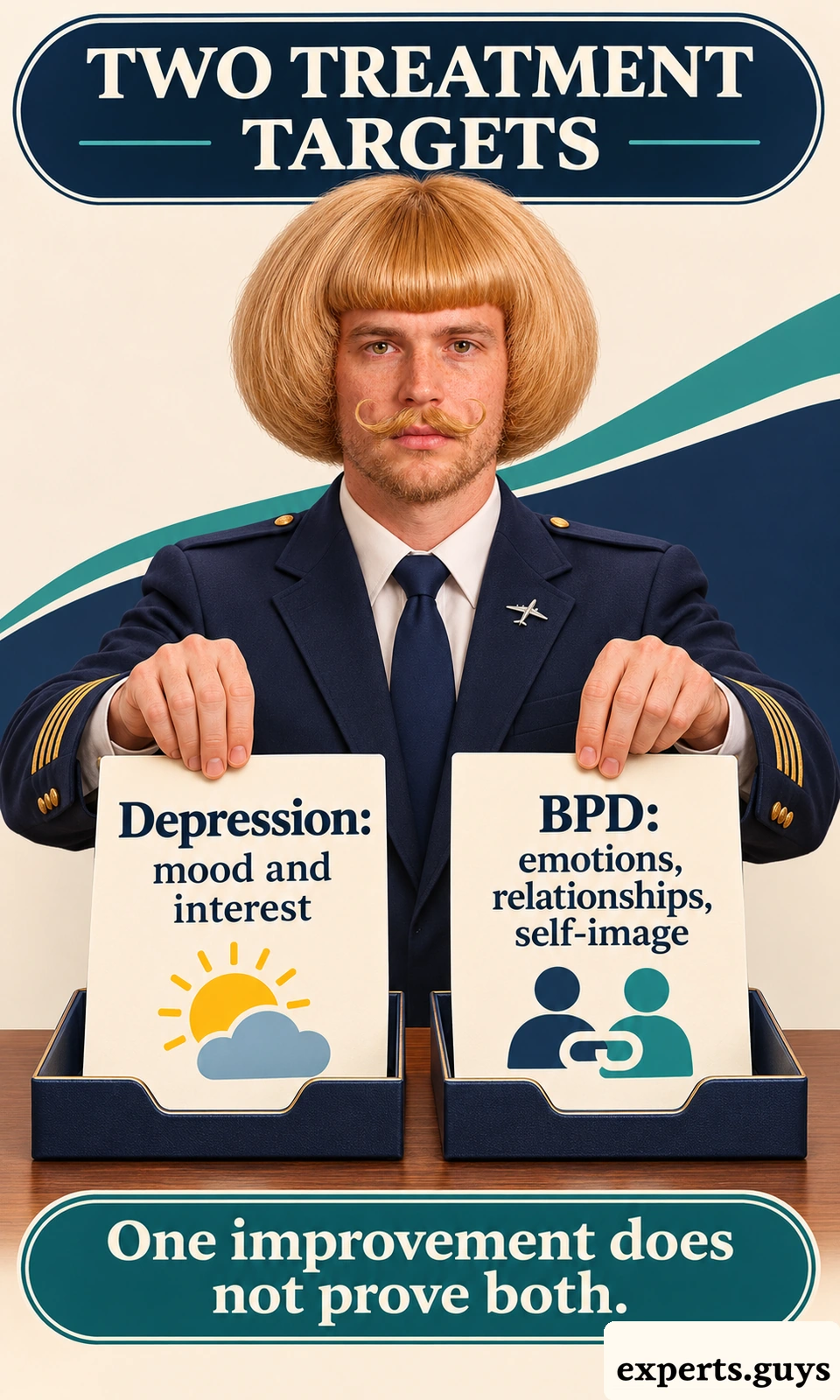
Consider an illustrative example. Someone has BPD, prolonged loss of interest and recurring relationship crises. A proposal to address an assessed depressive illness should explain what improvement in depression would look like, while the care plan continues to address relationship difficulties. It would be misleading to describe an improvement in interest as proof that every part of the BPD pattern had resolved.
This is also why “BPD depression” is an incomplete treatment description. It might refer to co-occurring major depression, distress during interpersonal difficulties or a mixture of experiences. Those possibilities cannot be sorted by a banner, questionnaire total or clinic sales page. The guide to mental pain in BPD and depression explores the experience of distress; this page focuses on evaluating the intervention proposed for it.
Understand the mechanism without turning it into a promise
In repetitive TMS, a coil near the scalp produces changing magnetic fields that induce electrical activity in the brain. Repeated pulses can influence neural circuits. The NIMH explanation of brain stimulation therapies describes established depression uses, the procedure and its limits. Standard outpatient rTMS usually keeps the person awake and does not require anesthesia.
BPD research often investigates the dorsolateral prefrontal cortex, usually shortened to DLPFC. A proposed role in cognitive control gives researchers a reason to study it; it does not prove that stimulating this area will improve an individual’s relationships or sense of self. The chain from a plausible target to a useful treatment still needs clinical evidence at the outcome level.
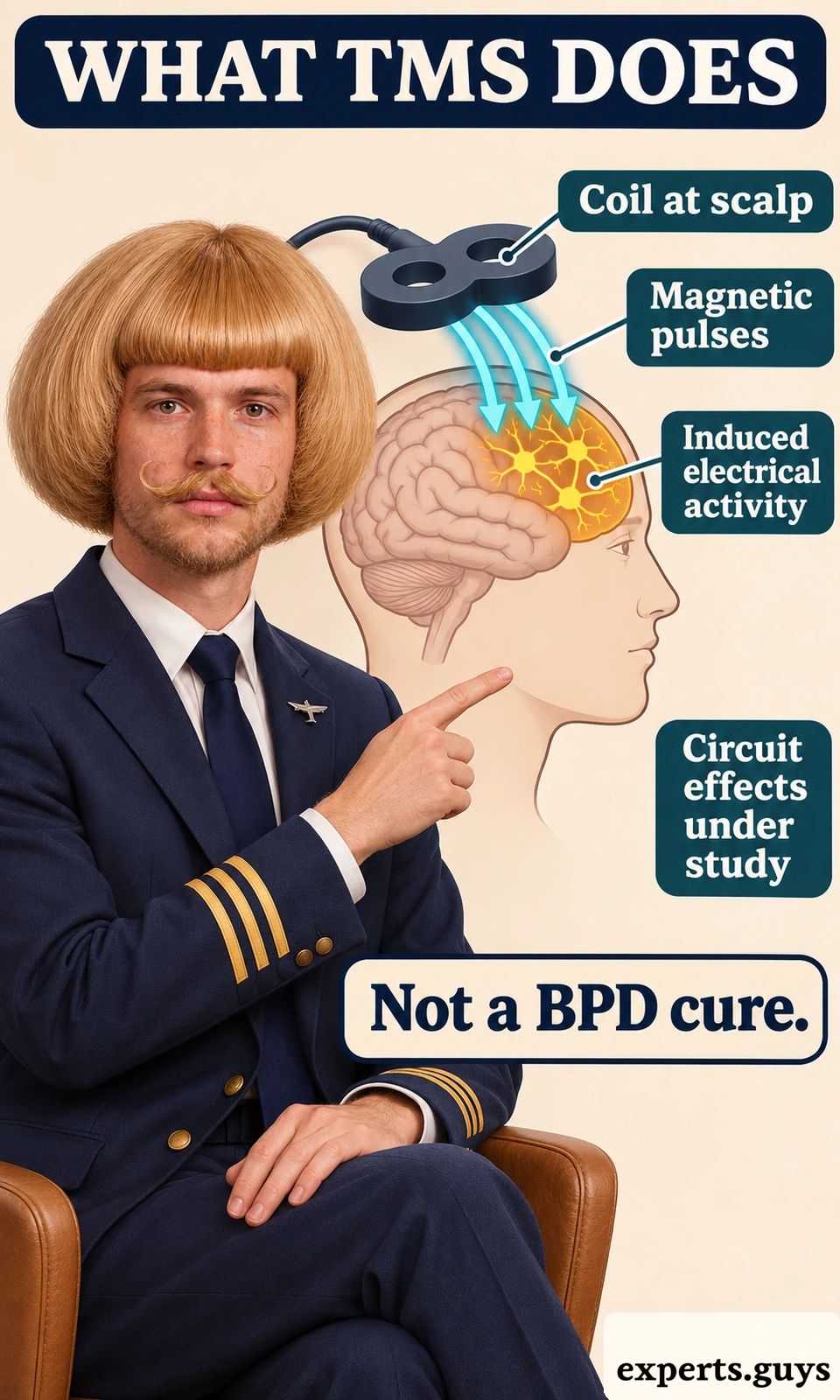
Avoid the simplified idea that BPD is a broken brain region that a coil repairs. A mechanism describes how an intervention can affect tissue or activity; an efficacy study asks whether people benefit in a meaningful way. Those are connected questions, but answering the first does not settle the second. Attractive brain graphics should not erase that gap.
Keep psychotherapy and other treatment decisions distinct
Structured psychotherapy remains the established foundation of BPD care. NICE guidance recommends an integrated psychological approach and addressing co-occurring conditions within a coordinated plan. Its medication recommendations do not support using a drug specifically for BPD itself or routinely using antipsychotics as long-term BPD treatment.
That foundation changes how to evaluate an added procedure. The practical question is what TMS would contribute, rather than what existing care it can automatically replace. If an offer assumes that attending stimulation sessions makes BPD-focused treatment unnecessary, ask for the evidence behind that assumption. Do not stop prescribed medication or therapy to make a treatment package fit its marketing story.
A legitimate treatment for one condition can still be unsupported for another. Likewise, an off-label proposal is not automatically evidence of wrongdoing or proof of effectiveness. Ask the provider to distinguish the regulatory indication, the clinical rationale and the limits of the research. These are separate explanations; a statement that a device is cleared should identify what it is cleared to treat.
What do the BPD studies actually show?
The research supports continued investigation, but it does not establish TMS as a reliable treatment for the whole BPD pattern. Small studies can suggest a useful direction, yet leave uncertainty about chance, comparison groups and durability. Look at the study design before deciding how much weight to give a striking improvement claim.
A comparison group changes what an improvement means
In a double-blind sham-controlled trial published online in September 2026, 30 women with BPD received 15 sessions of active or sham right-DLPFC stimulation. The main longitudinal analyses did not establish an advantage for active treatment over sham. Improvements within individual groups therefore did not establish a stimulation-specific benefit. The small, selected sample also limits generalization.
This matters because “people improved” and “the treatment caused the improvement” answer different questions. A sham condition is designed to resemble treatment while withholding the active stimulation being tested. It helps researchers examine whether change exceeds what happens with the treatment setting, expectations, other care and the passage of time. It is not a judgment that anyone’s distress or improvement was imaginary.

A useful evidence distinction is the difference between a total and its components. An overall questionnaire score can fall while one important difficulty remains unchanged. Conversely, a specific improvement may matter even when the total moves little. When a claim concerns “BPD symptoms,” ask whether it names the actual domain or merges several outcomes into one appealing phrase. The point is to preserve meaning, not to search for whichever number looks most favorable.
A negative comparison is not proof that no person could ever benefit. It means the trial did not demonstrate the superiority being tested. Equally, an encouraging result in a subset or an exploratory analysis cannot simply replace the main comparison. The fair interpretation keeps both limits visible: uncertainty should not become either a sales guarantee or a universal dismissal.
Read the earlier findings in proportion
A small randomized pilot involving 10 people reported improvements in selected outcomes after right-DLPFC rTMS. Such an early signal can justify larger research. With so few participants, however, it cannot establish a dependable response rate, identify who should receive treatment or show that a benefit will last.
Another trial involving 29 people compared right-sided 1-Hz and left-sided 5-Hz stimulation over 15 sessions. Both groups improved on several measures, but there was no sham arm. Because everyone received an active protocol, the design could not isolate a stimulation-specific effect from other explanations for improvement. It also does not establish which protocol a new patient should choose.
There is a difference between an exploratory finding and a result planned as the main test. Searching across many symptoms or subgroups increases the opportunities to notice an interesting pattern. That pattern may deserve another study, but it should not silently become the headline conclusion. If a summary emphasizes one favorable detail while omitting the main comparison, return to the original research question before interpreting the result.
Do not combine these studies into a homemade success percentage. Different targets, pulse patterns, participants and outcomes make the denominator unclear. Counting every reported improvement as the same kind of success would hide the very differences that matter. A provider quoting a number should be able to identify the population, outcome, comparator and follow-up behind it.
Use a four-part claim check
When reading a study summary or clinic claim, use four questions in order. This is an evidence-reading aid, not a clinical assessment or a validated treatment-selection instrument. Its purpose is to reveal what the claim actually establishes before you decide whether it belongs in a treatment discussion.
- Name the outcome. Was the study measuring depression, impulsivity, self-harm, overall BPD severity or everyday functioning?
- Check who was studied. Does the claim describe people with BPD, depression alone, or both, and are important restrictions missing?
- Find the comparison. Was there sham treatment, another active protocol, usual care or only a before-and-after observation?
- Check follow-up. Was improvement assessed only at the end of sessions, or was its persistence actually examined?

For an illustrative example, imagine an advertisement saying “TMS improved symptoms in people with BPD.” If the underlying outcome was a depression score, the claim does not automatically extend to impulsive behavior. If there was no sham group, the wording also leaves causation unresolved. Correcting the interpretation does not require rejecting the study; it requires using the result for the question it can answer.
A depression score also does not tell you whether a full depressive diagnosis was established in the study. If those terms are unclear, the explanation of clinical depression versus depressive symptoms covers that language distinction. Here, it matters because evidence about a measured symptom should not be silently expanded into evidence about every condition a participant has.
A common mistake is to stop when a headline says “randomized.” Randomization can compare two active approaches, as in the 29-person study, without including sham. Another mistake is treating a statistically detectable change as a complete account of meaningful daily benefit. Ask what changed in life, how the study measured it and what uncertainty remains around that estimate.
If concentration is limited, start with just the first question: “What outcome was measured?” Ask someone you trust to read the methods with you if wanted, or ask the provider to explain the comparison aloud. Completion means that you can state the target and the main uncertainty in your own words. It does not mean deciding whether TMS is medically suitable without an assessment.
What should you expect from sessions and safety screening?
A TMS course involves assessment, a specified stimulation protocol and repeated clinical visits. The experience is not just the minutes during which the coil is active. Screening, setup, hearing protection, adjustment and access to the treatment team all affect whether the proposed course is workable and appropriately supervised.
Ask what the protocol changes
“TMS” is an umbrella term. Conventional repetitive TMS, theta-burst patterns, deeper-reaching coil designs and accelerated schedules differ in how stimulation is delivered. A shorter appointment, more sessions per day or a different coil does not by itself establish greater benefit for BPD. Ask why the proposed protocol matches the named target and the evidence discussed.
The protocol description should identify the device or coil, intended target, session schedule and review arrangements. You need not learn to operate the equipment or select pulse settings. The useful task is to understand what is being offered well enough to compare its rationale with the clinical goal. Technical complexity should not prevent a plain-language explanation.
For context, NIMH describes typical rTMS sessions ranging from a few minutes to around 40 minutes and conventional courses often involving weekday visits for several weeks. These are examples of depression treatment delivery, not a standard BPD prescription. Ask for the actual schedule, including assessment time and any taper or follow-up appointments, rather than budgeting from the shortest advertised session.
Prepare for assessment without changing treatment yourself
The updated clinical TMS consensus emphasizes assessment of medical and psychiatric history, medicines and seizure-related risks. Implanted devices or metal near the stimulation area require device-specific consideration. Disclose the details; do not assume that every implant is automatically safe or that every metal item automatically rules treatment out.
- Before the first session, tell the team about implants, seizure history and relevant head injuries; use existing records if available.
- Review current medicines, recent changes and substance use with the team. Do not skip or alter doses to prepare yourself.
- Ask staff to provide and check hearing protection and explain what sensations to expect.
- Agree how to request a pause, then practise that signal or phrase before stimulation starts.
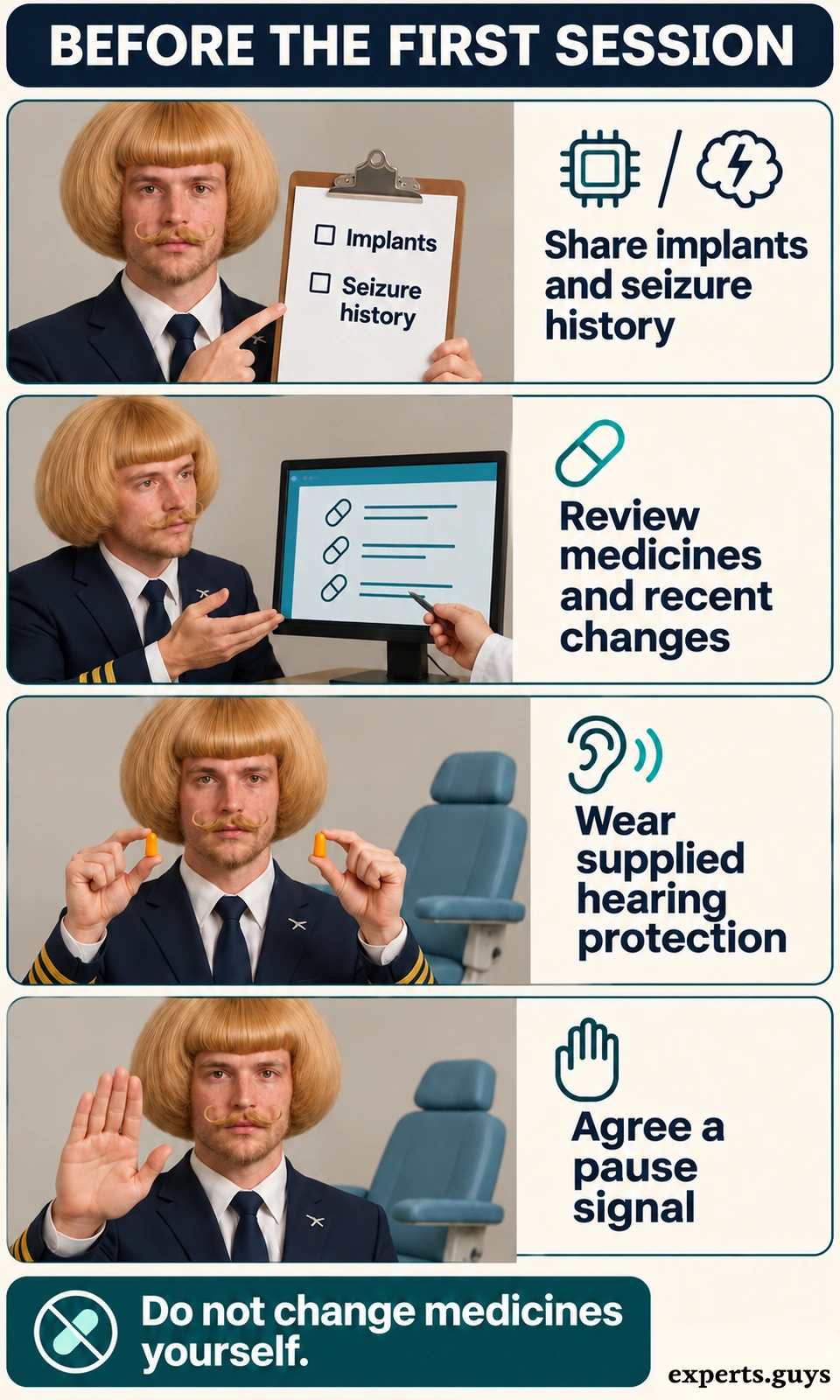
This sequence solves a practical access problem: important information and a way to pause should be clear before the procedure begins. You do not need a new written diary. If explaining the history feels difficult, bring existing medicine packaging or an available medication list and ask a trusted person to help communicate, with your permission. Uncertainty about an implant is a reason to identify it, not to guess.
A completed preparation step means the team has the relevant information and you know how to interrupt the session. It does not mean passing a self-administered safety checklist. The clinical team must decide suitability and settings. If you feel pressured to conceal a medicine, implant or substance use to remain eligible, do not proceed on that basis.
Distinguish tolerability from a change needing review
Scalp discomfort, headache and muscle sensations can occur during TMS. Seizures are uncommon but possible, which is one reason appropriate screening and supervision matter. Tell the team about significant discomfort rather than trying to endure it silently. A procedure being noninvasive does not mean it has no risks or that every new symptom should be accepted as normal.
New agitation, an unusually reduced need for sleep, escalating impulsivity or worsening safety needs deserve prompt clinical review. These changes do not diagnose a cause, but they can change the treatment plan. The separate guide to BPD and bipolar patterns explains why a change in energy and sleep should not be collapsed into the phrase “mood swings.”
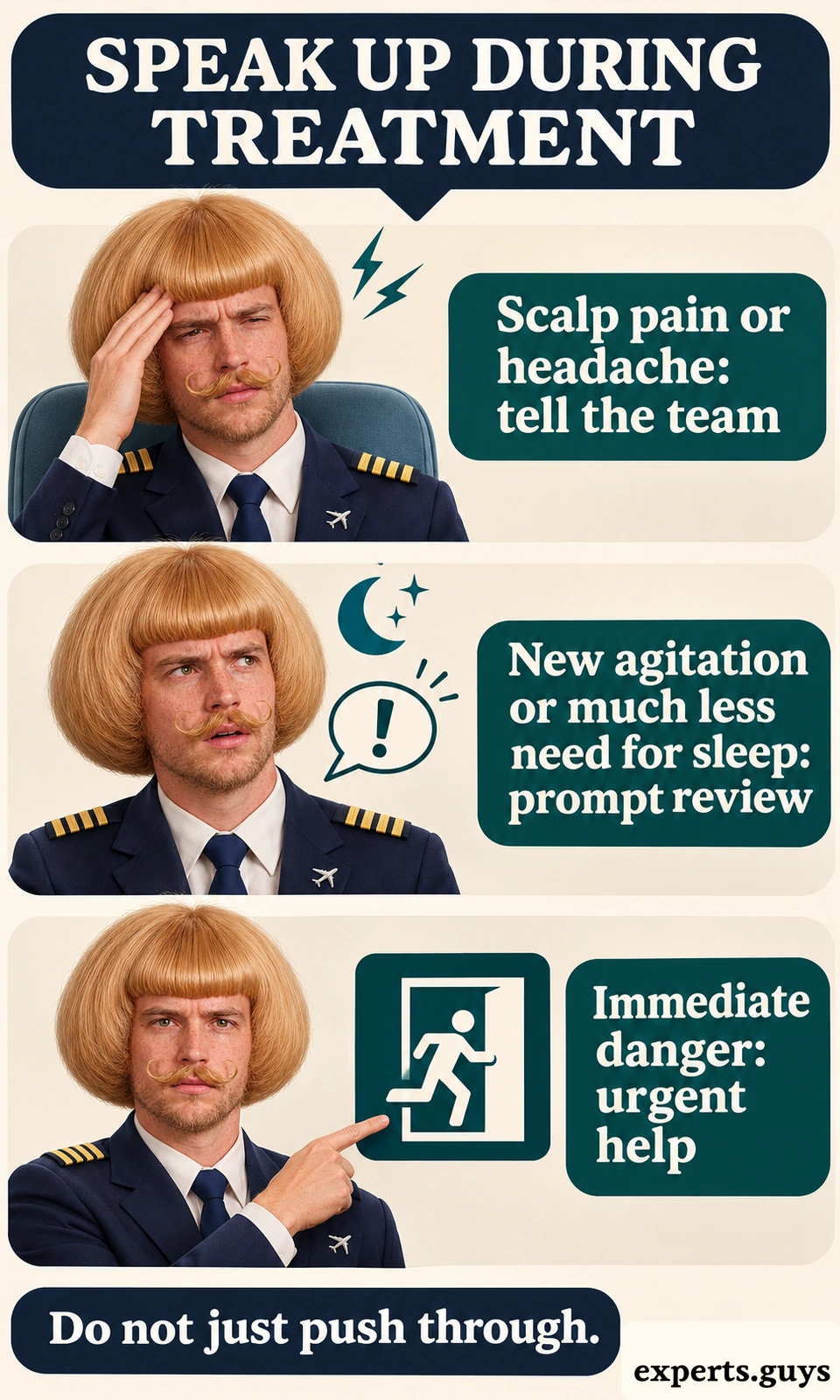
The useful distinction is between reporting a symptom and deciding its explanation. You can say “I have hardly slept and feel unusually driven” without deciding that TMS caused it or that you have a different diagnosis. The team can assess the timing, other treatments and alternatives. Immediate danger requires emergency help rather than waiting for a routine appointment or the next session.
A clinic should distinguish the roles of the person operating the equipment, the clinician supervising treatment and the person reviewing the broader care plan. Those roles may be shared or separate. Ask who can answer a safety concern between visits and how information reaches the clinician responsible for your other treatment. A familiar technician and a clear route to clinical review perform different jobs; both should be understandable.
There is also a practical consent issue when stimulation sensations feel overwhelming. Ask what adjustment or interruption is possible and how the team handles an incomplete session. Having a pause plan preserves communication; it is not a promise that treatment will be comfortable. An accessible explanation, a support person where appropriate and time to ask questions can matter more than a polished waiting room.
How can you compare a TMS offer without overpaying for a promise?
Compare the clinical target, supporting evidence, total commitment and review plan together. A favorable price cannot compensate for an unclear purpose, while a clear purpose does not automatically make an expensive course worthwhile. This is a shared treatment decision under uncertainty, not a contest to find the most impressive machine.
Compare the whole course, not the headline price
Ask which assessment and treatment visits the quote includes, whether follow-up is included and what happens if sessions are missed or the course ends early. Coverage and reimbursement depend on the jurisdiction, payer and indication. Obtain confirmation for the actual proposal rather than assuming that coverage for depression extends to a BPD-specific use.
| Part of the offer | A useful answer contains |
|---|---|
| Target and evidence | The assessed problem, intended outcome and evidence that matches it, with the uncertainty explained. |
| Protocol and schedule | What is delivered, why it was chosen and the total visit commitment rather than coil time alone. |
| Full financial commitment | Assessment, sessions, follow-up, travel, time away from work and cancellation or early-stop terms. |
| Clinical review | Who evaluates progress and adverse effects, when review occurs and what could change or stop the plan. |
| Ongoing BPD care | How existing psychological care and other necessary treatment remain coordinated. |

For an illustrative comparison, offer A might advertise a low price per session but leave the number of sessions and follow-up costs unclear. Offer B might provide those details but still fail to explain why its protocol addresses the intended problem. Neither offer can be ranked confidently from price alone. The next action is to obtain the missing information, not assign a clinical quality score to the paperwork.
Travel and attendance also have opportunity costs. A course that displaces an established therapy appointment or requires repeated unpaid leave may be harder to sustain than the appointment length suggests. Discuss scheduling conflicts before paying. A workable plan should make room for the care you already need rather than quietly forcing you to choose between appointments after treatment has begun.
Agree what would change the plan
Ask when the proposed course will be reviewed and what the review will consider. Useful domains include the named target, functioning, adverse effects, attendance burden and your preferences. Clinical rating scales may help the team assess change, but a lower total is not the only question. Improvement in one domain should not make unresolved difficulties disappear from the conversation.
Avoid an open-ended arrangement in which every disappointing result is answered by selling more sessions. Equally, do not set an unsupported personal deadline based on another person’s testimonial. Ask the team to explain the planned evaluation points, what would justify continuation and what would prompt reassessment. Those answers should be available before an optional extension is purchased.
Lack of benefit is not proof that someone was insufficiently motivated or failed to cooperate. It is information for the treatment decision. A reasonable review can conclude that the current approach has not added enough value, that the target needs reassessment or that another option deserves discussion. This is especially relevant when the original promise was broad: narrowing the question may be more useful than repeatedly escalating the commitment.
If treatment has already started, uncertainty about the target is still worth resolving. Ask the supervising clinician to restate the purpose and review plan before you decide about an extension. Do not change medication or skip necessary care to test which intervention is working. Several treatments can be appropriate at once even when their separate contributions are difficult to untangle.
Use three spoken questions at the consultation
Start with the target, then the rationale, then the conditions for changing course. You can ask these questions aloud in an assessment or follow-up discussion. They are an editorial communication aid for informed discussion, not a medical selection algorithm, and you do not need to complete a form or gather a perfect symptom history first.
- “What are we treating?” Ask for the assessed condition or symptom target and a meaningful outcome.
- “Why this protocol?” Ask how the evidence matches your situation and what reasonable alternatives remain.
- “What would change the plan?” Ask about review timing, adverse effects, limited benefit and the option to stop or reconsider.
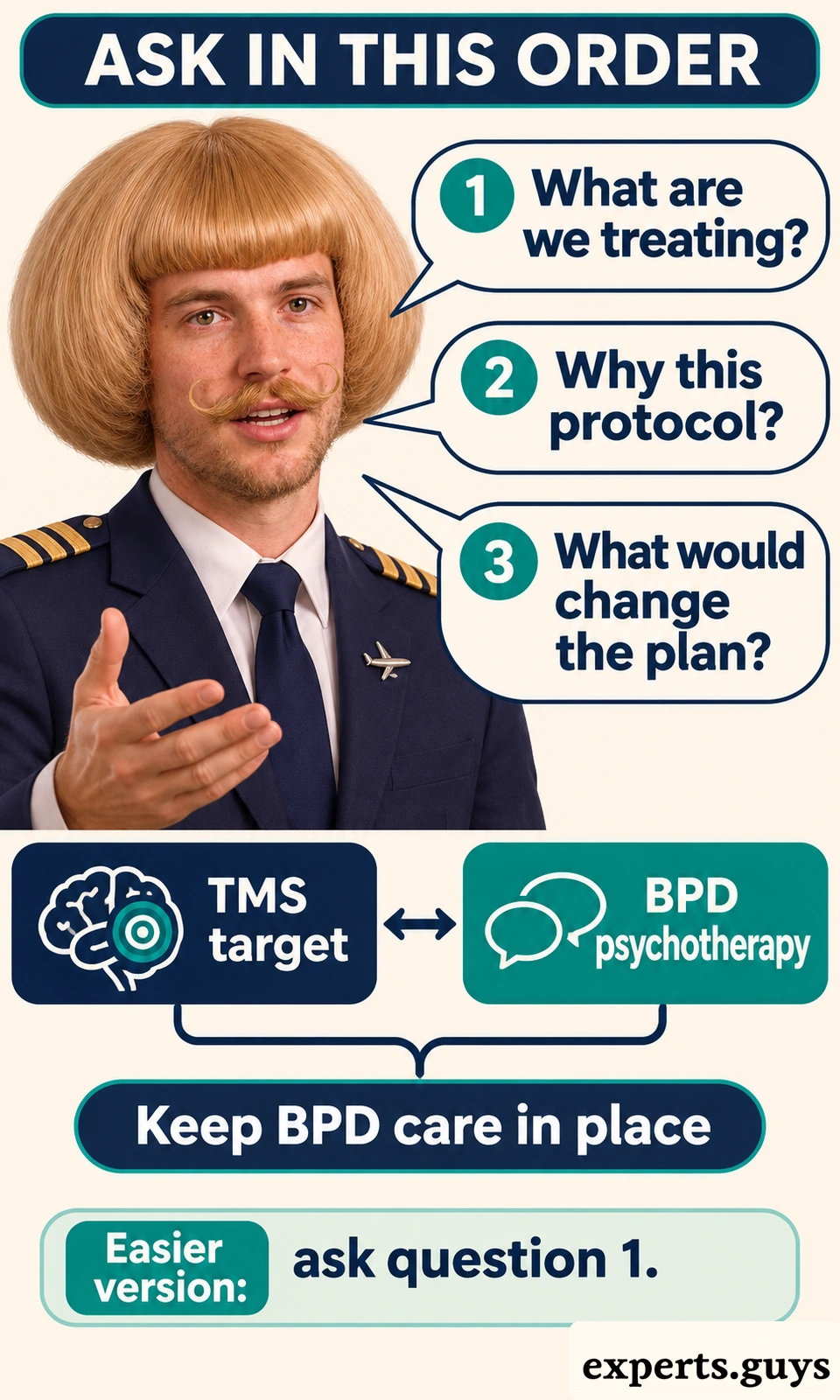
For example, “We are treating your depression” is a beginning, but “This course is expected to fix your personality” is an unsupported expansion of the claim. Ask the provider to return to the specific target and explain the limits. If the answer is too technical, request a plain-language version; understanding the purpose does not require understanding every engineering parameter.
The easier version is a single question: “What are we treating?” You can pause the discussion after that answer and return with support if needed. The observable outcome is that you can explain the proposed purpose, its uncertainty and the next review point. You do not need to feel confident about every possible outcome or agree to treatment during the first conversation.
If the offer is part of a research study, distinguish research consent from a routine treatment agreement. Ask what is experimental, whether assignment could involve sham, which costs are covered and what care remains available if you withdraw. Participation can contribute to knowledge without guaranteeing personal benefit. An honest explanation of uncertainty is a reason to understand the proposal carefully, not a reason to feel obliged to enroll.
Our editorial recommendation is to treat TMS for core BPD symptoms as an evidence-limited proposal requiring a particularly clear rationale, rather than a routine next purchase after a difficult period. A separate depressive illness may create a different discussion. In both situations, preserve a coherent care plan and require an explanation of what the intervention adds before committing time and money.
Frequently asked questions
Can TMS tell me whether I have BPD?
No. A response or lack of response to stimulation does not establish the diagnosis. Assessment considers the broader pattern and other possible explanations; treatment response is not a stand-alone diagnostic test.
What if I cannot afford the full course?
Ask about the complete cost, coverage requirements and alternatives before making a commitment. Do not assume that buying a few sessions provides the same benefit as the proposed course. Financial constraints belong in the shared decision; they are not a personal failure.
Does an expensive brain scan make a treatment claim more convincing?
Only if its role is explained and supported for the decision being made. Ask whether it changes targeting or management, what limitation it has and whether its cost is included. A technical-looking image does not by itself establish that a treatment will help BPD.
What if the provider guarantees that TMS will cure BPD?
Ask for the specific evidence, population and outcome behind that guarantee. The evidence described here does not support a guaranteed BPD cure. Do not let a time-limited discount replace an explanation of uncertainty, alternatives and the right to decline.
Can I judge an offer from another patient’s testimonial?
A testimonial can describe one person’s experience, but it cannot establish your likely outcome or separate stimulation from other care. Use it to generate questions about the course, not as a substitute for comparative evidence and an individual assessment.
A clear target comes before a commitment
At the next TMS discussion, ask what the course is intended to treat and request the evidence that matches that target. Then check the review plan and the full commitment. If those answers remain unclear, resolve them before paying for a course or extension; a clear explanation is part of the decision itself.










