
CCI depression resources are free self-help materials from the Centre for Clinical Interventions, including the Back from the Bluez workbook. If you are new to them, open the official depression page and begin with the overview rather than a random worksheet. These resources support learning and practice; they do not diagnose depression or replace individual care.
Open the official CCI depression resources to find the workbook, information sheets and practice forms. You can use the material on a screen; printing is optional. The guide below helps you choose and access a resource without turning the task into another daily log.
| Your immediate task | Start with | Useful checkpoint |
|---|---|---|
| Understand what the material covers | The workbook overview | You know what you are opening |
| Learn one unfamiliar skill | Its teaching module | You understand the explanation before the form |
| Practise an already explained skill | The matching worksheet | You can follow its instructions |
| Resolve confusion or increasing difficulty | The relevant explanation or a care conversation | You have a suitable next step |
Which CCI depression resources are you looking for?
In this guide, CCI means the Centre for Clinical Interventions in Western Australia. The same initials appear in unrelated medical and research contexts, so the surrounding words matter. Here the reader task is using its depression self-help material, not interpreting an injury model or a hospital research measure.
Check the source before opening a download
Use this check when a search result says only “CCI” or offers a workbook through an unfamiliar download page. The initials alone do not identify the publisher. Confirming the source avoids mixing a self-help resource with unrelated research terminology.
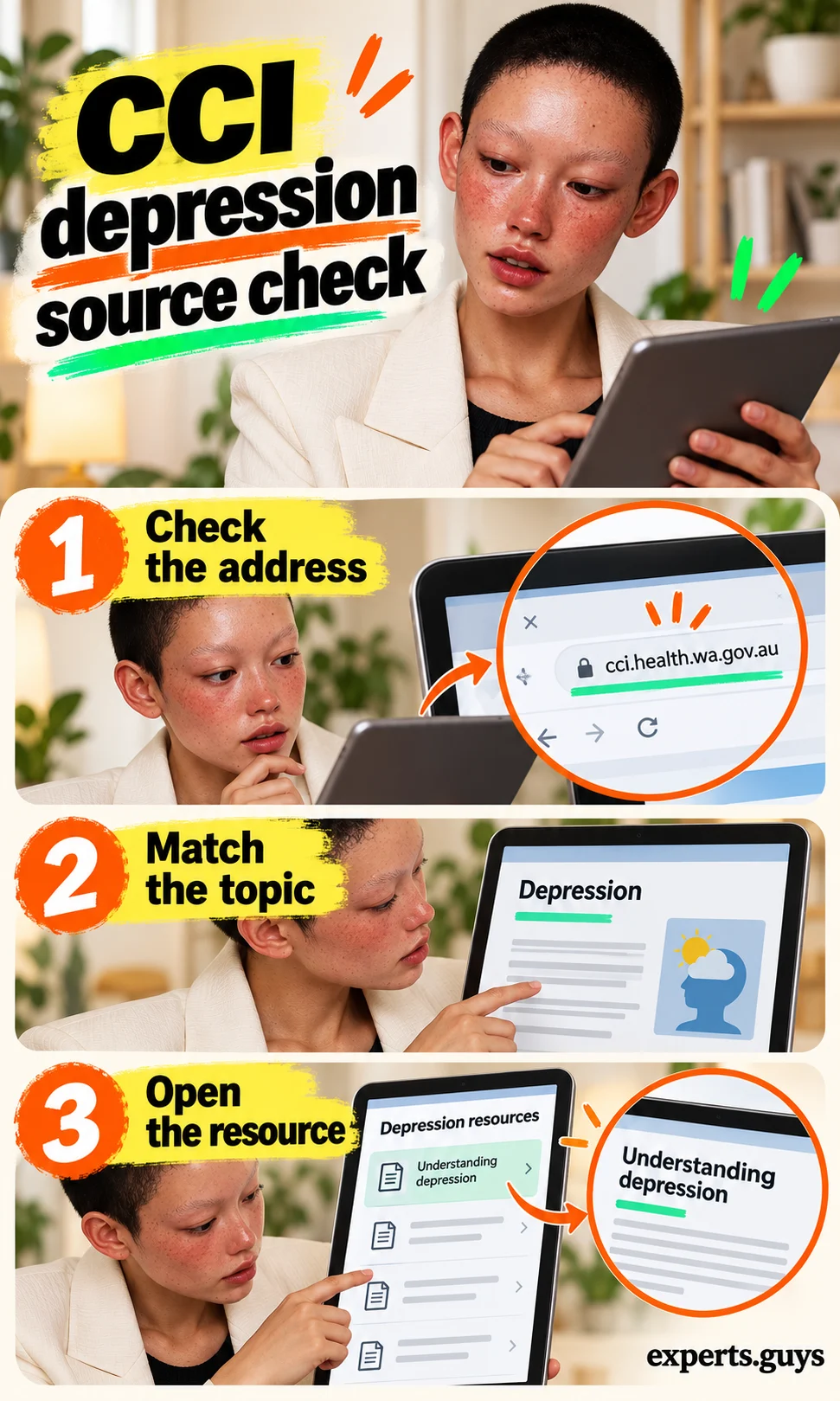
- Open the official CCI depression page linked above.
- Check that the address belongs to cci.health.wa.gov.au and that the page identifies depression resources.
- Open a resource from that page, then confirm its title matches the item you selected.
Illustrative example: you want a depression workbook, but a search result discusses nerve injury. Return to the official resource page instead of treating the shared initials as a match.
An advert or a familiar-looking PDF cover is not proof of origin. If checking a long address is difficult, use the official link in this article and bookmark that page. Finish with one trusted starting page, not a collection of unverified downloads.
Choose an explanation, a module or a practice sheet
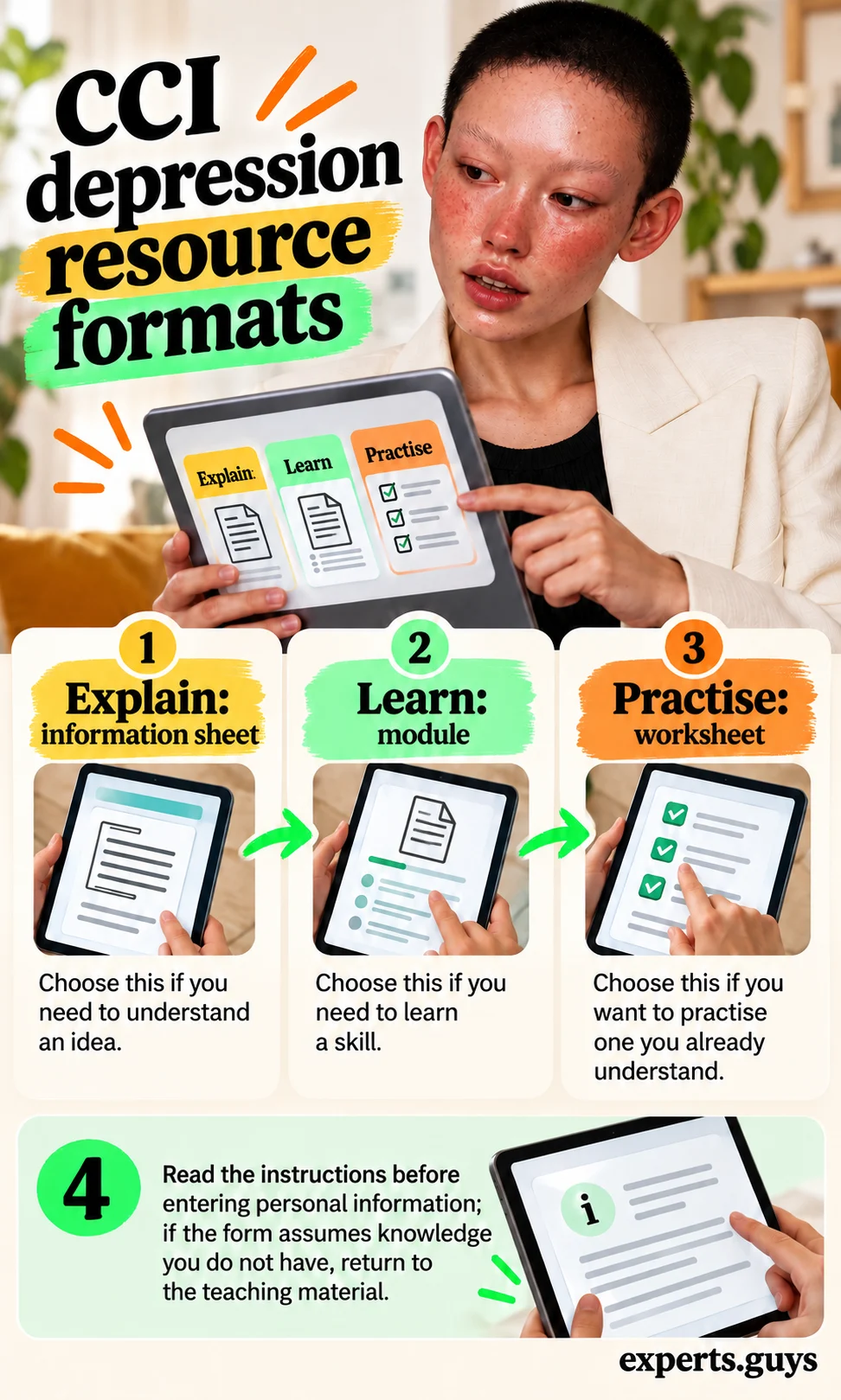
Choose the format by the job you need it to do. An information sheet introduces an idea, a workbook module adds teaching and practice, and a worksheet gives you space to apply a skill. A blank form can feel confusing when its explanation is missing.
- Decide whether you need to understand an idea, learn a skill or practise one you already understand.
- Choose the corresponding information sheet, module or worksheet on the resource page.
- Read the instructions before entering personal information; if the form assumes knowledge you do not have, return to the teaching material.
Illustrative example: a thought diary looks unfamiliar. Open the relevant teaching section first instead of guessing what each box means.
Downloading everything can make the next decision harder. Keep one item open; if that is still too much, read its title and first explanation with someone you trust. You have selected successfully when you can say what the resource is for.
The 13 depression worksheets article covers a broader set of practice examples. Use that page when you want to compare exercise types. Stay here when the obstacle is finding or using the CCI material itself.
Where should you start in Back from the Bluez?
The workbook is a sequence of nine modules, rather than nine interchangeable downloads. Its progression moves from an overview and behavioural strategies into thinking skills, core beliefs and self-management. Use the sequence as a learning aid, while allowing your needs and any agreed care plan to guide how you work through it.
Find your place in the workbook sequence
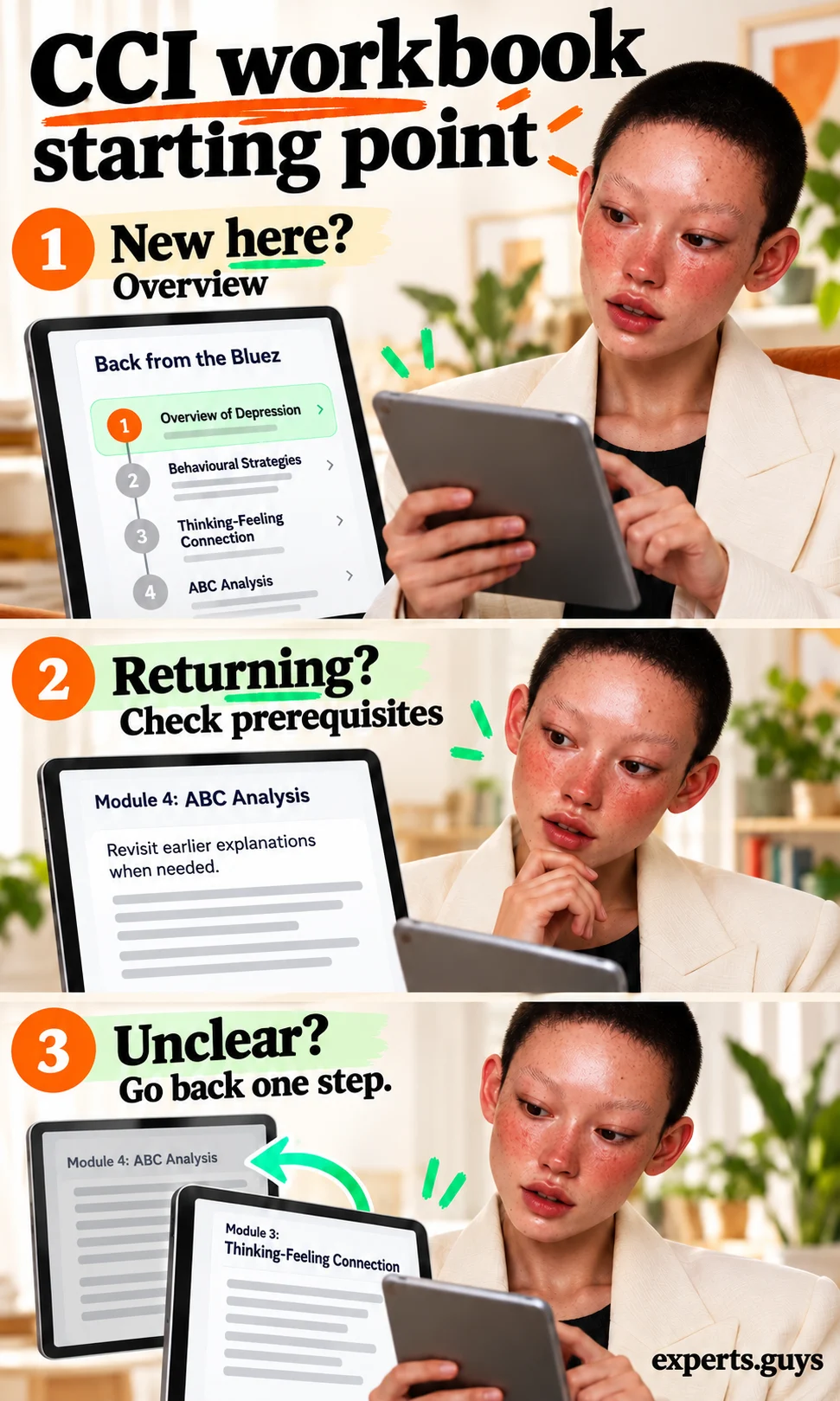
Start with the overview if the programme is new to you. CCI recommends working through the modules in sequence, although it does not make completion of one a condition for opening the next. If a clinician has already selected a section with you, use that agreed starting point.
- Open the overview and identify the next module in the sequence.
- If you are returning to a specific skill, read that module’s introduction and check whether it refers to earlier material.
- Move back to that explanation when a term or worksheet is unfamiliar; keep the later resource available for when you are ready.
Illustrative example: a later thought exercise assumes that you can distinguish a situation from your interpretation. Revisit the earlier teaching rather than filling the later form at random.
The highest module number is not the best starting point, and finishing quickly is not a recovery measure. For a lower-effort start, read only the overview’s contents. The checkpoint is knowing where to begin and why, not completing a module in one sitting.
| Workbook area | What it covers | Navigation implication |
|---|---|---|
| Module 1 | Overview | A starting point for new readers |
| Module 2 | Behavioural strategies | Activity-related teaching |
| Modules 3–7 | Thinking and feeling, ABC analysis, thinking styles, examining thoughts and balanced responses | Earlier explanations support later exercises |
| Module 8 | Core beliefs | Use support if this material feels difficult to apply |
| Module 9 | Self-management | Revisit relevant learning as you plan continuation |
Make one reading session easier to use
A usable session ends with one idea you understand, even if you read very little. Choose a small section before starting so that the screen has a clear stopping point. This is an access adaptation for the workbook, not a prescribed treatment dose.
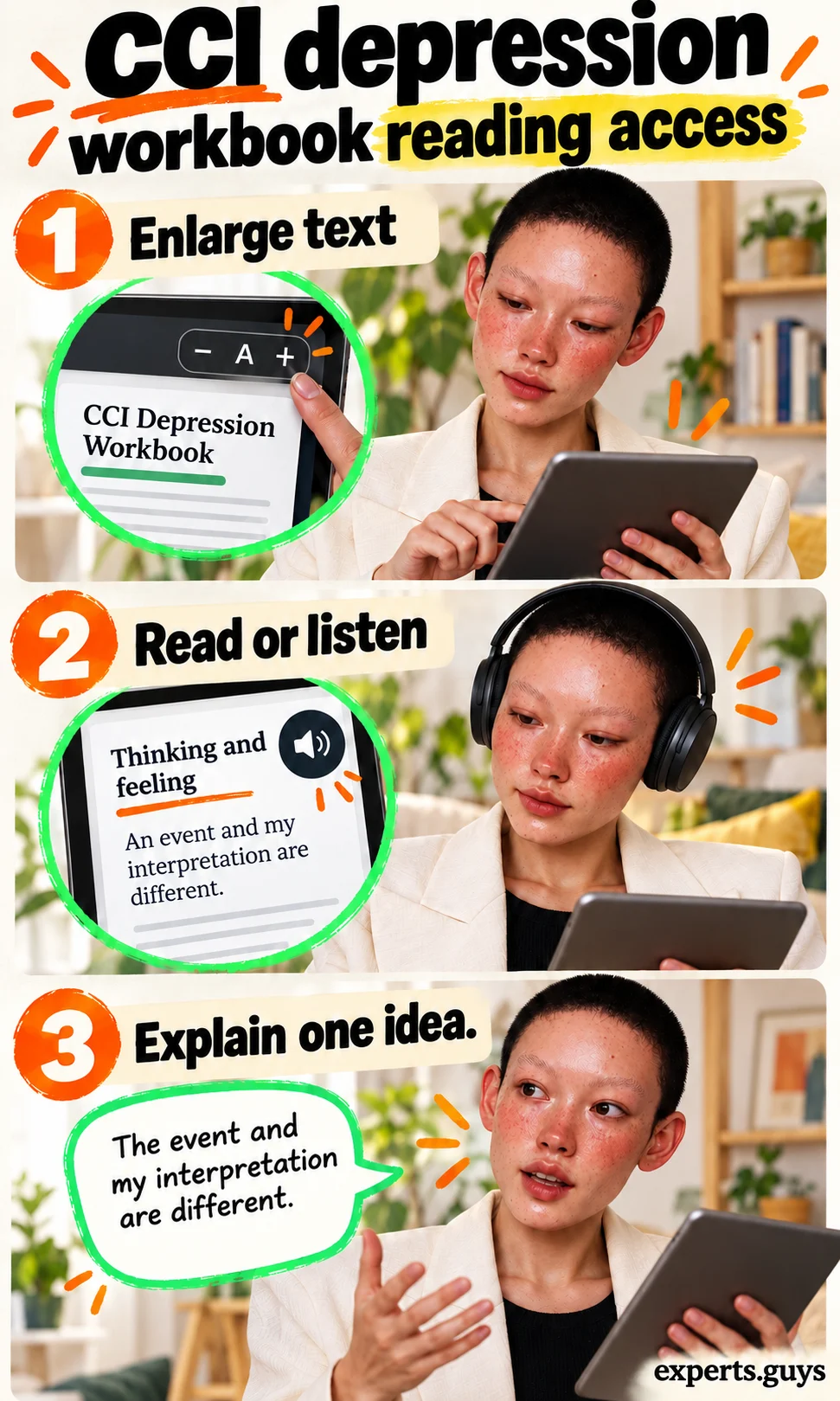
- Open one section and enlarge the text to a comfortable size.
- Read one short explanation; use your device’s read-aloud function if it is available and works with the PDF.
- Say the main point in your own words, then stop or continue according to your concentration.
Illustrative example: after a section about thoughts and feelings, say, “The event and my interpretation are different.” You do not need to produce a polished summary or a written entry.
Rereading repeatedly without understanding is a cue to change the format or ask for help, not to force a longer session. A smaller option is to read one heading together with a trusted person. Judge the session by understanding, not by how many pages you turned.
If remembering what you have just read is a recurring difficulty, the article on depression and memory problems explains the distinction between attention, learning and recall. That distinction can make a reading difficulty easier to describe. New or worsening cognitive symptoms should not automatically be attributed to depression.
How can you use CCI worksheets on a phone?
A digital copy is useful only if you can read it, retain any intended entries and find your place again. Reading a PDF, annotating it and saving the changes are separate functions. The checks below are practical access suggestions; availability depends on your device and PDF reader.
Use the PDF without printing it
You can read the resource digitally and use a compatible PDF annotation feature when you want to enter an answer. Do not assume every file contains interactive form fields or that a browser preview saves edits. Test the save behaviour before entering sensitive information.
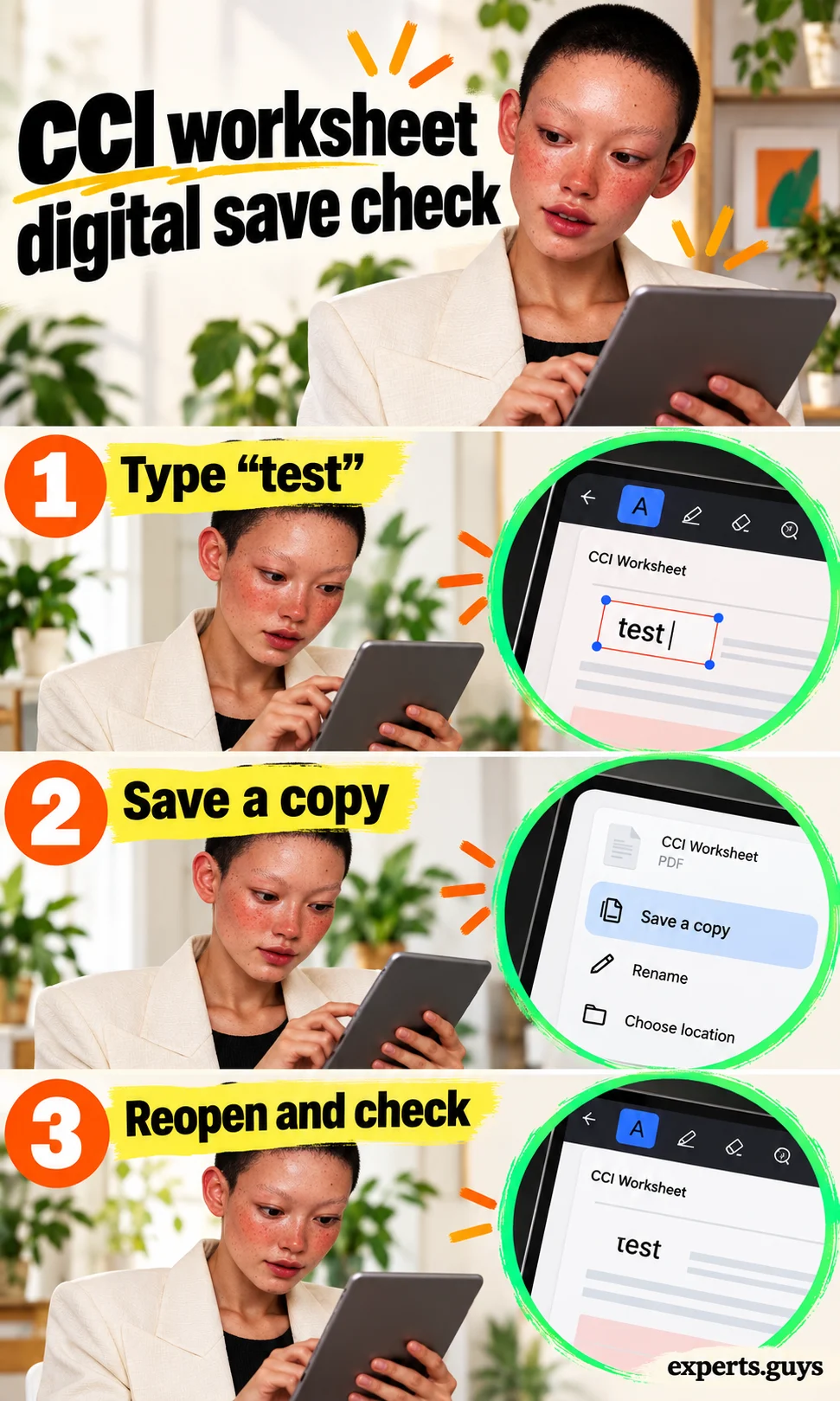
- Download the selected file to a location you control and open it in your chosen PDF reader.
- Try a harmless word such as “test” using a text or annotation feature; save a separate copy.
- Close and reopen the copy to confirm the text remains, then delete the test entry before using it.
Illustrative example: typed text disappears after closing a browser preview. Reopen the downloaded file in a reader with a save function, or type only your own response in a private note alongside the PDF.
Button names vary by device and reader, so look for the function rather than an exact menu label. If annotation is awkward, use a larger screen or discuss the question aloud. Review cloud sync and shared-device access before storing personal responses; successful saving does not establish privacy.
Return to your place without restarting everything
A useful bookmark should remove the search for where to continue. Keep the module title and section heading together, because page numbers can differ between a PDF viewer and printed page labels. You do not need a mood log to preserve your place.
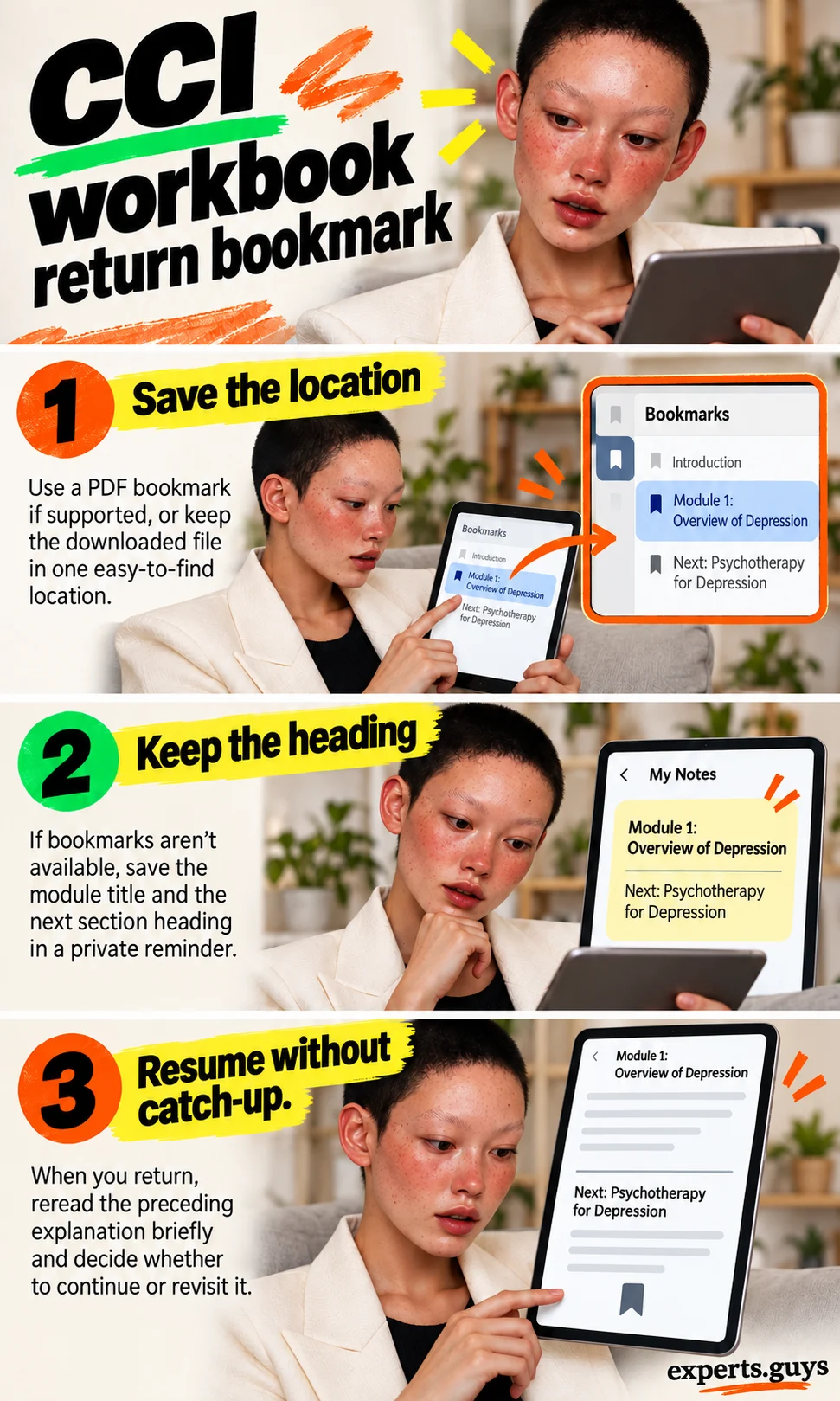
- Bookmark the source page or keep the downloaded file in one easy-to-find location.
- Use a PDF bookmark if supported; otherwise save the module title and next section heading in a private reminder.
- On returning, reread the preceding explanation briefly and decide whether to continue or revisit it.
Illustrative example: a reminder says, “Module 1 – next: psychotherapy section.” It tells you where to return without requiring a daily record or personal symptom detail.
A missed day does not erase what you learned. If reminders become pressure, remove the schedule and keep only the location. The checkpoint is whether you can reopen the right section without hunting through several downloads.
What if CCI self-help is confusing or not enough?
Confusion about a form does not establish that self-help is unsuitable, but a workbook cannot assess your symptoms or respond to a crisis. Persistent, worsening or disabling symptoms deserve professional assessment. The NIMH depression guidance describes concentration difficulties and disruption to everyday activities, along with treatment options.
Separate a resource problem from a need for more care
A technical problem and worsening depression require different responses. Missing text, tiny print or an unclear term may call for a format change or explanation. Increasing distress or loss of everyday functioning calls for support rather than another download.
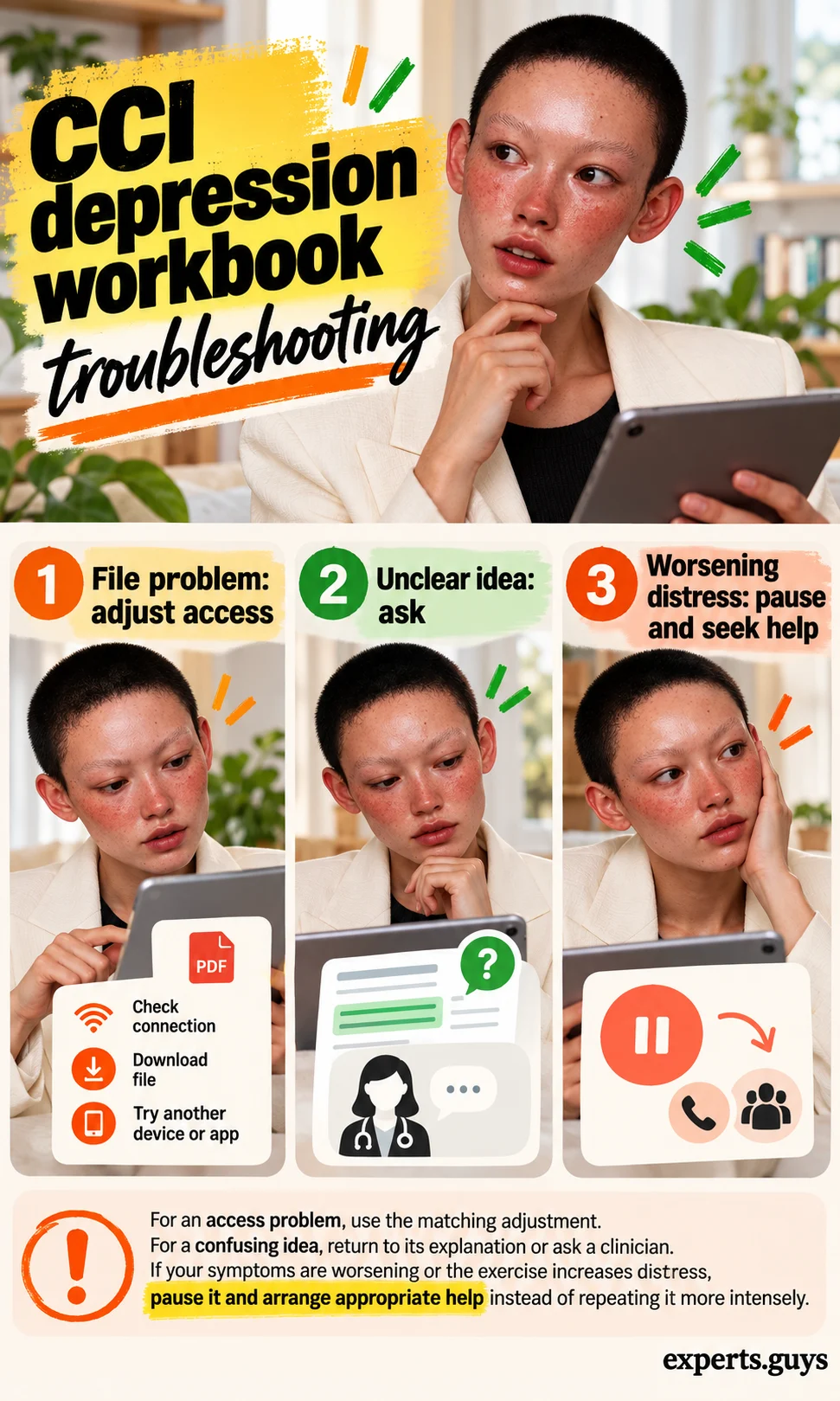
- Identify the immediate obstacle: opening the file, understanding it, or feeling able to use it.
- For an access problem, use the matching adjustment in the table below; for a confusing idea, return to its explanation or ask a clinician.
- If your symptoms are worsening or the exercise increases distress, pause it and arrange appropriate help instead of repeating it more intensely.
Illustrative example: you understand the words but feel increasingly overwhelmed each time you attempt the exercise. That is different from needing larger text; tell your clinician what happens and ask whether to change the approach.
Do not interpret difficulty with a worksheet as proof that treatment will not work. A smaller option is to identify just the obstacle and leave the form unfinished. Completion here means choosing the appropriate kind of help, not producing a finished worksheet.
| Obstacle | Try this | What changes the next step |
|---|---|---|
| File will not open | Return to the official page and try a fresh download in a PDF reader | A continuing technical failure needs access help |
| Text is too small | Increase zoom or use a larger screen | If reading remains difficult, ask for an accessible alternative |
| Instructions make little sense | Revisit the earlier explanation or discuss one example | More pages are not necessarily the solution |
| Practice increases distress | Pause and discuss the reaction with a clinician | Worsening symptoms need care, not a harder exercise |
Bring one resource question into a care conversation
Use the workbook to make a conversation more specific, not to decide whether you deserve care. Show the section that caused difficulty and describe what happens when you try it. A clinician can help assess fit and discuss treatment options that a static PDF cannot provide.
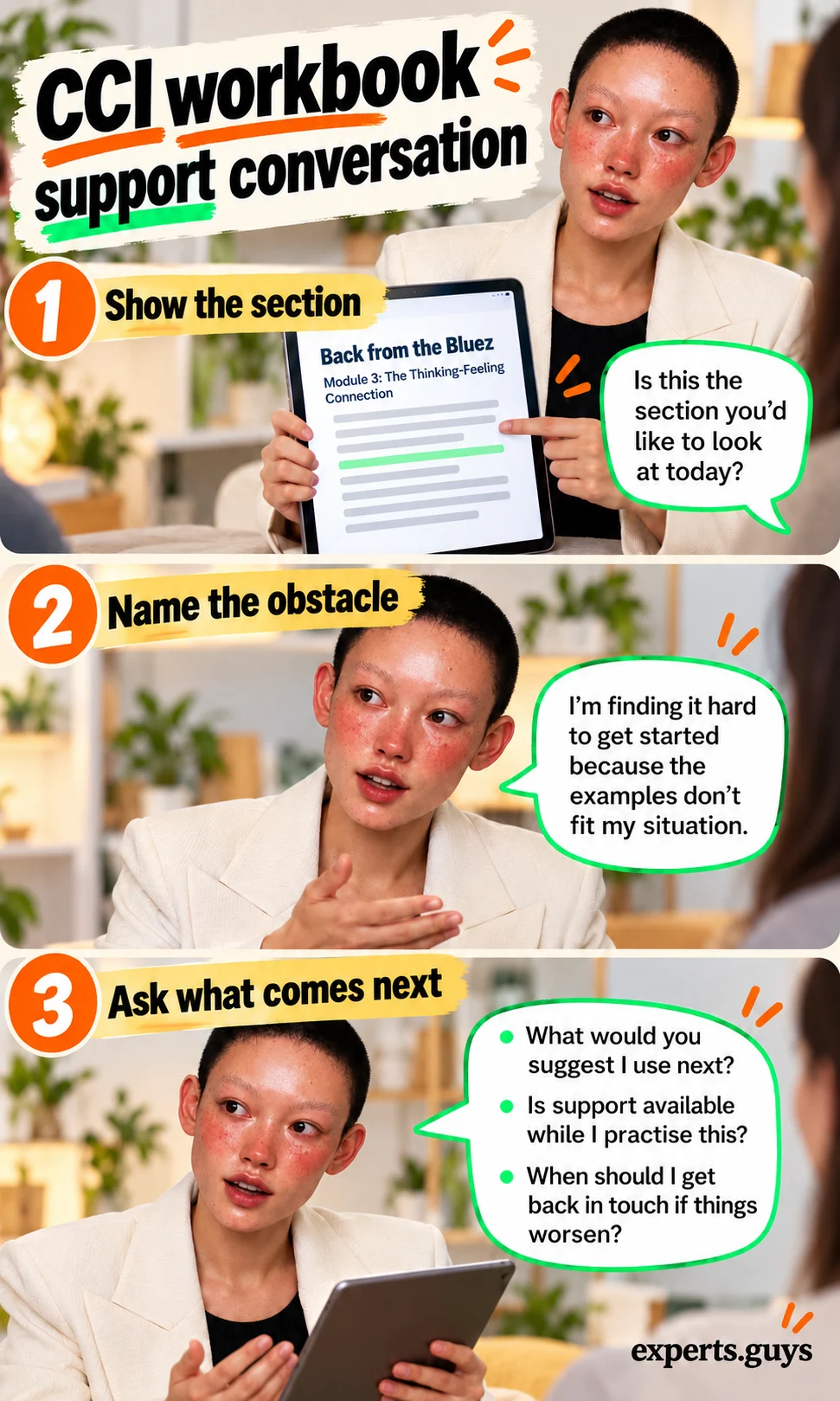
- Keep the resource title and relevant section ready on your device.
- Describe the obstacle in one sentence, without needing to complete the worksheet first.
- Ask what to use next, whether support is available while you practise, and when you should get back in touch if things worsen.
Illustrative example: “I can read this section, but I get stuck applying it to my situation. Could we go through one example together?” You can say this aloud or show it as a short message.
Avoid sending a full personal worksheet through an unfamiliar upload form. Ask the service how it accepts sensitive information, or show the screen during the appointment. If speaking is difficult, start with the resource title and the words “I am stuck here”; you can add detail together.
Seek assessment if low mood or loss of interest persists for roughly two weeks, or sooner if symptoms are severe or daily life is becoming difficult. Mention periods of unusually elevated or irritable mood, markedly reduced need for sleep, or unusual behaviour, because assessment may need to consider conditions beyond unipolar depression. Do not change prescribed medication on the basis of a workbook.
Questions about using CCI resources
Do I have to finish every worksheet?
No. A worksheet is a practice aid, not a test you must pass before getting help. If you do not understand its purpose or it feels unsuitable, discuss it with your clinician or return to the relevant explanation.
Is there a fixed time limit for finishing the workbook?
This guide does not prescribe a completion deadline. The useful pace is one that allows understanding and suitable practice, with support when needed. Finishing pages quickly does not measure recovery.
Can I put the CCI PDFs on my own website?
Do not assume that free access means permission to republish. Check CCI’s copyright and disclaimer before sharing or adapting its materials. Linking readers to the official source avoids presenting a copied workbook as your own.
Does this page provide CCI treatment or an official CCI service?
No. This is an independent guide to finding and using the public resources. Access to a PDF is separate from eligibility for a clinical service, and the guide does not establish a treatment relationship.
Your next step
Open one official resource that matches your immediate task. Make sure you can read it and return to it, then use the explanation before attempting its worksheet. If the obstacle is worsening symptoms rather than access, bring that difficulty into a care conversation instead of adding more forms.