
Caregiver depression can affect people of every racial background after a loved one’s critical illness, and an older White-versus-nonwhite study cannot predict one person’s outcome. Its useful message is to pay attention to continuing distress and gaps in support, including when the patient remains in a care facility. Start with your own symptoms and the practical barrier keeping you from care, rather than treating race as a diagnosis.
This article concerns family members and friends supporting someone through prolonged, severe illness after intensive care. Their responsibilities can include decisions, travel, arranging services and staying available even when professionals provide the bedside care. The practical examples below help organize communication and access; they are not a treatment program or a depression test.
| What you notice | Useful next step | What not to assume |
|---|---|---|
| Persistent low mood or loss of interest affecting everyday life | Arrange an assessment for yourself; seek help sooner if symptoms are severe. | You must wait until the patient recovers. |
| Instructions or responsibilities are unclear | Ask for a plain-language handover and confirm it in your own words. | Understanding is your responsibility alone. |
| Work, cost, language or care cover blocks access | Name the specific barrier and request an available adjustment. | A referral automatically means you can use the service. |
| Someone offered help, but nothing happened | Confirm one task, a person, a time and a backup. | A vague offer is reliable care cover. |
What does the White and nonwhite caregiver study actually tell us?
The original study reported that caregivers grouped as nonwhite whose relatives remained in an institution two months after discharge showed the least improvement in depressive symptoms. The 2010 caregiver study examined symptoms and other caregiver outcomes, rather than establishing a racial cause of depression. Its findings are a reason to notice unmet needs, not to rank the worth or resilience of different families.
The research used the CES-D symptom questionnaire. A raised symptom score does not by itself establish a clinical diagnosis, and a group association is not an individual forecast. The broad “nonwhite” category also combines people whose histories, resources and experiences may differ substantially.
The data came from a particular US hospital context and an earlier period of care. They cannot supply a current worldwide prevalence estimate or prove that moving a patient to a facility causes caregiver depression. Use the finding as a prompt to ask about the caregiver’s actual circumstances.
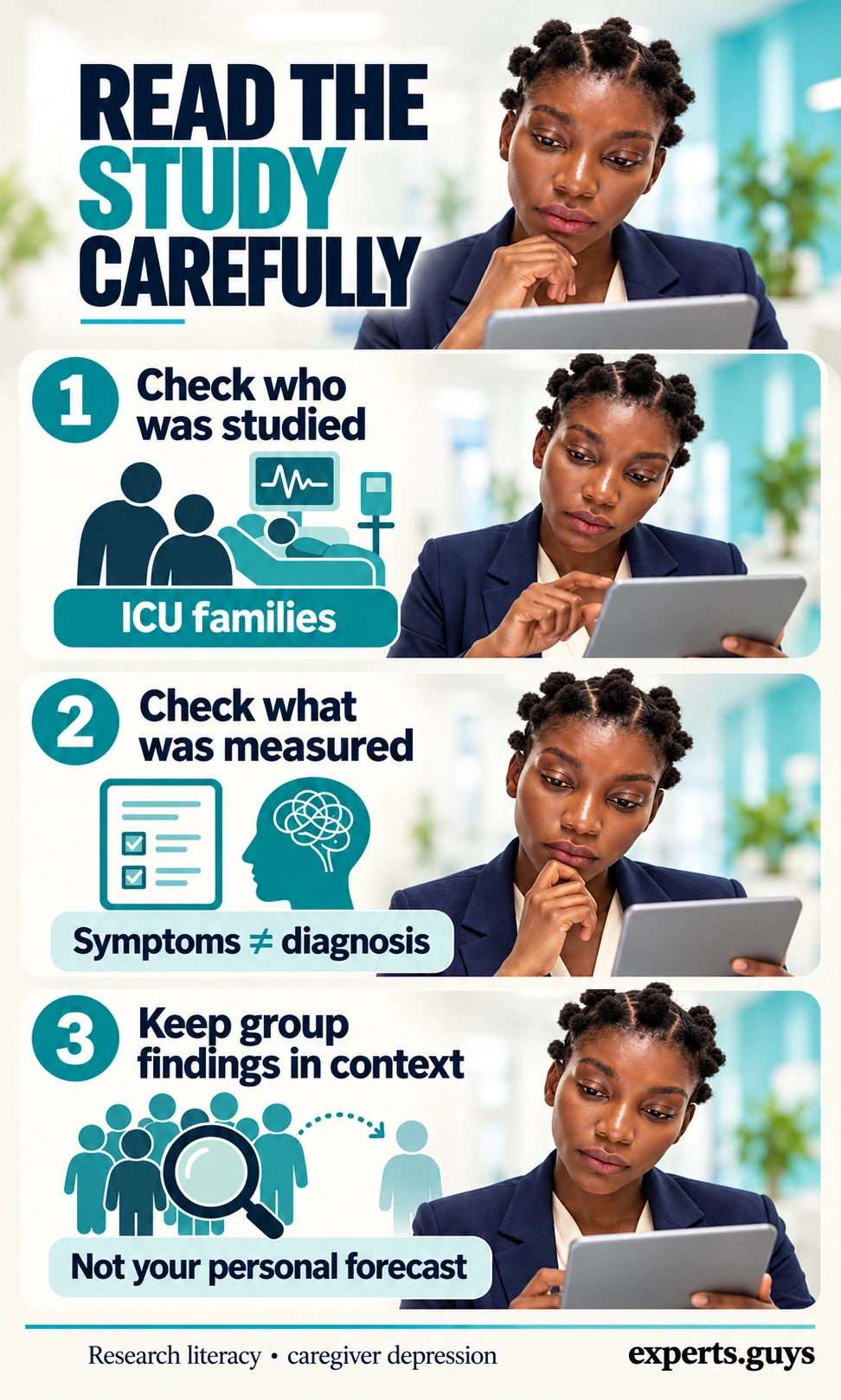
Method 1: check the population, measure and conclusion
Use this three-check reading method when a headline about caregiver race makes you worry about your own future. Open the study summary on your phone and look for who took part, what the researchers measured and what the conclusion can support. This is a way to avoid overinterpreting evidence, not a way to calculate your risk.
- Check the population: was it ICU-related caregiving, another illness or the general public?
- Check the measure: were researchers reporting symptoms, a screening threshold or a clinician’s diagnosis?
- Check the conclusion: does it describe an association in a group, or actually test a cause? Keep the study’s time and setting attached to the finding.
Example: “A symptom pattern in this caregiver group deserves attention” is more accurate than “my race determines whether I will become depressed.” A common mistake is reading the title without checking the measure. If the summary is difficult to interpret, use the cautious conclusion above and discuss your own symptoms separately; a successful check leaves you with a clear limitation, not a new label.
Method 2: turn an access barrier into a concrete request
Ask about the obstacle you actually face rather than assuming that a racial category explains it. A work shift, a fee you cannot meet, an unfamiliar language or previous dismissal by a service each calls for a different response. Naming the obstacle gives the coordinator something specific to address, although it cannot guarantee that a service has the resources you need.
- Choose the next service you need and the one obstacle most likely to prevent access.
- Tell its coordinator what adjustment would make attendance possible, such as a suitable appointment time, a professional interpreter or a phone option if clinically appropriate.
- Ask who will arrange it and when you should expect a response; keep that information in a private phone contact or calendar entry.
Example: “I cannot attend before my shift ends. Is there a suitable later appointment or a phone assessment?” Avoid treating a polite “we will try” as a confirmed arrangement. If your preferred option is unavailable, ask what alternative exists and what it costs; progress means a usable next step has been confirmed, not merely that a referral was sent.

There is no need to decide whether you are “strong enough” before asking for support. If guilt about needing assistance is getting in the way, the separate guide to depression and feeling like a burden addresses that thought pattern. Here, the immediate task is to remove one concrete access problem.
When does caregiver distress need its own mental-health assessment?
Your symptoms need attention when they persist, worsen or interfere with daily life, even if the caregiving situation explains why you feel distressed. The NIMH depression guide describes persistent low mood or loss of interest, along with changes in sleep, appetite, concentration and functioning. Around two weeks is a useful prompt for assessment, not a rule to delay help when symptoms are severe.
Exhaustion, grief, anxiety and depression can overlap. A clinician considers the pattern and other possible contributors rather than diagnosing from tiredness alone. Treatment may involve psychotherapy, medication or both; practical caregiver support does not replace that assessment or treatment.
Method 3: prepare a private, three-part appointment brief
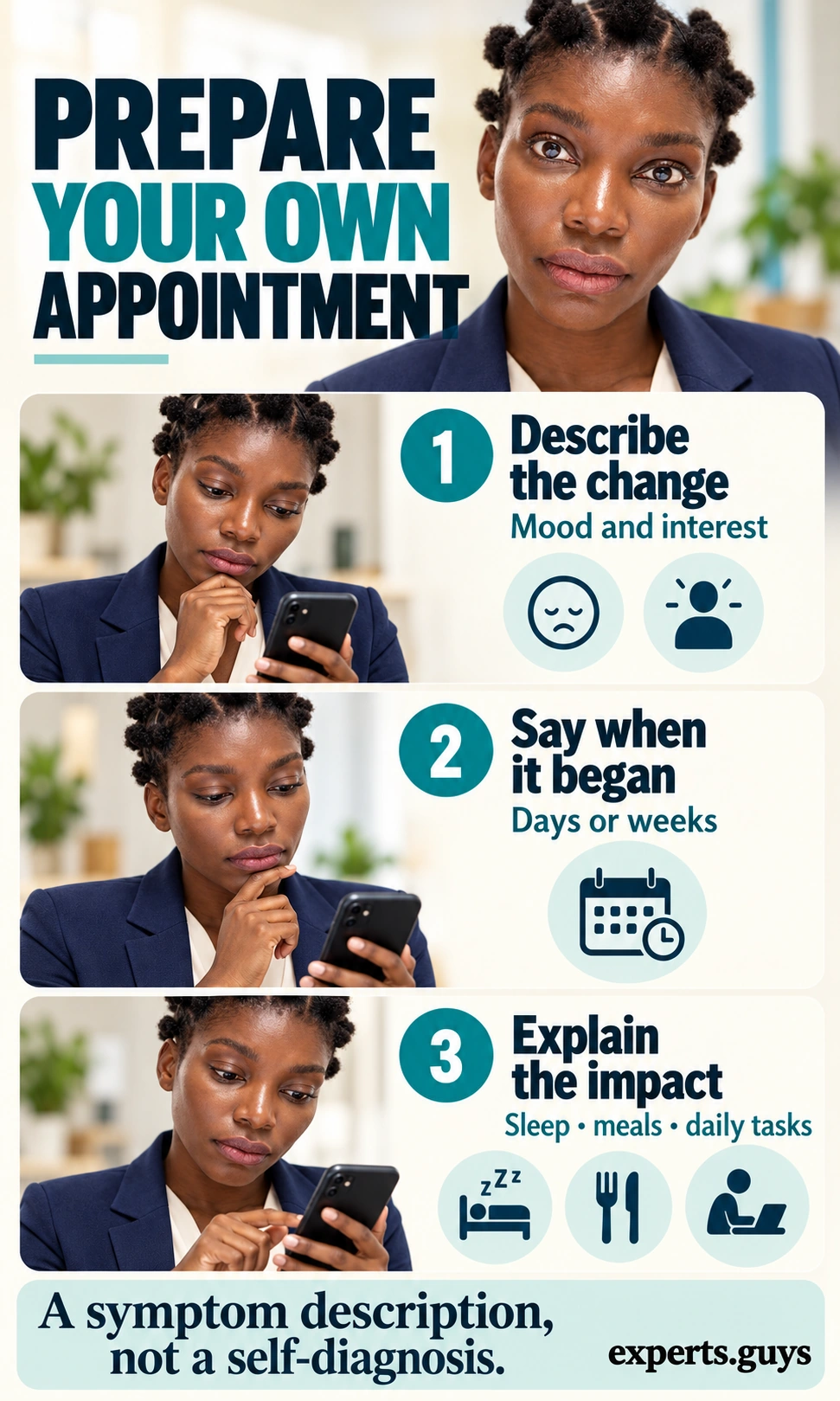
Before your own visit, use a private phone note or simply rehearse three points: what changed, when it began and what it prevents you from doing. Keep the focus on your health rather than turning the whole appointment into an update about the patient. You do not need a daily diary, a symptom score or a perfect timeline to begin the conversation.
- Describe the main change in mood or interest in your own words.
- Give an approximate start and pattern, such as “most days since the hospital admission.”
- Add one functional example, such as difficulty eating regularly, concentrating at work or getting through ordinary tasks; tell the clinician directly about any safety concern.
Example: “For about three weeks I have felt low most days, stopped enjoying calls with friends and struggled to finish meals.” Avoid describing only how ill your relative is, because your own symptoms may then remain invisible. If typing is tiring, say the brief aloud or ask a trusted person to help you communicate with your permission; the checkpoint is whether the clinician understands your concern and agrees a next step.
Method 4: make the appointment possible with safe cover
An available appointment is useful only if you can actually attend it. Identify whether the patient needs someone present, which tasks require trained support and how much travel or waiting time your visit may involve. The aim is a workable arrangement for your care, not an assumption that any willing friend can replace skilled help.
- Book your own assessment and ask about appointment format, privacy, access and any charges.
- If the patient needs supervision, confirm suitable cover for the appointment and travel time with the responsible care team or an appropriately prepared helper.
- If cover cannot be arranged, tell the service before the visit and ask about alternatives; do not leave a dependent person without necessary care.
Example: A friend can bring food while a trained service provides the care the patient requires. The mistake is counting a meal delivery as full supervision or medical cover. If you have no available helper, ask the discharge coordinator or social worker what support can be explored; the checkpoint is that the arrangement is confirmed and safe, not just entered in a calendar.

If you need to compare sustained loss of interest with exhaustion tied to demands, read depression vs burnout. That distinction may improve the description you give at an appointment. It cannot settle a diagnosis or make ongoing distress unimportant.
How can you reduce uncertainty during a hospital or facility transition?
Reduce transition uncertainty by confirming the care plan, your role and who answers questions after the move. A patient leaving intensive care may still need considerable support, while a facility placement can change rather than end family responsibilities. Clear information can reduce avoidable confusion; it is not evidence that a better handover will cure caregiver depression.
Method 5: use teach-back for the handover
Ask the clinician to explain one part of the plan, then say it back in your own words so gaps can be corrected. AHRQ’s teach-back guidance treats this as a check of clear communication, not a test of the caregiver. Use it before discharge or transfer and again if the plan changes.
- Ask for one clear explanation of the next step or responsibility, using an interpreter if needed.
- Say, “Let me check I understood,” and explain what you believe will happen and who will do it.
- Ask the clinician to correct gaps and provide the agreed information through an appropriate secure digital summary; seek supervised training for any practical medical task.
Example: “The receiving team will review this tomorrow, and I should call this number if the agreed concern arises. Is that right?” Nodding while still confused is the common failure point. If you cannot explain the plan after another explanation, ask for a simpler version or further support before taking on the task; progress means shared understanding, not memorizing jargon.

Method 6: save a named contact and an after-hours route
Before the move, ask which team owns each unresolved question. AHRQ’s IDEAL discharge approach emphasizes involving patients and families and checking understanding of next steps. The contact routine below is an editorial adaptation that makes those next steps easier to use.
- Save the relevant team name and confirmed phone number in your phone; distinguish patient-care contacts from your own clinician.
- Ask who responds after hours and what to do if the usual contact is unavailable.
- Confirm the team’s urgent instructions and how quickly routine messages are answered; do not wait for a portal reply during an emergency.
Example: “If this question comes up tonight, which service is responsible?” A general hospital switchboard number alone may not answer that question. If the team changes after transfer, confirm the new route with the receiving service; the checkpoint is knowing whom to call without searching through old messages.

Protecting a period away from care depends on appropriate cover, rather than simply turning off alerts. If sleep remains disrupted even when someone else is safely responsible, the guide to depression and sleep problems explains patterns worth discussing at your own appointment. Do not alter the patient’s treatment or monitoring schedule to make a break possible.
How do you turn offers of help into support that actually arrives?
Make support specific enough to be accepted, scheduled and checked. A promise to “help sometime” leaves the caregiver holding the coordination work, whereas an agreed meal delivery or ride has a clear owner. This is a practical organization strategy, not proof that task sharing alone treats depression.
Method 7: request one task with a time and a backup
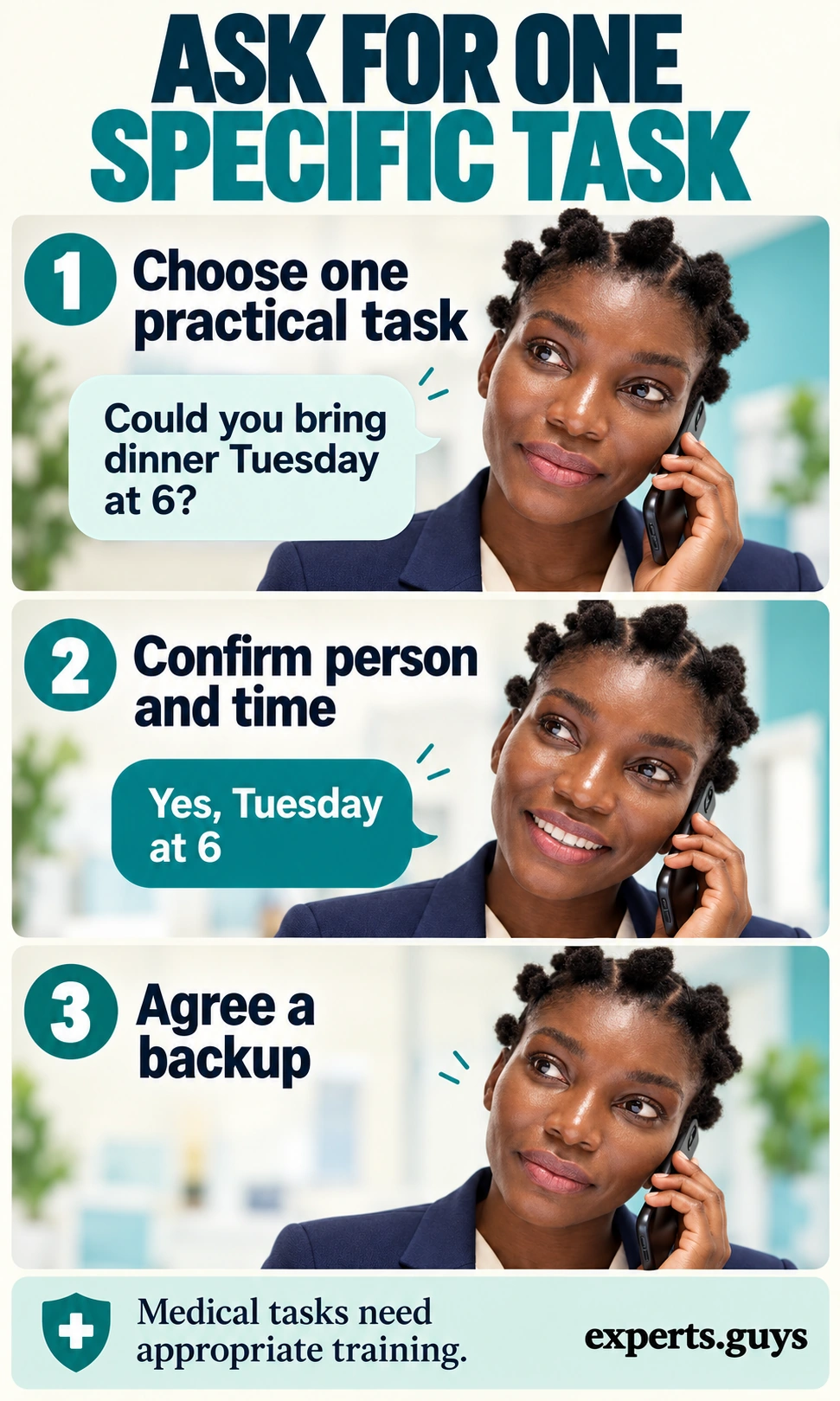
Start with an everyday task someone can safely do without clinical training. Choose a task that genuinely removes work, and share only the information the helper needs. The request should allow a clear yes or no so you can arrange another option if necessary.
- Ask for one concrete task with a time: a meal delivery, shopping trip or ride for your own appointment.
- Confirm who accepted it and what “done” means; add the agreed time to a shared calendar only with the people who need access.
- Agree what happens if the helper cannot come, such as contacting you early enough to make another arrangement.
Example: “Could you bring dinner on Tuesday at 6? Please tell me by lunchtime if that changes.” Avoid sending a broad “can anyone help?” message and assuming someone has taken ownership. If there is no personal support network, ask a coordinator about local services and eligibility; progress means one task is reliably covered without creating more work than it removes.
Method 8: check that your own support actually arrived
Follow the request through to a usable service, rather than stopping at “referred.” The US National Family Caregiver Support Program includes information, access assistance, counseling, training and respite within its eligibility rules. Similar services and their availability differ by country; neither an older-adult program nor a hospital referral covers every caregiver automatically.
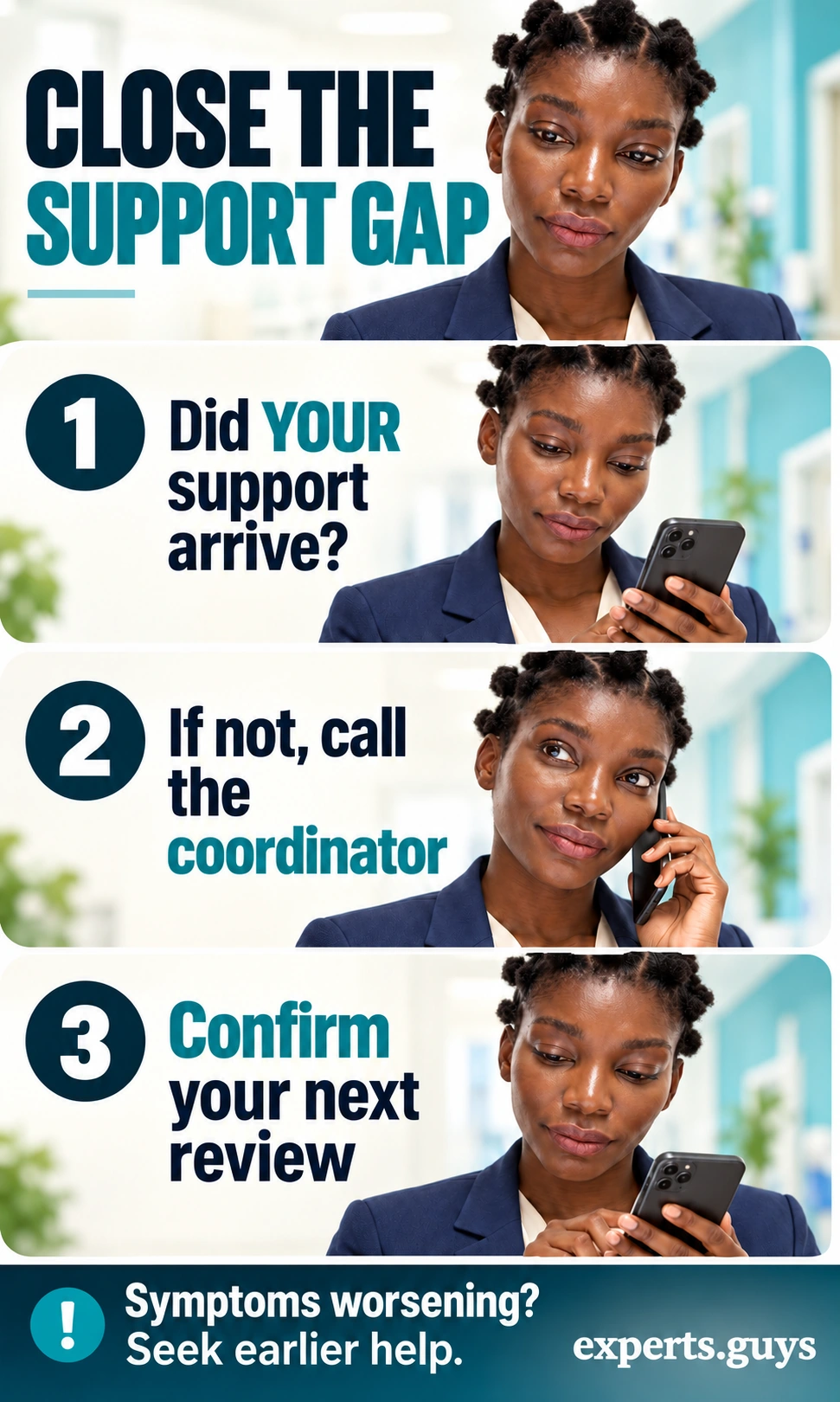
- At the response time agreed with the service, check whether you received the appointment, call or support requested.
- If it did not arrive, contact the coordinator with the request date and the unresolved barrier; ask for an alternative or a new expected response time.
- Confirm your next review and tell your clinician sooner if symptoms worsen; an unanswered referral should not become an indefinite wait.
Example: “The appointment team was due to call yesterday, but I have not heard from them. Who can check the referral?” The common mistake is interpreting silence as a refusal or assuming another team is handling it. If repeated contacts fail, ask your own clinician or the service’s patient-support office for another route; success is access and a review plan, not the number of calls you made.
When a service is available, check whether its hours, language support and approach fit your situation. The guide to mental health counseling covers choosing and starting professional support. A peer group can offer connection, but it should not be presented as a substitute for assessment when symptoms are persistent or severe.
| If this approach stalls | Likely practical gap | Adjustment |
|---|---|---|
| A referral was sent, but no visit is booked | No confirmed owner or response time | Ask the referring service to confirm receipt and the next contact. |
| A helper cancels repeatedly | The task or timing exceeds their availability | Offer a smaller task or explore another source of cover. |
| The care plan still feels confusing | Too much information or an unresolved responsibility | Request one topic at a time and another teach-back conversation. |
| Practical help arrives, but mood is not improving | Support needs and clinical needs may coexist | Keep your own assessment and treatment review; do not assume logistics resolve depression. |
Frequently asked questions
Can I still need support if my relative is in a facility?
Yes. Decisions, travel, communication and worry can continue when staff provide daily care. Describe the responsibilities you still carry rather than assuming the placement means your own needs have ended.
Does accepting help mean I am failing as a caregiver?
No. Accepting a defined task or suitable care cover is a way to make responsibilities manageable. If guilt repeatedly stops you seeking help, bring that concern to your own clinician or counselor.
Do I have to share my mental-health information with the family group chat?
No. Keep your personal symptoms and appointment details in a private conversation with your clinician unless you choose to share them. A helper may need the time and task, without needing your full health history.
Are these eight methods a treatment for depression?
No. They are research-reading, communication and access routines. They can help you organize support while assessment and any recommended treatment address your mental health.
Summary: make the next step specific
The study’s race comparison should lead to closer attention to caregiver needs, not assumptions about an individual. Choose the unresolved problem that is blocking you now: your own assessment, unclear care instructions, inaccessible support or an unconfirmed offer of help. Make that one next step specific, and check that it happens while keeping worsening symptoms on your clinician’s agenda.