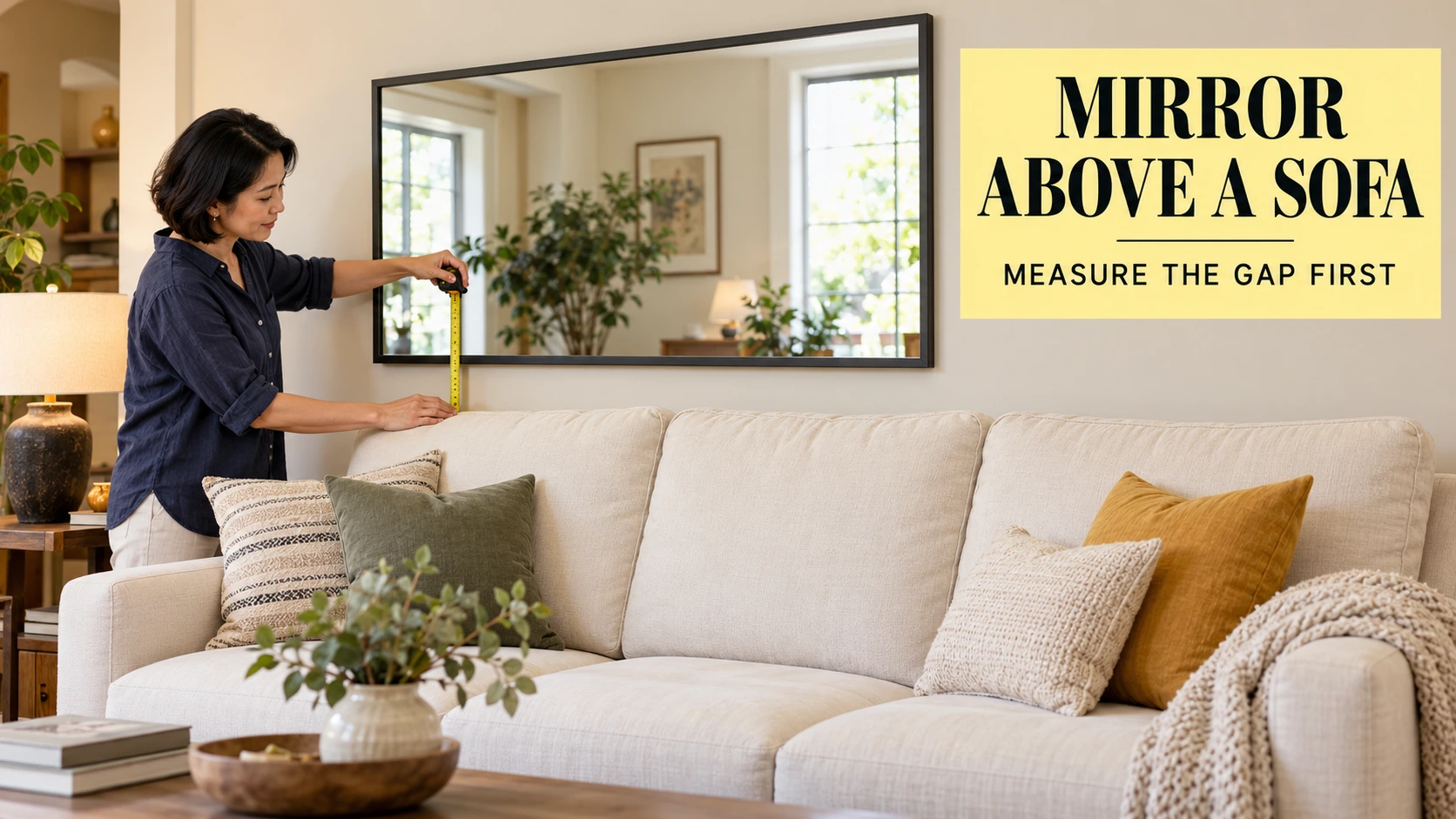
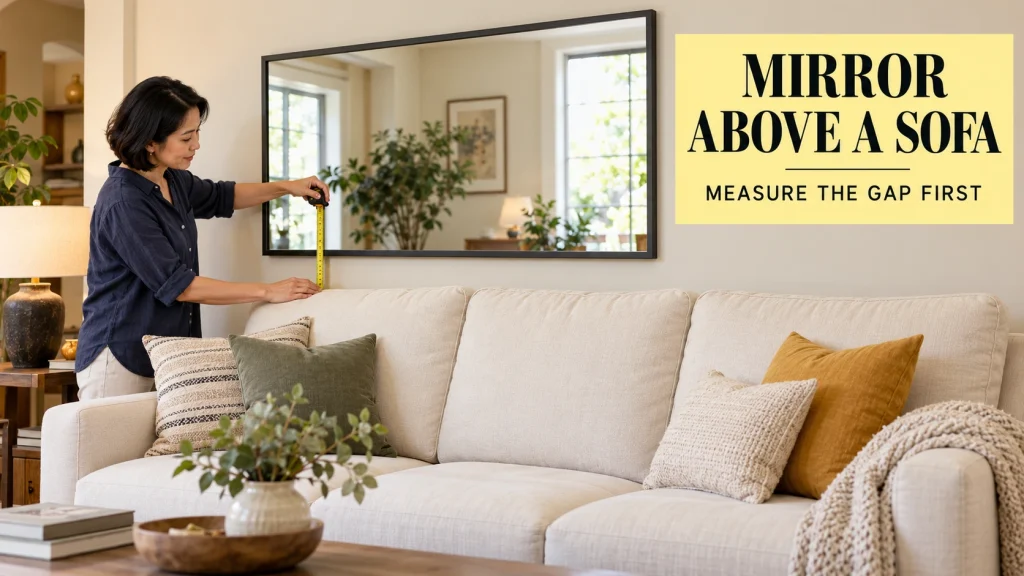
Start with the bottom of the mirror’s outer frame about 6–10 inches (15–25 cm) above the highest part of the sofa back. Adjust that starting gap if a paper-template test shows head contact, awkward reflections or poor proportions; the 57-inch center rule should not force the mirror into the sofa.
The two height rules, and why they clash
The gap rule connects the mirror to the furniture below it. The center rule places the middle of a piece around a standing viewer’s eye level on an open wall. They measure different things, so applying both without checking the arithmetic can produce conflicting marks.
A gallery hanging reference places the middle of each artwork at 57 inches, while domestic arrangements often use a 57–60-inch center reference. Neither number specifies where the bottom edge must sit above a sofa. Once furniture occupies the wall, its height and the way people use it become part of the placement decision.
For a sofa mirror, mirror-specific hanging guidance uses an 8–10-inch gap and calls for adjustment to avoid head contact. That is a useful position to test within the broader 6–10-inch decorating range. It does not establish a universal safe distance for every cushion, person or projecting frame.
- Measure from the floor to the highest sofa back or back cushion in its normal position.
- Measure the mirror’s complete outer height and width, including decorative projections.
- Choose an initial gap, then calculate the bottom, center and top before marking hardware.
- Test a paper outline from seated and standing positions; verify the mounting system separately.
How high to hang a mirror above a sofa
Use the sofa back as the starting reference, then add the gap you want to test. Do not measure from the seat cushion, a hidden timber rail or the top of a cushion after pushing it down. Loose back cushions should be arranged as they normally sit before you take the measurement.
For a round mirror, the gap ends at the lowest point of the outer frame. For an irregular frame, include any projection that reaches below the glass. If the shape has long decorative rays, the related guide to decorating with sunburst mirrors covers that different outline.
Worked example: an 84-inch sofa
Consider an illustrative sofa that is 84 inches wide, with its highest back cushion 34 inches above the floor, and a mirror measuring 56 inches wide by 30 inches tall. An 8-inch gap puts the bottom at 42 inches, the center at 57 inches and the top at 72 inches. These are calculated example dimensions, not measurements from a photographed installation.
| Chosen gap | Bottom / center / top from floor |
|---|---|
| 6 inches (15.24 cm) | 40 / 55 / 70 inches (101.6 / 139.7 / 177.8 cm) |
| 8 inches (20.32 cm) | 42 / 57 / 72 inches (106.68 / 144.78 / 182.88 cm) |
| 10 inches (25.4 cm) | 44 / 59 / 74 inches (111.76 / 149.86 / 187.96 cm) |
The calculation is simple: bottom height equals sofa-back height plus gap; center height equals bottom height plus half the mirror height; top height equals bottom height plus the full mirror height. Keep every input in the same unit. Measure from the finished floor at the wall, especially if a rug or uneven floor would otherwise change your reference.
When the center lands above 60 inches
A taller back or taller mirror can move the center above the open-wall reference even with a modest gap. A 38-inch back, 36-inch mirror and 8-inch gap give a center height of 64 inches. Forcing that mirror’s center down to 57 inches would leave just a 1-inch gap above the back cushion.
In that situation, keep a useful furniture relationship and test the higher center rather than chasing 57 inches. If clearance, reflection and wall space cannot work together, try a shorter mirror or another location. Adding a fixed extra two inches cannot guarantee clearance because people, reclining sofas and frame depths differ.
Test the entire outline before committing
Cut a paper template to the mirror’s outer dimensions and tape it to the proposed position on a suitable wall finish. Mark the center lightly on the template so the height comparison is visible. This lets you assess the complete outline without holding heavy glass above someone’s head.
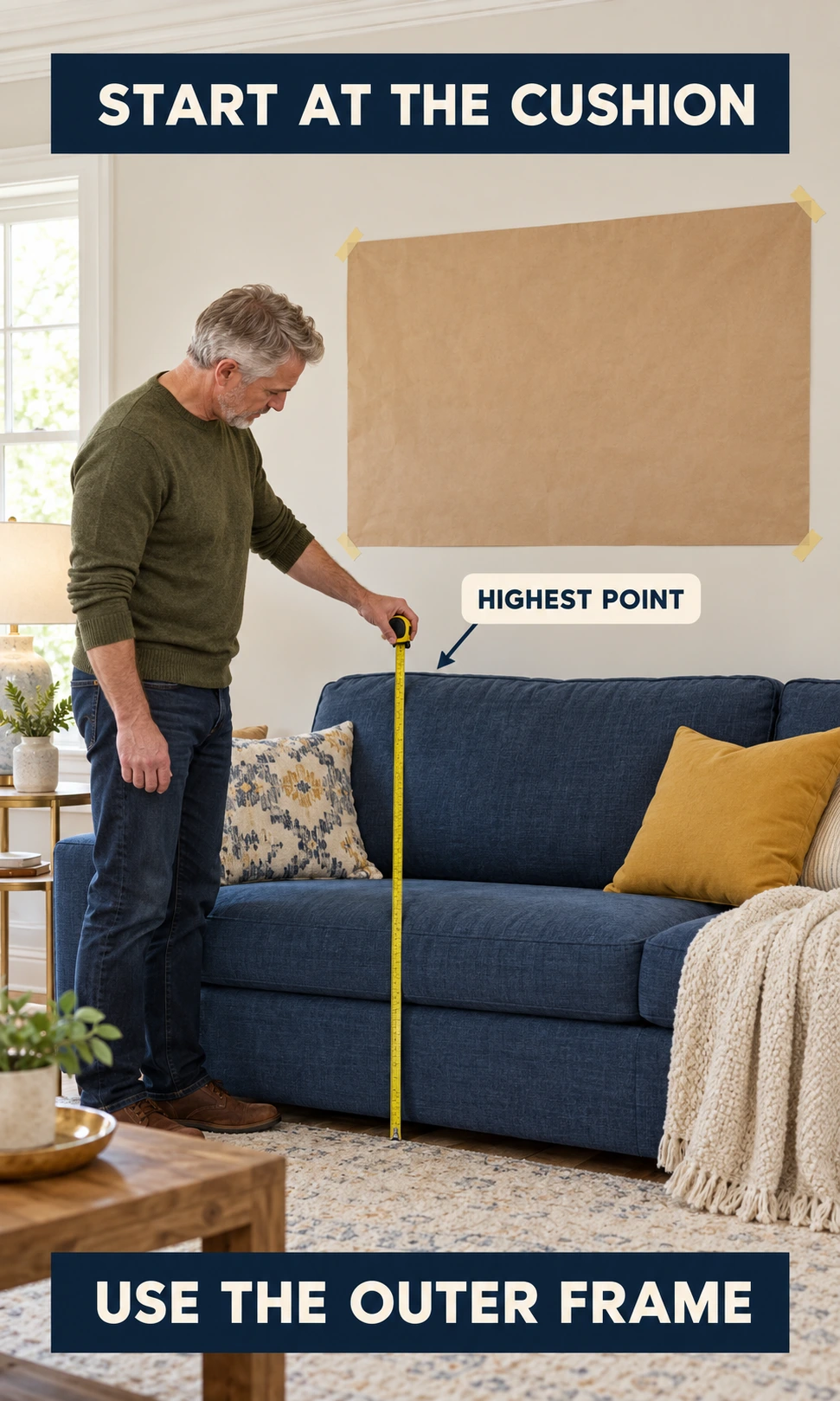
Sit where you normally sit, lean back naturally and stand up without touching the template area. Check every frequently used seat, including a taller household member’s position and any recliner’s normal movement. A flat outline cannot reproduce frame depth, so account for that projection before accepting the position.
- Head contact: change the position or mirror; do not treat the styling gap as proof of safety.
- Large empty strip above the sofa: test a smaller gap only if physical clearance remains suitable.
- Mirror top near a ceiling or shelf: allow for the mounting system’s required lift and engagement movement.
- Uncomfortable view from the main seat: reassess the frame size, reflection or wall location.
Width matters, but it does not set the height
Around two-thirds of the sofa’s width is a useful visual starting point for the complete framed piece. For an 84-inch sofa, that reference is 56 inches; for a 96-inch sofa, it is 64 inches. It is a proportion to compare with a template, not a minimum purchasing requirement or a reason to replace a mirror you like.
Count the frame in both directions because a thick border changes the footprint even when the glass stays small. Center a single mirror over the sofa as a first trial, then check nearby doors, shelves and lamps before accepting the arrangement. A deliberately wider piece can work visually, but it needs a full-outline test rather than a claim that wider automatically looks better.
| What you notice | What to test next |
|---|---|
| Center above 60 inches | Check the gap, seated view and full outline; do not lower the mirror into the cushion zone just to match an open-wall rule. |
| Frame narrower than expected | Compare its outer width with the sofa; a smaller mirror may work as part of a deliberate composition. |
| Bright TV or doorway in the glass | Check from the main seat and room entrance; consider another wall before changing the hanging height. |
| Top fits, but installation is tight | Check the lift or engagement clearance required by the specified mounting system. |
Check what the glass will reflect
A paper template can test the footprint, but it cannot show the reflection. Inspect an existing mirror at a safe height or ask an installer to assess the intended sightline without placing unsecured glass over an occupied sofa. Look from the seats and the doorway rather than judging only from a standing position directly in front of the wall.
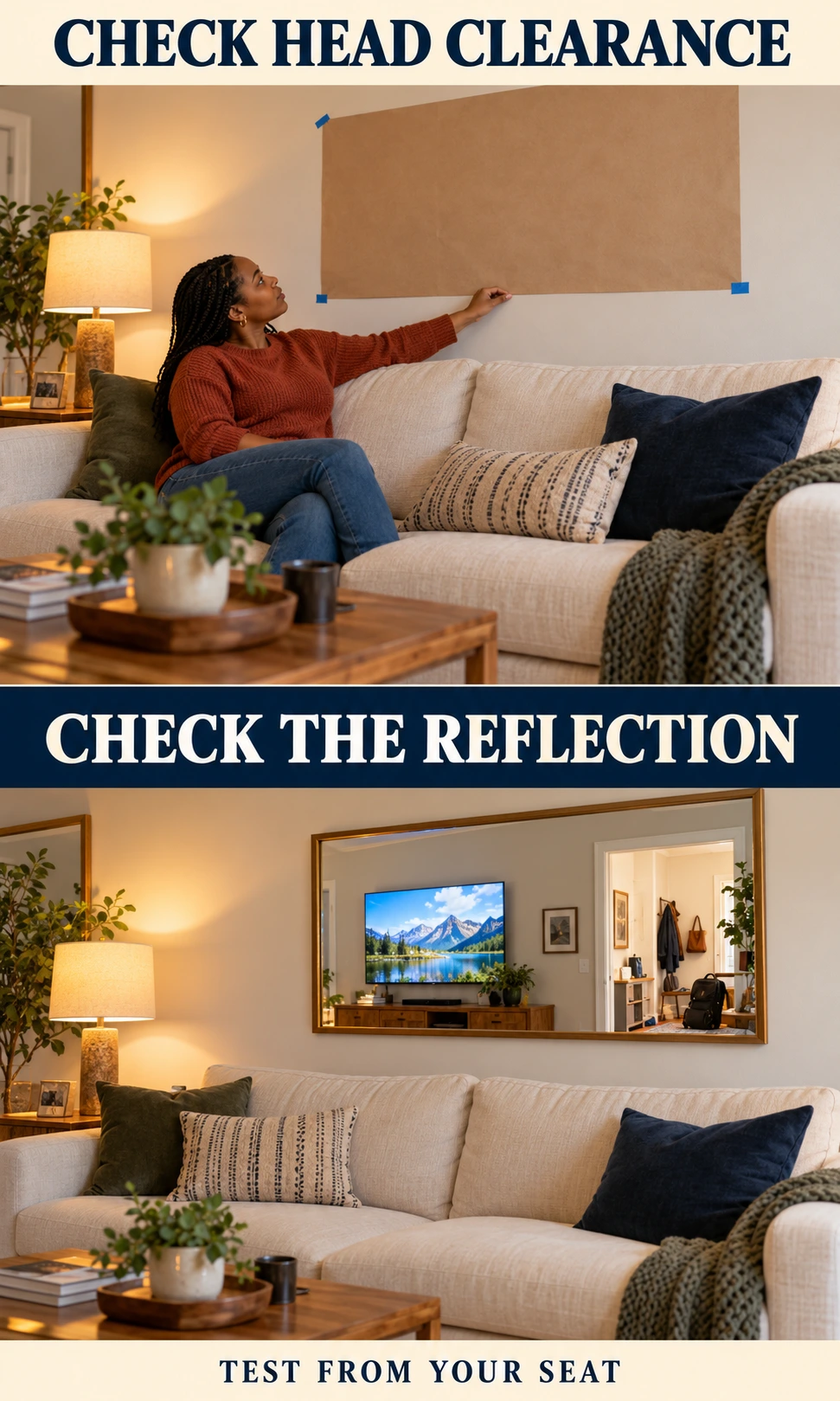
A television, a cluttered passage or a bright window may dominate the reflection from one seat and disappear from another. Check during the time of day the room is actually used, especially when direct sunlight or screen glare is a concern. A mirror can redistribute available light; it cannot create daylight in a room that receives none.
Turn the frame marks into hanging-point positions
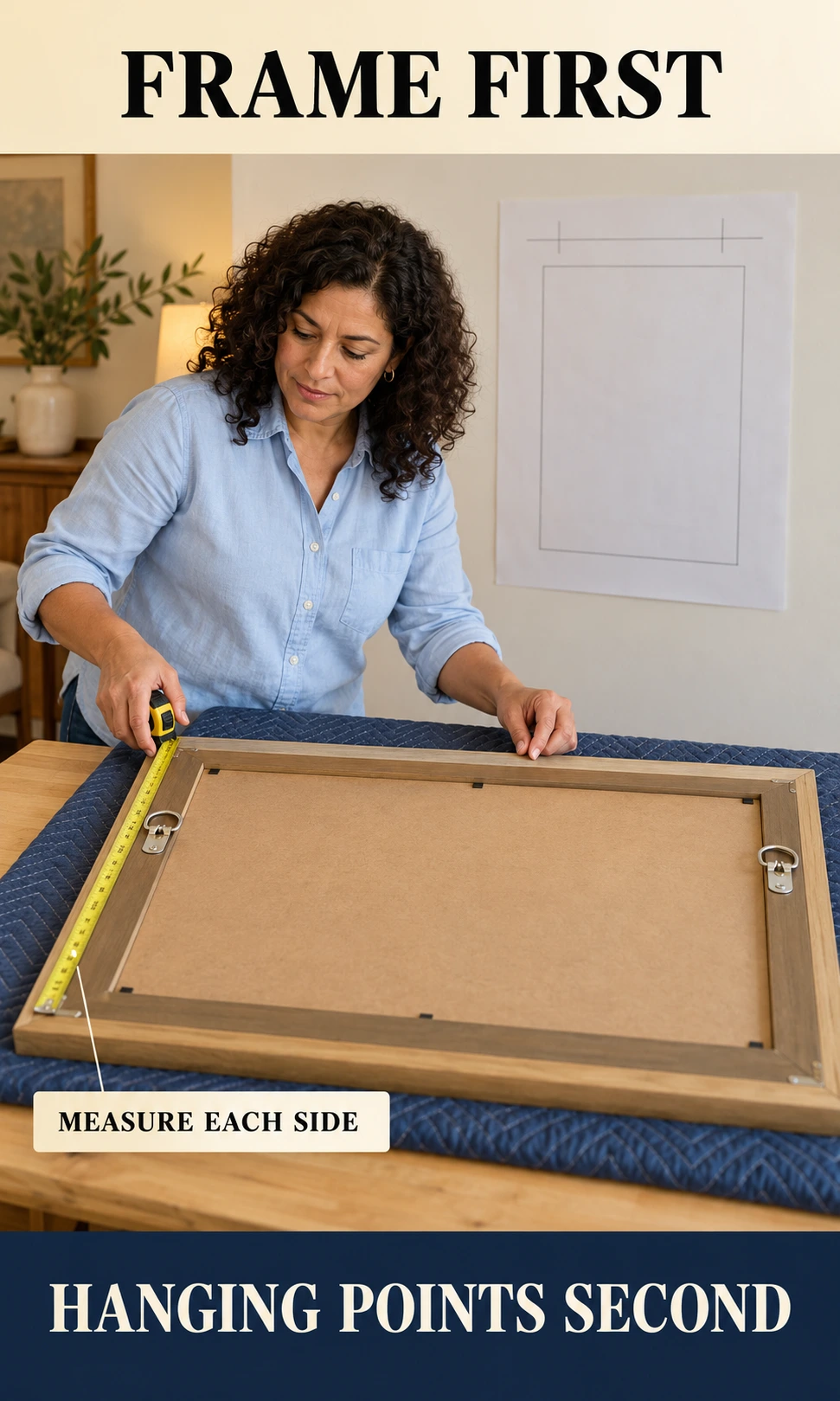
The bottom, center and top marks locate the mirror, not the holes for its hardware. With two D-rings, measure from the top frame edge to each ring’s engaged contact point and measure their horizontal spacing. Follow the mirror manufacturer’s instructions, including any requirement to hang directly from the rings rather than adding wire.
- Mark the intended top edge and horizontal placement of the frame.
- Measure the left and right contact drops independently; do not assume the hardware is symmetrical.
- Subtract each drop from the top-edge floor height to locate that contact point vertically.
- Use the hanger instructions to translate contact points into screw holes, then verify the finished frame is level.
For the 72-inch top mark in the example, a 5-inch left contact drop gives a 67-inch contact height. If the right drop is 5.5 inches, its contact height is 66.5 inches; those unequal positions can support a level top edge. The screw holes may sit elsewhere because hook geometry adds another offset, so these contact heights are not drilling instructions.
| Mark | Meaning |
|---|---|
| Bottom edge | Sofa-back height plus chosen gap. |
| Center | Bottom-edge height plus half the mirror’s outer height. |
| Top edge | Bottom-edge height plus the mirror’s outer height. |
| Engaged ring contact | Top-edge height minus the measured contact drop on that side. |
| Drilling position | Defined by the actual hanger or mounting template; not automatically the ring contact. |
Wire systems require their loaded geometry to be measured using the intended support arrangement, and cleats require the correct engagement reference. Neither can be reduced safely to an arbitrary drop entered for two D-rings. A mirror mounting guide explains why wall construction, mirror weight and hardware type must be checked together.
Try your measurements in Sofa Mirror Fit Studio
Enter the sofa back, sofa width, mirror dimensions, desired gap and upper obstruction height to calculate the three frame marks. Compare the 6-, 8- and 10-inch starting gaps, then record the template, reflection and mounting checks. The printable report carries those measurements and any unfinished checks into a separate A4 window.
Sofa Mirror Fit Studio
Turn your measurements into wall marks. Check the gap, center height and clearance before drilling.
This experience calculates the position of one mirror from its outer frame dimensions. A 6–10 inch gap is a styling starting range, not a safety clearance or an anchor specification. Use a paper template to test the result.
Need help? Find and compare an installer
A mirror installer or experienced picture hanger can assess a framed mirror. Use a glazier for frameless glass. Ask about the actual wall and mirror weight.
Enter up to three businesses you find. Compare written scope, wall assessment, relevant experience, insurance where applicable, availability, price and aftercare. No businesses or rankings are supplied automatically.
Calculations are placement geometry only. They do not certify mounting strength, head clearance or installation safety. Entries stay in this page; external searches send the search phrase and location to Google.
When to stop and ask an installer
Stop if the wall type, mirror weight, mounting instructions or condition of the hardware is uncertain. Do not assume that two anchor ratings can simply be added together, or use an adhesive strip above seating without explicit approval for that mirror and surface. A mirror installer or experienced picture hanger can assess a framed piece; frameless glass calls for a glazier and its specified system.
If you rent, obtain any required permission before drilling and discuss alternatives that are approved for the mirror and location. A working fireplace, bathroom installation or full mirrored wall needs different checks and falls outside this sofa-placement method. Solving a visual gap does not resolve heat exposure, substrate strength or glass installation requirements.
Compare Local Home Specialists Near You
Tell us what kind of help you need, then compare nearby businesses by location, Google rating, review volume and contact options.
HomeFix Local Match
Turn a home problem into a practical local hiring decision. Check the clues, see the specialist types that fit, open focused surrounding-location searches, then compare the strongest three before you call.
 YOUR PROBLEM
YOUR AREA
COMPARE 3
✓ Ready to compare
What is happening?
Choose the closest problem type, then check every clue that applies. Your selections change the specialist order.
Where should the search focus?
Use Google’s “near me” context or enter the area you actually want a specialist to serve.
Simple local search: open nearby Google results, choose the businesses that look suitable, then compare your best three here before you call.
Problem snapshot
Who should you call first?
These are the specialist types most likely to fit the clues you selected.
Search around your location
Compare your top three
Use the same factors for each option so a high star rating does not hide a weak scope, poor diagnosis, missing credentials or unclear aftercare.
Comparison result
Your result combines the Google signals you entered with the practical hiring checks you completed.
Questions to ask every finalist
Use the same questions with each shortlisted business so the comparison stays consistent.
Frequently asked questions
How high should a mirror be above a sofa?
Begin by testing a 6–10-inch gap between the highest back cushion and the lowest outer frame point. Adjust after checking head movement, frame depth and the reflection. The range is a styling guideline, not a guaranteed safe clearance.
What size mirror should go above a sofa?
Around two-thirds of the sofa’s outer width is a useful first comparison for the entire framed mirror. That gives a 56-inch reference for an 84-inch sofa. Test the complete outline before treating that proportion as a buying decision.
Do you measure mirror height from the floor or the sofa?
Use the sofa back to choose the gap, then convert the position into floor marks for the bottom, center and top. The finished floor provides a consistent reference for marking the wall. Measure to the highest normal back-cushion position rather than the seat.
Is the 57-inch rule for the center or the bottom?
It refers to the center of the piece. On a sofa wall, applying that center without calculating the bottom edge can put a tall mirror too close to the cushions. Check the furniture gap and clearance before accepting the center mark.
Should high ceilings make me hang the mirror higher?
High ceilings do not automatically change the relationship between the mirror and the sofa. Test the normal starting gap and judge the entire wall from the main seat. If the arrangement feels too small, reconsider scale or composition before raising it substantially.
Can a mirror above a sofa be wider than the sofa?
It can be a deliberate design choice, but it will extend beyond the sofa when centered. Test the outer outline against nearby furniture, circulation and available mounting positions. Width alone does not determine a safe or successful installation.
Choose the gap that works with the sofa
Keep the chosen mirror visually connected to the sofa, then let clearance and the seated reflection decide whether the position works. Calculate the frame outline before dealing with rings, hooks or screw holes. If a suitable outline and a verified mounting system cannot coexist, change the mirror or its location before drilling.