

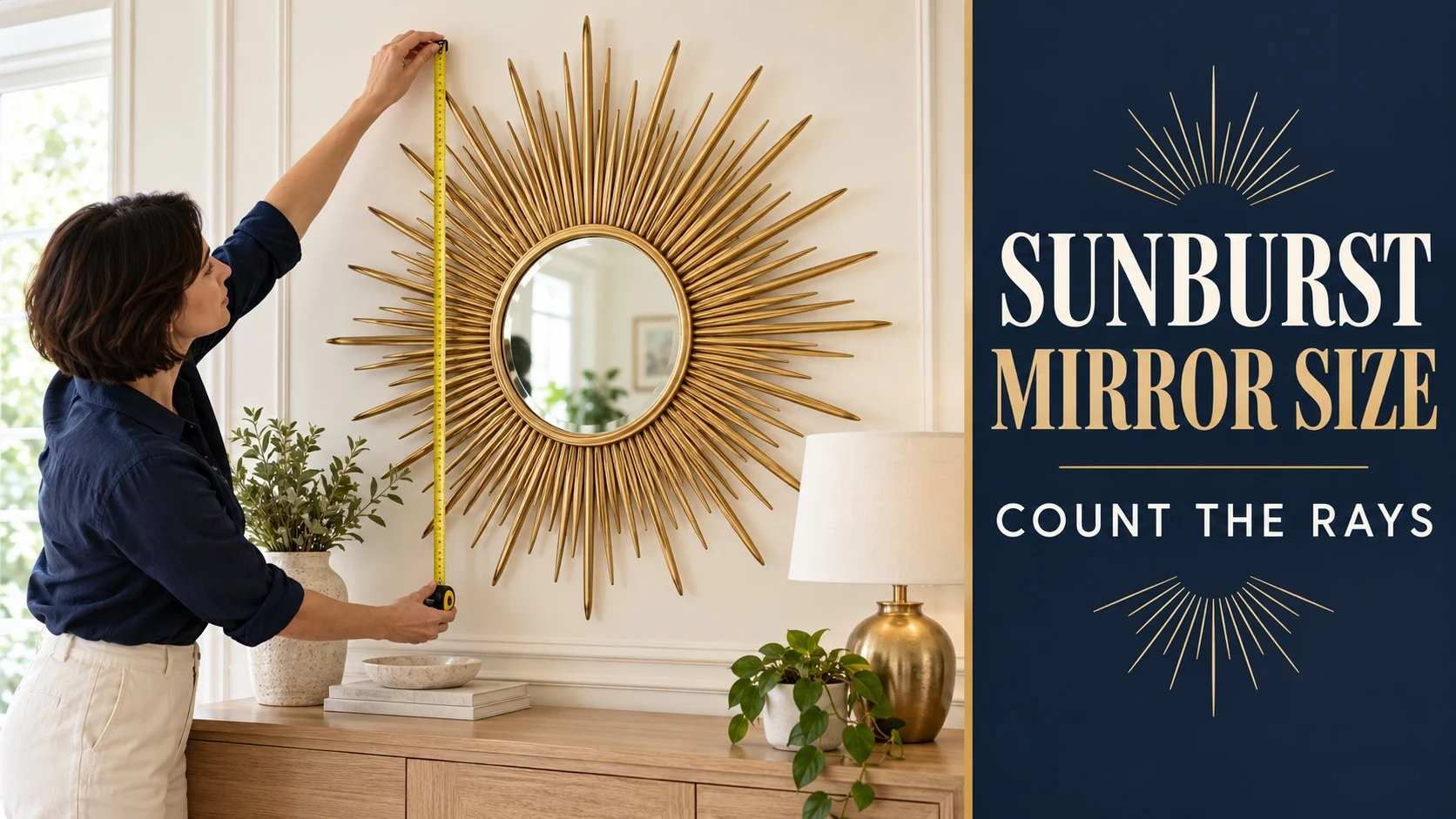
Measure a sunburst mirror across its outermost ray tips, then record its full height in the intended hanging position. Use those outer dimensions to check wall fit and furniture proportion; the central glass diameter tells you how much reflection you get. Before ordering, mark the complete footprint on the wall and check the nearest door, sconce and ceiling edge.
Why the listed size can be the wrong number
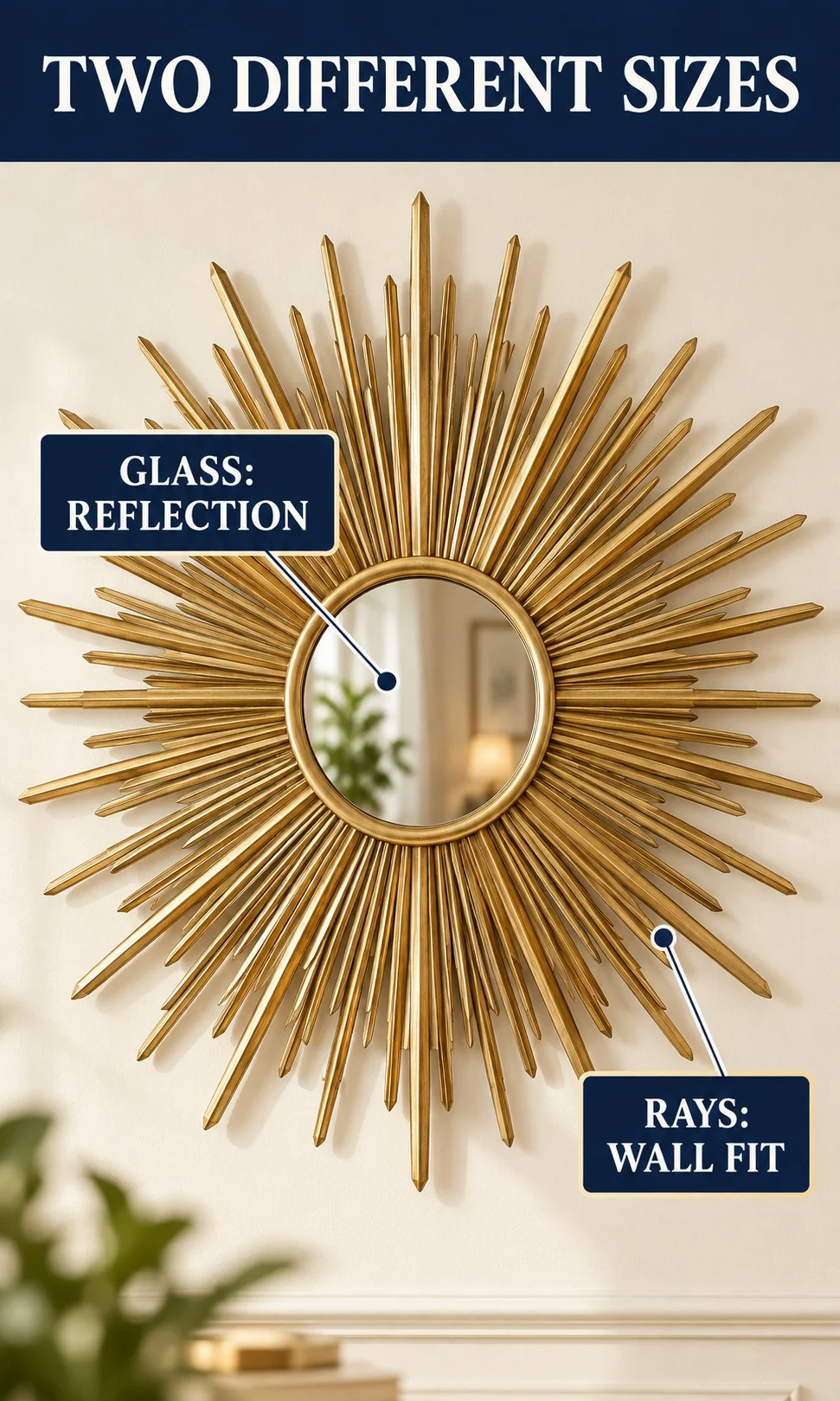
A sunburst mirror has two useful sizes: the decorative object and the reflective glass. A listing may give both, but a short product title can leave the distinction unclear. Do not assume that a number beside the word “mirror” describes the whole piece.
The difference can be substantial. One manufacturer lists an outer size of 40.8 inches by 40.8 inches, while the central glass measures only 8 inches by 8 inches. That example illustrates the problem; it does not establish a standard ray length for other mirrors.
Ask the seller for overall width, overall height and depth, including every projecting part. Request a dimension drawing if the description mixes glass size, frame size and package dimensions. Carton measurements are shipping information, not the footprint you should tape onto your wall.
How to measure a sunburst mirror, including the rays
Work in the orientation in which the mirror will hang. Support the backing on a protected surface, and avoid pressing on slender rays or resting the weight on their tips. If the mirror is large or awkward, ask another person to help support it rather than trying to hold it by the decoration.
- Measure the full horizontal span between the farthest left and right tips.
- Measure the full vertical span between the highest and lowest tips.
- Record the glass diameter separately, without including its frame.
- Record depth and the position of each factory hanger.
- Repeat the outer measurements before transferring the footprint to the wall.
Tip-to-tip width and height
For a symmetrical circular design, the width and height may be the same. Still check both directions: a taller top ray, a bent spoke or an uneven arrangement can change the result. Measure the widest horizontal envelope and tallest vertical envelope, rather than a convenient pair of shorter opposing rays.
A long diagonal tip-to-tip measurement is not automatically the horizontal width. Imagine a rectangle enclosing the mirror in its intended orientation: the leftmost, rightmost, highest and lowest points define that rectangle. This keeps the measurement useful when the rays do not form a perfect circle.
Glass diameter
Measure the visible reflective surface separately from the surrounding ring and rays. A large outer span with a small centre can make a strong wall feature while offering a limited view of your face or clothing. If the mirror must serve an entryway or dressing function, check that reflective area before choosing it for its wall presence.
Flat and convex glass also serve different purposes. Convex glass gives a wider, distorted view and is usually chosen for its decorative effect. If you need an ordinary grooming reflection, inspect the actual glass type and the view it provides at the intended height.
Depth and hanger offset
Depth includes anything projecting toward the room or away from the wall. That matters beside a swinging door, in a narrow passage or where a lamp stands in front of the mirror. A width check cannot tell you whether those objects will collide in three dimensions.
Measure the topmost ray to the point where each hanger will actually bear on the wall hardware. That offset converts a desired top edge into a hanger reference height. Do not use the top of a loose D-ring or the outer edge of a bracket unless it is the bearing point specified for the installation.
Which size to use above a console, sofa or mantel
Use the overall ray width when comparing the mirror with the furniture below it. Around one-half to two-thirds of the furniture width is a useful styling starting range, rather than a rule that every room must follow. Ray density, surrounding art and the visible wall area can make the same outer width feel lighter or heavier.
For a 60-inch console, that starting range is 30 to 40 inches overall, approximately 76 to 102 centimetres. A 36-inch outer mirror falls within it at 60% of the console width, regardless of whether its glass is 11 inches or 24 inches across. This is an illustrative calculation, not a measurement of a mirror tested for this article.
A wider sofa may make the same mirror look small, but that does not mean the glass needs to be larger by the same amount. Preview the full outer shape and its relationship to the seating arrangement. If the mirror needs neighbouring artwork to form a group, judge the group width as a separate composition rather than disguising a small mirror with an invented sizing rule.
Above ordinary furniture, a lowest-ray gap of roughly 4 to 8 inches, about 10 to 20 centimetres, can be a practical visual starting point. Measure that gap from the furniture top to the lowest projecting ray, not to the glass. Adjust it for lamps, tall objects, headboards and the way people use the space.
On an open wall, position the centre for the view you want rather than forcing a furniture-based gap. A common gallery-style starting height places the centre near eye level, but a small glass centre may still give an unhelpful reflection. Test standing and seated views before choosing the final position.
Check your dimensions in Sunburst Fit Studio
Enter the overall width and height, the furniture width and a clear wall rectangle above the furniture. The Studio separates physical footprint from styling proportion, and it can calculate a hanger bearing reference if you supply the offset. Its result is a preview of your measurements, so it still needs a real-room check before ordering or drilling.
Sunburst Fit Studio checks the full ray footprint, furniture proportion and hanger reference. Loading interactive controls…
Sunburst Fit Studio
Check the full footprint before you order or drill.
Overall size Furniture proportion A4 reportEnter the full outer dimensions, then compare them with a clear wall area. The half-to-two-thirds furniture range is a styling starting point; this check does not approve mounting hardware or fireplace heat clearance.