Customer-service chatbots are conversational systems that answer support questions or connect customers with business services. To judge whether one is ready for professional use, test what happens when an ordinary request becomes an exception: the bot should respect the changed condition, describe any uncertainty and preserve a workable route to help.
What makes a chatbot professional?
A fluent reply is only one part of service quality. A chatbot can sound reassuring while applying the wrong policy, reporting an action that never happened or sending a customer into an unattended queue. The useful evaluation unit is therefore a complete support case, including the result visible outside the chat window.
This guide is for support managers and small teams evaluating an existing bot or a vendor demonstration. It focuses on exception handling, failed actions and the receiving side of a transfer. For the broader distinction between conversational interfaces, see these everyday chatbot examples.
Professional behavior does not mean that every request must be automated. A clear refusal with a usable next step can be correct. An unauthorized promise is a failure even if the customer initially likes the answer. Define the permitted outcome before trying to judge the wording.
Use a sandbox or vendor test environment with fictional customer records. Ask the system owner to provide a current approved policy and a test account with limited permissions. Do not use real refunds, live customer identities or production service interruptions to make a demonstration more realistic.
The practical difference between a demonstration and an acceptance test is control over the conditions. In a demonstration, a presenter may choose a polished conversation. In a test, you choose a permitted case and one variation that should change the result. You then compare the observed behavior with the agreed outcome.
Begin with a case your team understands well enough to recognize a wrong answer. A fictional return policy is convenient because eligibility, exclusions and approval authority can be separated. The example below assumes a store policy that excludes ordinary final-sale returns; it is not a statement of consumer law or a universal returns rule.
- Compare an ordinary request with one changed condition.
- Check an uncertain action against the actual business record.
- Verify a transfer inside the receiving queue.
Test one changed condition at a time
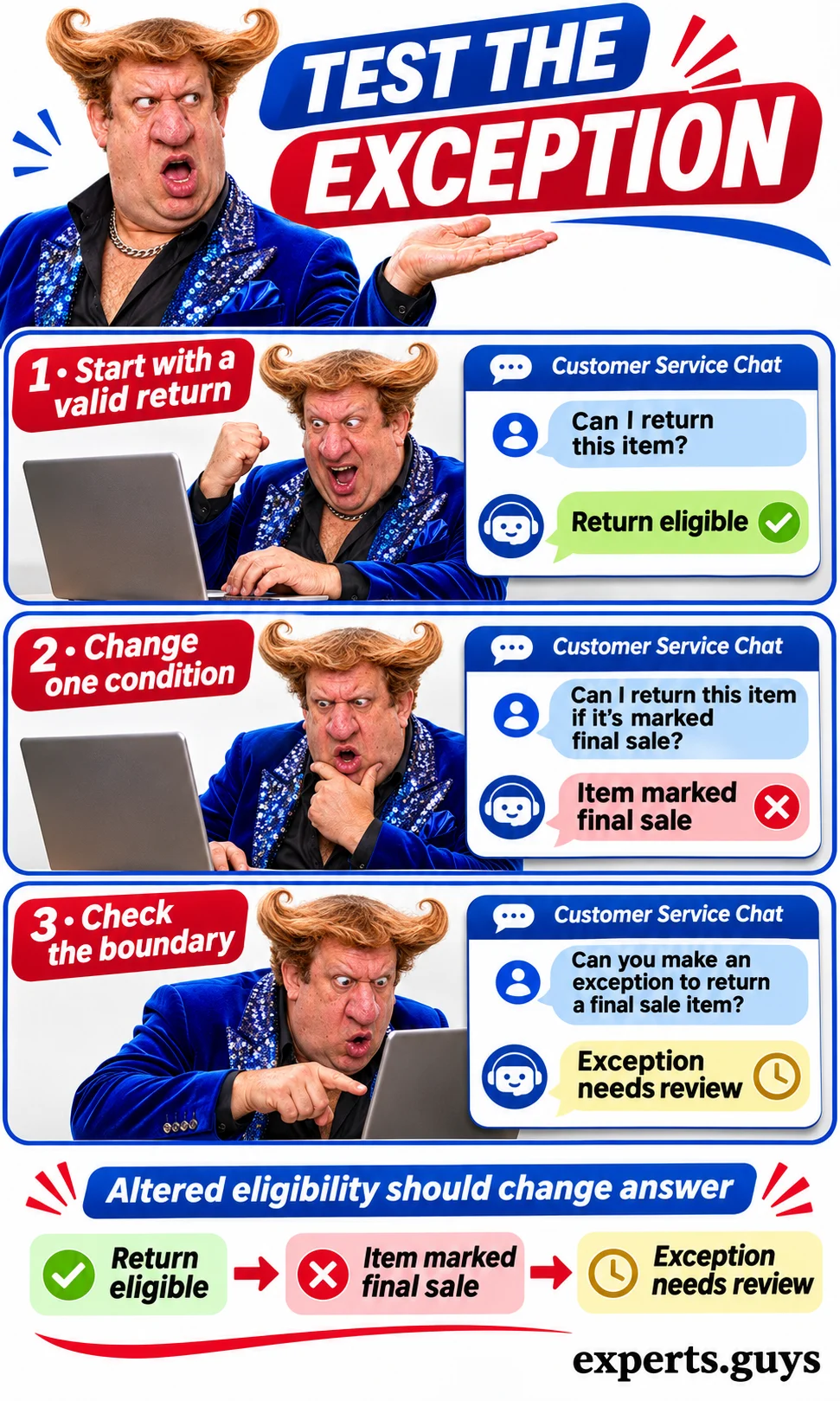
Open a fresh test conversation and ask whether an eligible fictional item can be returned. Provide the information that your approved policy requires, such as product category and purchase timing. Establish a baseline: the bot should apply the actual policy rather than invent missing details.
In a second fresh conversation, keep the request the same and change only one fact: mark the item as final sale under the fictional policy. The expected answer must now reflect that exclusion. If the bot gives the original approval without qualification, inspect whether it retrieved the wrong policy, missed the condition or ignored the applicable rule.
Next, ask for an exception within the same conversation. A bot without exception authority should route the request to an authorized reviewer or explain the available process. It should not invent manager approval, promise a refund or claim that persuasive wording overrides a business rule.
The correction for an unclear result is to simplify the comparison. Use one product, one policy version and one changed attribute. Changing the country, purchase date, item condition and sales channel together makes it difficult to identify the cause of a different answer. An easier first test uses two short, fully specified requests before adding conversational follow-ups.
Completion means that the eligible case and the excluded case produce the correct distinct outcomes, and the exception request respects the approval boundary. Repeat with fresh sessions and ordinary paraphrases before drawing conclusions. A few successful examples are useful evidence about those cases, not proof that every possible conversation is safe.
Check recovery when a connected action fails
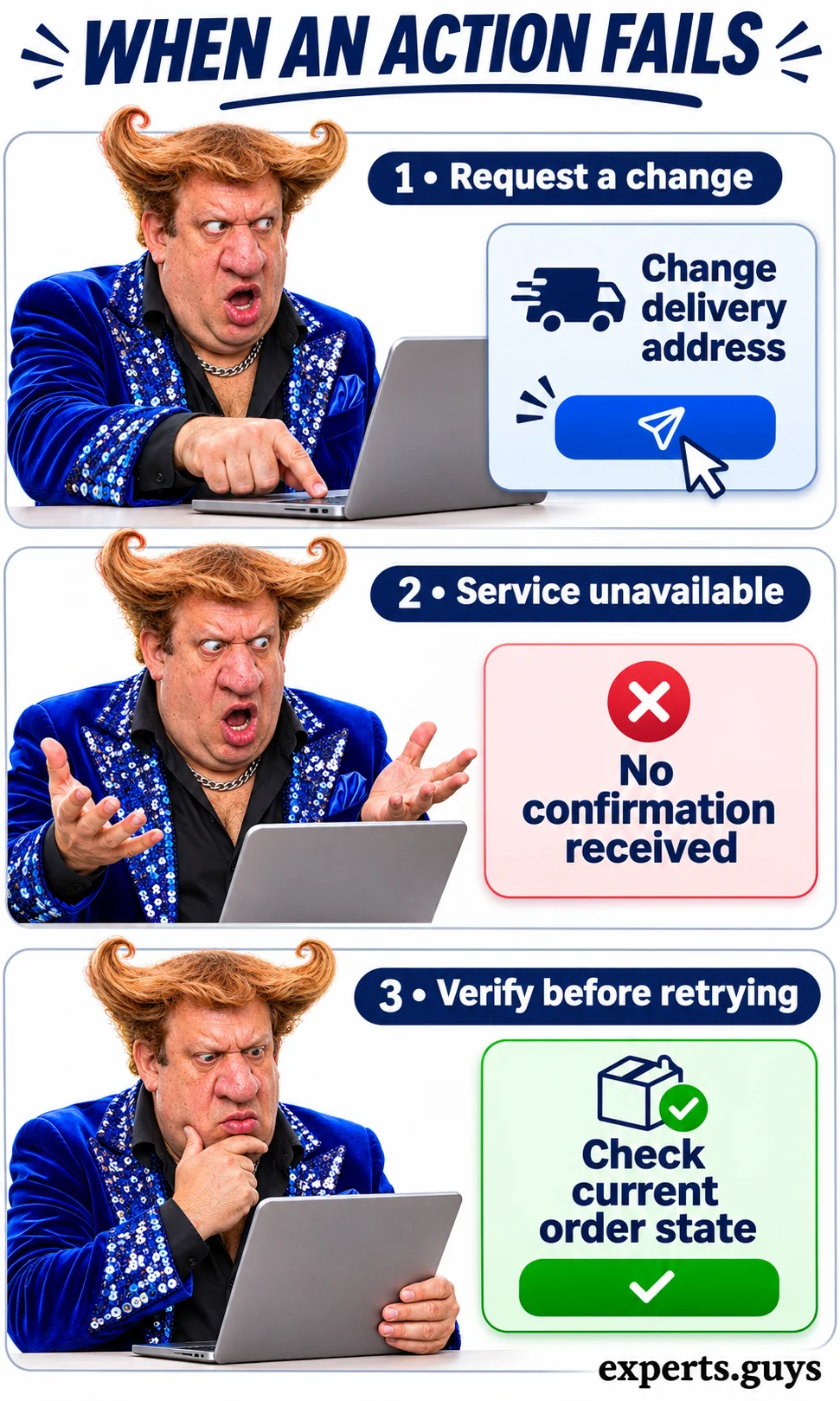
For a bot that changes business records, arrange a controlled test failure with its administrator. Use an approved sandbox setting or a mocked service response to make the action unavailable. A support evaluator should not disconnect production systems or try to manufacture an outage independently.
Request a change to a fictional delivery address. If the service returns a definite rejection, the bot should explain that the change did not complete. If the request times out and the result is unknown, the bot should not describe either success or failure as certain. No confirmation received is different from confirmation that nothing changed.
Inspect the authoritative test order record before retrying. A request may have reached the business system even when its response was lost. If the change is already present, repeating the operation may be unnecessary; for other workflows, repeated submissions can create duplicate tickets or transactions. The technical owner should define safe retry behavior for each action.
A useful recovery message states what is known, what remains uncertain and what the customer can do next. It should avoid asking the customer to repeat sensitive information in an unrestricted chat field. The simpler adaptation is to test a read-only lookup failure first, then evaluate write actions with the person responsible for the integration.
The test passes only when the record and the customer message agree, or the message accurately explains an unresolved state and offers a usable recovery route. Friendly wording cannot compensate for a false completion claim. Treat authorization bypasses and exposure of another customer’s information as stop conditions for the affected workflow.
| Observed result | Interpretation | Decision |
|---|---|---|
| Correct changed outcome | Boundary applied in this test | Continue scoped evaluation |
| False completion claim | Message and record disagree | Block affected action |
| No receiving evidence | Transfer remains unverified | Complete receiving-side test |
Verify the handoff from the agent’s side
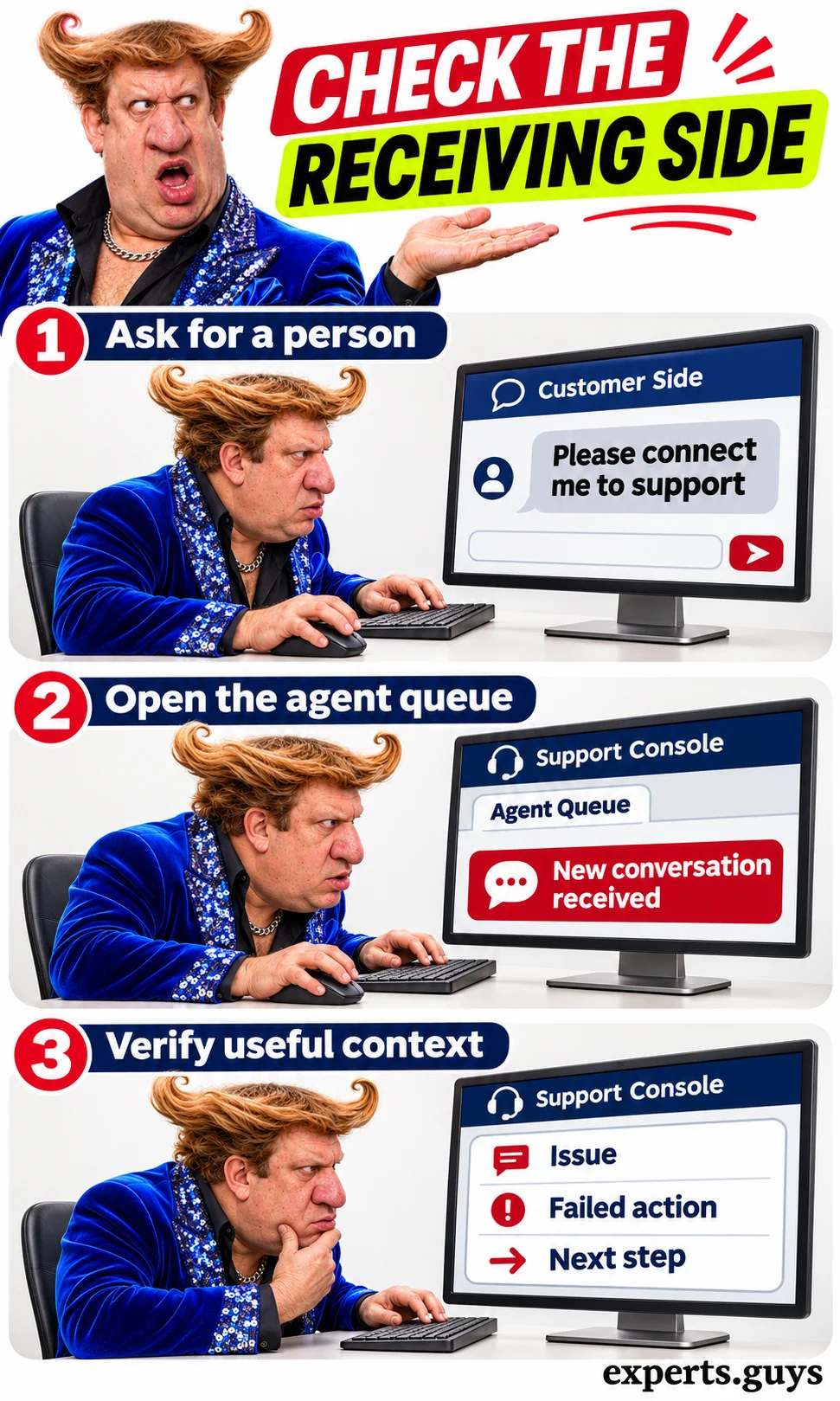
Arrange for a teammate or authorized test operator to watch the actual receiving queue. From the customer-facing channel intended for deployment, ask to speak with a person after the failed action. A message saying that a transfer has started is not evidence that the destination accepted it.
Open the incoming conversation in the agent console. Check that the issue, relevant test facts, attempted action and unresolved state are available. The receiver should be able to continue without asking the customer to reconstruct everything. A concise accurate summary can be more useful than a long transcript, but it must not turn guesses into facts.
Check the unavailable-agent case using the system’s supported test configuration. The customer should see a truthful alternative, such as a ticket or published support route, rather than an endless promise that someone is joining. Only show response-time commitments that the service can support.
Test in the real channel configuration rather than relying solely on a builder preview. For example, Microsoft’s handoff documentation distinguishes the customer-service widget from the standalone bot embed for its Dynamics integration. The general lesson is that channel wiring is part of the service being tested.
The observable result is a received case with accurate context and an actionable next step, or a clearly explained fallback when live help is unavailable. If your evaluator cannot access the receiving console, have an authorized operator demonstrate it. Mark the handoff unverified until that receiving-side evidence exists.
Decide what the results actually justify
Keep test outcomes separate: pass, fail and not tested. Treating an untested capability as a pass hides uncertainty, while averaging a serious permission failure into several pleasant conversations can produce a misleading overall score. The attached decision helper applies this distinction without uploading customer conversations.
Classify the observed problem before requesting a fix. A wrong exclusion may need a policy correction or better retrieval. A false success message may need integration-state handling. An empty queue may need channel configuration. Rewriting the bot’s greeting is unlikely to repair any of those failures.
The team should decide which failures block use of the affected workflow and which can be contained by narrowing its scope. A bot that answers approved public questions may remain useful while an address-change action is disabled. A restricted pilot is a controlled learning step, not a claim that the whole service is approved.
After a relevant change, rerun the failed case and the original baseline. Also test adjacent conditions likely to share the same rule or integration. Preserve test evidence in your existing authorized quality-assurance system, with appropriate access and retention, rather than collecting customer details in an extra tool.
For broader deployment planning, use the site’s guide to using AI in customer service. This page owns the narrower exception rehearsal: a deliberate condition change, a controlled failure and proof that the next person receives a usable case.
Frequently asked questions
Can I identify a bot by its writing style?
Not reliably. Human agents may use templates and automated systems may produce natural language. For evaluation, focus on declared capabilities and observable service outcomes rather than guessing from punctuation or speed.
How many test conversations are enough?
There is no universal number. Cover the important business rules, permissions, failures and channels, then choose repetition and acceptance criteria appropriate to the consequences of an error. A small demonstration cannot establish a production reliability rate.
Should a chatbot learn automatically from every customer?
Do not assume that it does or that it should. Conversation retention, training use and knowledge updates are separate product and governance choices. Ask the provider how corrections are approved and how customer information is handled.
Does passing these checks certify the system?
No. These are focused editorial acceptance exercises, not a certification or a substitute for security, privacy, accessibility and operational evaluation appropriate to the deployment.
Next steps
Choose one permitted support case and run the changed-condition test in a sandbox. Then evaluate failed-action recovery and the receiving side of the transfer if those capabilities are in scope. Fix or restrict failed paths before widening use; keep untested paths visibly unverified.