
Staffing agencies in San Antonio connect employers and job seekers across office, technical, industrial and healthcare work, but the best starting point depends on the actual role and worksite. Compare a few relevant agencies from the 15 below, then confirm the shift and hiring arrangement before committing to an application or recruitment contract.
For IT and professional searches, start by comparing tri-starr talent, Deacon Recruiting and Robert Half. For office support, LeadingEdge Personnel is a more focused starting point; industrial and clinical searches need different desks. These are editorial starting points based on published service scope, not a tested ranking of placement quality.
Use the list to narrow a search rather than register indiscriminately. The useful question is which recruiter can discuss the work you can actually accept, with enough detail to separate a real opening from a general talent-pool application.
- Job seekers: compare role requirements, the client worksite and the arrangement being offered.
- Employers: compare the same job brief and cost assumptions across providers.
- Both: an agency’s listed specialty does not establish a current vacancy, available worker or guaranteed start.
Which San Antonio staffing agencies fit your work?
The directory preserves the original 15-provider scope while updating names and routes where verified. Numbering makes entries easy to find; it does not indicate that the first agency is better than the fifteenth. Published services establish a plausible shortlist, while the next conversation establishes whether that shortlist fits today’s requirement.
A broad agency can be useful when a company needs several types of workers, but breadth can conceal differences between recruiting teams. Ask to speak with the desk handling your occupation. A healthcare office receptionist, a registered nurse and a hospital systems administrator may work in the same building while requiring entirely different recruitment conversations.
Agency location is also different from assignment location. A San Antonio office may serve surrounding communities or recruit nationally, and a local recruiter can offer a role outside your travel range. Treat “serving San Antonio” as a coverage statement until the particular client site is identified.
For the wider mechanics of agency employment, the guide to how staffing agencies work supplies the background. This page concentrates on the local shortlist and the checks that stop a seemingly suitable San Antonio opportunity from becoming an impractical one.
The following comparison summarizes published service categories. Read the profiles for the important boundaries, especially the difference between healthcare office support and clinical care, and between local branches and national recruitment operations.
| Agency | Published service focus | First check |
|---|---|---|
| FirstOption Workforce Solutions | Local workforce recruitment | Ask which current role and client site fit. |
| Trinity Staffing Services | Office, manufacturing and warehouse | Compare San Antonio with surrounding service areas. |
| tri-starr talent | Technology, engineering, administration, executive search | Ask for the relevant specialist desk. |
| Deacon Recruiting | Finance, corporate services, IT and medical | Distinguish search from contract staffing. |
| Reliable Staffing | Office, manufacturing, skilled labor, medical and IT | Confirm branch and recruiting specialty. |
| Stability Staffing and Consulting | Professional, allied healthcare, government and disaster support | Separate local work from deployment. |
| LeadingEdge Personnel | Clerical and administrative specialisms | Separate medical office work from clinical care. |
| Labor On Demand | On-demand workforce assignments | Confirm worksite and reporting instructions. |
| BBM Staffing | Automotive, distribution and light manufacturing | Ask about the actual production task. |
| SNL Staffing Solutions | Clerical, light industrial and manufacturing | Check shift and job-specific requirements. |
| MedTrust | Healthcare recruitment, including government settings | Confirm current San Antonio coverage; local office unverified. |
| NURSES Etc STAFFING | Per diem, travel and government healthcare | Confirm local versus travel assignment. |
| Robert Half | Finance, technology and business functions | Select the San Antonio role and practice area. |
| Express Employment Professionals | Office, industrial and skilled trades | Choose the relevant metro office. |
| PrideStaff San Antonio (North) | Office, finance, production and logistics | Check the exact I-35 corridor worksite. |
1. FirstOption Workforce Solutions
FirstOption Workforce Solutions: FirstOption provides a local starting point for workforce recruitment, with separate employer and job-seeker routes. Its site offers a job board and application path, so it is more useful to begin with a suitable advertised role than assume a general registration will produce work immediately. A local presence helps establish where to begin the conversation; it does not tell you where the client expects you to report.
If an advertised position looks relevant, ask whether the vacancy is still active, which site it serves and what remains before an assignment can be confirmed. Employers should distinguish a request for available staff from a defined recruitment engagement. The fit test is a concrete discussion of duties, shift and start conditions rather than the agency’s promotional claims.
2. Trinity Staffing Services
Trinity Staffing Services: Trinity lists administrative, clerical, accounting, legal, medical office, warehouse, light-industrial and manufacturing placements. Its service area includes San Antonio and surrounding South Texas communities, with temporary, temp-to-hire and direct-hire services. That breadth makes it worth comparing when a search crosses office and operations work, or when an employer needs a clearly defined local staffing arrangement.
Do not let the service-area description substitute for the assignment address. A role in Seguin or New Braunfels may be sensible for one applicant and unworkable for another. Ask which branch owns the vacancy and whether the initial assignment is temporary or intended to lead to a possible direct hire. Those are separate questions from whether the role itself is suitable.
3. tri-starr talent
tri-starr talent: The former Tri-Starr Group URL now leads to tri-starr talent. Its published categories distinguish technology and engineering, general and administrative recruitment, executive search and manufacturing. For a San Antonio IT search, that explicit technical category is a useful reason to include the firm in an initial comparison rather than send the same profile to every broad staffing office.
Identify the actual function before asking for help: desktop support, systems administration, development and cybersecurity are different searches. Discuss required tools, scope and work arrangement with the relevant desk. A technical category on a website is evidence of service focus, not proof that every specialist role is open or that a candidate qualifies for one.

4. Deacon Recruiting
Deacon Recruiting: Deacon lists accounting and finance, corporate services, IT, medical and professional contract services. It also distinguishes retained and contingent search, direct hire, contract and contract-to-hire. That makes it a relevant comparison for a specialist or professional role where the recruitment model can matter as much as the job title.
Employers should ask which search model is proposed and what it requires before authorizing work. Applicants should establish whether a conversation concerns a specific client search or a broader introduction. A retained leadership search and a short professional contract may both involve a recruiter, but they have different processes, timing and employment outcomes.
5. Reliable Staffing
Reliable Staffing: Reliable Staffing’s San Antonio page lists professional, manufacturing, office and clerical, skilled-labor, medical and dental, and IT categories. It also publishes several local office locations. This offers another broad-service comparison, particularly when the right recruiter depends on a job family rather than a single company-wide identity.
Choose the relevant contact route before traveling to an office. Multiple branches do not establish that each location is handling the same vacancy or can process the same application. Confirm which team owns the requirement and where the assignment takes place. Employers comparing branches should use one agreed brief so responses are about the same work.
6. Stability Staffing and Consulting
Stability Staffing and Consulting: Stability Staffing and Consulting describes San Antonio headquarters alongside national recruitment operations. Its published scope includes professional and allied healthcare personnel, administrative and clerical professionals, government contracting and emergency-disaster support. These categories make deployment and contract context particularly important; they should not be read as a list of ordinary local vacancies.
Ask whether the opportunity is a routine local placement, a government-related assignment or a deployment. Location, readiness requirements and assignment duration can change the decision. A candidate seeking a predictable local schedule should establish those boundaries early. An employer should identify the specific service needed rather than assume the provider’s emergency-response capability is relevant to a standard office opening.
7. LeadingEdge Personnel
LeadingEdge Personnel: LeadingEdge emphasizes office, clerical and administrative staffing, including legal support, accounting support, customer service and call-center work. It lists temporary, temp-to-hire and direct-hire options and has San Antonio and Austin contact routes. This is a focused starting point when the vacancy is in business support rather than production or engineering.
The word “medical” needs attention here: medical office support is not interchangeable with bedside nursing or another licensed clinical job. Describe the actual duties and select the San Antonio route. A candidate comparing receptionist roles should ask about scheduling and systems responsibilities; an employer should specify whether the work includes billing, records or general front-desk support.
Specialty determines which conversation to start; it does not replace the vacancy check. The broader guide to employment agencies by industry explains the sector differences without turning every San Antonio application into a general recruitment lesson.
8. Labor On Demand
Labor On Demand: The former lodstaffing.com route redirects to Labor On Demand’s current site. The business describes on-demand workforce solutions and offers separate job-seeker and employer paths. Its emphasis makes it relevant to investigate for flexible assignments and short-notice staffing needs, provided the actual job requirements and reporting arrangements are clear.
“On demand” does not mean every applicant can start immediately or that every client request can be filled. Ask about the current assignment, reporting site and remaining steps. If a shift has an early start, transport and site access may determine suitability before experience does. Employers should also clarify what happens when a requested worker cannot attend.
9. BBM Staffing
BBM Staffing: BBM describes temporary and permanent staffing across several industries, including automotive manufacturing, distribution centers and light manufacturing. Its site publishes a San Antonio contact location. That makes it a relevant industrial comparison when the requirement concerns a particular production environment rather than a generic promise of any kind of employment.
Ask about the task behind the title. Assembly, material handling and machine-related work can have different training, physical and scheduling requirements. A job seeker should understand what the client expects before agreeing to attend. An employer should describe the station or process being staffed, including the training and supervision the site will provide.
10. SNL Staffing Solutions
SNL Staffing Solutions: SNL’s published San Antonio offering includes clerical and administrative talent, light-industrial labor, manufacturing operators and professional recruitment. It also describes onboarding and workforce-management services. Consider it alongside other local options when the search needs more detail about the actual assignment than a broad job-board category supplies.
For industrial roles, compare the shift and required experience before assuming the opening is suitable because the title sounds familiar. For employers, “operator” is not a complete brief: specify the equipment, responsibilities and training arrangements. SNL’s listed service categories justify an inquiry, while the client-specific conversation establishes whether the recruitment can proceed.
11. MedTrust
MedTrust: MedTrust’s current healthcare site describes staffing for government and private-sector organizations, with nursing, physician, allied and support categories. The older San Antonio directory entry should not be used as proof of a current local office: the current contact page lists Oklahoma City, and a present San Antonio vacancy or branch was not established for this guide.
Treat MedTrust as a healthcare inquiry with a local-coverage check, rather than an equally verified walk-in San Antonio office. Ask whether there is an active assignment at an acceptable San Antonio facility and which team is recruiting it. Do not substitute a similarly named medical staffing website; confirm the business identity and application route before sharing documents.
12. NURSES Etc STAFFING
NURSES Etc STAFFING: NURSES Etc STAFFING publishes per-diem, travel-nursing and government-services routes, including work connected with government and military facilities. It belongs in a healthcare comparison, with assignment location and arrangement settled before a candidate interprets a broad opportunity listing as a local shift.
A San Antonio-based search can lead to local work or a role requiring travel; the company’s reach does not decide which one is being discussed. Confirm facility, specialty, schedule and required onboarding. Medical office experience alone does not establish clinical eligibility, and a candidate should not treat a healthcare recruiter’s initial interest as final clearance to begin work.
13. Robert Half
Robert Half: Robert Half has a dedicated San Antonio page with remote and on-site recruitment and practice areas covering business functions such as finance and accounting and technology. It is a practical professional-search comparison when the local office and the relevant specialty can both be identified, rather than relying only on the national brand.
Use the actual role description to establish technical or functional fit. A help-desk job and an IT management role may sit within the same practice area while needing very different evidence of experience. Remote availability is vacancy-specific; a city page offering remote and on-site recruitment does not promise that the particular job can be performed from anywhere.
14. Express Employment Professionals
Express Employment Professionals: Express publishes a San Antonio metro office network, including New Braunfels. Local office pages describe office services, light-industrial and skilled-trades recruitment. The useful first choice is the office handling the relevant location and work category, not simply the first Express listing returned by a search engine.
Ask which office owns the vacancy and whether another office is already representing the same requirement. A metro network can widen a search while also producing confusion about contacts and client sites. Employers should clarify the scope of the office’s service and escalation contact. Job seekers should keep the branch conversation tied to the specific opening they can accept.
15. PrideStaff San Antonio (North)
PrideStaff San Antonio (North): PrideStaff’s current San Antonio North page lists contract and temporary staffing, temp-to-hire and direct recruiting. Its categories include administration, customer service, accounting and finance, manufacturing, skilled trades, logistics and healthcare office support. The published service area extends through communities along the I-35 corridor.
That corridor coverage is useful only if the actual site works for the applicant or hiring organization. A local branch label can still lead to an assignment in another community. Confirm the client address, shift and specialty, and distinguish healthcare office support from clinical staffing. Use the current location page instead of relying on an older directory address.
How do you turn the directory into a realistic local shortlist?
Use three filters in order: the occupation, the client worksite and the shift. Start with two or three agencies whose published services fit, then inspect an actual role or ask whether the relevant desk is recruiting one. This order avoids spending time on onboarding for work that could never fit your location or schedule.
- Open the agency’s official job route and identify one relevant role or specialty contact.
- Check the duties and must-have requirements before treating the title as a match.
- Confirm the client location and shift; ask what remains before interview or assignment.
- Proceed with the matching opportunity, or ask for a narrower search if the details fail your constraints.
For example, an IT support applicant could compare tri-starr talent, Deacon and Robert Half, then ask about the operating environment, on-site expectations and the level of support involved. An applicant with customer-service experience may get a more useful initial conversation with an office-support desk. The recommendation changes with the work, not with the outfit or title on a recruiter’s profile.

Test the worksite rather than the recruiter’s office
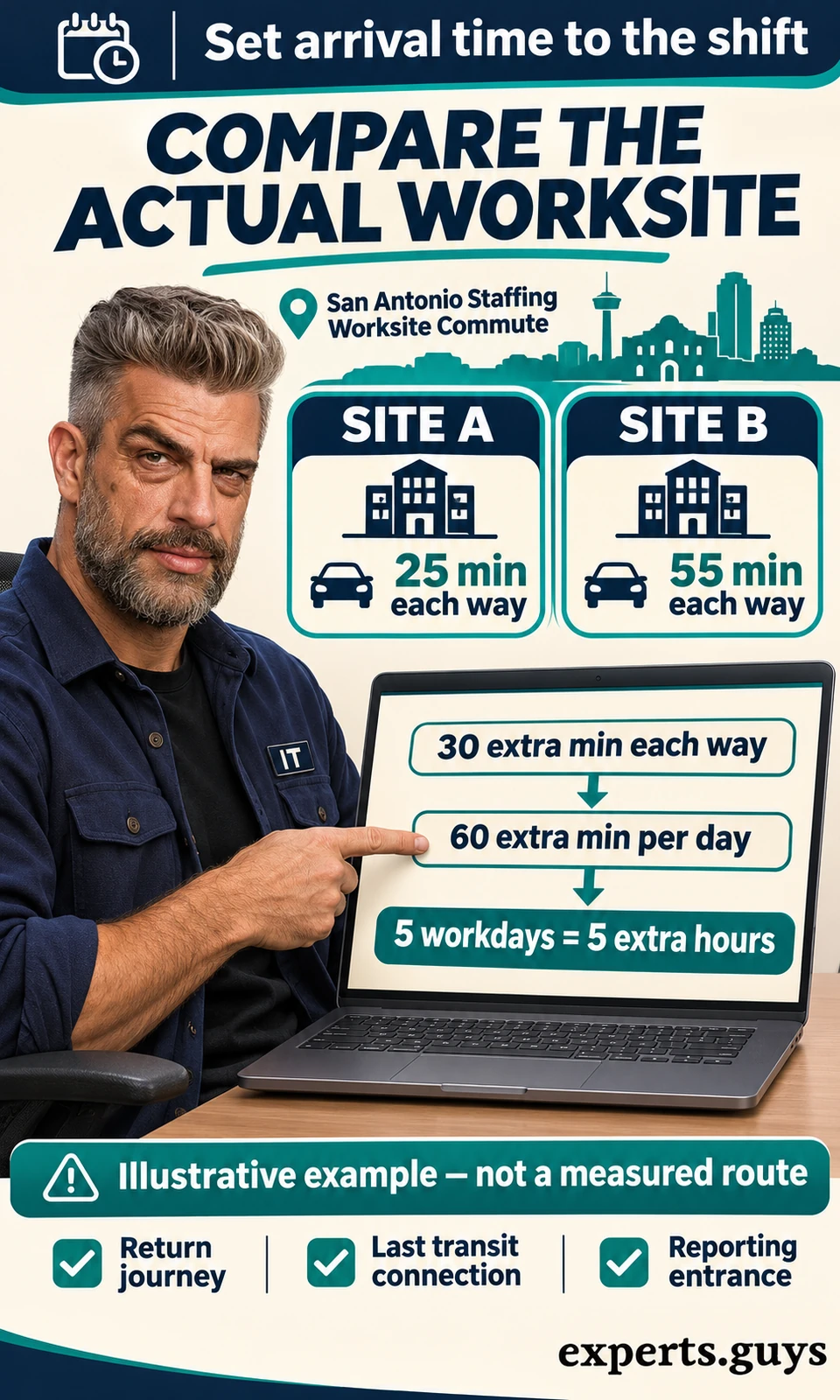
Ask for the assignment address or enough location detail to assess the trip. In a navigation app, set an arrival time matching the shift and inspect the return journey as well. For transit, check whether the service runs when the shift ends and whether the last part of the route reaches the reporting entrance. A recruiting-office appointment is a separate trip.
This matters for early production starts and late finishes, but it also affects professional roles described as hybrid. “Two office days” can be workable when fixed in advance and difficult when the days or sites change. If the client location cannot yet be disclosed, state your acceptable area and make clear that final acceptance depends on the address. Do not manufacture a reliable commute from a city name.
Consider this illustrative comparison: two jobs offer the same hourly pay and schedule. Site A requires 25 minutes each way; Site B requires 55 minutes each way. Across five working days, Site B adds five hours of travel: 30 extra minutes in each direction, multiplied by five. This is a personal time comparison, not a claim about paid working time or any actual San Antonio route.
If checking several routes feels excessive, settle the biggest barrier first: can you reach this particular site for this particular shift? A suitable agency with no feasible current assignment stays a future contact; it does not become a suitable job by collecting more application documents.
What should you confirm before an agency submits you?
Confirm the arrangement and authorize the specific submission you understand. Registration, recruiter screening, client interview and an offer are different stages. The general US recruitment-route guide explains those stages; the local task here is to apply them to a named opportunity without losing control of where your profile goes.
| Arrangement | Confirm before proceeding |
|---|---|
| Temporary or contract assignment | Who employs and pays you, the expected assignment term and the client site. |
| Temp-to-hire or contract-to-hire | The initial terms and conditions for any possible later direct appointment. |
| Direct hire | Which organization issues the offer and what screening remains. |
| Specialist healthcare assignment | The facility, assignment type and required credentialing or access steps. |
Ask directly: “Who would employ me initially, what is the expected term, and what has to happen before I can start?” If an agency describes a possible conversion after an initial assignment, ask what the client must approve. Judge the initial role on terms you can accept without assuming that the future direct offer will happen.

Prevent duplicate submissions to one client
Before granting a right to represent or agreeing to a submission, ask the recruiter to identify the client, role or requisition and the scope of the authorization. If confidentiality limits the client name, ask how the agency checks for a duplicate and what you are authorizing at this stage. Avoid consenting to an unrestricted submission merely to move the conversation along.
- Ask which specific role the recruiter intends to submit you for.
- Check whether you already applied directly or through another agency for that same role.
- Tell the recruiter about a possible overlap before consenting.
- Authorize the clarified submission only when you understand the scope; ask both contacts to resolve any conflict.
Illustrative example: Agency A discusses an accounts-payable contract and submits your profile with consent. Agency B later describes what appears to be the same client and requisition. Tell Agency B about the earlier submission before agreeing to another one. Working with more than one agency is different from being represented twice for the same opening; the client’s process determines how it handles that situation.

A genuine company name can also be impersonated. The FTC’s job-scam guidance warns against paying for a promised job and fake-check arrangements that ask you to send money onward. Use independently located agency contact details to verify an unexpected recruiter or unusual document request. An ordinary vacancy description should never be treated as proof of the sender’s identity.
How should employers compare offers and the first-day handoff?
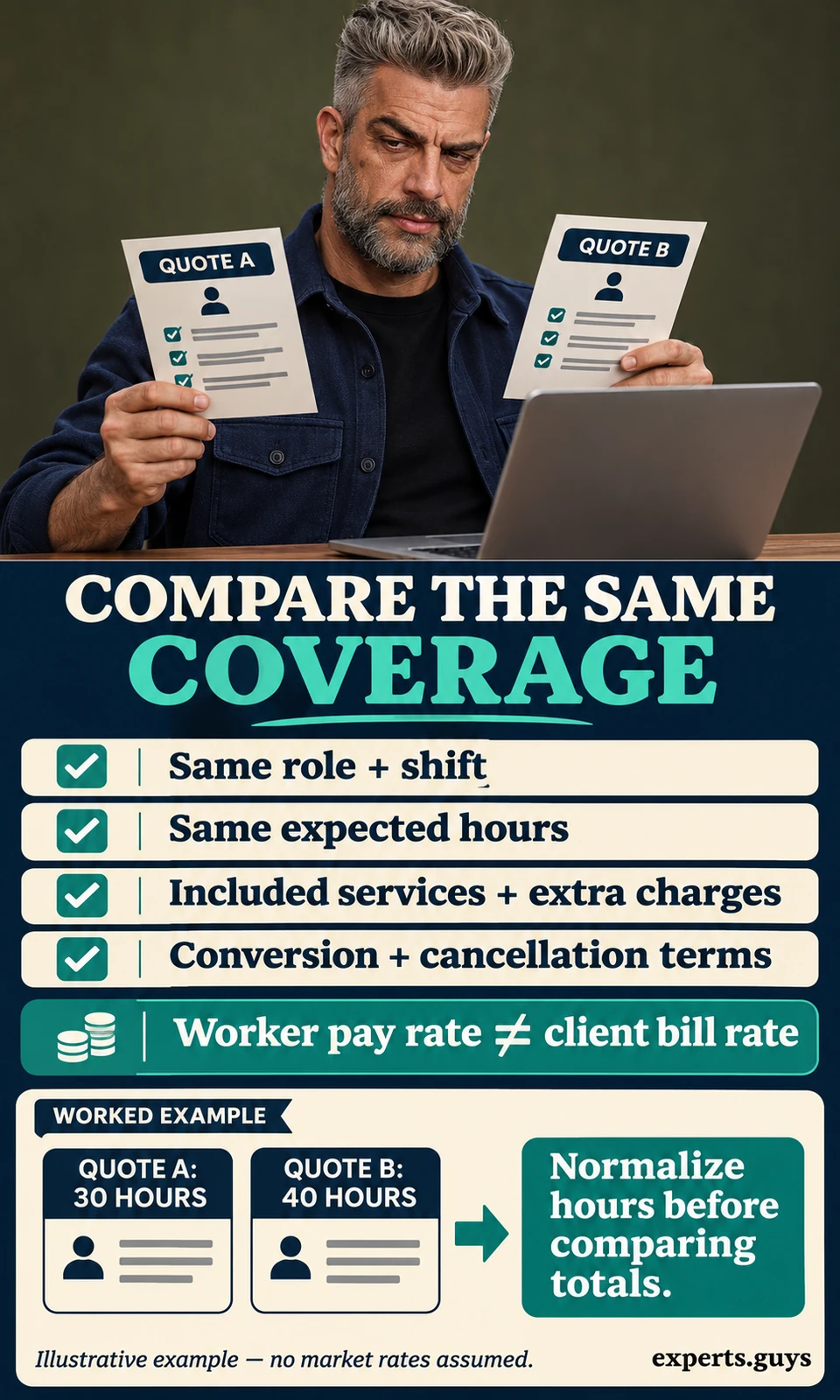
Give each provider the same work specification and ask for an itemized explanation of the proposed arrangement. A lower hourly bill rate may be attractive, but it is not comparable until the quotes cover the same pay assumption, shift, hours, screening and service scope. This is especially relevant when comparing industrial coverage with specialist search: the deliverables may be different products.
For a useful quotation, define the actual duties, worksite, shift, expected hours, required skills and planned start. Separate must-have skills from what the site will train. Ask the agency to identify which requirements it can meet and which remain uncertain. The practical output is a comparable proposal, not a polished promise that it can supply anyone.
- Agree the worker-pay assumption and ask how it relates to the quoted client bill rate.
- Compare included services and separate charges on the same expected hours.
- Ask about overtime billing, conversion terms, cancellation conditions and replacement support.
- Clarify which party handles each onboarding and site-training task before the first shift.
Suppose one illustrative proposal assumes 30 hours each week and another assumes 40. Their weekly totals cannot be compared as though they purchased the same coverage. Ask for both quotes on the same hours before discussing price differences. If one includes a service the other excludes, price or explain that difference rather than attributing the entire gap to margin. No universal staffing markup or saving is assumed here.
Make the first-day handoff explicit
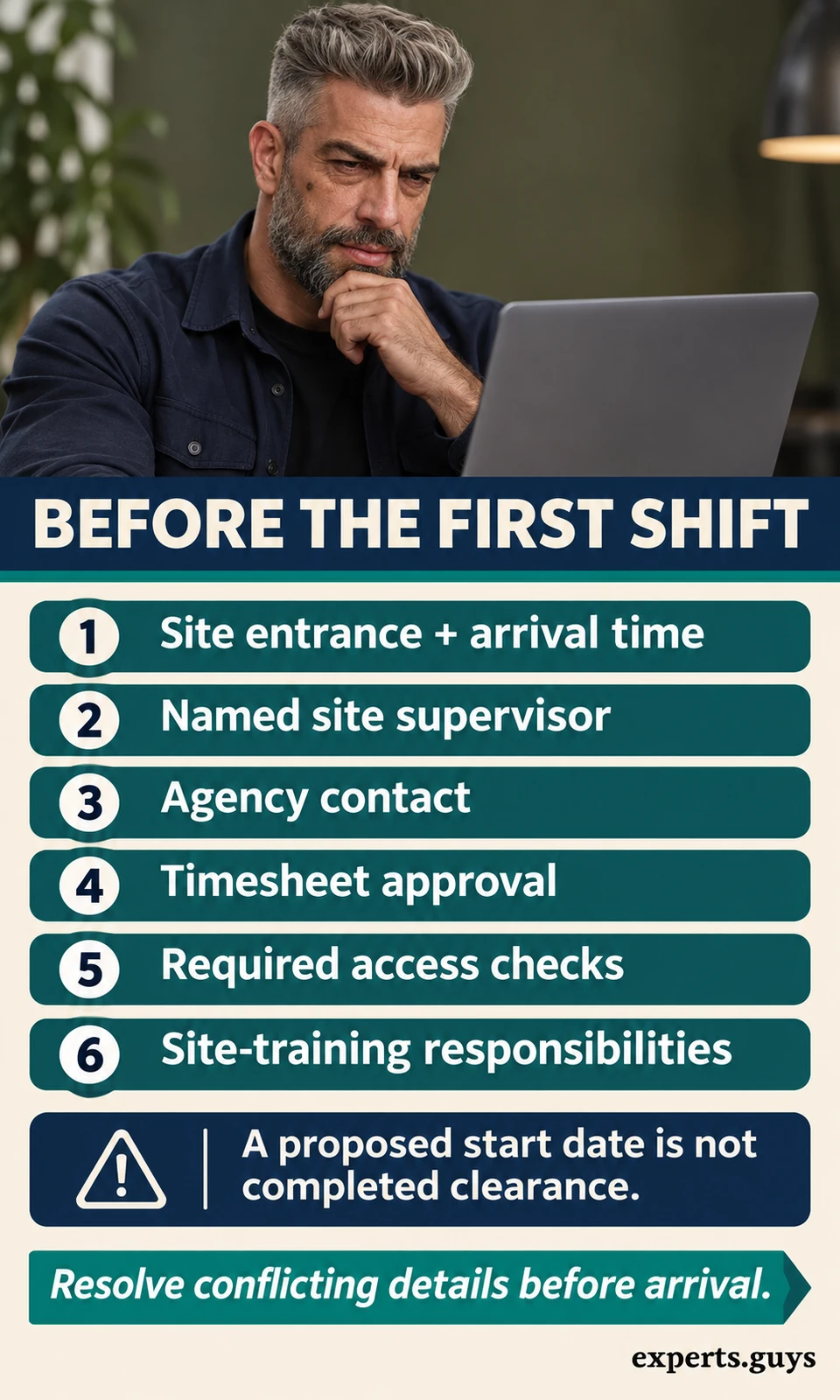
Before the assignment begins, the worker, agency and client should have consistent reporting details: site entrance, arrival time, named supervisor, agency contact and timesheet approval route. Include required access or credentialing steps when applicable. If details conflict, resolve the discrepancy before sending someone to an unfamiliar location with no clear person to meet.
Training responsibilities deserve their own confirmation. OSHA’s temporary-worker guidance describes responsibilities shared by staffing agencies and host employers, including the importance of communication and site-specific safety training. An agency introduction does not establish that a worker is prepared for a particular machine, hazard or clinical environment. The site and provider need to define the appropriate preparation for the actual work.
An easier handoff is one concise confirmation from the agency that names the reporting point and identifies who can resolve an arrival problem. For healthcare work, make sure the facility’s required onboarding is complete rather than interpreting a recruiter’s proposed date as clearance. This local handoff complements the wider hiring comparison; it is not an excuse to move training obligations into a vague “the other party handles it” statement.
Questions that remain after shortlisting
Does registration mean an agency has offered me work?
No. A registration can place you in a candidate pool or begin screening without establishing a specific assignment. Ask whether the conversation concerns an identified opening and which stages remain before an offer or confirmed start.
Can an agency with a local office place me outside San Antonio?
Yes, an office may recruit across a larger region or nationally. Check the particular worksite and any travel requirement rather than relying on the branch’s city name.
Are the agency numbers a quality ranking?
No. They are directory references. The shortlist is based on published service categories and verified contact routes, with important local-coverage limits stated. No placement-success comparison or firsthand service test was performed.
Should I visit a branch before applying online?
Follow the current official branch instructions. Confirm whether an appointment or online application is expected before traveling, and ask which office handles the role. A directory address alone does not establish walk-in availability.
Can a clinical recruiter also fill a medical receptionist role?
Possibly, but ask which desk handles the actual duties. Clinical staffing and healthcare office support are different categories, and neither label alone establishes that a specific opening or qualified worker is available.
Your next comparison
- Choose two or three agencies with a relevant published specialty.
- Ask about a specific role, worksite and shift before committing to extensive onboarding.
- Clarify the employment or recruitment arrangement and any submission authorization.
- For an employer brief, compare equivalent quoted scope and settle the reporting and training handoff.