




Major depressive disorder can lead to difficulties with relationships, work, self-care and the management of other health conditions. Serious complications can include suicidal behavior, while everyday consequences may begin with missed care or responsibilities that have become hard to manage. These outcomes are possible, not inevitable; the useful response depends on what has actually changed.
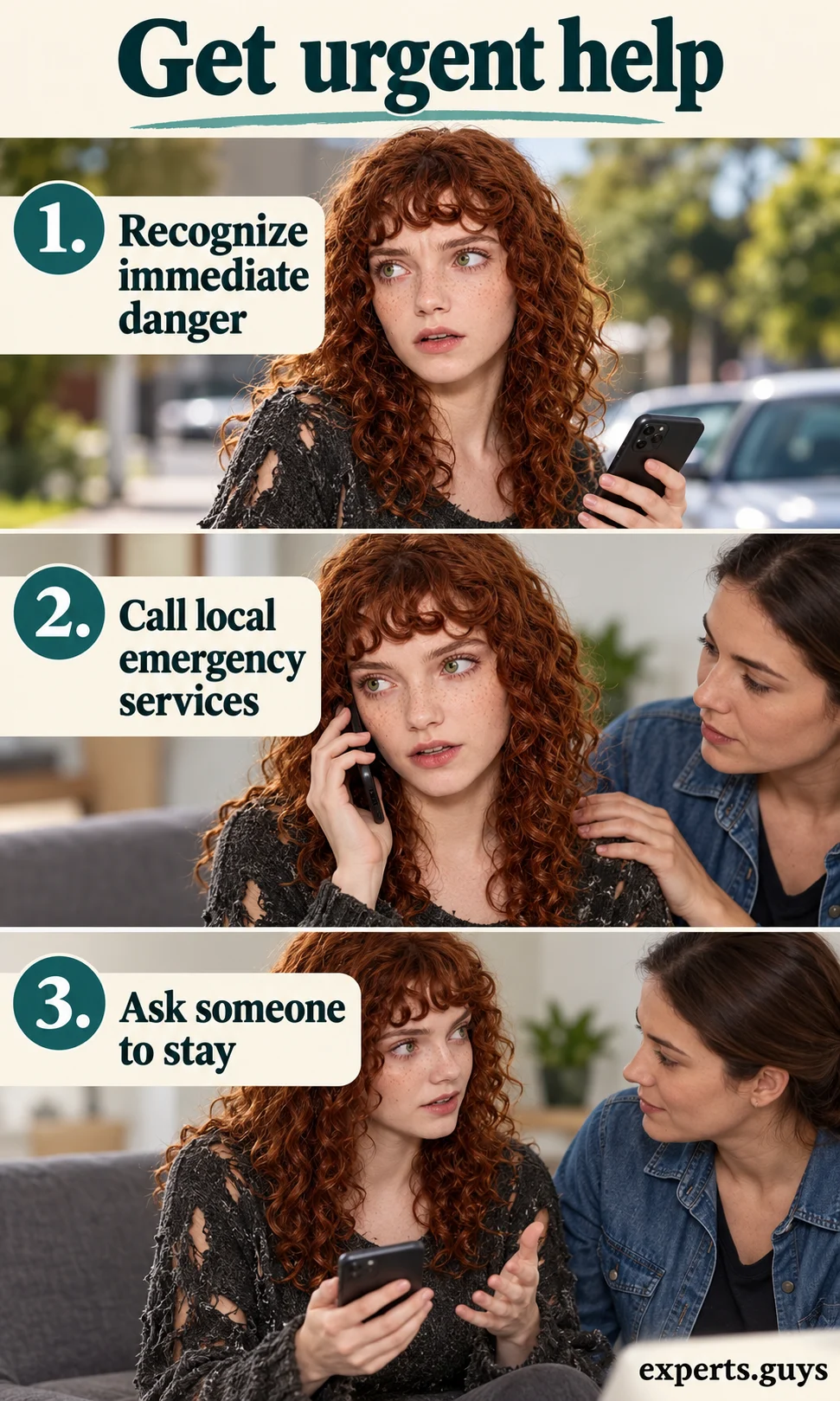
If you may act on suicidal thoughts, have already harmed yourself or cannot stay safe, seek emergency help now. Call local emergency services or go to the nearest emergency department, and ask someone you trust to stay with you. Do not wait to finish an exercise or an online activity.
What counts as a complication of major depression?
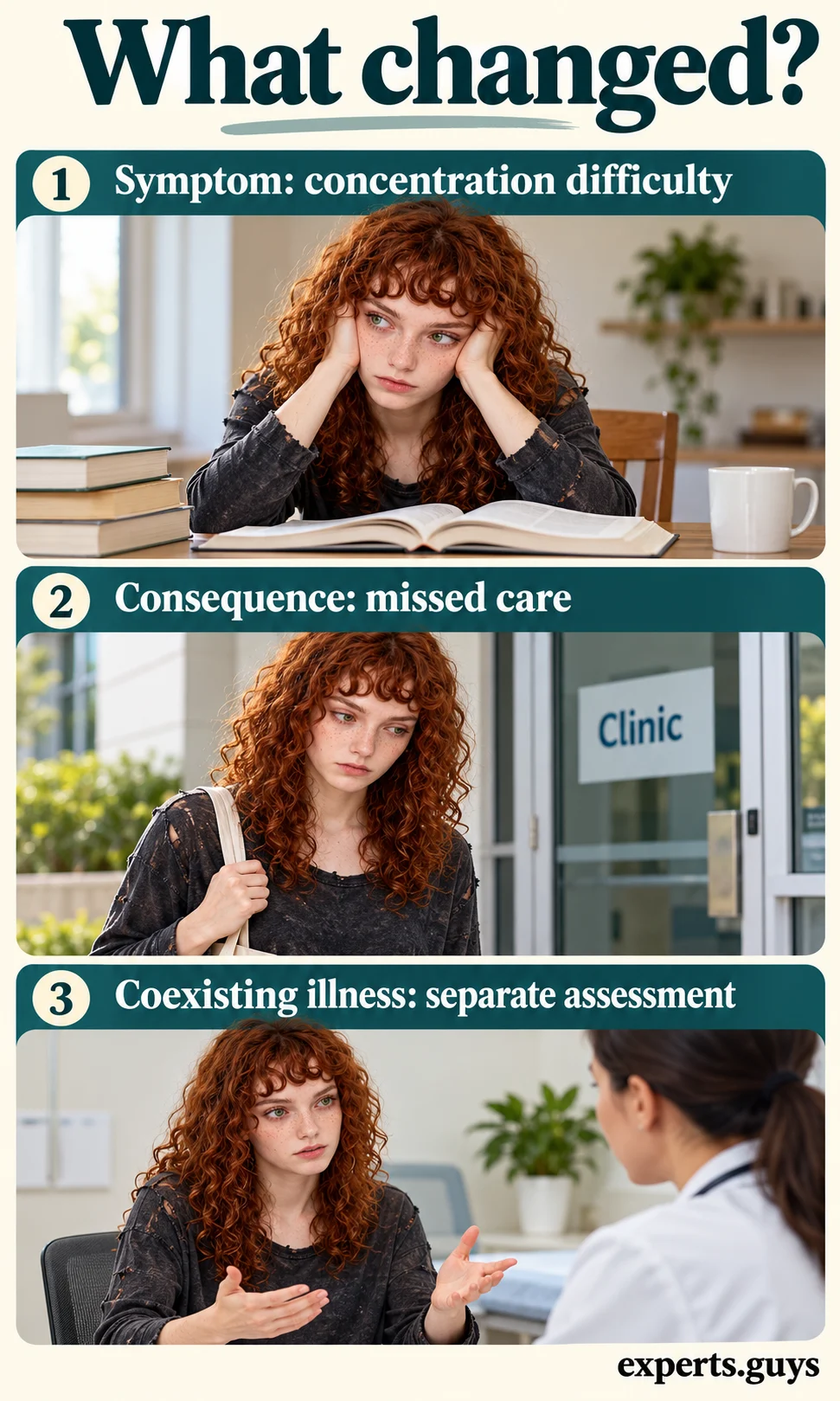
A symptom is part of the illness, such as low energy, loss of interest or difficulty concentrating. A practical consequence is what happens because daily functioning has become harder, such as an important appointment being missed. A coexisting condition is a separate health problem that may interact with depression but is not automatically caused by it.
These distinctions change the next action. A person who cannot concentrate may need a simpler task and a treatment review, while an unfamiliar physical symptom may need its own assessment. The following examples describe possible patterns rather than a checklist of what will happen to every person.
| Area affected | Possible consequence | What the distinction means |
|---|---|---|
| Work or study | Absence, errors or difficulty meeting essential demands | Describe the actual change; output alone does not establish recovery. |
| Relationships | Withdrawal, conflict or reduced sexual interest | A change in contact or intimacy needs context, not assumptions about caring. |
| Self-care | Difficulty eating, washing or maintaining ordinary routines | Functioning may need practical support as well as depression treatment. |
| Existing illness | Missed care or difficulty following the existing treatment plan | Mental and physical care need coordination; new symptoms still need assessment. |
| Safety | Suicidal thoughts or behavior; inability to manage safely | Urgency depends on the situation, not how well the person looks. |
The physical and social effects of depression can overlap. Someone who is exhausted may miss a meal and an appointment, but that does not prove a new disease has been caused by depression. Assessment needs the whole situation, including other illnesses, medicines, sleep and substance use.
How can complications build up?
Reduced energy, concentration and motivation can make ordinary actions harder to start or finish. The unfinished action may then create an additional problem, such as a missed follow-up or a responsibility left uncovered. The goal of practical support is to interrupt that consequence while treatment addresses the illness.
For example, a fictional reader becomes distracted while cooking and feels unable to keep watching the hob. Trying to finish the meal at any cost adds a demand that may no longer be manageable. Safely stopping the heat and choosing a suitable ready-to-eat option changes the immediate situation without requiring a better mood first.
Depression can also coexist with long-term physical illness, and the relationship may run in both directions. The NIMH explanation of chronic disease and depression describes care-access difficulties and possible biological pathways. These associations cannot identify the cause of a particular person’s new symptom.
Which changes need urgent help?
Urgent help is needed when safety or essential physical needs are deteriorating. You do not need to wait for a routine appointment or a particular number of symptoms before asking for assessment. A person who is barely managing may still appear composed during a short conversation.
If you are supporting someone, use clear words about what is happening now. Stay with them when it is safe to do so, and help them reach the appropriate service. Do not make access to help depend on completing one of the practical steps below.
- Immediate danger: possible action on suicidal thoughts, serious self-harm or inability to stay safe requires emergency help.
- Urgent assessment: new or worsening suicidal thoughts, hallucinations, severe confusion or inability to drink adequately need prompt clinical help.
- Deteriorating function: essential care, food intake or dependent care becoming unmanageable is a reason to contact the care team promptly.
- New physical symptoms: assess them on their own merits; severe or life-threatening symptoms require emergency care.
How to pause cooking safely when concentration drops
Use this skill when you are already cooking and realize you cannot keep attending to it. It is an ordinary safety action for a specific difficulty, not a test of whether you have depression. It applies only when you can reach the appliance controls safely and there is no fire or other immediate danger.
The setup matters: know which control belongs to the heat source and keep its approach clear. Loose sleeves, cords and flammable items should be away from the cooking surface before cooking begins. If the controls are inaccessible, ask a capable adult for help rather than leaning across a hot pan.
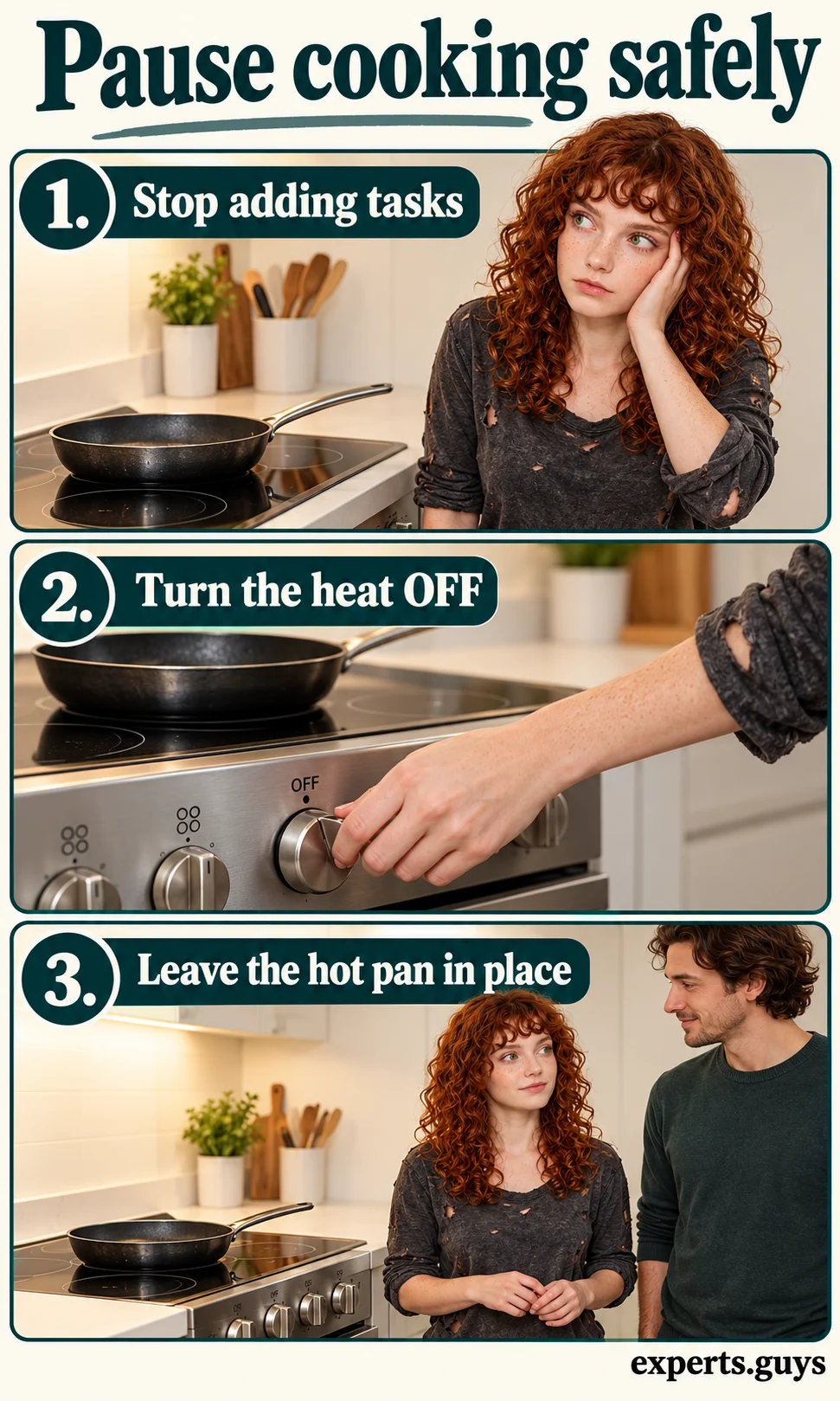
- Stop adding demands. Stay beside the cooking area while deciding to pause; do not begin another chore or leave the room with the heat running.
- Switch the relevant heat source off. Use the appliance’s normal control and check its off position according to its design. Do not rely on a quiet pan or a dark-looking surface to mean that the appliance is off.
- Leave hot cookware in place. Keep other people away from the hot area and avoid carrying a hot pan around to make the kitchen look finished. Ask a capable adult to help if the remaining situation needs supervision.
The practical result is an appliance no longer actively heating, with the hot area left safely managed. Finishing the recipe or feeling calmer is not required for this step to count. The U.S. Fire Administration’s cooking guidance specifically advises turning the burner off when leaving the kitchen.
Correction: off does not mean cool
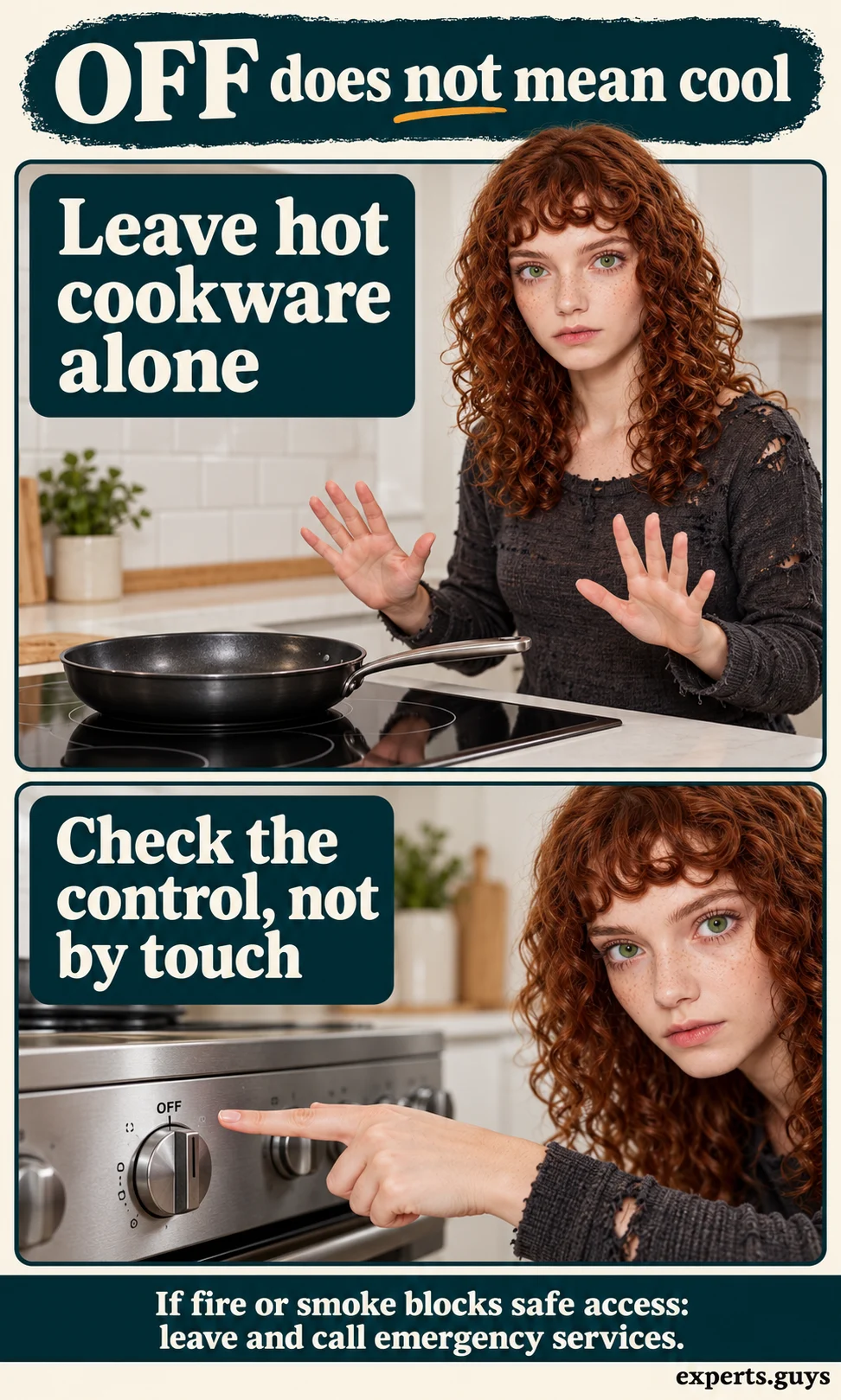
The common mistake is to treat the off setting as permission to touch or move everything immediately. Cookware and electric cooking surfaces may remain hot after power is off. Check the control visually; never use a hand on the burner or pan to test whether it is cool.
Do not repeatedly turn the control back on to check it. If you cannot interpret the controls or remain unsure whether you have switched off the correct heat source, ask a capable adult for direct help. If fire, smoke or another hazard makes approaching unsafe, leave the area and call emergency services from safety.
An easier option when heating food is too much
Once the cooking area is safely managed, a suitable ready-to-eat food can remove the need to restart the hob. For example, plain yogurt and a banana may work for someone who can eat those foods safely and whose dietary needs allow them. This is an example of reducing task demands, not a food prescription or a treatment for depression.
- Sit at a cool, stable surface away from the cooking area if standing is tiring.
- Choose food already safe to eat without heating, cutting or a complicated preparation sequence. Open the package or peel the fruit only if you can do so safely.
- Eat what is manageable and return perishable items to their appropriate storage promptly. Ask for assistance if opening packaging or feeding yourself is difficult.
The easier version is to have another person open a suitable ready-to-eat item and place it within comfortable reach. Do not balance food on an unstable surface or use a chair that could slip. If food or fluid intake is repeatedly inadequate, additional assessment is needed; a simplified snack cannot resolve that problem on its own.

A stopped cooking task is not evidence of failure. It may be the safest completion point for that occasion, especially with marked fatigue or drowsiness. For the separate task of managing ongoing appetite changes, see depression and appetite.
Prepare actual medicine containers for a care review
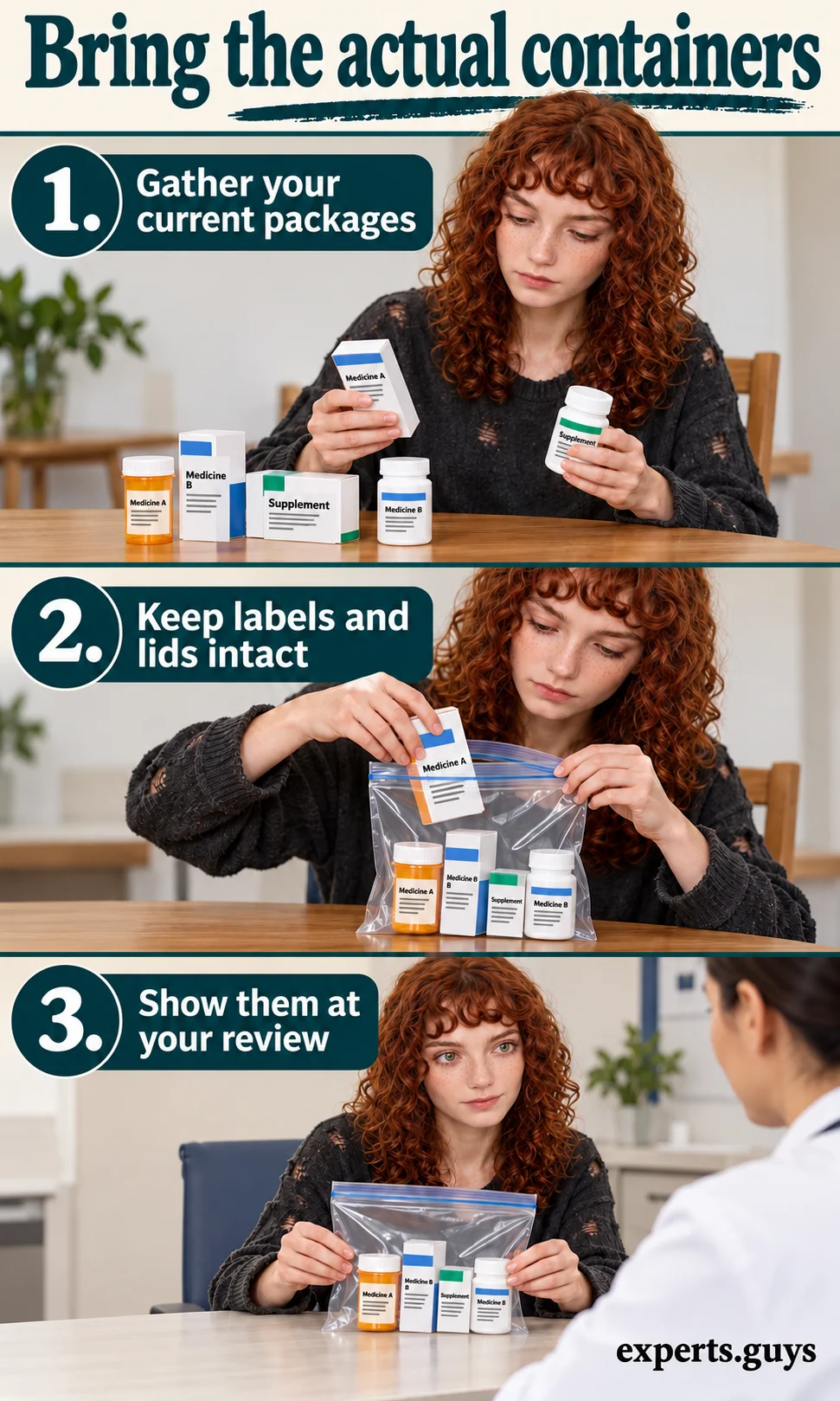
When recalling medicine names or explaining several treatments is difficult, bringing the actual packages can make the review more concrete. This suits an upcoming in-person appointment when the clinic accepts medicines being brought in. It does not tell you whether a medicine is causing a symptom or which treatment should change.
Use your own current medicines in their original labelled containers, along with relevant over-the-counter products and supplements. Keep lids closed and packages intact while gathering them at a stable surface. The National Institute on Aging’s appointment guidance includes bringing medicine containers as a way to prepare for a visit.
- Gather without changing treatment. Bring the labelled packages together where you can sit comfortably, asking for help with inaccessible storage. Do not tip tablets out, combine containers or decide which medicines to stop.
- Keep the original information. Put suitable closed packages into a plain bag that you can handle comfortably. Keep old or uncertain products identifiable and tell the clinician which ones you actually use rather than guessing.
- Show them during the visit. Take the bag out when medicines are discussed and explain any uncertainty about actual use. Ask the clinician or pharmacist to clarify instructions that you do not understand.
Adaptation: keep storage and access needs intact
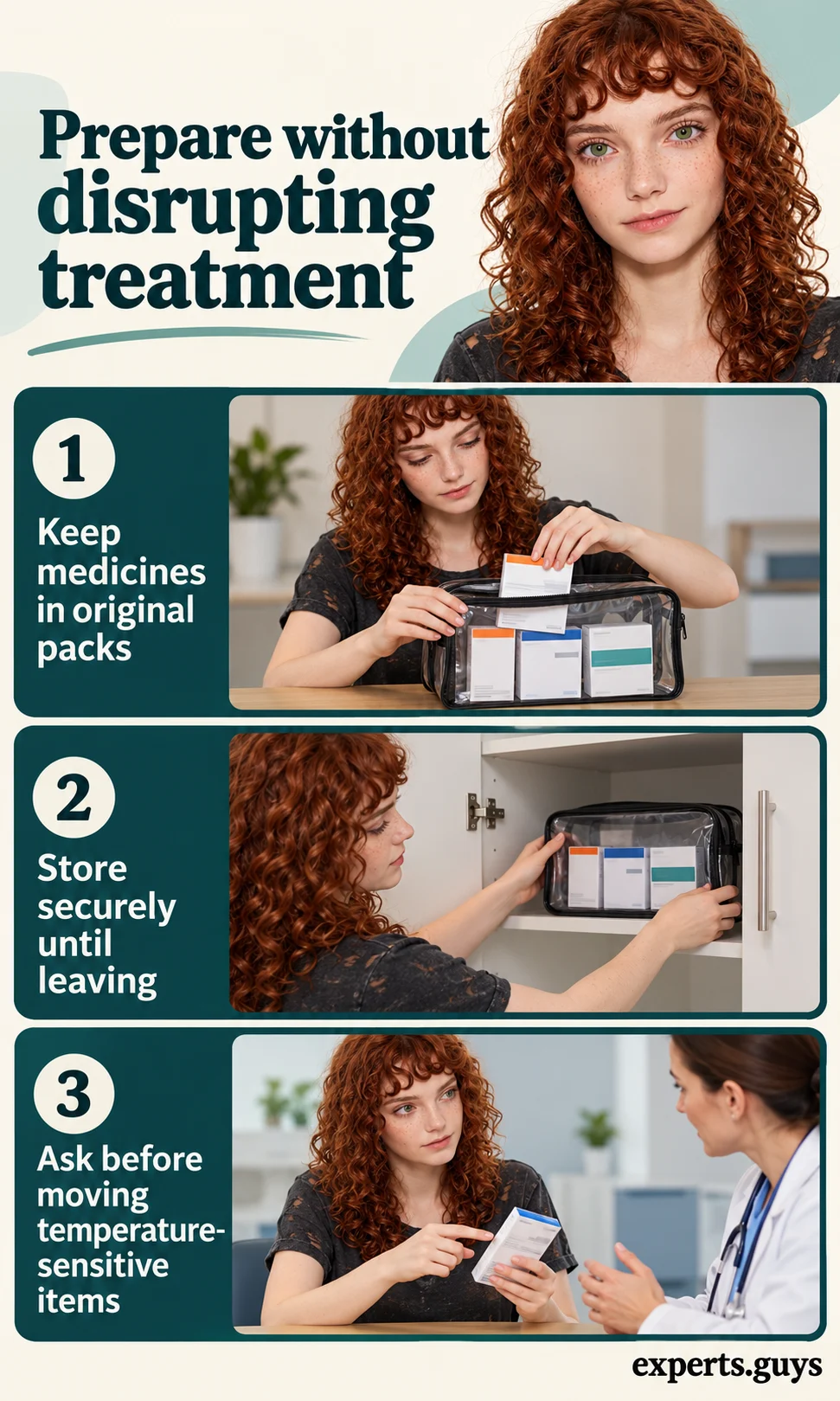
Preparing for a visit must not make medicines unavailable or unsafe at home. Until it is time to leave, keep them in their required storage conditions and secure from children, pets or other people who should not access them. A bag left by the front door is not a safe default storage place.
Some medicines need refrigeration or other special handling. Do not take them out of required storage simply to complete this preparation; ask the clinic or pharmacist how to present their information appropriately. If carrying a bag is difficult, a trusted person can help bring the containers while you retain control of the care discussion.
Completion means the care professional can identify the products and understand what you are taking, including uncertainties. It does not mean that you have solved a missed dose or an unwanted effect by sorting the containers. Dose uncertainty needs medicine-specific advice, and a suspected overdose or severe reaction needs urgent medical help.
Which health problems need their own assessment?
Appetite and sleep changes are depression symptoms, but their consequences can become additional problems. Significant weight change, inadequate intake or sleep disruption that prevents safe daily functioning should be discussed with the care team. The response depends on the actual change and other possible causes, rather than a generic exercise.
Alcohol or other substance use may coexist with depression and complicate care. Using alcohol to manage distress can add problems with judgment, sleep or treatment, and both conditions deserve attention. If you may be physically dependent on alcohol, seek medical advice before attempting abrupt withdrawal; the separate guide to the quitting alcohol timeline explains that different question.
Persistent pain and worsening management of a long-term condition also need assessment. New hallucinations or delusions can occur in severe illness and require urgent clinical help; depression does not inevitably develop into psychosis. These problems should not be treated as evidence that a person has failed to manage an everyday routine.
What about work, relationships and other everyday consequences?
A complication may be practical before it becomes medically dramatic. Missed deadlines, conflict or unpaid bills can matter even when a person continues going to work. The response should address the concrete responsibility and the underlying depression, with support proportionate to the person’s needs.
For work or study, describe the essential duty that has become difficult and discuss available adjustments with an appropriate person. For relationships, explain the change in capacity without assuming that either person can solve the illness through effort alone. Where a dependent’s needs cannot be met safely, arrange capable help promptly rather than waiting for symptoms to settle.
The broader task-initiation problem has its own explanation in why depression makes simple tasks feel hard. Specific difficulties with washing and dressing are covered in depression and personal hygiene. Each problem may need a different adaptation, rather than another version of the same exercise.
Can treatment reduce complications?
Depression is treatable, and improvement can include daily functioning as well as mood. Psychological therapies, medication and other treatments are chosen according to the person’s needs and clinical situation. Practical changes make a task safer or more accessible while treatment is assessed; they do not replace that assessment.
Tell the care team when daily functioning remains poor, when unwanted effects appear or when the current plan is difficult to follow. A review may need to consider other health conditions, sleep, substance use and access barriers. For more on coordinating the physical and mental-health picture, see depression and chronic ailments.
Recovery does not always happen evenly. Someone may feel less sad while concentration is still unreliable, or regain some capacity while a relationship problem remains unresolved. A practical change is useful information for shared treatment decisions, not a reason to set your own diagnosis or stop prescribed treatment.
Daily-Life Action Check
Choose one of the two practical situations below if you want to view its steps together. You can perform the actions directly from the article without using this optional interface or printing anything. Emergency guidance takes priority over either choice.
Daily-Life Action Check
A4 PDF edition · v2.0.1
Choose a practical situation and review its physical steps.

If you cannot stay safe, call local emergency services now and ask a trusted person to stay with you. This selector does not assess urgency or diagnose depression.
The actions work without a device, written record or printed card. No selection is sent or saved by this interface.
Your practical next step
Do the action
Check the practical result
Frequently asked questions
Does major depression always cause complications?
No. The effects vary with symptoms, other health conditions, circumstances and access to support. Possible complications are not a forecast of an individual’s future. Focus on an actual change in functioning rather than assuming every problem listed here will occur.
Can depression cause another physical illness?
Depression is associated with some physical health conditions, but an association cannot establish the cause of a particular person’s illness. Existing illness and depression may also worsen each other. New symptoms need appropriate assessment rather than automatic attribution to depression.
What if I can do a task but only with much more effort?
That change still matters. Continuing to work or cook does not mean the task is safe or sustainable under the current demands. Explain the extra effort and any near misses to your care team so they understand more than the final output.
Should I stop medicines if I think they contribute to a problem?
Do not change or abruptly stop prescribed treatment based on this article. Ask the prescriber or pharmacist about the specific medicine and what you are experiencing. Immediate danger, a severe reaction or suspected overdose needs urgent medical help.
Does pausing an activity mean I should avoid it permanently?
No. A safe pause addresses the demands of that occasion. Whether and how to resume depends on the task, your current capacity and appropriate care advice. The goal is a manageable return when suitable, not pressure to finish despite unsafe conditions.
Summary
Major depression can affect health, safety, relationships and everyday responsibilities, but complications are not inevitable. Respond to the real difficulty: make an unsafe task safe to pause, bring useful treatment information to review and seek help when functioning deteriorates. Immediate danger needs immediate human help.










