Customer-service chatbots can damage a small business when they promise things the business cannot deliver, trap customers in automated loops, make people repeat work, or hide unresolved problems behind attractive metrics. Keep automation where it helps, but repair the failed customer journey before expanding it.
The useful question is not whether a bot sounds friendly. It is whether a customer can reach a correct, usable outcome with reasonable effort. A restaurant can answer instantly and still lose a booking if the reply promises an unavailable table; a retailer can close a chat while the refund dispute remains open.
This guide treats the four failures as service-recovery problems. The checks below use synthetic examples and existing service records, not real payment details or a new notebook. They help you distinguish a wording problem from a broken connection, an unstaffed queue, or an outcome that was never measured.
| Failure | Check | Repair |
|---|---|---|
| Unsupported promise | Policy or action record | Remove unsupported commitment |
| Blocked handoff | Receiving inbox | Restore a staffed route |
| Repeated work | Context received by staff | Transfer useful summary |
| False success | Outcome evidence | Separate unknown cases |
1. The chatbot makes a promise your business cannot keep
A promise is any statement that creates a concrete expectation: a refund is approved, a reservation is secured, a replacement will arrive tomorrow, or a fee will be waived. A policy explanation is different. The first commits the business to an outcome; the second explains what normally applies.
An incorrect promise may come from an outdated help article, a conflicting policy, a missing lookup, or generated text that sounds more certain than its evidence allows. Fixing the tone alone will not repair these causes. A warmer version of the same unsupported commitment is still unsupported.
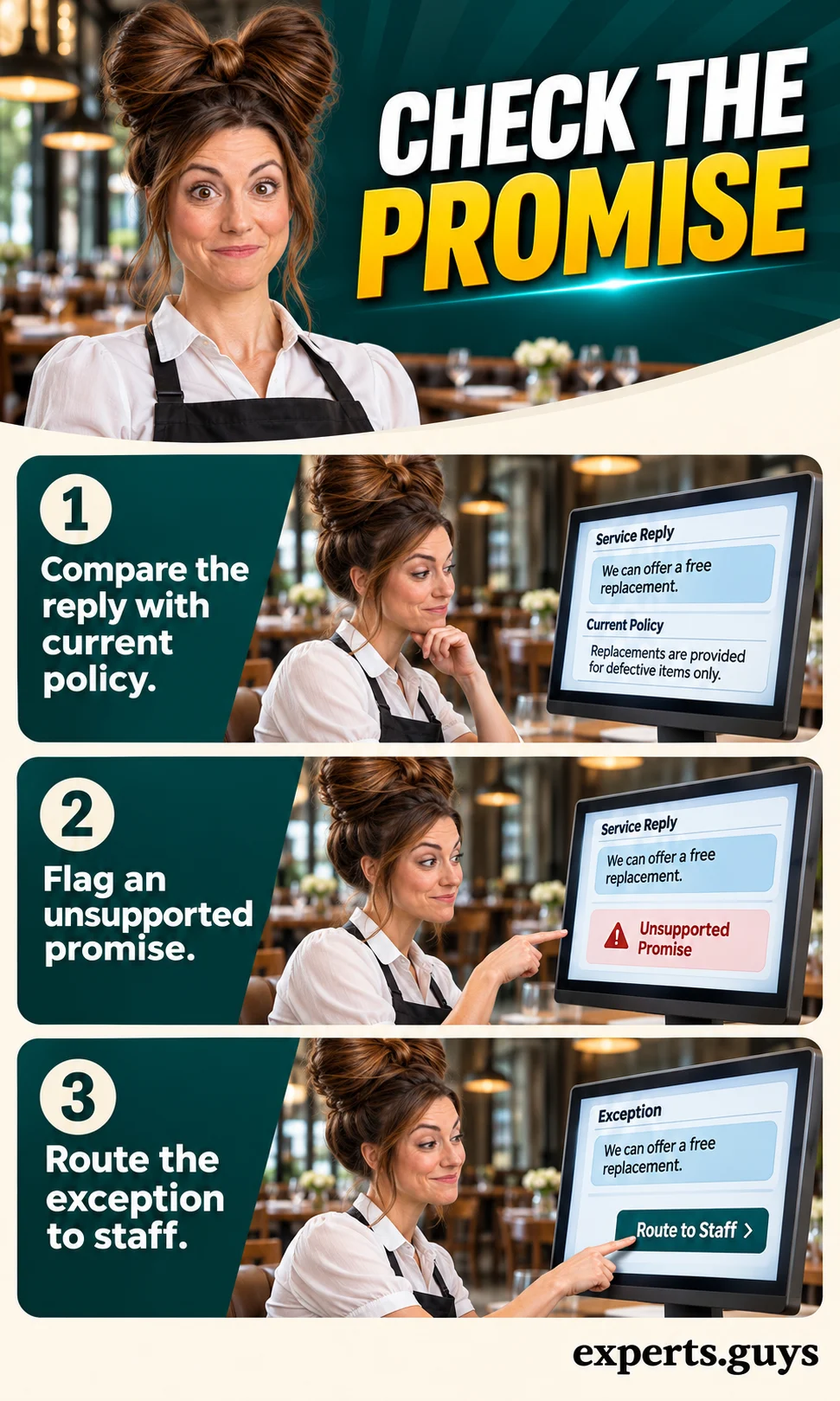
Run a promise check in a test conversation. Choose one exception your staff actually encounters, such as a late cancellation. Compare the reply with the current approved policy and the record for the synthetic booking. Highlight the specific sentence that promises an outcome. If the system cannot show the authority or completed transaction behind it, change the response to a request for review and route it to the responsible staff member.
What should the customer hear while staff check?
Use wording that names the unfinished state: “Your cancellation request has been sent for review. It is not approved yet.” Give the real next contact route and only a response window the team can support. Avoid “all sorted” or “you are eligible” when eligibility depends on an exception decision.
For generative systems, confident false content is a recognized risk. The NIST Generative AI Profile describes this as confabulation. In practical customer service, that means fluent wording needs a separate check against the policy and action record; the wording itself is not proof.
After a failure, correct the affected source and the customer-facing response together. If the wrong promise was already delivered, a staff member should explain the correction and available options. Do not silently change the help article and assume the earlier customer has learned about the change.
2. The route to a person exists on screen but fails in practice
A “talk to someone” button is not a working handoff unless a staffed destination receives the request. A customer may see a transfer animation while no ticket is created, or enter a queue whose opening hours have ended. Both failures look like deliberate obstruction from the customer’s side.
- Customer sees an accurate next step.
- Staff receive the matching case.
- A person or team owns the queue.
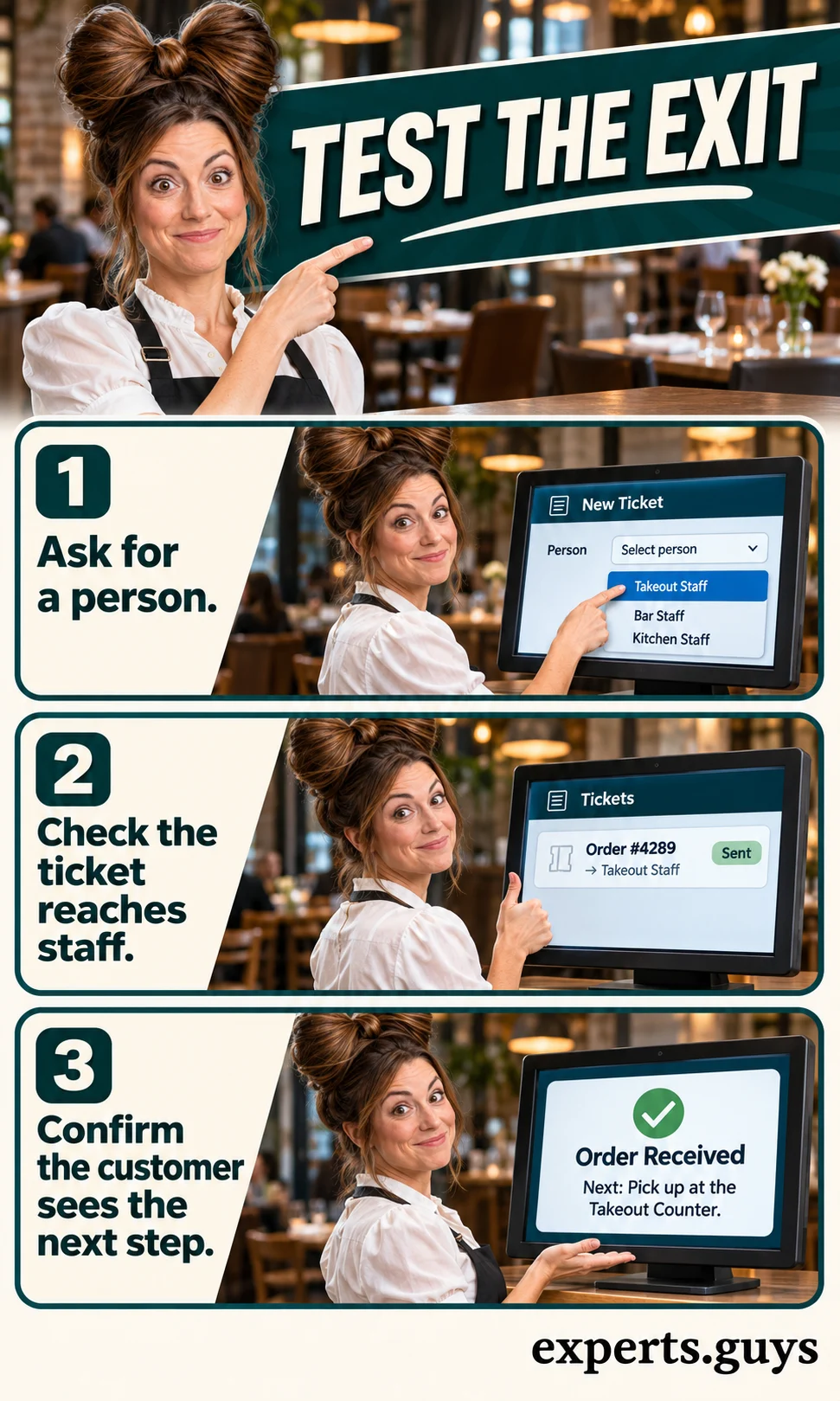
Test the exit as a customer would. In a synthetic session, ask for a person directly, then use the visible contact option. Check the staff inbox for the matching request, its category, its priority and its arrival time. Confirm that the customer sees an accurate next step. Repeat the same test outside service hours: the expected result is an honest asynchronous route, not an imaginary live agent.
A successful handoff has two sides. Staff can find and own the request; the customer knows whether to wait, expect a reply, or use another channel. A ticket identifier is useful when it lets both sides locate the same case. It should not substitute for actually assigning responsibility.
How much automation should happen before escalation?
Let an explicit request for a person reach the configured route without forcing repeated troubleshooting. Some routine clarification is useful, but asking the same question again after the customer has answered it creates friction without adding evidence. Sensitive exceptions, disputed outcomes and unsupported requests need a clear escape path.
If the destination is unavailable, say so and offer the real alternatives. An email queue can be appropriate when it is monitored and the expected response window is honest. A failed integration should expose a fallback contact route rather than leaving the customer staring at a spinner.
Keep the response promise aligned with staffing. A small restaurant during dinner service may accept a follow-up request but cannot credibly promise an immediate manager review. The customer benefits more from a reliable expectation than from a reassuring message that nobody can fulfill.
3. The bot passes the customer along but discards their work
Repeated work is a separate failure from a blocked handoff. The customer reaches a person, but must repeat the order number, describe the same issue again, or redo steps already attempted. Staff then spend time reconstructing a story that the system already collected.
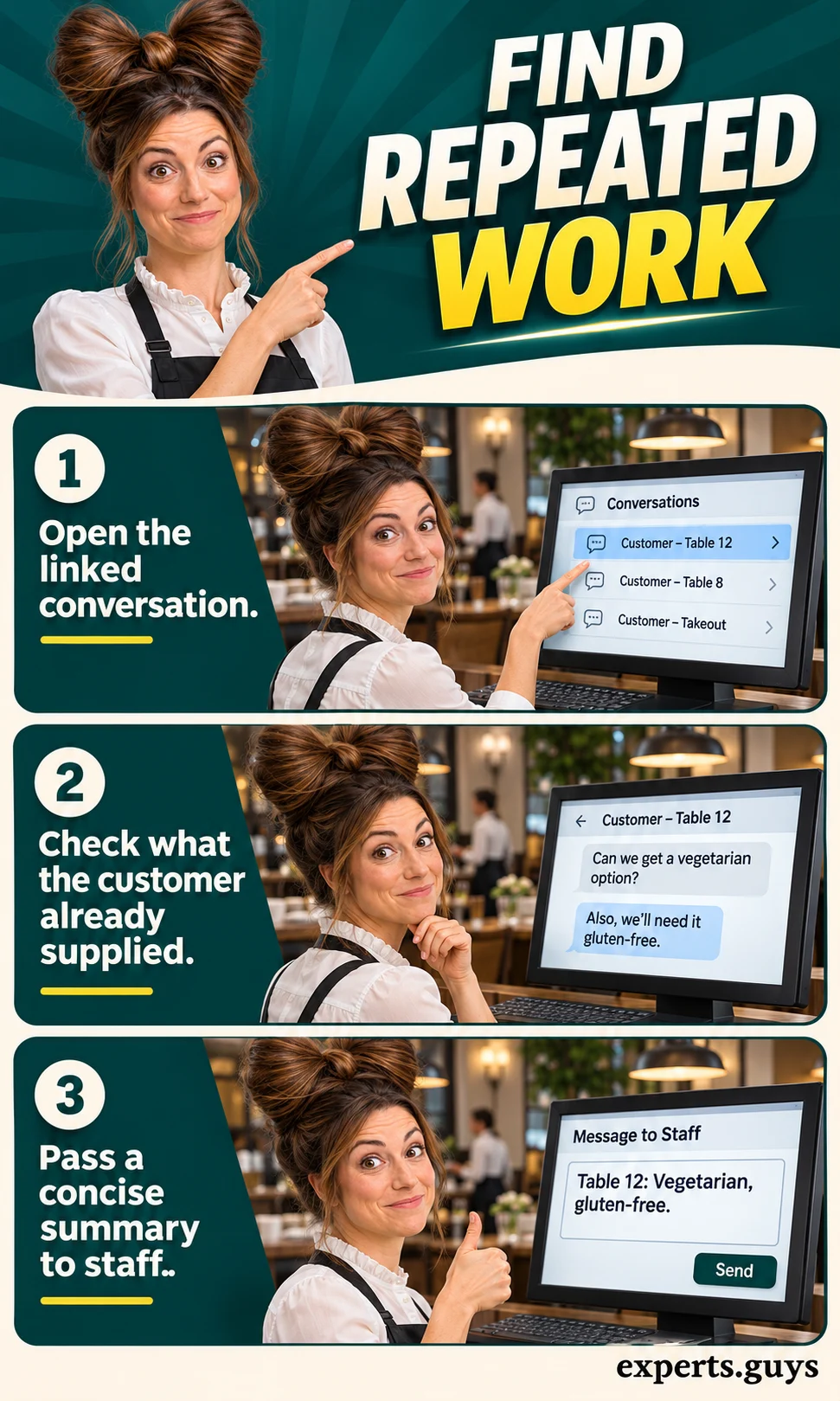
Run a context check using a synthetic case. Supply a short problem description and complete one harmless troubleshooting step. Trigger the handoff and open the staff view. Compare the received summary with the actual conversation. The minimum useful context is the customer’s goal, relevant authenticated record reference, completed steps, unresolved question and requested next action.
Keep observations distinct from interpretations. “Customer reports the item arrived damaged” preserves uncertainty; “carrier damaged the item” invents a cause. A summary should help the next staff member continue the case without converting a customer claim into a verified fact.
What information should carry over?
Pass only information needed for the service task through the approved system. Do not copy passwords, full payment-card details or unrelated personal information into a general chat summary. If identity must be rechecked in another channel, explain why; necessary authentication is different from asking the customer to repeat the entire problem.
Give the receiving staff member access to the relevant conversation where permitted, because summaries can omit qualifications. A concise summary plus the source conversation is more useful than either a huge unfiltered transcript or a polished paragraph with no way to verify it.
When an integration cannot transfer context reliably, narrow what the bot collects. Asking five detailed questions that the staff member cannot see creates more effort than a short triage message with a working contact route. Collection should earn its place by making the next service step easier.
4. The dashboard counts silence as success
A customer who stops replying may be satisfied, distracted, frustrated or using another channel. A closed chat therefore does not prove resolution. Similarly, a conversation that avoids a human agent can still create a later phone call, a duplicate ticket or an abandoned purchase.
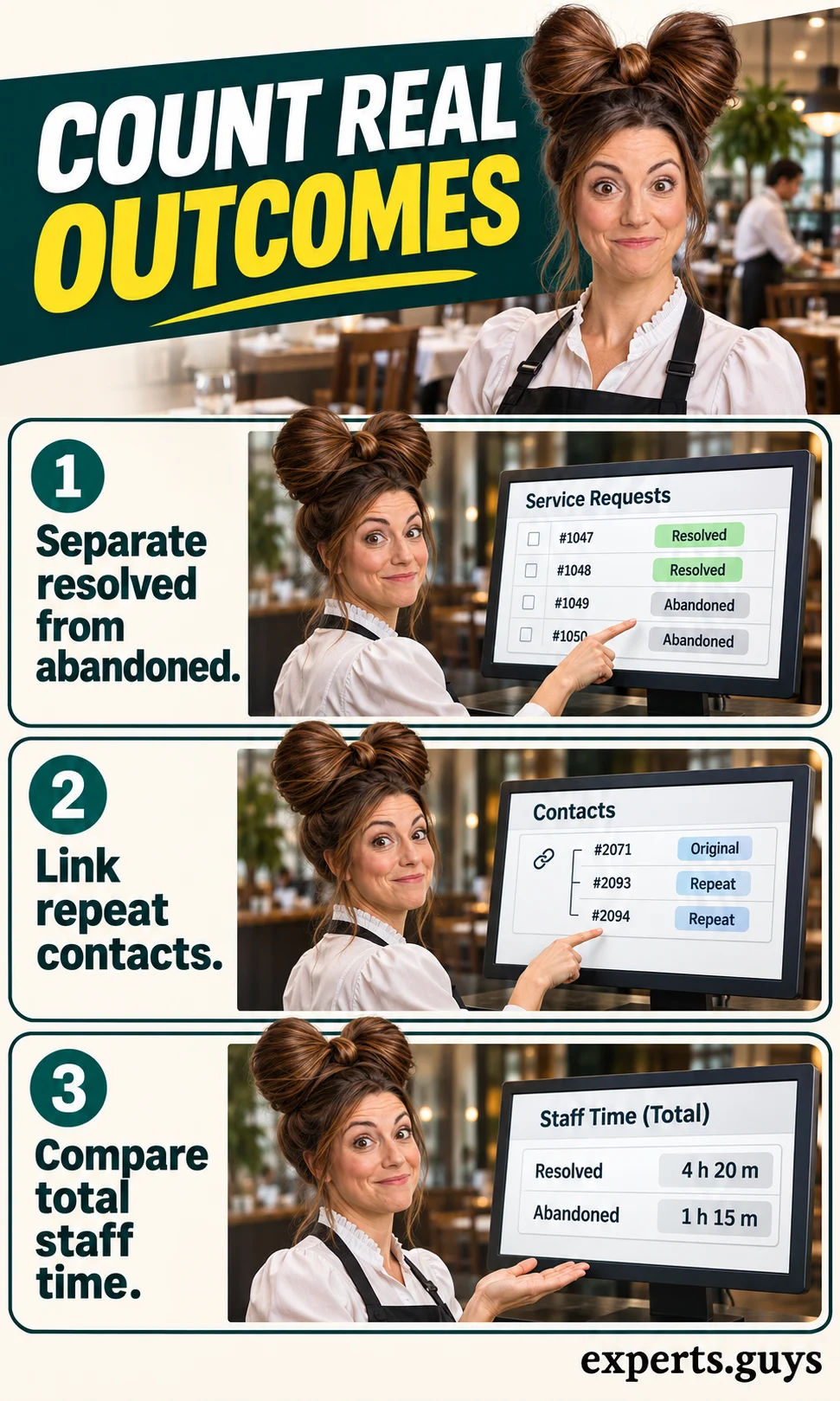
Run an outcome reconciliation on a defined cohort, such as one week of a single contact reason. Separate verified resolutions, explicit unresolved cases, transfers and unknown outcomes. Link repeat contacts to the original issue where your systems and permissions allow. Keep an unknown category instead of assigning every silent conversation to success.
Compare total staff work for that cohort, including later follow-ups and correction time. Use the same contact reason and a comparable period when evaluating a change. A busy holiday week and a quiet ordinary week can differ for reasons unrelated to the chatbot. This is a local operational check, not proof that automation caused every change.
Which numbers help a small business decide?
Use a small set of interpretable measures: verified resolution share, repeat-contact share within a declared window, successful handoff share and total staff minutes per issue. Define each denominator. If only a sample is reviewed, label the result as a sample and report its size.
For example, suppose 100 synthetic demonstration cases include 55 verified resolutions, 20 transfers, 10 unresolved cases and 15 unknown outcomes. Verified resolution is 55% of all 100 cases, not 85% because only 15 were labeled unknown. Transfers may eventually resolve, but they need their own outcome evidence before being counted.
Cost comparisons should include subscription charges, usage charges, setup, maintenance and human correction work. Time saved is capacity released, not automatically cash saved. A ten-minute reduction can help staff serve other customers even when payroll does not change.
Choose the smallest repair that addresses the failure
Prioritize the failure with the clearest customer consequence. An unsupported refund promise needs immediate containment of that promise route. A missing handoff needs a working destination. A weak summary needs better context transfer. A misleading dashboard needs corrected definitions before it informs expansion.
Retest the exact failing case after the repair, plus a nearby case that should still work. Keep the affected route limited until the expected behavior is visible on both customer and staff sides. A broad rewrite of every chatbot answer can introduce new errors without addressing the original defect.
This page owns the recovery diagnosis. For a broader launch process, use the AI customer-service implementation guide. If you need the basic distinction between a conversational answer and a connected action, see the chatbot examples guide.
Should every small business use a chatbot?
No. Low inquiry volume, frequently changing exceptions or an unstaffed escalation route can make a simpler contact form or human inbox more useful. Assess the service task and maintenance capacity before buying software.
Can a rule-based bot create these failures?
Yes. Fixed menus can contain old policies, lead to dead ends or lose context. Generated language adds other risks, but these service failures are not limited to generative systems.
How long should the repeat-contact window be?
Choose a window that matches the service process and disclose it. A restaurant booking and a delayed replacement have different timelines. Keep the definition consistent when comparing periods.
Does a human transfer mean the bot failed?
No. A correct transfer can be the intended result for an exception. Evaluate whether the customer reaches the right staff member with useful context, rather than treating every transfer as a negative outcome.
Summary: repair the customer journey first
A useful chatbot makes accurate commitments, offers a working exit, preserves relevant context and leaves evidence of the outcome. Repair the failing route, retest the customer and staff experience, and expand only when the service result supports it.