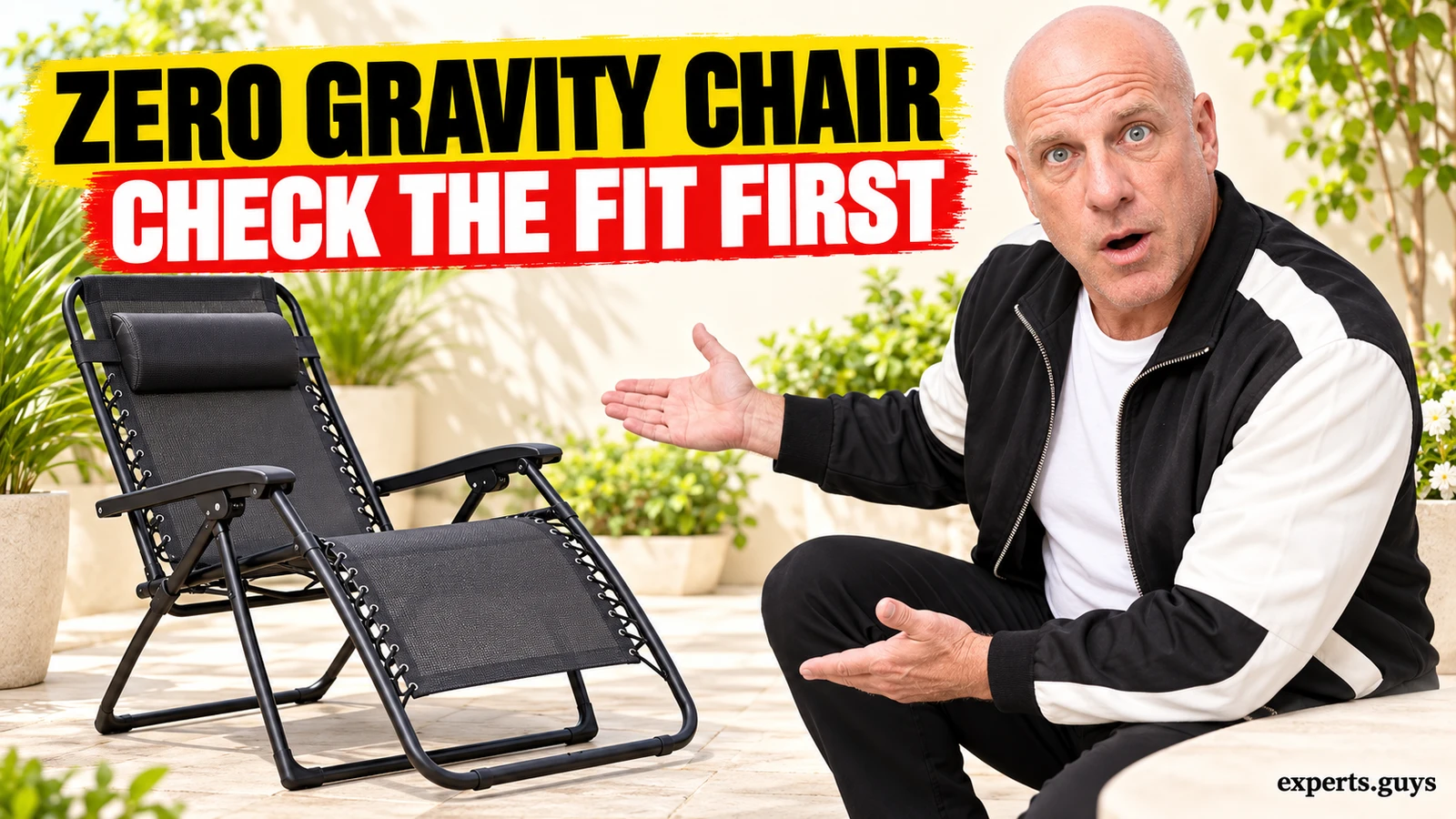
A zero gravity outdoor chair is a reclining seat that raises the leg support as the back tilts, giving you a supported lounging position. Choose one by body fit, its fully reclined footprint and how you will dry and store it; a high weight rating alone does not tell you whether it will be comfortable. Start by checking the space with the chair open and someone ready to get out.
The useful question is whether this moving piece of furniture suits your everyday routine. A chair can look compact beside a patio table yet block a door when reclined. This guide concentrates on those chair-specific checks, rather than repeating whole-garden decorating advice.
Will a zero gravity outdoor chair fit your body and patio?
Fit has two separate parts: support for the person and room for the mechanism to move. The chair needs to work upright, reclined and during entry or exit. Assess all three states before keeping a purchase, preferably within a return period that allows an appropriate indoor trial.
Try the seat, headrest and foot support
Start with the manufacturer’s load limit and intended use, then check the dimensions of the actual sitting surface. Overall width includes the armrests and frame, so it is not the same as usable seat width. A tall user may need a different back and leg-support length even when both users fall comfortably below the same load rating.
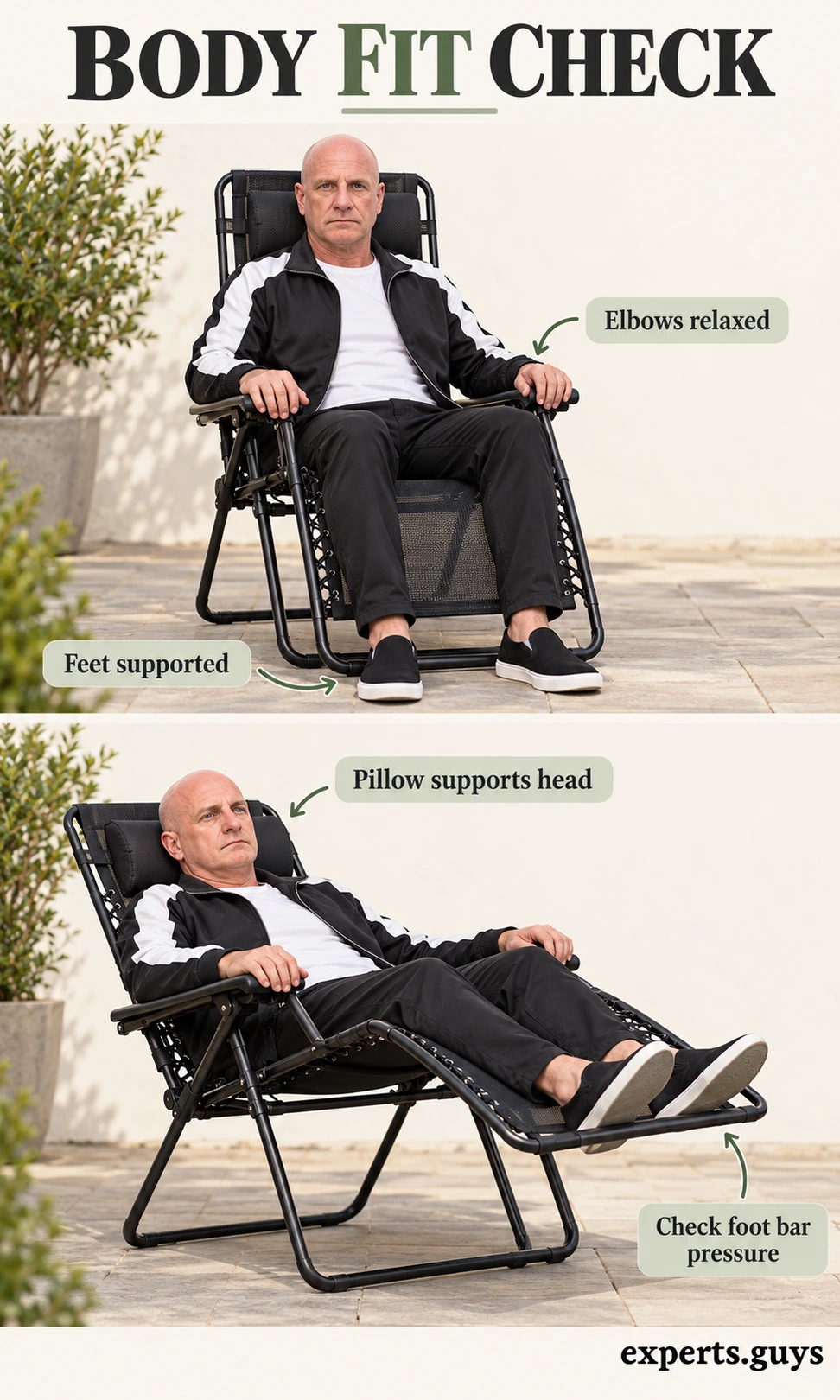
- On a stable, level surface, sit in the upright chair following its instructions. Check whether your feet are supported and your elbows can rest without raising your shoulders.
- Recline only as directed, then adjust the supplied pillow to support your head comfortably. Check for pressure from the foot bar or seat edge.
- Return upright and get out before deciding the chair fits. If you must twist, scramble or pull hard on nearby furniture, try a different seat height or a more stable chair design.
For example, two chairs with identical advertised capacity can feel quite different if one has a longer leg section. Choose the one that supports your usual position without an uncomfortable edge under your legs. If a showroom trial is unavailable, ask for usable seat width and support length, save the answer on your phone, and confirm return conditions before ordering.
Measure the occupied reclining space
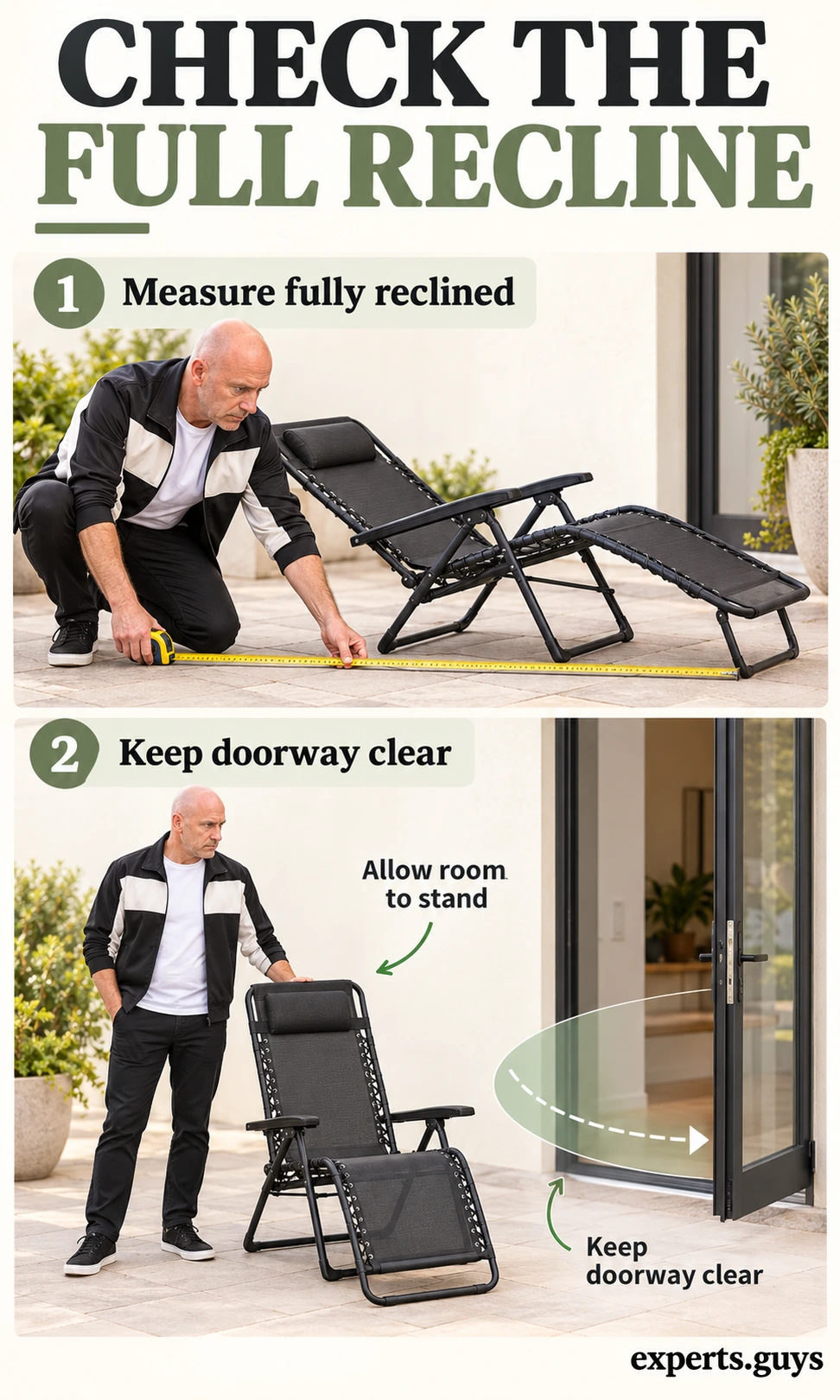
Measure the maximum horizontal footprint, including anything projecting beyond the frame, rather than the upright depth alone. Add room for entry, standing and any route that must stay open. These allowances depend on the household, local access requirements and the chair instructions; there is no single clearance number that certifies every patio.
- Get the exact model’s maximum reclined length and overall width, including an attached tray. If the listing only gives “open” dimensions, ask which position they describe.
- Measure your usable area after fixed obstructions and door swings. Use a tape measure for the buying decision; phone photographs are useful reminders but an unverified camera measurement is not a reliable fit check.
- Compare the remaining length and width with your chosen access allowances. Then try the actual movement and exit route before accepting the layout.
As an illustrative calculation, a 240 cm-long clear area minus a 165 cm reclined chair leaves 75 cm in total along that axis. If you have reserved a combined 80 cm for front and rear access, the arrangement is 5 cm short. That arithmetic does not decide whether a sideways route works: doorway swing, chair movement and the person getting up still need a physical check.
The Patio Fit Check below performs this subtraction using your own allowances. It checks one chair in one rectangular area, with no automatic rotation or assumption that spare width can replace missing length. For the surrounding garden layout, see how to decorate a small backyard; this page keeps the decision focused on the reclining chair itself.
Patio Fit Check
Compare one reclining chair with your clear space and your chosen access allowances.
A measurement check, not a safety or accessibility approval. Check the actual movement, doorway swing, ground and manufacturer instructions. No account or data submission.
Enter your measurements
Remaining space = clear area − chair footprint − your combined allowance, calculated separately for length and width.
Which fabric and frame suit your outdoor routine?
Choose the material around where the chair spends its time between uses. Mesh can suit a routine that prioritises airflow and easy inspection, while padding may suit a sheltered lounging area if its care instructions match your storage habits. Neither “outdoor” nor “water resistant” means every component can stay exposed indefinitely.
Match the material to drying and storage
Compare the complete seat assembly, not just a fabric trade name. Some padded technical fabrics are designed to drain and dry, while other padded fabrics are intended primarily for indoor use. Lafuma’s material and maintenance guidance illustrates this difference within one manufacturer’s range, so avoid judging all padding by appearance alone.
| Your routine | What to compare | Question before buying |
|---|---|---|
| Frequent short outdoor sessions | Open mesh, seams and suspension | Can I inspect and dry the whole seat easily? |
| Sheltered, longer lounging | Outdoor-rated padding and removable parts | What is the stated cleaning and drying method? |
| Frequent carrying | Complete chair weight and folded shape | Can I carry it through my actual doorway? |
| Coastal or damp setting | Frame finish, joints and hardware | What care does this model require after exposure? |
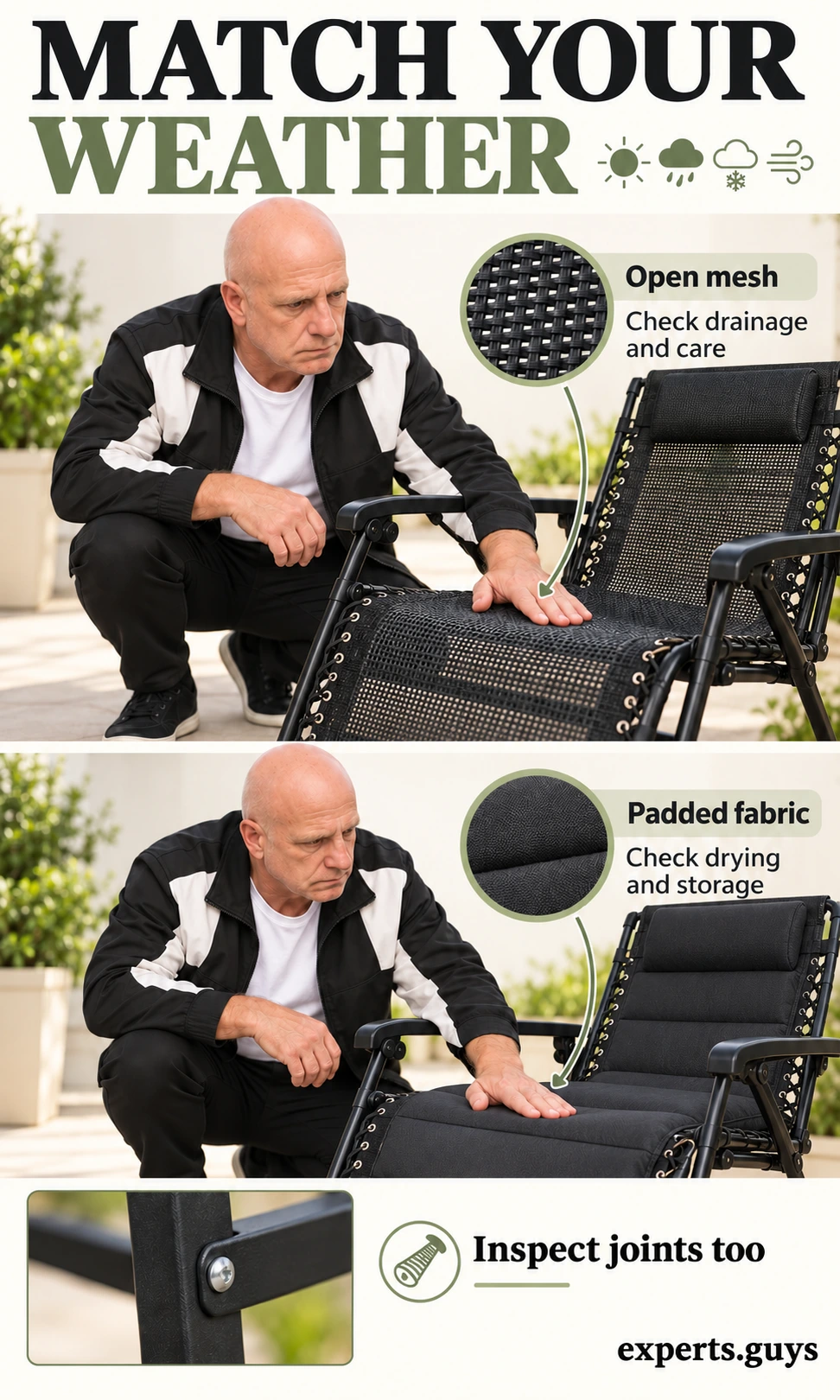
A practical comparison is a shaded covered patio versus a chair left beside an uncovered pool. The sheltered location may make regular cushion storage easy; the exposed location makes drying and hardware care more demanding. If you cannot provide the care a design needs, choose a simpler assembly or a different kind of outdoor seat rather than relying on a cover to solve everything.
Inspect the support system before sitting
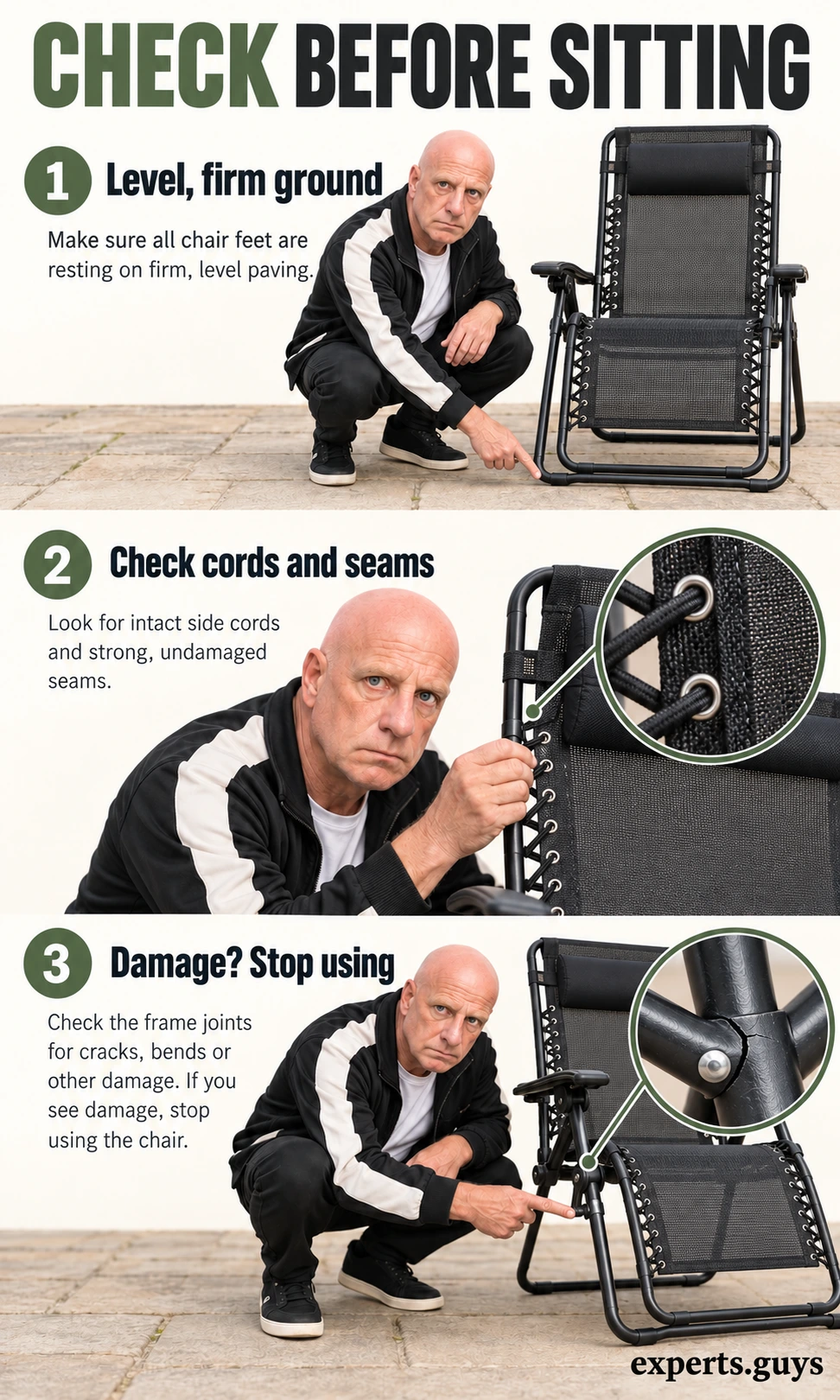
The fabric, suspension, frame and joints work together to carry the user. A strong-looking tube does not compensate for a torn seam or damaged cord. A visual check cannot prove structural safety, but visible damage is enough to stop using the chair.
- Open the chair as instructed on firm, level ground and check that its supports make proper contact. Relocate a rocking or sinking chair instead of wedging it with loose objects.
- Look over the sling, seams, lacing or clips, frame joints and controls with the chair empty. Keep fingers away from the folding mechanism.
- Stop using it if a load-bearing part is broken, worn, missing or damaged. Identify the exact model before obtaining the manufacturer’s specified repair or replacement.
For example, fraying at a heavily loaded attachment is not a reason to keep reclining more gently. Take a close phone photo and the model label to the seller so the replacement can be matched correctly. The manufacturer’s instructions for the BCP oversized range explicitly require stopping use when parts are damaged or worn; its particular capacity and controls must not be transferred to another chair.
How do you recline, get up and reach things comfortably?
Learn the controls while the chair is upright, then make slow movements in the sequence for that model. Some chairs use levers and others use knobs, and a control that holds position should not be treated as permission to lean beyond the frame. Keep children and pets away from the moving parts during adjustment.
Learn the controls before leaning back
Save the model’s instruction page on your phone before the first use. Identify which control releases movement and which sets the position, including whether both sides need operating. If you cannot identify the mechanism confidently, ask the seller for the matching instructions before attempting to recline.
- Sit centrally in the opened, upright chair using its intended supports. Check that nothing is underneath or behind the moving frame.
- Release the controls exactly as instructed, then move slowly through the permitted range. Do not force movement against an engaged control.
- Set the position as directed and remain within the chair’s supported posture. If it unexpectedly slips or will not hold as described, return upright safely and stop using it until the cause is resolved.
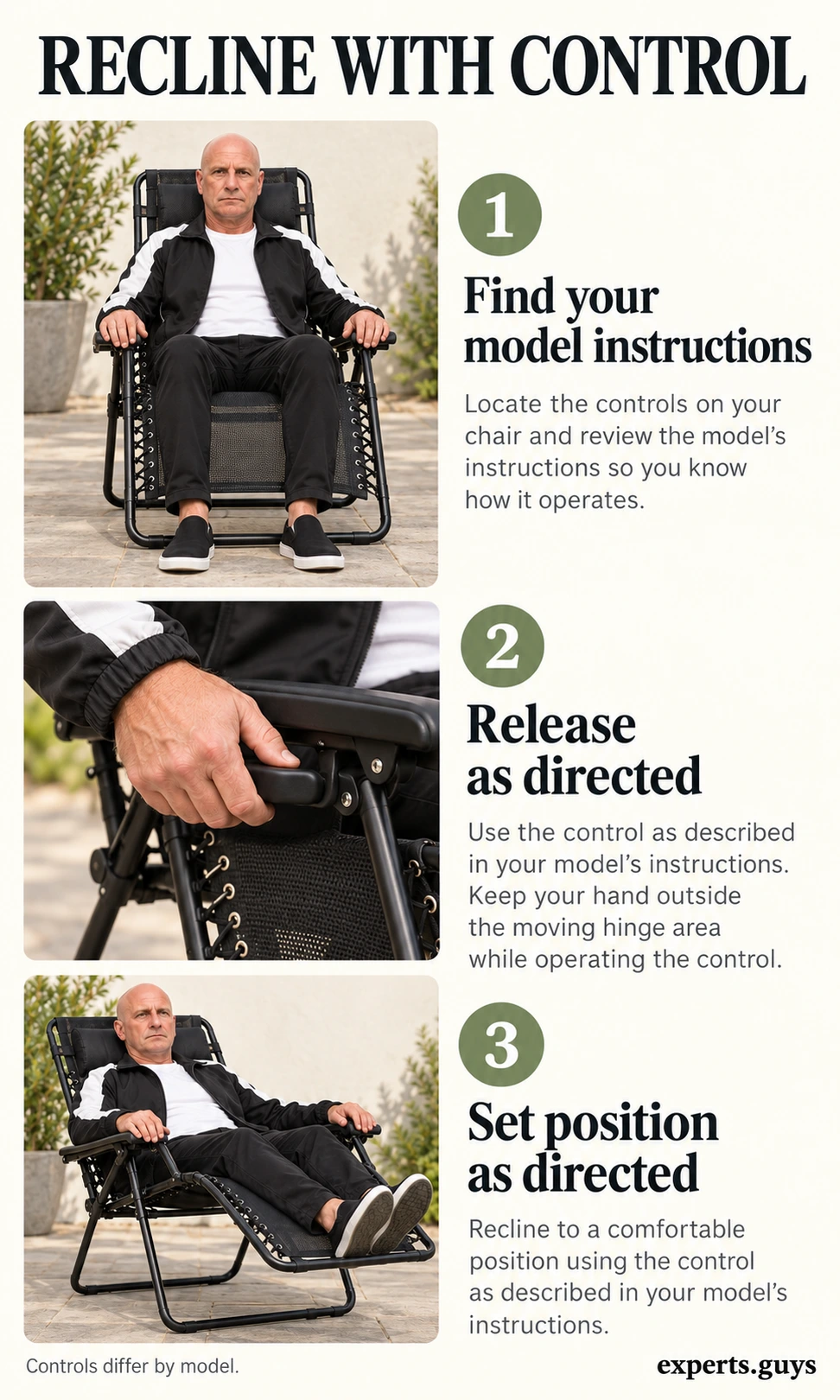
A generic “turn clockwise” instruction is unreliable because control arrangements differ. The useful checkpoint is that your exact mechanism behaves as its manual describes without excessive force. If operating it strains your hands or requires awkward reaching, a simpler chair can be a better purchase than adding unofficial handles or clamps.
Make getting out and reaching simple
The easiest exit starts before you stand: bring the chair fully upright using its prescribed sequence. Place a phone or drink where it can be reached without pulling your torso over the side. A small independent table can work better than a bulky tray if the attachment reduces your clear route.
- Return fully upright and lower the leg section as the manufacturer directs. Do not try to step off an elevated footrest.
- Place your feet securely on the ground and stand in a controlled movement, using only the supports intended for that purpose. Do not use the chair as a step or pull on a loose side table.
- Test the reachable position of essentials while seated upright. Move the table, rather than leaning farther, and keep all accessories outside the moving frame.
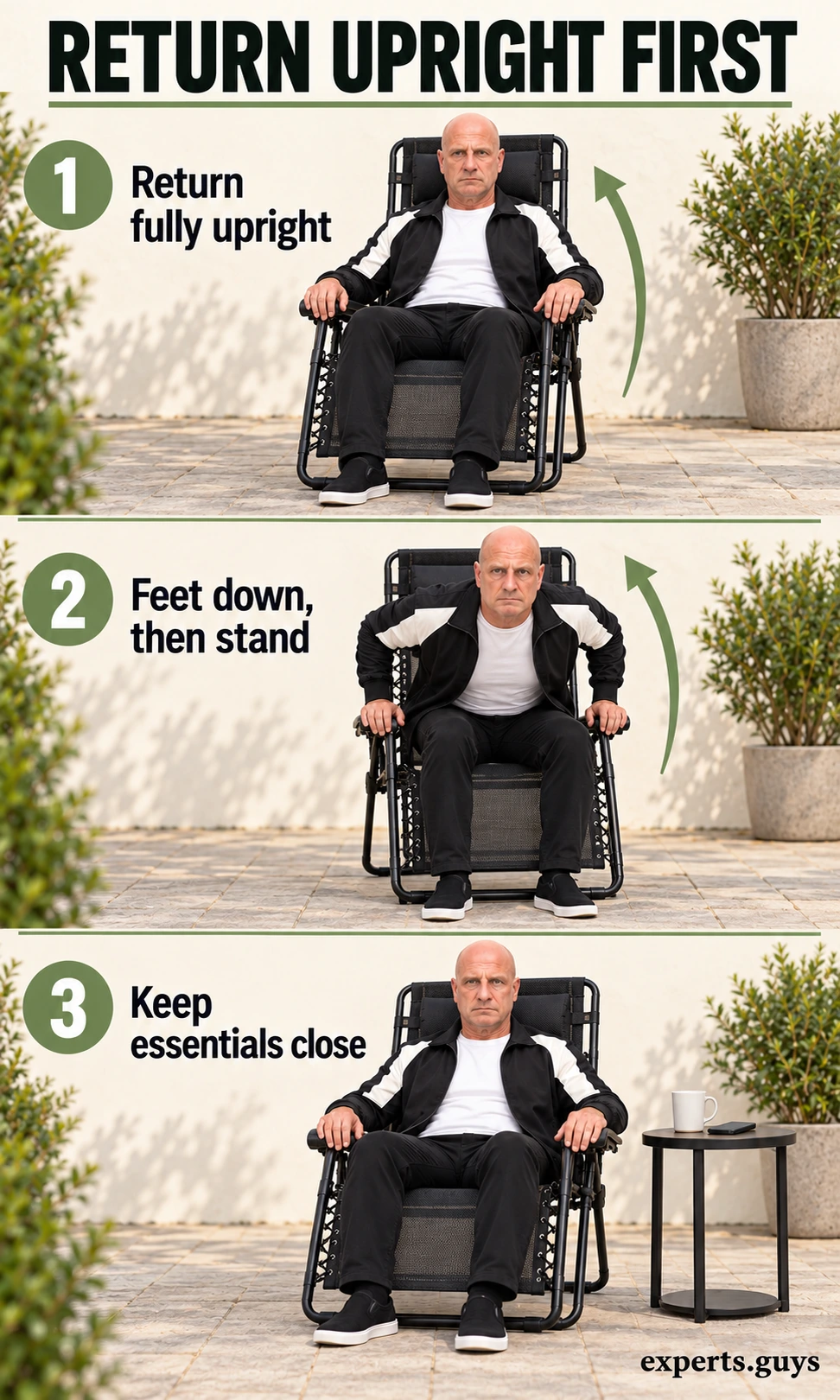
Suppose a tray clears the wall when the chair is empty but catches it during adjustment. Remove or reposition the accessory as permitted, then repeat the movement check before use. If getting up remains difficult, choose a more suitable upright seat or a model that you can enter and leave comfortably; extra pillows do not repair an unsuitable mechanism or unstable base.
How do you keep the chair usable between outings?
Storage is part of the purchase decision, especially when rain, dirt or salt exposure is routine. A folded chair still occupies a substantial rectangle and must travel through doors or along stairs. Check that journey while comparing models, rather than discovering it after the first wet evening.
Clean according to the fabric label
Start with the exact care instructions because coatings and upholstery vary. For compatible frame and canvas materials, Lafuma’s care sheet specifies soapy water and a non-abrasive sponge. That is a useful product-specific example, not approval for every cleaner on every outdoor fabric.
- Remove loose dirt gently and prepare the cleaner allowed by the manufacturer. Avoid abrasive treatment or unapproved chemicals.
- Clean lightly and remove residue in the way the care instructions specify. Do not flood controls or dismantle joints as an improvised cleaning method.
- Leave the chair open in a suitable ventilated place until fabric, seams and concealed damp areas are dry. Inspect it before folding and storing.
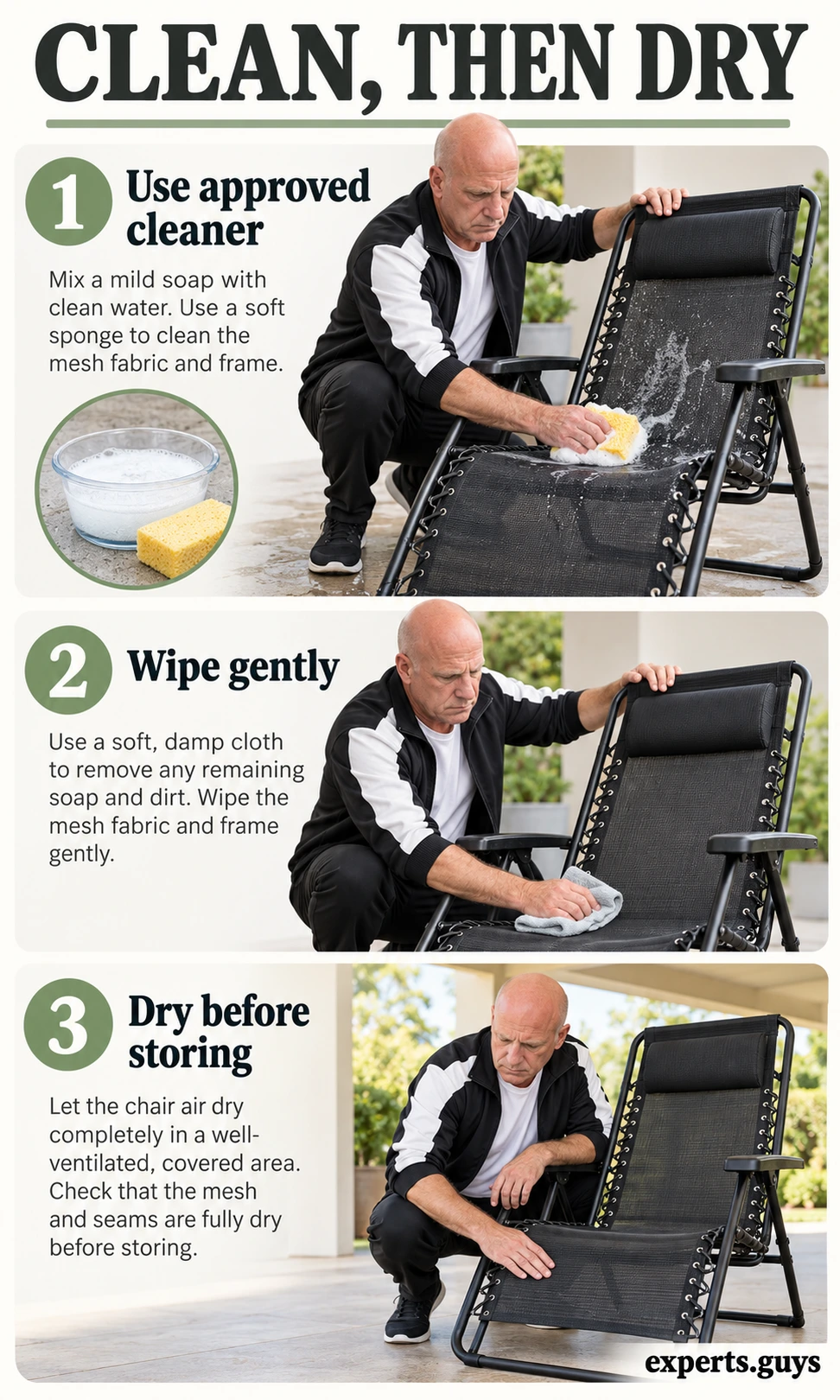
The common mistake is judging dryness only by the exposed middle of the fabric. A seam or padded edge may still feel damp after the surface looks dry. If you cannot dry the chair properly before storage, leave it open under appropriate shelter and reconsider whether that fabric suits your routine.
Test the fold and the journey to storage
Compare folded height, width and thickness with the actual storage opening and interior. Include handles, trays and other protrusions in the comparison, and do not assume two folded chairs occupy exactly twice one listed thickness. Test weight as well as geometry: a chair that fits the cupboard but is awkward to carry may rarely get put away.
- Empty the chair and remove detachable accessories where the instructions require it. Keep people and pets clear, and fold using the prescribed grip points away from hinges.
- Check the folded dimensions against the storage space without forcing the frame. Store it dry and secure against falling.
- Try the clear carrying route, including doors and turns, without dragging the chair or trapping fingers. If stairs or a narrow door make the job awkward, choose a lighter or more compact design.
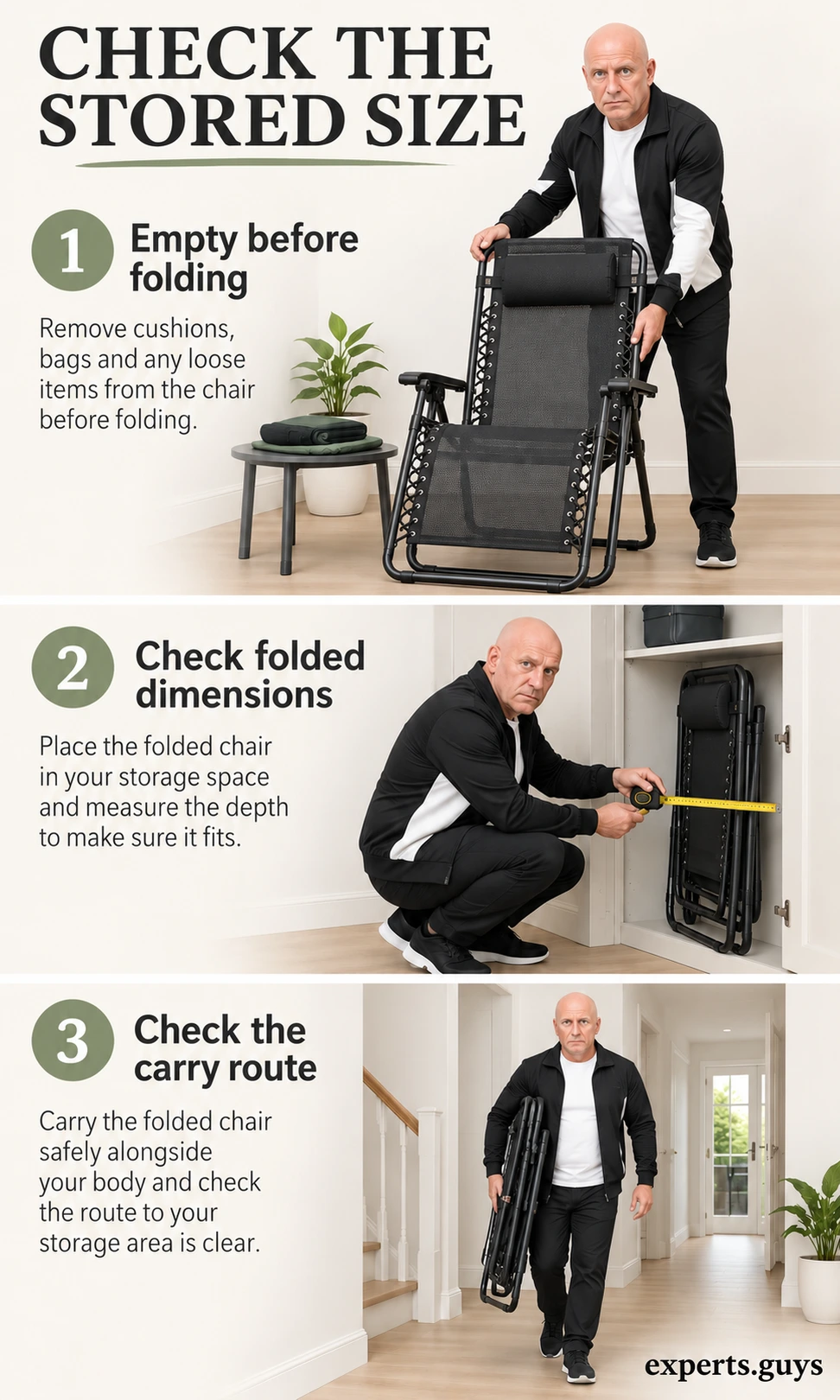
For a household that uses a chair only on weekends, easy storage may matter more than a large padded seat. A photograph of the folded chair beside the storage opening can help compare candidates on your phone. Keep the model label and receipt digitally so any future fabric or suspension purchase can be matched to the correct version.
Compare Local Home Specialists Near You
Tell us what kind of help you need, then compare nearby businesses by location, Google rating, review volume and contact options.
HomeFix Local Match
Turn a home problem into a practical local hiring decision. Check the clues, see the specialist types that fit, open focused surrounding-location searches, then compare the strongest three before you call.
 YOUR PROBLEM
YOUR AREA
COMPARE 3
✓ Ready to compare
What is happening?
Choose the closest problem type, then check every clue that applies. Your selections change the specialist order.
Where should the search focus?
Use Google’s “near me” context or enter the area you actually want a specialist to serve.
Simple local search: open nearby Google results, choose the businesses that look suitable, then compare your best three here before you call.
Problem snapshot
Who should you call first?
These are the specialist types most likely to fit the clues you selected.
Search around your location
Compare your top three
Use the same factors for each option so a high star rating does not hide a weak scope, poor diagnosis, missing credentials or unclear aftercare.
Comparison result
Your result combines the Google signals you entered with the practical hiring checks you completed.
Questions to ask every finalist
Use the same questions with each shortlisted business so the comparison stays consistent.
Frequently asked questions
Does “zero gravity” mean the chair makes you weightless?
No. It describes a reclined seating arrangement with raised leg support, not the removal of gravity. Treat it as a furniture feature rather than evidence of a medical benefit.
Is a zero gravity chair the same as a flat sun lounger?
Not necessarily. A linked reclining chair can change back and leg positions together without becoming a flat bed. Check the model’s maximum position if lying flat is essential.
Can I use one at a dining table?
Some models may fit upright, but arm height, seat height and movement can make table use awkward. Compare the actual chair and table before buying it for dining. A purpose-made dining chair is often simpler for frequent meals.
Can I replace cords with a generic kit?
Only use replacements the manufacturer confirms are suitable for the exact model and follow its installation instructions. Similar-looking lacing can differ in dimensions and attachment requirements. A kit does not address a damaged frame.
Is an outdoor reclining chair a treatment for back pain?
This guide does not establish a treatment benefit. Comfort is individual, and advertising claims about spinal decompression or circulation are not proof that a particular chair treats a condition. Stop using a position that causes pain or numbness and choose a seat you can use comfortably.
Next steps
Shortlist a chair only after its body support, full recline and storage route all work for your home. Use the model instructions to check operation, then compare material care and replacement-part availability. If one of those checks fails, changing the chair is usually more useful than trying to make an unsuitable design fit.
Images are created instructional illustrations of a generic chair, not photographs of product testing. Controls and construction vary by model.