
Fluffing can redistribute settled filling, but it cannot reliably restore the volume of worn, compressed EPS beads. Shredded foam needs a different check: rolling and kneading the closed chair may loosen clumps, while persistent flattening calls for model-specific advice rather than an automatic bead refill. Start with the filling label and the condition of the cover before spending money.
Why a bean bag chair goes flat after you fluff it
A bean bag can look taller after a shake because its filling has moved from the edges back toward the middle. That appearance does not prove the filling has recovered. Once an adult sits down, material moves around the body again, and a chair with too little usable fill can return to the same low shape.
Separate the position of the filling from the amount of usable filling. Redistribution changes where the material sits; it does not add cushioning volume. A stretched cover, leak, or newly unpacked foam insert can produce a similar low seat, so flatness alone is not a diagnosis.
| Observation | Likely direction | Next check |
|---|---|---|
| Shape improves and stays usable | Settlement or foam clumping may be involved | Repeat the normal care routine; monitor comfort. |
| Bead chair sinks low again after sitting | Insufficient usable bead volume is possible | Inspect for leaks, then check approved refill guidance. |
| Foam chair never reaches expected shape | Expansion, clumping, or insert condition needs checking | Confirm unpacking steps and the model’s expansion window. |
| Beads escape or a seam opens | Containment has failed | Stop using the chair; resolve the closure or seam before adding fill. |
What fluffing can and cannot restore
EPS beads: moving them is different from restoring them
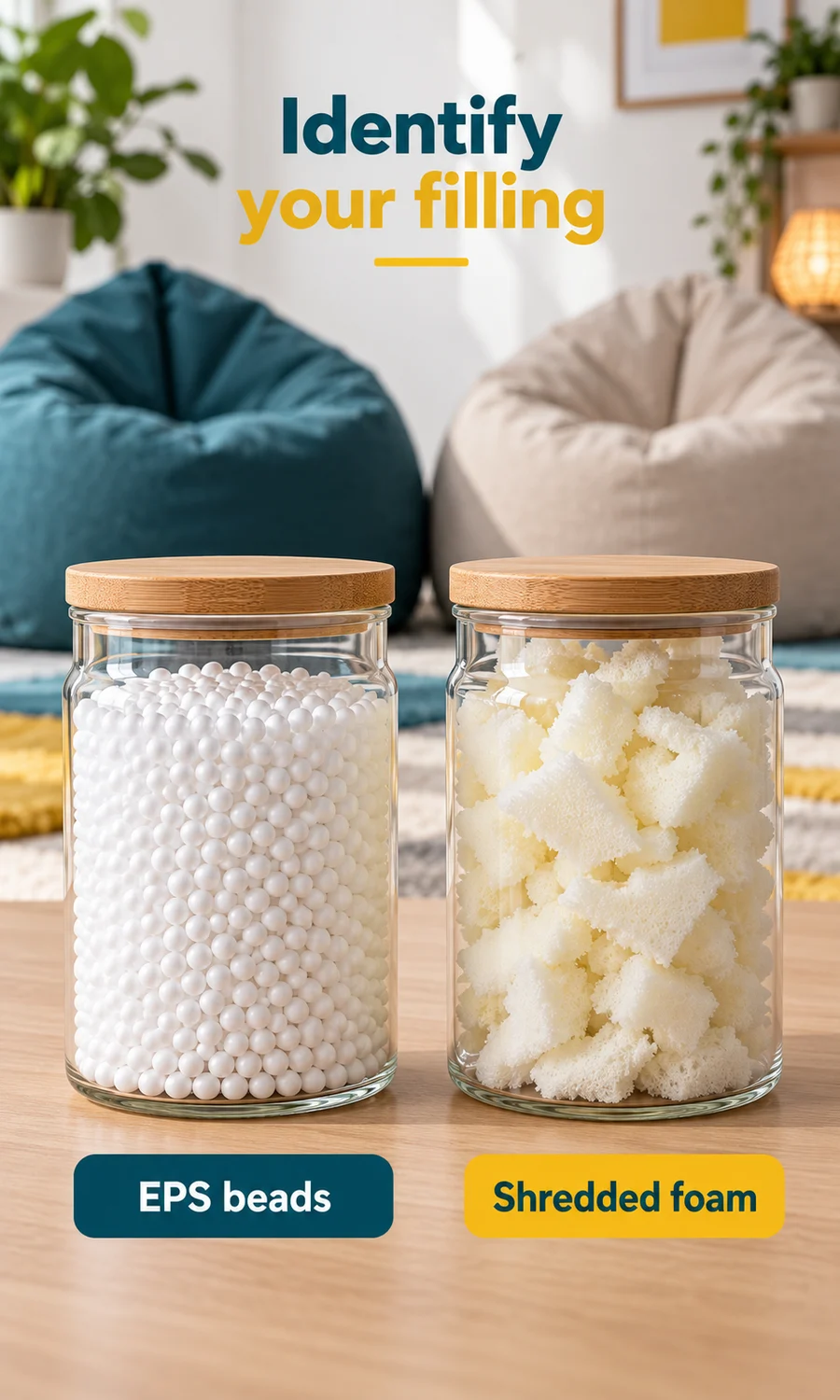
EPS is expanded polystyrene, a lightweight foamed plastic. The beads can move freely while the cover shapes around the sitter, but repeated loading can reduce their usable volume. A shake does not manufacture new beads or reliably reverse wear in old ones.
This is why a refill can help a bead chair when fluffing only improves its silhouette. Big Joe’s bead-refill guidance describes compression during use and provides a model-specific opening and filling procedure. Use that as a manufacturer example, not proof that every chair has the same zipper or needs the same quantity.
Shredded foam: try the approved care routine first
Foam pieces can gather into a dense lump and leave part of the cover feeling empty. Rolling and kneading the closed insert may redistribute them without exposing the contents. Follow the chair’s instructions rather than cutting the liner open or pulling foam out by hand.
A newly delivered foam chair introduces another variable: shipping compression. Big Joe’s Fuf instructions allow up to 48 hours for that product to expand and describe rolling it to refresh the shape. That time belongs to that product; use the stated expansion period for your own model.
Identify the filling before you open the chair
Read the care label, order record, or manufacturer’s product page first. Names such as “bean bag”, “memory foam” and “lounger” are not interchangeable specifications. If the label is missing, send the maker a photograph of the chair and its tag before ordering replacement material.
- EPS bead filling: small, lightweight foamed-plastic beads; use only filling approved for the model.
- Shredded foam: irregular flexible pieces; a chair may use polyurethane foam, memory foam, or a blend.
- Unknown or mixed filling: do not assume that beads, packaging peanuts, textile scraps, and foam can be substituted.
- Outer cover versus insert: a washable cover does not mean the foam-filled insert can be put in a washing machine.
Keep the distinction practical. A bead refill is a response to insufficient usable bead volume, while a foam-care routine is a response to the way the insert has settled. Our bean bag chair overview introduces the broader furniture category; this guide concentrates on maintaining a chair you already own.
Run a closed-chair fluff and sit check
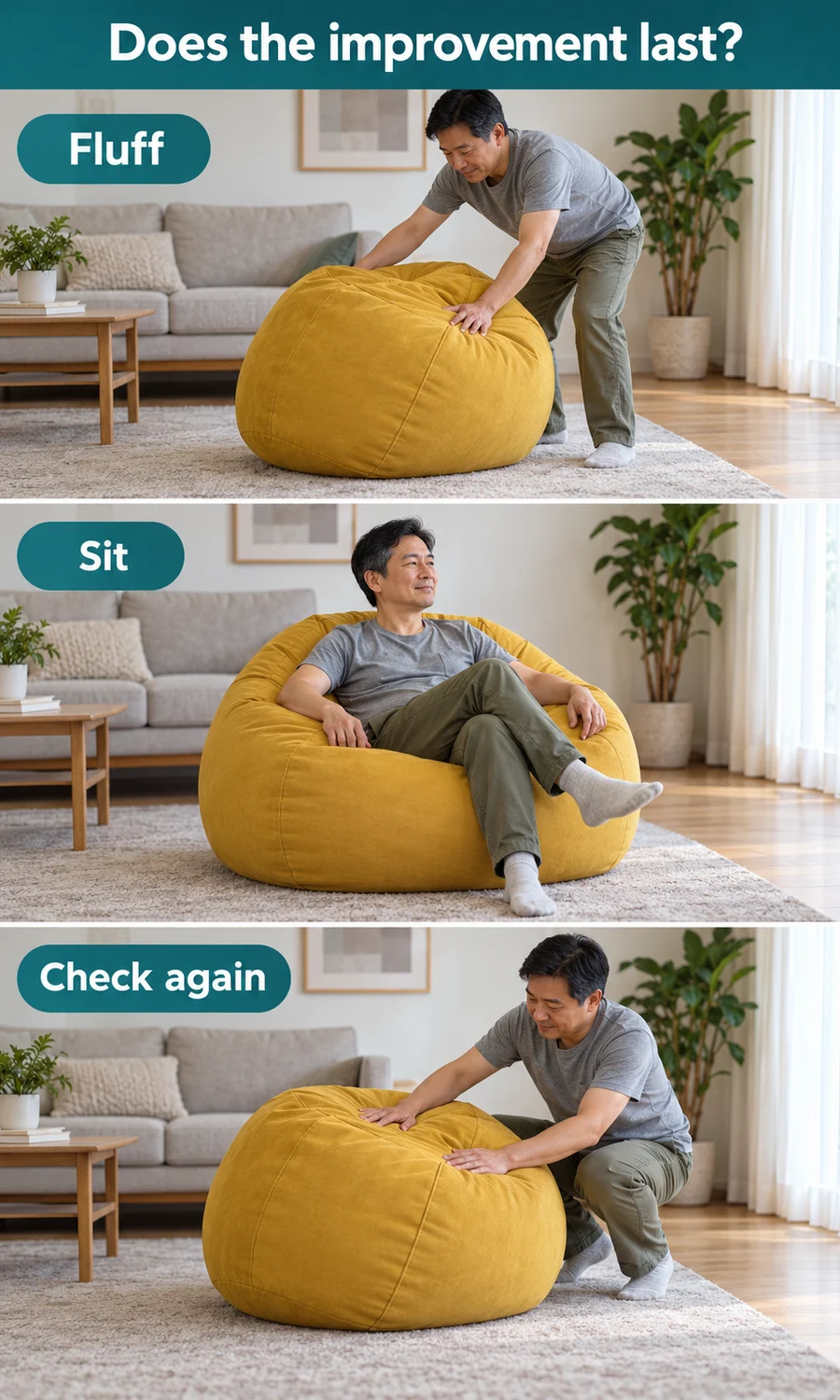
Place the chair on the same dry, level surface used for normal sitting. Check the seams and zipper from outside, then redistribute the filling using the manufacturer’s care method with all closures secured. Stop if the liner leaks, the zipper separates, or moving the chair feels unsafe because of its weight.
Sit in your usual position and compare the seat with its condition before fluffing. Note whether the chair remains usable or returns to the same uncomfortable low point. A repeat check the next morning helps distinguish a brief change in appearance from an improvement that lasts through use.
Keep the comparison consistent: the same sitter, floor position, and sitting posture make the observation more useful. A photograph from the same side can help you remember the shape, but a few centimetres of apparent height do not establish a defect. This is a household screening check, not a laboratory compression test.
Choose your next maintenance step
Seat Revival Studio turns those observations into a maintenance route. It checks containment first, then filling type and the response to fluffing. Its result is a practical next step, with uncertainty kept visible; it does not identify a brand, certify safety, or calculate an invented refill volume.

Seat Revival Studio
Find your next step when fluffing does not last.
Fill checkCare routeA4 notesCheck the cover first, then compare bead or foam care. This guide uses your observations; it cannot confirm a defect or specify a universal refill quantity.
Start with the label
Confirm the fill and check for damage before opening or ordering material.
Next action
Select the observations you can verify, then run your chair check.
Keep loose fill away from children and pets. Never force a zipper or cut open a sealed insert.
A refill is not always the first step
Redistribution cannot add usable volume. Check the approved refill route if the seat stays low.
Try model-specific expansion and care instructions before considering an insert adjustment.
Resolve leaks, damaged closures and moisture before adding new filling.
No scores, product rankings or health claims. Your inputs stay in this page; local search opens Google with the location you enter.
When a top-up is enough
A top-up is a reasonable option when the maker permits refilling, the bead chair has no leak, and redistribution does not leave a usable seat. First check whether early flattening is covered by the seller’s support or warranty process. Adding new filling before documenting a new-chair problem may make a claim harder to explain.
Ask for the model’s refill type and recommended quantity rather than estimating from the outside diameter. A shaped cover is not a sphere, and the amount already inside is usually unknown. A full-fill capacity also does not tell you how much is needed for a top-up.
| Condition | Practical route |
|---|---|
| Intact bead chair remains low after redistribution | Check approved refill instructions; add gradually if permitted. |
| Foam chair still low after care and full expansion time | Contact the manufacturer about insert condition and approved foam options. |
| Split seam, escaping fill, or zipper teeth separating | Stop use and repair or replace the damaged component first. |
| Damp, musty, contaminated, or heavily degraded filling | Seek cleaning or replacement guidance; fresh filling is not a contamination fix. |
| Oversized, stretched, or mismatched cover | Resolve the cover fit before buying more filling. |
There is no universal “75-80% full” rule for adult bean bags. The correct amount depends on the pattern, filling, and intended seated shape. Add a small amount, secure every closure, redistribute, and sit again; stop when the chair remains usable and still moulds around you without straining seams or zippers.
Foam replacement also needs a model-specific route. Lovesac’s replacement-foam instructions describe support approval, incremental additions, and closing both insert zippers afterward. That procedure is useful for its Sacs, but does not authorize opening an unrelated sealed insert.
Refill without turning the room into a bead spill
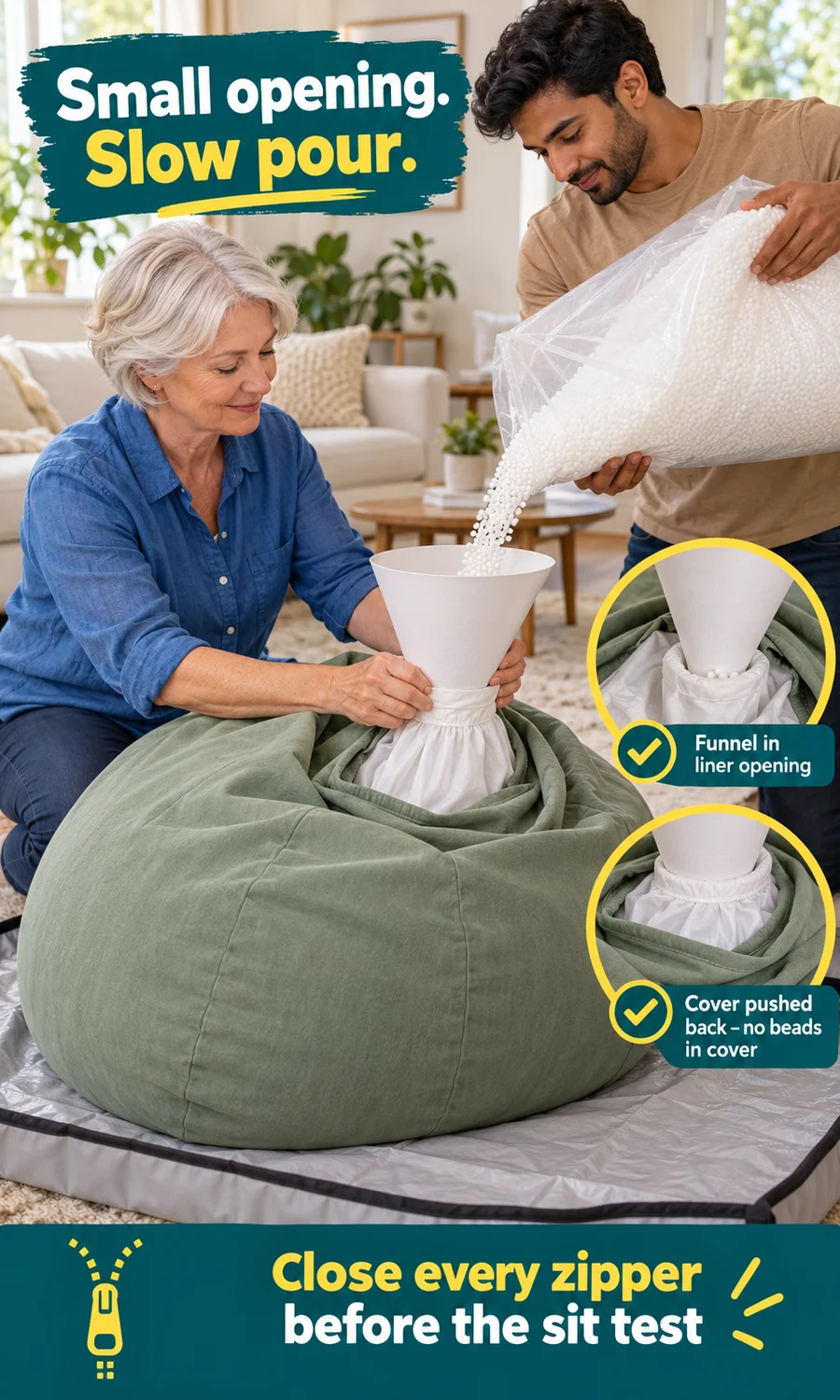
Prepare a calm, dry indoor workspace before opening a refill bag. Spread a containment sheet beneath the chair and keep children and pets out of the area. Use a helper if possible: one person controls the opening while the other controls the pour.
- Confirm that the chair is designed to open and refill; inspect the manufacturer’s closure instructions.
- Open the outer closure only as directed, then identify the actual fill compartment or inner closure. Do not pour into the space between cover and liner.
- Keep the fill opening narrow and use a paper funnel or the manufacturer’s filling sleeve. Pour slowly and pause before the opening becomes crowded.
- Close every fill-compartment zipper and secure the outer closure before redistributing or sitting.
- Check the seat after each small addition, clear the work area, and store unused filling securely.
Some child-resistant zipper sliders deliberately have no attached pull. A temporary opening aid is appropriate only when the manufacturer instructs it; do not force damaged teeth or treat every missing pull as a fault. Remove any temporary aid after closing so it cannot defeat the safety feature.
When fluffing and refilling will not solve the problem
More filling cannot repair a weakened seam or make a stretched cover match its original pattern. It may increase stress and turn a small opening into a larger leak. If the shell is damaged, ask the manufacturer or an upholstery specialist whether the liner, zipper, or cover can be repaired without losing the original closure protection.
When the existing insert is sound but its outer cover no longer fits, record the insert’s dimensions and construction before commissioning another cover. Our guide to custom-made bean bag chairs discusses that separate route. A replacement still needs suitable seams, a compatible liner arrangement, and an appropriate closure; appearance alone is not enough.
Dusty fragments, moisture, persistent mustiness, or crumbling foam are reasons to ask about the condition of the contents, not to hide them under a fresh top-up. Keep questionable material contained and avoid pouring or shaking it into the room. A photograph of the label and closed chair is usually a better first support step than opening an unfamiliar insert.
An open bean bag is also a containment hazard. The CPSC‘s bean bag recall guidance describes the risks of children accessing the inside and becoming trapped or choking on filling. Keep access restricted during maintenance, and do not return a chair to use until its closures are fully secured.
What to do with old filling
Collect unwanted fill into securely closed bags or containers as you work. Never let beads escape into drains, gardens, or outdoor bins where they can scatter. Ask your local waste service whether it accepts loose EPS or foam; acceptance of rigid packaging does not automatically include furniture filling.
Do not assume a refill fixes every uncomfortable seat. A low, soft chair may still be unsuitable for someone who struggles to get up from floor-level furniture. Treat the decision as furniture maintenance and suitability, rather than a claim that the chair improves posture or treats pain.
Questions about a bean bag that keeps going flat
Why does my bean bag go flat so fast?
First identify the filling and check for leaks. A bead chair can lose usable volume as its filling compresses, while a new foam chair may still be expanding or an older insert may need redistribution. Early flattening is worth documenting with the manufacturer before altering the chair.
Can you fix a flat bean bag without buying filling?
Sometimes. If the issue is settlement or foam clumping, the approved rolling or fluffing routine can improve the seat. If an intact bead chair remains too low after sitting, moving the same beads around may not be enough.
Do memory foam bean bags go flat?
They can look or feel compressed, and the care routine depends on the actual foam blend and insert design. Follow the expansion and fluffing instructions for the model. If the seat remains unusable after those steps, ask about support or an approved insert adjustment.
How often should an adult bean bag be refilled?
There is no reliable schedule that applies to every chair. Use the response to normal care, filling condition, and manufacturer guidance rather than a fixed number of months. Foam-filled products may use a different support process and may not be intended for routine refilling.
Why do bean bag beads stick to my clothes?
Static electricity can make lightweight beads cling to clothing and surfaces. Keep the opening small, pour slowly over a containment sheet, and keep the contents dry. Do not spray water or household chemicals into the filling to make it easier to handle.
Is a flat bean bag a manufacturing defect?
Flatness alone cannot establish a defect. Normal bead compression, missing fill, a leak, an incorrectly fitted cover, or incomplete foam expansion can look similar. Record the model, purchase date, and response to the approved care routine, then ask the seller to assess it.
Before you buy another bag of filling
- Identify the model and filling from a reliable label or manufacturer record.
- Check that the cover, liner, seams, and closures are intact.
- Try the approved care routine and compare the same seated position afterward.
- Use the model’s support or refill route if the improvement does not last.
- Secure every closure and remove escaped filling before using the chair again.
Compare Local Home Specialists Near You
Tell us what kind of help you need, then compare nearby businesses by location, Google rating, review volume and contact options.
HomeFix Local Match
Turn a home problem into a practical local hiring decision. Check the clues, see the specialist types that fit, open focused surrounding-location searches, then compare the strongest three before you call.
 YOUR PROBLEM
YOUR AREA
COMPARE 3
✓ Ready to compare
What is happening?
Choose the closest problem type, then check every clue that applies. Your selections change the specialist order.
Where should the search focus?
Use Google’s “near me” context or enter the area you actually want a specialist to serve.
Simple local search: open nearby Google results, choose the businesses that look suitable, then compare your best three here before you call.
Problem snapshot
Who should you call first?
These are the specialist types most likely to fit the clues you selected.
Search around your location
Compare your top three
Use the same factors for each option so a high star rating does not hide a weak scope, poor diagnosis, missing credentials or unclear aftercare.
Comparison result
Your result combines the Google signals you entered with the practical hiring checks you completed.
Questions to ask every finalist
Use the same questions with each shortlisted business so the comparison stays consistent.