
Bean bag chairs are flexible seats filled with small beads, shredded foam or another specified filling instead of relying on a conventional rigid seat frame. They can work well for relaxed, occasional seating, but the useful checks are their occupied footprint, construction, cleaning requirements and how easily you can sit down and get up. Start with the label and your available floor space, rather than the size name on the listing.
Quick decision: choose one only if you have a suitable clear route around it, can use it comfortably and know how its cover should be cleaned. “Large,” “washable” and “supportive” are incomplete descriptions without the exact model details. A soft seat is also not an infant sleeping surface or a treatment for back pain.
- Need a definition? Start with construction below.
- Trying to fit one into a room? Use the footprint and access checks.
- Buying for regular use? Check the seated activity, closure and cleaning job.
- Already own a flat chair? Go to why fluffing does not fix a flat bean bag chair for the separate filling problem.
What is inside a bean bag chair, and what changes the feel?
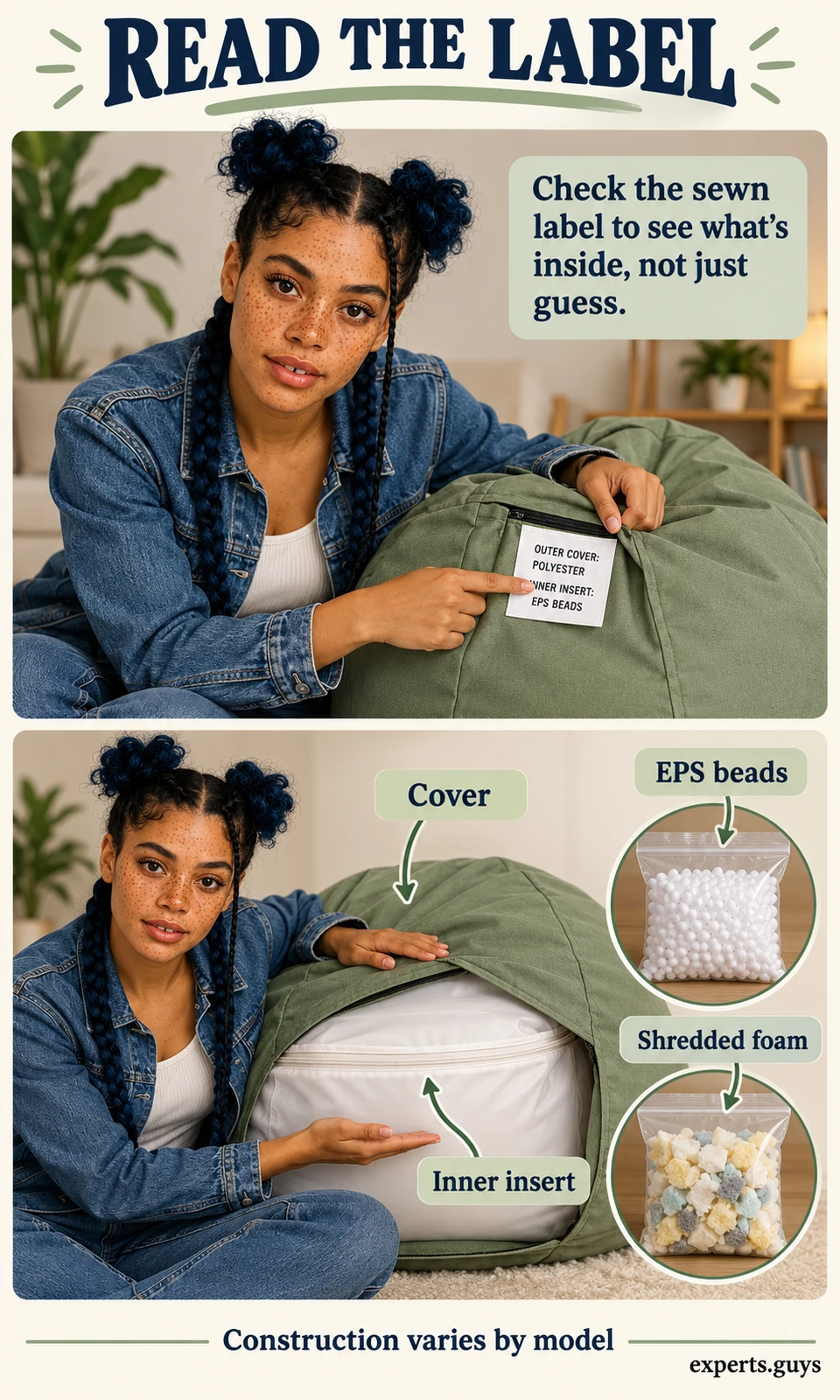
The word “bean” describes the product category, not a promise that it contains dried beans. Common commercial versions use expanded polystyrene, usually shortened to EPS, or shredded polyurethane foam. Filling moves or compresses under load, while the shape of the cover and any internal compartments help control the resulting seat.
That means two chairs with similar-looking covers can feel different. A broad sack allows a different position from a shaped lounger with a defined back, and an empty cover has no useful support until it receives its specified filling. Consider the construction as a whole rather than treating fabric softness as a measure of support.
Check 1: Read the construction, not just the product name
Use this check when a listing is vague about what is included or which layer is washable. Open the exact model description on your phone and find the filling, cover arrangement and care instructions. If one is missing, ask the seller for the product label or manual before buying; a photo of a similar chair does not resolve the uncertainty.
- Identify the filling: beads, shredded foam or another named material.
- Confirm whether the sale is a filled chair, an empty cover or a replacement cover.
- Find out whether a separate sealed insert holds the filling. Do not open the filling chamber to investigate.
- Match the cleaning instructions to the outer cover and the insert separately.
For example, a removable fabric cover around a sealed foam insert gives you a different cleaning job from a fixed bead-filled shell. If the listing says only “washable,” ask which component can be washed and under what settings. Keep a screenshot of the exact model details so you can compare them with the delivered item.
| Construction | What it changes | What to verify |
|---|---|---|
| EPS bead filling | Small beads shift as you move; the amount and cover shape affect the seat. | Specified refill compatibility, closure instructions and care label. |
| Shredded foam filling | Foam pieces compress; a large filled chair can be substantial to move. | Filled weight, expansion instructions and insert/cover arrangement. |
| Removable outer cover | Separates the visible fabric from the filling chamber when designed that way. | Whether the particular fabric is machine washable or spot-clean only. |
| Fixed cover | Routine cleaning takes place on the assembled chair. | Approved surface-cleaning method; do not assume immersion is allowed. |
Manufacturer instructions illustrate why these distinctions matter: Big Joe distinguishes bead-filled products from foam-filled Fuf chairs and gives them different care arrangements. Those details apply to its specified products, not automatically to every bean bag. Use the table to ask better questions, then follow the instructions supplied for your model.
How do you know whether it will fit your room and daily routine?
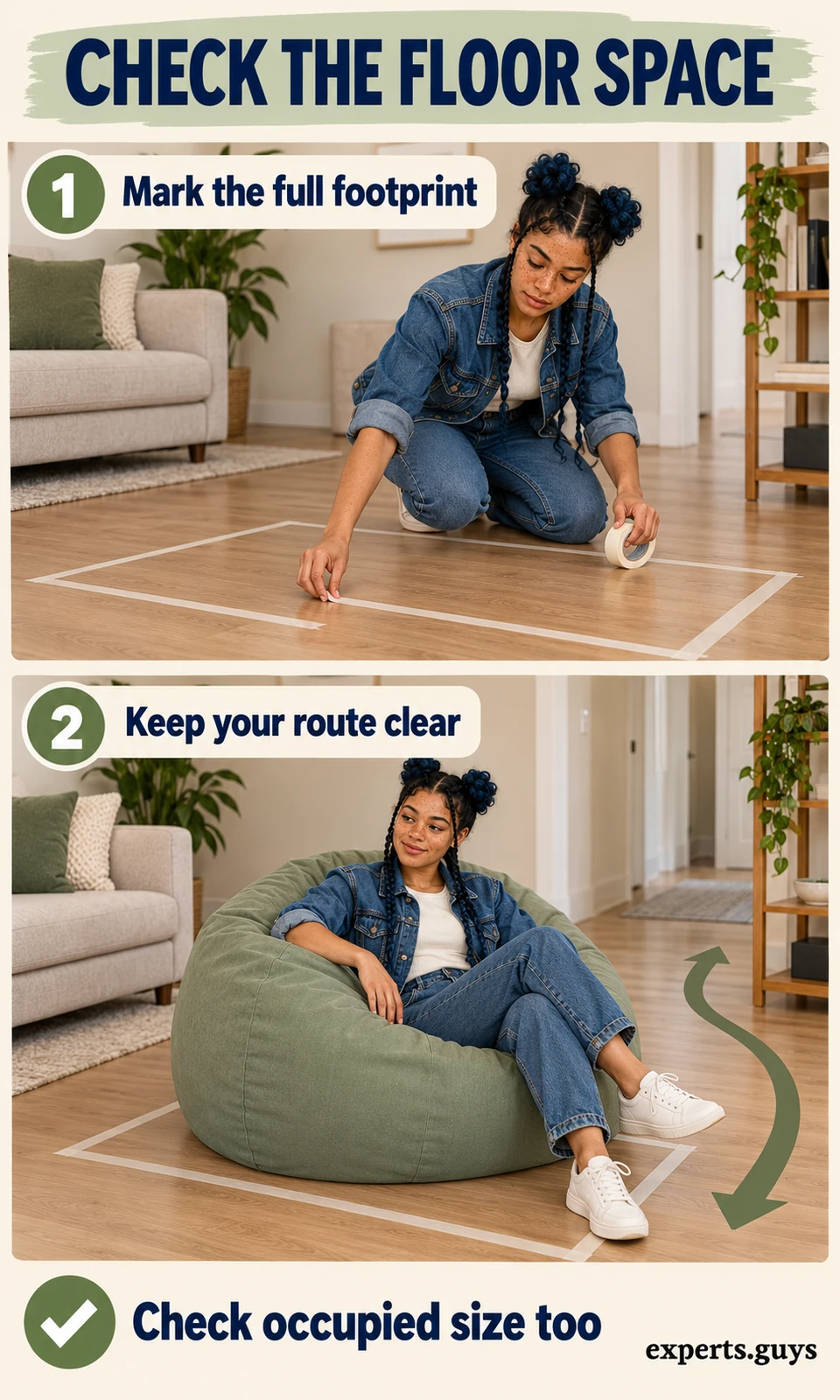
A listed width is only the starting footprint. The chair may spread when occupied, and your feet, a side table and the path past the seat also use space. Check the arrangement as it will be used, including an open door or drawer, rather than judging it from an empty-room product photograph.
Check 2: Mark the footprint before ordering
Use the manufacturer’s assembled width and depth, a tape measure and removable tape suitable for your floor. Test the tape discreetly first; on a delicate surface, use a loose cord that you remove immediately after the check. Confirm the dimensions refer to the filled chair rather than the shipping carton or flat cover.
- Mark the full listed width and depth in the intended spot.
- Open nearby doors and drawers and allow space for your legs in the intended sitting direction.
- Walk the usual route past the outline. Use your normal mobility aid if applicable, without squeezing past a trial obstruction.
- Ask for occupied dimensions or test the actual chair if the layout is close.
Here is a planning example, not a clearance standard: a 180 cm-wide zone minus a 110 cm-wide chair leaves 70 cm in that direction before occupied spread or other obstructions. It does not establish that the route is safe, accessible or adequate for your household. If you cannot keep the route you need, rotate the proposed layout, choose a smaller seat or use a different location; do not solve the problem by blocking an exit.
Check 3: Check the route in and the route out
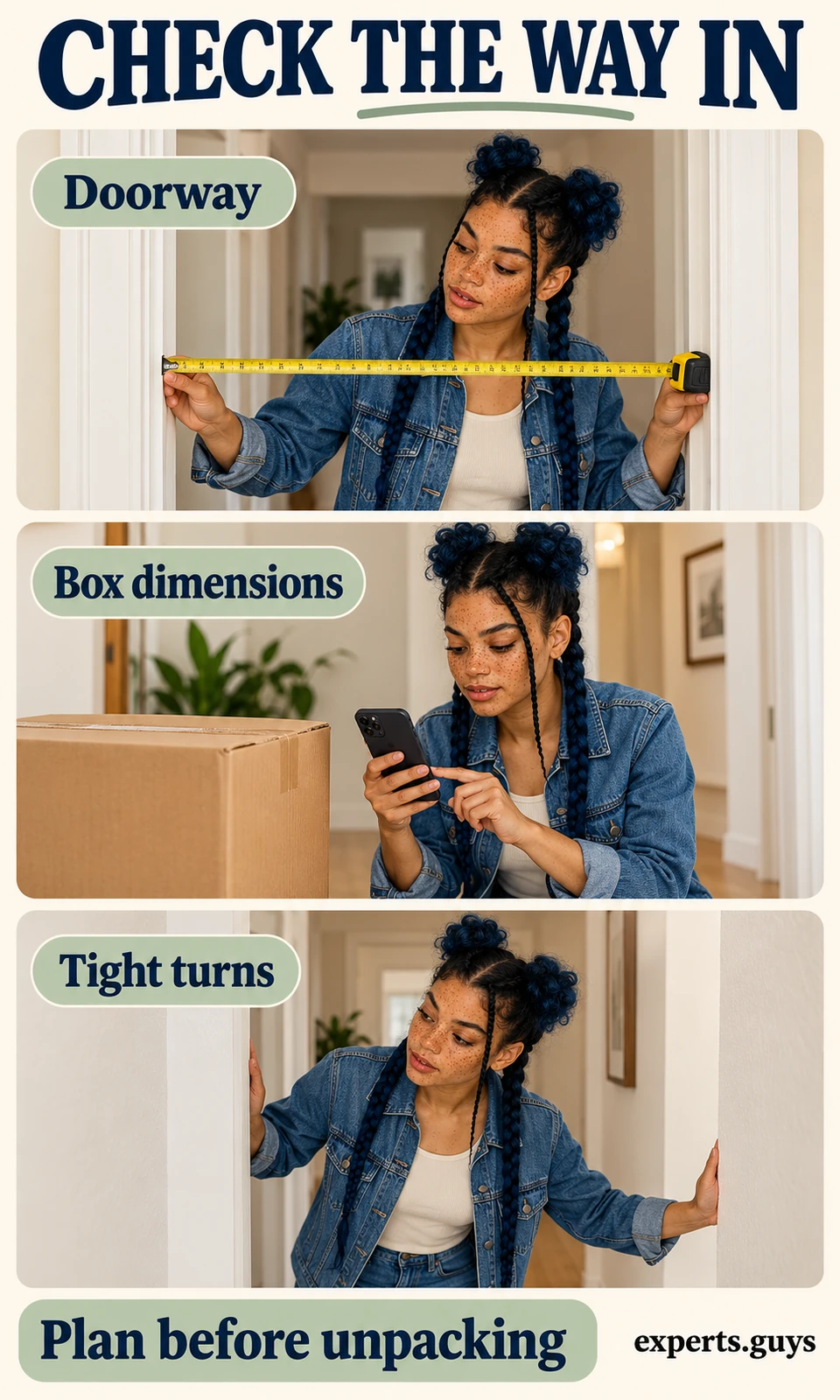
This matters most for large foam-filled seats that arrive compressed. A compact delivery carton does not mean the expanded chair will fit back into it or through every doorway later. Check the packed dimensions and the fully expanded size as separate questions before opening the packaging.
- Measure the narrowest usable doorway along the route, with the door in its normal open position.
- Check the carton dimensions, hallway turns, stair landings and any lift restrictions against that route.
- Find out whether the expanded chair can be moved intact and whether returns require particular packaging.
- Arrange help for a heavy or awkward item instead of relying on one small carrying handle.
A carton may clear a doorway yet fail at a tight turn, so width alone cannot prove that delivery will work. If access is uncertain, give the seller the actual doorway and corner measurements and ask about the exact packed item. A smaller model is often the simpler solution when the route cannot change.
Check 4: Test your activity and your exit
Try the chair in the way you intend to use it: reading, watching a screen or occasional conversation. Sit normally, let the filling settle and notice whether you must keep bracing yourself or adjusting to hold the position. Also check that rising feels manageable; a seat that feels pleasant once you are in it may still be inconvenient to leave.
- Try your normal reading or viewing position with the actual object or screen height you use.
- Check whether your feet and back feel adequately supported for that activity, without forcing a prescribed posture.
- Stand only in your usual safe way; do not test an unstable chair alone if transfers are already difficult.
- Stop if you feel pain, numbness, instability or difficulty rising, and try a firmer, higher seat instead.
For example, a reclined bag may suit a short film session but leave a laptop too low for comfortable typing. Do not interpret a relaxed feeling as evidence that the chair corrects posture or treats pain. If you need dependable support for desk work or easier transfers, compare a conventional chair rather than buying extra filling to imitate a rigid frame.

Which safety and cleaning details should you inspect?
Keep filling inaccessible and never use a bean bag as an infant sleeping surface. Loose filling and entry into a cover can create serious hazards for children. The CPSC’s bean-bag-cover recall illustrates the risks of accessible zippers, including entrapment and suffocation; a reassuring sales description is not a substitute for an intact product.
Check 5: Inspect the closed chair and check recalls
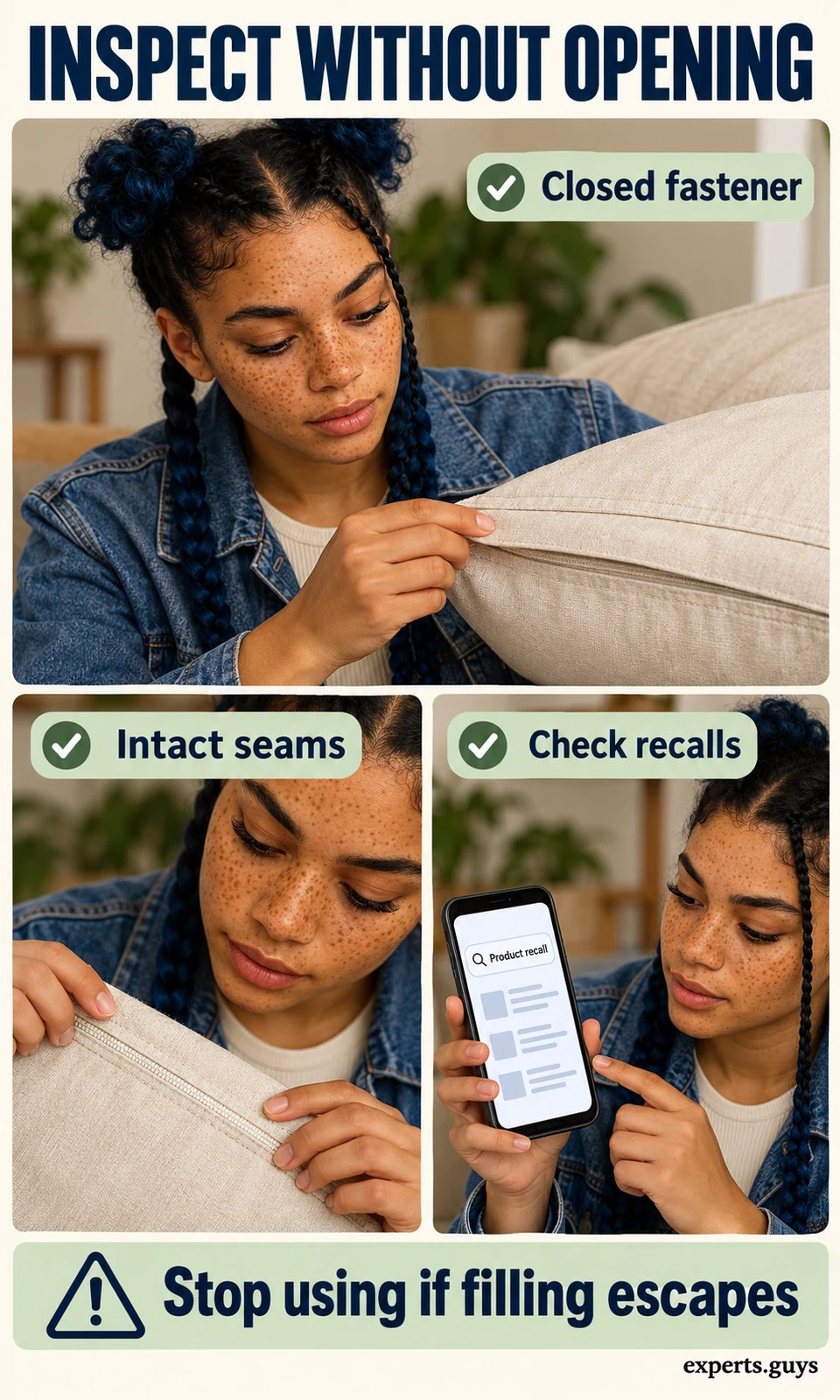
Do this before first use and whenever you notice damage. Keep the filling chamber closed while checking the exterior seams, closure and product identification. Child-resistant does not mean impossible for a child to open, so keep unused covers and refill supplies out of reach too.
- Look along the seams for openings, damage and escaping filling.
- Check that the fastener is closed and secured exactly as its instructions require. Do not attach a permanent pull or bypass its safety arrangement.
- Use the brand and model from the label to check the relevant product-safety recall service in your country.
- If filling escapes or the closure fails, stop use, keep children and pets away, and follow the manufacturer’s repair, recall or disposal instructions.
Do not open a suspect bag to see how much filling remains or rely on an improvised patch as a safety repair. If the model cannot be identified, ask the seller for documentation before using a second-hand chair. Australia’s bean bag mandatory standard sets specific local requirements; its legal scope should not be presented as a worldwide rule.
Check 6: Rehearse the cleaning job
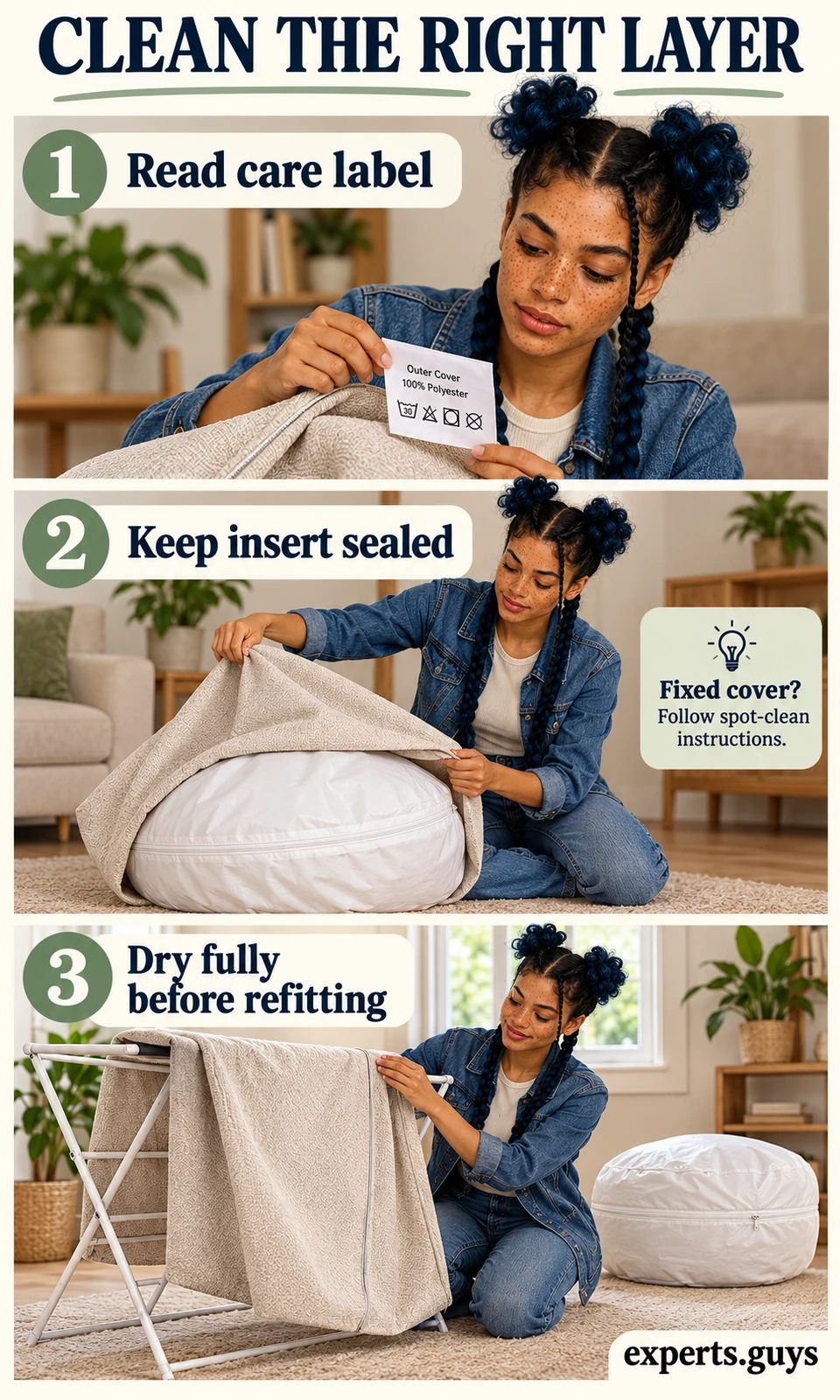
The right cleaning method depends on the fabric and construction, not just whether the chair contains foam or beads. Before choosing a model, think through where you would remove, clean and fully dry its cover. If the routine is unrealistic for your space, a different approved surface-cleaning fabric may be the more useful choice.
- Read the exact care label before applying water or detergent.
- For an approved removable cover, remove only that outer layer and leave the filling insert sealed, dry and inaccessible to children.
- Wash or clean the cover only by its prescribed method. A removable cover is not automatically machine washable.
- Dry it completely by the approved method before refitting it; then secure the closure.
- For a fixed cover, follow its surface-cleaning instructions instead of putting the whole filled chair in a washer or soaking it.
For a concrete model-specific example, Big Joe’s removable Fuf cover instructions specify a cold gentle wash and air drying, but exclude premium vegan leather covers from that method. If your label differs, its instructions take priority. When the label is missing, identify the fabric and obtain the manufacturer’s care directions rather than testing an aggressive cleaner on the visible surface.
What should you plan before paying and unpacking?
First-day setup and return logistics are part of choosing a bean bag. Some foam-filled models arrive compressed and have a specific cover-fitting sequence, while other seats arrive ready to use. Read that sequence before cutting packaging or assuming the item has reached its final shape.
Check 7: Plan the first setup
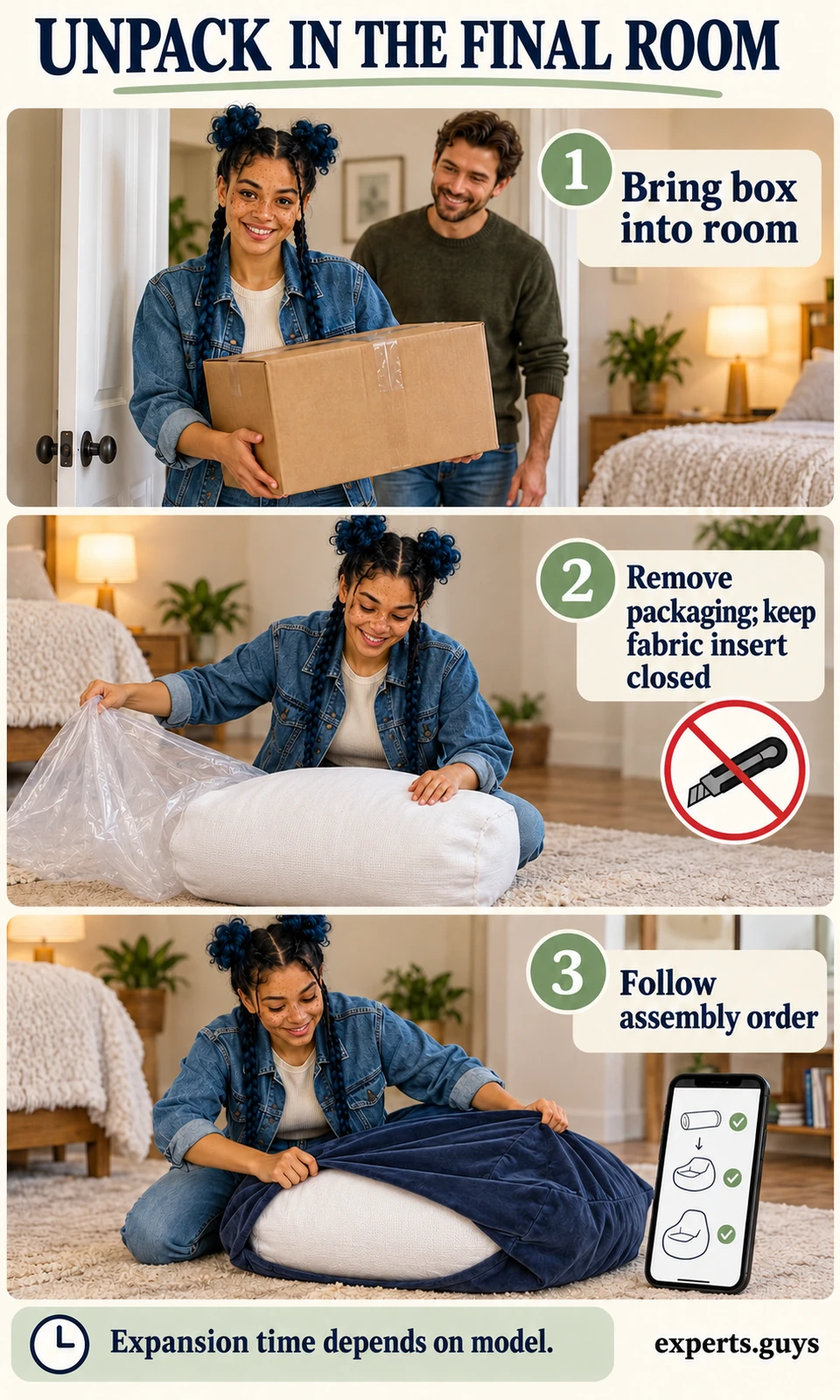
Prepare the final position, clear the route and open the manufacturer’s instructions on your phone. Keep children and pets away from packaging and any removable cover during setup. Obtain help if the carton or insert is too bulky to handle comfortably.
- Move the unopened product into the intended room when the delivery instructions allow.
- Remove only the shipping and compression packaging as directed; keep the filling insert sealed and avoid cutting the fabric.
- Fit the cover in the specified order. Some models require this before the insert fully expands.
- Allow the stated expansion period, then reassess the footprint and comfort with the closure fully secured.
For example, Big Joe’s Fuf assembly guide advises fitting the cover immediately after opening and says expansion may take up to 48 hours. That is a product-specific example, not a universal waiting time. If your item remains materially different from its instructions or shows damage, send the seller photos of the label and problem before making alterations that could affect a return.
Check 8: Compare the complete ownership job
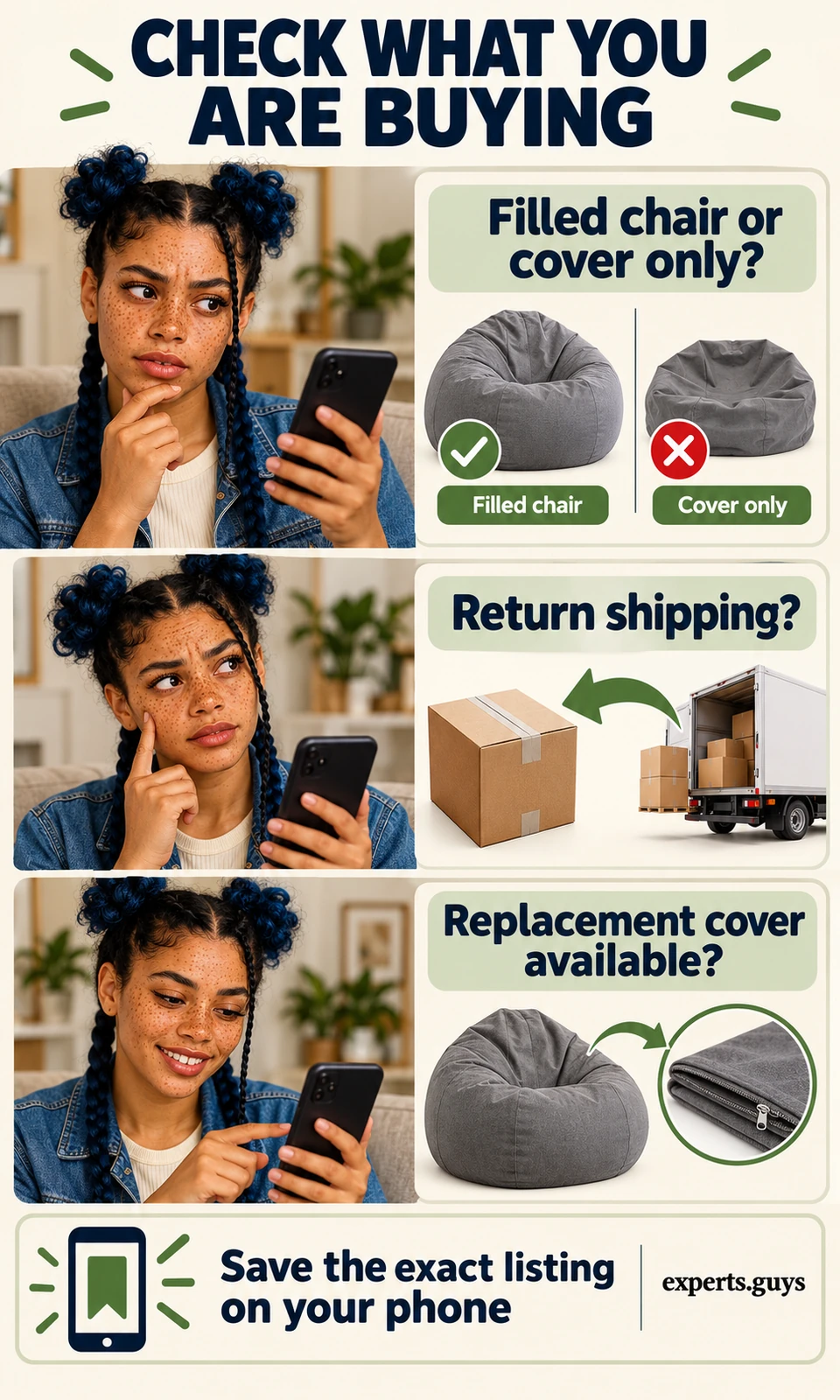
Compare the finished purchase, not just the number beside a cover photograph. Open the exact variant in the seller’s listing and check the included components, delivery charge and return conditions together. Confirm replacement parts by model rather than assuming a cover with a similar diameter will fit.
- Confirm whether filling and an inner insert are included where required.
- Check the return window, condition requirements and who pays return shipping after unpacking.
- Find out whether a compatible replacement cover is available and whether the manufacturer supplies approved maintenance parts.
- Save the listing, care instructions and order confirmation on your phone before purchase.
Imagine two listings with similar pictures: one includes a filled chair, while the other sells only its fabric shell. The lower initial price does not settle the comparison because the second purchase still needs compatible filling and assembly. If the complete cost, maintenance or return process no longer suits you, pause the purchase instead of treating those details as problems to solve after delivery.
| If your check reveals… | Your next decision |
|---|---|
| The occupied chair obstructs a route or door | Change the position or size before buying. |
| Sitting or rising feels difficult | Compare a firmer, higher seat; do not assume more filling will solve it. |
| Loose filling, damaged seams or a failed closure | Stop use and resolve the product-safety issue. |
| The care label conflicts with the sales description | Obtain model-specific clarification before cleaning or purchase. |
| Price excludes filling or returns are impractical | Compare the full purchase and return commitment. |
Compare Local Home Specialists Near You
Tell us what kind of help you need, then compare nearby businesses by location, Google rating, review volume and contact options.
HomeFix Local Match
Turn a home problem into a practical local hiring decision. Check the clues, see the specialist types that fit, open focused surrounding-location searches, then compare the strongest three before you call.
 YOUR PROBLEM
YOUR AREA
COMPARE 3
✓ Ready to compare
What is happening?
Choose the closest problem type, then check every clue that applies. Your selections change the specialist order.
Where should the search focus?
Use Google’s “near me” context or enter the area you actually want a specialist to serve.
Simple local search: open nearby Google results, choose the businesses that look suitable, then compare your best three here before you call.
Problem snapshot
Who should you call first?
These are the specialist types most likely to fit the clues you selected.
Search around your location
Compare your top three
Use the same factors for each option so a high star rating does not hide a weak scope, poor diagnosis, missing credentials or unclear aftercare.
Comparison result
Your result combines the Google signals you entered with the practical hiring checks you completed.
Questions to ask every finalist
Use the same questions with each shortlisted business so the comparison stays consistent.
Frequently asked questions
Can a bean bag replace a sofa?
It can provide occasional lounge seating, but compare the actual number of usable seats, access needs and footprint. A large sack may take substantial floor space without giving each person a separate supported position. Try the arrangement with the intended users before replacing your main seating.
Does a water-resistant cover make it suitable outdoors?
No. A water-resistant fabric does not establish that the filling, seams, closure and whole chair can tolerate outdoor exposure. Use a product specifically intended for the setting and follow its storage and drying instructions.
Is a bean bag automatically environmentally friendly?
No. Recycled content, durability, repair options and local disposal routes are separate questions. Look for specific material statements and check what your local service actually accepts; do not assume loose EPS filling belongs in household recycling.
Can I use household beans or rice as replacement filling?
Use only the filling specified for the model. Food products change the weight and maintenance conditions and are not a substitute for verified compatible fill. If the chair needs attention, identify its existing material before considering any replacement.
Your next step
Start with the exact model label and a trial outline on your floor. If the construction, occupied space and seated trial work for you, move on to cleaning and purchase terms before ordering. The best outcome is a chair that fits your actual routine, with a maintenance job you are willing and able to do.