An Among Us Crewmate’s next useful move depends on the match: identify your mode and role, respond to an urgent event, then return to tasks and evidence gathering. In Classic mode, the crew works toward task completion or ejecting the Impostors. In Hide n Seek, survival and the countdown change that decision.
There is no reliable way to predict another player’s next action from a colour, costume or brief movement. A person walking away from you may be going to a task, following information, using a role ability or simply hesitating. Good decisions begin with the rules you can check, rather than a story you have guessed.
Check the match before choosing a move
Read the selected mode, your assigned role and the relevant lobby settings. This takes less time than recovering from a confident accusation based on a rule that is not active. The guide below concerns the standard game; do not silently apply it to mods, custom variants or a different Among Us title.
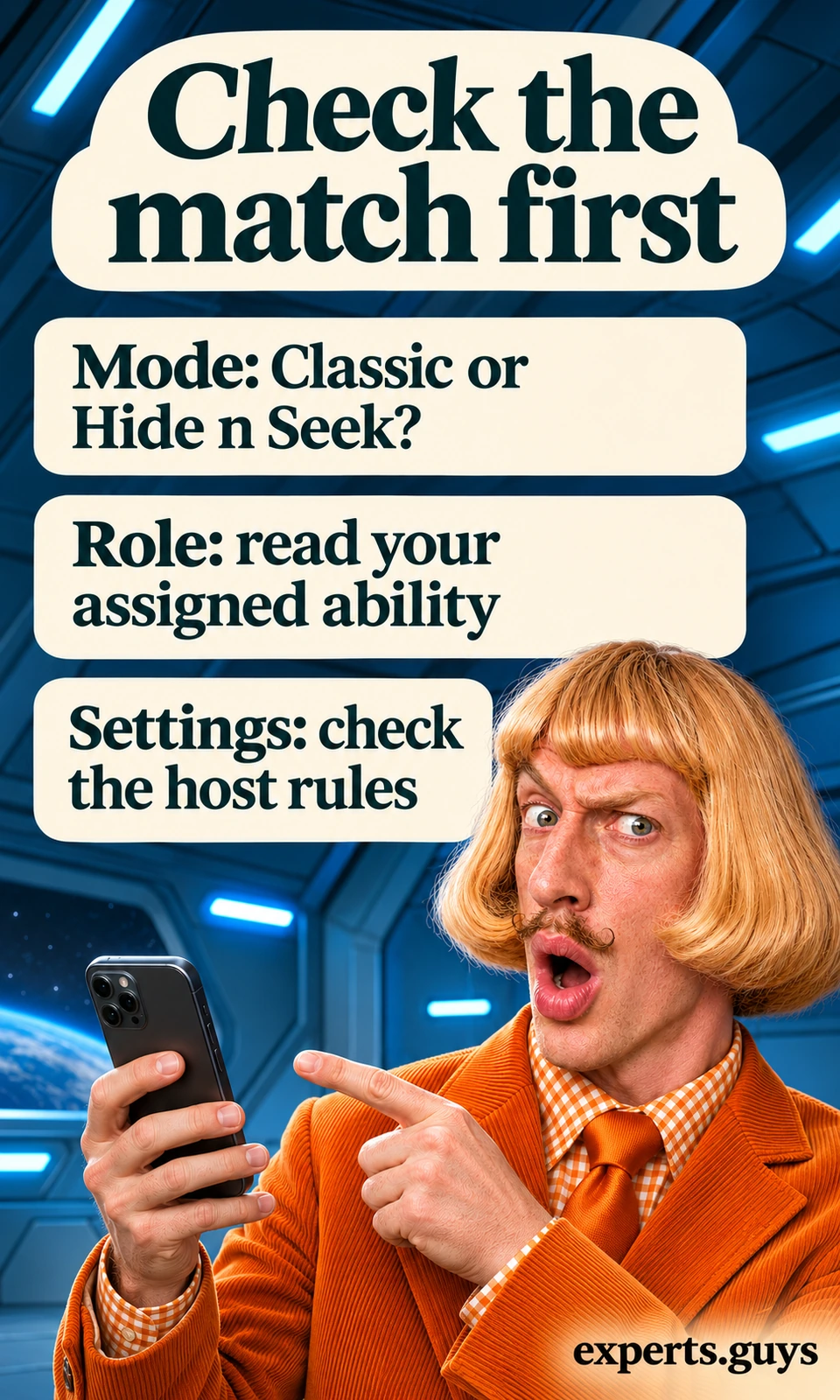
Innersloth’s official Roles Explanation confirms that special roles depend on the host’s settings. It is therefore misleading to describe every Crewmate as having the same abilities. Your own assignment and the match’s enabled roles are the starting point.
An Engineer can use vents. A Scientist has access to vitals through a role ability. Other enabled roles may change the information available to players, including after death. You do not need to memorize every role before your first match, but you do need to read what your assigned role can do.
Treat the map and its information systems as context rather than as a promise. A camera view, a map display and a direct sighting have different limits. Something that was true a moment ago may no longer describe the room you are entering.
A useful opening plan is deliberately modest: understand your task list, choose a reachable task, and keep enough awareness to respond if the situation changes. You are trying to make progress while staying useful to the crew, not to perform a route perfectly regardless of events.
Before leaving the lobby or rushing into a familiar routine, use these checks to avoid importing rules from a previous game.
- Confirm Classic or Hide n Seek.
- Read your own role and ability information.
- Check the host’s important settings, including enabled roles.
- Use the task list assigned to you in this match.
- Follow the group’s fair-play rules for communication.
In Classic mode, let urgency interrupt routine
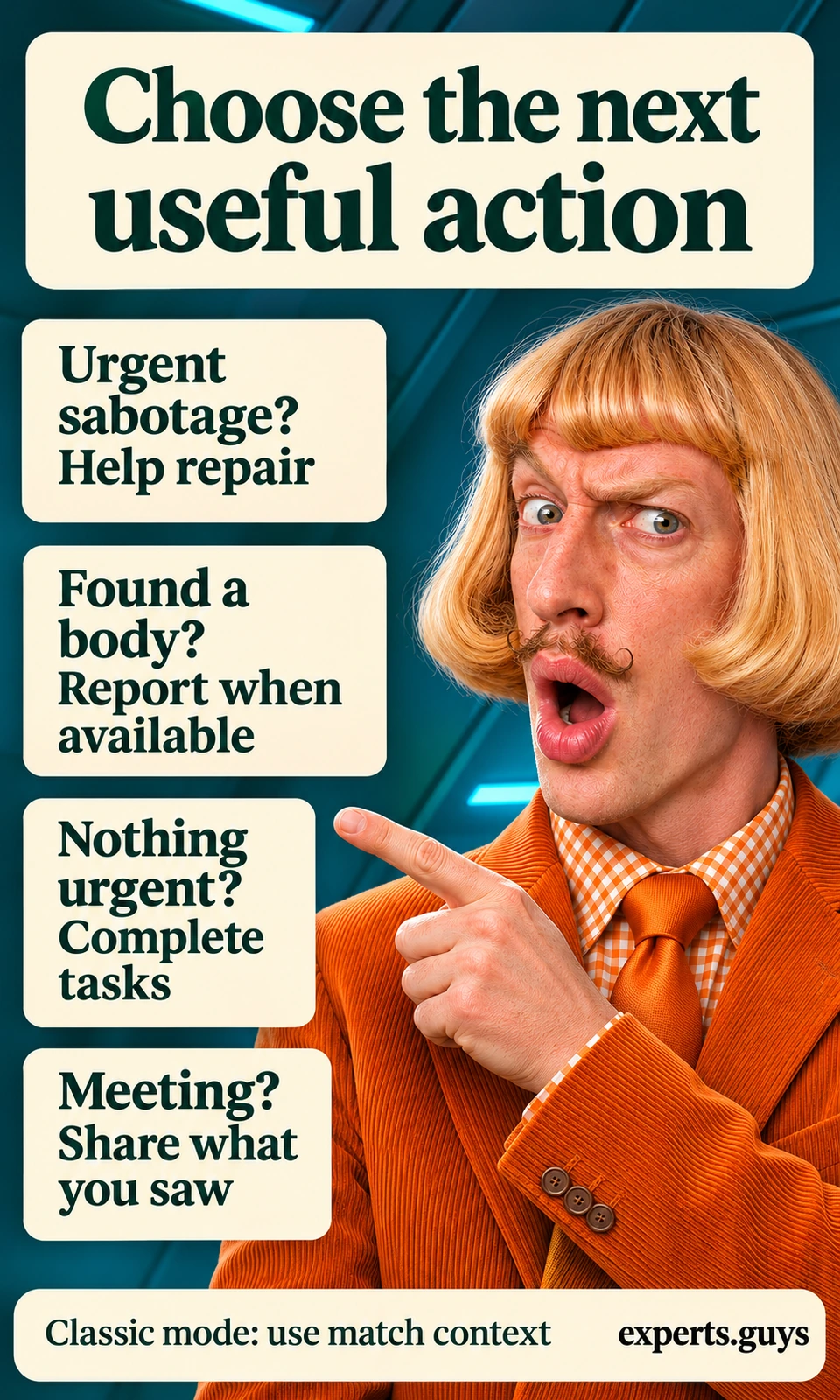
A task route is a plan, not a contract. When a critical sabotage threatens the match, a nearby Crewmate who can help may be more useful repairing it than finishing an unrelated task. Use the actual map and the available repair controls rather than assuming every sabotage works identically.
The same idea applies to discovering a body. Reporting a body and calling an emergency meeting at the button are different interactions. If the Report option is available, use that interaction; do not describe a body report as a button press at the meeting table.
Once the urgent event is resolved, return to meaningful task progress. Endless aimless following can leave the crew with little information and an unfinished objective. Equally, ignoring everything around a task can mean missing the one event the meeting needs you to describe.
The official Among Us page describes the crew’s task and deduction objectives. The important practical point is that these are connected: information can help remove an Impostor, while completed tasks give the crew another route to victory.
Use the table as a situational reference, not a guaranteed algorithm. Distance, available controls, the current role and the state of the match can change which action is feasible. A guide should help you notice those constraints rather than conceal them.
| Situation | Useful next action | Avoid assuming |
|---|---|---|
| Classic: critical sabotage active | Help with the relevant repair when you can reach it; use the map and available controls. | That finishing your current task always comes first. |
| Classic: body discovered | Use the Report option when available; communicate what you actually saw. | That an emergency-button press is the same action as reporting. |
| Classic: no urgent event | Progress assigned tasks while paying attention to your surroundings. | That standing near a task proves it was completed. |
| Classic: meeting | Share location, sequence and what remains uncertain. | That loud confidence is stronger evidence. |
| Classic: dead Crewmate | Continue remaining tasks; use only assigned in-game ghost abilities. | That ghost knowledge may be passed through outside voice chat. |
| Hide n Seek | Survive and use tasks to reduce the timer when safe. | That Classic meetings and voting define this mode. |
Make a task route that can survive an interruption
Choose a nearby assigned task or a small cluster you can reasonably reach. Think in terms of a short next segment rather than an elaborate whole-map loop. That gives you a clear purpose while making it easier to explain where you went if a meeting interrupts you.
If you become unsure, reopen the task list and map instead of wandering indefinitely behind another player. There is no need for a notebook or a second-screen tracking system. Use the information the game supplies and the events you actually remember.
Standing in front of a task is not proof of innocence. Some tasks do not display their completion to another player, and what is visible can depend on settings. Avoid converting “I watched them stand there” into “I know they completed it.”
The same caution applies to the group task bar. Its update behaviour can be affected by the lobby configuration, and it is not a personal receipt attached to the player nearest a console. Check the rule before presenting a bar movement as decisive evidence.
Report an observation without adding an invented story
In a meeting, a useful report identifies the location, sequence and limitation of what you saw. “I entered, saw the body, and saw another player leaving” is more informative than “they looked suspicious.” It gives the group something to compare with other accounts.
Then separate observation from inference. Seeing a player leave a room is an observation. Deciding that they caused what happened inside is a conclusion that needs supporting context. Say which part you know and which part you are unsure about.
This also makes disagreement less personal. Another player can challenge the timing, route or role explanation without either of you needing to invent certainty. A calm correction is more valuable than repeating the same accusation louder.
Why venting is no longer a universal shortcut to guilt
An Engineer is a Crewmate who can use vents when that role is enabled. That single rule is enough to invalidate the blanket claim that every vent user must be an Impostor. It does not mean a vent sighting is irrelevant; it means you must interpret it against the match.
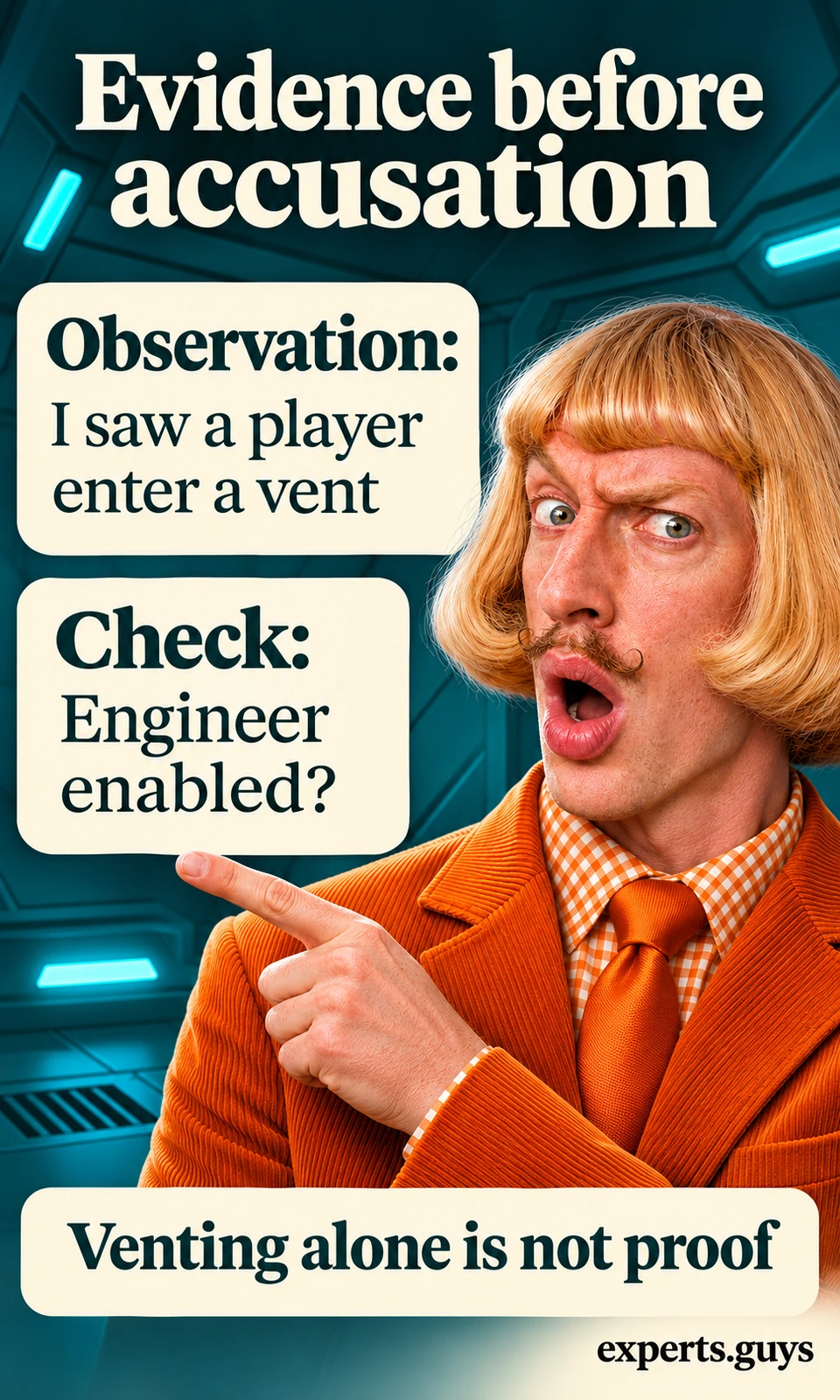
Ask what the observation rules out, if anything, under the active settings. Do not demand that one clue answer every question. A role claim may itself need examination, but rejecting it automatically because it contradicts an old guide is not careful deduction.
Avoid universal “tells” based on walking style, typing speed, skin, gender, accent or confidence. Those are unreliable foundations for an accusation and can turn a party game into an unpleasant argument. Use in-game events that other players can meaningfully discuss.
What should a dead Crewmate do next?
Continue the unfinished tasks available to you in Classic mode. Death changes your interaction with the living players, but it does not make abandoning the task objective helpful. Stay within the abilities and communication rules of your actual ghost role.
Current roles make a simple “ghosts can never affect living players” statement incomplete. Innersloth’s guide includes Guardian Angel protection and Influencer’s predefined picture messages. Those are bounded game abilities, not permission to reveal everything you know through an outside voice channel.
Keep the distinction clear: using an assigned in-game role is part of the match. Messaging a living friend on another app to name the Impostor is outside information. Do not turn a legitimate new feature into an excuse for unrestricted ghost coaching.
If your group uses voice chat, agree on when living and dead players may speak before the round begins. A fair communication rule should be understandable to everyone, not a private exception negotiated after someone dies.
Hide n Seek requires a different priority
Innersloth’s Hide n Seek introduction points players to a mode with a different structure from Classic social deduction. As a hiding Crewmate, survival matters, and completing tasks helps reduce the countdown.
That changes how you weigh a task. A task can shorten the danger period, but committing to one at an unsafe moment may expose you. Use the mode’s own prompts, threat information and available abilities rather than applying a meeting-and-voting strategy.
Do not copy exact cooldown numbers or ability counts from an unrelated lobby. Read the current mode information and the host’s settings. The transferable skill is noticing when the next action should change, not memorizing one universal sequence.
Keep the guide separate from prediction and cheats
The phrase “what will a Crewmate do next?” can sound like a request for a prediction engine. That is the wrong expectation for a human multiplayer game. Even a sensible plan can change because another player reports, sabotages, disconnects or takes a different route.
If you want broader background, the site’s Among Us introduction covers a different reader question. For current abilities and rules, use the developer’s guidance and the match itself rather than treating an older introduction as an exhaustive rulebook.
You do not need an external tool to play this decision process. A script that claims to identify hidden roles would create false confidence or interfere with fair play. The useful help is already available: know the rules, progress the objective and communicate observations accurately.
Frequently asked questions
Can you predict exactly what a Crewmate will do next?
No. Movement depends on the player, task list, role, map, mode and lobby settings. A useful guide helps choose an action; it cannot read another player’s intentions.
Does entering a vent prove someone is an Impostor?
No. Engineers are Crewmates who can use vents when the role is enabled. Venting may be relevant evidence, but it is not a universal identity test.
Should a dead Crewmate stop doing tasks?
No. Remaining tasks can still contribute to the crew’s task objective in Classic mode. Use any assigned ghost ability according to the game’s rules; do not pass hidden information through external chat.
Can ghosts communicate with living players now?
Some enabled ghost roles have specific in-game abilities. Innersloth’s current guide includes Influencer messages to living Crewmates. That does not authorize unrestricted external voice messages revealing hidden information.
Are Hide n Seek tasks the same objective as Classic tasks?
No. Hide n Seek is about surviving the timer, and task completion reduces the remaining time. Classic mode uses the group task objective and social deduction. Check the selected mode before applying a strategy.
Next steps
For the next round, make one change: read the mode and your role before moving, then choose a short task segment that you can interrupt. In the first meeting, describe one observation clearly and leave its uncertainty visible. That is a more repeatable improvement than trying to guess everybody’s next move.