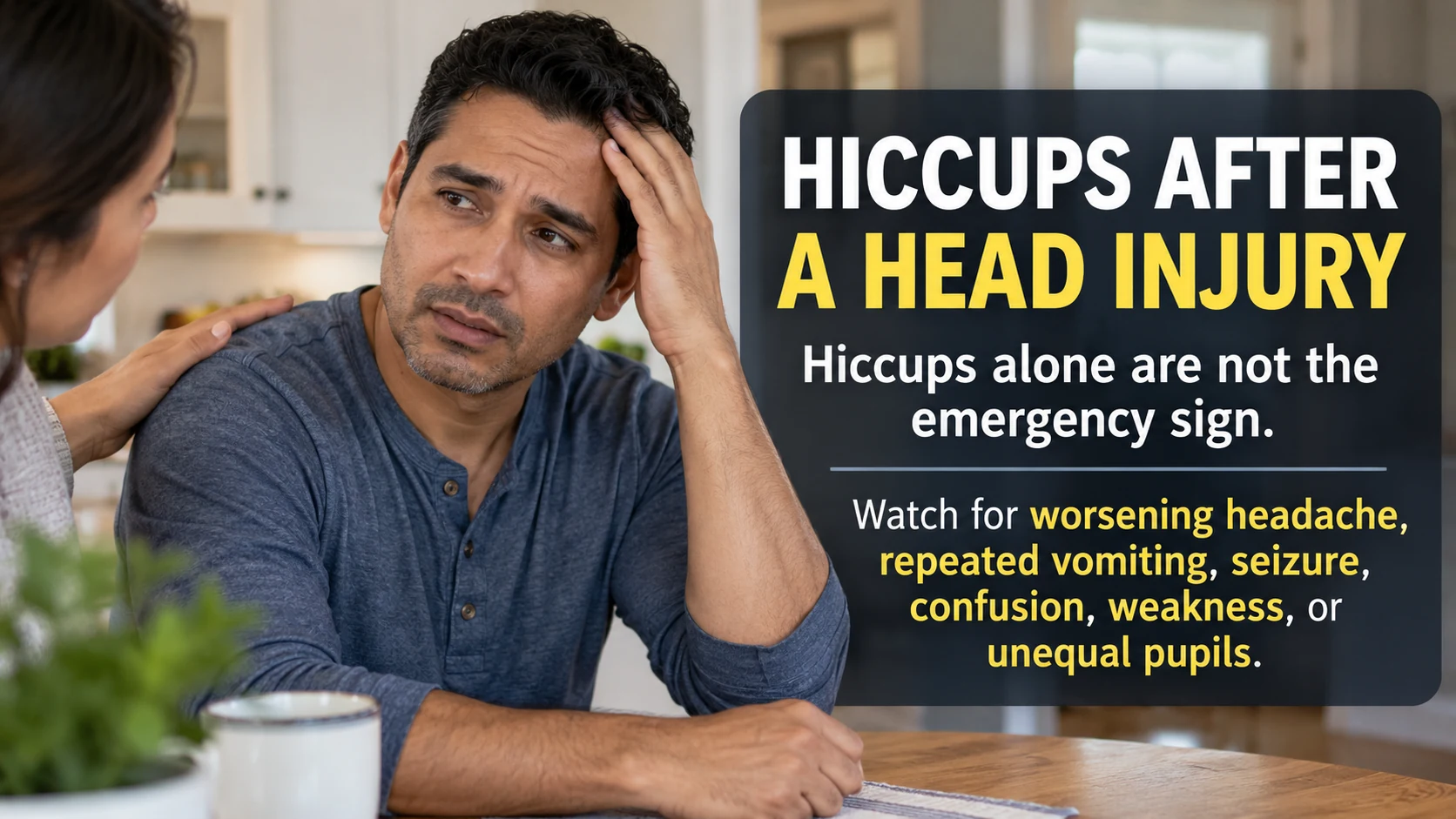

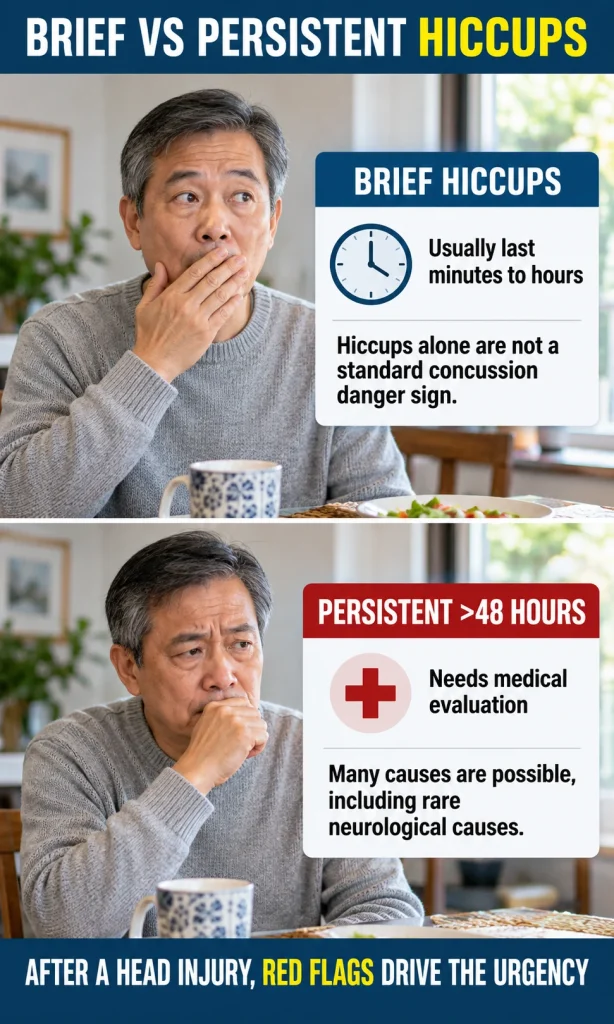
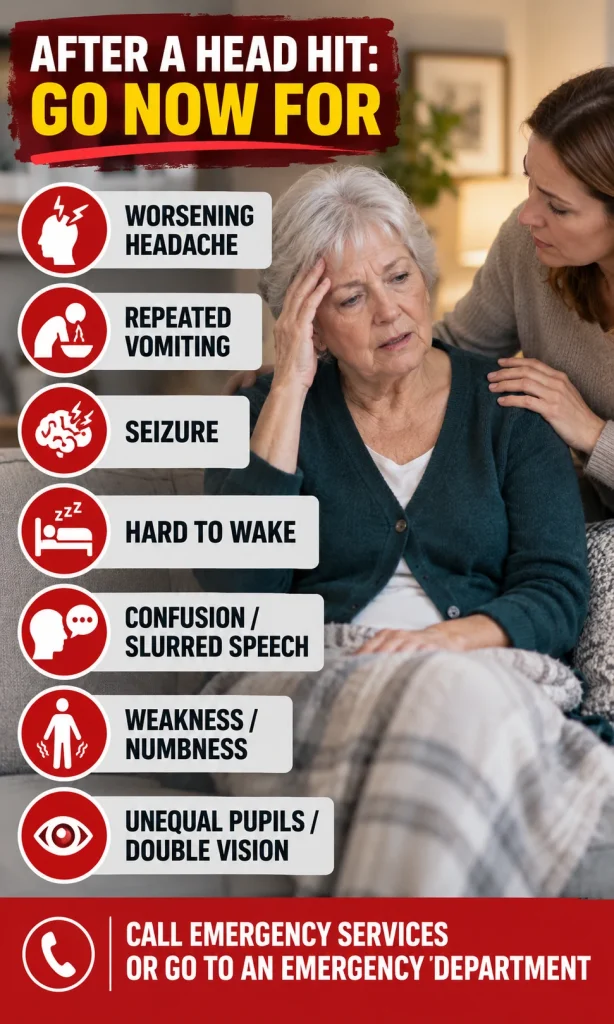
A brief bout of hiccups after bumping your head is not, by itself, a standard danger sign of concussion or severe traumatic brain injury. What changes the situation is a new or worsening neurological symptom such as repeated vomiting, a worsening headache, seizure, confusion, slurred speech, weakness or numbness, difficulty waking, or unequal pupils. If one of those warning signs appears after a head injury, seek emergency medical care rather than waiting to see whether the hiccups stop.
Hiccups that continue for more than 48 hours deserve medical evaluation even when no emergency head-injury sign is present, because persistent hiccups can have many gastrointestinal, medication-related, metabolic, chest, and neurological causes. The Cleveland Clinic overview of persistent hiccups uses the same 48-hour threshold for seeking medical attention, while the CDC concussion danger-sign guidance focuses on neurological deterioration rather than hiccups themselves.
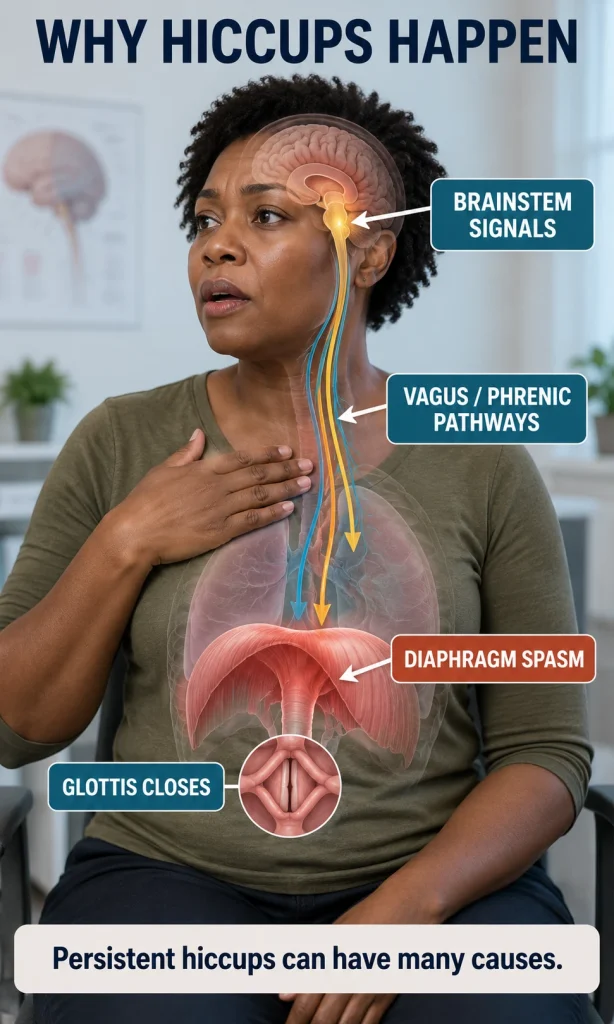
A hiccup is a reflex: the diaphragm contracts suddenly and the glottis closes, creating the familiar sound. That reflex involves signals traveling through the brainstem and nerves including the vagus and phrenic pathways, so diseases or injuries affecting the nervous system can occasionally contribute to persistent hiccups. The important word is occasionally – the existence of a neurological pathway does not make an ordinary hiccup a reliable test for brain injury severity.
This distinction matters because the old version of this page treated sudden hiccups, numbness, dizziness, and vomiting as if they were equivalent clues to severe brain injury. They are not equivalent. After a head impact, emergency decisions should be driven by established head-injury red flags, while the duration and context of hiccups are considered separately.
| What you notice after a head injury | What it means for urgency | What to do |
|---|---|---|
| Worsening headache, repeated vomiting, seizure, increasing confusion, slurred speech, weakness/numbness, difficulty waking, unequal pupils or double vision | Emergency red flag | Call local emergency services or go to an emergency department now. |
| Dizziness, balance trouble, nausea, headache, light/noise sensitivity, feeling foggy, concentration or memory problems without an emergency red flag | Possible concussion symptoms | Arrange prompt medical assessment and watch for any worsening or new danger sign. |
| Brief hiccups lasting minutes or hours with no other new symptom | Not a standard concussion danger sign by itself | Monitor the person and the injury. Seek care if head-injury symptoms appear or you are otherwise concerned. |
| Hiccups continuing beyond 48 hours | Persistent hiccups need evaluation for an underlying cause | Contact a healthcare professional; escalate immediately if neurological red flags are also present. |
| Head injury while taking blood-thinning medication or with a bleeding disorder | Lower threshold for urgent assessment | Seek urgent medical advice even if symptoms seem mild; emergency signs still require emergency care. |
The table is a routing aid, not a diagnosis. A dangerous intracranial bleed can evolve after the initial impact, and some concussion symptoms appear immediately while others emerge hours or days later. The CDC notes that symptoms can be delayed, which is why a person who initially seems fine still needs attention if something new develops.
Are hiccups actually a sign of concussion?
Hiccups are not included in standard lists of common concussion symptoms or emergency danger signs from the CDC or Mayo Clinic. Typical concussion symptoms are more likely to include headache, dizziness, nausea, balance problems, vision changes, light or noise sensitivity, fatigue, difficulty concentrating, memory problems, sleep changes, and feeling foggy or slowed down. That makes a short hiccup episode a weak signal compared with a clear neurological change.
Persistent hiccups are different because the reflex can be influenced by the central nervous system. Reviews of hiccups describe neurological causes such as stroke, tumors, demyelinating disease, and head trauma among many other possibilities, but these causes are uncommon relative to benign or gastrointestinal triggers. A clinician therefore evaluates the whole picture instead of assuming that hiccups point directly to the brain.
A September 2026 clinical case report described persistent hiccups after a moderate traumatic brain injury, which shows that post-traumatic hiccups can occur. It does not establish hiccups as a screening test for TBI, predict how severe an injury is, or tell you whether an individual patient has brain damage. A single case is useful evidence of possibility, not evidence that ordinary hiccups after a bump are usually neurological.
When hiccups after a head injury need medical attention
If hiccups persist beyond 48 hours, contact a healthcare professional even when there are no other symptoms. The assessment is not limited to the brain because persistent hiccups can arise from reflux, chest disease, medication effects, metabolic abnormalities, irritation along the vagus or phrenic nerves, and neurological disease. The aim is to identify the cause rather than simply suppress the hiccup reflex.
After a recent head injury, persistent hiccups become more concerning if they appear alongside a worsening headache, vomiting, new weakness or numbness, confusion, speech changes, abnormal drowsiness, vision changes, loss of coordination, or seizure. In that combination, the neurological red flag controls the decision: emergency assessment should not be delayed while waiting for the 48-hour hiccup threshold.
Emergency red flags after a head injury
- A headache that gets worse and does not go away.
- Repeated vomiting.
- Convulsions or seizures.
- Increasing confusion, agitation, unusual behavior, or inability to recognize people or places.
- Slurred speech or a clear change in the ability to speak or understand.
- Weakness, numbness, or decreased coordination.
- One pupil larger than the other or double vision.
- Loss of consciousness, increasing drowsiness, or difficulty waking the person.
- Clear fluid or blood draining from the nose or ears after trauma.
These signs are consistent with the CDC HEADS UP emergency guidance and the Mayo Clinic description of moderate-to-severe TBI symptoms. Do not make the person drive themselves if they are confused, drowsy, dizzy, visually impaired, or otherwise unsafe to drive. If there is concern for a neck injury, avoid unnecessary movement while waiting for emergency help.
Why hiccups can involve the brain, nerves, and diaphragm
The hiccup reflex is not just a stomach event. Sensory input can travel through the vagus, phrenic, and sympathetic pathways, central processing is thought to involve the brainstem, and the outgoing signal produces a sudden diaphragm contraction followed by closure of the glottis. Because the circuit crosses several body systems, persistent hiccups have a long list of possible causes.
This is also why brain imaging is not automatically the first step for every person with hiccups. A clinician uses the history, neurological examination, other symptoms, medications, recent procedures or injuries, and possible gastrointestinal or metabolic clues to decide what testing is appropriate. When a head injury is part of the history, the mechanism of injury and the person’s neurological status matter much more than the presence of a single hiccup episode.
What to do after a head bump if there are no emergency signs
If there is no emergency red flag, note when the injury happened, how it happened, whether there was any loss of consciousness or memory gap, and which symptoms developed afterward. Symptoms such as headache, dizziness, nausea, balance problems, vision changes, fatigue, light or noise sensitivity, concentration trouble, and memory problems can fit a mild TBI or concussion pattern. A healthcare professional can assess those symptoms and decide whether further evaluation is needed.
Do not return to contact sport, risky exercise, driving, or another activity that could cause a second head impact while concussion is suspected. The CDC recovery guidance for mild TBI recommends medical follow-up when symptoms worsen or fail to improve, and return to activity should be gradual. If the person is a child or adolescent, use age-appropriate concussion guidance and seek a clinician experienced in pediatric head injuries.
If the person takes anticoagulant or antiplatelet medication, has a bleeding disorder, is very young, is an older adult, or was injured in a high-energy event, the threshold for medical assessment is lower. The NHS head-injury guidance specifically advises urgent help after a head injury for people taking blood-thinning medicines and identifies high-risk mechanisms and neurological changes as reasons for immediate emergency care. Local guidance may differ, so the safest route is to follow the emergency system where the injury occurred.
Use the Head Impact Action Check
The interactive check below is designed for one job: separate established emergency warning signs from lower-risk symptoms and from hiccups that simply need follow-up because they have persisted. It does not diagnose concussion, rule out bleeding, decide whether a CT scan is needed, or replace an in-person examination. If the result says emergency care, act on that recommendation instead of spending time completing or printing the rest of the experience.

Emergency red-flag routing
Head Impact
Action Check
Check established danger signs, persistent hiccups, and key risk factors. The result tells you which level of care to consider next - it does not diagnose concussion or rule out bleeding.
This educational check cannot examine the person, diagnose concussion, rule out intracranial bleeding, or decide whether CT/MRI is required. When symptoms are severe, worsening, or concerning, use professional medical care rather than a web result.
How doctors decide whether imaging is needed
Doctors assess the injury mechanism, mental status, pupils, speech, strength, coordination, memory, symptoms, medications, and other risk factors. In more serious injuries they may use the Glasgow Coma Scale, while CT or MRI is selected according to the clinical situation rather than ordered solely because someone has hiccups. The Mayo Clinic overview of TBI diagnosis explains how neurological assessment and imaging fit into emergency evaluation.
That matters because a normal-looking bump can coexist with a concussion, while a dramatic bruise can still be superficial. Neither the appearance of the bump nor the presence of hiccups can substitute for neurological assessment when concerning symptoms are present. If you are trying to judge an unrelated symptom rather than a recent head injury, this broader guide to physical symptoms you should not ignore may help you decide when medical review is warranted.
Common mistakes after a head injury
One mistake is waiting for a symptom to become extreme before seeking help, particularly when the symptom is clearly neurological or worsening. Another is using a single home sign – including hiccups, pupil checking without understanding what is abnormal, or the size of a scalp bump – as a substitute for the full clinical picture. A third is assuming that feeling normal immediately after the injury guarantees that no symptoms will appear later.
Avoid unproven or potentially risky home maneuvers for hiccups when the person has just had a head injury, especially anything that interferes with normal breathing or delays assessment. Ordinary hiccup remedies are not treatment for brain injury. If persistent hiccups are the only problem, a clinician can help determine whether the cause is gastrointestinal, medication-related, metabolic, neurological, or something else.
FAQ
Are hiccups a sign of a concussion?
Hiccups are not a standard or common concussion danger sign. A brief episode may be coincidental, while persistent hiccups can have many causes and occasionally involve the nervous system. After a head injury, use established neurological red flags – not hiccups alone – to decide whether emergency care is needed.
How long can hiccups last before I should see a doctor?
Hiccups lasting more than 48 hours are considered persistent and should be medically evaluated. Do not wait 48 hours if the hiccups occur with a worsening headache, repeated vomiting, seizure, confusion, weakness, speech change, abnormal drowsiness, or another head-injury danger sign. Those symptoms require more urgent assessment.
Can a brain injury cause persistent hiccups?
Yes, it can happen, but it is uncommon and does not mean persistent hiccups are usually caused by brain injury. Medical literature includes neurological and post-traumatic causes because the hiccup reflex involves brainstem and nerve pathways. A clinician has to consider many non-neurological causes as well.
Should I go to the emergency department if I get hiccups after hitting my head?
Hiccups alone do not automatically mean you need emergency care. Go urgently if you also have a worsening headache, repeated vomiting, seizure, confusion, slurred speech, weakness or numbness, unequal pupils, double vision, loss of consciousness, or increasing difficulty staying awake. If you are unsure because the impact was significant or you have additional risk factors, seek medical advice rather than relying on the hiccups as a test.
Can symptoms of a concussion start later?
Yes. Some concussion symptoms appear immediately, while others can emerge hours or days later. New or worsening symptoms after a head injury should be taken seriously, and emergency danger signs require immediate care regardless of when they begin.
Do I need to wake someone repeatedly after a head injury?
There is no universal home waking schedule that can prove a head injury is safe. What matters is whether the person has been medically assessed when needed and whether they can be awakened normally; increasing drowsiness or inability to wake is an emergency danger sign. Follow the instructions given by the clinician who evaluated the injury.
Bottom line
Do not use hiccups as a home test for severe brain injury. Brief hiccups alone are not a standard concussion danger sign, while persistent hiccups lasting more than 48 hours deserve medical review because they can have many causes. After a head impact, the symptoms that should change your action immediately are worsening headache, repeated vomiting, seizure, confusion, speech or coordination changes, weakness or numbness, unequal pupils or double vision, and abnormal drowsiness or inability to wake.