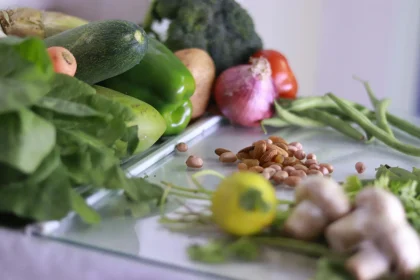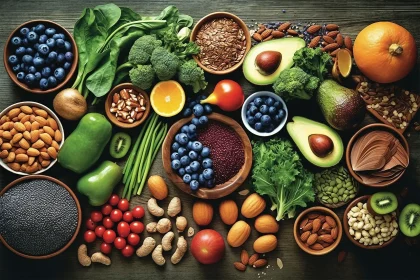

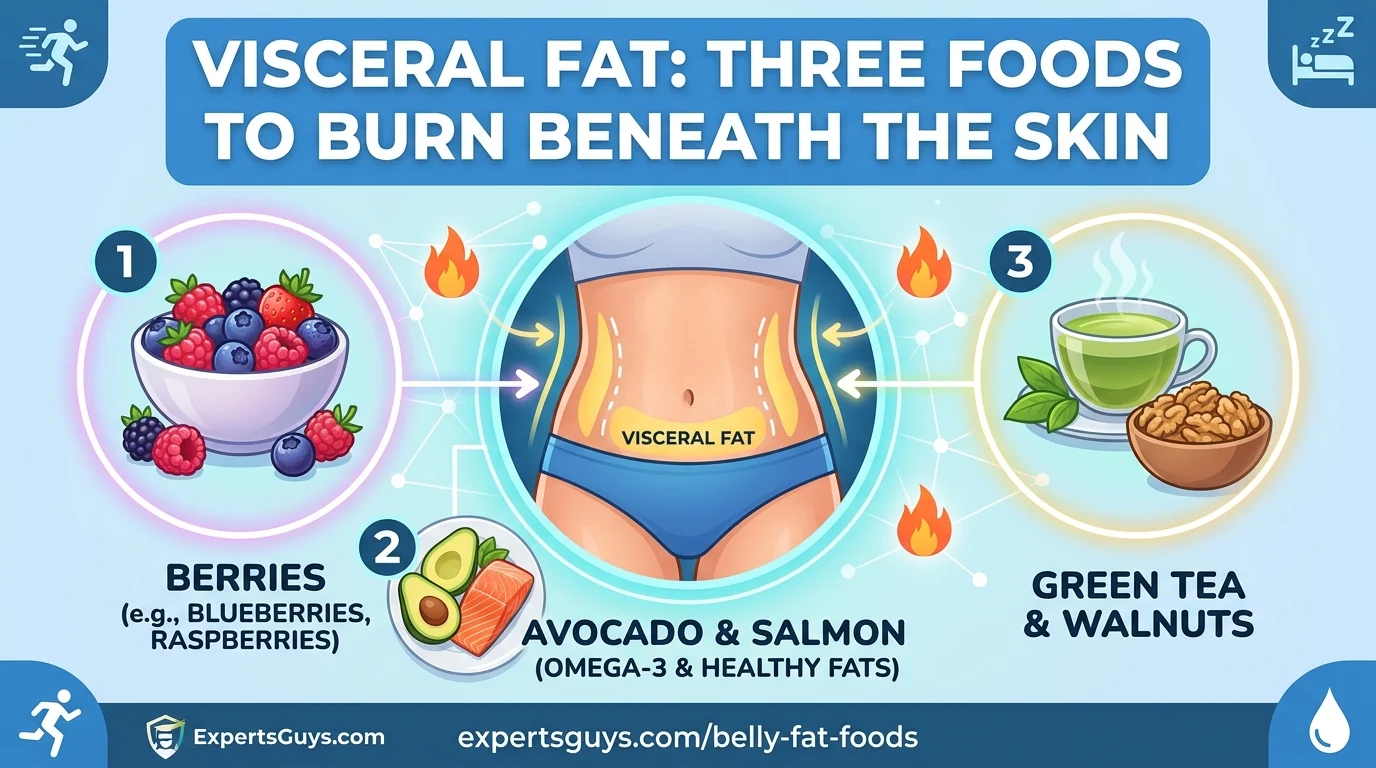

No single food can selectively burn fat from your stomach, but some foods make overall fat loss easier by improving fullness, meal quality, and the amount of fiber or protein you get from each meal. Visceral fat – the deeper abdominal fat around internal organs – usually responds to the same sustainable habits that reduce total body fat, so the useful question is not “What melts belly fat?” but “Which foods make a healthy eating pattern easier to keep?”
The seven foods below earn a place because they can replace lower-fiber, lower-protein, or more calorie-dense choices without requiring a special “belly fat” diet. If your waist size is increasing despite little change on the scale, remember that waist size can add useful health context alongside body weight, but it is still only one screening measure rather than a diagnosis.
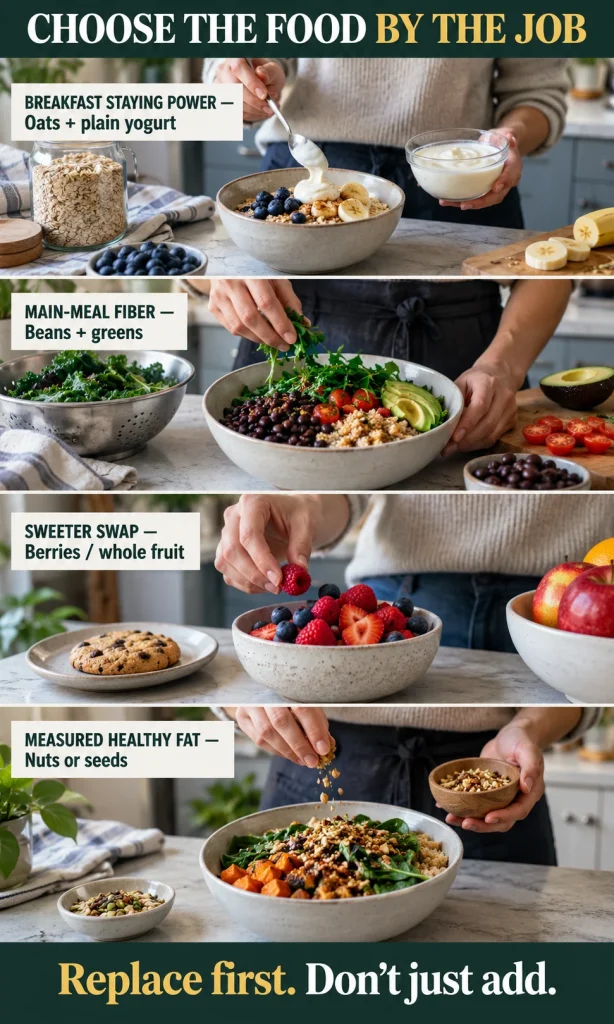
Build most meals around a high-fiber plant food, a satisfying protein source, and vegetables or fruit. Oats, beans and lentils, plain high-protein yogurt, eggs, leafy vegetables, berries or other whole fruit, and a measured portion of nuts or seeds are practical places to start.
| Food | Main job | Best use | Watch for |
|---|---|---|---|
| Oats | Soluble fiber and meal staying power | Breakfast or snack base | Sweetened instant packets can add more sugar than expected |
| Beans and lentils | Fiber + plant protein | Soups, bowls, salads, stews | Increase gradually if you are sensitive to fermentable fiber |
| Plain Greek-style yogurt | Convenient protein | Breakfast, dessert swap, snack | Compare added sugar and protein on the label |
| Eggs | Protein-rich meal anchor | Breakfast, lunch, salad | The rest of the meal still matters |
| Leafy and non-starchy vegetables | Food volume for relatively few calories | Half-plate base, soups, stir-fries | Calorie-dense dressings and frying can change the meal |
| Berries and other whole fruit | Fiber, water, sweetness | Dessert or snack replacement | Whole fruit is more filling than juice for most people |
| Nuts and seeds | Unsaturated fats, fiber, texture | Small snack or meal topping | Easy to over-pour because they are energy-dense |
Why “belly-fat burning foods” is the wrong promise
Fat loss is not directed by the ingredient you just ate. In a large randomized weight-loss trial, participants reduced abdominal and visceral fat across several energy-reduced diets even though the diets differed in protein, fat, and carbohydrate targets; the important shared feature was sustained weight loss rather than a single macronutrient formula. That is why the POUNDS LOST trial is more useful here than a list of supposedly magical foods.
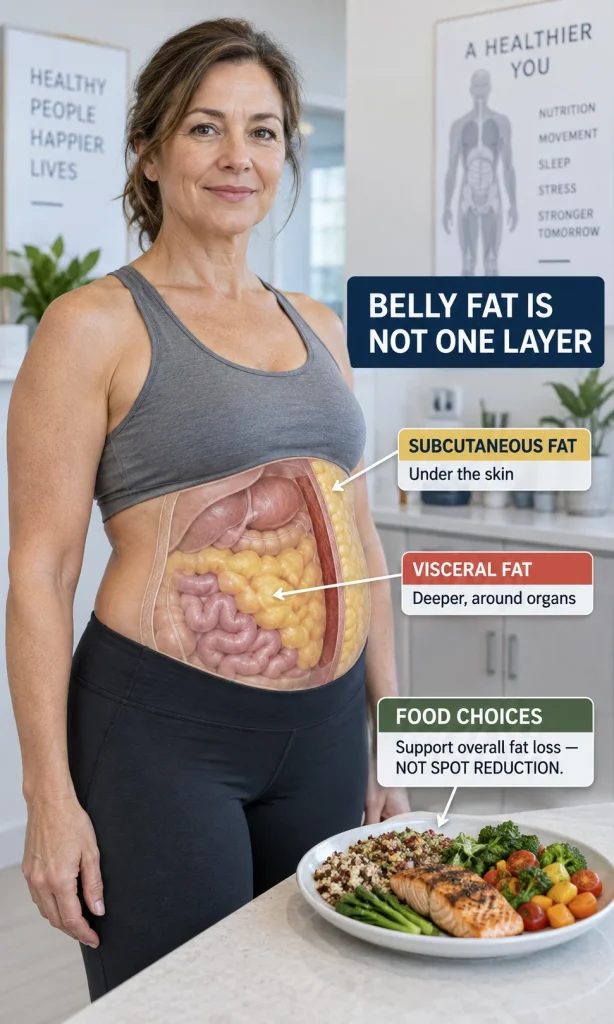
Visceral fat is metabolically important because it sits deeper in the abdomen and is associated with cardiometabolic risk, but you cannot reliably tell how much visceral fat you have just by looking in a mirror. Waist circumference can be a practical screening clue, while imaging methods such as CT or MRI are used in research and clinical settings when direct measurement is needed.
1. Oats: a better breakfast when hunger returns too fast
Oats are useful because beta-glucan, a soluble fiber, absorbs water and increases the viscosity of food moving through the digestive tract. That does not make oats a fat burner, but it can make a breakfast more satisfying than a low-fiber option, especially when the bowl also contains a protein source and whole fruit.
The practical improvement is to keep the oats relatively plain and build flavor with berries, cinnamon, chopped nuts, or yogurt rather than relying on heavily sweetened instant packets. If you already like oatmeal, the highest-value change may be adding protein rather than making the portion much larger.
2. Beans and lentils: the strongest fiber-plus-protein combination on this list
Beans, chickpeas, and lentils combine fiber with meaningful plant protein, so they can replace part of a refined starch or a higher-saturated-fat ingredient without leaving the meal feeling empty. They work especially well in soups, grain bowls, salads, curries, and taco-style fillings because they add bulk as well as texture.
If beans make you feel bloated, do not assume the food is “bad” for fat loss. Increase the amount gradually, rinse canned beans, and test which varieties you tolerate best; readers who struggle with gas may also find the site’s guide to foods that commonly cause bloating useful before pushing fiber higher.
3. Plain Greek-style yogurt: convenient protein without dessert-level sweetness
Plain strained yogurt can be a simple way to add protein to breakfast or snacks, which matters when your usual alternative is a pastry, sweetened cereal, or a snack that leaves you hungry again quickly. The label matters more than the marketing name: compare protein, added sugar, and serving size rather than assuming every “Greek” or “high-protein” product is equivalent.
Yogurt is not proven to selectively remove abdominal fat, and probiotic claims vary by strain and product. Its main advantage here is practical – it is fast, portable, easy to pair with fruit or oats, and can make a lower-sugar snack more satisfying.
4. Eggs: a compact protein anchor for breakfast or lunch
Eggs can make a meal more filling when they replace a breakfast built mostly from refined carbohydrates, but they do not have a special fat-melting effect. Older randomized research found better weight-loss outcomes from an egg breakfast only when participants were also following an energy-reduced diet, which is a useful reminder that the whole eating pattern controls the result.
Use eggs as an anchor rather than as the entire strategy: pair them with vegetables, whole-grain toast, beans, or fruit. If eggs do not suit your diet, tofu, tempeh, edamame, or another protein-rich alternative can fill the same structural role.
5. Leafy greens and other non-starchy vegetables: more food volume, not more diet rules
Spinach, kale, lettuce, broccoli, peppers, mushrooms, zucchini, and similar vegetables can increase the volume of a meal without requiring a large calorie increase. That can be more useful than trying to “eat as little as possible,” because a plate that looks and feels substantial is often easier to repeat day after day.
The cooking method can change the equation. A tray of roasted vegetables with a modest amount of oil is different from vegetables buried under creamy dressing, cheese sauce, or deep-frying, so judge the finished dish rather than giving the vegetable itself all the credit.
- Is there a clear protein source?
- Is there a high-fiber plant food?
- Is most of the drink calorie-free or unsweetened?
- Did the sauce, topping, or cooking fat quietly become the most calorie-dense part of the meal?
6. Berries and other whole fruit: a sweeter swap that still brings fiber and water
Berries are convenient because they give you sweetness, fiber, water, and a relatively low energy density in the same food. Kiwi, apples, citrus, melon, and many other whole fruits can play a similar role, so there is no reason to chase a single “best” fruit for belly fat.
Use fruit where it replaces something less filling: berries in yogurt instead of a syrupy topping, an apple with a small handful of nuts instead of a candy bar, or fruit after dinner instead of making dessert automatic every night. This is the same replacement logic behind many practical foods that help you lose weight – the benefit comes from what the food helps you eat less of, not from a special fat-burning compound.
7. Nuts and seeds: useful in measured portions
Walnuts, almonds, pistachios, chia, flax, and other nuts or seeds provide unsaturated fats, fiber, and satisfying texture. Mediterranean-style dietary trials are interesting because patterns rich in plant foods, nuts, and unsaturated fats have reduced visceral fat in some groups, but those results should not be misread as proof that walnuts alone “burn” abdominal fat.
One randomized trial of a green Mediterranean pattern reported a larger reduction in MRI-measured visceral fat than the comparison diet while also changing several parts of the dietary pattern at once, including plant intake and red-meat intake. The DIRECT-PLUS trial therefore supports the overall pattern more strongly than it supports a single-food claim.
What matters more than choosing the “perfect” seven foods
A strong diet can still fail if the portions, drinks, snacks, or weekends regularly erase the advantage of the main meals. The most effective food changes are usually the ones that solve a real friction point: breakfast leaves you hungry, dinner lacks vegetables, snacks are mostly refined carbohydrates, or convenience food takes over when you are tired.
The CDC’s healthy-eating guidance emphasizes a pattern built from nutrient-dense foods, protein sources, vegetables, fruits, healthy fats, and whole grains rather than a short list of “fat-burning” ingredients. That same pattern is easier to sustain when it also fits your culture, budget, cooking skill, schedule, and digestion.
Three common mistakes that make healthy foods less useful
Adding without replacing. Nuts, avocado, yogurt, and oats can all be nutritious, but simply adding them on top of your normal intake can raise total energy rather than reduce it. Ask what each new food is replacing.
Turning every healthy food into a dessert. Oats with several spoonfuls of sugar, yogurt loaded with syrup and granola, or fruit blended into a large sweet drink can behave very differently from the simpler version. Keep the basic food visible and let toppings remain toppings.
Increasing fiber too quickly. Beans, oats, vegetables, berries, and seeds can make a diet much more fiber-rich within a few days. If your gut is not used to that, increase gradually and drink enough fluid so digestive discomfort does not make you abandon the plan.

A simple one-week way to use the list
Do not overhaul every meal at once. Pick one eating moment that repeatedly causes trouble, improve that first, and then decide whether the change actually reduced hunger or made the meal easier to repeat.
- Breakfast: try oats plus plain yogurt and berries, or eggs with vegetables and whole-grain toast.
- Lunch or dinner: add beans or lentils to a vegetable-heavy bowl, soup, curry, or salad.
- Snack: pair whole fruit with a small portion of nuts, or choose plain high-protein yogurt.
- Review: notice hunger, convenience, digestion, and whether the new meal displaced a less-filling choice.
If your biggest problem is consistency rather than food knowledge, the better next step may be getting healthy eating habits back on track instead of adding another nutrition rule. A sustainable change that survives busy days is more valuable than a perfect menu you follow for three days.
How to tell whether your approach is working
Body weight naturally fluctuates from water, glycogen, bowel contents, sodium intake, and menstrual-cycle changes, so daily scale movement is a noisy signal. Look for a trend over several weeks and combine it with practical signs such as waist fit, hunger control, energy, meal consistency, and whether you can maintain the pattern without constant restriction.
Seek personalized medical or dietetic advice if you have an eating disorder history, unexplained weight change, diabetes treated with glucose-lowering medication, pregnancy, significant gastrointestinal disease, kidney disease, or another condition that changes what a safe diet looks like. The goal is a healthier pattern, not aggressive restriction.
Frequently Asked Questions
Can any food specifically burn belly fat?
No. Foods can make overall fat loss easier by improving satiety, protein intake, fiber intake, food volume, and meal quality, but they do not selectively pull fat from your abdomen.
Is visceral fat different from the soft fat I can pinch?
Yes. Subcutaneous fat sits under the skin, while visceral fat is stored deeper around internal organs. Both can change with overall fat loss, but visceral fat is especially relevant to cardiometabolic risk.
Are oats, yogurt, or eggs better for breakfast?
The best choice is the one that gives you enough protein and fiber to stay satisfied. Oats become stronger when paired with yogurt, milk, soy, nuts, or seeds; eggs become stronger when paired with vegetables, beans, whole grains, or fruit.
Do I need to avoid bananas, watermelon, or other sweet fruit?
Usually no. Whole fruit can fit well in a weight-management pattern because it provides water, fiber, and nutrients; portion size and the overall diet matter more than labeling one fruit as fattening.
What is the easiest first change if I eat poorly now?
Change one repeated meal or snack rather than your entire diet. Replacing a low-fiber breakfast, sugary drink, or highly refined snack with a protein-and-fiber combination usually gives you clearer feedback than making seven changes at once.