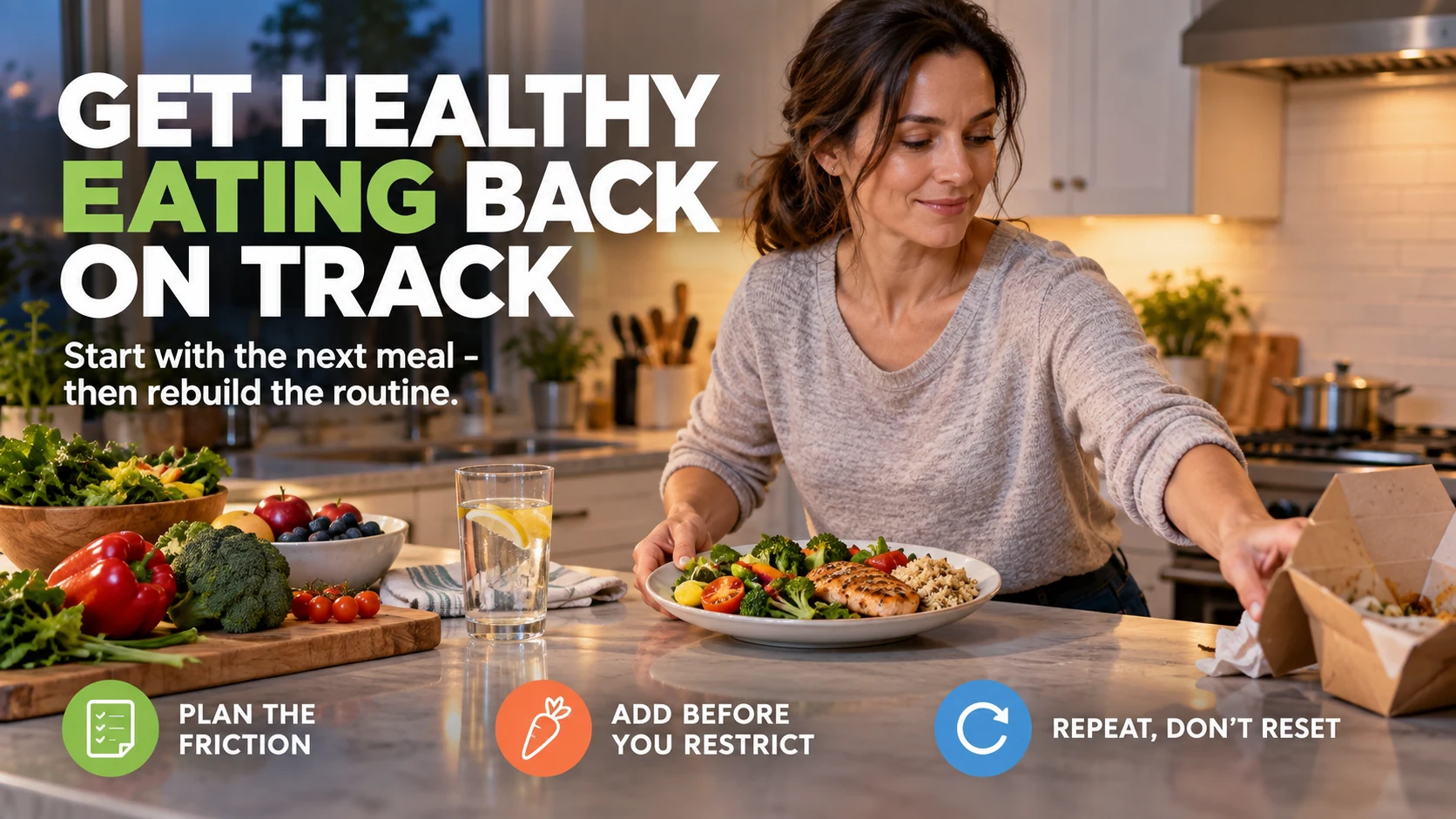

The fastest way to get healthy eating habits back on track is to make your next meal reasonably balanced and then rebuild the routines that make that choice easier to repeat. You do not need a detox, a punishment meal, or a perfect Monday restart; you need a practical default for the moments when time, hunger, stress, or convenience usually wins. Start with one meal, remove one point of friction, and let consistency grow from there.
- Eat a normal next meal instead of compensating for the last one.
- Choose one repeatable meal pattern before trying to fix the whole day.
- Put convenient nutritious food where you can actually reach it.
- Use backup meals for busy days instead of relying on willpower.
- Review what caused the slip, then change the environment around that trigger.
Start with the next meal, not a reset ritual
A rough food day does not require a dramatic correction. Skipping meals, cutting entire food groups, or trying to “make up” for eating differently than planned can make the next decision harder because you arrive at it hungrier, more preoccupied with food, or more tired of making choices.
A healthier restart is deliberately ordinary: eat when you are reasonably hungry, build a meal with nutritious foods you enjoy, and continue with the day. The World Health Organization’s healthy-diet guidance emphasizes adequacy, balance, moderation, and diversity rather than a single perfect menu, which is a useful way to think about a sustainable return to routine.
First, find what knocked the routine off course
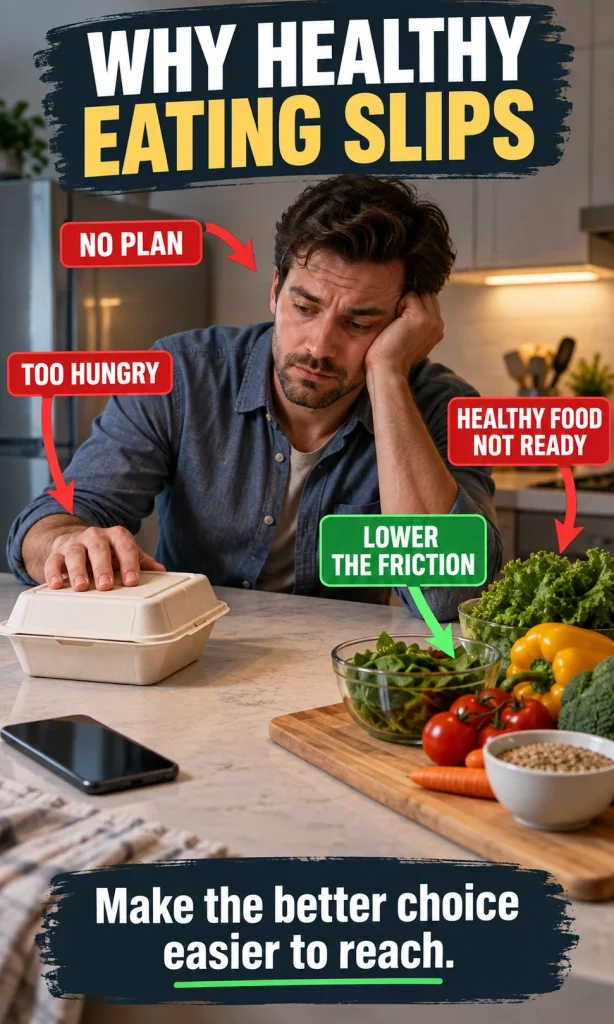
“I lost motivation” is usually too vague to fix. Healthy eating often slips because the easier choice changed: work ran late, breakfast disappeared, groceries were not ready to use, the afternoon became a hunger emergency, or the same meals became boring enough that takeout felt more appealing.
Look for the repeatable moment rather than judging the entire week. If the problem happens at 6:30 p.m. when you are exhausted, the answer may be a prepared protein, frozen vegetables, or a reliable order from a nearby restaurant – not a more ambitious recipe list.
Rebuild one default meal before fixing the whole day
A default meal is not the only meal you are allowed to eat. It is a low-effort combination you can make, assemble, or buy without starting a new decision process every time, which is especially useful on the days when your routine is most fragile.
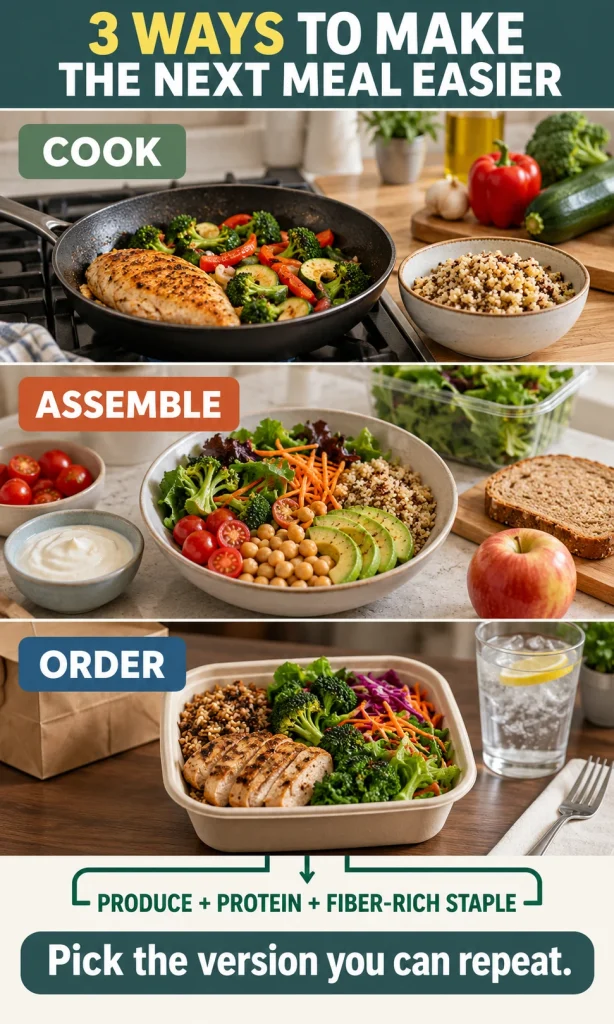
Build that default around foods that give the meal some staying power and variety: a protein source, fruit or vegetables, a fiber-rich staple such as whole grains or beans when they fit the meal, and enough flavor or fat to make the food satisfying. You can adapt those pieces to your culture, budget, appetite, medical needs, and what is actually available where you live.
If you want more everyday combinations after you have your default meal working, these daily diet tips for eating healthy can help you expand the routine without turning every meal into a nutrition project.
Choose the version that matches your real day
- Cook: one-pan protein and vegetables with a grain, potato, or beans.
- Assemble: yogurt or a bean-and-grain bowl with fruit, vegetables, nuts, seeds, or whole-grain bread.
- Order: choose a meal with a clear protein source and vegetables, then add a high-fiber side or staple when it is available.
- Emergency backup: keep two or three shelf-stable, frozen, or refrigerated options that can become a meal before hunger turns into an urgent decision.
Meal planning should remove decisions, not create homework
The useful part of meal planning is not producing a perfect seven-day schedule. It is deciding a few things before you are hungry: which meals are likely to be difficult, what ingredients cover several meals, and what the backup option will be when the original plan fails.
A small planning session can be enough. Pick two or three meals you will genuinely make, write a short grocery list, wash or portion one ingredient that usually creates friction, and place the foods you want to remember where they are visible.
If cost is the reason your plan keeps breaking, build the routine around flexible staples rather than specialty “health foods.” The site’s guide to healthy meal plans on a budget can help you choose ingredients that work across several meals instead of buying a different set of groceries for every recipe.
Eating Rhythm Reset
Find the friction behind your eating routine, choose one realistic next-meal strategy, and leave with a seven-day reset you can actually repeat.

Your reset is ready
Use an if-then plan for the moment that usually gets you
Healthy intentions are easier to act on when the trigger and response are decided in advance. Instead of “I will eat better this week,” use a concrete rule such as, “If my meeting runs late, then I will use my freezer meal before I open a delivery app,” or, “If I am hungry at 4 p.m., then I will eat the snack I packed rather than waiting until dinner.”
This works best when the plan is small enough to execute under pressure. The goal is to reduce the number of choices you need at the exact moment when hunger, stress, or fatigue makes decision-making less reliable.
Processed food is not a pass-or-fail category
“Avoid processed foods” sounds simple, but it is too broad to be useful. Frozen vegetables, canned beans, plain yogurt, whole-grain bread, nut butter, and pre-cooked grains are processed too, and they may be exactly what makes a healthier meal possible on a busy day.
A better filter is to look at what the food contributes and what tends to dominate your overall pattern. Foods that are very high in added sugar, sodium, or saturated fat can be worth limiting more often, while minimally processed and convenient foods can reduce cooking friction without turning the meal into a nutritional compromise.
For a more detailed explanation of that distinction, read reasons to eat processed food according to a dietitian. The practical question is not “Was this food processed?” but “Does this choice help me build a balanced meal I can actually repeat?”
Match the fix to the friction
The same advice does not solve every broken routine. Match your reset to the obstacle that shows up most often, then test whether the new setup makes the next week easier rather than merely more controlled.
| What keeps happening | Change first | Useful backup |
|---|---|---|
| You get too hungry late in the day | Protect the earlier meal or add a planned snack | Fruit plus yogurt, nuts, eggs, hummus, or another satisfying option |
| Dinner collapses on busy nights | Create one default dinner | Frozen vegetables + ready protein + simple staple |
| Nutritious food keeps spoiling | Buy fewer fragile ingredients | Use frozen, canned, or longer-lasting produce |
| Snacking happens automatically | Change visibility and portioning | Keep an easy planned snack at eye level |
| You are bored with “healthy” meals | Keep the meal structure, change the flavors | Rotate sauces, herbs, spices, textures, or cuisines |
Mindful eating is useful when it reduces autopilot
Mindful eating does not require silence, perfect hunger awareness, or turning every bite into an exercise. Its practical value is simpler: create enough attention to notice whether you are hungry, distracted, rushed, already satisfied, or using food to solve a problem that food cannot solve.
That can mean sitting down instead of eating from the package, pausing before a second serving, or noticing that the urge to snack appears mainly during a particular work task. Treat those observations as information, not as a scorecard for how disciplined you were.
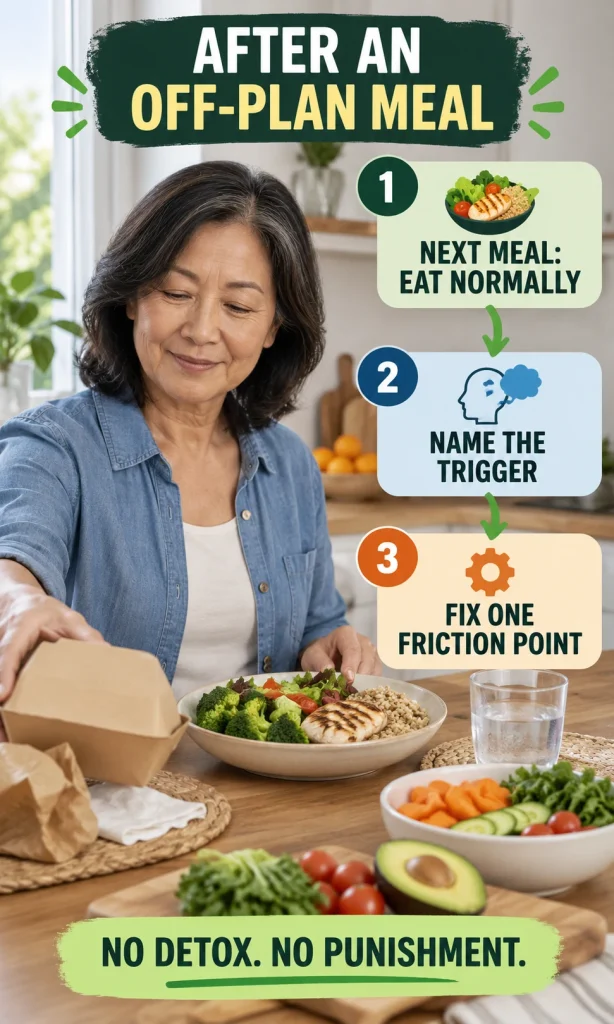
After an off-plan meal, return to normal eating
The most useful recovery move is usually the least dramatic one: return to your normal eating pattern at the next meal. A single meal that was larger, richer, or less balanced than you intended does not require fasting, a cleanse, or an unusually restrictive day afterward.
Then ask one practical question: what made that meal more likely? If you were ravenous because lunch was skipped, the fix belongs earlier in the day; if it was a social meal you enjoyed, there may be nothing to fix at all.
How long does it take to rebuild a healthy eating habit?
There is no reliable 21-day rule. A systematic review of health-behavior habit formation found that the time to reach stronger automaticity varied widely, with medians around two months in some studies and substantial variation between people and behaviors; many of the included studies also had important quality limitations.
The useful takeaway is not the exact day count. Repetition in a stable context matters more than forcing a deadline, so judge the reset by whether the behavior is becoming easier to start and requires less negotiation each time; the habit-formation systematic review is worth reading if you want the evidence behind those ranges.
When “getting back on track” is the wrong goal
If eating has become dominated by guilt, fear, compensatory fasting, frequent binge episodes, purging, or rigid food rules, a tighter reset plan can make the problem worse. In that situation, the better next step is individualized support from a qualified health professional, such as a registered dietitian or clinician experienced with eating concerns.
The same caution applies when you have a medical condition, pregnancy, a history of an eating disorder, or medications that materially affect nutrition needs. General healthy-eating guidance can support routine, but it should not replace personalized medical or dietetic care.
Frequently Asked Questions
Can I get my eating habits back on track in one day?
You can make a useful correction in one meal, but the habit itself takes repetition. Focus on returning to a normal next meal and setting up one easier default for the days that usually disrupt you.
Should I cut out sugar, bread, or carbs to restart healthy eating?
Not by default. A sustainable healthy pattern can include carbohydrate foods, including whole grains, beans, fruit, and other staples; the more useful goal is to improve the overall meal pattern and limit foods that crowd out nutrient-dense choices rather than banning an entire macronutrient.
Do I have to meal prep to eat well consistently?
No. You can cook, assemble, or buy a balanced meal; the useful question is whether the option is available when you need it. Meal prep is only one way to reduce friction.
Can convenience foods still fit a healthy eating routine?
Yes. Frozen vegetables, canned beans, plain dairy foods, whole-grain bread, pre-cooked grains, and other convenient foods can make nutritious meals easier to assemble. Judge them by what they add to the meal and how they fit the overall pattern rather than by processing alone.
What if I keep overeating after trying to restrict food?
Repeated cycles of restriction and overeating are a sign to move away from harsher rules, not tighten them. If the pattern is frequent, distressing, or feels hard to control, speak with a registered dietitian or other qualified clinician for individualized support.
Decision summary: make the next choice easier
Getting healthy eating habits back on track works better when you stop treating the lapse as proof that you need more discipline. Return to a normal next meal, identify the recurring friction point, and build one default meal or backup that is easy enough to use on your hardest day.
Once that foundation is reliable, add variety rather than rules. The goal is a food routine that can absorb travel, stressful weeks, takeout, celebrations, and imperfect days without forcing you to “start over” again.